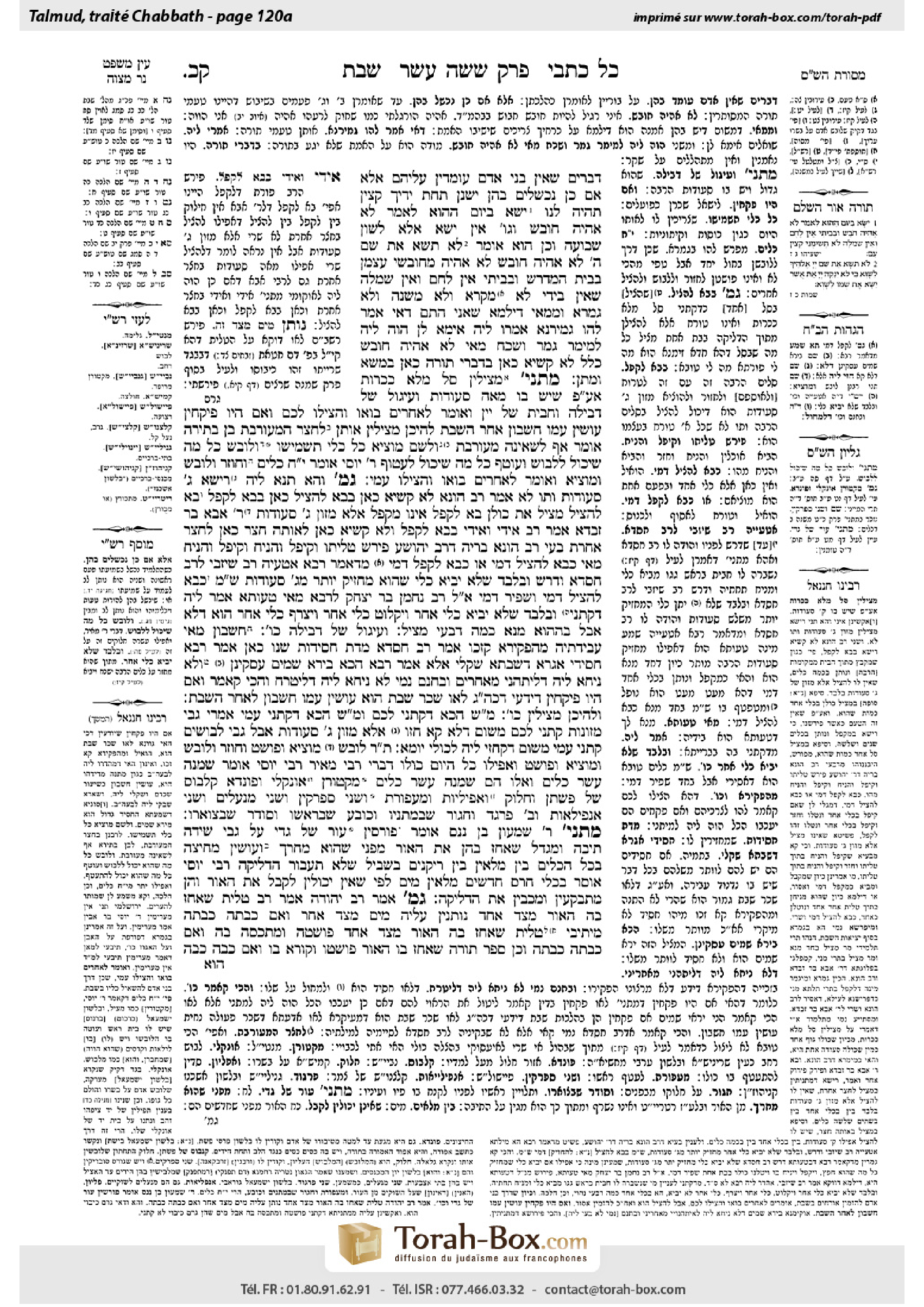
Shabbat 120a: Talmud study for Daf Yomi
Daf Yomi is the daily study of one Talmud folio. Explore 37 tractates with scans, Hebrew text, Sefaria English and AI-generated French translations where annotated.
Passage selection and English or AI-generated French translation are available where the scan has annotations. Daf Study is independent of Torah-Box and Sefaria.
Browse Shabbat · שבת · All tractatesShabbat 120a text and translations
This page of Shabbat includes the Aramaic text, an English translation and an AI-generated French translation, alongside the scan above.
שבת ק״כ א · Aramaic and Hebrew text
דְּבָרִים שֶׁאֵין בְּנֵי אָדָם עוֹמְדִין עֲלֵיהֶם אֶלָּא אִם כֵּן נִכְשָׁלִים בָּהֶן יֶשְׁנָן תַּחַת יָדֶיךָ, ״קָצִין תִּהְיֶה לָנוּ״. ״יִשָּׂא בַיּוֹם הַהוּא לֵאמֹר לֹא אֶהְיֶה חוֹבֵשׁ וְגוֹ׳״ — אֵין יִשָּׂא אֶלָּא לְשׁוֹן שְׁבוּעָה, וְכֵן הוּא אוֹמֵר ״לֹא תִשָּׂא אֶת שֵׁם ה׳״. ״לֹא אֶהְיֶה חוֹבֵשׁ״ — לֹא אֶהְיֶה מֵחוֹבְשֵׁי עַצְמָן בְּבֵית הַמִּדְרָשׁ. ״וּבְבֵיתִי אֵין לֶחֶם וְאֵין שִׂמְלָה״ — שֶׁאֵין בְּיָדִי לֹא מִקְרָא וְלֹא מִשְׁנָה וְלֹא גְּמָרָא. וּמִמַּאי? דִּילְמָא שָׁאנֵי הָתָם, דְּאִי אֲמַר לְהוּ גְּמִירְנָא, אֲמַרוּ לֵיהּ: אֵימָא לַן. הֲוָה לֵיהּ לְמֵימַר גְּמַר וּשְׁכַח, מַאי ״לֹא אֶהְיֶה חוֹבֵשׁ״? — כְּלָל! לָא קַשְׁיָא: כָּאן בְּדִבְרֵי תוֹרָה, כָּאן בְּמַשָּׂא וּמַתָּן.
מַתְנִי׳ מַצִּילִין סַל מָלֵא כִּכָּרוֹת, אַף עַל פִּי שֶׁיֵּשׁ בּוֹ מֵאָה סְעוּדוֹת, וְעִיגּוּל שֶׁל דְּבֵילָה, וְחָבִית שֶׁל יַיִן. וְאוֹמֵר לַאֲחֵרִים: בּוֹאוּ וְהַצִּילוּ לָכֶם. וְאִם הָיוּ פִּיקְחִין, עוֹשִׂין עִמּוֹ חֶשְׁבּוֹן אַחַר הַשַּׁבָּת.
לְהֵיכָן מַצִּילִין אוֹתָן — לֶחָצֵר הַמְעוֹרֶבֶת. בֶּן בְּתִירָה אוֹמֵר: אַף לְשֶׁאֵינָהּ מְעוֹרֶבֶת. וּלְשָׁם מוֹצִיא כׇּל כְּלֵי תַּשְׁמִישׁוֹ, וְלוֹבֵשׁ כׇּל מַה שֶּׁיָּכוֹל לִלְבּוֹשׁ, וְעוֹטֵף כׇּל מַה שֶּׁיָּכוֹל לַעֲטוֹף. רַבִּי יוֹסֵי אוֹמֵר: שְׁמֹנָה עָשָׂר כֵּלִים. וְחוֹזֵר וְלוֹבֵשׁ וּמוֹצִיא, וְאוֹמֵר לַאֲחֵרִים: בּוֹאוּ וְהַצִּילוּ עִמִּי.
גְּמָ׳ וְהָא תְּנָא לֵיהּ רֵישָׁא שָׁלֹשׁ סְעוּדוֹת וְתוּ לָא! אָמַר רַב הוּנָא: לָא קַשְׁיָא, כָּאן — בְּבָא לְהַצִּיל, כָּאן — בְּבָא לְקַפֵּל. וּבָא לְהַצִּיל — מַצִּיל אֶת כּוּלָּן. בָּא לְקַפֵּל — אֵינוֹ מְקַפֵּל אֶלָּא מְזוֹן שָׁלֹשׁ סְעוּדוֹת. רַבִּי אַבָּא בַּר זַבְדָּא אָמַר רַב: אִידֵּי וְאִידֵּי בָּבָא לְקַפֵּל, וְלָא קַשְׁיָא: כָּאן — לְאוֹתָהּ חָצֵר, כָּאן — לְחָצֵר אַחֶרֶת. בָּעֵי רַב הוּנָא בְּרֵיהּ דְּרַב יְהוֹשֻׁעַ: פֵּירַשׂ טַלִּיתוֹ, וְקִיפֵּל וְהִנִּיחַ, וְקִיפֵּל וְהִנִּיחַ, מַאי: כְּבָא לְהַצִּיל דָּמֵי, אוֹ כְּבָא לְקַפֵּל דָּמֵי?
מִדְּאָמַר רָבָא: אַטְעֲיֵהּ רַב שֵׁיזְבִי לְרַב חִסְדָּא, וּדְרַשׁ: וּבִלְבַד שֶׁלֹּא יָבִיא כְּלִי שֶׁהוּא מַחֲזִיק יוֹתֵר מִשָּׁלֹשׁ סְעוּדוֹת, שְׁמַע מִינַּהּ כְּבָא לְהַצִּיל דָּמֵי, וְשַׁפִּיר דָּמֵי. אֲמַר לֵיהּ רַב נַחְמָן בַּר יִצְחָק לְרָבָא: מַאי טָעוּתָא? אֲמַר לֵיהּ, דְּקָתָנֵי: וּבִלְבַד שֶׁלֹּא יָבִיא כְּלִי אַחֵר וְיִקְלוֹט, כְּלִי אַחֵר וִיצָרֵף. כְּלִי אַחֵר הוּא דְּלָא, אֲבָל בְּהָהוּא מָנָא — כַּמָּה דְּבָעֵי מַצִּיל.
וְעִיגּוּל שֶׁל דְּבֵילָה כּוּ׳. חֶשְׁבּוֹן מַאי עֲבִידְתֵּיהּ? מֵהֶפְקֵירָא קָזָכוּ? — אָמַר רַב חִסְדָּא: מִדַּת חֲסִידוּת שָׁנוּ כָּאן. אָמַר רָבָא: חֲסִידֵי אַגְרָא דְשַׁבְּתָא שָׁקְלִי?! אֶלָּא אָמַר רָבָא: הָכָא בִּירֵא שָׁמַיִם עָסְקִינַן, וְלָא נִיחָא לֵיהּ דְּלִיתְהֲנֵי מֵאֲחֵרִים, וּבְחִנָּם נָמֵי לָא נִיחָא לֵיהּ דְּלִיטְרַח. וְהָכִי קָאָמַר: וְאִם הָיוּ פִּיקְחִין, דְּיָדְעִי דִּכְהַאי גַּוְונָא לָאו שְׂכַר שַׁבָּת הוּא, עוֹשִׂין עִמּוֹ חֶשְׁבּוֹן לְאַחַר הַשַּׁבָּת.
וּלְהֵיכָן מַצִּילִין כּוּ׳. מַאי שְׁנָא הָכָא דְּקָתָנֵי ״לָכֶם״, וּמַאי שְׁנָא הָכָא דְּקָתָנֵי ״עִמִּי״? אָמְרִי: גַּבֵּי מְזוֹנוֹת קָתָנֵי ״לָכֶם״ — מִשּׁוּם דְּלָא קָא חֲזֵי אֶלָּא מְזוֹן שָׁלֹשׁ סְעוּדוֹת. אֲבָל גַּבֵּי לְבוּשִׁים קָתָנֵי ״עִמִּי״ — מִשּׁוּם דְּקָחֲזֵי לֵיהּ לְכוּלֵּי יוֹמָא.
תָּנוּ רַבָּנַן: לוֹבֵשׁ מוֹצִיא וּפוֹשֵׁט, וְחוֹזֵר וְלוֹבֵשׁ וּמוֹצִיא וּפוֹשֵׁט, וַאֲפִילּוּ כׇּל הַיּוֹם כּוּלּוֹ — דִּבְרֵי רַבִּי מֵאִיר. רַבִּי יוֹסֵי אוֹמֵר: שְׁמֹנָה עָשָׂר כֵּלִים, וְאֵלּוּ הֵם שְׁמֹנָה עָשָׂר כֵּלִים: מִקְטוֹרֶן, אוּנְקְלֵי, וּפוּנְדָּא, קַלְבּוֹס שֶׁל פִּשְׁתָּן, וְחָלוּק, וְאַפִּילְיוֹן, וּמַעְפּוֹרֶת, וּשְׁנֵי סַפְרֵקִין, וּשְׁנֵי מִנְעָלִים, וּשְׁנֵי אַנְפִּילָאוֹת, וּשְׁנֵי פַּרְגּוֹד, וַחֲגוֹר שֶׁבְּמׇתְנָיו, וְכוֹבַע שֶׁבְּרֹאשׁוֹ, וְסוּדָר שֶׁבְּצַוָּארוֹ.
מַתְנִי׳ רַבִּי שִׁמְעוֹן בֶּן נַנָּס אוֹמֵר: פּוֹרְסִין עוֹר שֶׁל גְּדִי עַל גַּבֵּי שִׁידָּה תֵּיבָה וּמִגְדָּל שֶׁאָחַז בָּהֶן אֶת הָאוּר, מִפְּנֵי שֶׁהוּא מְחָרֵךְ. וְעוֹשִׂין מְחִיצָה בְּכׇל הַכֵּלִים, בֵּין מְלֵאִין בֵּין רֵיקָנִים, בִּשְׁבִיל שֶׁלֹּא תַּעֲבוֹר הַדְּלֵיקָה. רַבִּי יוֹסֵי אוֹסֵר בִּכְלֵי חֶרֶס חֲדָשִׁים מְלֵאִין מַיִם, לְפִי שֶׁאֵין יְכוֹלִין לְקַבֵּל אֶת הָאוּר וְהֵן מִתְבַּקְּעִין וּמְכַבִּין אֶת הַדְּלֵיקָה.
גְּמָ׳ אָמַר רַב יְהוּדָה אָמַר רַב: טַלִּית שֶׁאָחַז בָּהּ הָאוּר מִצַּד אֶחָד — נוֹתְנִין עָלֶיהָ מַיִם מִצַּד אַחֵר, וְאִם כָּבְתָה — כָּבְתָה. מֵיתִיבִי: טַלִּית שֶׁאָחַז בָּהּ הָאוּר מִצַּד אֶחָד — פּוֹשְׁטָהּ וּמִתְכַּסֶּה בָּהּ, וְאִם כָּבְתָה — כָּבְתָה. וְכֵן סֵפֶר תּוֹרָה שֶׁאָחַז בּוֹ הָאוּר — פּוֹשְׁטוֹ וְקוֹרֵא בּוֹ, וְאִם כָּבָה — כָּבָה.
Shabbat 120a · English translation
Matters of Torah that people do not ascertain unless they misunderstand them are in your hands; therefore, be a chief over us. It is stated later on in that passage: “He will rise [yissa] on that day, saying, I will not be a ruler while in my house there is no bread and no garment, you shall not appoint me as chief of the people” (Isaiah 3:7). The term rise [yissa] means nothing other than an oath, as it says: “Do not raise [tissa] the name of the Lord your God in vain” (Exodus 20:17). I will not be a ruler, means: I will not be one of those who close themselves up in the study hall, as I do not regularly do so, while in my house there is no bread and no garment, for I have neither Bible nor Mishna nor Gemara in my hands. According to this explanation, there were people of faith who truthfully admitted that they did not study Torah, even during the time of the destruction of Jerusalem. The Gemara rejects this: And from what do you conclude that this admission was due to their faithfulness? Perhaps it is different in that case, as had he told them: I studied Torah, they would have said to him: Tell us what you studied. As he would not know to respond, he would have no choice other than to admit that he did not study. The Gemara rejects this: That is not difficult, as he could have at least said he learned and forgot. The Gemara asks: Therefore, what is: I will not be a ruler? It means that he is telling the truth and although he could have lied, he admits that he did not study Torah at all. The Gemara answers: This is not difficult. Here, where it was taught that they were faithful, that was with regard to matters of Torah; whereas here, where it was taught that there were no more people of faith in Jerusalem, that was with regard to matters of business.
MISHNA: One may rescue a basket full of loaves and the like from a fire on Shabbat, even if there is food for one hundred meals in it. And one may rescue a round cake of dried figs, even though it is very large, and one may rescue a barrel full of wine. And one may even say to others: Come and rescue for yourselves. And if the people who rescue with him were clever, they make a calculation with him after Shabbat in order to receive payment for the items that they rescued.
To where may one rescue items moved from the fire? One may do so to a courtyard where an eiruv was established, and it is permitted to carry. Ben Beteira says: One may do so even to a courtyard where an eiruv was not established. And one may carry there all the utensils, and put on all the garments that he can wear, and one may wrap all the cloths that he can wrap around himself in order to rescue his property. Rabbi Yosei says: One may put on only eighteen garments at once, as people sometimes wear that number of garments, but not more. However, one may again put on that number of garments and carry it out. And he may say to others: Come and rescue with me.
GEMARA: The Gemara asks: Wasn’t it taught in the first clause, i.e., the preceding mishna, that one may rescue three meals and no more? Rav Huna said: This is not difficult. This current mishna permitted rescuing a greater amount when one comes to rescue a basket or round cake of figs; that previous mishna permitted rescuing food for only three meals in a case where one comes to collect the food. When one comes to rescue, he may rescue everything; when one comes to collect, he may collect food for only three meals. However, Rabbi Abba bar Zavda said that Rav said: Both this and that are referring to a case where one comes to collect, and this is not difficult. This current mishna permitted rescuing a greater amount when one moves the objects to the same courtyard; that, the previous mishna, permitted saving food for only three meals when one transfers it to a different courtyard. Rav Huna, son of Rav Yehoshua, raised a dilemma: If one spread his cloak on the ground and collected and placed objects in the cloak, and collected and placed objects inside it, what is the ruling? Is he considered as one who comes to rescue or is he like one who comes to collect?
The Gemara attempts to resolve the dilemma from that which Rava said: Rav Sheizvi misled Rav Ḥisda, and Rav Ḥisda taught (Rabbeinu Ḥananel) a halakha with regard to a barrel that breaks on a roof, and added: And it is permitted provided that one does not bring a vessel that holds more than three meals. Conclude from the fact that Rava said that Rav Ḥisda’s restriction of the amount that can be rescued to food sufficient for three meals is mistaken, that one who takes a large amount all at once is like one who comes to rescue, and he may well do so. Rav Naḥman bar Yitzḥak said to Rava: What is the error in Rav Ḥisda’s statement? Perhaps it is actually prohibited. He said to him, as it is taught: Provided that he does not bring another vessel and place it on the ground to catch the liquid, another vessel and attach the vessel next to the roof. Apparently it is another vessel that one may not bring, but in that same vessel, one may rescue as much as he wants, and the Sages did not establish a maximum size for the vessel.
And we learned in the mishna that one is permitted to rescue a round cake of dried figs from a fire, and one may even say to others: Come and rescue for yourselves. And if the people who rescue with him are clever, they make a calculation with him after Shabbat. The Gemara is surprised at this: What is the mention of a calculation doing here? Aren’t they acquiring food from ownerless property? What calculation is necessary here? Whatever they rescue is theirs, and they do not need to return it to the original owner. Rav Ḥisda said: They taught an attribute of piety here. These are pious people. They want to return the objects to their owner even though they are not legally obligated to do so, and they were permitted to receive payment for their efforts. Rava said: And do pious people take payment for work they do on Shabbat? Rather, Rava said: Here, we are dealing with one who is Heaven-fearing but not completely pious. And it is uncomfortable for him to benefit from the property of others, and it is also uncomfortable for him to exert himself for free. And this is what the mishna is saying: And if they are clever and know that in a situation of this kind it is not technically payment for Shabbat labor, and it is permitted because they are only receiving a small portion of the value of the objects that they rescued, they may make a calculation with him after Shabbat.
We learned in the mishna that one may say to others: Come and rescue for yourselves. We also learned: And to where may one rescue the food? According to the first tanna, one may rescue to a courtyard in which an eiruv was established. According to ben Beteira, one may rescue even to a courtyard in which an eiruv was not established. The Gemara asks: What is different here, with regard to rescuing food, that it is taught that one may say to others: Come and rescue for yourselves, and what is different here, with regard to rescuing clothing, that it is taught that one may say to others: Come and rescue with me? The Gemara answers: With regard to food, it taught: For yourselves, because only food for three meals is suited for him, and only others can benefit from the rest. However, with regard to the garments, it is taught: With me, because it is suited for him to continue rescuing garments all day, since he is permitted to wear other clothes.
The Sages taught in a baraita: If one wants to rescue objects from a fire and there are many garments there, he may wear them, and take them out to a safe place, and remove them there, and return to the fire, and wear other clothes, and take them out and remove them. And he may even do so all day long; this is the statement of Rabbi Meir. Rabbi Yosei says: One may wear only eighteen garments, and these are the eighteen garments: A cloak [miktoren], a cape [unkali], a broad garment worn on one’s shoulders, and a large hollow belt worn over the clothes, a wide linen garment [kalbus], and a robe worn against the skin, a robe wrapped above, and a kerchief on one’s head, and two straps, i.e., belts, and two shoes, and two socks [anpilaot], and two tall boots [pargod], and a belt around one’s loins over the robe, and a hat on one’s head, and a scarf around one’s neck.
MISHNA: Rabbi Shimon ben Nannas says: One may spread out a moist goat’s hide over a box, a chest, or a closet that caught fire, because the fire singes and does not burn it. The fire does not burn the wet goat’s hide but merely singes it, and by doing so the wooden vessels are preserved. And one may establish a barrier against the fire with all vessels, both full and empty, so that the fire will not pass. Rabbi Yosei prohibits using new earthenware vessels full of water, because they cannot withstand the heat of the fire and they will burst and extinguish the fire, and it is prohibited to cause the fire to be extinguished on Shabbat even indirectly.
GEMARA: Rav Yehuda said that Rav said: If a garment caught fire on one side, one may place water on its other side, and if as a result the fire is extinguished, it is extinguished. The Gemara raises an objection based on the following Tosefta: If a garment caught fire on one side, one may stretch it out and cover himself with it, and if the fire is extinguished, it is extinguished. And so too, if a Torah scroll caught fire, one may open it and read it, and if the fire is extinguished, it is extinguished. Apparently, it is prohibited to actually pour water, but one may perform a permitted act that will incidentally extinguish.
Shabbat 120a · Traduction française (IA)
Les paroles de Torah que les gens ne parviennent à établir qu’en les comprenant mal sont entre tes mains ; sois donc notre chef. Il est dit plus loin dans ce passage : « Il se lèvera [yissa] ce jour-là et dira : “Je ne serai pas un chef ; dans ma maison, il n’y a ni pain ni vêtement ; ne me nommez pas chef du peuple” » (Isaïe 3,7). Le terme « se lèvera » [yissa] ne désigne rien d’autre qu’un serment, comme il est dit : « Tu ne prononceras pas [tissa] le nom du Seigneur ton Dieu en vain » (Exode 20,17). « Je ne serai pas un chef » signifie : « Je ne serai pas de ceux qui s’enferment dans la maison d’étude, car je ne le fais pas régulièrement ; dans ma maison, il n’y a ni pain ni vêtement », car je n’ai entre les mains ni Bible, ni Michna, ni Guemara. Selon cette explication, il y avait des gens honnêtes qui reconnaissaient en toute sincérité ne pas étudier la Torah, même à l’époque de la destruction de Jérusalem. La Guemara objecte : D’où conclus-tu que cet aveu était dû à leur honnêteté ? Peut-être ce cas est-il différent, car s’il leur avait dit : « J’ai étudié la Torah », ils lui auraient dit : « Raconte-nous ce que tu as étudié. » Comme il n’aurait pas su quoi répondre, il n’aurait eu d’autre choix que d’avouer qu’il n’avait pas étudié. La Guemara objecte : Cela ne pose pas de difficulté, car il aurait au moins pu dire qu’il avait appris puis oublié. La Guemara demande : Que signifie donc « Je ne serai pas un chef » ? Cela signifie qu’il dit la vérité et que, bien qu’il aurait pu mentir, il reconnaît n’avoir pas étudié la Torah du tout. La Guemara répond : Cela ne pose pas de difficulté. Le passage où il est enseigné qu’ils étaient honnêtes concerne les paroles de Torah ; tandis que le passage où il est enseigné qu’il n’y avait plus de gens honnêtes à Jérusalem concerne les affaires commerciales.
MICHNA : On peut sauver d’un incendie, pendant Chabbat, un panier rempli de miches de pain et d’autres choses semblables, même s’il contient de la nourriture pour cent repas. On peut aussi sauver un gâteau rond de figues sèches, même s’il est très grand, ainsi qu’un tonneau rempli de vin. On peut même dire à d’autres : « Venez sauver pour vous-mêmes. » Et si ceux qui sauvent avec lui sont avisés, ils font un compte avec lui après Chabbat afin de recevoir une rémunération pour les objets qu’ils ont sauvés.
Jusqu’où peut-on transporter les objets que l’on sauve de l’incendie ? On peut les transporter dans une cour où un érouv a été établi et où le transport est permis. Ben Beteira dit : On peut les transporter même dans une cour où aucun érouv n’a été établi. On peut y transporter tous les ustensiles, enfiler tous les vêtements que l’on peut porter et s’envelopper de tous les tissus dont on peut se couvrir, afin de sauver ses biens. Rabbi Yosei dit : On ne peut enfiler que dix-huit vêtements à la fois, car il arrive que les gens portent ce nombre de vêtements, mais pas davantage. Toutefois, on peut enfiler à nouveau ce nombre de vêtements et les emporter. On peut aussi dire à d’autres : « Venez sauver avec moi. »
GUEMARA : La Guemara demande : N’a-t-il pas été enseigné dans la première partie, c’est-à-dire dans la Michna précédente, qu’on peut sauver trois repas et pas davantage ? Rav Houna dit : Il n’y a pas de difficulté. La présente Michna permet d’en sauver davantage lorsqu’on vient sauver un panier ou un gâteau rond de figues ; la Michna précédente permettait de ne sauver que de la nourriture pour trois repas lorsqu’on venait la ramasser. Lorsqu’on vient sauver, on peut tout sauver ; lorsqu’on vient ramasser, on ne peut ramasser que de la nourriture pour trois repas. Cependant, Rabbi Abba bar Zavda a dit au nom de Rav : Les deux enseignements concernent un cas où l’on vient ramasser, et il n’y a pas de difficulté. La présente Michna permet d’en sauver davantage lorsqu’on transporte les objets dans la même cour ; la Michna précédente ne permettait de sauver de la nourriture que pour trois repas que lorsqu’on la transportait dans une autre cour. Rav Houna, fils de Rav Yehochoua, souleva une question : Si quelqu’un étend son manteau à terre, puis ramasse des objets et les dépose dans le manteau, et ramasse encore des objets pour les y déposer, quelle est la règle ? Est-il considéré comme quelqu’un qui vient sauver, ou comme quelqu’un qui vient ramasser ?
La Guemara tente de résoudre la question à partir de ce que Rava a dit : Rav Cheizvi a induit Rav Ḥisda en erreur, et Rav Ḥisda a enseigné (Rabbeinu Ḥananel) une halakha au sujet d’un tonneau qui se brise sur un toit, en ajoutant : « À condition de ne pas apporter un récipient pouvant contenir plus de trois repas. » Déduis de ce que Rava a dit — à savoir que la restriction de Rav Ḥisda, qui limite la quantité que l’on peut sauver à de la nourriture suffisante pour trois repas, est erronée — que celui qui prend une grande quantité en une seule fois est considéré comme quelqu’un qui vient sauver, et qu’il peut bien agir ainsi. Rav Naḥman bar Yitzḥak dit à Rava : En quoi l’enseignement de Rav Ḥisda est-il erroné ? Peut-être est-ce effectivement interdit. Rava lui répondit : C’est ce qui est enseigné : « À condition de ne pas apporter un autre récipient pour le poser à terre et recueillir le liquide, ni un autre récipient pour le fixer à côté du toit. » Apparemment, on ne peut pas apporter un autre récipient, mais dans ce même récipient, on peut sauver autant qu’on le veut, et les Sages n’ont pas fixé de contenance maximale pour le récipient.
Nous avons appris dans la Michna que l’on peut sauver un gâteau rond de figues sèches d’un incendie et que l’on peut même dire à d’autres : « Venez sauver pour vous-mêmes. » Et si ceux qui sauvent avec lui sont avisés, ils font un compte avec lui après Chabbat. La Guemara s’en étonne : Pourquoi est-il question ici d’un compte ? Ne s’approprient-ils pas des biens sans maître ? Quelle nécessité y a-t-il de faire un compte ? Tout ce qu’ils sauvent leur appartient, et ils n’ont pas besoin de le rendre à son propriétaire initial. Rav Ḥisda dit : On enseigne ici un trait de piété. Ce sont des gens pieux. Ils souhaitent rendre les objets à leur propriétaire, bien qu’ils n’y soient pas légalement obligés, et ils étaient autorisés à recevoir une rémunération pour leurs efforts. Rava dit : Des gens pieux accepteraient-ils une rémunération pour un travail accompli pendant Chabbat ? Rava dit plutôt : Il s’agit ici d’une personne qui craint le Ciel sans être pleinement pieuse. Elle est gênée de profiter des biens d’autrui, mais aussi de se donner du mal gratuitement. Voici donc ce que dit la Michna : si ces gens sont avisés et savent que, dans une telle situation, il ne s’agit pas techniquement d’une rémunération pour un travail effectué pendant Chabbat, et que cela est permis parce qu’ils ne reçoivent qu’une petite partie de la valeur des objets qu’ils ont sauvés, ils peuvent faire un compte avec lui après Chabbat.
Nous avons appris dans la Michna que l’on peut dire à d’autres : « Venez sauver pour vous-mêmes. » Nous avons également appris : « Jusqu’où peut-on transporter la nourriture que l’on sauve ? » Selon le premier tanna, on peut la transporter dans une cour où un érouv a été établi. Selon Ben Beteira, on peut la transporter même dans une cour où aucun érouv n’a été établi. La Guemara demande : Pourquoi, dans le cas où l’on sauve de la nourriture, enseigne-t-on qu’on peut dire à d’autres : « Venez sauver pour vous-mêmes », tandis que, dans le cas où l’on sauve des vêtements, enseigne-t-on qu’on peut dire : « Venez sauver avec moi » ? La Guemara répond : Pour la nourriture, l’enseignement dit « pour vous-mêmes », car seule la nourriture correspondant à trois repas lui convient, et seuls les autres peuvent profiter du reste. En revanche, pour les vêtements, il est dit « avec moi », car il peut continuer à en sauver toute la journée, puisqu’il est autorisé à porter d’autres vêtements.
Les Sages ont enseigné dans une baraïta : Si quelqu’un veut sauver des objets d’un incendie et qu’il y a là de nombreux vêtements, il peut les enfiler, les emporter dans un endroit sûr et les retirer là-bas, puis retourner vers l’incendie, enfiler d’autres vêtements, les emporter et les retirer. Il peut même agir ainsi toute la journée ; telle est l’opinion de Rabbi Meïr. Rabbi Yosei dit : On ne peut enfiler que dix-huit vêtements. Les voici : un manteau [miktoren], une cape [unkali], un vêtement large porté sur les épaules, une large ceinture creuse portée par-dessus les vêtements, un vêtement de lin ample [kalbus], une robe portée à même la peau, une robe enroulée par-dessus, un foulard sur la tête, deux courroies, c’est-à-dire deux ceintures, deux chaussures, deux chaussettes [anpilaot], deux bottes hautes [pargod], une ceinture autour des reins, par-dessus la robe, un chapeau sur la tête et une écharpe autour du cou.
MICHNA : Rabbi Shimon ben Nannas dit : On peut étendre une peau humide de chèvre sur un coffre, un bahut ou une armoire qui a pris feu, car le feu la roussit sans la brûler. Le feu ne brûle pas la peau de chèvre humide, il la roussit seulement, ce qui préserve les ustensiles en bois. On peut également faire barrage au feu avec tous les ustensiles, qu’ils soient pleins ou vides, afin que le feu ne se propage pas. Rabbi Yosei interdit d’utiliser des récipients neufs en terre cuite remplis d’eau, car ils ne résistent pas à la chaleur du feu et éclateront, éteignant ainsi le feu ; or, il est interdit de provoquer l’extinction du feu pendant Chabbat, même indirectement.
GUEMARA : Rav Yehouda a dit au nom de Rav : Si un vêtement prend feu d’un côté, on peut mettre de l’eau de l’autre côté ; si le feu s’éteint alors, qu’il s’éteigne. La Guemara soulève une objection à partir de la Tosefta suivante : Si un vêtement prend feu d’un côté, on peut l’étendre et s’en couvrir ; si le feu s’éteint, qu’il s’éteigne. De même, si un rouleau de Torah prend feu, on peut l’ouvrir et le lire ; si le feu s’éteint, qu’il s’éteigne. Il semble qu’il soit interdit de verser effectivement de l’eau, mais qu’on puisse accomplir un acte permis qui éteindra incidemment le feu.
Traduction française générée par IA à partir de l’édition anglaise de Sefaria. Vérifie toujours un passage avec le texte source.
Text from Sefaria: William Davidson Edition - Vocalized Aramaic (CC BY NC); William Davidson Edition - English (CC BY NC).