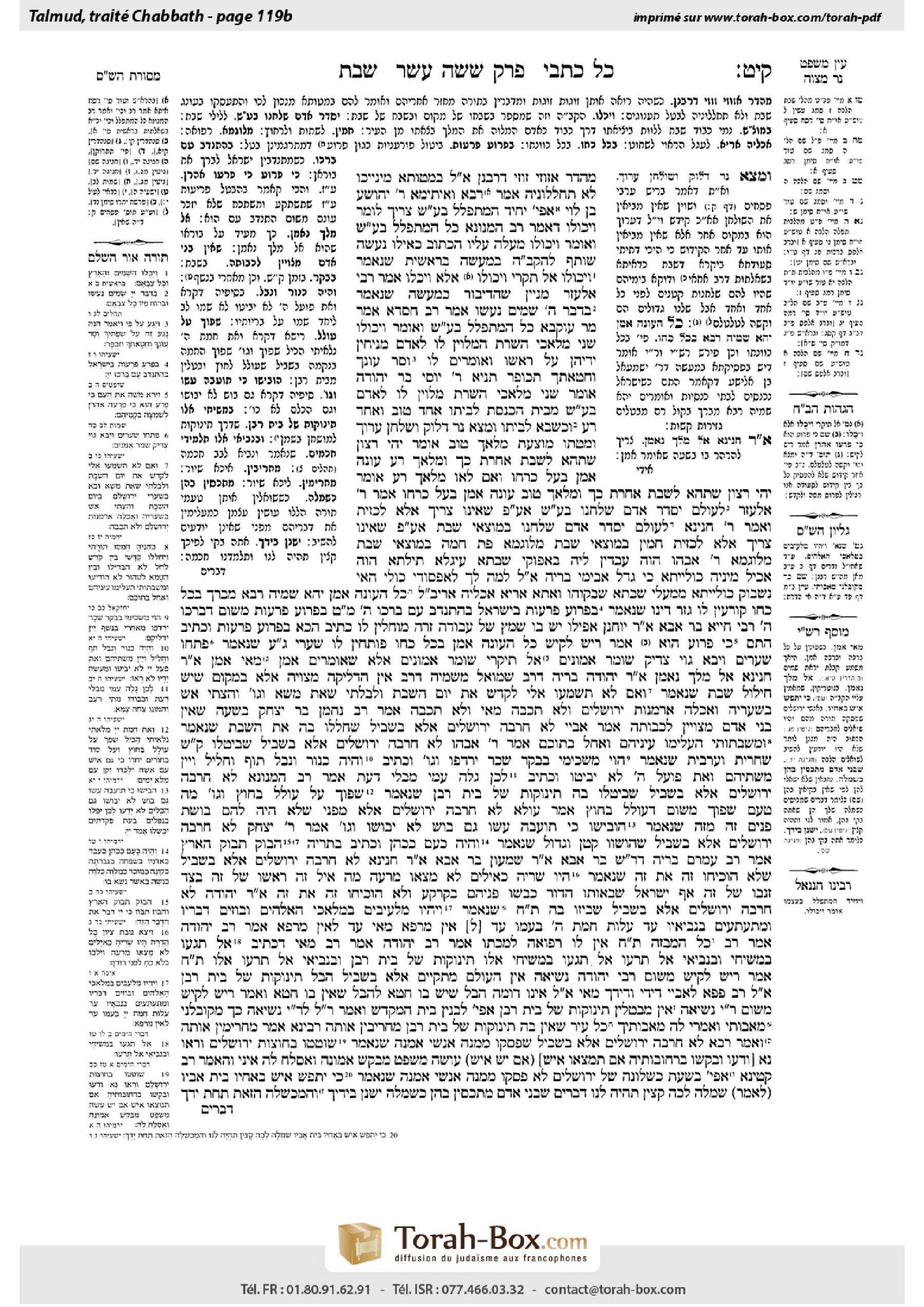
Shabbat 119b: Talmud study for Daf Yomi
Daf Yomi is the daily study of one Talmud folio. Explore 37 tractates with scans, Hebrew text, Sefaria English and AI-generated French translations where annotated.
Passage selection and English or AI-generated French translation are available where the scan has annotations. Daf Study is independent of Torah-Box and Sefaria.
Browse Shabbat · שבת · All tractatesShabbat 119b text and translations
This page of Shabbat includes the Aramaic text, an English translation and an AI-generated French translation, alongside the scan above.
שבת קי״ט ב · Aramaic and Hebrew text
מְהַדַּר אַזּוּזֵי זוּזֵי דְּרַבָּנַן, אֲמַר לְהוּ: בְּמָטוּתָא מִינַּיְיכוּ לָא תְּחַלְּלוּנֵיהּ.
אָמַר רָבָא, וְאִיתֵּימָא רַבִּי יְהוֹשֻׁעַ בֶּן לֵוִי: אֲפִילּוּ יָחִיד הַמִּתְפַּלֵּל בְּעֶרֶב שַׁבָּת צָרִיךְ לוֹמַר ״וַיְכוּלּוּ״, דְּאָמַר רַב הַמְנוּנָא: כׇּל הַמִּתְפַּלֵּל בְּעֶרֶב שַׁבָּת וְאוֹמֵר ״וַיְכוּלּוּ״, מַעֲלֶה עָלָיו הַכָּתוּב כְּאִילּוּ נַעֲשָׂה שׁוּתָּף לְהַקָּדוֹשׁ בָּרוּךְ הוּא בְּמַעֲשֵׂה בְרֵאשִׁית, שֶׁנֶּאֱמַר: ״וַיְכוּלּוּ״ — אַל תִּקְרֵי ״וַיְכוּלּוּ״ אֶלָּא ״וַיְכַלּוּ״. אָמַר רַבִּי אֶלְעָזָר: מִנַּיִין שֶׁהַדִּיבּוּר כְּמַעֲשֶׂה — שֶׁנֶּאֱמַר: ״בִּדְבַר ה׳ שָׁמַיִם נַעֲשׂוּ״.
אָמַר רַב חִסְדָּא אָמַר מָר עוּקְבָא: כׇּל הַמִּתְפַּלֵּל בְּעֶרֶב שַׁבָּת וְאוֹמֵר ״וַיְכוּלּוּ״, שְׁנֵי מַלְאֲכֵי הַשָּׁרֵת הַמְלַוִּין לוֹ לָאָדָם מַנִּיחִין יְדֵיהֶן עַל רֹאשׁוֹ וְאוֹמְרִים לוֹ ״וְסָר עֲוֹנֶךָ וְחַטָּאתְךָ תְּכֻפָּר״. תַּנְיָא, רַבִּי יוֹסֵי בַּר יְהוּדָה אוֹמֵר: שְׁנֵי מַלְאֲכֵי הַשָּׁרֵת מְלַוִּין לוֹ לְאָדָם בְּעֶרֶב שַׁבָּת מִבֵּית הַכְּנֶסֶת לְבֵיתוֹ, אֶחָד טוֹב וְאֶחָד רָע. וּכְשֶׁבָּא לְבֵיתוֹ וּמֹצֵא נֵר דָּלוּק וְשֻׁלְחָן עָרוּךְ וּמִטָּתוֹ מוּצַּעַת, מַלְאָךְ טוֹב אוֹמֵר: ״יְהִי רָצוֹן שֶׁתְּהֵא לְשַׁבָּת אַחֶרֶת כָּךְ״, וּמַלְאָךְ רַע עוֹנֶה ״אָמֵן״ בְּעַל כׇּרְחוֹ. וְאִם לָאו, מַלְאָךְ רַע אוֹמֵר: ״יְהִי רָצוֹן שֶׁתְּהֵא לְשַׁבָּת אַחֶרֶת כָּךְ״, וּמַלְאָךְ טוֹב עוֹנֶה ״אָמֵן״ בְּעַל כׇּרְחוֹ.
אָמַר רַבִּי אֶלְעָזָר: לְעוֹלָם יְסַדֵּר אָדָם שֻׁלְחָנוֹ בְּעֶרֶב שַׁבָּת, אַף עַל פִּי שֶׁאֵינוֹ צָרִיךְ אֶלָּא לִכְזַיִת. וְאָמַר רַבִּי חֲנִינָא: לְעוֹלָם יְסַדֵּר אָדָם שֻׁלְחָנוֹ בְּמוֹצָאֵי שַׁבָּת, אַף עַל פִּי שֶׁאֵינוֹ צָרִיךְ אֶלָּא לִכְזַיִת. חַמִּין בְּמוֹצָאֵי שַׁבָּת — מְלוּגְמָא, פַּת חַמָּה בְּמוֹצָאֵי שַׁבָּת — מְלוּגְמָא. רַבִּי אֲבָהוּ הֲוָה עָבְדִין לֵיהּ בְּאַפּוֹקֵי שַׁבְּתָא עִיגְלָא תִּילְתָּא, הֲוָה אָכֵיל מִינֵּיהּ כּוּלְיְיתָא. כִּי גְדַל אֲבִימִי בְּרֵיהּ, אֲמַר לֵיהּ: לְמָה לָךְ לְאַפְסוֹדֵי כּוּלֵּי הַאי, נִשְׁבּוֹק כּוּלְיְיתָא מִמַּעֲלֵי שַׁבְּתָא. שַׁבְקוּה וַאֲתָא אַרְיָא אַכְלֵיהּ.
אָמַר רַבִּי יְהוֹשֻׁעַ בֶּן לֵוִי: כׇּל הָעוֹנֶה ״אָמֵן יְהֵא שְׁמֵיהּ רַבָּא מְבָרַךְ״ בְּכׇל כֹּחוֹ, קוֹרְעִין לוֹ גְּזַר דִּינוֹ, שֶׁנֶּאֱמַר: ״בִּפְרוֹעַ פְּרָעוֹת בְּיִשְׂרָאֵל בְּהִתְנַדֵּב עָם בָּרְכוּ ה׳״. מַאי טַעְמָא ״בִּפְרוֹעַ פְּרָעוֹת״ — מִשּׁוּם דְּ״בָרְכוּ ה׳״. רַבִּי חִיָּיא בַּר אַבָּא אָמַר רַבִּי יוֹחָנָן: אֲפִילּוּ יֵשׁ בּוֹ שֶׁמֶץ שֶׁל עֲבוֹדָה זָרָה — מוֹחֲלִין לוֹ. כְּתִיב הָכָא: ״בִּפְרוֹעַ פְּרָעוֹת״, וּכְתִיב הָתָם: ״כִּי פָרוּעַ הוּא״. אָמַר רֵישׁ לָקִישׁ: כָּל הָעוֹנֶה ״אָמֵן״ בְּכׇל כֹּחוֹ פּוֹתְחִין לוֹ שַׁעֲרֵי גַן עֵדֶן, שֶׁנֶּאֱמַר: ״פִּתְחוּ שְׁעָרִים וְיָבֹא גוֹי צַדִּיק שׁוֹמֵר אֱמוּנִים״, אַל תִּיקְרֵי ״שׁוֹמֵר אֱמוּנִים״ אֶלָּא: ״שֶׁאוֹמְרִים אָמֵן״. מַאי ״אָמֵן״? אָמַר רַבִּי חֲנִינָא: ״אֵל מֶלֶךְ נֶאֱמָן״.
אָמַר רַב יְהוּדָה בְּרֵיהּ דְּרַב שְׁמוּאֵל מִשְּׁמֵיהּ דְּרַב: אֵין הַדְּלֵיקָה מְצוּיָה אֶלָּא בִּמְקוֹם שֶׁיֵּשׁ חִילּוּל שַׁבָּת, שֶׁנֶּאֱמַר: ״וְאִם לֹא תִשְׁמְעוּ אֵלַי לְקַדֵּשׁ אֶת יוֹם הַשַּׁבָּת וּלְבִלְתִּי שְׂאֵת מַשָּׂא וְגוֹ׳ וְהִצַּתִּי אֵשׁ בִּשְׁעָרֶיהָ וְאָכְלָה אַרְמְנוֹת יְרוּשָׁלִַים וְלֹא תִכְבֶּה״. מַאי ״וְלֹא תִכְבֶּה״? אָמַר רַב נַחְמָן בַּר יִצְחָק: בְּשָׁעָה שֶׁאֵין בְּנֵי אָדָם מְצוּיִין לְכַבּוֹתָהּ. אָמַר אַבָּיֵי: לָא חָרְבָה יְרוּשָׁלַיִם אֶלָּא בִּשְׁבִיל שֶׁחִלְּלוּ בָּהּ אֶת הַשַּׁבָּת, שֶׁנֶּאֱמַר: ״וּמִשַׁבְּתוֹתַי הֶעְלִימוּ עֵינֵיהֶם וָאֵחַל בְּתוֹכָם״.
אָמַר רַבִּי אֲבָהוּ: לֹא חָרְבָה יְרוּשָׁלַיִם אֶלָּא בִּשְׁבִיל שֶׁבִּיטְּלוּ קְרִיאַת שְׁמַע שַׁחֲרִית וְעַרְבִית, שֶׁנֶּאֱמַר: ״הוֹי מַשְׁכִּימֵי בַבֹּקֶר שֵׁכָר יִרְדֹּפוּ וְגוֹ׳״, וּכְתִיב: ״וְהָיָה כִנּוֹר וָנֶבֶל תּוֹף וְחָלִיל וָיַיִן מִשְׁתֵּיהֶם וְאֵת פּוֹעַל ה׳ לֹא יַבִּיטוּ״, וּכְתִיב: ״לָכֵן גָּלָה עַמִּי מִבְּלִי דָעַת״.
אָמַר רַב הַמְנוּנָא: לֹא חָרְבָה יְרוּשָׁלַיִם אֶלָּא בִּשְׁבִיל שֶׁבִּיטְּלוּ בָּהּ תִּינוֹקוֹת שֶׁל בֵּית רַבָּן, שֶׁנֶּאֱמַר: ״שְׁפוֹךְ עַל עוֹלָל בַּחוּץ וְגוֹ׳״. מַה טַּעַם ״שְׁפוֹךְ״ — מִשּׁוּם דְּ״עוֹלָל בַּחוּץ״. אָמַר עוּלָּא: לֹא חָרְבָה יְרוּשָׁלַיִם אֶלָּא מִפְּנֵי שֶׁלֹּא הָיָה לָהֶם בּוֹשֶׁת פָּנִים זֶה מִזֶּה, שֶׁנֶּאֱמַר: ״הוֹבִישׁוּ כִּי תוֹעֵבָה עָשׂוּ גַּם בּוֹשׁ לֹא יֵבוֹשׁוּ וְגוֹ׳״. אָמַר רַבִּי יִצְחָק: לֹא חָרְבָה יְרוּשָׁלַיִם אֶלָּא בִּשְׁבִיל שֶׁהוּשְׁווּ קָטָן וְגָדוֹל, שֶׁנֶּאֱמַר: ״וְהָיָה כָעָם כַּכֹּהֵן״, וּכְתִיב בָּתְרֵיהּ: ״הִבּוֹק תִּבּוֹק הָאָרֶץ״.
אָמַר רַב עַמְרָם בְּרֵיהּ דְּרַבִּי שִׁמְעוֹן בַּר אַבָּא, אָמַר רַבִּי שִׁמְעוֹן בַּר אַבָּא, אָמַר רַבִּי חֲנִינָא: לֹא חָרְבָה יְרוּשָׁלַיִם אֶלָּא בִּשְׁבִיל שֶׁלֹּא הוֹכִיחוּ זֶה אֶת זֶה, שֶׁנֶּאֱמַר: ״הָיוּ שָׂרֶיהָ כְּאַיָּלִים לֹא מָצְאוּ מִרְעֶה״. מָה אַיִל זֶה, רֹאשׁוֹ שֶׁל זֶה בְּצַד זְנָבוֹ שֶׁל זֶה, אַף יִשְׂרָאֵל שֶׁבְּאוֹתוֹ הַדּוֹר כָּבְשׁוּ פְּנֵיהֶם בַּקַּרְקַע וְלֹא הוֹכִיחוּ זֶה אֶת זֶה. אָמַר רַבִּי יְהוּדָה: לֹא חָרְבָה יְרוּשָׁלַיִם אֶלָּא בִּשְׁבִיל שֶׁבִּיזּוּ בָּהּ תַּלְמִידֵי חֲכָמִים, שֶׁנֶּאֱמַר: ״וַיִּהְיוּ מַלְעִיבִים בְּמַלְאֲכֵי הָאֱלֹהִים וּבוֹזִים דְּבָרָיו וּמִתַּעְתְּעִים בִּנְבִיאָיו עַד עֲלוֹת חֲמַת ה׳ בְּעַמּוֹ עַד [לְ]אֵין מַרְפֵּא״. מַאי ״עַד לְאֵין מַרְפֵּא״? אָמַר רַב יְהוּדָה אָמַר רַב: כׇּל הַמְבַזֶּה תַּלְמִידֵי חֲכָמִים אֵין לוֹ רְפוּאָה לְמַכָּתוֹ.
אָמַר רַב יְהוּדָה אָמַר רַב: מַאי דִּכְתִיב ״אַל תִּגְּעוּ בִּמְשִׁיחָי וּבִנְבִיאַי אַל תָּרֵעוּ״, ״אַל תִּגְעוּ בִּמְשִׁיחָי״ — אֵלּוּ תִּינוֹקוֹת שֶׁל בֵּית רַבָּן, ״וּבִנְבִיאַי אַל תָּרֵעוּ״ — אֵלּוּ תַּלְמִידֵי חֲכָמִים. אָמַר רֵישׁ לָקִישׁ מִשּׁוּם רַבִּי יְהוּדָה נְשִׂיאָה: אֵין הָעוֹלָם מִתְקַיֵּים אֶלָּא בִּשְׁבִיל הֶבֶל תִּינוֹקוֹת שֶׁל בֵּית רַבָּן. אֲמַר לֵיהּ רַב פָּפָּא לְאַבָּיֵי: דִּידִי וְדִידָךְ מַאי? אֲמַר לֵיהּ: אֵינוֹ דּוֹמֶה הֶבֶל שֶׁיֵּשׁ בּוֹ חֵטְא לְהֶבֶל שֶׁאֵין בּוֹ חֵטְא. וְאָמַר רֵישׁ לָקִישׁ מִשּׁוּם רַבִּי יְהוּדָה נְשִׂיאָה: אֵין מְבַטְּלִין תִּינוֹקוֹת שֶׁל בֵּית רַבָּן אֲפִילּוּ לְבִנְיַן בֵּית הַמִּקְדָּשׁ. וְאָמַר רֵישׁ לָקִישׁ לְרַבִּי יְהוּדָה נְשִׂיאָה: כָּךְ מְקּוּבְּלַנִי מֵאֲבוֹתַי, וְאָמְרִי לַהּ מֵאֲבוֹתֶיךָ: כׇּל עִיר שֶׁאֵין בָּהּ תִּינוֹקוֹת שֶׁל בֵּית רַבָּן מַחֲרִיבִין אוֹתָהּ, רָבִינָא אָמַר: מַחְרִימִין אוֹתָהּ.
וְאָמַר רָבָא: לֹא חָרְבָה יְרוּשָׁלַיִם אֶלָּא בִּשְׁבִיל שֶׁפָּסְקוּ מִמֶּנָּה אַנְשֵׁי אֲמָנָה, שֶׁנֶּאֱמַר: ״שׁוֹטְטוּ בְּחוּצוֹת יְרוּשָׁלִַים וּרְאוּ נָא [וּדְעוּ וּבַקְשׁוּ בִרְחוֹבוֹתֶיהָ אִם תִּמְצְאוּ אִישׁ] (אִם יֵשׁ אִישׁ) עוֹשֶׂה מִשְׁפָּט מְבַקֵּשׁ אֱמוּנָה וְאֶסְלַח לָהּ״. אִינִי?! וְהָאָמַר רַב קַטִּינָא: אֲפִילּוּ בִּשְׁעַת כִּשְׁלוֹנָהּ שֶׁל יְרוּשָׁלָיִם לֹא פָּסְקוּ מִמֶּנָּה אַנְשֵׁי אֲמָנָה, שֶׁנֶּאֱמַר: ״כִּי יִתְפֹּשׂ אִישׁ בְּאָחִיו בֵּית אָבִיו לֵאמֹר שִׂמְלָה לְכָה קָצִין תִּהְיֶה לָּנוּ״, דְּבָרִים שֶׁבְּנֵי אָדָם מִתְכַּסִּין בָּהֶן כְּשִׂמְלָה יֶשְׁנָן בְּיָדֶיךָ. ״וְהַמַּכְשֵׁלָה הַזֹּאת תַּחַת יָדֶךָ״,
Shabbat 119b · English translation
would seek pairs of Sages engaged in conversation on Shabbat and said to them: Please do not desecrate Shabbat by failing to delight in Shabbat.
Rava said, and some say it was Rabbi Yehoshua ben Levi who said: Even an individual who prays on Shabbat evening must recite the passage: “And the heavens and the earth were finished [vaykhullu]” (Genesis 2:1–3), as Rav Hamnuna said: Anyone who prays on Shabbat evening and recites the passage of vaykhullu, the verse ascribed him credit as if he became a partner with the Holy One, Blessed be He, in the act of Creation. As it is stated: “And the heavens and the earth were finished [vaykhullu].” Do not read it as: Were finished [vaykhullu]; rather, as: They finished [vaykhallu]. It is considered as though the Holy One, Blessed be He, and the individual who says this become partners and completed the work together. Rabbi Elazar said: From where is it derived that speech is like action? As it is stated: “By the word of God the heavens were made, and all of their hosts by the breath of His mouth” (Psalms 33:6).
Rav Ḥisda said that Mar Ukva said: One who prays on Shabbat evening and recites vaykhullu, the two ministering angels who accompany the person at all times place their hands on his head and say to him: “And your iniquity has passed, and your sin has been atoned” (Isaiah 6:7). It was taught in a baraita: Rabbi Yosei bar Yehuda says: Two ministering angels accompany a person on Shabbat evening from the synagogue to his home, one good angel and one evil angel. And when he reaches his home and finds a lamp burning and a table set and his bed made, the good angel says: May it be Your will that it shall be like this for another Shabbat. And the evil angel answers against his will: Amen. And if the person’s home is not prepared for Shabbat in that manner, the evil angel says: May it be Your will that it shall be so for another Shabbat, and the good angel answers against his will: Amen.
Rabbi Elazar said: A person should always set his table on Shabbat eve with all the preparations for an important feast, even if he only needs the table set for an olive-bulk of food. And Rabbi Ḥanina said: A person should always set his table at the conclusion of Shabbat, Saturday night, for a feast in deference to the Shabbat that passed, even if he only needs the table set for an olive-bulk of food. And with regard to the meal at the conclusion of Shabbat, they said: Hot water after Shabbat is a remedy [melugma], warm bread at the conclusion of Shabbat is a remedy. The Gemara relates: They would prepare for Rabbi Abbahu at the conclusion of Shabbat a third-born calf, and he would eat one kidney from it. When his son Avimi grew up, he said to his father: Why do you waste so much? Let us leave a kidney over from Shabbat eve, and you will not need to slaughter an entire calf for that purpose. Indeed, they left the calf and did not slaughter it, and a lion came and ate it. This teaches that one should not be miserly when it comes to honoring Shabbat.
Apropos the reward for honoring Shabbat, the Gemara cites statements about the reward for answering amen. Rabbi Yehoshua ben Levi said that anyone who answers: Amen, may His great name be blessed, wholeheartedly, with all his might, they rip his sentence, as it is stated: “When punishments are annulled in Israel, when the people offer themselves, bless the Lord” (Judges 5:2). What is the reason for when punishments are annulled? Because the Jewish people blessed God. When one recites: Amen, may His great name be blessed, and blesses God, his punishment is annulled. Rabbi Ḥiyya bar Abba said that Rabbi Yoḥanan said: Even if one has within him a trace of idolatry, when he answers amen he is forgiven. It is written here, in the verse above: “When punishments [pera’ot] are annulled.” And it is written there, with regard to the sin of the Golden Calf: “And Moses saw that the nation was wild [paru’a], for Aaron had let them loose for anyone who might rise against them” (Exodus 32:25). Even one with the wildness of idolatry is forgiven. Reish Lakish said: One who answers amen with all his strength, they open the gates of the Garden of Eden before him, as it is stated: “Open the gates, and a righteous nation shall come who keeps the faith” (Isaiah 26:2). Do not read: Who keeps [shomer] the faith [emunim], but rather: Who say [she’omerim] amen. What is the allusion of the word amen? Rabbi Ḥanina said: It is an acronym of the words: God, faithful King [El Melekh ne’eman].
Rav Yehuda, son of Rav Shmuel, said in the name of Rav: Fire is only found in a place where there is desecration of Shabbat, as it is stated: “And if you do not heed Me to sanctify the day of Shabbat, and to refrain from carrying burdens and come to the gates of Jerusalem on the day of Shabbat, and I will light a fire in its gates and it will consume the palaces of Jerusalem and it will not be extinguished” (Jeremiah 17:27). The Gemara asks: What is the meaning of: And it will not be extinguished? Rav Naḥman bar Yitzḥak said: Fire will break out at a time when people are not found to extinguish it. Abaye said: Jerusalem was destroyed only because people desecrated the Shabbat in it, as it is stated: “And from My Shabbatot they averted their eyes, and I was profaned among them” (Ezekiel 22:26). Several punishments were decreed to befall Jerusalem as punishment for this transgression.
The Gemara suggests additional reasons for the destruction of Jerusalem.
Rabbi Abbahu said: Jerusalem was destroyed only because its citizens intentionally omitted recitation of Shema morning and evening, as it is stated: “Woe to those who rise early in the morning and pursue the drink and are aflame from wine until late in the evening” (Isaiah 5:11). And it is written in the continuation of that passage: “And their drinking parties have lyre and lute, drum and flute and wine, and they do not look upon the actions of God, and they do not see His hands’ creations” (Isaiah 5:12). This means that in the morning and evening, when the Jews should have been reciting Shema, they were drinking wine and liquor. And it is written in that passage: “Therefore My nation is being exiled for its ignorance; its honor will die of hunger and its multitudes will be parched with thirst” (Isaiah 5:13).
Rav Hamnuna said: Jerusalem was destroyed only because schoolchildren there were interrupted from studying Torah, as it is stated: “And I am filled with the wrath of God, I cannot contain it, pour it onto the infants in the street and onto the gathering of youths together, for men and women alike will be captured, the elderly along with those of advanced years” (Jeremiah 6:11). Rav Hamnuna explains: What is the reason that the wrath is poured? It is because infants are outside in the streets and are not studying Torah.
Ulla said: Jerusalem was destroyed only because people had no shame before each other, as it is stated: “They acted shamefully; they have performed abominations, yet they neither were ashamed nor did they know humiliation. Therefore, they will fall among the fallen, they will fail at the time that I punish them, said God” (Jeremiah 6:15).
Rabbi Yitzḥak said: Jerusalem was destroyed only because its small and the great citizens were equated. They did not properly value the prominent leaders of their generation, as it is stated: “And the common people were like the priest, the slave like his master, the maidservant like her mistress, the buyer like the seller, the lender like the borrower, the creditor like the one indebted to him” (Isaiah 24:2). And it is written afterward: “The land shall be utterly desolate and completely plundered, for God has said this” (Isaiah 24:3).
Rav Amram, son of Rabbi Shimon bar Abba, said that Rabbi Shimon bar Abba said that Rabbi Ḥanina said: Jerusalem was destroyed only because the people did not rebuke one another, as it is stated: “Her ministers were like stags that found no pasture, and they walked without strength before their pursuer” (Lamentations 1:6). Just as this stag turns its head toward the other’s tail when it grazes, and each one feeds on its own, so too, the Jewish people in that generation lowered their faces to the ground and did not rebuke one another.
Rabbi Yehuda said: Jerusalem was destroyed only because they disparaged the Torah scholars in it, as it is stated: “And they mocked the messengers of God and disdained His words and taunted His prophets, until the wrath of God arose against His people, until it could not be healed” (II Chronicles 36:16). What is the meaning of: Until it could not be healed? Rav Yehuda said that Rav said: It means that anyone who disparages Torah scholars cannot be healed from his wound.
Rav Yehuda said that Rav said: What is the meaning of that which is written: “Do not touch My anointed ones and do My prophets no harm” (I Chronicles 16:22)? “Do not touch My anointed ones,” these are the schoolchildren, who are as precious and important as kings and priests (Maharsha); “and do not harm My prophets,” these are Torah scholars. Reish Lakish said in the name of Rabbi Yehuda Nesia: The world only exists because of the breath, i.e., reciting Torah, of schoolchildren. Rav Pappa said to Abaye: My Torah study and yours, what is its status? Why is the Torah study of adults worth less? He said to him: The breath of adults, which is tainted by sin, is not similar to the breath of children, which is not tainted by sin. And Reish Lakish said in the name of Rabbi Yehuda Nesia: One may not interrupt schoolchildren from studying Torah, even in order to build the Temple. And Reish Lakish said to Rabbi Yehuda Nesia: I have received from my ancestors, and some say that he said to him: I have received from your ancestors as follows: Any city in which there are no schoolchildren studying Torah, they destroy it. Ravina said: They leave it desolate.
And Rava said: Jerusalem was destroyed only because there were no more trustworthy people there, as it is stated: “Roam about the streets of Jerusalem and see, and search its plazas, if you can find a person, who acts justly, who seeks integrity, that I should forgive it” (Jeremiah 5:1). The Gemara asks: Is that so? Didn’t Rav Ketina say: Even at the time of Jerusalem’s failure, trustworthy people did not cease there, as it is stated: “For a man will grab his brother of his father’s house and say: You have a garment. Come be a chief over us and let this ruin be under your care” (Isaiah 3:6)? Things that people use to cover up like a garment, secrets, are in your hands and you know about them. Therefore, you should be a leader of the community. And that which is stated: “And let this ruin be under your care,” meaning:
Shabbat 119b · Traduction française (IA)
Il cherchait des paires de Sages qui conversaient pendant Chabbat et leur disait : « Je vous en prie, ne profanez pas Chabbat en vous privant de vous réjouir de Chabbat. »
Rava a dit — et certains disent que c’est Rabbi Yehoshua ben Levi qui l’a dit : même un particulier qui prie le soir de Chabbat doit réciter le passage : « Le ciel et la terre furent achevés [vaykhullu] » (Genèse 2, 1-3). En effet, Rav Hamnuna a dit : quiconque prie le soir de Chabbat et récite le passage de vaykhullu, le verset lui en attribue le mérite comme s’il était devenu associé au Saint, béni soit-Il, dans l’œuvre de la Création. Comme il est dit : « Le ciel et la terre furent achevés [vaykhullu]. » Ne lis pas : « furent achevés [vaykhullu] », mais plutôt : « achevèrent [vaykhallu] ». C’est considéré comme si le Saint, béni soit-Il, et celui qui prononce ces mots étaient devenus associés et avaient achevé ensemble l’œuvre. Rabbi Elazar a dit : d’où déduit-on que la parole équivaut à l’action ? Comme il est dit : « Par la parole de Dieu les cieux furent faits, et toute leur armée par le souffle de sa bouche » (Psaumes 33, 6).
Rav Ḥisda a dit que Mar Ukva a dit : celui qui prie le soir de Chabbat et récite vaykhullu, les deux anges de service qui l’accompagnent en tout temps posent leurs mains sur sa tête et lui disent : « Ton iniquité a été effacée et ton péché expié » (Isaïe 6, 7). Il a été enseigné dans une baraïta : Rabbi Yosei bar Yehuda dit que deux anges de service accompagnent une personne le soir de Chabbat, de la synagogue à son domicile, l’un bon et l’autre mauvais. Lorsqu’elle arrive chez elle et trouve une lampe allumée, une table dressée et son lit préparé, l’ange bon dit : « Puisse-t-il être Ta volonté qu’il en soit ainsi un autre Chabbat. » Et l’ange mauvais répond malgré lui : « Amen. » Mais si le domicile de la personne n’est pas préparé ainsi pour Chabbat, l’ange mauvais dit : « Puisse-t-il être Ta volonté qu’il en soit ainsi un autre Chabbat », et l’ange bon répond malgré lui : « Amen. »
Rabbi Elazar a dit : une personne doit toujours dresser sa table la veille de Chabbat, avec toutes les préparations nécessaires à un festin important, même si elle n’a besoin que d’une table dressée pour une quantité de nourriture de la taille d’une olive. Rabbi Ḥanina a dit : une personne doit toujours dresser sa table à la fin de Chabbat, le samedi soir, pour un festin en hommage au Chabbat qui vient de s’achever, même si elle n’a besoin que d’une table dressée pour une quantité de nourriture de la taille d’une olive. Au sujet du repas de la fin de Chabbat, ils ont dit : l’eau chaude après Chabbat est un remède [melugma], et le pain chaud à la fin de Chabbat est un remède. La Guemara rapporte qu’à la fin de Chabbat, on préparait pour Rabbi Abbahu un veau âgé d’un tiers de sa croissance, et qu’il en mangeait un rein. Quand son fils Avimi grandit, il dit à son père : « Pourquoi gaspilles-tu tant ? Laissons un rein de côté la veille de Chabbat, et tu n’auras pas besoin d’abattre un veau entier pour cela. » Ils laissèrent effectivement le veau sans l’abattre, et un lion vint le dévorer. Cela enseigne qu’il ne faut pas être avare lorsqu’il s’agit d’honorer Chabbat.
À propos de la récompense due à ceux qui honorent Chabbat, la Guemara cite des déclarations sur la récompense de celui qui répond « amen ». Rabbi Yehoshua ben Levi a dit que quiconque répond de tout son cœur et de toutes ses forces : « Amen, que Son grand nom soit béni », voit son décret déchiré, comme il est dit : « Lorsque les châtiments furent annulés en Israël, lorsque le peuple s’offrit volontairement, bénissez l’Éternel » (Juges 5, 2). Pourquoi les châtiments furent-ils annulés ? Parce que le peuple juif bénit Dieu. Quand quelqu’un récite : « Amen, que Son grand nom soit béni » et bénit Dieu, son châtiment est annulé. Rabbi Ḥiyya bar Abba a dit que Rabbi Yoḥanan a dit : même si quelqu’un porte en lui une trace d’idolâtrie, il est pardonné lorsqu’il répond « amen ». Il est écrit ici, dans le verset cité plus haut : « Lorsque les châtiments [pera’ot] furent annulés. » Et il est écrit là, au sujet du péché du Veau d’or : « Moïse vit que le peuple était déchaîné [paru’a], car Aaron l’avait livré au désordre, l’exposant à ceux qui se dresseraient contre lui » (Exode 32, 25). Même celui qui porte en lui le désordre de l’idolâtrie est pardonné. Reish Lakish a dit : celui qui répond « amen » de toutes ses forces voit s’ouvrir devant lui les portes du Jardin d’Éden, comme il est dit : « Ouvrez les portes, afin qu’entre une nation juste qui garde la fidélité » (Isaïe 26, 2). Ne lis pas : « qui garde [shomer] la fidélité [emunim] », mais plutôt : « qui dit [she’omerim] amen ». Quelle est l’allusion contenue dans le mot amen ? Rabbi Ḥanina a dit : c’est l’acronyme des mots « Dieu, Roi fidèle » [El Melekh ne’eman].
Rav Yehuda, fils de Rav Shmuel, a dit au nom de Rav : le feu ne se trouve que dans un lieu où l’on profane Chabbat, comme il est dit : « Si vous ne m’écoutez pas pour sanctifier le jour de Chabbat, vous abstenir de porter des fardeaux et entrer par les portes de Jérusalem le jour de Chabbat, alors j’allumerai un feu à ses portes ; il dévorera les palais de Jérusalem et ne s’éteindra pas » (Jérémie 17, 27). La Guemara demande : que signifie « et ne s’éteindra pas » ? Rav Naḥman bar Yitzḥak a dit : le feu éclatera à un moment où personne ne sera là pour l’éteindre. Abaye a dit : Jérusalem ne fut détruite que parce que ses habitants y profanaient Chabbat, comme il est dit : « Ils détournaient les yeux de Mes Chabbatot, et J’étais profané parmi eux » (Ézéchiel 22, 26). Plusieurs châtiments furent décrétés contre Jérusalem en punition de cette transgression.
La Guemara propose d’autres raisons à la destruction de Jérusalem. Rabbi Abbahu a dit : Jérusalem ne fut détruite que parce que ses habitants omettaient délibérément de réciter le Chéma matin et soir, comme il est dit : « Malheur à ceux qui se lèvent tôt le matin pour poursuivre la boisson et qui s’enflamment de vin jusqu’au soir » (Isaïe 5, 11). Et il est écrit dans la suite de ce passage : « Leurs festins sont accompagnés de lyre et de luth, de tambourin et de flûte, et de vin ; mais ils ne considèrent pas les œuvres de Dieu et ne voient pas les ouvrages de ses mains » (Isaïe 5, 12). Cela signifie que le matin et le soir, aux heures où les Juifs auraient dû réciter le Chéma, ils buvaient du vin et des boissons alcoolisées. Et il est écrit dans ce passage : « C’est pourquoi mon peuple est exilé faute de connaissance ; ses notables mourront de faim et ses multitudes seront desséchées par la soif » (Isaïe 5, 13).
Rav Hamnuna a dit : Jérusalem ne fut détruite que parce que les enfants qui y étudiaient furent empêchés d’étudier la Torah, comme il est dit : « Je suis rempli de la colère de Dieu, je ne peux la contenir ; déverse-la sur les enfants dans la rue et sur le rassemblement des jeunes gens ; hommes et femmes seront pris, le vieillard avec celui qui est avancé en âge » (Jérémie 6, 11). Rav Hamnuna explique : pourquoi la colère est-elle déversée ? Parce que les enfants sont dehors dans les rues et n’étudient pas la Torah. Ulla a dit : Jérusalem ne fut détruite que parce que les gens n’éprouvaient aucune honte les uns devant les autres, comme il est dit : « Ils ont agi honteusement, ils ont commis des abominations ; pourtant, ils n’ont éprouvé aucune honte et ne connaissent pas l’humiliation. C’est pourquoi ils tomberont parmi ceux qui tombent et trébucheront au moment où Je les punirai, dit Dieu » (Jérémie 6, 15). Rabbi Yitzḥak a dit : Jérusalem ne fut détruite que parce que les petits et les grands de ses habitants furent mis sur un pied d’égalité. Ils n’accordaient pas aux dirigeants éminents de leur génération la considération qui leur était due, comme il est dit : « Le peuple sera comme le prêtre, l’esclave comme son maître, la servante comme sa maîtresse, l’acheteur comme le vendeur, le prêteur comme l’emprunteur, le créancier comme son débiteur » (Isaïe 24, 2). Et il est écrit ensuite : « Le pays sera entièrement dévasté et complètement pillé, car Dieu l’a dit » (Isaïe 24, 3).
Rav Amram, fils de Rabbi Shimon bar Abba, a dit que Rabbi Shimon bar Abba a dit que Rabbi Ḥanina a dit : Jérusalem ne fut détruite que parce que ses habitants ne se réprimandaient pas les uns les autres, comme il est dit : « Ses chefs étaient comme des cerfs qui ne trouvent pas de pâturage ; ils s’avançaient sans force devant leur poursuivant » (Lamentations 1, 6). De même que ce cerf tourne la tête vers la queue de l’autre lorsqu’il broute, et que chacun se nourrit de son côté, de même les Juifs de cette génération baissaient le visage vers le sol et ne se réprimandaient pas les uns les autres. Rabbi Yehuda a dit : Jérusalem ne fut détruite que parce que ses habitants méprisaient les érudits de la Torah qui s’y trouvaient, comme il est dit : « Ils se moquèrent des messagers de Dieu, méprisèrent ses paroles et raillèrent ses prophètes, jusqu’à ce que la colère de Dieu s’abattît sur son peuple, jusqu’à ce qu’il n’y ait plus de guérison » (II Chroniques 36, 16). Que signifie « jusqu’à ce qu’il n’y ait plus de guérison » ? Rav Yehuda a dit que Rav a dit : cela signifie que quiconque méprise les érudits de la Torah ne peut être guéri de sa blessure.
Rav Yehuda a dit que Rav a dit : que signifie ce qui est écrit : « Ne touchez pas à Mes oints et ne faites aucun mal à Mes prophètes » (I Chroniques 16, 22) ? « Ne touchez pas à Mes oints » désigne les enfants qui étudient, précieux et importants comme des rois et des prêtres (Maharsha) ; « et ne faites aucun mal à Mes prophètes » désigne les érudits de la Torah. Reish Lakish a dit au nom de Rabbi Yehuda Nesia : le monde n’existe que grâce au souffle — c’est-à-dire à la récitation de la Torah — des enfants qui étudient. Rav Pappa a dit à Abaye : « Qu’en est-il de mon étude de la Torah et de la tienne ? Pourquoi l’étude de la Torah des adultes vaut-elle moins ? » Il lui a répondu : « Le souffle des adultes, entaché par le péché, n’est pas comparable au souffle des enfants, qui n’est entaché par aucun péché. » Reish Lakish a dit au nom de Rabbi Yehuda Nesia : on ne doit pas interrompre les enfants qui étudient la Torah, même pour construire le Temple. Reish Lakish a dit à Rabbi Yehuda Nesia : « J’ai reçu de mes ancêtres » — et certains disent qu’il lui a dit : « J’ai reçu de tes ancêtres » — la tradition suivante : toute ville où aucun enfant n’étudie la Torah, on la détruit. Ravina a dit : on la laisse déserte.
Rava a dit : Jérusalem ne fut détruite que parce qu’il n’y restait plus de gens dignes de confiance, comme il est dit : « Parcourez les rues de Jérusalem, regardez et cherchez sur ses places : si vous pouvez trouver un homme qui agisse avec justice et recherche l’intégrité, alors Je lui pardonnerai » (Jérémie 5, 1). La Guemara demande : est-ce vraiment le cas ? Rav Ketina n’a-t-il pas dit que, même au moment de la ruine de Jérusalem, il n’y cessa pas d’y avoir des gens dignes de confiance, comme il est dit : « Un homme saisira son frère, dans la maison de son père, et lui dira : Tu as un manteau ; viens, sois notre chef, et que cette ruine soit sous ta responsabilité » (Isaïe 3, 6) ? Les choses que les gens utilisent pour se couvrir comme d’un manteau, c’est-à-dire les secrets, sont entre tes mains et tu les connais. C’est pourquoi tu devrais être un dirigeant de la communauté. Et ce qui est dit : « Que cette ruine soit sous ta responsabilité », signifie :
Traduction française générée par IA à partir de l’édition anglaise de Sefaria. Vérifie toujours un passage avec le texte source.
Text from Sefaria: William Davidson Edition - Vocalized Aramaic (CC BY NC); William Davidson Edition - English (CC BY NC).