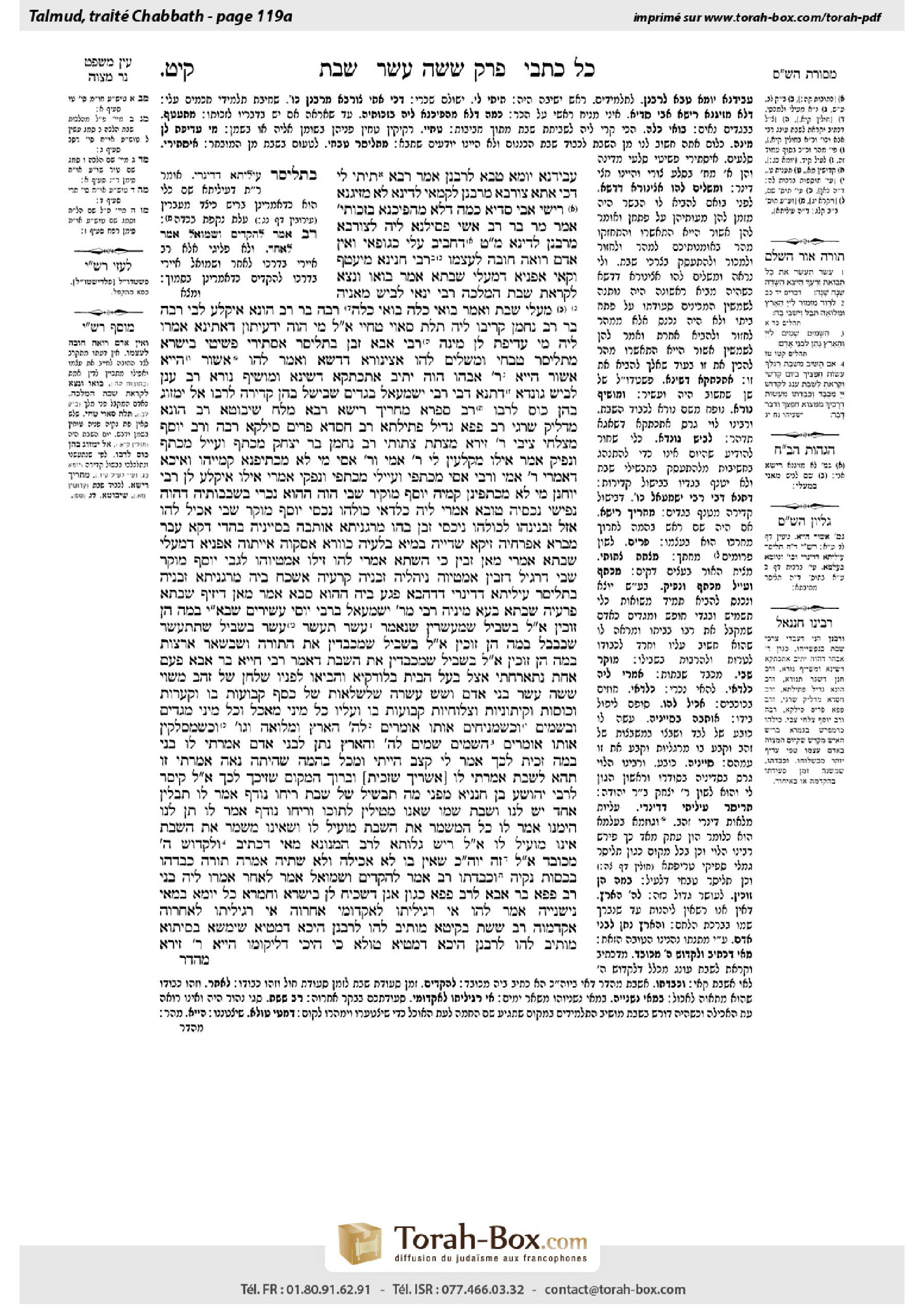
Shabbat 119a: Talmud study for Daf Yomi
Daf Yomi is the daily study of one Talmud folio. Explore 37 tractates with scans, Hebrew text, Sefaria English and AI-generated French translations where annotated.
Passage selection and English or AI-generated French translation are available where the scan has annotations. Daf Study is independent of Torah-Box and Sefaria.
Browse Shabbat · שבת · All tractatesShabbat 119a text and translations
This page of Shabbat includes the Aramaic text, an English translation and an AI-generated French translation, alongside the scan above.
שבת קי״ט א · Aramaic and Hebrew text
עָבֵידְנָא יוֹמָא טָבָא לְרַבָּנַן. אָמַר רָבָא תֵּיתֵי לִי, דְּכִי אֲתָא צוּרְבָּא מֵרַבָּנַן לְקַמַּאי לְדִינָא, לָא מָזֵיגְנָא רֵישִׁי אַבֵּי סַדְיָא כַּמָּה דְּלָא מְהַפֵּיכְנָא בְּזָכוּתֵיהּ. אָמַר מָר בַּר רַב אָשֵׁי: פְּסִילְנָא לֵיהּ לְצוּרְבָּא מֵרַבָּנַן לְדִינָא. מַאי טַעְמָא? — דְּחַבִּיב עֲלַי כְּגוּפַאי, וְאֵין אָדָם רוֹאֶה חוֹבָה לְעַצְמוֹ.
רַבִּי חֲנִינָא מִיעֲטֵף וְקָאֵי אַפַּנְיָא דְמַעֲלֵי שַׁבְּתָא, אָמַר: ״בּוֹאוּ וְנֵצֵא לִקְרַאת שַׁבָּת הַמַּלְכָּה״. רַבִּי יַנַּאי לָבֵישׁ מָאנֵי מְעַלְּיֵי (שַׁבָּת) [וּמִיכַּסֵּי], וְאָמַר: ״בּוֹאִי כַלָּה, בּוֹאִי כַלָּה״. רַבָּה בַּר רַב הוּנָא אִיקְּלַע לְבֵי רַבָּה בַּר רַב נַחְמָן. קָרִיבוּ לֵיהּ תְּלָת סָאוֵי טַחְיֵי. אֲמַר לְהוּ: מִי הֲוָה יָדְעִיתוּן דְּאָתֵינָא? אֲמַרוּ לֵיהּ: מִי עֲדִיפַתְּ לַן מִינַּהּ?
רַבִּי אַבָּא זָבֵן בִּתְלֵיסַר אִסְתִּירֵי פְּשִׁיטֵי בִּישְׂרָא מִתְּלֵיסַר טַבָּחֵי, וּמְשַׁלֵּים לְהוּ אַצִּינּוֹרָא דְּדַשָּׁא, וַאֲמַר לְהוּ: ״אַשּׁוּר הַיָּיא, אַשּׁוּר הַיָּיא״. רַבִּי אֲבָהוּ הֲוָה יָתֵיב אַתַּכְתָּקָא דְשִׁינָּא וּמוֹשֵׁיף נוּרָא. רַב עָנָן לָבֵישׁ גּוּנְדָּא, דְּתָנָא דְּבֵי רַבִּי יִשְׁמָעֵאל: בְּגָדִים שֶׁבִּישֵּׁל בָּהֶן קְדֵירָה לְרַבּוֹ — אַל יִמְזוֹג בָּהֶן כּוֹס לְרַבּוֹ.
רַב סָפְרָא מְחָרֵיךְ רֵישָׁא. רָבָא מָלַח שִׁיבּוּטָא. רַב הוּנָא מַדְלֵיק שְׁרָגֵי. רַב פָּפָּא גָּדֵיל פְּתִילָתָא. רַב חִסְדָּא פָּרֵים סִילְקָא. רַבָּה וְרַב יוֹסֵף מְצַלְּחִי צִיבֵי. רַבִּי זֵירָא מְצַתֵּת צַתּוֹתֵי. רַב נַחְמָן בַּר יִצְחָק מְכַתֵּף וְעָיֵיל, מְכַתֵּף וְנָפֵיק. אָמַר: אִילּוּ מִקַּלְעִין לִי רַבִּי אַמֵּי וְרַבִּי אַסִּי, מִי לָא מְכַתֵּיפְנָא קַמַּיְיהוּ? וְאִיכָּא דְאָמְרִי: רַבִּי אַמֵּי וְרַבִּי אַסִּי מְכַתְּפִי וְעָיְילִי, מְכַתְּפִי וְנָפְקִי, אָמְרִי: אִילּוּ אִיקְּלַע לַן רַבִּי יוֹחָנָן, מִי לָא מְכַתְּפִינַן קַמֵּיהּ?!
יוֹסֵף מוֹקַר שַׁבֵּי, הֲוָה הָהוּא גּוֹי בְּשִׁבָבוּתֵיהּ דַּהֲוָה נְפִישִׁי נִכְסֵיהּ טוּבָא. אָמְרִי לֵיהּ כַּלְדָּאֵי: כּוּלְּהוּ נִכְסֵי — יוֹסֵף מוֹקַר שַׁבֵּי אָכֵיל לְהוּ. אֲזַל זַבְּנִינְהוּ לְכוּלְּהוּ נִיכְסֵי, זְבַן בְּהוּ מַרְגָּנִיתָא, אוֹתְבַהּ בִּסְיָינֵיהּ. בַּהֲדֵי דְּקָא עָבַר מַבָּרָא — אַפְרְחֵיהּ זִיקָא, שַׁדְיֵיהּ בְּמַיָּא, בַּלְעֵיהּ כַּוְורָא. אַסְּקוּהּ, אַיְיתוּהּ אַפַּנְיָא דְּמַעֲלֵי שַׁבְּתָא. אָמְרִי: מַאן זָבֵין כִּי הַשְׁתָּא? אָמְרִי לְהוּ: זִילוּ אַמְטְיוּהּ לְגַבֵּי יוֹסֵף מוֹקַר שַׁבֵּי דִּרְגִיל דְּזָבֵין. אַמְטְיוּהּ נִיהֲלֵיהּ, זַבְנֵיהּ, קַרְעֵיהּ אַשְׁכַּח בֵּיהּ מַרְגָּנִיתָא. זַבְּנַיהּ בִּתְלֵיסַר עִילִּיָּתָא דְּדִינָרֵי דְּדַהֲבָא. פְּגַע בֵּיהּ הָהוּא סָבָא אֲמַר: מַאן דְּיָזֵיף שַׁבְּתָא — פַּרְעֵיהּ שַׁבְּתָא.
בְּעָא מִינֵּיהּ רַבִּי מֵרַבִּי יִשְׁמָעֵאל בְּרַבִּי יוֹסֵי: עֲשִׁירִים שֶׁבְּאֶרֶץ יִשְׂרָאֵל בַּמָּה הֵן זוֹכִין? אֲמַר לֵיהּ: בִּשְׁבִיל שֶׁמְּעַשְּׂרִין, שֶׁנֶּאֱמַר: ״עַשֵּׂר תְּעַשֵּׂר״ — עַשֵּׂר בִּשְׁבִיל שֶׁתִּתְעַשֵּׁר. שֶׁבְּבָבֶל בַּמָּה הֵן זוֹכִין? אֲמַר לֵיהּ: בִּשְׁבִיל שֶׁמְּכַבְּדִין אֶת הַתּוֹרָה.
וְשֶׁבִּשְׁאָר אֲרָצוֹת בַּמָּה הֵן זוֹכִין? אֲמַר לֵיהּ: בִּשְׁבִיל שֶׁמְּכַבְּדִין אֶת הַשַּׁבָּת. דְּאָמַר רַבִּי חִיָּיא בַּר אַבָּא: פַּעַם אַחַת נִתְאָרַחְתִּי אֵצֶל בַּעַל הַבַּיִת בְּלוּדְקִיָּא, וְהֵבִיאוּ לְפָנָיו שֻׁלְחָן שֶׁל זָהָב מַשּׂוֹי שִׁשָּׁה עָשָׂר בְּנֵי אָדָם, וְשֵׁשׁ עֶשְׂרֵה שַׁלְשְׁלָאוֹת שֶׁל כֶּסֶף קְבוּעוֹת בּוֹ, וּקְעָרוֹת וְכוֹסוֹת וְקִיתוֹנִיּוֹת וּצְלוֹחִיּוֹת קְבוּעוֹת בּוֹ, וְעָלָיו כׇּל מִינֵי מַאֲכָל וְכׇל מִינֵי מְגָדִים וּבְשָׂמִים. וּכְשֶׁמַּנִּיחִים אוֹתוֹ אוֹמְרִים: ״לַה׳ הָאָרֶץ וּמְלוֹאָהּ וְגוֹ׳״. וּכְשֶׁמְּסַלְּקִין אוֹתוֹ אוֹמְרִים: ״הַשָּׁמַיִם שָׁמַיִם לַה׳ וְהָאָרֶץ נָתַן לִבְנֵי אָדָם״. אָמַרְתִּי לוֹ: בְּנִי בַּמֶּה זָכִיתָ לְכָךְ? אָמַר לִי: קַצָּב הָיִיתִי, וּמִכׇּל בְּהֵמָה שֶׁהָיְתָה נָאָה, אָמַרְתִּי: זוֹ תְּהֵא לַשַּׁבָּת. אָמַרְתִּי לוֹ: [אַשְׁרֶיךָ שֶׁזָּכִיתָ], וּבָרוּךְ הַמָּקוֹם שֶׁזִּיכְּךָ לְכָךְ.
אָמַר לוֹ קֵיסָר לְרַבִּי יְהוֹשֻׁעַ בֶּן חֲנַנְיָא: מִפְּנֵי מָה תַּבְשִׁיל שֶׁל שַׁבָּת רֵיחוֹ נוֹדֵף? אָמַר לוֹ: תַּבְלִין אֶחָד יֵשׁ לָנוּ וְשַׁבָּת שְׁמוֹ, שֶׁאָנוּ מְטִילִין לְתוֹכוֹ וְרֵיחוֹ נוֹדֵף. אָמַר לוֹ: תֵּן לָנוּ הֵימֶנּוּ. אָמַר לוֹ: כׇּל הַמְשַׁמֵּר אֶת הַשַּׁבָּת — מוֹעִיל לוֹ, וְשֶׁאֵינוֹ מְשַׁמֵּר אֶת הַשַּׁבָּת — אֵינוֹ מוֹעִיל לוֹ.
אֲמַר לֵיהּ רֵישׁ גָּלוּתָא לְרַב הַמְנוּנָא: מַאי דִּכְתִיב ״וְלִקְדוֹשׁ ה׳ מְכוּבָּד״? אֲמַר לֵיהּ: זֶה יוֹם הַכִּפּוּרִים, שֶׁאֵין בּוֹ לֹא אֲכִילָה וְלֹא שְׁתִיָּה, אָמְרָה תּוֹרָה: כַּבְּדֵהוּ בִּכְסוּת נְקִיָּה. ״וְכִבַּדְתּוֹ״, רַב אָמַר: לְהַקְדִּים, וּשְׁמוּאֵל אָמַר: לְאַחֵר. אֲמַרוּ לֵיהּ בְּנֵי רַב פָּפָּא בַּר אַבָּא לְרַב פָּפָּא: כְּגוֹן אֲנַן, דִּשְׁכִיחַ לַן בִּישְׂרָא וְחַמְרָא כׇּל יוֹמָא, בְּמַאי נִישַׁנְּיֵיהּ? אֲמַר לְהוּ: אִי רְגִילִיתוּ לְאַקְדּוֹמֵי — אַחֲרוּהּ, אִי רְגִילִיתוּ לְאַחוֹרֵיהּ — אַקְדְּמוּהּ. רַב שֵׁשֶׁת בְּקַיְטָא מוֹתֵיב לְהוּ לְרַבָּנַן הֵיכָא דְּמָטְיָא שִׁימְשָׁא. בְּסִיתְוָא מוֹתֵיב לְהוּ לְרַבָּנַן הֵיכָא דְּמָטְיָא טוּלָּא, כִּי הֵיכִי דְּלֵיקוּמוּ הַיָּיא. רַבִּי זֵירָא
Shabbat 119a · English translation
I make a feast for the Sages. Rava said: May I receive my reward because when a young Torah scholar comes before me for judgment, I do not put my head on the pillow until I seek as many of his merits as possible, based on conditions and his claims. Mar bar Rav Ashi said: I am disqualified to sit in judgment of a young Torah scholar. What is the reason that I am disqualified? It is because the Torah scholar is as beloved to me as my own self, and a person does not find fault in himself.
The Gemara now returns to the issue of delight in and deference to Shabbat. Rabbi Ḥanina would wrap himself in his garment and stand at nightfall on Shabbat eve, and say: Come and we will go out to greet Shabbat the queen. Rabbi Yannai put on his garment on Shabbat eve and said: Enter, O bride. Enter, O bride. The Gemara relates: Rabba bar Rav Huna happened to come to the house of Rabba bar Rav Naḥman. They brought before him three se’a of oiled biscuits. He said to them: Did you know I was coming and prepared all of this in my honor? They said to him: Are you more important to us than Shabbat? The biscuits were prepared in deference to Shabbat.
Rabbi Abba bought thirteen plain staters [astirei peshitei] worth half a zuz of meat from thirteen butchers in deference to Shabbat, so that he would have various types of fine meat. And he would place the meats at the door hinge at the entrance to his house to hurry to bring another type of meat. And he said to the cooks, in order to rush them: Hurry and prepare it, hurry and prepare it. The Gemara also relates: Rabbi Abbahu would sit on an ivory chair [takhteka] and fan the fire cooking the food for Shabbat, in order to play a role in preparations for Shabbat. Rav Anan would don a simple black garment for the Shabbat preparations, as the school of Rabbi Yishmael taught: While wearing the garments in which he cooked a pot of food for his master, one should not dilute a cup of wine for his Master. One should wear a garment appropriate for the task at hand.
Rav Safra would roast the head of an animal to prepare it for Shabbat. Rava salted a shibuta fish in deference to Shabbat. Rav Huna kindled lamps in deference to Shabbat. Rav Pappa spun the wicks for the Shabbat lamp. Rav Ḥisda cut the beets in preparation for Shabbat. Rabba and Rav Yosef cut wood. Rabbi Zeira prepared thin sticks for kindling. Rav Naḥman bar Yitzḥak would load objects on his shoulder and enter, load objects on his shoulder and exit. He said: If Rabbi Ami and Rabbi Asi happened to visit me, would I not load objects on my shoulder before them? So too, it is fitting to do so in deference to Shabbat. And some say that Rabbi Ami and Rabbi Asi would load objects on their shoulders and enter, load objects on their shoulders and exit. They said: If Rabbi Yoḥanan happened to come to visit us, would we not load objects on our shoulders before him?
The Gemara relates with regard to Yosef who cherishes Shabbat: There was a gentile in his neighborhood whose property was extremely plentiful. The astrologers said to the gentile with regard to all his property: Yosef who cherishes Shabbat will consume it. The gentile went and sold all of his property, and with the money he received he bought a pearl, and he placed it in his hat. When he was crossing a river in a ferry, the wind blew his hat and cast it into the water, and a fish swallowed it. The fish was caught and removed from the water and it was brought to shore adjacent to nightfall on Shabbat eve. The fishermen said: Who buys fish at a time like this? The townspeople said to the fishermen: Go bring it to Yosef who cherishes Shabbat, as he regularly purchases delicacies in deference to Shabbat. They brought it to him and he purchased it. He ripped the fish open and found a pearl inside it. He sold it for thirteen vessels filled with golden dinars (Tosafot). This elderly man who encountered him and said: One who lends to Shabbat, Shabbat repays him.
Rabbi Yehuda HaNasi raised a dilemma before Rabbi Yishmael, son of Rabbi Yosei: With regard to the wealthy of Eretz Yisrael, by what virtue do they merit their wealth? He said to him: Because they tithe, as it is stated: “A tithe you shall tithe [asser te’asser] from all the crops of your seed that come out of the field each year” (Deuteronomy 14:22). The Sages interpreted this homiletically: Take a tithe [asser] so that you will become wealthy [titasher]. He asked: With regard to the wealthy of Babylonia, who are not obligated to tithe, by what virtue do they merit their wealth? He said to him: Because they honor the Torah and the Sages in Babylonia.
With regard to the wealthy of other countries, where there are no Sages, by what virtue do they merit their wealth? He said to him: Because they honor Shabbat, as Rabbi Ḥiyya bar Abba said: One time I was hosted at the home of a homeowner in Laodicea and they brought before him a table of gold that was so heavy it required sixteen people to carry it, and there were sixteen chains of silver attached to it, and there were bowls and cups and pitchers and flasks attached to it, and there were all sorts of food, and delicacies, and fragrant spices on it. And when they placed it there they would say: “The earth and all that fills it is God’s, the world and all that inhabit it” (Psalms 24:1). And when they removed it they would say: “The heavens are God’s heavens, but the earth He gave to mankind” (Psalms 115:16). I said to him: My son, what did you do to merit this? He said to me: I was a slaughterer, and when I would come across parts from every animal that I slaughtered that was fine, I would say: This will be for Shabbat. I said to him: Happy are you that you merited this, and blessed is God, Who has afforded you this merit.
The Roman emperor said to Rabbi Yehoshua ben Ḥananya: Why does the fragrance of a cooked Shabbat dish diffuse? He said to him: We have a certain spice called dill [shevet], which we place in the cooked dishes and its fragrance diffuses. The emperor said to him: Give us some of it. He said to him: For anyone who observes Shabbat, the spice is effective, and for one who does not observe Shabbat, it is not effective.
The Exilarch said to Rav Hamnuna: What is the meaning of that which is written, “The holy one of God is honored” (Isaiah 58:13)? Rav Hamnuna said to him: That is Yom Kippur, when there is no eating or drinking, and so the Torah said: Honor it with a clean garment. And with regard to that which is stated about Shabbat, “And you shall honor it,” Rav said: To honor Shabbat, make the Shabbat feast earlier than on other days, in order to show that one delights in eating it. And Shmuel said: To honor Shabbat, make the Shabbat feast later, so that one’s appetite will be greater. The sons of Rav Pappa bar Abba said to Rav Pappa: People like us, for whom meat and wine is found on our table every day, in what manner can we change it on Shabbat? He said to them: If you are accustomed to eating your meal early, make it later on Shabbat; if you are accustomed to making it late, make it earlier on Shabbat. This difference will underscore the uniqueness of Shabbat. The Gemara relates: In the summer, Rav Sheshet would seat the Sages who attended his lecture in a place where the sun would reach; in the winter, he would seat the Sages in a place where the shade would reach. He did this so that they would stand quickly after the lecture ended and not engage in discussion, which would detract from the time devoted to delighting in Shabbat. Rabbi Zeira
Shabbat 119a · Traduction française (IA)
« Je fais un festin pour les Sages. » Rava dit : « Puissé-je recevoir ma récompense, car lorsqu’un jeune érudit en Torah comparaît devant moi pour être jugé, je ne pose pas ma tête sur l’oreiller avant d’avoir recherché tous les mérites possibles en sa faveur, en tenant compte des circonstances et de ses arguments. » Mar bar Rav Ashi dit : « Je ne peux pas siéger pour juger un jeune érudit en Torah. » Pourquoi ne le puis-je pas ? Parce que l’érudit en Torah m’est aussi cher que moi-même, et on ne trouve pas de défaut en soi-même.
La Guemara revient maintenant à la question du plaisir du Chabbat et de la déférence qui lui est due. Rabbi Ḥanina s’enveloppait dans son vêtement et se tenait debout à la tombée de la nuit, la veille du Chabbat, en disant : « Venez, sortons accueillir le Chabbat, la reine. » Rabbi Yannai revêtait son vêtement la veille du Chabbat et disait : « Entre, ô fiancée ! Entre, ô fiancée ! » La Guemara rapporte que Rabba bar Rav Huna se trouva un jour chez Rabba bar Rav Naḥman. On lui apporta trois séa de biscuits à l’huile. Il leur dit : « Saviez-vous que je venais et avez-vous préparé tout cela en mon honneur ? » Ils lui répondirent : « Êtes-vous plus important pour nous que le Chabbat ? » Les biscuits avaient été préparés en l’honneur du Chabbat.
Rabbi Abba acheta, en l’honneur du Chabbat, pour une valeur d’un demi-zouz de viande auprès de treize bouchers, en payant treize statères simples [astirei peshitei], afin d’avoir plusieurs sortes de viandes de qualité. Il déposait les viandes près du gond de la porte, à l’entrée de sa maison, afin de se hâter d’apporter une autre sorte de viande. Pour presser les cuisiniers, il leur disait : « Dépêchez-vous de la préparer, dépêchez-vous de la préparer ! » La Guemara rapporte également que Rabbi Abbahu s’asseyait sur un siège d’ivoire [takhteka] et attisait le feu où cuisait le repas du Chabbat, afin de prendre part aux préparatifs du Chabbat. Rav Anan revêtait un simple vêtement noir pour les préparatifs du Chabbat, car l’école de Rabbi Yishmael enseignait : « Celui qui porte les vêtements avec lesquels il a fait cuire un plat pour son maître ne doit pas lui verser le vin dans sa coupe. » Il faut porter un vêtement adapté à la tâche que l’on accomplit.
Rav Safra faisait rôtir la tête d’un animal pour la préparer au Chabbat. Rava salait un poisson shibuta en l’honneur du Chabbat. Rav Huna allumait les lampes en l’honneur du Chabbat. Rav Pappa filait les mèches de la lampe du Chabbat. Rav Ḥisda coupait les betteraves en préparation du Chabbat. Rabba et Rav Yosef coupaient du bois. Rabbi Zeira préparait de fines brindilles pour allumer le feu. Rav Naḥman bar Yitzḥak chargeait des objets sur son épaule et entrait, puis en chargeait d’autres sur son épaule et sortait. Il disait : « Si Rabbi Ami et Rabbi Asi venaient me rendre visite, ne porterais-je pas des objets sur mon épaule devant eux ? Il convient donc d’agir ainsi en l’honneur du Chabbat. » Certains disent que Rabbi Ami et Rabbi Asi chargeaient eux-mêmes des objets sur leurs épaules et entraient, puis en chargeaient d’autres et sortaient. Ils disaient : « Si Rabbi Yoḥanan venait nous rendre visite, ne porterions-nous pas des objets sur nos épaules devant lui ? »
La Guemara rapporte, au sujet de Yosef qui chérit le Chabbat, qu’un non-Juif de son voisinage possédait des biens extrêmement nombreux. Les astrologues dirent au non-Juif, au sujet de tous ses biens : « Yosef, qui chérit le Chabbat, les consommera. » Le non-Juif alla vendre tous ses biens et, avec l’argent qu’il en reçut, acheta une perle qu’il plaça dans son chapeau. Alors qu’il traversait un fleuve en bac, le vent emporta son chapeau et le jeta dans l’eau, où un poisson avala la perle. Le poisson fut pêché, sorti de l’eau et amené sur la rive à l’approche de la tombée de la nuit, la veille du Chabbat. Les pêcheurs dirent : « Qui achèterait du poisson à une heure pareille ? » Les habitants de la ville leur dirent : « Allez l’apporter à Yosef, qui chérit le Chabbat, car il achète régulièrement des mets délicats en l’honneur du Chabbat. » Ils le lui apportèrent et il l’acheta. Il ouvrit le poisson et y trouva une perle. Il la vendit contre treize récipients remplis de dinars d’or (Tosafot). Un vieillard qui le rencontra lui dit : « Celui qui prête au Chabbat, le Chabbat le lui rend. »
Rabbi Yehuda HaNasi soumit une question à Rabbi Yishmael, fils de Rabbi Yosei : « Grâce à quel mérite les riches d’Eretz Israël doivent-ils leur fortune ? » Il lui répondit : « Parce qu’ils prélèvent la dîme », comme il est dit : « Tu prélèveras la dîme [asser te’asser] de toutes les récoltes de tes semences provenant des champs, chaque année » (Deutéronome 14:22). Les Sages en donnèrent une interprétation homilétique : « Prélève la dîme [asser] afin de devenir riche [titasher]. » Il lui demanda : « Grâce à quel mérite les riches de Babylonie, qui ne sont pas tenus de prélever la dîme, doivent-ils leur fortune ? » Il lui répondit : « Parce qu’ils honorent la Torah et les Sages en Babylonie. »
« Grâce à quel mérite les riches des autres pays, où il n’y a pas de Sages, doivent-ils leur fortune ? » lui demanda-t-il. Il lui répondit : « Parce qu’ils honorent le Chabbat », comme Rabbi Ḥiyya bar Abba l’a dit : « Un jour, j’ai été reçu chez un propriétaire à Laodicée. On lui apporta une table en or si lourde que seize personnes étaient nécessaires pour la porter ; seize chaînes d’argent y étaient attachées, ainsi que des bols, des coupes, des cruches et des flacons. On y avait disposé toutes sortes de mets, de friandises et d’épices parfumées. Lorsqu’on la déposait, on disait : “À Dieu appartient la terre et tout ce qui la remplit, le monde et tous ceux qui l’habitent” (Psaumes 24:1). Lorsqu’on l’enlevait, on disait : “Les cieux sont les cieux de Dieu, mais la terre, Il l’a donnée aux hommes” (Psaumes 115:16). Je lui dis : “Mon fils, qu’as-tu fait pour mériter cela ?” Il me répondit : “J’étais boucher et, lorsque je trouvais un morceau de choix parmi les bêtes que j’avais abattues, je disais : ‘Celui-ci sera pour le Chabbat.’” Je lui dis : “Heureux es-tu d’avoir mérité cela, et béni soit Dieu, qui t’a accordé ce mérite.” »
L’empereur romain dit à Rabbi Yehoshua ben Ḥananya : « Pourquoi le parfum d’un plat cuisiné pour le Chabbat se répand-il ? » Il lui répondit : « Nous avons une certaine épice appelée aneth [shevet], que nous mettons dans les plats, et son parfum se répand. » L’empereur lui dit : « Donne-nous-en. » Il lui répondit : « Pour quiconque observe le Chabbat, cette épice est efficace ; pour celui qui n’observe pas le Chabbat, elle ne l’est pas. »
L’exilarque dit à Rav Hamnuna : « Que signifie ce qui est écrit : “Le saint de Dieu est honoré” (Isaïe 58:13) ? » Rav Hamnuna lui répondit : « Il s’agit de Yom Kippour, où l’on ne mange ni ne boit ; la Torah dit donc de l’honorer en portant un vêtement propre. » Quant à ce qui est dit au sujet du Chabbat : « Et tu l’honoreras », Rav dit : « Pour honorer le Chabbat, prenez le repas du Chabbat plus tôt que les autres jours, afin de montrer que l’on prend plaisir à le manger. » Shmuel dit : « Pour honorer le Chabbat, prenez le repas du Chabbat plus tard, afin d’avoir davantage d’appétit. » Les fils de Rav Pappa bar Abba dirent à Rav Pappa : « Pour des gens comme nous, qui avons chaque jour de la viande et du vin sur notre table, comment pouvons-nous marquer une différence le Chabbat ? » Il leur répondit : « Si vous avez l’habitude de prendre votre repas tôt, prenez-le plus tard le Chabbat ; si vous avez l’habitude de le prendre tard, prenez-le plus tôt le Chabbat. Cette différence soulignera le caractère unique du Chabbat. » La Guemara rapporte qu’en été Rav Sheshet installait les Sages qui assistaient à son cours dans un endroit atteint par le soleil ; en hiver, il les installait dans un endroit atteint par l’ombre. Il faisait cela afin qu’ils se lèvent rapidement à la fin du cours et ne se mettent pas à discuter, ce qui réduirait le temps consacré au plaisir du Chabbat. Rabbi Zeira
Traduction française générée par IA à partir de l’édition anglaise de Sefaria. Vérifie toujours un passage avec le texte source.
Text from Sefaria: William Davidson Edition - Vocalized Aramaic (CC BY NC); William Davidson Edition - English (CC BY NC).