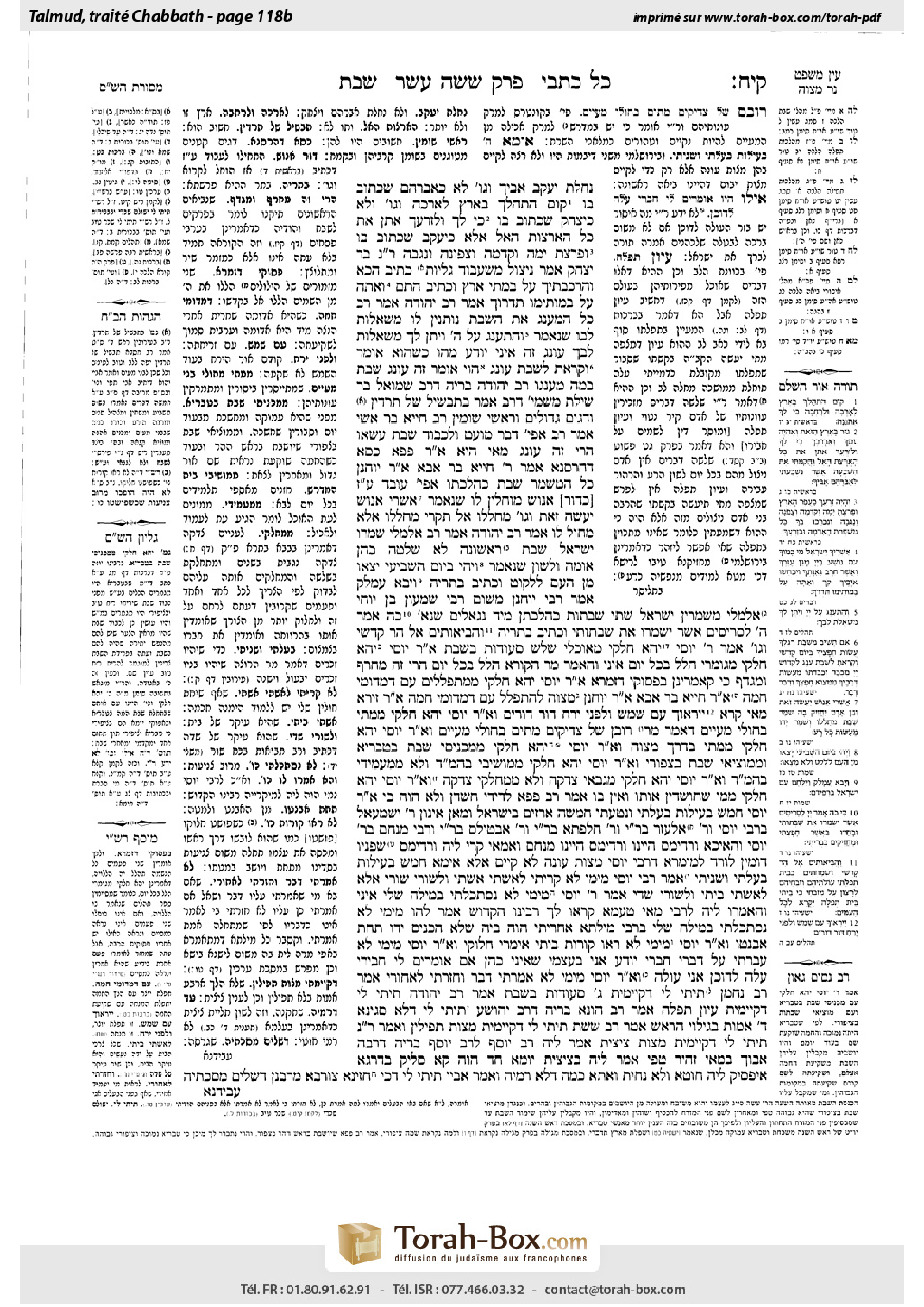
Shabbat 118b: Talmud study for Daf Yomi
Daf Yomi is the daily study of one Talmud folio. Explore 37 tractates with scans, Hebrew text, Sefaria English and AI-generated French translations where annotated.
Passage selection and English or AI-generated French translation are available where the scan has annotations. Daf Study is independent of Torah-Box and Sefaria.
Browse Shabbat · שבת · All tractatesShabbat 118b text and translations
This page of Shabbat includes the Aramaic text, an English translation and an AI-generated French translation, alongside the scan above.
שבת קי״ח ב · Aramaic and Hebrew text
נַחֲלַת יַעֲקֹב אָבִיךָ וְגוֹ׳״. לֹא כְּאַבְרָהָם, שֶׁכָּתוּב בּוֹ ״קוּם הִתְהַלֵּךְ בָּאָרֶץ לְאׇרְכָּהּ וְגוֹ׳״. וְלֹא כְּיִצְחָק, שֶׁכָּתוּב בּוֹ ״כִּי לְךָ וּלְזַרְעֲךָ אֶתֵּן אֶת כׇּל הָאֲרָצוֹת הָאֵל״. אֶלָּא כְּיַעֲקֹב, שֶׁכָּתוּב בּוֹ ״וּפָרַצְתָּ יָמָּה וָקֵדְמָה וְצָפוֹנָה וָנֶגְבָּה״.
רַב נַחְמָן בַּר יִצְחָק אָמַר: נִיצּוֹל מִשִּׁעְבּוּד גָּלִיּוֹת. כְּתִיב הָכָא: ״וְהִרְכַּבְתִּיךְ עַל בׇּמֳתֵי אָרֶץ״, וּכְתִיב הָתָם: ״וְאַתָּה עַל בָּמוֹתֵימוֹ תִדְרוֹךְ״. אָמַר רַב יְהוּדָה אָמַר רַב: כׇּל הַמְעַנֵּג אֶת הַשַּׁבָּת נוֹתְנִין לוֹ מִשְׁאֲלוֹת לִבּוֹ, שֶׁנֶּאֱמַר: ״וְהִתְעַנַּג עַל ה׳ וְיִתֶּן לְךָ מִשְׁאֲלוֹת לִבֶּךָ״. עוֹנֶג זֶה אֵינִי יוֹדֵעַ מַהוּ. כְּשֶׁהוּא אוֹמֵר ״וְקָרָאתָ לַשַּׁבָּת עוֹנֶג״ — הֱוֵי אוֹמֵר זֶה עוֹנֶג שַׁבָּת. בַּמֶּה מְעַנְּגוֹ? רַב יְהוּדָה בְּרֵיהּ דְּרַב שְׁמוּאֵל בַּר שִׁילַת מִשְּׁמֵיהּ דְּרַב אָמַר: בְּתַבְשִׁיל שֶׁל תְּרָדִין וְדָגִים גְּדוֹלִים וְרָאשֵׁי שׁוּמִין. רַב חִיָּיא בַּר אָשֵׁי אָמַר רַב: אֲפִילּוּ דָּבָר מוּעָט, וְלִכְבוֹד שַׁבָּת עֲשָׂאוֹ — הֲרֵי זֶה עוֹנֶג. מַאי הִיא? אָמַר רַב פָּפָּא: כָּסָא דְהַרְסָנָא.
אָמַר רַבִּי חִיָּיא בַּר אַבָּא אָמַר רַבִּי יוֹחָנָן: כׇּל הַמְשַׁמֵּר שַׁבָּת כְּהִלְכָתוֹ, אֲפִילּוּ עוֹבֵד עֲבוֹדָה זָרָה [כְּדוֹר] אֱנוֹשׁ — מוֹחֲלִין לוֹ, שֶׁנֶּאֱמַר: ״אַשְׁרֵי אֱנוֹשׁ יַעֲשֶׂה זֹּאת וְגוֹ׳ מֵחַלְּלוֹ״. אַל תִּקְרֵי ״מֵחַלְּלוֹ״ אֶלָּא: ״מָחוּל לוֹ״.
אָמַר רַב יְהוּדָה אָמַר רַב: אִלְמָלֵי שָׁמְרוּ יִשְׂרָאֵל שַׁבָּת רִאשׁוֹנָה לֹא שָׁלְטָה בָּהֶן אוּמָּה וְלָשׁוֹן, שֶׁנֶּאֱמַר: ״וַיְהִי בַּיּוֹם הַשְּׁבִיעִי יָצְאוּ מִן הָעָם לִלְקוֹט״, וּכְתִיב בָּתְרֵיהּ: ״וַיָּבֹא עֲמָלֵק״. אָמַר רַבִּי יוֹחָנָן מִשּׁוּם רַבִּי שִׁמְעוֹן בֶּן יוֹחַי: אִלְמָלֵי מְשַׁמְּרִין יִשְׂרָאֵל שְׁתֵּי שַׁבָּתוֹת כְּהִלְכָתָן — מִיָּד נִגְאָלִים, שֶׁנֶּאֱמַר: ״כֹה אָמַר ה׳ לַסָּרִיסִים אֲשֶׁר יִשְׁמְרוּ אֶת שַׁבְּתוֹתַי״, וּכְתִיב בָּתְרֵיהּ: ״וַהֲבִיאוֹתִים אֶל הַר קׇדְשִׁי וְגוֹ׳״.
אָמַר רַבִּי יוֹסֵי: יְהֵא חֶלְקִי מֵאוֹכְלֵי שָׁלֹשׁ סְעוּדוֹת בַּשַּׁבָּת. אָמַר רַבִּי יוֹסֵי: יְהֵא חֶלְקִי מִגּוֹמְרֵי הַלֵּל בְּכׇל יוֹם. אִינִי?! וְהָאָמַר מָר: הַקּוֹרֵא הַלֵּל בְּכׇל יוֹם הֲרֵי זֶה מְחָרֵף וּמְגַדֵּף! כִּי קָאָמְרִינַן — בִּפְסוּקֵי דְזִמְרָא.
אָמַר רַבִּי יוֹסֵי: יְהֵא חֶלְקִי מִמִּתְפַּלְּלִים עִם דִּמְדּוּמֵי חַמָּה. אָמַר רַבִּי חִיָּיא בַּר אַבָּא אָמַר רַבִּי יוֹחָנָן: מִצְוָה לְהִתְפַּלֵּל עִם דִּמְדּוּמֵי חַמָּה. אָמַר רַבִּי זֵירָא, מַאי קְרָא: ״יִירָאוּךָ עִם שָׁמֶשׁ וְלִפְנֵי יָרֵחַ דּוֹר דּוֹרִים״.
וְאָמַר רַבִּי יוֹסֵי: יְהֵא חֶלְקִי מִמֵּתֵי בְּחוֹלִי מֵעַיִים, דַּאֲמַר מָר: רוּבָּן שֶׁל צַדִּיקִים מֵתִים בְּחוֹלִי מֵעַיִים. וְאָמַר רַבִּי יוֹסֵי: יְהֵא חֶלְקִי מִמֵּתֵי בְּדֶרֶךְ מִצְוָה. וְאָמַר רַבִּי יוֹסֵי: יְהֵא חֶלְקִי מִמַּכְנִיסֵי שַׁבָּת בִּטְבֶרְיָא, וּמִמּוֹצִיאֵי שַׁבָּת בְּצִפּוֹרִי. וְאָמַר רַבִּי יוֹסֵי: יְהֵא חֶלְקִי מִמּוֹשִׁיבֵי בֵּית הַמִּדְרָשׁ, וְלֹא מִמַּעֲמִידֵי בֵּית הַמִּדְרָשׁ.
וְאָמַר רַבִּי יוֹסֵי: יְהֵא חֶלְקִי מִגַּבַּאי צְדָקָה וְלָא מִמְּחַלְּקֵי צְדָקָה. וְאָמַר רַבִּי יוֹסֵי: יְהֵא חֶלְקִי מִמִּי שֶׁחוֹשְׁדִין אוֹתוֹ וְאֵין בּוֹ. אָמַר רַב פָּפָּא: לְדִידִי חַשְׁדֻן וְלָא הֲוָה בִּי.
אָמַר רַבִּי יוֹסֵי: חָמֵשׁ בְּעִילוֹת בָּעַלְתִּי, וְנָטַעְתִּי חֲמִשָּׁה אֲרָזִים בְּיִשְׂרָאֵל. וּמַאן אִינּוּן — רַבִּי יִשְׁמָעֵאל בְּרַבִּי יוֹסֵי, וְרַבִּי אֶלְעָזָר בְּרַבִּי יוֹסֵי, וְרַבִּי חֲלַפְתָּא בְּרַבִּי יוֹסֵי, וְרַבִּי אַבְטִילָס בְּרַבִּי יוֹסֵי, וְרַבִּי מְנַחֵם בְּרַבִּי יוֹסֵי. וְהָאִיכָּא וַרְדִּימָס! הַיְינוּ וַרְדִּימָס הַיְינוּ מְנַחֵם, וְאַמַּאי קָרֵי לֵיהּ ״וַרְדִּימָס״? — שֶׁפָּנָיו דּוֹמִין לְוֶרֶד. לְמֵימְרָא דְּרַבִּי יוֹסֵי מִצְוַת עוֹנָה לֹא קִיֵּים?! אֶלָּא אֵימָא: חָמֵשׁ בְּעִילוֹת בָּעַלְתִּי וְשָׁנִיתִי.
אָמַר רַבִּי יוֹסֵי: מִיָּמַי לֹא קָרִיתִי לְאִשְׁתִּי ״אִשְׁתִּי״ וּלְשׁוֹרִי ״שׁוֹרִי״, אֶלָּא לְאִשְׁתִּי — ״בֵּיתִי״, וּלְשׁוֹרִי — ״שָׂדִי״.
אָמַר רַבִּי יוֹסֵי: מִיָּמַי לֹא נִסְתַּכַּלְתִּי בַּמִּילָּה שֶׁלִּי. אִינִי? וְהָאֲמַרוּ לֵיהּ לְרַבִּי: מַאי טַעְמָא קָרוּ לָךְ רַבֵּינוּ הַקָּדוֹשׁ? אֲמַר לְהוּ: מִיָּמַי לֹא נִסְתַּכַּלְתִּי בַּמִּילָּה שֶׁלִּי. בְּרַבִּי מִילְּתָא אַחֲרִיתִי הֲוָה בֵּיהּ, שֶׁלֹּא הִכְנִיס יָדוֹ תַּחַת אַבְנֵטוֹ. וְאָמַר רַבִּי יוֹסֵי: מִיָּמַי לֹא רָאוּ קוֹרוֹת בֵּיתִי אִימְרֵי חֲלוּקִי.
וְאָמַר רַבִּי יוֹסֵי: מִיָּמַי לֹא עָבַרְתִּי עַל דִּבְרֵי חֲבֵרַי. יוֹדֵעַ אֲנִי בְּעַצְמִי שֶׁאֵינִי כֹּהֵן, אִם אוֹמְרִים לִי חֲבֵירַי: עֲלֵה לַדּוּכָן — אֲנִי עוֹלֶה. וְאָמַר רַבִּי יוֹסֵי: מִיָּמַי לֹא אָמַרְתִּי דָּבָר וְחָזַרְתִּי לַאֲחוֹרַי.
אָמַר רַב נַחְמָן: תֵּיתֵי לִי, דְּקַיֵּימִית שָׁלֹשׁ סְעוּדוֹת בְּשַׁבָּת. אָמַר רַב יְהוּדָה: תֵּיתֵי לִי, דְּקַיֵּימִית עִיּוּן תְּפִלָּה. אָמַר רַב הוּנָא בְּרֵיהּ דְּרַב יְהוֹשֻׁעַ: תֵּיתֵי לִי, דְּלָא סָגֵינָא אַרְבַּע אַמּוֹת בְּגִילּוּי הָרֹאשׁ. אָמַר רַב שֵׁשֶׁת: תֵּיתֵי לִי, דְּקַיֵּימִית מִצְוַת תְּפִילִּין. וְאָמַר רַב נַחְמָן: תֵּיתֵי לִי, דְּקַיֵּימִית מִצְוַת צִיצִית.
אֲמַר לֵיהּ רַב יוֹסֵף לְרַב יוֹסֵף בְּרֵיהּ דְּרַבָּה: אֲבוּךְ, בְּמַאי זְהִיר טְפֵי? אֲמַר לֵיהּ: בְּצִיצִית. יוֹמָא חַד הֲוָה קָא סָלֵיק בְּדַרְגָּא. אִיפְּסִיק לֵיהּ חוּטָא, וְלָא נְחֵית וַאֲתָא, כַּמָּה דְּלָא רַמְיַהּ. וְאָמַר אַבָּיֵי: תֵּיתֵי לִי, דְּכִי חָזֵינָא צוּרְבָּא מֵרַבָּנַן דִּשְׁלִים מַסֶּכְתֵּיהּ
Shabbat 118b · English translation
on the inheritance of Jacob your father, as the mouth of God has spoken” (Isaiah 58:13–14). The reward for delighting in Shabbat is specifically the portion of Jacob. Not that of Abraham, about whom it is written, “Rise, walk through the land through its length and its width because I have given it to you” (Genesis 13:17), i.e., only this land alone in its borders. And not that of Isaac, about whom it is written, “Dwell in this land and I will be with you and I will bless you because I will give all of these lands to you and your offspring” (Genesis 26:3), meaning these lands and no others. Rather, that of Jacob, about whom it is written, “And your offspring will be like the dust of the earth, and you will spread out to the west and to the east and to the north and to the south, and all of the families of the land will be blessed through you and your offspring” (Genesis 28:14). There are no boundaries for Jacob’s portion.
Rav Naḥman bar Yitzḥak said: One who delights in Shabbat is rescued from the oppression of exile. He derives it by means of a verbal analogy. It is written here, with regard to Shabbat: “And I will cause you to ride on the heights [bamotei] of the world” (Isaiah 58:14), and it is written there: “You are fortunate Israel, who is like you? A nation redeemed by God, the shield that aids you and the sword of your triumph. Your enemies will try to defeat you and you will trample their high places [bamoteimo]” (Deuteronomy 33:29). Rav Yehuda said that Rav said: With regard to anyone who delights in the Shabbat, God grants him his heart’s desires, as it is stated: “And you shall delight in God and He will grant you your heart’s desires” (Psalms 37:4). This delight in God, which is mentioned in the verse, I do not know what it is. When it says: “And you shall call the Shabbat delight,” one must say: It is the delight of Shabbat. The Gemara asks: With what does one delight in the day of Shabbat? Rav Yehuda, son of Rav Shmuel bar Sheilat, said in the name of Rav: With a dish of beets, and large fish, and heads of garlic. Rav Ḥiyya bar Ashi said that Rav said: Even with regard to a small item and one prepared it in deference to Shabbat, it is a delight. The Gemara asks: What is the small item mentioned? Rav Pappa said: Small fried fish.
Rabbi Ḥiyya bar Abba said that Rabbi Yoḥanan said: With regard to anyone who observes Shabbat in accordance with its halakhot, even if he worships idolatry as in the generation of Enosh, God forgives him his sins, as it is stated: “Fortunate is the man [enosh] who does this and the person who holds strong to it, one who guards the Shabbat from desecrating it [meḥallelo], and guards his hand from doing any evil” (Isaiah 56:2). Do not read it as: From desecrating it [meḥallelo], but rather: He is forgiven [maḥul lo]. With regard to the generation of Enosh it is written: “And to Seth, to him also there was born a son; and he called his name Enosh. Then they began [huḥal] to call upon the Name of God” (Genesis 4:26), meaning to desecrate [leḥallel] His name.
Rav Yehuda said that Rav said: Had the Jewish people properly observed the first Shabbat that was commanded them, no nation or tongue would have ever ruled them, as it is stated: “And it happened on the seventh day, some people went out from the nation to collect and they did not find” (Exodus 16:27). And it is written after they went out to collect manna: “And Amalek came and fought with Israel in Refidim” (Exodus 17:8). Rabbi Yoḥanan said in the name of Rabbi Shimon ben Yoḥai: If only the Jewish people would keep two Shabbatot in accordance with their halakhot, they would be immediately redeemed, as it is stated: “So said God to the eunuchs who will keep My Shabbatot” (Isaiah 56:4), and it is written after that: “And I will bring them to My holy mountain and will let them rejoice in My house of prayer” (Isaiah 56:7).
Rabbi Yosei said: May my portion be among those who eat three meals on Shabbat. Apropos this statement of Rabbi Yosei, the Gemara cites additional declarations. Rabbi Yosei said: May my portion be among those who complete hallel every day. The Gemara is surprised at this: Is that so? Didn’t the Master say: One who reads hallel every day is tantamount to one who curses and blasphemes God. He displays contempt for hallel by not reserving it for days on which miracles occurred. The Gemara answers: When we say this statement of Rabbi Yosei, we are referring to the verses of praise [pesukei dezimra], recited during the morning service, not to hallel (Psalms 113–118) recited on special days.
And furthermore, Rabbi Yosei said: May my portion be among those who pray the morning and afternoon prayers with the reddening of the sun, i.e., the morning prayer at sunrise and the afternoon prayer adjacent to nightfall. Rabbi Ḥiyya bar Abba said that Rabbi Yoḥanan said: It is a mitzva to pray with the reddening of the sun. Rabbi Zeira said: What verse alludes to this? “They will fear You with the sun and before the moon, generation upon generation” (Psalms 72:5). Fear of God, prayer, should be with the sun and before the moon.
And Rabbi Yosei said: May my portion be among those who die from intestinal disease, as the Master said: Most righteous people die of intestinal disease. It is a very harsh disease through which the sins of righteous people are cleansed before their death and also, as a result, they die with a clean body. And Rabbi Yosei said: May my portion be among those who die on the path to perform a mitzva. And Rabbi Yosei said: May my portion be among those who accept Shabbat in Tiberias, which is in a valley where day turns to evening earlier, and among those who see Shabbat out in Tzippori, which is located on a mountain top where the sun is visible for longer, and Shabbat ends later. And Rabbi Yosei said: May my portion be among those who seat others in the study hall, i.e., who cause others to come sit and study, and not among those who cause others to stand in the study hall, i.e., who announce that it is time to leave the study hall and go to eat.
And Rabbi Yosei said: May my portion be among the collectors of charity and not the distributors of charity. One who collects charity collects fixed amounts, whereas distributors may inadvertently fail to give the poor person enough to cover his needs. And Rabbi Yosei said: May my portion be with one whom others suspect of sin and there is no basis for suspecting him. Rav Pappa said: They suspected me, and there was no basis for suspecting me.
Furthermore, Rabbi Yosei said: I engaged in relations five times, and I planted five cedars in Eretz Yisrael. And who are these cedars? The sons of Rabbi Yosei, who were great Sages of Israel: Rabbi Yishmael, son of Rabbi Yosei, and Rabbi Elazar, son of Rabbi Yosei, and Rabbi Ḥalafta, son of Rabbi Yosei, and Rabbi Avtilas, son of Rabbi Yosei, and Rabbi Menaḥem, son of Rabbi Yosei. The Gemara asks: Isn’t there Vardimas, who was also Rabbi Yosei’s son? The Gemara answers: Vardimas is the same as Menaḥem. And why did they call him Vardimas? Because his face was as beautiful as a rose [vered]. The Gemara asks: Is that to say based on this statement that Rabbi Yosei did not fulfill the mitzva of his wife’s conjugal rights, but only had relations with her five times? Rather, say it this way: I engaged in relations five times and I did so again, and the Sages said that one who seeks to father male offspring should engage in relations and do so again.
Furthermore, Rabbi Yosei said that he always spoke euphemistically: In all my days, I did not call my wife, my wife, nor my ox, my ox. Rather, I called my wife, my home, because she is the essence of the home, and my ox, my field, because it is the primary force in the fields.
Rabbi Yosei said: In all my days, due to modesty, I never looked at my circumcision. The Gemara asks: Is that so? Didn’t they say to Rabbi Yehuda HaNasi: Why did they call you our holy Rabbi? He said to them: It is because in all my days I never looked at my circumcision. If so, why wasn’t Rabbi Yosei also called our holy Rabbi? The Gemara replies: In the case of Rabbi Yehuda HaNasi, another matter of modesty was present in him, as he did not insert his hand below his belt due to his great modesty. And Rabbi Yosei said: In all my days, the walls of my house never saw the seams of my robe due to modesty, as he would only undress under his bed sheets.
And Rabbi Yosei said: In all my days I never violated the words of my friends. I know about myself that I am not a priest, and nevertheless, if my friends say to me: Go up to the platform with the priests, I go up. And Rabbi Yosei said: In all my days I never said something and then retreated from it. Rabbi Yosei never said something positive or negative about a specific person and then denied it.
Rav Naḥman said: May I receive my reward because I fulfilled the obligation to eat three meals on Shabbat magnificently. Rav Yehuda said: May I receive my reward because I fulfilled the obligation of consideration during prayer. Rav Huna, son of Rav Yehoshua, said: May I receive my reward because I never walked four cubits with my head uncovered. Rav Sheshet said: May I receive my reward because I fulfilled the mitzva of phylacteries magnificently. And Rav Naḥman said: May I receive my reward because I fulfilled the mitzva of ritual fringes magnificently.
Rav Yosef said to Rav Yosef, son of Rabba: In what area was your father, Rabba, especially vigilant? He said to him: It was in the mitzva of ritual fringes. The Gemara relates: One day he was climbing the stairs when a string from his ritual fringes was severed, and he would not descend until he placed a new string on the garment. And Abaye said: May I receive my reward because when I see a young Torah scholar who has completed a tractate that he studied
Shabbat 118b · Traduction française (IA)
sur l’héritage de Jacob, ton père, comme la bouche de Dieu l’a annoncé » (Isaïe 58, 13-14). La récompense de celui qui prend plaisir au Chabbat est précisément la part de Jacob, et non celle d’Abraham, au sujet duquel il est écrit : « Lève-toi, parcours le pays dans sa longueur et dans sa largeur, car c’est à toi que Je le donne » (Genèse 13, 17), c’est-à-dire cette terre seulement, à l’intérieur de ses frontières. Ni celle d’Isaac, au sujet duquel il est écrit : « Séjourne dans ce pays, Je serai avec toi et Je te bénirai, car Je donnerai tous ces pays à toi et à ta descendance » (Genèse 26, 3), c’est-à-dire ces pays et aucun autre. Mais celle de Jacob, au sujet duquel il est écrit : « Ta descendance sera comme la poussière de la terre ; tu t’étendras à l’ouest et à l’est, au nord et au sud, et toutes les familles de la terre seront bénies par toi et par ta descendance » (Genèse 28, 14). La part de Jacob n’a pas de frontières.
Rav Naḥman bar Yitzḥak dit : Celui qui prend plaisir au Chabbat est sauvé de l’oppression de l’exil. Il le déduit au moyen d’une analogie verbale. Il est écrit ici, au sujet du Chabbat : « Je te ferai chevaucher les hauteurs [bamotei] du monde » (Isaïe 58, 14), et il est écrit là : « Heureux es-tu, Israël ! Qui est comme toi, peuple sauvé par Dieu, bouclier qui te secourt et épée de ton triomphe. Tes ennemis tenteront de te vaincre, mais tu fouleras leurs hauteurs [bamoteimo] » (Deutéronome 33, 29). Rav Yehouda dit au nom de Rav : À quiconque prend plaisir au Chabbat, Dieu accorde les désirs de son cœur, comme il est dit : « Fais tes délices de Dieu, et Il t’accordera les désirs de ton cœur » (Psaumes 37, 4). Je ne sais pas ce que désigne cette joie en Dieu mentionnée dans le verset. Mais quand il est dit : « Tu appelleras le Chabbat un délice », il faut dire qu’il s’agit du délice du Chabbat. La Guemara demande : De quoi se délecte-t-on le jour du Chabbat ? Rav Yehouda, fils de Rav Shmuel bar Sheilat, dit au nom de Rav : d’un plat de betteraves, de gros poissons et de têtes d’ail. Rav Ḥiyya bar Ashi dit au nom de Rav : Même si l’on a préparé une petite chose en l’honneur du Chabbat, cela constitue un délice. La Guemara demande : Quelle est cette petite chose mentionnée ? Rav Pappa dit : De petits poissons frits.
Rabbi Ḥiyya bar Abba dit au nom de Rabbi Yoḥanan : Quiconque observe le Chabbat conformément à ses halakhot, même s’il pratique l’idolâtrie comme à l’époque de la génération d’Enosh, Dieu lui pardonne ses péchés, comme il est dit : « Heureux l’homme [enosh] qui fait cela, et le fils de l’homme qui s’y attache, qui garde le Chabbat sans le profaner [meḥallelo] et préserve sa main de faire le mal » (Isaïe 56, 2). Ne lis pas : « sans le profaner [meḥallelo] », mais plutôt : « il lui est pardonné [maḥul lo] ». Au sujet de la génération d’Enosh, il est écrit : « À Seth aussi naquit un fils, et il l’appela Enosh. C’est alors qu’on commença [huḥal] à invoquer le nom de Dieu » (Genèse 4, 26), ce qui signifie qu’on profana [leḥallel] Son nom.
Rav Yehouda dit au nom de Rav : Si le peuple juif avait correctement observé le premier Chabbat qui lui fut ordonné, aucune nation ni aucun peuple ne l’aurait jamais dominé, comme il est dit : « Le septième jour, des gens sortirent du peuple pour en ramasser, mais ils n’en trouvèrent pas » (Exode 16, 27). Et il est écrit, après qu’ils furent sortis ramasser la manne : « Amalek vint combattre Israël à Refidim » (Exode 17, 8). Rabbi Yoḥanan dit au nom de Rabbi Shimon ben Yoḥai : Si seulement le peuple juif observait deux Chabbatot conformément à leurs halakhot, il serait aussitôt délivré, comme il est dit : « Ainsi parle Dieu aux eunuques qui garderont Mes Chabbatot » (Isaïe 56, 4), et il est écrit ensuite : « Je les amènerai sur Ma montagne sainte et les réjouirai dans Ma maison de prière » (Isaïe 56, 7).
Rabbi Yosei dit : Que ma part soit parmi ceux qui prennent trois repas le Chabbat. À propos de cette déclaration de Rabbi Yosei, la Guemara rapporte d’autres déclarations. Rabbi Yosei dit : Que ma part soit parmi ceux qui récitent le Hallel complet chaque jour. La Guemara s’en étonne : Est-ce possible ? Le maître n’a-t-il pas dit que celui qui récite le Hallel chaque jour est comparable à quelqu’un qui maudit et blasphème Dieu ? Il témoigne ainsi de son mépris pour le Hallel, puisqu’il ne le réserve pas aux jours où des miracles se sont produits. La Guemara répond : Quand nous rapportons cette déclaration de Rabbi Yosei, nous parlons des versets de louange [pesukei dezimra], récités pendant l’office du matin, et non du Hallel (Psaumes 113-118), récité lors des jours particuliers.
De plus, Rabbi Yosei dit : Que ma part soit parmi ceux qui prient les offices du matin et de l’après-midi au moment où le soleil rougit, c’est-à-dire l’office du matin au lever du soleil et celui de l’après-midi à l’approche de la nuit. Rabbi Ḥiyya bar Abba dit au nom de Rabbi Yoḥanan : C’est une mitsva de prier au moment où le soleil rougit. Rabbi Zeira dit : Quel verset y fait allusion ? « Ils Te craindront avec le soleil et devant la lune, de génération en génération » (Psaumes 72, 5). La crainte de Dieu, c’est-à-dire la prière, doit s’exprimer avec le soleil et devant la lune.
Et Rabbi Yosei dit : Que ma part soit parmi ceux qui meurent d’une maladie intestinale, car le maître a dit que la plupart des justes meurent d’une maladie intestinale. C’est une maladie très douloureuse, qui purifie les justes de leurs péchés avant leur mort et leur permet ainsi de mourir avec un corps pur. Et Rabbi Yosei dit : Que ma part soit parmi ceux qui meurent en chemin pour accomplir une mitsva. Et Rabbi Yosei dit : Que ma part soit parmi ceux qui accueillent le Chabbat à Tibériade, située dans une vallée où le jour devient soir plus tôt, et parmi ceux qui prennent congé du Chabbat à Tsippori, située au sommet d’une montagne où le soleil reste visible plus longtemps et où le Chabbat se termine donc plus tard. Et Rabbi Yosei dit : Que ma part soit parmi ceux qui font asseoir les autres dans la maison d’étude, c’est-à-dire ceux qui amènent les autres à venir s’asseoir et étudier, et non parmi ceux qui font se lever les autres dans la maison d’étude, c’est-à-dire ceux qui annoncent qu’il est temps de quitter la maison d’étude pour aller manger.
Et Rabbi Yosei dit : Que ma part soit parmi les collecteurs de tsédaka, et non parmi ceux qui la distribuent. Celui qui collecte la tsédaka recueille des sommes fixes, tandis que ceux qui la distribuent risquent par inadvertance de ne pas donner au pauvre de quoi couvrir ses besoins. Et Rabbi Yosei dit : Que ma part soit avec celui que les autres soupçonnent d’un péché sans qu’il y ait de raison de le soupçonner. Rav Pappa dit : On m’a soupçonné, sans raison.
De plus, Rabbi Yosei dit : J’ai eu des relations cinq fois et j’ai planté cinq cèdres en Eretz Israël. Et qui sont ces cèdres ? Les fils de Rabbi Yosei, qui étaient de grands Sages d’Israël : Rabbi Yishmael, fils de Rabbi Yosei ; Rabbi Elazar, fils de Rabbi Yosei ; Rabbi Ḥalafta, fils de Rabbi Yosei ; Rabbi Avtilas, fils de Rabbi Yosei ; et Rabbi Menaḥem, fils de Rabbi Yosei. La Guemara demande : Vardimas n’était-il pas lui aussi le fils de Rabbi Yosei ? La Guemara répond : Vardimas et Menaḥem ne sont qu’une seule et même personne. Et pourquoi l’appelait-on Vardimas ? Parce que son visage était beau comme une rose [vered]. La Guemara demande : Faut-il déduire de cette déclaration que Rabbi Yosei ne s’acquittait pas de l’obligation conjugale envers sa femme et n’avait eu de relations avec elle que cinq fois ? Il faut plutôt dire ainsi : J’ai eu des relations cinq fois, puis je l’ai fait de nouveau, et les Sages ont dit que celui qui souhaite engendrer des garçons doit avoir des relations et le faire de nouveau.
De plus, Rabbi Yosei dit qu’il s’exprimait toujours par euphémismes : De toute ma vie, je n’ai jamais appelé ma femme « ma femme », ni mon bœuf « mon bœuf ». J’appelais plutôt ma femme « ma maison », car elle est l’essence de la maison, et mon bœuf « mon champ », car il est la principale force de travail dans les champs.
Rabbi Yosei dit : De toute ma vie, par pudeur, je n’ai jamais regardé mon organe circoncis. La Guemara demande : Est-ce possible ? N’a-t-on pas demandé à Rabbi Yehouda HaNassi : « Pourquoi t’appelle-t-on notre saint Rabbi ? » Il leur répondit : « Parce que de toute ma vie, je n’ai jamais regardé mon organe circoncis. » Si tel est le cas, pourquoi Rabbi Yosei n’était-il pas lui aussi appelé « notre saint Rabbi » ? La Guemara répond : Rabbi Yehouda HaNassi faisait preuve d’une autre forme de pudeur, car, par grande modestie, il ne glissait pas la main sous sa ceinture. Et Rabbi Yosei dit : De toute ma vie, par pudeur, les murs de ma maison n’ont jamais vu les coutures de ma robe, car il ne se déshabillait que sous ses draps.
Et Rabbi Yosei dit : De toute ma vie, je n’ai jamais transgressé les paroles de mes compagnons. Je sais que je ne suis pas prêtre ; néanmoins, si mes compagnons me disent : « Monte sur l’estrade avec les prêtres », j’y monte. Et Rabbi Yosei dit : De toute ma vie, je n’ai jamais dit quelque chose pour ensuite m’en rétracter. Rabbi Yosei n’a jamais tenu de propos positifs ou négatifs au sujet d’une personne en particulier pour ensuite les nier.
Rav Naḥman dit : Que ma récompense me soit accordée, car j’ai accompli avec excellence l’obligation de prendre trois repas le Chabbat. Rav Yehouda dit : Que ma récompense me soit accordée, car j’ai observé l’obligation de concentration pendant la prière. Rav Houna, fils de Rav Yehoshua, dit : Que ma récompense me soit accordée, car je n’ai jamais marché quatre coudées la tête découverte. Rav Sheshet dit : Que ma récompense me soit accordée, car j’ai accompli avec excellence la mitsva des tefillin. Et Rav Naḥman dit : Que ma récompense me soit accordée, car j’ai accompli avec excellence la mitsva des franges rituelles.
Rav Yosef dit à Rav Yosef, fils de Rabba : Dans quel domaine ton père, Rabba, était-il particulièrement vigilant ? Il lui répondit : Dans la mitsva des franges rituelles. La Guemara rapporte : Un jour, il montait l’escalier lorsqu’un fil de ses franges rituelles se rompit, et il ne voulut pas redescendre avant d’avoir fixé un nouveau fil au vêtement. Et Abaye dit : Que ma récompense me soit accordée, car lorsque je vois un jeune érudit en Torah qui a achevé un traité qu’il a étudié
Traduction française générée par IA à partir de l’édition anglaise de Sefaria. Vérifie toujours un passage avec le texte source.
Text from Sefaria: William Davidson Edition - Vocalized Aramaic (CC BY NC); William Davidson Edition - English (CC BY NC).