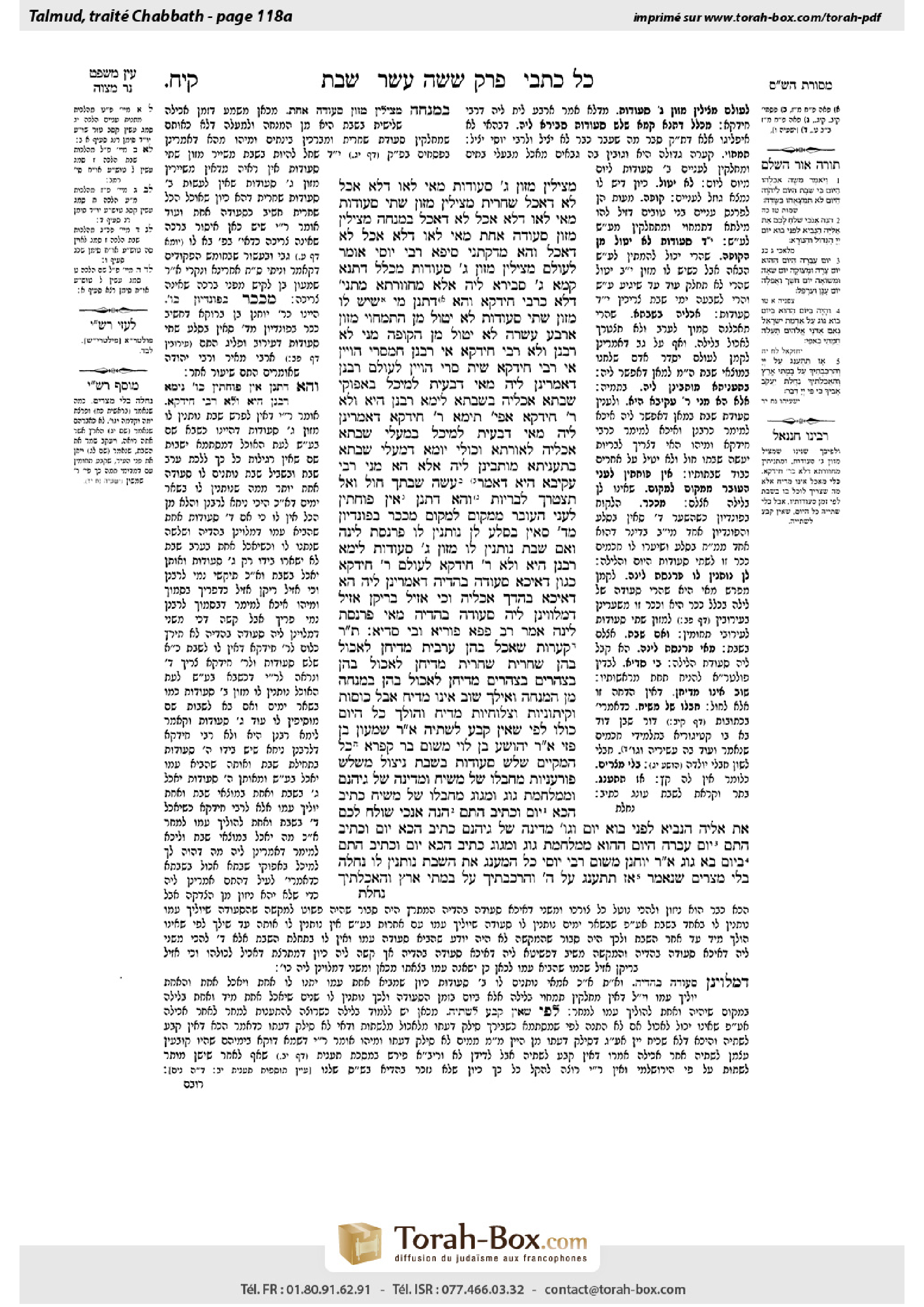
Shabbat 118a: Talmud study for Daf Yomi
Daf Yomi is the daily study of one Talmud folio. Explore 37 tractates with scans, Hebrew text, Sefaria English and AI-generated French translations where annotated.
Passage selection and English or AI-generated French translation are available where the scan has annotations. Daf Study is independent of Torah-Box and Sefaria.
Browse Shabbat · שבת · All tractatesShabbat 118a text and translations
This page of Shabbat includes the Aramaic text, an English translation and an AI-generated French translation, alongside the scan above.
שבת קי״ח א · Aramaic and Hebrew text
מַצִּילִין מְזוֹן שָׁלֹשׁ סְעוּדוֹת, מַאי לָאו — דְּלָא אֲכַל! לָא, דַּאֲכַל. שַׁחֲרִית מַצִּילִין מְזוֹן שְׁתֵּי סְעוּדוֹת, מַאי לָאו — דְּלָא אֲכַל? לָא, דַּאֲכַל. בְּמִנְחָה מַצִּילִין מְזוֹן סְעוּדָה אַחַת, מַאי לָאו — דְּלָא אֲכַל? לָא, דַּאֲכַל!
וְהָא מִדְּקָתָנֵי סֵיפָא: רַבִּי יוֹסֵי אוֹמֵר לְעוֹלָם מַצִּילִין מְזוֹן שָׁלֹשׁ סְעוּדוֹת — מִכְּלָל דְּתַנָּא קַמָּא שָׁלֹשׁ סְבִירָא לֵיהּ! אֶלָּא מְחַוַּורְתָּא, מַתְנִיתִין דְּלָא כְּרַבִּי חִידְקָא.
וְהָא דִּתְנַן: מִי שֶׁיֵּשׁ לוֹ מְזוֹן שְׁתֵּי סְעוּדוֹת — לֹא יִטּוֹל מִן הַתַּמְחוּי, מְזוֹן אַרְבַּע עֶשְׂרֵה — לֹא יִטּוֹל מִן הַקּוּפָּה. מַנִּי? לָא רַבָּנַן, וְלָא רַבִּי חִידְקָא. אִי רַבָּנַן — חַמְסְרֵי הָוְיָין. אִי רַבִּי חִידְקָא — שֵׁית סְרֵי הָוְיָין! לְעוֹלָם רַבָּנַן, דְּאָמְרִינַן לֵיהּ: מַאי דְּבָעֵית לְמֵיכַל בְּאַפּוֹקֵי שַׁבְּתָא, אִכְלֵיהּ בְּשַׁבְּתָא.
לֵימָא רַבָּנַן הִיא, וְלָא רַבִּי חִידְקָא. אֲפִילּוּ תֵּימָא רַבִּי חִידְקָא, דְּאָמְרִינַן לֵיהּ: מַאי דְּבָעֵית לְמֵיכַל בְּמַעֲלֵי שַׁבְּתָא, אִכְלֵיהּ לְאוּרְתָּא. וְכוּלֵּי יוֹמָא דְמַעֲלֵי שַׁבְּתָא בְּתַעֲנִיתָא מוֹתְבִינַן לֵיהּ?! אֶלָּא הָא מַנִּי — רַבִּי עֲקִיבָא הִיא, דְּאָמַר: עֲשֵׂה שַׁבַּתְּךָ חוֹל וְאַל תִּצְטָרֵךְ לַבְּרִיּוֹת.
וְהָא דִּתְנַן: אֵין פּוֹחֲתִין לְעָנִי הָעוֹבֵר מִמָּקוֹם לְמָקוֹם מִכִּכָּר בְּפוּנְדְּיוֹן מֵאַרְבַּע סְאִין בְּסֶלַע. לָן — נוֹתְנִין לוֹ פַּרְנָסַת לִינָה, וְאִם שָׁבַת — נוֹתְנִין לוֹ מְזוֹן שָׁלֹשׁ סְעוּדוֹת. לֵימָא רַבָּנַן הִיא, וְלָא רַבִּי חִידְקָא? לְעוֹלָם רַבִּי חִידְקָא — כְּגוֹן דְּאִיכָּא סְעוּדָה בַּהֲדֵיהּ, דְּאָמְרִינַן לֵיהּ: הָא דְּאִיכָּא בַּהֲדָךְ — אִכְלֵיהּ. וְכִי אָזֵיל בְּרֵיקָן אָזֵיל?! דִּמְלַוִּוינַן לֵיהּ סְעוּדָה בַּהֲדֵיהּ. מַאי פַּרְנָסַת לִינָה? אָמַר רַב פָּפָּא: פּוּרְיָא וּבֵי סַדְיָא.
תָּנוּ רַבָּנַן: קְעָרוֹת שֶׁאָכַל בָּהֶן עַרְבִית — מַדִּיחָן לֶאֱכוֹל בָּהֶן שַׁחֲרִית. שַׁחֲרִית — מַדִּיחָן לֶאֱכוֹל בָּהֶן בַּצׇּהֳרַיִם. בַּצׇּהֳרַיִם — מַדִּיחָן לֶאֱכוֹל בָּהֶן בַּמִּנְחָה. מִן הַמִּנְחָה וְאֵילָךְ — שׁוּב אֵינוֹ מַדִּיחַ. אֲבָל כּוֹסוֹת וְקִיתוֹנִיּוֹת וּצְלוֹחִיּוֹת — מַדִּיחַ וְהוֹלֵךְ כׇּל הַיּוֹם כּוּלּוֹ, לְפִי שֶׁאֵין קֶבַע לִשְׁתִיָּה.
אָמַר רַבִּי שִׁמְעוֹן בֶּן פַּזִּי אָמַר רַבִּי יְהוֹשֻׁעַ בֶּן לֵוִי מִשּׁוּם בַּר קַפָּרָא: כָּל הַמְקַיֵּים שָׁלֹשׁ סְעוּדוֹת בְּשַׁבָּת נִיצּוֹל מִשָּׁלֹשׁ פּוּרְעָנִיּוֹת: מֵחֶבְלוֹ שֶׁל מָשִׁיחַ, וּמִדִּינָהּ שֶׁל גֵּיהִנָּם, וּמִמִּלְחֶמֶת גּוֹג וּמָגוֹג. מֵחֶבְלוֹ שֶׁל מָשִׁיחַ — כְּתִיב הָכָא ״יוֹם״, וּכְתִיב הָתָם: ״הִנֵּה אָנֹכִי שׁוֹלֵחַ לָכֶם אֵת אֵלִיָּה הַנָּבִיא לִפְנֵי בּוֹא יוֹם וְגוֹ׳״. מִדִּינָהּ שֶׁל גֵּיהִנָּם — כְּתִיב הָכָא ״יוֹם״, וּכְתִיב הָתָם: ״יוֹם עֶבְרָה הַיּוֹם הַהוּא״. מִמִּלְחֶמֶת גּוֹג וּמָגוֹג — כְּתִיב הָכָא ״יוֹם״, וּכְתִיב הָתָם: ״בְּיוֹם בֹּא גּוֹג״.
אָמַר רַבִּי יוֹחָנָן מִשּׁוּם רַבִּי יוֹסֵי: כָּל הַמְעַנֵּג אֶת הַשַּׁבָּת נוֹתְנִין לוֹ נַחֲלָה בְּלִי מְצָרִים, שֶׁנֶּאֱמַר: ״אָז תִּתְעַנַּג עַל ה׳ וְהִרְכַּבְתִּיךָ עַל בׇּמֳתֵי אָרֶץ וְהַאֲכַלְתִּיךָ
Shabbat 118a · English translation
one rescues food for three meals. What, is this not referring to a situation where he has not yet eaten any meals? Apparently, one is obligated to eat only three meals on Shabbat. The Gemara rejects this: No, it is referring to a situation where one already ate one meal. Three meals still remain, in accordance with the opinion of Rabbi Ḥidka, who requires four meals. The Gemara challenges this from the continuation of the mishna: If a fire ignited in the morning, one may only rescue food for two meals. What, is it not referring to a situation where one has not yet eaten one’s morning meal and the obligation is to eat only three meals, one at night and two during the day? The Gemara rejects this: No, it is referring to a situation where one has already eaten the morning meal. The Gemara challenges this from the continuation of the mishna: If a fire ignited in the afternoon, one may rescue food for one meal. What, is it not referring to a situation where one has not yet eaten the afternoon meal and the obligation is to eat only three meals? The Gemara rejects this: No, it is referring to a situation where one has already eaten.
The Gemara challenges this: From the fact that it is taught in the latter clause of the mishna: Rabbi Yosei says: One may always rescue food for three meals, by inference, even the first tanna holds that the obligation is to eat three meals, as there is no dispute with regard to the number of meals on Shabbat. Rather, it is clear that the mishna is not in accordance with the opinion of Rabbi Ḥidka. According to the tanna’im in the mishna, one is obligated to eat three meals on Shabbat.
And that which we learned in another mishna: One who has sufficient food for two meals in his possession may not take food from the charity plate that is distributed to the poor. He is not considered needy and would be taking food at the expense of people who are worse off than he. And one who has food for fourteen meals, enough meals for an entire week, may not take money from the charity fund. The Gemara asks: In accordance with whose opinion is this mishna? Apparently, it is neither in accordance with the opinion of the Rabbis nor in accordance with the opinion of Rabbi Ḥidka. If it were in accordance with the opinion of the Rabbis, they maintain that they are fifteen meals that are eaten in a week, two each day, evening and morning, and three on Shabbat. If it were in accordance with the opinion of Rabbi Ḥidka, they are sixteen meals that are eaten in a week, twelve during the six days of the week and four on Shabbat. The Gemara rejects this: Actually, the mishna is in accordance with the opinion of the Rabbis, but we say to him: That which you want to eat at the conclusion of Shabbat, Saturday night, eat it as the third meal on Shabbat.
The Gemara asks: Let us say that this mishna is in accordance with the opinion of the Rabbis and not in accordance with the opinion of Rabbi Ḥidka. The Gemara rejects that approach: Even if you say that it is in accordance with the opinion of Rabbi Ḥidka, the mishna can be understood, as we can say to him: That which you want to eat on Shabbat eve, Friday afternoon, eat at night on Shabbat instead. The Gemara asks: And do we have a person sit and fast all day on Shabbat eve? According to this suggestion, he would not eat at all on Friday. Rather, we must say: In accordance with whose opinion is this mishna? It is in accordance with the opinion of Rabbi Akiva, who said: Make your Shabbat like a weekday and do not be beholden to other beings. It is preferable to eat two meals on Shabbat as he does during the week if he can thereby avoid taking charity.
And that which we learned in another mishna: One gives no less charity to a poor person who is traveling from place to place than a loaf worth a pundeyon, one forty-eighth of a sela, when the standard price of grain is four se’a for a sela. If he sleeps there, one gives him money for sleeping; and if he spends Shabbat in that city, one gives him food for three meals. Let us say that is in accordance with the opinion of the Rabbis and not the opinion of Rabbi Ḥidka. The Gemara rejects this: Actually, it is in accordance with the opinion of Rabbi Ḥidka. When it says that if the poor traveler spends Shabbat there one gives him food for three meals, it is referring to a case where there is one meal that he brought with him, for we say to him: This meal that you have with you, eat it. The Gemara is surprised at this: And when he goes, does he go empty-handed, with no food. The Gemara answers: We provide him a meal to accompany him when he leaves. The Gemara asks: What is the meaning of money for sleeping? Rav Pappa said: It means that one provides his sleeping needs, i.e., a bed and cushions.
The Sages taught in a baraita: With regard to bowls from which one ate in the evening on Shabbat, he may rinse them in order to eat from them in the morning. Bowls from which one ate in the morning, he may rinse them to eat from them in the afternoon. Bowls from which one ate in the afternoon, he may rinse them to eat from them in the afternoon. However, from the afternoon onward, one may no longer rinse them because there is no further need for these bowls on Shabbat, and it is prohibited to make preparations on Shabbat for a weekday. However, with regard to cups, and ladles, and flasks, which are vessels used for drinking, one rinses them all day long because there is no fixed time for drinking, and one does not know when he will drink again.
Rabbi Shimon ben Pazi said that Rabbi Yehoshua ben Levi said in the name of bar Kappara: Anyone who fulfills the obligation to eat three meals on Shabbat is rescued from three punishments: From the pangs of the Messiah, i.e., the suffering that precedes the advent of Messiah, and from the judgment of Gehenna, and from the war of Gog and Magog. The Gemara derives that one is rescued from the pangs of Messiah by means of a verbal analogy. It is written here, with regard to Shabbat, day: “Eat it today” (Exodus 16:25). And it is written there, with regard to Messiah, day: “Behold, I am sending you Elijah the prophet before the coming of the great and awesome day of God” (Malachi 3:23). The Gemara derives that one is rescued from the judgment of Gehenna by means of a verbal analogy. It is written here, with regard to Shabbat, day, as cited above. And it is written there, day: “That day will be a day of wrath, a day of trouble and distress, a day of destruction and desolation, a day of darkness and blackness, a day of cloud and thick fog” (Zephaniah 1:15), which is interpreted as referring to the punishment of Gehenna. The Gemara derives that one is rescued from the war of Gog and Magog by means of a verbal analogy. It is written here, with regard to Shabbat, day. And it is written there, with regard to the War of Gog and Magog, day: “And it shall be on that day, on the day that Gog arrives on the land of Israel” (Ezekiel 38:18).
Rabbi Yoḥanan said in the name of Rabbi Yosei: With regard to anyone who delights in the Shabbat, God gives him a boundless portion, i.e., a very large reward, as it is stated: “If you keep your feet from violating Shabbat, from pursuing your affairs on My holy day, and you call Shabbat a delight, the Lord’s holy day honored, and you honor it by not going your own way, or attending to your own matters or speaking idle words. Then you shall delight in the Lord and I will cause you to ride on the heights of the world, and to feast
Shabbat 118a · Traduction française (IA)
on sauve de la nourriture pour trois repas. Cela ne désigne-t-il pas une situation où il n’a encore pris aucun repas ? Apparemment, on est tenu de prendre seulement trois repas pendant Chabbat. La Guemara rejette cette interprétation : non, il s’agit d’une situation où il a déjà pris un repas. Il lui reste encore trois repas, conformément à l’opinion de Rabbi Ḥidka, qui en exige quatre. La Guemara conteste cette explication en s’appuyant sur la suite de la Michna : si un incendie s’est déclaré le matin, on ne peut sauver de la nourriture que pour deux repas. Cela ne désigne-t-il pas une situation où il n’a pas encore pris son repas du matin et où l’obligation est de prendre seulement trois repas, un le soir et deux pendant la journée ? La Guemara rejette cette interprétation : non, il s’agit d’une situation où il a déjà pris son repas du matin. La Guemara conteste cette explication en s’appuyant sur la suite de la Michna : si un incendie s’est déclaré l’après-midi, on ne peut sauver de la nourriture que pour un repas. Cela ne désigne-t-il pas une situation où il n’a pas encore pris son repas de l’après-midi et où l’obligation est de prendre seulement trois repas ? La Guemara rejette cette interprétation : non, il s’agit d’une situation où il a déjà mangé.
La Guemara conteste cette explication : puisque la dernière clause de la Michna enseigne que Rabbi Yosei dit : « On peut toujours sauver de la nourriture pour trois repas », on peut en déduire que même le premier tanna considère qu’il faut prendre trois repas, car il n’y a pas de désaccord sur le nombre de repas pendant Chabbat. Il est donc clair que la Michna ne suit pas l’opinion de Rabbi Ḥidka. Selon les tannaïm de la Michna, on est tenu de prendre trois repas pendant Chabbat.
Et ce que nous avons appris dans une autre Michna : celui qui possède assez de nourriture pour deux repas ne peut pas prendre de nourriture dans le plat de tsedaka distribué aux pauvres. Il n’est pas considéré comme nécessiteux et prendrait de la nourriture au détriment de personnes plus démunies que lui. Celui qui possède de quoi prendre quatorze repas, soit suffisamment de repas pour toute une semaine, ne peut pas recevoir d’argent de la caisse de tsedaka. La Guemara demande : selon l’opinion de qui cette Michna a-t-elle été enseignée ? Apparemment, elle ne suit ni l’opinion des Sages ni celle de Rabbi Ḥidka. Si elle suivait l’opinion des Sages, il faudrait compter quinze repas dans la semaine : deux par jour, le soir et le matin, et trois pendant Chabbat. Si elle suivait l’opinion de Rabbi Ḥidka, il faudrait compter seize repas dans la semaine : douze pendant les six jours de la semaine et quatre pendant Chabbat. La Guemara rejette cette interprétation : en réalité, la Michna suit l’opinion des Sages, mais on lui dit : « Ce que tu veux manger à la fin de Chabbat, le samedi soir, mange-le comme troisième repas de Chabbat. »
La Guemara demande : peut-on dire que cette Michna suit l’opinion des Sages et non celle de Rabbi Ḥidka ? La Guemara rejette cette approche : même si l’on dit qu’elle suit l’opinion de Rabbi Ḥidka, la Michna reste compréhensible, car on peut lui dire : « Ce que tu veux manger la veille de Chabbat, le vendredi après-midi, mange-le plutôt le soir de Chabbat. » La Guemara demande : peut-on laisser quelqu’un jeûner toute la journée de la veille de Chabbat ? Selon cette suggestion, il ne mangerait rien le vendredi. Il faut donc plutôt dire : selon l’opinion de qui cette Michna a-t-elle été enseignée ? Selon l’opinion de Rabbi Akiva, qui a dit : « Fais de ton Chabbat un jour de semaine et ne dépends pas d’autrui. » Mieux vaut prendre deux repas pendant Chabbat, comme en semaine, si cela permet d’éviter de recevoir la tsedaka.
Et ce que nous avons appris dans une autre Michna : on ne donne pas moins à un pauvre qui voyage de ville en ville qu’un pain valant un poundeyon, soit un quarante-huitième de sela, lorsque le prix courant du grain est de quatre se’a pour un sela. S’il y passe la nuit, on lui donne de quoi dormir ; et s’il passe Chabbat dans cette ville, on lui donne de quoi prendre trois repas. Peut-on dire que cela suit l’opinion des Sages et non celle de Rabbi Ḥidka ? La Guemara rejette cette interprétation : en réalité, cela suit l’opinion de Rabbi Ḥidka. Lorsqu’il est dit que si le pauvre voyageur passe Chabbat là-bas, on lui donne de quoi prendre trois repas, il s’agit d’un cas où il a apporté un repas avec lui, car on lui dit : « Ce repas que tu as avec toi, mange-le. » La Guemara s’en étonne : lorsqu’il part, part-il les mains vides, sans nourriture ? La Guemara répond : on lui fournit un repas pour son départ. La Guemara demande : que signifie « de quoi dormir » ? Rav Pappa a dit : cela signifie qu’on lui fournit ce dont il a besoin pour dormir, c’est-à-dire un lit et des coussins.
Les Sages ont enseigné dans une baraïta : les bols dans lesquels on a mangé le soir de Chabbat, on peut les rincer afin d’y manger le matin. Les bols dans lesquels on a mangé le matin, on peut les rincer afin d’y manger l’après-midi. Les bols dans lesquels on a mangé l’après-midi, on peut les rincer afin d’y manger l’après-midi. Cependant, à partir de l’après-midi, on ne peut plus les rincer, car on n’a plus besoin de ces bols pendant Chabbat et il est interdit de préparer pendant Chabbat ce qui servira un jour de semaine. En revanche, les gobelets, les louches et les flacons, qui sont des récipients utilisés pour boire, on peut les rincer toute la journée, car il n’y a pas d’heure fixe pour boire et l’on ne sait pas quand on boira de nouveau.
Rabbi Shimon ben Pazi a dit que Rabbi Yehoshua ben Levi a dit au nom de bar Kappara : quiconque accomplit l’obligation de prendre trois repas pendant Chabbat est préservé de trois châtiments : des douleurs qui précèdent la venue du Messie, c’est-à-dire les souffrances qui précèdent son avènement ; du jugement de la Géhenne ; et de la guerre de Gog et Magog. La Guemara déduit qu’on est préservé des douleurs qui précèdent la venue du Messie au moyen d’une analogie verbale. Il est écrit ici, à propos de Chabbat, « jour » : « Mangez-le aujourd’hui » (Exode 16:25). Et il est écrit là-bas, à propos du Messie, « jour » : « Voici, je vous envoie Élie le prophète avant la venue du grand et redoutable jour de Dieu » (Malachie 3:23). La Guemara déduit qu’on est préservé du jugement de la Géhenne au moyen d’une analogie verbale. Il est écrit ici, à propos de Chabbat, « jour », comme cité plus haut. Et il est écrit là-bas, « jour » : « Ce jour sera un jour de colère, un jour de détresse et d’angoisse, un jour de destruction et de désolation, un jour de ténèbres et d’obscurité, un jour de nuées et de brouillard épais » (Sophonie 1:15), ce qui est interprété comme faisant référence au châtiment de la Géhenne. La Guemara déduit qu’on est préservé de la guerre de Gog et Magog au moyen d’une analogie verbale. Il est écrit ici, à propos de Chabbat, « jour ». Et il est écrit là-bas, à propos de la guerre de Gog et Magog, « jour » : « Et il arrivera en ce jour-là, le jour où Gog viendra dans le pays d’Israël » (Ézéchiel 38:18).
Rabbi Yoḥanan a dit au nom de Rabbi Yosei : quiconque se délecte du Chabbat, Dieu lui accorde une part sans limites, c’est-à-dire une très grande récompense, comme il est dit : « Si tu retiens ton pied de violer le Chabbat, de poursuivre tes affaires en Mon saint jour, si tu appelles le Chabbat un délice, le saint jour de l’Éternel, un jour honoré, et si tu l’honores en ne suivant pas ta voie, en ne t’occupant pas de tes affaires et en ne tenant pas de propos futiles, alors tu te délecteras en l’Éternel, et Je te ferai chevaucher les hauteurs du monde, et te ferai festoyer »
Traduction française générée par IA à partir de l’édition anglaise de Sefaria. Vérifie toujours un passage avec le texte source.
Text from Sefaria: William Davidson Edition - Vocalized Aramaic (CC BY NC); William Davidson Edition - English (CC BY NC).