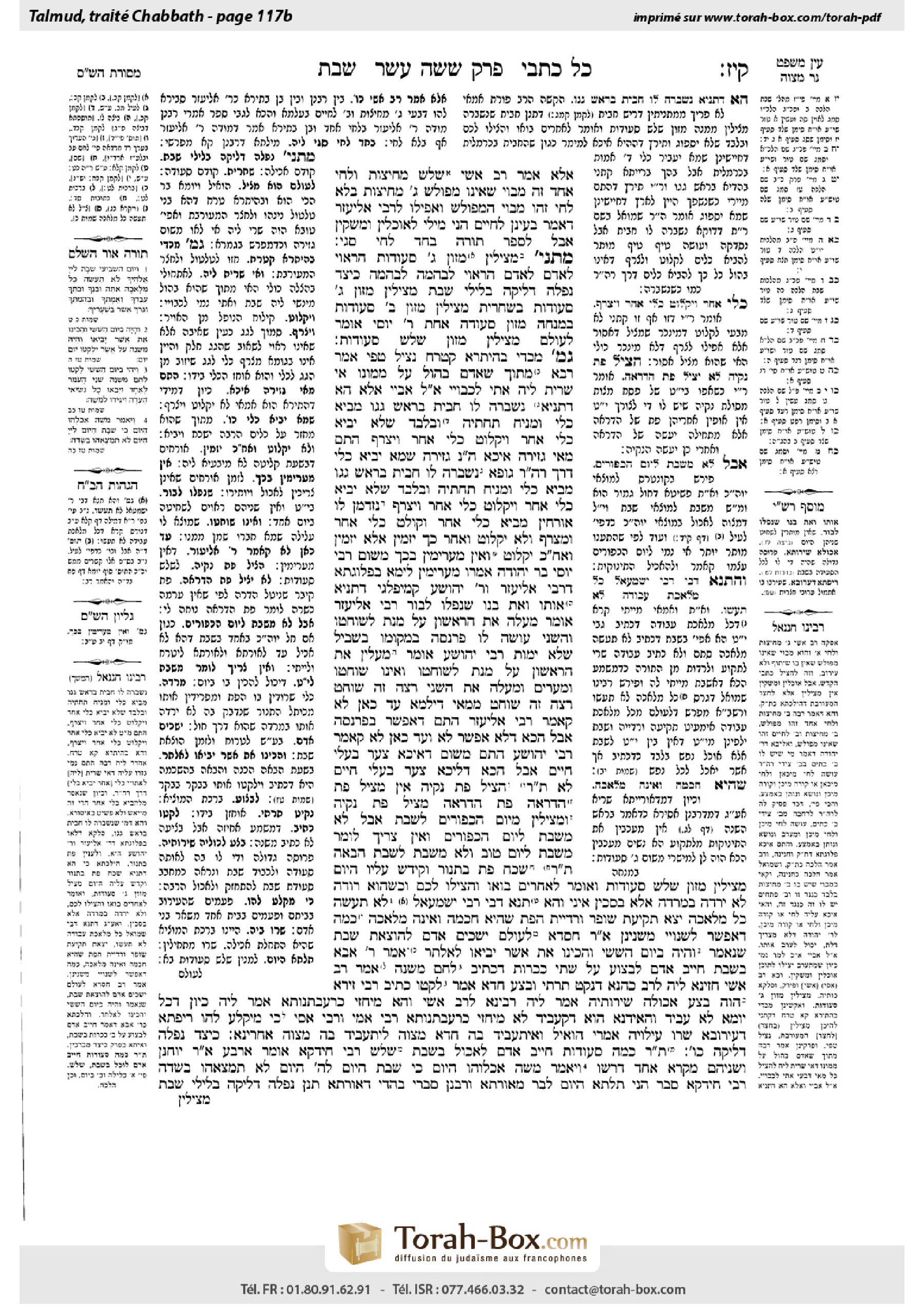
Shabbat 117b: Talmud study for Daf Yomi
Daf Yomi is the daily study of one Talmud folio. Explore 37 tractates with scans, Hebrew text, Sefaria English and AI-generated French translations where annotated.
Passage selection and English or AI-generated French translation are available where the scan has annotations. Daf Study is independent of Torah-Box and Sefaria.
Browse Shabbat · שבת · All tractatesShabbat 117b text and translations
This page of Shabbat includes the Aramaic text, an English translation and an AI-generated French translation, alongside the scan above.
שבת קי״ז ב · Aramaic and Hebrew text
אֶלָּא אָמַר רַב אָשֵׁי: שָׁלֹשׁ מְחִיצּוֹת וְלֶחִי אֶחָד — זֶה מָבוֹי שֶׁאֵינוֹ מְפוּלָּשׁ. שָׁלֹשׁ מְחִיצּוֹת בְּלֹא לֶחִי — זֶהוּ מָבוֹי הַמְפוּלָּשׁ. וַאֲפִילּוּ לְרַבִּי אֱלִיעֶזֶר דְּאָמַר בָּעֵינַן לְחָיַיִם, הָנֵי מִילֵּי לָאוֹכָלִין וּמַשְׁקִין, אֲבָל לְסֵפֶר תּוֹרָה — בְּחַד לֶחִי סַגִּי.
מַתְנִי׳ מַצִּילִין מָזוֹן שָׁלֹשׁ סְעוּדוֹת. הָרָאוּי לָאָדָם — לָאָדָם, הָרָאוּי לַבְּהֵמָה — לַבְּהֵמָה. כֵּיצַד? נָפְלָה דְּלֵיקָה בְּלֵילֵי שַׁבָּת — מַצִּילִין מְזוֹן שָׁלֹשׁ סְעוּדוֹת. בַּשַּׁחֲרִית — מַצִּילִין מְזוֹן שְׁתֵּי סְעוּדוֹת. בַּמִּנְחָה — מְזוֹן סְעוּדָה אַחַת. רַבִּי יוֹסֵי אוֹמֵר: לְעוֹלָם מַצִּילִין מְזוֹן שָׁלֹשׁ סְעוּדוֹת.
גְּמָ׳ מִכְּדֵי בְּהֶיתֵּרָא קָטָרַח, נַצֵּיל טְפֵי? אָמַר רָבָא: מִתּוֹךְ שֶׁאָדָם בָּהוּל עַל מָמוֹנוֹ, אִי שָׁרֵית לֵיהּ — אָתֵי לְכַבּוֹיֵי. אֲמַר לֵיהּ אַבָּיֵי, אֶלָּא הָא דְּתַנְיָא: נִשְׁבְּרָה לוֹ חָבִית בְּרֹאשׁ גַּגּוֹ — מֵבִיא כְּלִי וּמַנִּיחַ תַּחְתֶּיהָ, וּבִלְבַד שֶׁלֹּא יָבִיא כְּלִי אַחֵר וְיִקְלוֹט, כְּלִי אַחֵר וִיצָרֵף. הָתָם, מַאי גְּזֵירָה אִיכָּא? הָכָא נָמֵי, גְּזֵירָה שֶׁמָּא יָבִיא כְּלִי דֶּרֶךְ רְשׁוּת הָרַבִּים.
גּוּפָא: נִשְׁבְּרָה לוֹ חָבִית בְּרֹאשׁ גַּגּוֹ — מֵבִיא כְּלִי וּמַנִּיחַ תַּחְתֶּיהָ, וּבִלְבַד שֶׁלֹּא יָבִיא כְּלִי אַחֵר וְיִקְלוֹט, כְּלִי אַחֵר וִיצָרֵף. נִזְדַּמְּנוּ לוֹ אוֹרְחִין — מֵבִיא כְּלִי אַחֵר וְקוֹלֵט, כְּלִי אַחֵר וּמְצָרֵף. וְלֹא יִקְלוֹט וְאַחַר כָּךְ יַזְמִין, אֶלָּא יַזְמִין וְאַחַר כָּךְ יִקְלוֹט. וְאֵין מַעֲרִימִין בְּכָךְ, מִשּׁוּם רַבִּי יוֹסֵי בַּר יְהוּדָה אָמְרוּ: מַעֲרִימִין.
לֵימָא בִּפְלוּגְתָּא דְּרַבִּי אֱלִיעֶזֶר וְרַבִּי יְהוֹשֻׁעַ קָמִיפַּלְגִי? דְּתַנְיָא: אוֹתוֹ וְאֶת בְּנוֹ שֶׁנָּפְלוּ לְבוֹר? — רַבִּי אֱלִיעֶזֶר אוֹמֵר: מַעֲלֶה אֶת הָרִאשׁוֹן עַל מְנָת לְשׁוֹחְטוֹ, וְהַשֵּׁנִי עוֹשֶׂה לוֹ פַּרְנָסָה בִּמְקוֹמוֹ בִּשְׁבִיל שֶׁלֹּא יָמוּת. רַבִּי יְהוֹשֻׁעַ אוֹמֵר: מַעֲלֶה אֶת הָרִאשׁוֹן עַל מְנָת לְשׁוֹחְטוֹ וְאֵינוֹ שׁוֹחֲטוֹ, וּמַעֲרִים וּמַעֲלֶה אֶת הַשֵּׁנִי — רָצָה זֶה שׁוֹחֵט, רָצָה זֶה שׁוֹחֵט.
מִמַּאי? דִּילְמָא עַד כָּאן לָא קָאָמַר רַבִּי אֱלִיעֶזֶר הָתָם, דְּאֶפְשָׁר בְּפַרְנָסָה, אֲבָל הָכָא דְּלָא אֶפְשָׁר — לָא. וְעַד כָּאן לָא קָאָמַר רַבִּי יְהוֹשֻׁעַ הָתָם, מִשּׁוּם דְּאִיכָּא צַעַר בַּעֲלֵי חַיִּים, אֲבָל הָכָא דְּלֵיכָּא צַעַר בַּעֲלֵי חַיִּים — לָא.
תָּנוּ רַבָּנַן: הִצִּיל פַּת נְקִיָּה — אֵין מַצִּיל פַּת הַדְרָאָה, פַּת הַדְרָאָה — מַצִּיל פַּת נְקִיָּה. וּמַצִּילִין מִיּוֹם הַכִּפּוּרִים לַשַּׁבָּת, אֲבָל לֹא מִשַּׁבָּת לְיוֹם הַכִּפּוּרִים. וְאֵין צָרִיךְ לוֹמַר מִשַּׁבָּת לְיוֹם טוֹב, וְלֹא מִשַּׁבָּת לַשַּׁבָּת הַבָּאָה.
תָּנוּ רַבָּנַן: שָׁכַח פַּת בַּתַּנּוּר וְקִידֵּשׁ עָלָיו הַיּוֹם — מַצִּילִין מְזוֹן שָׁלֹשׁ סְעוּדוֹת, וְאוֹמֵר לַאֲחֵרִים: בּוֹאוּ וְהַצִּילוּ לָכֶם. וּכְשֶׁהוּא רוֹדֶה, לֹא יִרְדֶּה בְּמַרְדֶּה, אֶלָּא בְּסַכִּין. אִינִי?! וְהָא תָּנָא דְּבֵי רַבִּי יִשְׁמָעֵאל: ״לֹא תַעֲשֶׂה כׇל מְלָאכָה״, יָצָא תְּקִיעַת שׁוֹפָר וּרְדִיַּית הַפַּת שֶׁהִיא חָכְמָה וְאֵינָהּ מְלָאכָה? כַּמָּה דְּאֶפְשָׁר לְשַׁנּוֹיֵי מְשַׁנֵּינַן.
אָמַר רַב חִסְדָּא: לְעוֹלָם יַשְׁכִּים אָדָם לְהוֹצָאַת שַׁבָּת, שֶׁנֶּאֱמַר: ״וְהָיָה בַּיּוֹם הַשִּׁשִּׁי וְהֵכִינוּ אֵת אֲשֶׁר יָבִיאוּ״, לְאַלְתַּר. אָמַר רַבִּי אַבָּא: בְּשַׁבָּת חַיָּיב אָדָם לִבְצוֹעַ עַל שְׁתֵּי כִכָּרוֹת, דִּכְתִיב: ״לֶחֶם מִשְׁנֶה״.
אָמַר רַב אָשֵׁי: חֲזֵינָא לֵיהּ לְרַב כָּהֲנָא דְּנָקֵט תַּרְתֵּי וּבָצַע חֲדָא. אָמַר: ״לָקְטוּ״ כְּתִיב. רַבִּי זֵירָא הֲוָה בָּצַע אַכּוּלַּהּ שֵׁירוּתֵיהּ. אֲמַר לֵיהּ רָבִינָא לְרַב אָשֵׁי: וְהָא מִיחְזֵי כְּרַעַבְתָנוּתָא? אֲמַר לֵיהּ: כֵּיוָן דְּכׇל יוֹמָא לָא עָבֵיד, וְהָאִידָּנָא הוּא דְּקָעָבֵיד — לָא מִיחְזֵי כְּרַעַבְתָנוּתָא. רַבִּי אַמֵּי וְרַבִּי אַסִּי כִּי מִיקְּלַע לְהוּ רִיפְתָּא דְעֵירוּבָא — שָׁרוּ עִילָּוֵיהּ, אָמְרִי: הוֹאִיל וְאִיתְעֲבִיד בַּהּ חֲדָא מִצְוָה — לִיתְעֲבִיד בַּהּ מִצְוָה אַחֲרִינָא.
כֵּיצַד? נָפְלָה דְּלֵיקָה כּוּ׳. תָּנוּ רַבָּנַן: כַּמָּה סְעוּדוֹת חַיָּיב אָדָם לֶאֱכוֹל בַּשַּׁבָּת — שָׁלֹשׁ. רַבִּי חִידְקָא אוֹמֵר: אַרְבַּע. אָמַר רַבִּי יוֹחָנָן, וּשְׁנֵיהֶם מִקְרָא אֶחָד דָּרְשׁוּ: ״וַיֹּאמֶר מֹשֶׁה אִכְלוּהוּ הַיּוֹם כִּי שַׁבָּת הַיּוֹם לַה׳ הַיּוֹם לֹא תִמְצָאֻהוּ בַּשָּׂדֶה״. רַבִּי חִידְקָא סָבַר: הָנֵי תְּלָתָא ״הַיּוֹם״ לְבַר מֵאוּרְתָּא, וְרַבָּנַן סָבְרִי: בַּהֲדֵי דְּאוּרְתָּא. תְּנַן: נָפְלָה דְּלֵיקָה בְּלֵילֵי שַׁבָּת
Shabbat 117b · English translation
Rather, Rav Ashi said: The Sages in the mishna disagree with regard to the opinion of Rabbi Eliezer: Three walls and one post is an alley that is closed; three walls without a post at all is an open alley. And even according to Rabbi Eliezer, who said we need two posts, one post being insufficient, those words were stated to permit one to move food and drinks, but for the purpose of moving a Torah scroll, one post is sufficient.
MISHNA: One may rescue food for three meals from a fire on Shabbat. One may rescue food that is suitable for a person for a person; and one may rescue food that is suitable for an animal for an animal. How so? If a fire ignited on Friday night before the Shabbat evening meal, one may rescue food for three meals. If a fire ignited in the morning, after the Shabbat evening meal has been eaten and before the meal of Shabbat day, one may only rescue food for two meals. If a fire ignited in the afternoon, one may rescue food for one meal. Rabbi Yosei says: One may always rescue food for three meals, which is the measure that the Sages permitted without distinguishing between the times of day.
GEMARA: The Gemara asks: Now, since one is exerting himself to move permitted objects, let us rescue more. Why was he allowed to rescue food for only three meals? Rava said: Since a person is agitated about his property, if you permit him to move more, he will come to extinguish the fire. Abaye said to him: Rather, that which was taught in a baraita: If one’s barrel broke atop one’s roof on Shabbat, he may bring a vessel and place it under the barrel to salvage its contents, and this is permitted provided that he does not bring another vessel and place it on the ground to catch the liquid that flows out of the barrel. Similarly, one may not bring another vessel and attach the vessel next to the roof so that the liquid from the barrel will pour into it. There, what decree applies to prohibit saving it in any other way? Rava said to him: Here, too, it is a decree issued due to the concern lest one bring the additional vessel through the public domain, which is prohibited.
Apropos this baraita, the Gemara discusses the matter itself: If one’s barrel broke atop one’s roof on Shabbat, he may bring a vessel and place it under the barrel to salvage its contents, and this is permitted provided that he does not bring another vessel and place it on the ground to catch the liquid, another vessel and attach the vessel next to the roof. If guests happen to come to him and he needs more to drink, he may bring another vessel and catch the liquid, and he may bring another vessel and attach it. And one may not catch the liquid and then invite guests; rather, one must first invite guests, and afterward catch the liquid. Until he invites guests, there is no need for the beverage, and he will be catching the liquid in a prohibited manner. And one may not employ artifice in this by inviting guests expressly for the purpose of rescuing his wine. In the name of Rabbi Yosei bar Yehuda, they said: One may even employ artifice.
The Gemara suggests: Let us say that Rabbi Yosei bar Yehuda and the Rabbis disagree in the dispute between Rabbi Eliezer and Rabbi Yehoshua, as it was taught in a baraita: With regard to it and its offspring that fell into a pit on a Festival, Rabbi Eliezer says: One may raise the first in order to slaughter it, and then slaughter it; and with regard to the second one, one may provide it sustenance in its place in the pit so that it will not die. Rabbi Yehoshua says: One may raise the first in order to slaughter it, and then reconsider and not slaughter it, and one may employ artifice and say that he reconsidered and wants to slaughter the other, and raise the second. If he so desires, he slaughters this one; if he so desires, he slaughters that one.
The Gemara rejects this: From what does that conclusion ensue? Perhaps Rabbi Eliezer only stated that he may not raise the second animal there, in a case where it is possible to save the animal by feeding it in the pit; however, here, in the case of the barrel, where it is impossible to save it by feeding it in the pit, no, he would permit doing so. Perhaps even he agrees that it is permitted to employ artifice in this case. And similarly, perhaps Rabbi Yehoshua only said there that one may employ artifice because there is an issue of the suffering of living beings, but here, where there is no issue of the suffering of living beings, perhaps he did not permit employing artifice.
The Sages taught in the Tosefta: If one rescued sufficient fine bread for his needs, he may not then rescue coarse bread [hadra’a], bread made from flour and bran. However, if one rescued coarse bread, he may then rescue fine bread. And one may rescue bread on Yom Kippur for the purpose of Shabbat; however, one may not rescue bread on Shabbat for the purpose of Yom Kippur. And, needless to say, one may not rescue bread on Shabbat for the purpose of a Festival, and one may not rescue bread on Shabbat for the purpose of the next Shabbat.
And the Sages taught: If one forgot bread in the oven and did not remove it until the day of Shabbat was sanctified, he may rescue enough food for three meals from the oven. And, one may say to others: Come and rescue bread for yourselves. And when one removes the bread from the oven, he may not remove it in the usual manner with a baker’s paddle, but he removes it in an unusual manner, e.g., with a knife. The Gemara asks: Is that so? Didn’t the school of Rabbi Yishmael teach that it is stated: “And the seventh day is Shabbat for the Lord, your God, you shall not perform any labor” (Exodus 20:10), and the emphasis on the word labor excludes blowing the shofar and removing bread, which is a skill and not a labor, and which therefore is not prohibited on Shabbat. If by Torah law removing bread on Shabbat is permitted, why may one not remove it in the usual manner? The Gemara answers: Nevertheless, as much as it is possible to alter the manner in which one removes bread from the oven one alters, to emphasize that the day is Shabbat.
Rav Ḥisda said: A person should always rise early on Friday in order to prepare all of the expenditures for Shabbat, as it is written with regard to the collection of the manna: “And it shall be on the sixth day, and they will prepare that which they have brought” (Exodus 16:5), indicating that the children of Israel would begin preparing the food for Shabbat immediately upon collecting the manna in the morning. Apropos manna, the Gemara mentions other matters derived from it. Rabbi Abba said: On Shabbat a person is obligated to break bread in his meal over two loaves of bread, as it is written: “And it happened on the sixth day, they collected double the bread, two omer for each one” (Exodus 16:22).
Rav Ashi said: I saw that Rav Kahana took two loaves in his hand and broke one, not both at once. He said in explanation that it is written: “They collected double the bread,” meaning that one collects and holds two loaves together, but need not break both. Rabbi Zeira would break off a piece that would suffice for his entire meal. Ravina said to Rav Ashi: Doesn’t that appear like gluttony? Rav Ashi said to him: Since on every other day he does not do this and now he is doing so, it does not appear like gluttony. Rabbi Ami and Rabbi Asi, when the bread from the eiruv would happen to become available to them, they would begin and recite the blessing over it. They said in explanation: Since one mitzva was performed with it, let an additional mitzva be performed with it.
We learned in the mishna that one may rescue food for three meals on Shabbat. How so? If a fire ignited before the meal on Shabbat evening, one rescues food for three meals; if a fire ignited Shabbat morning, he rescues food for two meals; if a fire ignited in the afternoon, he rescues food for one meal. With regard to meals on Shabbat, the Sages taught in a baraita: How many meals is a person obligated to eat on Shabbat? Three. Rabbi Ḥidka says: Four. Rabbi Yoḥanan said: And both of them derived their opinions from one verse: “And Moses said: Eat it today, for today is Shabbat for God, today you will not find it in the field” (Exodus 16:25). Rabbi Ḥidka holds: These three mentions of the word today allude to the number of meals on Shabbat besides the evening meal, as Moses spoke on Shabbat morning. And the Rabbis hold that these three mentions include the evening meal. We learned in the mishna: If a fire ignited on Shabbat evening,
Shabbat 117b · Traduction française (IA)
Rav Ashi dit plutôt : les Sages de la Michna sont en désaccord avec Rabbi Eliezer : trois murs et un poteau forment une ruelle fermée ; trois murs sans aucun poteau forment une ruelle ouverte. Et même selon Rabbi Eliezer, qui a dit qu’il faut deux poteaux et qu’un seul ne suffit pas, ces paroles s’appliquent pour permettre de déplacer de la nourriture et des boissons ; mais pour déplacer un rouleau de la Torah, un seul poteau suffit.
MICHNA : On peut sauver d’un incendie, pendant Chabbat, de la nourriture pour trois repas. On peut sauver des aliments convenant à une personne pour une personne, et des aliments convenant à un animal pour un animal. Comment cela ? Si un incendie s’est déclaré le vendredi soir, avant le repas du soir de Chabbat, on peut sauver de la nourriture pour trois repas. Si un incendie s’est déclaré le matin, après le repas du soir de Chabbat et avant le repas du jour de Chabbat, on ne peut sauver de la nourriture que pour deux repas. Si un incendie s’est déclaré l’après-midi, on peut sauver de la nourriture pour un seul repas. Rabbi Yossei dit : On peut toujours sauver de la nourriture pour trois repas, quantité que les Sages ont autorisée sans distinguer selon le moment de la journée.
GUEMARA : La Guemara demande : Puisqu’on se donne la peine de déplacer des objets qu’il est permis de déplacer, pourquoi ne pas en sauver davantage ? Pourquoi n’a-t-on le droit de sauver de la nourriture que pour trois repas ? Rava dit : Comme une personne est bouleversée au sujet de ses biens, si tu lui permets d’en déplacer davantage, elle finira par éteindre l’incendie. Abayé lui dit : Mais alors, que faut-il dire de ce qui a été enseigné dans une baraïta : si le tonneau de quelqu’un s’est brisé sur son toit pendant Chabbat, il peut apporter un récipient et le placer sous le tonneau pour en récupérer le contenu, à condition de ne pas apporter un autre récipient et de le placer par terre pour recueillir le liquide qui s’écoule du tonneau. De même, il ne peut pas apporter un autre récipient et le fixer près du toit, afin que le liquide du tonneau s’y déverse. Quel décret s’applique là pour interdire de le sauver d’une autre manière ? Rava lui dit : Ici aussi, c’est un décret prononcé par crainte qu’il n’apporte le récipient supplémentaire en passant par le domaine public, ce qui est interdit.
À propos de cette baraïta, la Guemara examine le sujet lui-même : si le tonneau de quelqu’un s’est brisé sur son toit pendant Chabbat, il peut apporter un récipient et le placer sous le tonneau pour en récupérer le contenu, à condition de ne pas apporter un autre récipient et de le placer par terre pour recueillir le liquide, ni d’apporter un autre récipient et de le fixer près du toit. Si des invités se présentent chez lui et qu’il a besoin de davantage de boisson, il peut apporter un autre récipient pour recueillir le liquide et en fixer un autre. Il ne peut pas recueillir le liquide puis inviter des invités ; il doit d’abord inviter des invités, puis recueillir le liquide. Tant qu’il ne les a pas invités, il n’a pas besoin de la boisson, et il recueillerait le liquide de manière interdite. Il ne peut pas non plus user d’un stratagème en invitant des invités expressément dans le but de sauver son vin. Au nom de Rabbi Yossei bar Yehouda, on a dit : on peut même user d’un stratagème.
La Guemara suggère : Rabbi Yossei bar Yehouda et les Rabbins sont-ils en désaccord au sujet de la controverse entre Rabbi Eliezer et Rabbi Yehoshoua ? Car il a été enseigné dans une baraïta : si une bête et son petit sont tombés dans une fosse pendant un jour de fête, Rabbi Eliezer dit : on peut remonter la première pour l’égorger, puis l’égorger ; quant à la seconde, on peut la nourrir là où elle se trouve, dans la fosse, afin qu’elle ne meure pas. Rabbi Yehoshoua dit : on peut remonter la première pour l’égorger, puis changer d’avis et ne pas l’égorger ; on peut user d’un stratagème en disant qu’on a changé d’avis et qu’on veut égorger l’autre, puis remonter la seconde. S’il le souhaite, il égorge celle-ci ; s’il le souhaite, il égorge celle-là.
La Guemara rejette cette déduction : d’où découle cette conclusion ? Peut-être Rabbi Eliezer a-t-il seulement dit qu’on ne peut pas remonter la seconde bête, dans le cas où il est possible de la sauver en la nourrissant dans la fosse ; mais ici, dans le cas du tonneau, où il est impossible de le sauver en le nourrissant dans la fosse, il l’autoriserait. Peut-être admet-il même qu’il est permis d’user d’un stratagème dans ce cas. De même, peut-être Rabbi Yehoshoua a-t-il seulement dit là qu’on peut user d’un stratagème en raison de la souffrance des êtres vivants ; mais ici, où la souffrance des êtres vivants n’est pas en jeu, peut-être n’a-t-il pas autorisé à user d’un stratagème.
Les Sages ont enseigné dans la Tosefta : si quelqu’un a sauvé suffisamment de pain fin pour ses besoins, il ne peut ensuite sauver du pain grossier [hadra’a], du pain fait de farine et de son. Toutefois, s’il a sauvé du pain grossier, il peut ensuite sauver du pain fin. On peut sauver du pain à Yom Kippour en vue de Chabbat ; en revanche, on ne peut pas sauver du pain pendant Chabbat en vue de Yom Kippour. Et il va sans dire qu’on ne peut pas sauver du pain pendant Chabbat en vue d’un jour de fête, ni en vue du Chabbat suivant.
Et les Sages ont enseigné : si quelqu’un a oublié du pain dans le four et ne l’en a retiré qu’après l’entrée de Chabbat, il peut en sauver assez pour trois repas. Il peut aussi dire à d’autres : « Venez sauver du pain pour vous-mêmes. » Lorsqu’il retire le pain du four, il ne doit pas le faire de la manière habituelle, avec une pelle de boulanger, mais de manière inhabituelle, par exemple avec un couteau. La Guemara demande : Est-ce bien ainsi ? L’école de Rabbi Yishmaël n’a-t-elle pas enseigné qu’il est écrit : « Le septième jour est un Chabbat pour l’Éternel, ton Dieu ; tu ne feras aucun travail » (Exode 20, 10), et que l’accent mis sur le mot « travail » exclut le fait de sonner du chofar et de retirer le pain, actes qui relèvent d’un savoir-faire et non d’un travail, et qui ne sont donc pas interdits pendant Chabbat ? Si, selon la Torah, il est permis de retirer le pain pendant Chabbat, pourquoi ne peut-on pas le faire de la manière habituelle ? La Guemara répond : néanmoins, dans la mesure du possible, on modifie la manière de retirer le pain du four, afin de souligner que c’est Chabbat.
Rav Ḥisda dit : Une personne doit toujours se lever tôt le vendredi afin de préparer toutes les dépenses nécessaires pour Chabbat, comme il est écrit au sujet de la collecte de la manne : « Le sixième jour, ils prépareront ce qu’ils auront apporté » (Exode 16, 5). Cela indique que les enfants d’Israël commençaient à préparer la nourriture pour Chabbat dès qu’ils avaient recueilli la manne le matin. À propos de la manne, la Guemara mentionne d’autres enseignements qui en sont tirés. Rabbi Abba dit : Pendant Chabbat, une personne est tenue de rompre le pain de son repas sur deux pains, comme il est écrit : « Le sixième jour, ils recueillirent une double portion de pain, deux omers pour chacun » (Exode 16, 22).
Rav Ashi dit : J’ai vu Rav Kahana prendre deux pains dans sa main et en rompre un, pas les deux à la fois. Il expliqua que l’Écriture dit : « Ils recueillirent une double portion de pain », ce qui signifie qu’on recueille et tient ensemble deux pains, mais qu’on n’est pas obligé de rompre les deux. Rabbi Zeira rompait un morceau suffisant pour tout son repas. Ravina dit à Rav Ashi : Cela ne ressemble-t-il pas à de la gloutonnerie ? Rav Ashi lui répondit : Puisqu’il ne fait pas cela les autres jours et qu’il le fait maintenant, cela ne ressemble pas à de la gloutonnerie. Lorsque le pain de l’érouv était à leur disposition, Rabbi Ami et Rabbi Assi commençaient par prononcer la bénédiction sur lui. Ils expliquaient : puisqu’une mitsva a été accomplie avec lui, qu’une autre mitsva soit accomplie avec lui.
Nous avons appris dans la Michna qu’on peut sauver de la nourriture pour trois repas pendant Chabbat. Comment cela ? Si un incendie s’est déclaré avant le repas du soir de Chabbat, on sauve de la nourriture pour trois repas ; s’il s’est déclaré le matin de Chabbat, on en sauve pour deux repas ; s’il s’est déclaré l’après-midi, on en sauve pour un repas. Au sujet des repas de Chabbat, les Sages ont enseigné dans une baraïta : combien de repas une personne est-elle tenue de prendre pendant Chabbat ? Trois. Rabbi Ḥidka dit : quatre. Rabbi Yoḥanan dit : tous deux ont tiré leurs opinions d’un seul verset : « Moïse dit : Mangez-le aujourd’hui, car aujourd’hui est un Chabbat pour Dieu ; aujourd’hui, vous n’en trouverez pas dans le champ » (Exode 16, 25). Rabbi Ḥidka considère que ces trois occurrences du mot « aujourd’hui » font allusion aux repas de Chabbat en plus du repas du soir, puisque Moïse parlait le matin de Chabbat. Les Rabbins, eux, considèrent que ces trois occurrences comprennent le repas du soir. Nous avons appris dans la Michna : si un incendie s’est déclaré le soir de Chabbat,
Traduction française générée par IA à partir de l’édition anglaise de Sefaria. Vérifie toujours un passage avec le texte source.
Text from Sefaria: William Davidson Edition - Vocalized Aramaic (CC BY NC); William Davidson Edition - English (CC BY NC).