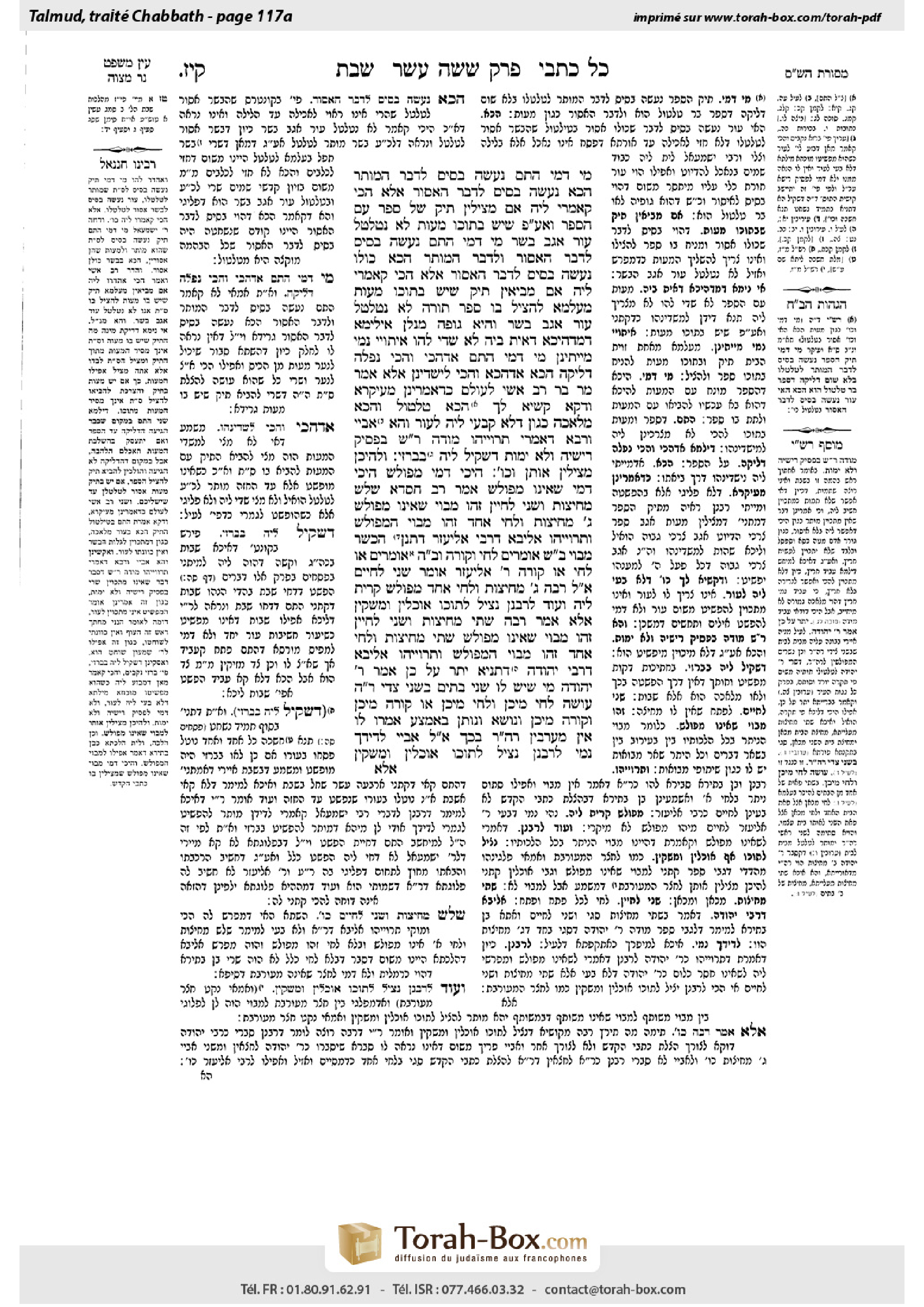
Shabbat 117a: Talmud study for Daf Yomi
Daf Yomi is the daily study of one Talmud folio. Explore 37 tractates with scans, Hebrew text, Sefaria English and AI-generated French translations where annotated.
Passage selection and English or AI-generated French translation are available where the scan has annotations. Daf Study is independent of Torah-Box and Sefaria.
Browse Shabbat · שבת · All tractatesShabbat 117a text and translations
This page of Shabbat includes the Aramaic text, an English translation and an AI-generated French translation, alongside the scan above.
שבת קי״ז א · Aramaic and Hebrew text
מִי דָּמֵי?! הָתָם — נַעֲשָׂה בָּסִיס לְדָבָר הַמּוּתָּר, הָכָא — נַעֲשָׂה בָּסִיס לְדָבָר הָאָסוּר! אֶלָּא הָכִי קָאָמְרִי לֵיהּ: אִם מַצִּילִין תִּיק שֶׁל סֵפֶר עִם הַסֵּפֶר, וְאַף עַל פִּי שֶׁיֵּשׁ בְּתוֹכוֹ מָעוֹת, לֹא נְטַלְטֵל עוֹר אַגַּב בָּשָׂר?! מִי דָּמֵי? הָתָם נַעֲשָׂה בָּסִיס לְדָבָר הָאָסוּר וּלְדָבָר הַמּוּתָּר, הָכָא — כּוּלּוֹ נַעֲשָׂה בָּסִיס לְדָבָר הָאָסוּר. אֶלָּא הָכִי קָאָמְרִי לֵיהּ: אִם מְבִיאִין תִּיק שֶׁיֵּשׁ בְּתוֹכוֹ מָעוֹת מֵעָלְמָא לְהַצִּיל בּוֹ סֵפֶר תּוֹרָה, לֹא נְטַלְטֵל עוֹר אַגַּב בָּשָׂר?!
וְהִיא גוּפָהּ מְנָלַן? אִילֵּימָא דְּמִדְּהֵיכָא דְּאִית בֵּיהּ לָא שָׁדֵי לְהוּ, אֵיתוֹיֵי נָמֵי מַיְיתִינַן — מִי דָּמֵי?! הָתָם — אַדְּהָכִי וְהָכִי נָפְלָה דְּלֵיקָה, הָכָא — אַדְּהָכָא וְהָכִי לִישְׁדִּינְהוּ. אֶלָּא אָמַר מָר בַּר רַב אָשֵׁי: לְעוֹלָם כִּדְאָמְרִינַן מֵעִיקָּרָא. וּדְקָא קַשְׁיָא לָךְ: הָכָא טִלְטוּל וְהָכָא מְלָאכָה — כְּגוֹן דְּלָא קָבָעֵי לֵיהּ לְעוֹר.
וְהָא אַבָּיֵי וְרָבָא דְּאָמְרִי תַּרְוַיְיהוּ: מוֹדֶה רַבִּי שִׁמְעוֹן בִּ״פְסִיק רֵישֵׁיהּ וְלָא יְמוּת״ — דְּשָׁקֵיל לֵיהּ בְּבַרְזֵי.
וּלְהֵיכָן מַצִּילִין אוֹתָן וְכוּ׳. הֵיכִי דָּמֵי מְפוּלָּשׁ, הֵיכִי דָּמֵי שֶׁאֵינוֹ מְפוּלָּשׁ? אָמַר רַב חִסְדָּא: שָׁלֹשׁ מְחִיצּוֹת וּשְׁנֵי לְחָיַיִן — זֶהוּ מָבוֹי שֶׁאֵינוֹ מְפוּלָּשׁ. שָׁלֹשׁ מְחִיצּוֹת וְלֶחִי אֶחָד — זֶהוּ מָבוֹי הַמְפוּלָּשׁ. וְתַרְוַיְיהוּ אַלִּיבָּא דְּרַבִּי אֱלִיעֶזֶר, דִּתְנַן: הֶכְשֵׁר מָבוֹי — בֵּית שַׁמַּאי אוֹמְרִים: לֶחִי וְקוֹרָה, וּבֵית הִלֵּל אוֹמְרִים: אוֹ לֶחִי אוֹ קוֹרָה. רַבִּי אֱלִיעֶזֶר אוֹמֵר: שְׁנֵי לְחָיַיִם.
אֲמַר לֵיהּ רַבָּה: שָׁלֹשׁ מְחִיצּוֹת וְלֶחִי אֶחָד ״מְפוּלָּשׁ״ קָרֵית לֵיהּ? וְעוֹד, לְרַבָּנַן נַצִּיל לְתוֹכוֹ אוֹכָלִין וּמַשְׁקִין! אֶלָּא אָמַר רַבָּה: שְׁתֵּי מְחִיצּוֹת וּשְׁנֵי לְחָיַיִן — זֶהוּ מָבוֹי שֶׁאֵינוֹ מְפוּלָּשׁ. שְׁתֵּי מְחִיצּוֹת וְלֶחִי אֶחָד — זֶהוּ מָבוֹי הַמְפוּלָּשׁ.
וְתַרְוַיְיהוּ אַלִּיבָּא דְּרַבִּי יְהוּדָה. דְּתַנְיָא, יָתֵר עַל כֵּן אָמַר רַבִּי יְהוּדָה: מִי שֶׁיֵּשׁ לוֹ שְׁנֵי בָתִּים בִּשְׁנֵי צִדֵּי רְשׁוּת הָרַבִּים — עוֹשֶׂה לֶחִי מִיכָּן וְלֶחִי מִיכָּן, אוֹ קוֹרָה מִיכָּן וְקוֹרָה מִיכָּן, וְנוֹשֵׂא וְנוֹתֵן בָּאֶמְצַע. אָמְרוּ לוֹ: אֵין מְעָרְבִין רְשׁוּת הָרַבִּים בְּכָךְ.
אֲמַר לֵיהּ אַבָּיֵי: לְדִידָךְ נָמֵי, לְרַבָּנַן נַצִּיל לְתוֹכוֹ אוֹכָלִין וּמַשְׁקִין?
Shabbat 117a · English translation
The Gemara asks: Are they comparable? There, with regard to the Torah scroll, the casing is a base for a permitted object, i.e., the scroll itself, which may be moved on Shabbat; whereas here, with regard to the hide of the Paschal lamb, the skin is a base for a prohibited object, i.e., the flesh of the sacrifice, which may not be moved until nightfall because it may not be eaten until night. Rather, this is what they said to him: If one may save the casing of the Torah scroll along with the scroll, even if there is money inside it, why then may one not move the hide together with the flesh? The Gemara asks: Are they comparable? There, with regard to the Torah scroll, the casing becomes a base for a prohibited object and a permitted object; whereas here, with regard to the hide, it is entirely a base for a prohibited object. Rather, this is what they said to him: If one may bring a casing that has money inside it from outside in order to save a Torah scroll in it, why may one not move the hide together with the flesh?
The Gemara asks: And from where do we derive this halakha itself? As it is not stated in the mishna, from where do we derive that it is permitted on Shabbat to bring a casing containing money from the outside in order to save a Torah scroll? If you say that from the fact that in a situation where the casing has money in it one does not throw it away but brings it out with the casing, when the casing is outside and has money in it, one may also bring the money along with it; is it comparable? There, with regard to the Torah scroll’s casing with money inside, if one tarries in order to empty the money from the case, in the meantime the fire might catch the Torah scroll and burn it; whereas here, with regard to bringing in the casing, in the meantime he could have thrown it away. Rather, Mar bar Rav Ashi said: Actually, it is as we said initially. The Sages equated carrying the Torah casing with flaying the hide of the Paschal lamb. And as for what was difficult for you, that here, with regard to the Torah casing, moving alone is involved, whereas here, with regard to a Paschal lamb, a prohibited labor is involved, it can be explained as referring to a case where one does not need the hide of the Paschal lamb. Therefore, he is exempt.
The Gemara asks: But Abaye and Rava both said: Rabbi Shimon concedes in cases categorized as cut off its head and will it not die, i.e., an action with an inevitable consequence. When an action has an inevitable consequence, even Rabbi Shimon, who normally exempts a person for performing an action with an unintended consequence, maintains the one is liable. Rather, we must say that one flays it strip by strip, and thereby he does not benefit from the hide. It therefore does not constitute the prohibited labor of stripping the hide.
We learned in the mishna: And to where may one rescue them? Into an alley that is closed, which, if it is surrounded on three sides, is considered to be a private domain by Torah law. Ben Beteira says: Even into an open alley. The Gemara asks: What are the circumstances of an alley that is open, and what are the circumstances of an alley that is not open? Rav Ḥisda said: An alley that has three walls and two posts at its entrance is an alley that is not open; one that has three walls and one post is an alley that is open. And they both, the first tanna and ben Beteira, disagree in the mishna in accordance with the opinion of Rabbi Eliezer, as we learned in a mishna: For preparation of an alley to permit carrying within it on Shabbat, Beit Shammai say the alley must have a post on the side of the entrance and a beam over the entrance. And Beit Hillel say: Either a post or a beam is sufficient. Rabbi Eliezer says: In order to permit carrying, two posts are required.
Rabba said to him: Did you call an alley that has three walls and one post open? Even if Rabbi Eliezer does not permit carrying there, it is still not considered to be open but closed. And furthermore, according to the Rabbis, if this is so, let us rescue food and drinks by carrying them there as well. Since the Sages only permitted carrying in an alley that is not open, and because, according to all opinions, it is permitted to carry in a closed alley, one should also be allowed to save food and water, and not only a Torah scroll, by carrying them there. Rather, Rabba said: An alley that has two walls and two posts at both entrances to the alley is an alley that is not open. If it has two walls and one post, it is an alley that is open.
And both of them hold in accordance with the opinion of Rabbi Yehuda. As it was taught in a baraita: Furthermore, Rabbi Yehuda said: One who has two houses opposite each other on two sides of the public domain, if he chooses, he may create a private domain for himself in the area of the public domain. He may place a ten-handbreadth high post from here, perpendicular to the public domain. This creates a symbolic wall which, in the halakhot of alleyways, has the legal status of a wall. And he may place an additional post from here, on the other side, and that has the same legal status as if he closed the public domain on all of its sides. Or, he can implement a different solution appropriate for alleyways by placing a beam extending from here, from one end of one house, to the end of the house opposite it. This creates a symbolic partition across the width of the street. And he may place a beam extending from here, from the other side of the house. According to Rabbi Yehuda, in that way, one is permitted to carry objects and place them in the area between the symbolic partitions, as he would in a private domain. The Rabbis said to him: One may not establish an eiruv in the public domain in that way.
Abaye said to Rabba: According to your opinion too, according to the opinion of the Rabbis cited in the mishna who agree with Rabbi Yehuda and permit carrying in an alley that is closed, let us also save food and drinks by carrying them there.
Shabbat 117a · Traduction française (IA)
La Guemara demande : Les deux cas sont-ils comparables ? Là, à propos de l’étui du rouleau de la Torah, celui-ci sert de base à un objet dont le déplacement est permis, à savoir le rouleau lui-même, que l’on peut déplacer le Chabbat ; tandis qu’ici, à propos de la peau de l’agneau pascal, elle sert de base à un objet dont le déplacement est interdit, à savoir la chair du sacrifice, que l’on ne peut déplacer avant la tombée de la nuit, puisqu’elle ne peut être consommée avant la nuit. Voici plutôt ce qu’ils lui ont dit : Si l’on peut sauver l’étui du rouleau de la Torah avec le rouleau, même s’il contient de l’argent, pourquoi ne peut-on pas déplacer la peau avec la chair ? La Guemara demande : Les deux cas sont-ils comparables ? Là, à propos du rouleau de la Torah, l’étui sert de base à un objet dont le déplacement est interdit et à un objet dont le déplacement est permis ; tandis qu’ici, à propos de la peau, elle sert entièrement de base à un objet dont le déplacement est interdit. Voici plutôt ce qu’ils lui ont dit : Si l’on peut apporter de l’extérieur un étui contenant de l’argent afin d’y sauver un rouleau de la Torah, pourquoi ne peut-on pas déplacer la peau avec la chair ?
La Guemara demande : Et d’où déduisons-nous cette halakha elle-même ? Puisqu’elle n’est pas énoncée dans la Michna, d’où déduisons-nous qu’il est permis, le Chabbat, d’apporter de l’extérieur un étui contenant de l’argent afin d’y sauver un rouleau de la Torah ? Si tu dis que, puisque, lorsque l’étui contient de l’argent, on ne le jette pas, mais qu’on l’emporte avec l’étui, on peut aussi emporter l’argent avec l’étui lorsque celui-ci se trouve à l’extérieur et contient de l’argent, les deux cas sont-ils comparables ? Là, à propos de l’étui du rouleau de la Torah contenant de l’argent, si l’on s’attarde pour retirer l’argent de l’étui, le feu risque entre-temps d’atteindre le rouleau de la Torah et de le brûler ; tandis qu’ici, lorsqu’on apporte l’étui, on aurait pu entre-temps le jeter. Mar bar Rav Ashi dit plutôt : En réalité, c’est comme nous l’avons dit au début. Les Sages ont assimilé le transport de l’étui de la Torah au dépeçage de la peau de l’agneau pascal. Quant à la difficulté que vous souleviez — là, à propos de l’étui de la Torah, seul un déplacement est en jeu, tandis qu’ici, à propos de l’agneau pascal, il s’agit d’un travail interdit —, cela s’explique par un cas où l’on n’a pas besoin de la peau de l’agneau pascal. Il est donc exempt.
La Guemara demande : Mais Abayé et Rava ont tous deux dit : Rabbi Chimon reconnaît le principe selon lequel, si l’on coupe la tête, l’animal ne mourra-t-il pas ? Autrement dit, il s’agit d’un acte dont la conséquence est inévitable. Lorsqu’un acte a une conséquence inévitable, même Rabbi Chimon, qui exonère généralement celui qui accomplit un acte dont la conséquence n’est pas intentionnelle, estime que celui-ci est passible. Il faut donc plutôt dire qu’il dépouille la peau bande par bande et qu’ainsi, il ne tire aucun profit de la peau. Cela ne constitue donc pas le travail interdit consistant à dépouiller la peau.
Nous avons appris dans la Michna : Et jusqu’où peut-on les sauver ? Dans une ruelle fermée qui, lorsqu’elle est entourée de trois côtés, est considérée selon la Torah comme un domaine privé. Ben Beteira dit : Même dans une ruelle ouverte. La Guemara demande : Quelles sont les caractéristiques d’une ruelle ouverte et celles d’une ruelle fermée ? Rav Ḥisda dit : Une ruelle qui a trois murs et deux poteaux à son entrée est une ruelle fermée ; celle qui a trois murs et un poteau est une ruelle ouverte. Le premier tanna et Ben Beteira sont tous deux en désaccord dans la Michna conformément à l’opinion de Rabbi Éliézer, comme nous l’avons appris dans une Michna : Pour aménager une ruelle afin d’y permettre le transport le Chabbat, Beit Chammaï disent qu’elle doit avoir un poteau à côté de l’entrée et une poutre au-dessus de l’entrée. Beit Hillel disent : Un poteau ou une poutre suffit. Rabbi Éliézer dit : Pour permettre le transport, deux poteaux sont nécessaires.
Rabba lui dit : Appelles-tu ouverte une ruelle qui a trois murs et un poteau ? Même si Rabbi Éliézer n’y permet pas le transport, elle n’est pas considérée comme ouverte, mais comme fermée. De plus, selon les Sages, s’il en est ainsi, permettons aussi d’y sauver de la nourriture et des boissons. Puisque les Sages n’ont permis le transport que dans une ruelle fermée et que, selon toutes les opinions, il est permis de transporter des objets dans une ruelle fermée, on devrait également pouvoir y sauver de la nourriture et de l’eau, et pas seulement un rouleau de la Torah. Rabba dit plutôt : Une ruelle qui a deux murs et deux poteaux, un à chacune de ses entrées, est une ruelle fermée. Si elle a deux murs et un poteau, c’est une ruelle ouverte.
Tous deux sont d’accord avec l’opinion de Rabbi Yehouda. En effet, il a été enseigné dans une baraïta : En outre, Rabbi Yehouda a dit : Celui qui possède deux maisons situées l’une en face de l’autre, de part et d’autre du domaine public, peut, s’il le souhaite, créer pour lui-même un domaine privé dans l’espace du domaine public. Il peut placer ici un poteau haut de dix téfaḥim, perpendiculairement au domaine public. Cela crée une paroi symbolique qui, selon les lois relatives aux ruelles, a le statut juridique d’une paroi. Il peut placer un autre poteau de l’autre côté, ce qui a le même statut juridique que s’il avait fermé le domaine public de tous côtés. Ou bien, il peut appliquer une autre solution adaptée aux ruelles en plaçant une poutre qui s’étend d’ici, depuis l’extrémité d’une maison jusqu’à l’extrémité de la maison qui lui fait face. Cela crée une séparation symbolique en travers de la largeur de la rue. Il peut aussi placer une poutre qui s’étend d’ici, depuis l’autre côté de la maison. Selon Rabbi Yehouda, de cette manière, on est autorisé à transporter des objets et à les déposer dans l’espace situé entre les séparations symboliques, comme on le ferait dans un domaine privé. Les Sages lui dirent : On ne peut pas établir ainsi un érouv dans le domaine public.
Abayé dit à Rabba : Même selon ton opinion, puisque les Sages cités dans la Michna sont d’accord avec Rabbi Yehouda et permettent le transport dans une ruelle fermée, permettons également d’y sauver de la nourriture et des boissons.
Traduction française générée par IA à partir de l’édition anglaise de Sefaria. Vérifie toujours un passage avec le texte source.
Text from Sefaria: William Davidson Edition - Vocalized Aramaic (CC BY NC); William Davidson Edition - English (CC BY NC).