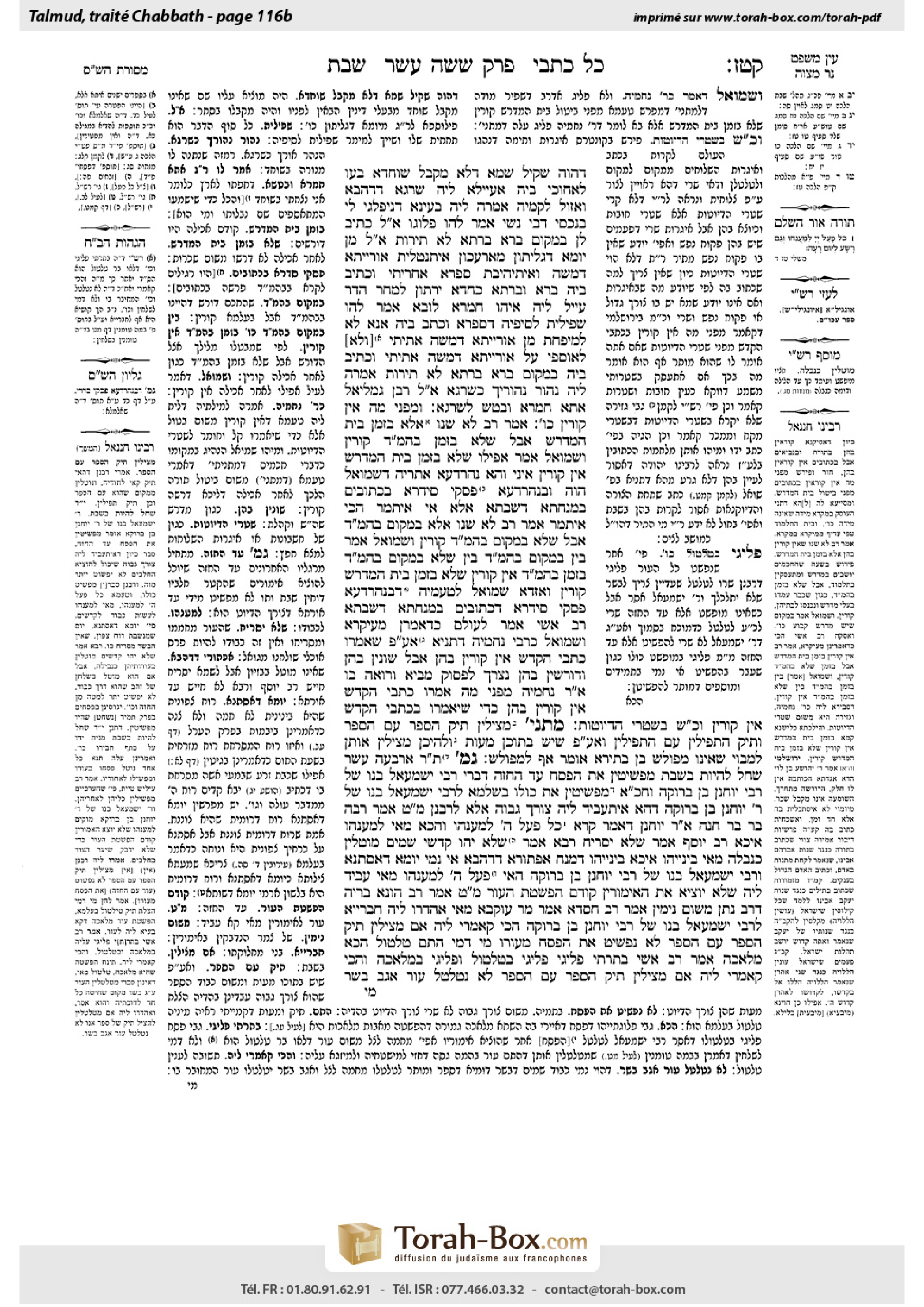
Shabbat 116b: Talmud study for Daf Yomi
Daf Yomi is the daily study of one Talmud folio. Explore 37 tractates with scans, Hebrew text, Sefaria English and AI-generated French translations where annotated.
Passage selection and English or AI-generated French translation are available where the scan has annotations. Daf Study is independent of Torah-Box and Sefaria.
Browse Shabbat · שבת · All tractatesShabbat 116b text and translations
This page of Shabbat includes the Aramaic text, an English translation and an AI-generated French translation, alongside the scan above.
שבת קי״ו ב · Aramaic and Hebrew text
דַּהֲוָה שְׁקִיל שְׁמָא דְּלָא מְקַבֵּל שׁוּחְדָּא. בְּעוֹ לְאַחוֹכֵי בֵּיהּ. עַיַּילָא לֵיהּ שְׁרָגָא דְּדַהֲבָא, וַאֲזוּל לְקַמֵּיהּ. אֲמַרָה לֵיהּ: בָּעֵינָא דְּנִיפְלְגוּ לִי בְּנִכְסֵי דְּבֵי נָשַׁי. אֲמַר לְהוּ: פְּלוּגוּ. אֲמַר לֵיהּ, כְּתִיב לַן: בִּמְקוֹם בְּרָא, בְּרַתָּא לָא תֵּירוֹת. אֲמַר לֵיהּ: מִן יוֹמָא דִּגְלִיתוּן מֵאַרְעֲכוֹן, אִיתְנְטִילַת אוֹרָיְיתָא דְּמֹשֶׁה וְאִיתִיְהִיבַת עֲווֹן גִּלְיוֹן, וּכְתִיב בֵּיהּ: בְּרָא וּבְרַתָּא כַּחֲדָא יִרְתוּן.
לְמָחָר הֲדַר עַיֵּיל לֵיהּ אִיהוּ חֲמָרָא לוּבָא. אֲמַר לְהוּ: שְׁפִילִית לְסֵיפֵיהּ דַּעֲווֹן גִּלְיוֹן, וּכְתִיב בֵּיהּ: אֲנָא לָא לְמִיפְחַת מִן אוֹרָיְיתָא דְּמֹשֶׁה אֲתֵיתִי [וְלָא] לְאוֹסֹפֵי עַל אוֹרָיְיתָא דְמֹשֶׁה אֲתֵיתִי, וּכְתִיב בֵּיהּ: בִּמְקוֹם בְּרָא — בְּרַתָּא לָא תֵּירוֹת. אֲמַרָה לֵיהּ: נְהוֹר נְהוֹרָיךְ כִּשְׁרָגָא. אֲמַר לֵיהּ רַבָּן גַּמְלִיאֵל: אֲתָא חַמְרָא וּבְטַשׁ לִשְׁרָגָא.
וּמִפְּנֵי מָה אֵין קוֹרִין כּוּ׳. אָמַר רַב: לֹא שָׁנוּ אֶלָּא בִּזְמַן בֵּית הַמִּדְרָשׁ, אֲבָל שֶׁלֹּא בִּזְמַן בֵּית הַמִּדְרָשׁ — קוֹרִין. וּשְׁמוּאֵל אָמַר: אֲפִילּוּ שֶׁלֹּא בִּזְמַן בֵּית הַמִּדְרָשׁ אֵין קוֹרִין. אִינִי?! וְהָא נְהַרְדְּעָא אַתְרֵיהּ דִּשְׁמוּאֵל הֲוָה, וּבִנְהַרְדְּעָא פָּסְקִי סִידְרָא בִּכְתוּבִים בְּמִנְחֲתָא דְשַׁבְּתָא. אֶלָּא אִי אִיתְּמַר, הָכִי אִיתְּמַר — אָמַר רַב: לֹא שָׁנוּ אֶלָּא בִּמְקוֹם בֵּית הַמִּדְרָשׁ. אֲבָל שֶׁלֹּא בִּמְקוֹם בֵּית הַמִּדְרָשׁ — קוֹרִין.
וּשְׁמוּאֵל אָמַר: בֵּין בִּמְקוֹם בֵּית הַמִּדְרָשׁ בֵּין שֶׁלֹּא בִּמְקוֹם בֵּית הַמִּדְרָשׁ, בִּזְמַן בֵּית הַמִּדְרָשׁ — אֵין קוֹרִין, שֶׁלֹּא בִּזְמַן בֵּית הַמִּדְרָשׁ — קוֹרִין. וְאַזְדָּא שְׁמוּאֵל לְטַעְמֵיהּ, דְּבִנְהַרְדְּעָא פָּסְקִי סִידְרָא דִכְתוּבִים בְּמִנְחֲתָא דְשַׁבְּתָא.
רַב אָשֵׁי אָמַר: לְעוֹלָם כְּדַאֲמַרַן מֵעִיקָּרָא, וּשְׁמוּאֵל כְּרַבִּי נְחֶמְיָה. דְּתַנְיָא: אַף עַל פִּי שֶׁאָמְרוּ כִּתְבֵי הַקֹּדֶשׁ אֵין קוֹרִין בָּהֶן — אֲבָל שׁוֹנִין בָּהֶן וְדוֹרְשִׁין בָּהֶן. נִצְרַךְ לְפָסוּק — מֵבִיא וְרוֹאֶה בּוֹ. אָמַר רַבִּי נְחֶמְיָה: מִפְּנֵי מָה אָמְרוּ כִּתְבֵי הַקֹּדֶשׁ אֵין קוֹרִין בָּהֶן — כְּדֵי שֶׁיֹּאמְרוּ: בְּכִתְבֵי הַקֹּדֶשׁ אֵין קוֹרִין, וְכׇל שֶׁכֵּן בְּשִׁטְרֵי הֶדְיוֹטוֹת.
מַתְנִי׳ מַצִּילִין תִּיק הַסֵּפֶר עִם הַסֵּפֶר, וְתִיק הַתְּפִילִּין עִם הַתְּפִילִּין, וְאַף עַל פִּי שֶׁיֵּשׁ בְּתוֹכָן מָעוֹת. וּלְהֵיכָן מַצִּילִין אוֹתָן — לְמָבוֹי שֶׁאֵינוֹ מְפוּלָּשׁ. בֶּן בְּתֵירָא אוֹמֵר: אַף לִמְפוּלָּשׁ.
גְּמָ׳ תָּנוּ רַבָּנַן: אַרְבָּעָה עָשָׂר שֶׁחָל לִהְיוֹת בְּשַׁבָּת, מַפְשִׁיטִין אֶת הַפֶּסַח עַד הֶחָזֶה — דִּבְרֵי רַבִּי יִשְׁמָעֵאל בְּנוֹ שֶׁל רַבִּי יוֹחָנָן בֶּן בְּרוֹקָה. וַחֲכָמִים אוֹמְרִים: מַפְשִׁיטִין אֶת כּוּלּוֹ. בִּשְׁלָמָא לְרַבִּי יִשְׁמָעֵאל בְּנוֹ שֶׁל רַבִּי יוֹחָנָן בֶּן בְּרוֹקָה, דְּהָא אִיתְעֲבִיד לֵיהּ צוֹרֶךְ גָּבוֹהַּ. אֶלָּא לְרַבָּנַן מַאי טַעְמָא? אָמַר רַבָּה בַּר בַּר חָנָה אָמַר רַבִּי יוֹחָנָן, דְּאָמַר קְרָא: ״כֹּל פָּעַל ה׳ לַמַּעֲנֵהוּ״. וְהָכָא, מַאי ״לְמַעֲנֵהוּ״ אִיכָּא? רַב יוֹסֵף אָמַר: שֶׁלֹּא יַסְרִיחַ. רָבָא אָמַר: שֶׁלֹּא יְהוּ קׇדְשֵׁי שָׁמַיִם מוּטָלִין כִּנְבֵלָה.
מַאי בֵּינַיְיהוּ? אִיכָּא בֵּינַיְיהוּ דְּמַנַּח אַפָּתוּרָא דְּדַהֲבָא, אִי נָמֵי יוֹמָא דְּאִסְתָּנָא. וְרַבִּי יִשְׁמָעֵאל בְּנוֹ שֶׁל רַבִּי יוֹחָנָן בֶּן בְּרוֹקָה, הַאי ״פָּעַל ה׳ לַמַּעֲנֵהוּ״ מַאי עָבֵיד לֵיהּ? שֶׁלֹּא יוֹצִיא אֶת הָאֵימוּרִין קוֹדֶם הַפְשָׁטַת הָעוֹר. מַאי טַעְמָא? אָמַר רַב הוּנָא בְּרֵיהּ דְּרַב נָתָן: מִשּׁוּם נִימִין.
אָמַר רַב חִסְדָּא אָמַר מָר עוּקְבָא: מַאי אַהְדַּרוּ לֵיהּ חַבְרַיָּיא לְרַבִּי יִשְׁמָעֵאל בְּנוֹ שֶׁל רַבִּי יוֹחָנָן בֶּן בְּרוֹקָה? הָכִי קָאָמְרִי לֵיהּ: אִם מַצִּילִין תִּיק הַסֵּפֶר עִם הַסֵּפֶר, לֹא נַפְשִׁיט אֶת הַפֶּסַח מֵעוֹרוֹ? מִי דָּמֵי?! הָתָם — טִלְטוּל, הָכָא — מְלָאכָה! אָמַר רַב אָשֵׁי: בְּתַרְתֵּי פְּלִיגִי, פְּלִיגִי בְּטִלְטוּל וּפְלִיגִי בִּמְלָאכָה, וְהָכִי קָאָמְרִי לֵיהּ: אִם מַצִּילִין תִּיק הַסֵּפֶר עִם הַסֵּפֶר, לֹא נְטַלְטֵל עוֹר אַגַּב בָּשָׂר?!
Shabbat 116b · English translation
who disseminated about himself the reputation that he does not accept bribes. They wanted to mock him and reveal his true nature. She privately gave him a golden lamp, and she and her brother came before him, approaching him as if they were seeking judgment. She said to the philosopher: I want to share in the inheritance of my father’s estate. He said to them: Divide it. Rabban Gamliel said to him: It is written in our Torah: In a situation where there is a son, the daughter does not inherit. The philosopher said to him: Since the day you were exiled from your land, the Torah of Moses was taken away and the avon gilyon was given in its place. It is written in the avon gilyon: A son and a daughter shall inherit alike.
The next day Rabban Gamliel brought the philosopher a Libyan donkey. Afterward, Rabban Gamliel and his sister came before the philosopher for a judgment. He said to them: I proceeded to the end of the avon gilayon, and it is written: I, avon gilayon, did not come to subtract from the Torah of Moses, and I did not come to add to the Torah of Moses. And it is written there: In a situation where there is a son, the daughter does not inherit. She said to him: May your light shine like a lamp, alluding to the lamp she had given him. Rabban Gamliel said to him: The donkey came and kicked the lamp, thereby revealing the entire episode.
We learned in the mishna: And why does one not read the Writings on Shabbat? Due to suspension of Torah study in the study hall. Rav said: They only taught that it is prohibited to read from the Writings on Shabbat during the hours of study in the study hall; but when it is not during the hours of study in the study hall, one may read them. And Shmuel said: Even when it is not the hours of study in the study hall one may not read from the Writings on Shabbat. The Gemara asks: Is that so? Wasn’t Neharde’a Shmuel’s place where he was the rabbi of the town, and in Neharde’a they concluded their regular weekly discourse with Writings on Shabbat afternoon. Rather, if a dispute was stated in this matter, it was stated as follows: Rav said: It was only taught that there is a prohibition in a place where there is a study hall nearby that people can attend; but not in a place where there is a study hall, one may read Writings.
And Shmuel said: Whether it is in the place of the study hall or it is not the place of the study hall, one may not read anywhere when it is during the hours of study in the study hall; but when it is not during the hours of study in the study hall, one may read. And Shmuel follows his line of reasoning stated elsewhere, as in Neharde’a they would conclude their studies with Writings on Shabbat afternoon.
Rav Ashi said: Actually, the dispute is as we stated initially, and Shmuel said what he said in accordance with the opinion of Rabbi Neḥemya. As it was taught in a baraita: Although the Sages said with regard to sacred writings that they may not be read on Shabbat, one may study the midrash on them and teach them before the congregation; if one requires a verse that is written in the Writings, he brings a book and looks in it. Rabbi Neḥemya said: Why did they say that sacred writings are not read on Shabbat? So that people will say: Sacred writings may not be read, all the more so that is the case with ordinary documents, i.e., contracts and letters. If so, according to Rabbi Neḥemya, reading any sacred writings on Shabbat is prohibited so that people will refrain from reading non-sacred documents on Shabbat. It was not prohibited to encourage attendance the study hall. Shmuel himself does not hold in accordance with the opinion of Rabbi Neḥemya.
MISHNA: One may rescue the casing of a Torah scroll from a fire on Shabbat together with the Torah scroll, and the casing of phylacteries along with the phylacteries, even if they have money inside them. And to where may one rescue them? Into an alley that is closed, which, if it is surrounded on three sides, is considered to be a private domain by Torah law. Ben Beteira says: Even into an open alley.
GEMARA: Apropos the mishna, the Gemara cites that which the Sages taught in a baraita: If the fourteenth of Nissan occurs on Shabbat, and the Paschal lamb is offered but not roasted until Shabbat ends, one flays the Paschal lamb up to the breast to enable removal of the parts of the animal that are offered on the altar on Shabbat. One flays the rest of the animal after Shabbat. Further skinning is only to facilitate eating the animal, therefore, it does not override Shabbat; this is the statement of Rabbi Yishmael, son of Rabbi Yoḥanan ben Beroka. And the Rabbis say: One flays it in its entirety. The Gemara asks: Granted, according to the opinion of Rabbi Yishmael, son of Rabbi Yoḥanan ben Beroka, who said one may flay only part of the animal, the halakha is understandable. Since it has already been used for its divine purpose of having its blood sprinkled on the altar, the animal no longer should be flayed. But according to the Rabbis, what is the reason for their opinion? Rabba bar bar Ḥana said that Rabbi Yoḥanan said: The verse states, “All that the Lord has made is for His sake” (Proverbs 16:4), meaning that a prohibited action is only permitted if its performance honors God. The Gemara asks: And here, what manifestation of for His sake is there in flaying the remaining hide from the Paschal lamb? Rav Yosef said: The Rabbis permitted removing the entire hide so that the sacrifice will not putrefy. Rava said: The Rabbis permitted removing the entire hide so that the sacred sacrifices will not be left in disgrace like a half-stripped animal carcass left unattended.
The Gemara asks: What is the practical difference between them? The Gemara answers: There is a practical difference between them when the Paschal lamb is laid on a golden table. In this case, there is indeed a concern that the carcass will putrefy, although there is no element of disgrace. Alternatively, there is a practical difference on a day with a cold northern wind. In this case, there is no concern that it will putrefy but there is a concern of disgracing the sacrifice. The Gemara asks: And what does Rabbi Yishamel, son of Rabbi Yoḥanan ben Beroka, do with the verse, “All that the Lord has made is for His sake”? The Gemara answers: He uses it to permit removing part of the hide, as if it was not for this verse, it would have been possible to remove the sacrificial parts offered on the altar before removing the hide by puncturing the hide of the animal and removing the fats through the opening. The Gemara asks: What is the reason that the Torah prohibited doing so? Rav Huna, son of Rav Natan, said: Because of the hairs, so that they do not become entangled in the sacrificial parts and distort them.
Rav Ḥisda said that Mar Ukva said: How did the members of the group respond to Rabbi Yishmael, son of Rabbi Yoḥanan ben Beroka? This is what they said to him: If one may save the casing of a Torah scroll along with the Torah scroll, why may one not strip the Paschal lamb of its skin? Here too, in the case of skinning the Paschal lamb, once part of the action is permitted one should be able to perform the entire act. The Gemara is surprised at this: Are they comparable? There, in rescuing the casing of the scroll, only moving is involved, which is prohibited by rabbinic law; whereas here, in the case of the Paschal lamb, the act of flaying is a prohibited labor by Torah law. Rav Ashi said: They are disagreeing with regard to two issues: They disagree with regard to moving the hide along with the flesh, and they disagree with regard to the labor of flaying the animal. And this is what they said to him: If one may rescue the casing of the Torah scroll along with the Torah scroll, will we not move the hide of the Paschal lamb together with the flesh of the sacrifice? The sacrifice should be moved with its skin so it does not putrefy.
Shabbat 116b · Traduction française (IA)
qui s’était fait connaître en prétendant ne pas accepter de pots-de-vin. Ils voulurent se moquer de lui et révéler sa véritable nature. Elle lui remit discrètement un candélabre en or, puis elle et son frère se présentèrent devant lui, comme s’ils venaient solliciter un jugement. Elle dit au philosophe : « Je veux prendre part à l’héritage des biens de mon père. » Il leur dit : « Partagez-le. » Rabban Gamliel lui dit : « Il est écrit dans notre Torah : lorsqu’il y a un fils, la fille n’hérite pas. » Le philosophe lui dit : « Depuis le jour où vous avez été exilés de votre pays, la Torah de Moïse a été retirée et l’avon gilyon a été donné à sa place. Il est écrit dans l’avon gilyon : “Un fils et une fille hériteront à égalité.” »
Le lendemain, Rabban Gamliel apporta au philosophe un âne de Libye. Ensuite, Rabban Gamliel et sa sœur se présentèrent devant le philosophe pour qu’il rende un jugement. Il leur dit : « J’ai poursuivi ma lecture jusqu’à la fin de l’avon gilayon, et il est écrit : “Moi, avon gilayon, je ne suis pas venu retrancher quoi que ce soit à la Torah de Moïse, et je ne suis pas venu ajouter quoi que ce soit à la Torah de Moïse.” Et il y est écrit : “Lorsqu’il y a un fils, la fille n’hérite pas.” » Elle lui dit : « Que ta lumière brille comme une lampe », faisant allusion à la lampe qu’elle lui avait donnée. Rabban Gamliel lui dit : « L’âne est arrivé et a donné un coup de sabot à la lampe », révélant ainsi toute l’affaire.
Nous avons appris dans la Michna : « Et pourquoi ne lit-on pas les Écrits le Chabbat ? À cause de la suspension de l’étude de la Torah dans la maison d’étude. » Rav dit : « Ils ont enseigné que la lecture des Écrits est interdite le Chabbat uniquement pendant les heures d’étude dans la maison d’étude ; en dehors de ces heures, on peut les lire. » Chmouel dit : « Même en dehors des heures d’étude dans la maison d’étude, on ne peut pas lire les Écrits le Chabbat. » La Guemara demande : « Est-ce vraiment le cas ? Nehardea n’était-elle pas la ville de Chmouel, où il était le maître de la ville, et à Nehardea, on concluait l’enseignement hebdomadaire habituel par les Écrits le Chabbat après-midi ? » Mais si un désaccord a été rapporté sur ce sujet, il l’a été de la manière suivante : Rav dit : « Ils ont enseigné qu’il y a une interdiction dans un endroit où se trouve à proximité une maison d’étude à laquelle les gens peuvent se rendre ; mais dans un endroit où il n’y a pas de maison d’étude, on peut lire les Écrits. »
Chmouel dit : « Que l’on se trouve ou non dans un endroit où il y a une maison d’étude, on ne peut lire nulle part pendant les heures d’étude dans la maison d’étude ; mais en dehors de ces heures, on peut lire. » Chmouel est cohérent avec son raisonnement énoncé ailleurs, car à Nehardea, on concluait l’étude par les Écrits le Chabbat après-midi.
Rav Achi dit : « En réalité, le désaccord est bien celui que nous avons énoncé au départ, et Chmouel a parlé conformément à l’opinion de Rabbi Neḥemya. » Car il a été enseigné dans une baraïta : « Bien que les Sages aient dit, au sujet des écrits sacrés, qu’on ne peut pas les lire le Chabbat, on peut étudier le midrach à leur sujet et l’enseigner devant l’assemblée ; si l’on a besoin d’un verset écrit dans les Écrits, on apporte un livre et on le consulte. » Rabbi Neḥemya dit : « Pourquoi ont-ils dit qu’on ne lit pas les écrits sacrés le Chabbat ? Afin que les gens disent : “On ne peut pas lire les écrits sacrés ; à plus forte raison, cela vaut pour les documents profanes”, c’est-à-dire les contrats et les lettres. » Ainsi, selon Rabbi Neḥemya, la lecture de tous les écrits sacrés le Chabbat est interdite, afin que les gens s’abstiennent de lire des documents profanes le Chabbat. L’interdiction n’a donc pas été édictée pour encourager la fréquentation de la maison d’étude. Chmouel lui-même ne suit pas l’opinion de Rabbi Neḥemya.
MICHNA : On peut sauver d’un incendie l’étui d’un rouleau de la Torah avec le rouleau de la Torah, et l’étui des téfilines avec les téfilines, même s’ils contiennent de l’argent. Et jusqu’où peut-on les sauver ? Dans une ruelle fermée qui, si elle est entourée de trois côtés, est considérée comme un domaine privé selon la Torah. Ben Beteira dit : même dans une ruelle ouverte.
GUEMARA : À propos de la Michna, la Guemara rapporte ce que les Sages ont enseigné dans une baraïta : si le quatorze Nissan tombe un Chabbat, le sacrifice pascal est offert, mais il n’est rôti qu’à la fin du Chabbat. On dépouille le sacrifice pascal jusqu’à la poitrine, afin de pouvoir retirer les parties de l’animal offertes sur l’autel le Chabbat. On dépouille le reste de l’animal après le Chabbat. Le dépouillement supplémentaire ne sert qu’à faciliter la consommation de l’animal ; il ne repousse donc pas le Chabbat. Telle est la déclaration de Rabbi Yishmael, fils de Rabbi Yoḥanan ben Beroka. Les Sages disent : « On le dépouille entièrement. » La Guemara demande : « Il est compréhensible que la halakha soit ainsi selon l’opinion de Rabbi Yishmael, fils de Rabbi Yoḥanan ben Beroka, qui dit qu’on ne peut dépouiller qu’une partie de l’animal. Puisque celui-ci a déjà servi à sa fin divine, son sang ayant été aspergé sur l’autel, il ne doit plus être dépouillé. Mais selon les Sages, quelle est la raison de leur opinion ? » Rabba bar bar Ḥana dit au nom de Rabbi Yoḥanan : « Le verset déclare : “Tout ce que le Seigneur a fait, Il l’a fait pour Lui-même” (Proverbes 16, 4), ce qui signifie qu’un acte interdit n’est permis que si son accomplissement honore Dieu. » La Guemara demande : « Et ici, en quoi le dépouillement du reste de la peau du sacrifice pascal est-il fait pour Lui-même ? » Rav Yossef dit : « Les Sages ont permis de retirer toute la peau afin que le sacrifice ne se putréfie pas. » Rava dit : « Les Sages ont permis de retirer toute la peau afin que les sacrifices consacrés ne soient pas laissés dans un état déshonorant, comme une carcasse à moitié dépouillée abandonnée sans surveillance. »
La Guemara demande : « Quelle est la différence pratique entre eux ? » La Guemara répond : « Il y a une différence pratique si le sacrifice pascal est posé sur une table en or. Dans ce cas, il y a effectivement un risque que la carcasse se putréfie, bien qu’il n’y ait pas de risque de déshonneur. » Autre possibilité : la différence pratique se présente un jour où souffle un vent froid du nord. Dans ce cas, il n’y a pas de risque de putréfaction, mais il y a un risque que le sacrifice soit déshonoré. La Guemara demande : « Et que fait Rabbi Yishmael, fils de Rabbi Yoḥanan ben Beroka, du verset : “Tout ce que le Seigneur a fait, Il l’a fait pour Lui-même” ? » La Guemara répond : « Il s’en sert pour permettre de retirer une partie de la peau. Car sans ce verset, il aurait été possible de retirer les parties du sacrifice offertes sur l’autel avant d’enlever la peau, en perforant celle-ci et en extrayant les graisses par l’ouverture. » La Guemara demande : « Pour quelle raison la Torah a-t-elle interdit de procéder ainsi ? » Rav Houna, fils de Rav Natan, dit : « À cause des poils, afin qu’ils ne s’emmêlent pas aux parties du sacrifice et ne les abîment pas. »
Rav Ḥisda dit au nom de Mar Ukva : « Qu’ont répondu les membres du groupe à Rabbi Yishmael, fils de Rabbi Yoḥanan ben Beroka ? Voici ce qu’ils lui ont dit : si l’on peut sauver l’étui d’un rouleau de la Torah avec le rouleau, pourquoi ne peut-on pas dépouiller le sacrifice pascal de sa peau ? Ici aussi, dans le cas du dépouillement du sacrifice pascal, dès lors qu’une partie de l’action est permise, on devrait pouvoir accomplir l’action entière. » La Guemara s’en étonne : « Ces cas sont-ils comparables ? Là, lorsqu’on sauve l’étui du rouleau, il s’agit seulement de le déplacer, ce qui est interdit par décret rabbinique ; tandis qu’ici, dans le cas du sacrifice pascal, le dépouillement est un travail interdit par la Torah. » Rav Achi dit : « Ils sont en désaccord sur deux questions : le déplacement de la peau avec la chair, et le travail consistant à dépouiller l’animal. Voici ce qu’ils lui ont dit : si l’on peut sauver l’étui du rouleau de la Torah avec le rouleau, ne déplacerons-nous pas la peau du sacrifice pascal avec la chair du sacrifice ? Il faut déplacer le sacrifice avec sa peau afin qu’il ne se putréfie pas. »
Traduction française générée par IA à partir de l’édition anglaise de Sefaria. Vérifie toujours un passage avec le texte source.
Text from Sefaria: William Davidson Edition - Vocalized Aramaic (CC BY NC); William Davidson Edition - English (CC BY NC).