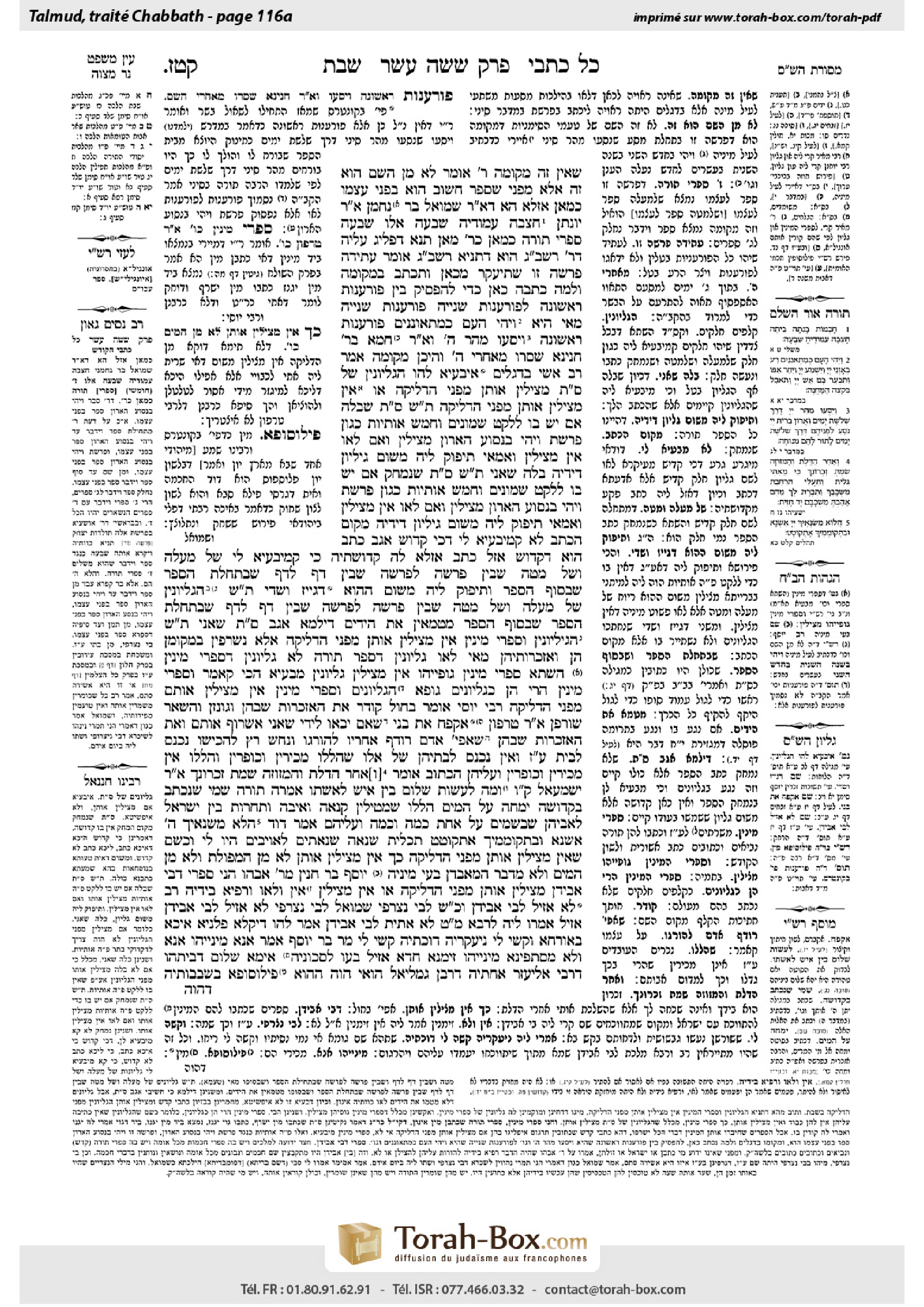
Shabbat 116a: Talmud study for Daf Yomi
Daf Yomi is the daily study of one Talmud folio. Explore 37 tractates with scans, Hebrew text, Sefaria English and AI-generated French translations where annotated.
Passage selection and English or AI-generated French translation are available where the scan has annotations. Daf Study is independent of Torah-Box and Sefaria.
Browse Shabbat · שבת · All tractatesShabbat 116a text and translations
This page of Shabbat includes the Aramaic text, an English translation and an AI-generated French translation, alongside the scan above.
שבת קי״ו א · Aramaic and Hebrew text
שֶׁאֵין זֶה מְקוֹמָהּ. רַבִּי אוֹמֵר: לֹא מִן הַשֵּׁם הוּא זֶה, אֶלָּא מִפְּנֵי שֶׁסֵּפֶר חָשׁוּב הוּא בִּפְנֵי עַצְמוֹ.
כְּמַאן אָזְלָא הָא דְּאָמַר רַבִּי שְׁמוּאֵל בַּר נַחְמָן אָמַר רַבִּי יוֹנָתָן: ״חָצְבָה עַמּוּדֶיהָ שִׁבְעָה״, אֵלּוּ שִׁבְעָה סִפְרֵי תוֹרָה? — כְּמַאן כְּרַבִּי.
מַאן תַּנָּא דִּפְלִיג עֲלֵיהּ דְּרַבִּי — רַבָּן שִׁמְעוֹן בֶּן גַּמְלִיאֵל הוּא. דְּתַנְיָא: רַבָּן שִׁמְעוֹן בֶּן גַּמְלִיאֵל אוֹמֵר: עֲתִידָה פָּרָשָׁה זוֹ שֶׁתֵּיעָקֵר מִכָּאן וְתִכָּתֵב בִּמְקוֹמָהּ. וְלָמָּה כְּתָבָהּ כָּאן — כְּדֵי לְהַפְסִיק בֵּין פּוּרְעָנוּת רִאשׁוֹנָה לְפוּרְעָנוּת שְׁנִיָּיה. פּוּרְעָנוּת שְׁנִיָּיה מַאי הִיא — ״וַיְהִי הָעָם כְּמִתְאוֹנְנִים״. פּוּרְעָנוּת רִאשׁוֹנָה — ״וַיִּסְעוּ מֵהַר ה׳״, וְאָמַר רַבִּי חָמָא בְּרַבִּי חֲנִינָא: שֶׁסָּרוּ מֵאַחֲרֵי ה׳. וְהֵיכָן מְקוֹמָהּ? אָמַר רַב אָשֵׁי: בַּדְּגָלִים.
אִיבַּעְיָא לְהוּ: הַגִּלְיוֹנִין שֶׁל סֵפֶר תּוֹרָה, מַצִּילִין אוֹתָן מִפְּנֵי הַדְּלֵיקָה אוֹ אֵין מַצִּילִין אוֹתָן מִפְּנֵי הַדְּלֵיקָה? תָּא שְׁמַע: סֵפֶר תּוֹרָה שֶׁבָּלָה, אִם יֵשׁ בּוֹ לְלַקֵּט שְׁמוֹנִים וְחָמֵשׁ אוֹתִיּוֹת, כְּגוֹן פָּרָשַׁת ״וַיְהִי בִּנְסוֹעַ הָאָרוֹן״ — מַצִּילִין, וְאִם לָאו אֵין מַצִּילִין. וְאַמַּאי, תִּיפּוֹק לֵיהּ מִשּׁוּם גִּילָּיוֹן דִּידֵיהּ! בָּלָה שָׁאנֵי.
תָּא שְׁמַע: סֵפֶר תּוֹרָה שֶׁנִּמְחַק, אִם יֵשׁ בּוֹ לְלַקֵּט שְׁמוֹנִים וְחָמֵשׁ אוֹתִיּוֹת, כְּגוֹן פָּרָשַׁת ״וַיְהִי בִּנְסוֹעַ הָאָרוֹן״ — מַצִּילִין, וְאִם לָאו — אֵין מַצִּילִין, וְאַמַּאי? תִּיפּוֹק לֵיהּ מִשּׁוּם גִּילָּיוֹן דִּידֵיהּ! מְקוֹם הַכְּתָב לָא קָמִיבַּעְיָא לִי, דְּכִי קָדוֹשׁ — אַגַּב כְּתָב הוּא דְּקָדוֹשׁ, אֲזַל כְּתָב — אֲזַלָא לַהּ קְדוּשְׁתֵּיהּ. כִּי קָמִיבַּעְיָא לִי שֶׁל מַעְלָה וְשֶׁל מַטָּה, שֶׁבֵּין פָּרָשָׁה לְפָרָשָׁה, שֶׁבֵּין דַּף לְדַף, שֶׁבִּתְחִלַּת הַסֵּפֶר, שֶׁבְּסוֹף הַסֵּפֶר. וְתִיפּוֹק לֵיהּ מִשּׁוּם הַהוּא! דְּגִיז וּשְׁדֵי.
תָּא שְׁמַע: הַגִּלְיוֹנִין שֶׁל מַעְלָה וְשֶׁל מַטָּה, שֶׁבֵּין פָּרָשָׁה לְפָרָשָׁה, שֶׁבֵּין דַּף לְדַף, שֶׁבִּתְחִלַּת הַסֵּפֶר, שֶׁבְּסוֹף הַסֵּפֶר — מְטַמְּאִין אֶת הַיָּדַיִם! דִילְמָא אַגַּב סֵפֶר תּוֹרָה שָׁאנֵי.
תָּא שְׁמַע: הַגִּילְיוֹנִין וְסִפְרֵי מִינִין אֵין מַצִּילִין אוֹתָן מִפְּנֵי הַדְּלֵיקָה, אֶלָּא נִשְׂרָפִין בִּמְקוֹמָן הֵן וְאַזְכָּרוֹתֵיהֶן. מַאי לָאו, גִּלְיוֹנִין דְּסֵפֶר תּוֹרָה? לָא, גִּלְיוֹנִין דְּסִפְרֵי מִינִין. הַשְׁתָּא סִפְרֵי מִינִין גּוּפַיְיהוּ אֵין מַצִּילִין, גִּלְיוֹנִין מִבַּעְיָא? הָכִי קָאָמַר: וְסִפְרֵי מִינִין הֲרֵי הֵן כְּגִלְיוֹנִים.
גּוּפַהּ: הַגִּלְיוֹנִים וְסִפְרֵי מִינִין אֵין מַצִּילִין אוֹתָם מִפְּנֵי הַדְּלֵיקָה. רַבִּי יוֹסֵי אוֹמֵר: בַּחוֹל קוֹדֵר אֶת הָאַזְכָּרוֹת שֶׁבָּהֶן וְגוֹנְזָן, וְהַשְּׁאָר — שׂוֹרְפָן. אָמַר רַבִּי טַרְפוֹן: אֲקַפֵּחַ אֶת בָּנַי, שֶׁאִם יָבֹאוּ לְיָדִי שֶׁאֲנִי אֶשְׂרוֹף אוֹתָם וְאֶת הָאַזְכָּרוֹת שֶׁבָּהֶן. שֶׁאֲפִילּוּ אָדָם רוֹדֵף אַחֲרָיו לְהוֹרְגוֹ, וְנָחָשׁ רָץ לְהַכִּישׁוֹ, נִכְנָס לְבֵית עֲבוֹדָה זָרָה וְאֵין נִכְנָס לְבָתֵּיהֶן שֶׁל אֵלּוּ, שֶׁהַלָּלוּ מַכִּירִין וְכוֹפְרִין, וְהַלָּלוּ אֵין מַכִּירִין וְכוֹפְרִין. וַעֲלֵיהֶן הַכָּתוּב אוֹמֵר: ״אַחַר הַדֶּלֶת וְהַמְּזוּזָה שַׂמְתְּ זִכְרוֹנֵךְ״.
אָמַר רַבִּי יִשְׁמָעֵאל, קַל וָחוֹמֶר: וּמָה לַעֲשׂוֹת שָׁלוֹם בֵּין אִישׁ לְאִשְׁתּוֹ אָמְרָה תּוֹרָה: שְׁמִי שֶׁנִּכְתַּב בִּקְדוּשָּׁה יִמָּחֶה עַל הַמַּיִם, הַלָּלוּ שֶׁמְּטִילִין קִנְאָה וְאֵיבָה וְתַחֲרוּת בֵּין יִשְׂרָאֵל לַאֲבִיהֶן שֶׁבַּשָּׁמַיִם — עַל אַחַת כַּמָּה וְכַמָּה. וַעֲלֵיהֶם אָמַר דָּוִד: ״הֲלֹא מְשַׂנְאֶיךָ ה׳ אֶשְׂנָא וּבִתְקוֹמְמֶיךָ אֶתְקוֹטָט תַּכְלִית שִׂנְאָה שְׂנֵאתִים לְאוֹיְבִים הָיוּ לִי״. וּכְשֵׁם שֶׁאֵין מַצִּילִין אוֹתָן מִפְּנֵי הַדְּלֵיקָה, כָּךְ אֵין מַצִּילִין אוֹתָן לֹא מִן הַמַּפּוֹלֶת וְלֹא מִן הַמַּיִם וְלֹא מִדָּבָר הַמְאַבְּדָן.
בָּעֵי מִינֵּיהּ יוֹסֵף בַּר חָנִין מֵרַבִּי אֲבָהוּ: הָנֵי סִפְרֵי דְבֵי אֲבִידָן, מַצִּילִין אוֹתָן מִפְּנֵי הַדְּלֵיקָה אוֹ אֵין מַצִּילִין? אִין וְלָאו וְרַפְיָא בִּידֵיהּ. רַב לָא אָזֵיל לְבֵי אֲבִידָן, וְכׇל שֶׁכֵּן לְבֵי נִצְרְפֵי. שְׁמוּאֵל לְבֵי נִצְרְפֵי לָא אָזֵיל, לְבֵי אֲבִידָן אָזֵיל. אֲמַרוּ לֵיהּ לְרָבָא: מַאי טַעְמָא לָא אָתֵית לְבֵי אֲבִידָן? אֲמַר לְהוּ: דִּיקְלָא פְּלָנְיָא אִיכָּא בְּאוֹרְחָא, וְקָשֵׁי לִי. נִיעְקְרֵיהּ. דּוּכְתֵּיהּ קָשֵׁי לִי. מָר בַּר יוֹסֵף אָמַר: אֲנָא מִינַּיְיהוּ אֲנָא, וְלָא מִסְתְּפֵינָא מִינַּיְיהוּ. זִימְנָא חֲדָא אֲזַל, בְּעוֹ לְסַכּוֹנֵיהּ. רַבִּי מֵאִיר הֲוָה קָרֵי לֵיהּ ״אָוֶון גִּלְיוֹן״. רַבִּי יוֹחָנָן הֲוָה קָרֵי לֵיהּ ״עֲווֹן גִּלְיוֹן״.
אִימָּא שָׁלוֹם, דְּבֵיתְהוּ דְּרַבִּי אֱלִיעֶזֶר, אֲחָתֵיהּ דְּרַבָּן גַּמְלִיאֵל הֲוַאי. הֲוָה הָהוּא פִילוֹסְפָא בְּשִׁבָבוּתֵיהּ
Shabbat 116a · English translation
that this is not its place, as the previous portion does not discuss the nation’s travels. Rabbi Yehuda HaNasi says: It is not for that reason that signs were inserted. Rather, the signs are there because this portion is considered a book unto itself.
The Gemara asks: According to whose opinion is that which Rabbi Shmuel bar Naḥman said that Rabbi Yonatan said, that with regard to the verse: “With wisdom she built her house, she carved its seven pillars” (Proverbs 9:1), these are the seven books of the Torah? According to whose opinion? It is according to the opinion of Rabbi Yehuda HaNasi, as by his count there are seven books of the Torah: Genesis; Exodus; Leviticus; Numbers until: “And when the Ark traveled”; the portion: “And when the Ark traveled,” which is considered its own book; the remainder of Numbers; and Deuteronomy.
Who is the tanna who disagrees with Rabbi Yehuda HaNasi? It is Rabban Shimon ben Gamliel. As it was taught in a baraita that Rabban Shimon ben Gamliel says: In the future, this portion will be uprooted from here, where it appears, and will be written in its proper place. And why was it written here, even though it discusses the travels of the children of Israel, and the portion before it does not? It is in order to demarcate between the first punishment and the second punishment. What is the second punishment that appears immediately afterward? It is the verse: “And the people complained wickedly in God’s ears, and God heard and became angry, and the fire of God burned in them and it consumed the edge of the camp” (Numbers 11:1). What is the first punishment? It is the verse: “And they traveled from the mountain of God [mehar Hashem] for three days” (Numbers 10:33), and Rabbi Ḥama, son of Rabbi Ḥanina, said: That they turned from after God [me’aḥarei Hashem] and hurriedly fled Mount Sinai. The Gemara asks: And if so, where is the proper place for this paragraph? Rav Ashi said: In the portion of the flags, where there is a description of the manner in which the Jewish people traveled through the desert.
A dilemma was raised before the Sages: With regard to the blank folios of parchment of a Torah scroll, does one rescue them from the fire on Shabbat, or does one not rescue them from the fire? Come and hear a resolution to this from that which we learned: With regard to a Torah scroll that is worn, if there is enough in it to compile eighty-five complete letters as in the portion of: “And when the Ark traveled,” one rescues it from the fire, and if not one does not rescue it. If even the blank folios are rescued, why would one not rescue a Torah scroll with fewer than the requisite number of letters? Derive that this scroll may be rescued due to its blank folios. The Gemara answers: A Torah scroll that is worn is different, because at that point its sanctity is negated, and its blank folios are not sacred. Therefore, one may rescue the scroll only if it contains eighty-five letters.
Come and hear a different resolution from that which was taught in another baraita: With regard to a Torah scroll that was erased, if there is enough in it to compile eighty-five complete letters as in the portion of: “And when the Ark traveled,” one rescues it from the fire, and if not, one does not rescue it. And why is that so? Derive that this scroll may be rescued due to its blank folios, as the erased section is surely no less significant than the blank folios of the scroll. The Gemara answers: That is not so. In a case where the place of the writing is erased it is not a dilemma for me, as it is sacred due to the writing. If the writing is gone, its sanctity is gone. When it is a dilemma for me is with regard to the blank portions that are above and below, that are between one section and another section, that are between one page and another page, that are at the beginning of the scroll, and that are at the end of the scroll. The Gemara asks again: Derive that this scroll may be rescued due to that area that is blank, whose sanctity remains. The Gemara replies: There, it is referring to a case where the blank area was cut and thrown out, and all that remains is the place of the writing.
Come and hear a different resolution from what we learned in a mishna: The Sages decreed that the blank folios that are above and below, that are between one section and another section, that are between one page and another page, that are at the beginning of the scroll, and that are at the end of the scroll render the hands that touch them ritually impure. Apparently, the blank folios have the sanctity of a Torah scroll. The Gemara replies: That is not a proof, as perhaps when it is part of the Torah scroll, it is different, and in those circumstances the sanctity of the Torah extends to the blank portions. When they stand alone they have no sanctity.
Therefore, come and hear a different resolution from that which was taught in another baraita: With regard to the blank folios and the Torah scrolls of heretics, one does not rescue them from the fire; rather, they burn in their place, they and the names of God contained therein. What, is this not referring to the blank folios of a Torah scroll? The Gemara rejects this: No, it is referring to the blank folios of the scrolls of heretics. The Gemara is surprised at this: Now, with regard to the scrolls of heretics themselves, one does not rescue them; is it necessary to say that one does not rescue their blank folios? Rather, this is what it is saying: And the scrolls of heretics are like blank folios.
Apropos the scrolls of heretics, the Gemara analyzes the matter itself. With regard to the blank folios and the Torah scrolls of the heretics, one does not rescue them from the fire. Rabbi Yosei says: During the week, one cuts the names of God contained therein and buries them, and burns the rest. Rabbi Tarfon said in the form of an oath: I will bury my sons if I fail to do the following, that if these books come into my possession I will burn them and the names contained therein. As even if a person is pursuing him with the intent to kill him, and a snake is hurrying to bite him, one enters a house of idolatry and does not enter the houses of these heretics. The reason is that these heretics are aware of the greatness of the Creator manifest in the Torah and its mitzvot, and nevertheless, they deny the existence of God; whereas these idolators are not aware, and that is the reason that they deny the existence of God. And with regard to the heretics, the verse says: “And behind the door and the doorpost you place your memory” (Isaiah 57:8). Although they remember the word of God, they treat it contemptuously, as if casting it behind the door.
Rabbi Yishmael said: The fact that the names of God in the scrolls of heretics may be burned can be derived through an a fortiori inference: Just as to make peace between a husband and his wife, the Torah says: My name that was written in sanctity shall be erased in the water in the framework of the ordeal of the sota; these, the heretics, who impose jealousy, and hatred, and conflict between the Jewish people and their Father in Heaven, all the more so it is proper to erase God’s names because of them. And with regard to heretics, David said: “For I hate those who hate You, God, and I fight those who rise against You. I hate them with the utmost hatred, they have become enemies to me” (Psalms 139:21–22). And just as they, the scrolls of heretics, are not rescued from the fire, neither are they rescued from a rockslide, nor from water, nor from any other matter that destroys them.
Yosef bar Ḥanin raised a dilemma before Rabbi Abbahu: With regard to these books of the house of Abidan, does one rescue them from the fire or does one not rescue them? There were sacred Jewish texts in that house, which were used in debates and discussions on matters of faith. Rabbi Abbahu did not give him a clear answer but said yes and no, and the matter was uncertain to him. Rav would not go to the house of Abidan for conversation, and all the more so he would not go to the house of Nitzrefei, the Persian fire-temple. Shmuel, to the house of Nitzrefei he did not go, but to the house of Abidan he did go. The gentile scholars said to Rava: Why did you not come to the house of Abidan? He evaded their question with an excuse and said to them: There is a certain palm tree on the road, and that makes the path difficult for me. They said to him: We will uproot it. He said to them: Nevertheless, the resulting pit in its place will be difficult for me. Mar bar Yosef said: I am one of them, we are friends, and I do not fear them. Still, one time he went and argued with them and they sought to endanger his life. Rabbi Meir would call the Christian writing, the Evangelion, the wicked folio [aven gilyon]; Rabbi Yoḥanan called it the sinful folio [avon gilyon].
The Gemara relates: Imma Shalom, the wife of Rabbi Eliezer, was Rabban Gamliel’s sister. There was a Christian philosopher [pilosofa] in their neighborhood
Shabbat 116a · Traduction française (IA)
que ce n’est pas sa place, puisque la section précédente ne traite pas des déplacements du peuple. Rabbi Yehouda HaNassi dit : Ce n’est pas pour cette raison que des signes ont été insérés. Les signes sont plutôt là parce que cette section est considérée comme un livre à part entière.
La Guemara demande : Selon l’opinion de qui faut-il comprendre ce que Rabbi Shmouel bar Naḥman a dit au nom de Rabbi Yonatan, à savoir que, dans le verset « La Sagesse a bâti sa maison, elle en a sculpté les sept piliers » (Proverbes 9:1), ces sept piliers désignent les sept livres de la Torah ? Selon l’opinion de qui ? Selon celle de Rabbi Yehouda HaNassi, car selon son décompte, la Torah compte sept livres : la Genèse ; l’Exode ; le Lévitique ; les Nombres jusqu’à « Lorsque l’Arche se mettait en marche » ; la section « Lorsque l’Arche se mettait en marche », qui est considérée comme un livre à part entière ; le reste des Nombres ; et le Deutéronome.
Qui est le tanna qui est en désaccord avec Rabbi Yehouda HaNassi ? C’est Rabban Shimon ben Gamliel. En effet, il a été enseigné dans une baraïta que Rabban Shimon ben Gamliel dit : À l’avenir, cette section sera déplacée d’ici, où elle apparaît, et écrite à sa place appropriée. Et pourquoi a-t-elle été écrite ici, alors qu’elle traite des déplacements des enfants d’Israël, contrairement à la section qui la précède ? C’est pour séparer la première punition de la seconde. Quelle est la seconde punition qui apparaît immédiatement après ? Le verset : « Le peuple se plaignit d’une manière mauvaise aux oreilles de Dieu ; Dieu l’entendit et se mit en colère, et le feu de Dieu brûla parmi eux et dévora l’extrémité du camp » (Nombres 11:1). Quelle est la première punition ? Le verset : « Ils partirent de la montagne de Dieu [mehar Hashem] pour trois jours » (Nombres 10:33), et Rabbi Ḥama, fils de Rabbi Ḥanina, a dit : Cela signifie qu’ils se détournèrent de Dieu [me’aḥarei Hashem] et s’enfuirent précipitamment du mont Sinaï. La Guemara demande : Si tel est le cas, où se trouve la place appropriée de ce paragraphe ? Rav Ashi a dit : Dans la section des étendards, où est décrit le mode de déplacement du peuple juif à travers le désert.
Un dilemme fut soumis aux Sages : concernant les feuillets vierges de parchemin d’un rouleau de la Torah, les sauve-t-on du feu pendant Chabbat, ou ne les sauve-t-on pas ? Voyons une réponse à partir de ce que nous avons appris : s’agissant d’un rouleau de la Torah usé, s’il contient suffisamment de texte pour former quatre-vingt-cinq lettres complètes, comme dans la section « Lorsque l’Arche se mettait en marche », on le sauve du feu ; sinon, on ne le sauve pas. Si l’on sauve même les feuillets vierges, pourquoi ne sauverait-on pas un rouleau de la Torah comportant moins que le nombre de lettres requis ? Il faudrait en déduire que ce rouleau peut être sauvé en raison de ses feuillets vierges. La Guemara répond : Le cas d’un rouleau de la Torah usé est différent, car à ce stade sa sainteté est annulée et ses feuillets vierges ne sont pas sacrés. Par conséquent, on ne peut sauver le rouleau que s’il contient quatre-vingt-cinq lettres.
Voyons une autre réponse à partir de ce qui a été enseigné dans une autre baraïta : s’agissant d’un rouleau de la Torah dont le texte a été effacé, s’il contient suffisamment de texte pour former quatre-vingt-cinq lettres complètes, comme dans la section « Lorsque l’Arche se mettait en marche », on le sauve du feu ; sinon, on ne le sauve pas. Pourquoi en est-il ainsi ? Il faudrait en déduire que ce rouleau peut être sauvé en raison de ses feuillets vierges, car la partie effacée n’est sûrement pas moins importante que les feuillets vierges du rouleau. La Guemara répond : Ce n’est pas le cas. La question de l’endroit où se trouvait l’écriture, mais qui a été effacé, ne se pose pas pour moi, car cet endroit est sacré du fait de l’écriture. Si l’écriture a disparu, sa sainteté a disparu. Le dilemme se pose pour moi au sujet des parties vierges situées en haut et en bas, entre une section et une autre, entre une page et une autre, au début du rouleau et à sa fin. La Guemara demande à nouveau : Il faudrait en déduire que ce rouleau peut être sauvé en raison de cette partie vierge, dont la sainteté subsiste. La Guemara répond : Là, il s’agit d’un cas où la partie vierge a été découpée et jetée ; il ne reste que l’endroit où se trouvait l’écriture.
Voyons une autre réponse à partir de ce que nous avons appris dans une Michna : les feuillets vierges situés en haut et en bas, entre une section et une autre, entre une page et une autre, au début du rouleau et à sa fin, rendent rituellement impures les mains qui les touchent. Apparemment, les feuillets vierges ont la sainteté d’un rouleau de la Torah. La Guemara répond : Ce n’est pas une preuve, car il se peut que leur cas soit différent lorsqu’ils font partie du rouleau de la Torah, et que, dans ces circonstances, la sainteté de la Torah s’étende aux parties vierges. Lorsqu’elles sont séparées, elles n’ont aucune sainteté.
Par conséquent, voyons une autre réponse à partir de ce qui a été enseigné dans une autre baraïta : les feuillets vierges et les rouleaux de la Torah des hérétiques, on ne les sauve pas du feu ; ils brûlent plutôt là où ils se trouvent, avec les noms de Dieu qu’ils contiennent. N’est-il pas question ici des feuillets vierges d’un rouleau de la Torah ? La Guemara rejette cette interprétation : Non, il s’agit des feuillets vierges des rouleaux des hérétiques. La Guemara s’en étonne : Or, si l’on ne sauve pas les rouleaux des hérétiques eux-mêmes, est-il nécessaire de préciser qu’on ne sauve pas leurs feuillets vierges ? Voici plutôt ce que cela signifie : les rouleaux des hérétiques sont comme des feuillets vierges.
À propos des rouleaux des hérétiques, la Guemara examine le sujet lui-même. Les feuillets vierges et les rouleaux de la Torah des hérétiques, on ne les sauve pas du feu. Rabbi Yossi dit : Pendant la semaine, on découpe les noms de Dieu qu’ils contiennent et on les enterre, puis on brûle le reste. Rabbi Tarfon déclara sous forme de serment : « Que mes fils soient enterrés si je ne fais pas ce qui suit : si ces livres tombent en ma possession, je les brûlerai avec les noms qu’ils contiennent. » Car même si quelqu’un le poursuit dans l’intention de le tuer et qu’un serpent se précipite pour le mordre, il entre dans une maison d’idolâtrie, mais n’entre pas dans les maisons de ces hérétiques. La raison en est que ces hérétiques connaissent la grandeur du Créateur, manifestée dans la Torah et ses mitsvot, et pourtant ils nient l’existence de Dieu ; tandis que ces idolâtres n’en ont pas connaissance, et c’est pourquoi ils nient l’existence de Dieu. Et au sujet des hérétiques, le verset dit : « Derrière la porte et le montant, tu as placé ton souvenir » (Isaïe 57:8). Bien qu’ils se souviennent de la parole de Dieu, ils la traitent avec mépris, comme s’ils la jetaient derrière la porte.
Rabbi Yishmaël a dit : On peut déduire par raisonnement a fortiori que les noms de Dieu figurant dans les rouleaux des hérétiques peuvent être brûlés : si, pour faire la paix entre un mari et sa femme, la Torah dit que Mon nom, écrit avec sainteté, sera effacé dans l’eau lors de l’épreuve de la sota, alors, à plus forte raison, il convient d’effacer les noms de Dieu à cause de ceux-ci, les hérétiques, qui suscitent la jalousie, la haine et les conflits entre le peuple juif et son Père dans les Cieux. Et au sujet des hérétiques, David a dit : « Ne haïssé-je pas ceux qui Te haïssent, ô Dieu, et ne combats-je pas ceux qui se dressent contre Toi ? Je les hais d’une haine extrême ; ils sont devenus mes ennemis » (Psaumes 139:21–22). Et de même qu’on ne sauve pas du feu les rouleaux des hérétiques, on ne les sauve pas non plus d’un éboulement, de l’eau, ni d’aucune autre chose qui les détruirait.
Yosef bar Ḥanin soumit un dilemme à Rabbi Abbahou : concernant ces livres de la maison d’Abidan, les sauve-t-on du feu ou ne les sauve-t-on pas ? Cette maison possédait des textes juifs sacrés, utilisés dans des débats et des discussions sur des questions de foi. Rabbi Abbahou ne lui donna pas de réponse claire, mais répondit oui et non, car la question était incertaine pour lui. Rav ne se rendait pas à la maison d’Abidan pour converser, et à plus forte raison ne se rendait-il pas à la maison de Nitzrefei, le temple du feu perse. Shmouel, lui, ne se rendait pas à la maison de Nitzrefei, mais se rendait à celle d’Abidan. Les érudits non juifs dirent à Rava : « Pourquoi n’es-tu pas venu à la maison d’Abidan ? » Il esquiva leur question par un prétexte et leur dit : « Il y a un certain palmier sur la route, et cela me rend le chemin difficile. » Ils lui dirent : « Nous l’arracherons. » Il leur répondit : « Malgré tout, le trou qui restera à sa place me gênera. » Mar bar Yosef dit : « Je suis des leurs, nous sommes amis et je ne les crains pas. » Pourtant, un jour, il alla discuter avec eux et ils cherchèrent à mettre sa vie en danger. Rabbi Meïr appelait l’écrit chrétien, l’Évangile, le feuillet du mal [aven gilyon] ; Rabbi Yoḥanan l’appelait le feuillet du péché [avon gilyon].
La Guemara rapporte : Imma Chalom, l’épouse de Rabbi Eliezer, était la sœur de Rabban Gamliel. Il y avait dans leur voisinage un philosophe chrétien [pilosofa].
Traduction française générée par IA à partir de l’édition anglaise de Sefaria. Vérifie toujours un passage avec le texte source.
Text from Sefaria: William Davidson Edition - Vocalized Aramaic (CC BY NC); William Davidson Edition - English (CC BY NC).