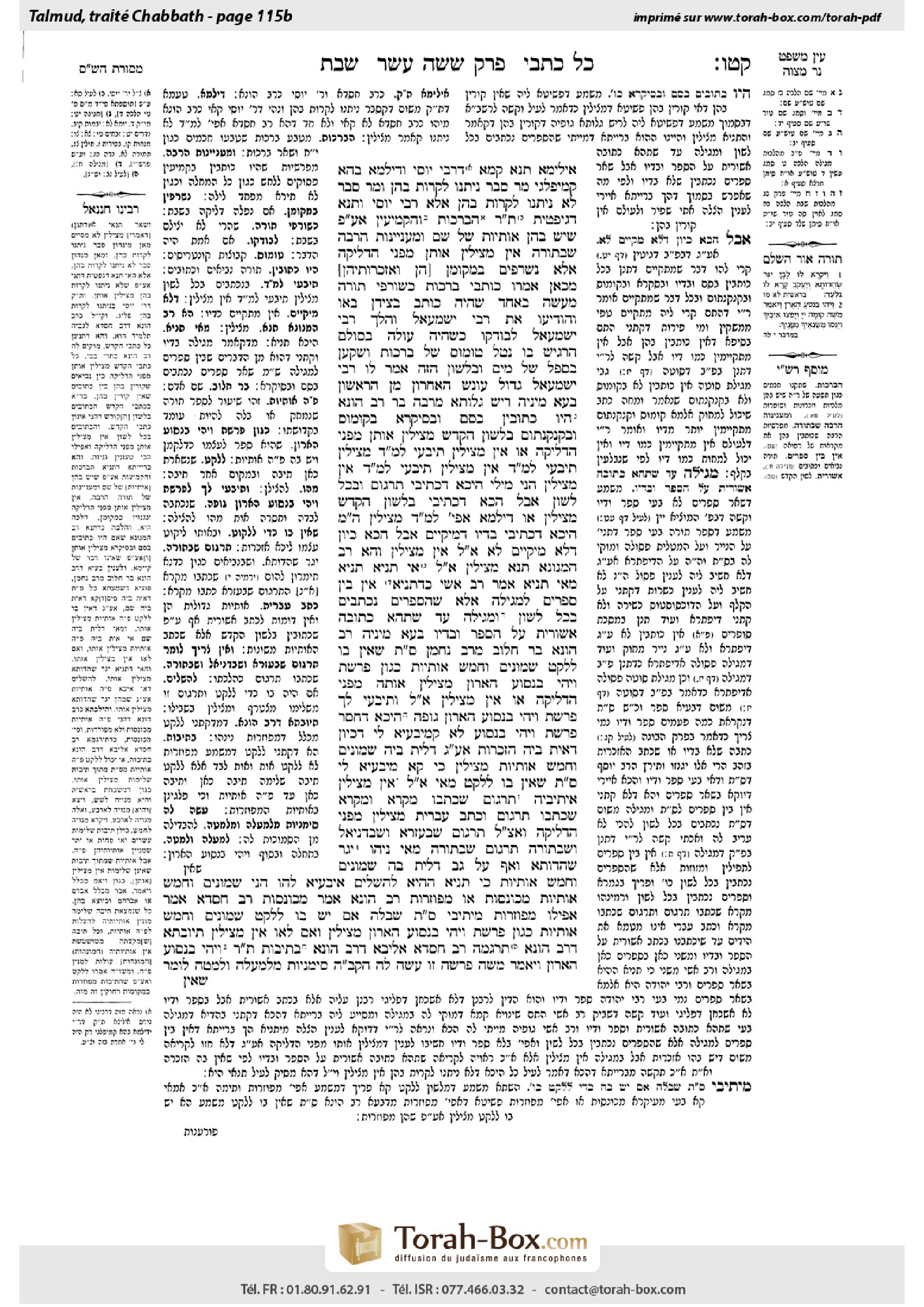
Shabbat 115b: Talmud study for Daf Yomi
Daf Yomi is the daily study of one Talmud folio. Explore 37 tractates with scans, Hebrew text, Sefaria English and AI-generated French translations where annotated.
Passage selection and English or AI-generated French translation are available where the scan has annotations. Daf Study is independent of Torah-Box and Sefaria.
Browse Shabbat · שבת · All tractatesShabbat 115b text and translations
This page of Shabbat includes the Aramaic text, an English translation and an AI-generated French translation, alongside the scan above.
שבת קי״ה ב · Aramaic and Hebrew text
אִילֵּימָא תַּנָּא קַמָּא דְּרַבִּי יוֹסֵי — וְדִילְמָא בְּהָא קָמִיפַּלְגִי, מָר סָבַר: נִיתְּנוּ לִקְרוֹת בָּהֶן, וּמָר סָבַר: לֹא נִיתְּנוּ לִקְרוֹת בָּהֶן. אֶלָּא רַבִּי יוֹסֵי וְתַנָּא דְּגִיפְטִית.
תָּנוּ רַבָּנַן: הַבְּרָכוֹת וְהַקְּמֵיעִין, אַף עַל פִּי שֶׁיֵּשׁ בָּהֶן אוֹתִיּוֹת שֶׁל שֵׁם וּמֵעִנְיָינוֹת הַרְבֵּה שֶׁבַּתּוֹרָה — אֵין מַצִּילִין אוֹתָן מִפְּנֵי הַדְּלֵיקָה, אֶלָּא נִשְׂרָפִים בִּמְקוֹמָן [הֵן וְאַזְכָּרוֹתֵיהֶן]. מִכָּאן אָמְרוּ: כּוֹתְבֵי בְרָכוֹת כְּשׂוֹרְפֵי תוֹרָה. מַעֲשֶׂה בְּאֶחָד שֶׁהָיָה כּוֹתֵב בְּצַיְדָּן, בָּאוּ וְהוֹדִיעוּ אֶת רַבִּי יִשְׁמָעֵאל, וְהָלַךְ רַבִּי יִשְׁמָעֵאל לְבוֹדְקוֹ. כְּשֶׁהָיָה עוֹלֶה בַּסּוּלָּם הִרְגִּישׁ בּוֹ, נָטַל טוֹמוֹס שֶׁל בְּרָכוֹת וְשִׁקְּעָן בְּסֵפֶל שֶׁל מַיִם. וּבַלָּשׁוֹן הַזֶּה אָמַר לוֹ רַבִּי יִשְׁמָעֵאל: גָּדוֹל עוֹנֶשׁ הָאַחֲרוֹן מִן הָרִאשׁוֹן.
בְּעָא מִינֵּיהּ רֵישׁ גָּלוּתָא מֵרַבָּה בַּר רַב הוּנָא: הָיוּ כְּתוּבִין בְּסַם וּבְסִיקְרָא בְּקוֹמוֹס וּבְקַנְקַנְתּוֹם, בִּלְשׁוֹן הַקֹּדֶשׁ, מַצִּילִין אוֹתָן מִפְּנֵי הַדְּלֵיקָה אוֹ אֵין מַצִּילִין? תִּיבְּעֵי לְמַאן דְּאָמַר מַצִּילִין, תִּיבְּעֵי לְמַאן דְּאָמַר אֵין מַצִּילִין. תִּיבְּעֵי לְמַאן דְּאָמַר אֵין מַצִּילִין — הָנֵי מִילֵּי הֵיכָא דִּכְתִיבִי תַּרְגּוּם וּבְכָל לָשׁוֹן, אֲבָל הָכָא דִּכְתִיבִי בִּלְשׁוֹן הַקֹּדֶשׁ — מַצִּילִין, אוֹ דִילְמָא אֲפִילּוּ לְמַאן דְּאָמַר מַצִּילִין — הָנֵי מִילֵּי הֵיכָא דִּכְתִיבִי בִּדְיוֹ דְּמִיקַּיַּים, אֲבָל הָכָא כֵּיוָן דְּלָא מִיקַּיַּים — לָא. אֲמַר לֵיהּ: אֵין מַצִּילִין. וְהָא רַב הַמְנוּנָא תָּנָא מַצִּילִין! אֲמַר לֵיהּ: אִי תַּנְיָא — תַּנְיָא. מַאי תַּנְיָא? אָמַר רַב אָשֵׁי, כִּדְתַנְיָא: אֵין בֵּין סְפָרִים לִמְגִילָּה אֶלָּא שֶׁהַסְּפָרִים נִכְתָּבִים בְּכׇל לָשׁוֹן, וּמְגִילָּה עַד שֶׁתְּהֵא כְּתוּבָה אַשּׁוּרִית, עַל הַסֵּפֶר, וּבִדְיוֹ.
בְּעָא מִינֵּיהּ רַב הוּנָא בַּר חֲלוּב מֵרַב נַחְמָן: סֵפֶר תּוֹרָה שֶׁאֵין בּוֹ לְלַקֵּט שְׁמוֹנִים וְחָמֵשׁ אוֹתִיּוֹת, כְּגוֹן פָּרָשַׁת ״וַיְהִי בִּנְסוֹעַ הָאָרוֹן״, מַצִּילִין אוֹתָן מִפְּנֵי הַדְּלֵיקָה, אוֹ אֵין מַצִּילִין? אֲמַר לֵיהּ: וְתִיבְּעֵי לָךְ פָּרָשַׁת ״וַיְהִי בִּנְסוֹעַ הָאָרוֹן״ גּוּפַהּ? הֵיכָא דְּחָסַר פָּרָשַׁת ״וַיְהִי בִּנְסוֹעַ״ — לָא קָמִיבַּעְיָא לִי, דְּכֵיוָן דְּאִית בֵּיהּ הַזְכָּרוֹת, אַף עַל גַּב דְּלֵית בֵּיהּ שְׁמוֹנִים וְחָמֵשׁ אוֹתִיּוֹת — מַצִּילִין. כִּי קָא מִיבַּעְיָא לִי סֵפֶר תּוֹרָה שֶׁאֵין בּוֹ לְלַקֵּט, מַאי? אֲמַר לֵיהּ: אֵין מַצִּילִין.
אֵיתִיבֵיהּ: תַּרְגּוּם שֶׁכְּתָבוֹ מִקְרָא, וּמִקְרָא שֶׁכְּתָבוֹ תַּרְגּוּם, וּכְתָב עִבְרִית — מַצִּילִין מִפְּנֵי הַדְּלֵיקָה. וְאֵין צָרִיךְ לוֹמַר תַּרְגּוּם שֶׁבְּעֶזְרָא וְשֶׁבְּדָנִיאֵל וְשֶׁבַּתּוֹרָה. תַּרְגּוּם שֶׁבַּתּוֹרָה מַאי נִיהוּ? — ״יְגַר שָׂהֲדוּתָא״, וְאַף עַל גַּב דְּלֵית בַּהּ שְׁמוֹנִים וְחָמֵשׁ אוֹתִיּוֹת! כִּי תַּנְיָא הַהִיא — לְהַשְׁלִים.
אִיבַּעְיָא לְהוּ: הָנֵי שְׁמוֹנִים וְחָמֵשׁ אוֹתִיּוֹת, מְכוּנָּסוֹת אוֹ מְפוּזָּרוֹת? רַב הוּנָא אָמַר: מְכוּנָּסוֹת. רַב חִסְדָּא אָמַר: אֲפִילּוּ מְפוּזָּרוֹת. מֵיתִיבִי: סֵפֶר תּוֹרָה שֶׁבָּלָה, אִם יֵשׁ בּוֹ לְלַקֵּט שְׁמוֹנִים וְחָמֵשׁ אוֹתִיּוֹת, כְּגוֹן פָּרָשַׁת ״וַיְהִי בִּנְסוֹעַ הָאָרוֹן״ — מַצִּילִין, וְאִם לָאו — אֵין מַצִּילִין. תְּיוּבְתָּא דְרַב הוּנָא! תַּרְגְּמַהּ רַב חִסְדָּא אַלִּיבָּא דְרַב הוּנָא בְּתֵיבוֹת.
תָּנוּ רַבָּנַן: ״וַיְהִי בִּנְסוֹעַ הָאָרוֹן וַיֹּאמֶר מֹשֶׁה״ — פָּרָשָׁה זוֹ עָשָׂה לָהּ הַקָּדוֹשׁ בָּרוּךְ הוּא סִימָנִיּוֹת מִלְּמַעְלָה וּלְמַטָּה, לוֹמַר
Shabbat 115b · English translation
If we say it is the first tanna who disagrees with Rabbi Yosei, that is not necessarily so, and perhaps they are disagreeing about this: This Master, the first tanna, holds that books written in other languages may be read; and this Master, Rabbi Yosei, holds that they may not be read, and their dispute is unrelated to the dispute between Rav Huna and Rav Ḥisda. Rather, it is the dispute between Rabbi Yosei and the first tanna, who spoke about books written in Coptic. According to that tanna, even books that may not be read are rescued, whereas Rabbi Yosei holds that they are not rescued.
The Sages taught in a baraita: The blessings that are written and the amulets, even though there are the letters of the Name of God in them and matters that appear in the Torah are mentioned in them, they are not rescued from the fire; rather, they burn in their place, they and the names of God contained therein. From here the Sages said: Writers of blessings are like burners of Torah scrolls, as it is prohibited to rescue these texts from the fire on Shabbat even though it is likely that they will be destroyed. There was an incident involving one who was writing pages with blessings in Sidon. They came and informed Rabbi Yishmael of his actions, and Rabbi Yishmael went to examine him to determine if the report was true. When Rabbi Yishmael was ascending the ladder to confront him, the scribe sensed his presence, took a bundle [tomos] of blessings, and submerged it in a basin of water to conceal it from Rabbi Yishmael. And in these words Rabbi Yishmael said to him: The punishment for the latter action is greater than the punishment for the former. Although it is prohibited to write blessings, destroying them is a greater violation.
The Exilarch raised a dilemma before Rabba bar Rav Huna: If the sacred scrolls were written in yellow-tinged arsenic, or red paint, in gum, or in iron sulfate, types of ink which may not be used to write Torah scrolls; however, the scrolls were written properly in the holy tongue, does one rescue them from the fire on Shabbat or does one not rescue them? The Gemara adds: This dilemma is raised according to the one who said that one rescues sacred writings written in other languages; and this dilemma is raised according to the one who said that one does not rescue them. The Gemara elaborates. This dilemma is raised according to the one who said that one does not rescue them: Perhaps that applies specifically in a case where they are written in Aramaic translation and in any foreign language; however, here, where they are written in the holy tongue, one rescues them. Or perhaps even according to the one who said that one rescues them, that applies specifically in a case where they are written in ink that endures; however, here, since the script does not endure, they are not rescued. Rabba bar Rav Huna said to him: One does not rescue them. The Exilarch said to him: Didn’t Rav Hamnuna teach in a baraita that one saves them. Rabba bar Rav Huna said to him: If it was taught in a baraita, it was taught, and I retract my statement. The Gemara asks: What is the baraita that was taught on this matter? Rav Ashi said, as it was taught in a baraita: The only difference between the books of the Bible and the Megilla of Esther is that the books are written in any language and are valid, and the Megilla is only valid if it is written in Assyrian script, the familiar square Hebrew script, on a parchment scroll, and in ink. Apparently, other sacred books need not be written in ink.
Rav Huna bar Ḥaluv raised a dilemma before Rav Naḥman: With regard to a Torah scroll in which there is not enough to compile from it eighty-five complete letters written properly and in order, which is the minimum measure determined by the Sages for a Torah to maintain the sanctity of a Torah scroll, as in the portion of: “And when the Ark traveled” (Numbers 10:35–36), does one rescue it from the fire on Shabbat or does one not rescue it? Rav Naḥman said to him: And raise a dilemma with regard to the portion of: “And when the Ark traveled,” itself, i.e., does one rescue it on Shabbat if it is missing a single letter? Rav Huna bar Ḥaluv answered: In a case where the portion of: “And when the Ark traveled,” is incomplete, it is not a dilemma for me, as since it contains names of God, even though there are not eighty-five letters in it, it is rescued. However, the case where it is a dilemma for me is with regard to a Torah scroll in which there is not enough to compile from it eighty-five complete letters; what is the ruling? Is it rescued on Shabbat or not? Rav Naḥman said to him: It is not rescued.
Rav Huna bar Ḥaluv raised an objection to his opinion from that which we learned: A verse that is originally written in Aramaic translation that was written in the language of the Bible, and a verse that is originally written in the language of the Bible that was written in Aramaic translation, and a Torah that was written in ancient Hebrew script, one rescues them from the fire on Shabbat. And, needless to say, one saves the verses written in Aramaic translation that are in the book of Ezra, and that are in the book of Daniel, and that are in the Torah. What are the verses originally written in Aramaic translation in the Torah? It is the verse: “And Laban called it Yegar Sahaduta, and Jacob called it Gal Ed” (Genesis 31:47), and apparently, it is rescued, even though there are not eighty-five letters in it. Rav Naḥman answered him: That is no proof, as when that baraita was taught, it was in a case where the Aramaic verse is counted to complete the total of eighty-five letters, but it is not independently significant.
A dilemma was raised before the Sages: With regard to these eighty-five letters that allow one to rescue a Torah scroll, is that specifically when they are juxtaposed, or even when they are scattered? Rav Huna said: Only when they are juxtaposed. Rav Ḥisda said: Even when they are scattered. The Gemara raises an objection from that which we learned: With regard to a Torah scroll that is worn, if there is enough to compile from it eighty-five complete letters as in the portion of: “And when the Ark traveled,” one rescues it from the fire, and if not one does not rescue it. The term: To compile, indicates that the letters are not juxtaposed, and this is a conclusive refutation of the opinion of Rav Huna. Rav Ḥisda interpreted it according to the opinion of Rav Huna: Indeed, the baraita is referring to a case where the letters are scattered, but they are juxtaposed in the form of words. In that case, even Rav Huna agrees that it is a sacred book. Rav Huna and Rav Ḥisda only disagree in a case where isolated letters are scattered.
Apropos the portion: “And when the Ark traveled,” the Gemara cites that which the Sages taught in a baraita. It is stated: “And when the Ark traveled and Moses proclaimed: Rise up, God, and Your enemies will scatter and those who hate You will flee from before You.” And The Holy One, Blessed be He, made signs in the Torah for this portion, above and below, i.e., before and after it, in order to say
Shabbat 115b · Traduction française (IA)
Si nous disons que c’est le premier tanna qui est en désaccord avec Rabbi Yossé, ce n’est pas nécessairement le cas. Peut-être sont-ils en désaccord sur le point suivant : le premier maître estime que les livres écrits dans d’autres langues peuvent être lus, tandis que Rabbi Yossé estime qu’ils ne peuvent pas l’être. Leur désaccord n’a donc aucun rapport avec celui de Rav Houna et Rav Ḥisda. Il s’agit plutôt du désaccord entre Rabbi Yossé et le premier tanna, qui a parlé des livres écrits en copte. Selon ce tanna, même les livres qui ne peuvent pas être lus sont sauvés, tandis que Rabbi Yossé estime qu’ils ne sont pas sauvés.
Les Sages enseignèrent dans une baraïta : Les bénédictions écrites et les amulettes, bien qu’elles contiennent les lettres du Nom de Dieu et mentionnent des éléments qui figurent dans la Torah, ne sont pas sauvées de l’incendie ; elles brûlent au contraire sur place, elles et les noms de Dieu qu’elles contiennent. C’est de là que les Sages ont dit : Les rédacteurs de bénédictions sont semblables à ceux qui brûlent des rouleaux de la Torah, puisqu’il est interdit de sauver ces textes de l’incendie pendant Chabbat, même s’il est probable qu’ils seront détruits. Un homme écrivait des pages de bénédictions à Sidon. On vint rapporter ses actes à Rabbi Yishmaël, qui alla vérifier si le rapport était vrai. Alors que Rabbi Yishmaël montait à l’échelle pour le confronter, le scribe sentit sa présence, prit un paquet [tomos] de bénédictions et le plongea dans une bassine d’eau pour le cacher à Rabbi Yishmaël. C’est à propos de cet acte que Rabbi Yishmaël lui dit : La punition pour le second acte est plus lourde que celle pour le premier. Bien qu’il soit interdit d’écrire des bénédictions, les détruire constitue une transgression plus grave.
L’exilarque souleva une question devant Rabba bar Rav Houna : Si des écrits sacrés ont été écrits avec de l’arsenic teinté de jaune, de la peinture rouge, de la gomme ou du sulfate de fer, sortes d’encres qui ne peuvent pas être utilisées pour écrire des rouleaux de la Torah, mais qu’ils ont été rédigés correctement dans la langue sainte, les sauve-t-on de l’incendie pendant Chabbat ou non ? La Guemara ajoute : Cette question se pose selon celui qui dit que l’on sauve les écrits sacrés rédigés dans d’autres langues, et également selon celui qui dit qu’on ne les sauve pas. La Guemara développe : cette question se pose selon celui qui dit qu’on ne les sauve pas. Peut-être cela ne s’applique-t-il que lorsqu’ils sont rédigés en araméen traduit ou dans une autre langue étrangère ; mais ici, où ils sont rédigés dans la langue sainte, on les sauve. Ou peut-être, même selon celui qui dit qu’on les sauve, cela ne s’applique-t-il que lorsqu’ils sont rédigés avec une encre durable ; mais ici, puisque l’écriture ne dure pas, on ne les sauve pas. Rabba bar Rav Houna lui répondit : On ne les sauve pas. L’exilarque lui dit : Rav Hamnouna n’a-t-il pas enseigné dans une baraïta qu’on les sauve ? Rabba bar Rav Houna lui répondit : Si cela a été enseigné dans une baraïta, c’est ainsi, et je reviens sur ce que j’ai dit. La Guemara demande : Quelle baraïta a été enseignée à ce sujet ? Rav Ashi dit : Voici ce qui a été enseigné dans une baraïta : La seule différence entre les livres de la Bible et le rouleau d’Esther est que les livres peuvent être écrits dans n’importe quelle langue et restent valides, tandis que le rouleau d’Esther n’est valide que s’il est écrit en écriture assyrienne, c’est-à-dire dans l’écriture carrée hébraïque familière, sur un rouleau de parchemin et à l’encre. Il ressort de là que les autres livres sacrés n’ont pas besoin d’être écrits à l’encre.
Rav Houna bar Ḥalouv souleva une question devant Rav Naḥman : À propos d’un rouleau de la Torah dont il ne reste pas assez de texte correctement écrit et dans l’ordre pour en constituer quatre-vingt-cinq lettres complètes — mesure minimale fixée par les Sages pour qu’un texte conserve la sainteté d’un rouleau de la Torah, comme dans le passage : « Lorsque l’Arche partait » (Nombres 10,35-36) — le sauve-t-on de l’incendie pendant Chabbat ou non ? Rav Naḥman lui dit : Soulève aussi la question au sujet du passage « Lorsque l’Arche partait » lui-même : le sauve-t-on pendant Chabbat s’il lui manque une seule lettre ? Rav Houna bar Ḥalouv répondit : Si le passage « Lorsque l’Arche partait » est incomplet, cela ne me pose pas de question, car, puisqu’il contient des noms de Dieu, on le sauve même s’il ne compte pas quatre-vingt-cinq lettres. Mais la question que je me pose concerne un rouleau de la Torah dont il ne reste pas assez de texte pour en constituer quatre-vingt-cinq lettres complètes : quelle est la halakha ? Le sauve-t-on pendant Chabbat ou non ? Rav Naḥman lui dit : On ne le sauve pas.
Rav Houna bar Ḥalouv souleva une objection à son avis à partir de ce que nous avons appris : Un verset qui est à l’origine rédigé en araméen sous forme de traduction, mais qui a été écrit dans la langue de la Bible ; un verset qui est à l’origine rédigé dans la langue de la Bible, mais qui a été écrit en araméen sous forme de traduction ; et une Torah écrite en ancienne écriture hébraïque : on les sauve de l’incendie pendant Chabbat. À plus forte raison sauve-t-on les versets rédigés en araméen sous forme de traduction qui se trouvent dans le livre d’Ezra, dans le livre de Daniel et dans la Torah. Quels sont les versets de la Torah qui sont à l’origine rédigés en araméen sous forme de traduction ? Le verset : « Laban l’appela Yegar Sahaduta, et Jacob l’appela Gal Ed » (Genèse 31,47). Il semble donc qu’on le sauve, bien qu’il ne compte pas quatre-vingt-cinq lettres. Rav Naḥman lui répondit : Ce n’est pas une preuve, car lorsque cette baraïta a été enseignée, il s’agissait d’un cas où le verset araméen était compté pour compléter le total de quatre-vingt-cinq lettres, mais n’avait pas d’importance à lui seul.
Une question fut soulevée devant les Sages : Ces quatre-vingt-cinq lettres qui permettent de sauver un rouleau de la Torah doivent-elles nécessairement être contiguës, ou peuvent-elles aussi être dispersées ? Rav Houna dit : Seulement si elles sont contiguës. Rav Ḥisda dit : Même si elles sont dispersées. La Guemara soulève une objection à partir de ce que nous avons appris : À propos d’un rouleau de la Torah usé, s’il reste assez de texte pour en constituer quatre-vingt-cinq lettres complètes, comme dans le passage « Lorsque l’Arche partait », on le sauve de l’incendie ; sinon, on ne le sauve pas. Le terme « constituer » indique que les lettres ne sont pas contiguës, ce qui réfute définitivement l’avis de Rav Houna. Rav Ḥisda interpréta la baraïta selon l’avis de Rav Houna : en effet, la baraïta parle d’un cas où les lettres sont dispersées, mais forment des mots contigus. Dans ce cas, même Rav Houna reconnaît qu’il s’agit d’un écrit sacré. Rav Houna et Rav Ḥisda ne sont en désaccord que dans le cas où des lettres isolées sont dispersées.
À propos du passage « Lorsque l’Arche partait », la Guemara cite ce que les Sages enseignèrent dans une baraïta. Il est dit : « Lorsque l’Arche partait, Moïse proclamait : Lève-toi, ô Dieu, et que Tes ennemis se dispersent, que ceux qui Te haïssent fuient devant Toi. » Le Saint, béni soit-Il, plaça des signes dans la Torah pour encadrer ce passage, au-dessus et au-dessous, c’est-à-dire avant et après, afin de dire
Traduction française générée par IA à partir de l’édition anglaise de Sefaria. Vérifie toujours un passage avec le texte source.
Text from Sefaria: William Davidson Edition - Vocalized Aramaic (CC BY NC); William Davidson Edition - English (CC BY NC).