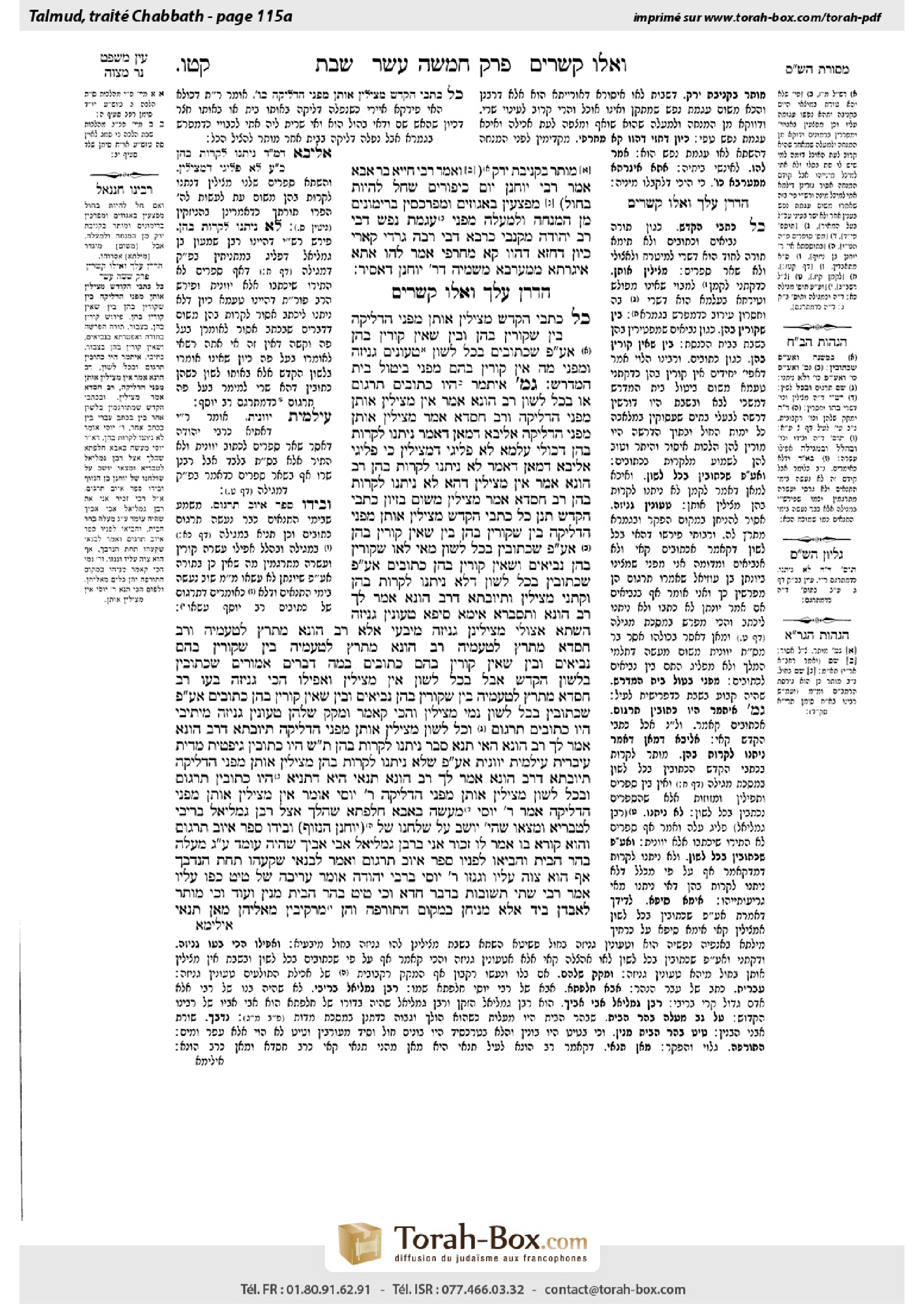
Shabbat 115a: Talmud study for Daf Yomi
Daf Yomi is the daily study of one Talmud folio. Explore 37 tractates with scans, Hebrew text, Sefaria English and AI-generated French translations where annotated.
Passage selection and English or AI-generated French translation are available where the scan has annotations. Daf Study is independent of Torah-Box and Sefaria.
Browse Shabbat · שבת · All tractatesShabbat 115a text and translations
This page of Shabbat includes the Aramaic text, an English translation and an AI-generated French translation, alongside the scan above.
שבת קי״ה א · Aramaic and Hebrew text
מוּתָּר בִּקְנִיבַת יָרָק. (וְאָמַר רַבִּי חִיָּיא בַּר אַבָּא אָמַר רַבִּי יוֹחָנָן: יוֹם כִּיפּוּרִים שֶׁחָל לִהְיוֹת בַּחוֹל) מְפַצְּעִין בֶּאֱגוֹזִים וּמְפַרְכְּסִין בְּרִימּוֹנִים מִן הַמִּנְחָה וּלְמַעְלָה מִפְּנֵי עׇגְמַת נֶפֶשׁ. דְּבֵי רַב יְהוּדָה מְקַנְּבִי כְּרָבָא. דְּבֵי רַבָּה גָּרְדִי קָארֵי. כֵּיוָן דַּחֲזָא דַּהֲווֹ קָא מְחָרְפִי, אֲמַר לְהוּ: אֲתַאי אִיגַּרְתָּא מִמַּעְרְבָא מִשְּׁמֵיהּ דְּרַבִּי יוֹחָנָן דַּאֲסִיר.
הדרן עלך ואלו קשרים
מַתְנִי׳ כׇּל כִּתְבֵי הַקֹּדֶשׁ מַצִּילִין אוֹתָן מִפְּנֵי הַדְּלֵיקָה, בֵּין שֶׁקּוֹרִין בָּהֶן, וּבֵין שֶׁאֵין קוֹרִין בָּהֶן. אַף עַל פִּי שֶׁכְּתוּבִים בְּכׇל לָשׁוֹן, טְעוּנִים גְּנִיזָה. וּמִפְּנֵי מָה אֵין קוֹרִין בָּהֶם — מִפְּנֵי בִּיטּוּל בֵּית הַמִּדְרָשׁ.
גְּמָ׳ אִיתְּמַר: הָיוּ כְּתוּבִים תַּרְגּוּם אוֹ בְּכׇל לָשׁוֹן, רַב הוּנָא אָמַר: אֵין מַצִּילִין אוֹתָן מִפְּנֵי הַדְּלֵיקָה, וְרַב חִסְדָּא אָמַר: מַצִּילִין אוֹתָן מִפְּנֵי הַדְּלֵיקָה. אַלִּיבָּא דְּמַאן דְּאָמַר נִיתְּנוּ לִקְרוֹת בָּהֶן — דְּכוּלֵּי עָלְמָא לָא פְּלִיגִי דְּמַצִּילִין. כִּי פְּלִיגִי אַלִּיבָּא דְּמַאן דְּאָמַר לֹא נִיתְּנוּ לִקְרוֹת בָּהֶן. רַב הוּנָא אָמַר: אֵין מַצִּילִין, דְּהָא לֹא נִיתְּנוּ לִקְרוֹת בָּהֶן. רַב חִסְדָּא: אָמַר מַצִּילִין מִשּׁוּם בִּזְיוֹן כִּתְבֵי הַקֹּדֶשׁ. תְּנַן: כׇּל כִּתְבֵי הַקֹּדֶשׁ מַצִּילִין אוֹתָן מִפְּנֵי הַדְּלֵיקָה, בֵּין שֶׁקּוֹרִין בָּהֶן בֵּין שֶׁאֵין קוֹרִין בָּהֶן, אַף עַל פִּי שֶׁכְּתוּבִין בְּכׇל לָשׁוֹן. מַאי לָאו, ״שֶׁקּוֹרִין בָּהֶן״ — נְבִיאִים, ״וְשֶׁאֵין קוֹרִין בָּהֶן״ — כְּתוּבִים, ״אַף עַל פִּי שֶׁכְּתוּבִין בְּכׇל לָשׁוֹן״ — דְּלֹא נִיתְּנוּ לִקְרוֹת בָּהֶן, וְקָתָנֵי: מַצִּילִין, וּתְיוּבְתָּא דְרַב הוּנָא!
אָמַר לְךָ רַב הוּנָא: וְתִסְבְּרָא? אֵימָא סֵיפָא: טְעוּנִין גְּנִיזָה — הַשְׁתָּא אַצּוֹלֵי מַצִּילִּינַן, גְּנִיזָה מִיבְּעֵי? אֶלָּא, רַב הוּנָא מְתָרֵץ לְטַעְמֵיהּ, וְרַב חִסְדָּא מְתָרֵץ לְטַעְמֵיהּ. רַב הוּנָא מְתָרֵץ לְטַעְמֵיהּ: ״בֵּין שֶׁקּוֹרִין בָּהֶם״ — נְבִיאִים, ״וּבֵין שֶׁאֵין קוֹרִין בָּהֶם״ — כְּתוּבִים. בַּמֶּה דְּבָרִים אֲמוּרִים — שֶׁכְּתוּבִין בִּלְשׁוֹן הַקֹּדֶשׁ, אֲבָל בְּכׇל לָשׁוֹן — אֵין מַצִּילִין, וַאֲפִילּוּ הָכִי גְּנִיזָה בָּעוּ. רַב חִסְדָּא מְתָרֵץ לְטַעְמֵיהּ: ״בֵּין שֶׁקּוֹרִין בָּהֶן״ — נְבִיאִים, ״וּבֵין שֶׁאֵין קוֹרִין בָּהֶן״ — כְּתוּבִים, אַף עַל פִּי שֶׁכְּתוּבִין בְּכׇל לָשׁוֹן, נָמֵי מַצִּילִין. וְהָכִי קָאָמַר: וּמְקָק שֶׁלָּהֶן טְעוּנִין גְּנִיזָה.
מֵיתִיבִי: הָיוּ כְּתוּבִים תַּרְגּוּם וְכׇל לָשׁוֹן — מַצִּילִין אוֹתָן מִפְּנֵי הַדְּלֵיקָה. תְּיוּבְתָּא דְרַב הוּנָא! אָמַר לְךָ רַב הוּנָא: הַאי תַּנָּא סָבַר נִיתְּנוּ לִקְרוֹת בָּהֶן. תָּא שְׁמַע: הָיוּ כְּתוּבִין גִּיפְטִית, מָדִית, עִיבְרִית, עֵילָמִית, יְווֹנִית, אַף עַל פִּי שֶׁלֹּא נִיתְּנוּ לִקְרוֹת בָּהֶן — מַצִּילִין אוֹתָן מִפְּנֵי הַדְּלֵיקָה. תְּיוּבְתָּא דְרַב הוּנָא! אָמַר לְךָ רַב הוּנָא: תַּנָּאֵי הִיא, דְּתַנְיָא: הָיוּ כְּתוּבִין תַּרְגּוּם וּבְכָל לָשׁוֹן — מַצִּילִין אוֹתָן מִפְּנֵי הַדְּלֵיקָה. רַבִּי יוֹסֵי אוֹמֵר: אֵין מַצִּילִין אוֹתָן מִפְּנֵי הַדְּלֵיקָה.
אָמַר רַבִּי יוֹסֵי: מַעֲשֶׂה בְּאַבָּא חֲלַפְתָּא שֶׁהָלַךְ אֵצֶל רַבָּן גַּמְלִיאֵל בְּרִיבִּי לִטְבֶרְיָא, וּמְצָאוֹ שֶׁהָיָה יוֹשֵׁב עַל שֻׁלְחָנוֹ שֶׁל יוֹחָנָן הַנָּזוּף וּבְיָדוֹ סֵפֶר אִיּוֹב תַּרְגּוּם, וְהוּא קוֹרֵא בּוֹ. אָמַר לוֹ: זָכוּר אֲנִי בְּרַבָּן גַּמְלִיאֵל אֲבִי אָבִיךָ שֶׁהָיָה עוֹמֵד עַל גַּבֵּי מַעֲלָה בְּהַר הַבַּיִת, וְהֵבִיאוּ לְפָנָיו סֵפֶר אִיּוֹב תַּרְגּוּם, וְאָמַר לַבַּנַּאי: שַׁקְּעֵהוּ תַּחַת הַנִּדְבָּךְ. אַף הוּא צִוָּה עָלָיו וּגְנָזוֹ. רַבִּי יוֹסֵי בְּרַבִּי יְהוּדָה אוֹמֵר: עֲרֵיבָה שֶׁל טִיט כָּפוּ עָלָיו. אָמַר רַבִּי, שְׁתֵּי תְּשׁוּבוֹת בַּדָּבָר: חֲדָא, וְכִי טִיט בְּהַר הַבַּיִת מִנַּיִן? וְעוֹד, וְכִי מוּתָּר לְאַבְּדָן בַּיָּד? אֶלָּא מַנִּיחָן בִּמְקוֹם הַתּוּרְפָּה וְהֵן מַרְקִיבִין מֵאֲלֵיהֶן. מַאן תַּנָּאֵי
Shabbat 115a · English translation
trimming vegetables is permitted. And Rabbi Ḥiyya bar Abba said that Rabbi Yoḥanan said: If Yom Kippur occurs on a weekday, one may crack nuts and remove pomegranate seeds from the late afternoon and onward, because doing so involves no actual labor and due to anxiety, i.e., if a person does not know that there is food prepared for when the fast ends, he suffers more during the final hours of the day (Rabbi Zeraḥia HaLevi). The Gemara relates: The members of Rav Yehuda’s house would trim cabbage. The members of Rabba’s house would scrub gourds. Once Rabba saw that they were doing this early, before the late afternoon, he said to them: A letter came from the West, i.e., from Eretz Yisrael, in the name of Rabbi Yoḥanan, saying that doing so is prohibited.
MISHNA: With regard to all sacred writings, one may rescue them from the fire on Shabbat, whether they are read in public, e.g., Torah or Prophets scrolls, or whether they are not read in public, e.g., Writings scrolls. This ruling applies even though they were written in any foreign language. According to the Rabbis, those scrolls are not read in public, but they are still sacred and require burial. And why does one not read the Writings on Shabbat? Due to suspension of Torah study in the study hall. People came to the study hall at specific times on Shabbat to hear words of halakha, and other texts were not allowed at those times.
GEMARA: It was stated that amora’im debated the status of sacred writings written in Aramaic translation or in any other language. Rav Huna said: One may not rescue them from the fire on Shabbat. And Rav Ḥisda said: One may rescue them from the fire on Shabbat. The Gemara adds: According to the one who said that sacred writings written in other languages may be read, everybody agrees that one may rescue them. Where they argue is according to the one who said that they may not be read. Rav Huna said: One may not rescue them, as they may not be read. Whereas Rav Ḥisda said: One may rescue them due to disgrace to sacred writings that will result. We learned in the mishna: With regard to all sacred writings, one may rescue them from the fire on Shabbat whether they are read in public or whether they are not read in public, even if they are written in any foreign language. What, is it not that the phrase: “That they are read” is referring to the books of the Prophets, and the phrase: “That they are not read” is referring to the Writings? Even though these are books written in any foreign language, which may not be read, it is taught that one may save them. This then is a conclusive refutation of the opinion of Rav Huna.
Rav Huna could have said to you: And do you understand the mishna that way? Say the latter clause of the mishna, which states: They require burial. This is unnecessary, as now, that it was mentioned that we rescue them from the fire, is it necessary to say that they require burial? Rather, the mishna must be emended. Rav Huna reconciles the mishna in accordance with his reasoning, and Rav Ḥisda reconciles the mishna in accordance with his reasoning. Rav Huna reconciles this in accordance with his reasoning: Whether they are read is referring to the Prophets, and whether they are not read is referring to the Writings. In what case is this statement said? It is in a case where they are written in the holy tongue, but if they are not written in Hebrew but in any other language, they are not rescued from the fire on Shabbat, and even so, they require burial. Rav Ḥisda reconciles the mishna in accordance with his reasoning: Whether they are read is referring to the Prophets, and whether they are not read is referring to the Writings, even if they are written in any language other than Hebrew, they are also rescued. And this is what the mishna is saying: And even the decayed sections of parchment require burial.
The Gemara raises an objection from that which was taught in a baraita: If they were written in Aramaic translation or in any language other than Hebrew, they are rescued from the fire on Shabbat. And this is a conclusive refutation of the opinion of Rav Huna, who states that these are not rescued. Rav Huna could have said to you: This tanna holds that sacred writings not written in Hebrew may be read, whereas Rav Huna stated his ruling in accordance with the opinion of the tanna who holds that they may not be read, and therefore may not be rescued. Come and hear another proof from that which was taught in a different baraita: Sacred writings that were written in Coptic, Egyptian; Median; Ivrit, i.e., ancient Hebrew script; Eilamitic; or Greek are rescued from the fire on Shabbat, even though they may not be read. This is a conclusive refutation of the opinion of Rav Huna, who holds that they are not rescued. Rav Huna could have said to you: This is a dispute between tanna’im, as it was taught in a baraita: If they were written in Aramaic translation or in any language other than Hebrew, one may rescue them from the fire on Shabbat. Rabbi Yosei says: One may not rescue them from the fire.
Rabbi Yosei said: There was an incident involving my father, Ḥalafta, who went to the esteemed Rabban Gamliel of Yavne in Tiberias, where he found him sitting at the table of Yoḥanan HaNazuf and in his hand there was a translation of the book of Job, and he was reading from it. Yoḥanan said to Rabban Gamliel of Yavne: I remember Rabban Gamliel, your father’s father, who was standing on top of a step on the Temple Mount. And they brought before him a translation of the book of Job, and he said to the builder: Bury this book under the course of bricks. When he heard of that incident, Rabban Gamliel of Yavne ordered that it be buried and he buried it. Rabbi Yosei, son of Rabbi Yehuda, says that on the Temple Mount they overturned a large bowl of mortar on it. Rabbi Yehuda HaNasi said: There are two responses to this that prove that it did not happen: One, from where would they get mortar on the Temple Mount? Construction on the Temple Mount was performed with other materials, not with mortar. And furthermore, is it permitted to actively destroy even sacred writings that are not read, with one’s hands? Rather, at the very least they leave them in a neglected place, where they are likely to decompose quickly, and they decay on their own. The Gemara seeks to clarify: Who are the tanna’im who dispute this halakha according to Rav Huna?
Shabbat 115a · Traduction française (IA)
La taille des légumes est permise. Rabbi Ḥiyya bar Abba a dit au nom de Rabbi Yoḥanan : Si Yom Kippour tombe un jour de semaine, on peut casser des noix et retirer les graines des grenades à partir de la fin de l’après-midi, car cela n’implique aucun véritable travail et en raison de l’anxiété : si quelqu’un ne sait pas que de la nourriture est préparée pour la fin du jeûne, il souffre davantage durant les dernières heures de la journée (Rabbi Zeraḥia HaLevi). La Guemara rapporte que les membres de la maison de Rav Yehuda taillaient du chou. Ceux de la maison de Rabba frottaient des courges. Un jour, Rabba les vit faire cela tôt, avant la fin de l’après-midi, et leur dit : « Une lettre est arrivée de l’Ouest, c’est-à-dire d’Eretz Israël, au nom de Rabbi Yoḥanan, disant que cela est interdit. »
Michna : Tous les écrits sacrés peuvent être sauvés du feu pendant Chabbat, qu’ils soient lus en public, comme les rouleaux de la Torah ou des Prophètes, ou qu’ils ne soient pas lus en public, comme les rouleaux des Écrits. Cette règle s’applique même s’ils ont été écrits dans une langue étrangère quelconque. Selon les Rabbins, ces rouleaux ne sont pas lus en public, mais ils demeurent sacrés et doivent être mis en terre. Et pourquoi ne lit-on pas les Écrits pendant Chabbat ? En raison de la suspension de l’étude de la Torah dans la maison d’étude. À des heures précises de Chabbat, les gens venaient à la maison d’étude écouter des enseignements de halakha, et d’autres textes n’étaient pas autorisés à ces moments-là.
Guemara : Des amoraïm ont débattu du statut des écrits sacrés rédigés en traduction araméenne ou dans une autre langue. Rav Huna a dit : On ne peut pas les sauver du feu pendant Chabbat. Rav Ḥisda a dit : On peut les sauver du feu pendant Chabbat. La Guemara ajoute : Selon celui qui affirme que les écrits sacrés rédigés dans d’autres langues peuvent être lus, tous conviennent qu’on peut les sauver. Leur désaccord porte sur l’opinion selon laquelle ils ne peuvent pas être lus. Rav Huna a dit : On ne peut pas les sauver, puisqu’ils ne peuvent pas être lus. Rav Ḥisda, en revanche, a dit : On peut les sauver, afin d’éviter le déshonneur qui serait fait aux écrits sacrés. Nous avons appris dans la Michna : Tous les écrits sacrés peuvent être sauvés du feu pendant Chabbat, qu’ils soient lus en public ou qu’ils ne le soient pas, même s’ils sont écrits dans une langue étrangère quelconque. Ne faut-il pas comprendre que l’expression « qu’ils soient lus » désigne les livres des Prophètes, et que l’expression « qu’ils ne soient pas lus » désigne les Écrits ? Bien qu’il s’agisse de livres écrits dans une langue étrangère quelconque et qui ne peuvent pas être lus, il est enseigné qu’on peut les sauver. Voilà donc une réfutation décisive de l’opinion de Rav Huna.
Rav Huna aurait pu te répondre : « Comprends-tu vraiment la Michna de cette façon ? » Considère la dernière partie de la Michna, qui dit qu’ils doivent être mis en terre. C’est superflu : maintenant qu’il a été précisé qu’on les sauve du feu, faut-il encore dire qu’ils doivent être mis en terre ? La Michna doit plutôt être corrigée. Rav Huna interprète la Michna conformément à son raisonnement, et Rav Ḥisda l’interprète conformément au sien. Rav Huna interprète la Michna conformément à son raisonnement : « qu’ils soient lus » désigne les Prophètes, et « qu’ils ne soient pas lus » désigne les Écrits. Dans quel cas cette déclaration est-elle faite ? Lorsque ces livres sont écrits dans la langue sainte. Mais s’ils ne sont pas écrits en hébreu et le sont dans une autre langue, on ne les sauve pas du feu pendant Chabbat ; ils doivent néanmoins être mis en terre. Rav Ḥisda interprète la Michna conformément à son raisonnement : « qu’ils soient lus » désigne les Prophètes, et « qu’ils ne soient pas lus » désigne les Écrits ; même s’ils sont écrits dans une langue autre que l’hébreu, on peut aussi les sauver. Et voici ce que dit la Michna : même les fragments de parchemin détériorés doivent être mis en terre.
La Guemara soulève une objection à partir de ce qui a été enseigné dans une baraïta : « S’ils ont été écrits en traduction araméenne ou dans une langue autre que l’hébreu, on peut les sauver du feu pendant Chabbat. » C’est une réfutation décisive de l’opinion de Rav Huna, qui affirme qu’on ne peut pas les sauver. Rav Huna aurait pu te répondre : « Ce tanna estime que les écrits sacrés qui ne sont pas rédigés en hébreu peuvent être lus, tandis que Rav Huna a formulé sa décision conformément à l’opinion du tanna qui estime qu’ils ne peuvent pas être lus et que, par conséquent, on ne peut pas les sauver. » Viens et entends une autre preuve tirée de ce qui a été enseigné dans une autre baraïta : « Les écrits sacrés rédigés en copte, c’est-à-dire en égyptien, en mède, en ivrit, c’est-à-dire dans l’ancienne écriture hébraïque, en élamite ou en grec peuvent être sauvés du feu pendant Chabbat, bien qu’ils ne puissent pas être lus. » C’est une réfutation décisive de l’opinion de Rav Huna, qui estime qu’on ne peut pas les sauver. Rav Huna aurait pu te répondre : « Il s’agit d’un désaccord entre des tannaïm, car il a été enseigné dans une baraïta : “S’ils ont été écrits en traduction araméenne ou dans une langue autre que l’hébreu, on peut les sauver du feu pendant Chabbat.” Rabbi Yosei dit : “On ne peut pas les sauver du feu.” »
Rabbi Yosei a dit : « Il est arrivé que mon père, Ḥalafta, se rende auprès du vénérable Rabban Gamliel de Yavné, à Tibériade, et le trouve assis à la table de Yoḥanan HaNazuf, avec dans la main une traduction du livre de Job, qu’il lisait. Yoḥanan dit à Rabban Gamliel de Yavné : “Je me souviens de Rabban Gamliel, le père de ton père, qui se tenait au sommet d’une marche sur le mont du Temple. On lui apporta une traduction du livre de Job, et il dit au maçon : ‘Enterre ce livre sous une rangée de briques.’” Ayant entendu parler de cet épisode, Rabban Gamliel de Yavné ordonna qu’on l’enterre, et il l’enterra. Rabbi Yosei, fils de Rabbi Yehuda, dit que, sur le mont du Temple, on renversa dessus une grande auge de mortier. Rabbi Yehuda HaNasi dit : “Deux arguments montrent que cela ne s’est pas produit. Premièrement, d’où aurait-on trouvé du mortier sur le mont du Temple ? Les constructions du mont du Temple étaient réalisées avec d’autres matériaux, et non avec du mortier. De plus, est-il permis de détruire volontairement, de ses propres mains, même des écrits sacrés qui ne sont pas lus ? Il faut plutôt, tout au moins, les laisser dans un endroit négligé, où ils risquent de se décomposer rapidement, et les laisser se détériorer d’eux-mêmes.” » La Guemara cherche à préciser : « Quels sont les tannaïm qui sont en désaccord sur cette halakha selon Rav Huna ? »
Traduction française générée par IA à partir de l’édition anglaise de Sefaria. Vérifie toujours un passage avec le texte source.
Text from Sefaria: William Davidson Edition - Vocalized Aramaic (CC BY NC); William Davidson Edition - English (CC BY NC).