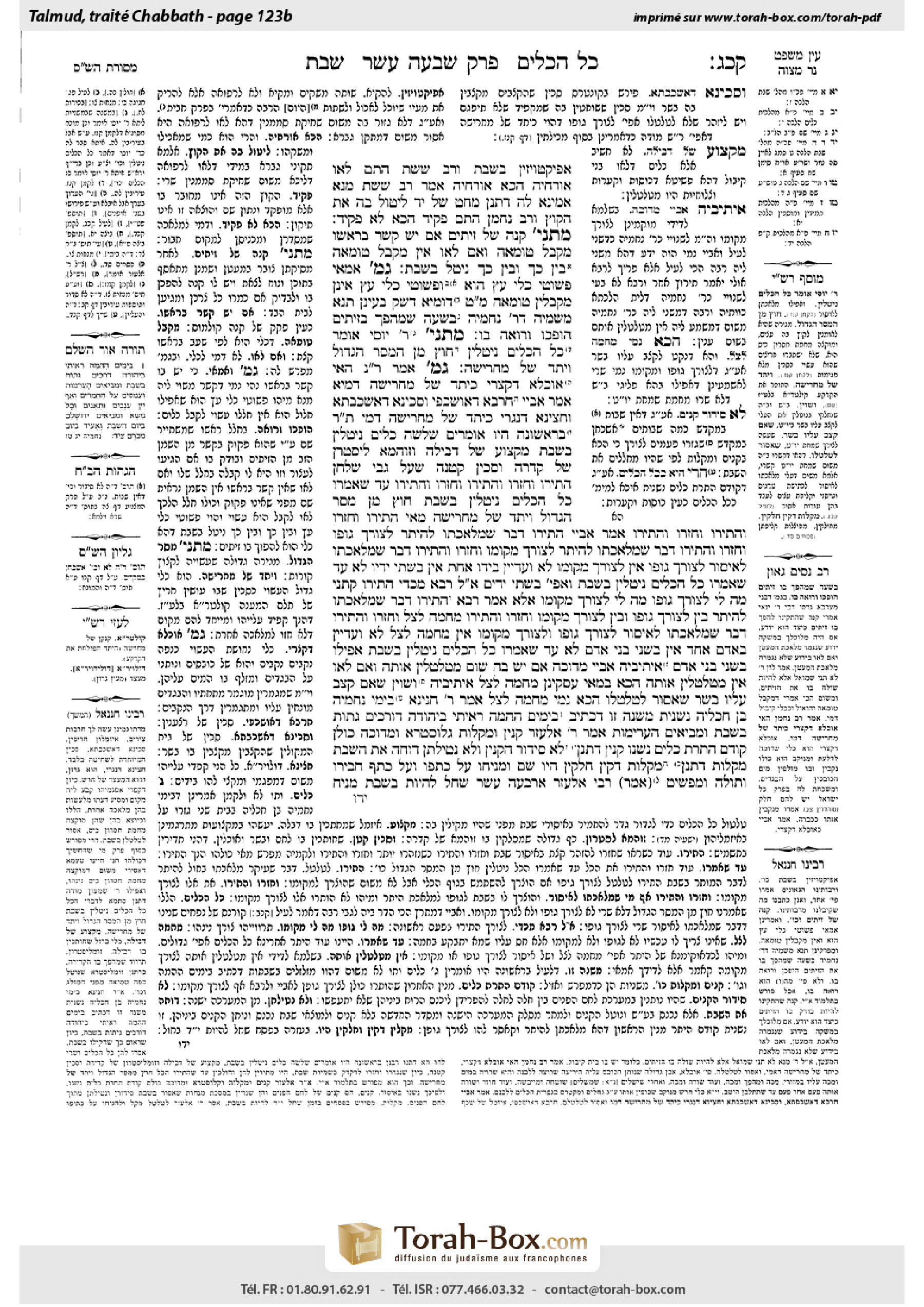
Shabbat 123b: Talmud study for Daf Yomi
Daf Yomi is the daily study of one Talmud folio. Explore 37 tractates with scans, Hebrew text, Sefaria English and AI-generated French translations where annotated.
Passage selection and English or AI-generated French translation are available where the scan has annotations. Daf Study is independent of Torah-Box and Sefaria.
Browse Shabbat · שבת · All tractatesShabbat 123b text and translations
This page of Shabbat includes the Aramaic text, an English translation and an AI-generated French translation, alongside the scan above.
שבת קכ״ג ב · Aramaic and Hebrew text
אַפִּיקְטְוִיזִין בַּשַּׁבָּת. וְרַב שֵׁשֶׁת: הָתָם — לָאו אוֹרְחֵיהּ, הָכָא — אוֹרְחֵיהּ.
אָמַר רַב שֵׁשֶׁת: מְנָא אָמֵינָא לַהּ — דִּתְנַן: מַחַט שֶׁל יָד — לִיטּוֹל בָּהּ אֶת הַקּוֹץ! וְרַב נַחְמָן: הָתָם — פְּקִיד, הָכָא — לָא פְּקִיד.
מַתְנִי׳ קָנֶה שֶׁל זֵיתִים, אִם יֵשׁ קֶשֶׁר בְּרֹאשׁוֹ — מְקַבֵּל טוּמְאָה, וְאִם לָאו — אֵין מְקַבֵּל טוּמְאָה. בֵּין כָּךְ וּבֵין כָּךְ — נִיטָּל בַּשַּׁבָּת.
גְּמָ׳ אַמַּאי? פְּשׁוּטֵי כְלֵי עֵץ הוּא, וּפְשׁוּטֵי כְלֵי עֵץ אֵינָן מְקַבְּלִין טוּמְאָה, מַאי טַעְמָא? — דּוּמְיָא דְּשַׂק בָּעֵינַן. תָּנָא מִשְּׁמֵיהּ דְּרַבִּי נְחֶמְיָה: בְּשָׁעָה שֶׁמְּהַפֵּךְ בְּזֵיתִים הוֹפְכוֹ וְרוֹאֶה בּוֹ.
מַתְנִי׳ רַבִּי יוֹסֵי אוֹמֵר: כׇּל הַכֵּלִים נִיטָּלִין, חוּץ מִן הַמַּסָּר הַגָּדוֹל וְיָתֵד שֶׁל מַחֲרֵישָׁה.
גְּמָ׳ אָמַר רַב נַחְמָן: הַאי אוּכְלָא דְקַצָּרֵי — כְּיָתֵד שֶׁל מַחֲרֵישָׁה דָּמְיָא.
אָמַר אַבָּיֵי: חַרְבָּא דְאוּשְׁכָּפֵי וְסַכִּינָא דְאַשְׁכָּבְתָּא וַחֲצִינָא דְנַגָּרֵי — כְּיָתֵד שֶׁל מַחֲרֵישָׁה דָּמֵי.
תָּנוּ רַבָּנַן: בָּרִאשׁוֹנָה הָיוּ אוֹמְרִים שְׁלֹשָׁה כֵּלִים נִיטָּלִין בַּשַּׁבָּת: מִקְצוֹעַ שֶׁל דְּבֵילָה, וְזוּהֲמָא לִיסְטְרוֹן שֶׁל קְדֵרָה, וְסַכִּין קְטַנָּה שֶׁעַל גַּבֵּי שֻׁלְחָן. הִתִּירוּ, וְחָזְרוּ וְהִתִּירוּ, וְחָזְרוּ וְהִתִּירוּ, עַד שֶׁאָמְרוּ: כׇּל הַכֵּלִים נִיטָּלִין בַּשַּׁבָּת, חוּץ מִן מַסָּר הַגָּדוֹל וְיָתֵד שֶׁל מַחֲרֵישָׁה.
מַאי הִתִּירוּ, וְחָזְרוּ וְהִתִּירוּ, וְחָזְרוּ וְהִתִּירוּ?
אֲמַר אַבָּיֵי: הִתִּירוּ דָּבָר שֶׁמְּלַאכְתּוֹ לְהֶיתֵּר לְצוֹרֶךְ גּוּפוֹ, וְחָזְרוּ וְהִתִּירוּ דָּבָר שֶׁמְּלַאכְתּוֹ לְהֶיתֵּר לְצוֹרֶךְ מְקוֹמוֹ, וְחָזְרוּ וְהִתִּירוּ דָּבָר שֶׁמְּלַאכְתּוֹ לְאִיסּוּר, לְצוֹרֶךְ גּוּפוֹ — אִין, לְצוֹרֶךְ מְקוֹמוֹ — לָא. וַעֲדַיִין בְּיָדוֹ אַחַת — אִין, בִּשְׁתֵּי יָדָיו — לָא, עַד שֶׁאָמְרוּ: כׇּל הַכֵּלִים נִיטָּלִין בַּשַּׁבָּת, וַאֲפִילּוּ בִּשְׁתֵּי יָדַיִם.
אֲמַר לֵיהּ רָבָא: מִכְּדֵי ״הִתִּירוּ״ קָתָנֵי, מַה לִּי לְצוֹרֶךְ גּוּפוֹ, מַה לִּי לְצוֹרֶךְ מְקוֹמוֹ? אֶלָּא אָמַר רָבָא: הִתִּירוּ דָּבָר שֶׁמְּלַאכְתּוֹ לְהֶיתֵּר בֵּין לְצוֹרֶךְ גּוּפוֹ וּבֵין לְצוֹרֶךְ מְקוֹמוֹ, וְחָזְרוּ וְהִתִּירוּ מֵחַמָּה לַצֵּל. וְחָזְרוּ וְהִתִּירוּ דָּבָר שֶׁמְּלַאכְתּוֹ לְאִיסּוּר, לְצוֹרֶךְ גּוּפוֹ וּלְצוֹרֶךְ מְקוֹמוֹ — אִין, מֵחַמָּה לַצֵּל — לָא. וַעֲדַיִין, בְּאָדָם אֶחָד — אִין, בִּשְׁנֵי בְּנֵי אָדָם — לָא, עַד שֶׁאָמְרוּ: כׇּל הַכֵּלִים נִיטָּלִין בַּשַּׁבָּת, אֲפִילּוּ בִּשְׁנֵי בְּנֵי אָדָם.
אֵיתִיבֵיהּ אַבָּיֵי: מְדוֹכָה, אִם יֵשׁ בָּהּ שׁוּם — מְטַלְטְלִין אוֹתָהּ, וְאִם לָאו — אֵין מְטַלְטְלִין אוֹתָהּ? הָכָא בְּמַאי עָסְקִינַן — מֵחַמָּה לַצֵּל. אֵיתִיבֵיהּ: וְשָׁוִין שֶׁאִם קִצֵּב עָלָיו בָּשָׂר שֶׁאָסוּר לְטַלְטְלוֹ? הָכָא נָמֵי מֵחַמָּה לַצֵּל.
אָמַר רַבִּי חֲנִינָא: בִּימֵי נְחֶמְיָה בֶּן חֲכַלְיָה נִשְׁנֵית מִשְׁנָה זוֹ, דִּכְתִיב: ״בַּיָּמִים הָהֵמָּה רָאִיתִי בִיהוּדָה דּוֹרְכִים גִּתּוֹת בַּשַּׁבָּת וּמְבִיאִים הָעֲרֵימוֹת״.
אָמַר רַבִּי אֶלְעָזָר: קָנִין, וּמַקְלוֹת, גְּלוּסְטְרָא, וּמְדוֹכָה — כּוּלָּן קוֹדֶם הַתָּרַת כֵּלִים נִשְׁנוּ.
קָנִין — דִּתְנַן: לֹא סִידּוּר הַקָּנִין וְלֹא נְטִילָתָן דּוֹחָה אֶת הַשַּׁבָּת.
מַקְלוֹת — דִּתְנַן: מַקְלוֹת דַּקִּין חֲלָקִין הָיוּ שָׁם, וּמַנִּיחוֹ עַל כְּתֵפוֹ וְעַל כֶּתֶף חֲבֵירוֹ, וְתוֹלֶה וּמַפְשִׁיט. אָמַר רַבִּי אֶלְעָזָר: אַרְבָּעָה עָשָׂר שֶׁחָל לִהְיוֹת בְּשַׁבָּת, מַנִּיחַ
Shabbat 123b · English translation
afiktoizin, a drug to induce vomiting, on Shabbat. Apparently, actions associated with treating the body on Shabbat are prohibited. And Rav Sheshet explains: There, with regard to a drug to induce vomiting, drinking it for any reason other than medicinal purposes is atypical. Here, aligning the limbs of an infant is typical conduct not undertaken solely for medicinal purposes.
Rav Sheshet said: From where do I say that this is the halakha? As we learned in the mishna: One is permitted to take an ordinary hand needle used for sewing clothes to extract a thorn with it. Apparently, some curative actions are permitted and there is no concern that they are similar to completing the production process of a vessel. And Rav Naḥman objects: That is no proof, as there, the thorn is merely deposited in the skin and it is not an organic part of the body. Removing a foreign object from the body effects no fundamental change in the body. Here, in the case of aligning the limbs, it is not merely tending to a foreign object deposited in the body; rather it involves effecting a fundamental change in the body itself, which is both a curative act and one similar to completing the production process.
MISHNA: A reed that is used for turning olives in a bundle, if there is a cork-like knot at the top of it, it can become ritually impure as a vessel, and if not, it cannot become ritually impure, because it is not a vessel. In either case, it may be moved on Shabbat for use in a permitted action.
GEMARA: The Gemara asks: Why would this reed become impure? It is in the category of flat wooden vessels without a receptacle, and the governing principle in that case is: Flat wooden vessels do not become ritually impure. What is the reason for this? We require an object similar to a sack. The halakhot of ritual impurity are derived from the sack mentioned in the Torah as an example of an item that can become ritually impure. If it lacks a receptacle, it is unlike that sack and it cannot become ritually impure. To explain this halakha, the Gemara cites that which was taught in a baraita in the name of Rabbi Neḥemya: At the time that one turns over the olives with the reed, he turns over the reed and sees inside it. There is a small cavity at the end of the reed near the knot. He looks there to ascertain whether it has filled with oil, which would indicate that the olives are ready to be placed in the olive press. That cavity is a type of small receptacle, which renders the reed fit to become ritually impure.
MISHNA: Rabbi Yosei says: All utensils may be moved on Shabbat except for a large saw and the blade of a plow. Since they must be sharp and ready for use and there is concern that they might be damaged, one sets them aside from his consciousness and they may not be used for any other purpose.
GEMARA: Rav Naḥman says: A launderer’s sprinkler is considered to be like the blade of a plow. Moving it is prohibited on Shabbat because one sets it aside from use out of concern that it might be damaged.
Abaye says: A shoemaker’s knife, and a butcher’s knife, and a carpenter’s drawknife are considered to be like the blade of a plow, because their owners set them aside from use out of concern that they might be damaged.
The Sages taught in the Tosefta: Initially, they would say that only three utensils may be moved on Shabbat: A knife for cutting a cake of dried figs, and a combined spoon and fork (ge’onim) to clean the filth [zuhama listeran] of a pot, and a small knife that is on the table. Each of these items is required for eating and may be used, and it had been prohibited to move any other utensil. However, over the generations, when the Rabbis saw that Jewish people were vigilant in observing the prohibitions of Shabbat, they permitted, and then they permitted again, and then they permitted again, until they said in the last mishna: All utensils may be moved on Shabbat except for a large saw and the blade of a plow.
The Gemara asks: What are the stages described in the Tosefta: They permitted, and then they permitted, and then they permitted?
Abaye says: Initially, they permitted moving an object whose primary function is for a permitted use, for the purpose of utilizing the object itself to perform a permitted action. And then they permitted moving an object whose primary function is for a permitted use, for the purpose of sitting in or utilizing its place. And then they permitted moving an object whose primary function is for a prohibited use, for the purpose of utilizing the object itself to perform a permitted action, yes; however, for the purpose of utilizing its place, no. And still, utensils that can be held in one of his hands, yes, they may be moved; however, utensils that can only be held in his two hands, no, they may not be moved, in order to signify that there is a prohibition to move certain items. This prohibition remained intact until they said: All utensils may be moved on Shabbat, and even those that can only be held in both hands.
Rava said to him: After all, it was taught in the Tosefta: They permitted, what difference is there to me if it is for the purpose of utilizing the object itself, and what difference is there to me if it is for the purpose of utilizing its place; why introduce distinctions that are not explicitly stated in the Tosefta? Rather, Rava said that it should be explained as follows: Initially, they permitted moving an object whose primary function is for a permitted use, both for the purpose of utilizing the object itself and for the purpose of sitting in or utilizing its place. And then they permitted moving that object from the sun into the shade. And then they permitted moving an object whose primary function is for a prohibited use, both for the purpose of utilizing the object itself and for the purpose of sitting in or utilizing its place, yes; however, moving that object from the sun into the shade, no, they did not permit it. And still, utensils that can be carried by one person, yes, they may be moved; however, utensils that can only be carried by two people, no, they may not be moved. This prohibition remained intact until they said: All utensils may be moved on Shabbat, and even those that can only be carried by two people.
Abaye raised a challenge to Rava’s opinion from that which was taught: With regard to a mortar, if it has garlic in it, one may move it on Shabbat, and if not, one may not move it on Shabbat. According to Rava’s opinion that all utensils may be moved, why is it prohibited to move the mortar? Rava responded: With what we are dealing here? We are dealing with a case of moving the mortar from the sun to the shade. Abaye raised a challenge to Rava’s opinion from that which was taught: Beit Shammai and Beit Hillel agree that if one cut meat on it for the purpose of a Festival that it is then prohibited to move it because there is no further need for it on the Festival. According to Rava’s opinion, all utensils may be moved. He answered him: Here, too, we are dealing with a case of moving the mortar from the sun to the shade.
Rabbi Ḥanina said: This mishna was taught in the days of Nehemiah, son of Hacaliah, a period when many stringent decrees were issued with regard to Shabbat prohibitions, as it is written: “In those days I saw in Judea some treading winepresses on Shabbat and bringing in heaps of grain and lading donkeys with them; as also wine, grapes, figs, and all manner of burdens which are brought into Jerusalem on the Shabbat day. I forewarned them on that day when they sold food” (Nehemiah 13:15). Since the people treated the sanctity of Shabbat with disdain, Nehemiah instituted many stringencies with regard to all the halakhot of Shabbat in order to educate the people to observe Shabbat.
Rabbi Elazar said: The mishnayot that deal with the topics of rods, poles, the thick end [gelostera] of the bolt in a door lock, and a mortar were all taught before permission to move utensils on Shabbat was adopted. At that time, moving most utensils was still prohibited and only a small number of utensils whose primary function was for a permitted use were permitted to be moved. The Gemara cites the relevant mishnayot.
Rods: Golden rods were placed between the loaves of showbread in the Temple to support the loaves and to aerate them. At that time, moving the rods was prohibited because they were considered to be set-aside, as we learned in a mishna: Neither arranging the rods nor moving them overrides the prohibition of set-aside on Shabbat.
And the source for the matter of poles is as we learned in a mishna: There were thin, smooth poles in the Temple, and every Passover eve one places the pole on his shoulder and on the shoulder of another, and suspends the Paschal lamb on it and flays its hide. And Rabbi Elazar said: With regard to the fourteenth of Nisan, the day that the Paschal lamb is sacrificed, that occurred on Shabbat, they would not use the poles, as a conspicuous reminder that it was Shabbat. Instead, one places
Shabbat 123b · Traduction française (IA)
de l’afiktoizin, un médicament destiné à provoquer des vomissements, pendant Chabbat. Apparemment, les actes liés aux soins du corps sont interdits pendant Chabbat. Rav Sheshet explique : dans le cas d’un médicament destiné à provoquer des vomissements, le boire pour une raison autre que médicale constitue un comportement inhabituel. Ici, en revanche, remettre les membres d’un nourrisson en place est un geste courant, qui n’est pas accompli uniquement à des fins médicales.
Rav Sheshet dit : D’où sais-je que telle est la halakha ? De ce que nous avons appris dans la Michna : il est permis de prendre une aiguille ordinaire à coudre les vêtements pour en extraire une épine. Apparemment, certains actes thérapeutiques sont permis et l’on ne craint pas qu’ils soient assimilables à l’achèvement de la fabrication d’un ustensile. Rav Naḥman objecte : cela ne prouve rien, car, dans ce cas, l’épine est simplement logée dans la peau et ne fait pas partie intégrante du corps. Retirer un corps étranger du corps n’entraîne aucun changement fondamental de celui-ci. Ici, lorsqu’on remet les membres en place, il ne s’agit pas simplement de traiter un corps étranger logé dans le corps ; il s’agit plutôt d’apporter un changement fondamental au corps lui-même, ce qui constitue à la fois un acte thérapeutique et un acte assimilable à l’achèvement de la fabrication d’un ustensile.
MICHNA : Un roseau dont on se sert pour retourner les olives dans un fagot peut devenir rituellement impur comme un ustensile s’il porte à son extrémité un nœud semblable à un bouchon ; sinon, il ne peut pas devenir rituellement impur, car ce n’est pas un ustensile. Dans les deux cas, on peut le déplacer pendant Chabbat pour accomplir une action permise.
GUEMARA : La Guemara demande : Pourquoi ce roseau deviendrait-il impur ? Il relève de la catégorie des ustensiles plats en bois dépourvus de réceptacle, et le principe applicable en pareil cas est le suivant : les ustensiles plats en bois ne deviennent pas rituellement impurs. Pour quelle raison ? Il faut un objet semblable à un sac. Les halakhot de l’impureté rituelle sont déduites du sac mentionné dans la Torah comme exemple d’un objet susceptible de devenir rituellement impur. S’il ne comporte pas de réceptacle, il ne ressemble pas à ce sac et ne peut pas devenir rituellement impur. Pour expliquer cette halakha, la Guemara cite ce qui a été enseigné dans une baraïta au nom de Rabbi Neḥemya : lorsqu’on retourne les olives avec le roseau, on retourne celui-ci et on regarde à l’intérieur. À son extrémité, près du nœud, se trouve une petite cavité. On y regarde pour vérifier si elle s’est remplie d’huile, ce qui indiquerait que les olives sont prêtes à être placées dans le pressoir. Cette cavité constitue une sorte de petit réceptacle, qui rend le roseau apte à devenir rituellement impur.
MICHNA : Rabbi Yosei dit : On peut déplacer tous les ustensiles pendant Chabbat, à l’exception d’une grande scie et de la lame d’une charrue. Comme ils doivent être bien affûtés et prêts à servir, et que l’on craint qu’ils ne soient endommagés, on les met à l’écart de toute utilisation et on ne peut les employer à aucune autre fin.
GUEMARA : Rav Naḥman dit : Le pulvérisateur d’un blanchisseur est considéré comme la lame d’une charrue. Il est interdit de le déplacer pendant Chabbat, car on le met à l’écart de toute utilisation par crainte qu’il ne soit endommagé.
Abaye dit : Le couteau d’un cordonnier, celui d’un boucher et le couteau à tirer d’un menuisier sont considérés comme la lame d’une charrue, car leurs propriétaires les mettent à l’écart de toute utilisation par crainte qu’ils ne soient endommagés.
Les Sages ont enseigné dans la Tosefta : Au début, on disait que seuls trois ustensiles pouvaient être déplacés pendant Chabbat : un couteau pour couper un gâteau de figues sèches, un ustensile combinant une cuillère et une fourchette (ge’onim) pour nettoyer les dépôts [zuhama listeran] d’une marmite, et un petit couteau posé sur la table. Chacun de ces objets est nécessaire pour manger et peut être utilisé ; il était interdit de déplacer tout autre ustensile. Cependant, au fil des générations, lorsque les rabbins virent que les Juifs observaient avec vigilance les interdits de Chabbat, ils accordèrent une permission, puis une autre, puis une autre encore, jusqu’à ce qu’on dise dans la dernière Michna : On peut déplacer tous les ustensiles pendant Chabbat, à l’exception d’une grande scie et de la lame d’une charrue.
La Guemara demande : Quelles sont les étapes auxquelles la Tosefta fait allusion en disant : « Ils accordèrent une permission, puis une autre, puis une autre encore » ?
Abaye dit : Au début, ils autorisèrent à déplacer un objet dont l’usage principal est permis afin d’utiliser l’objet lui-même pour accomplir une action permise. Puis ils autorisèrent à déplacer un objet dont l’usage principal est permis afin de s’asseoir à son emplacement ou d’utiliser celui-ci. Ensuite, ils autorisèrent à déplacer un objet dont l’usage principal est interdit afin d’utiliser l’objet lui-même pour accomplir une action permise, mais pas afin d’utiliser son emplacement. Et, malgré cela, les ustensiles qu’on peut tenir d’une seule main pouvaient être déplacés, mais ceux qu’on ne peut tenir qu’à deux mains ne le pouvaient pas, afin de marquer l’existence d’une interdiction de déplacer certains objets. Cette interdiction resta en vigueur jusqu’à ce qu’on dise : On peut déplacer tous les ustensiles pendant Chabbat, y compris ceux qu’on ne peut tenir qu’à deux mains.
Rava lui dit : Après tout, la Tosefta enseigne : « Ils accordèrent une permission. » Quelle différence cela fait-il que l’on déplace l’objet pour utiliser l’objet lui-même ou pour utiliser son emplacement ? Pourquoi introduire des distinctions qui ne sont pas énoncées explicitement dans la Tosefta ? Rava dit plutôt qu’il faut expliquer les choses ainsi : Au début, ils autorisèrent à déplacer un objet dont l’usage principal est permis, tant pour utiliser l’objet lui-même que pour s’asseoir à son emplacement ou utiliser celui-ci. Puis ils autorisèrent à déplacer cet objet du soleil vers l’ombre. Ensuite, ils autorisèrent à déplacer un objet dont l’usage principal est interdit, tant pour utiliser l’objet lui-même que pour s’asseoir à son emplacement ou utiliser celui-ci, mais ils n’autorisèrent pas à déplacer cet objet du soleil vers l’ombre. Et, malgré cela, les ustensiles qu’une seule personne peut porter pouvaient être déplacés, mais ceux que seules deux personnes peuvent porter ne le pouvaient pas. Cette interdiction resta en vigueur jusqu’à ce qu’on dise : On peut déplacer tous les ustensiles pendant Chabbat, y compris ceux que seules deux personnes peuvent porter.
Abaye souleva une objection contre l’opinion de Rava à partir de ce qui a été enseigné : s’il y a de l’ail dans un mortier, on peut déplacer celui-ci pendant Chabbat ; sinon, on ne peut pas le déplacer pendant Chabbat. Selon l’opinion de Rava, d’après laquelle on peut déplacer tous les ustensiles, pourquoi est-il interdit de déplacer le mortier ? Rava répondit : De quel cas s’agit-il ici ? D’un cas où l’on déplace le mortier du soleil vers l’ombre. Abaye souleva une objection contre l’opinion de Rava à partir de ce qui a été enseigné : Beth Shammaï et Beth Hillel conviennent que si l’on a découpé de la viande sur le mortier pour les besoins d’une fête, il est ensuite interdit de le déplacer, puisqu’on n’en a plus besoin pour la fête. Selon l’opinion de Rava, on peut déplacer tous les ustensiles. Il lui répondit : Ici aussi, il s’agit d’un cas où l’on déplace le mortier du soleil vers l’ombre.
Rabbi Ḥanina dit : Cette Michna a été enseignée à l’époque de Nehemia, fils de Hacaliah, période durant laquelle de nombreux décrets rigoureux furent édictés au sujet des interdits de Chabbat, comme il est écrit : « En ces jours-là, je vis en Juda des gens qui foulaient des pressoirs pendant Chabbat, apportaient des tas de céréales et en chargeaient des ânes, ainsi que du vin, des raisins, des figues et toutes sortes de fardeaux qu’on faisait entrer à Jérusalem le jour du Chabbat. Je les réprimandai ce jour-là, alors qu’ils vendaient des denrées alimentaires » (Néhémie 13:15). Comme le peuple traitait avec mépris la sainteté de Chabbat, Nehemia instaura de nombreuses rigueurs concernant l’ensemble des halakhot de Chabbat, afin d’éduquer le peuple à observer Chabbat.
Rabbi Elazar dit : Les Michnayot qui traitent des bâtons, des perches, de l’extrémité épaisse [gelostera] du verrou d’une porte et du mortier furent toutes enseignées avant l’adoption de l’autorisation de déplacer des ustensiles pendant Chabbat. À cette époque, il était encore interdit de déplacer la plupart des ustensiles et seule une petite catégorie d’ustensiles dont l’usage principal était permis pouvait être déplacée. La Guemara cite les Michnayot pertinentes.
Les bâtons : des bâtons d’or étaient placés entre les pains de proposition dans le Temple afin de les soutenir et de les aérer. À cette époque, il était interdit de déplacer ces bâtons, car ils étaient considérés comme mouktsé, ainsi que nous l’avons appris dans une Michna : ni disposer les bâtons ni les déplacer ne permet de déroger à l’interdiction du mouktsé pendant Chabbat.
La source concernant les perches est ce que nous avons appris dans une Michna : il y avait dans le Temple des perches fines et lisses ; chaque veille de Pessa’h, on plaçait la perche sur son épaule et sur celle d’un autre, on y suspendait l’agneau pascal et on lui retirait sa peau. Rabbi Elazar dit : lorsque le quatorze Nissan, jour où l’agneau pascal est sacrifié, tombait un Chabbat, ils n’utilisaient pas les perches, afin que ce soit un rappel manifeste que c’était Chabbat. À la place, on place
Traduction française générée par IA à partir de l’édition anglaise de Sefaria. Vérifie toujours un passage avec le texte source.
Text from Sefaria: William Davidson Edition - Vocalized Aramaic (CC BY NC); William Davidson Edition - English (CC BY NC).