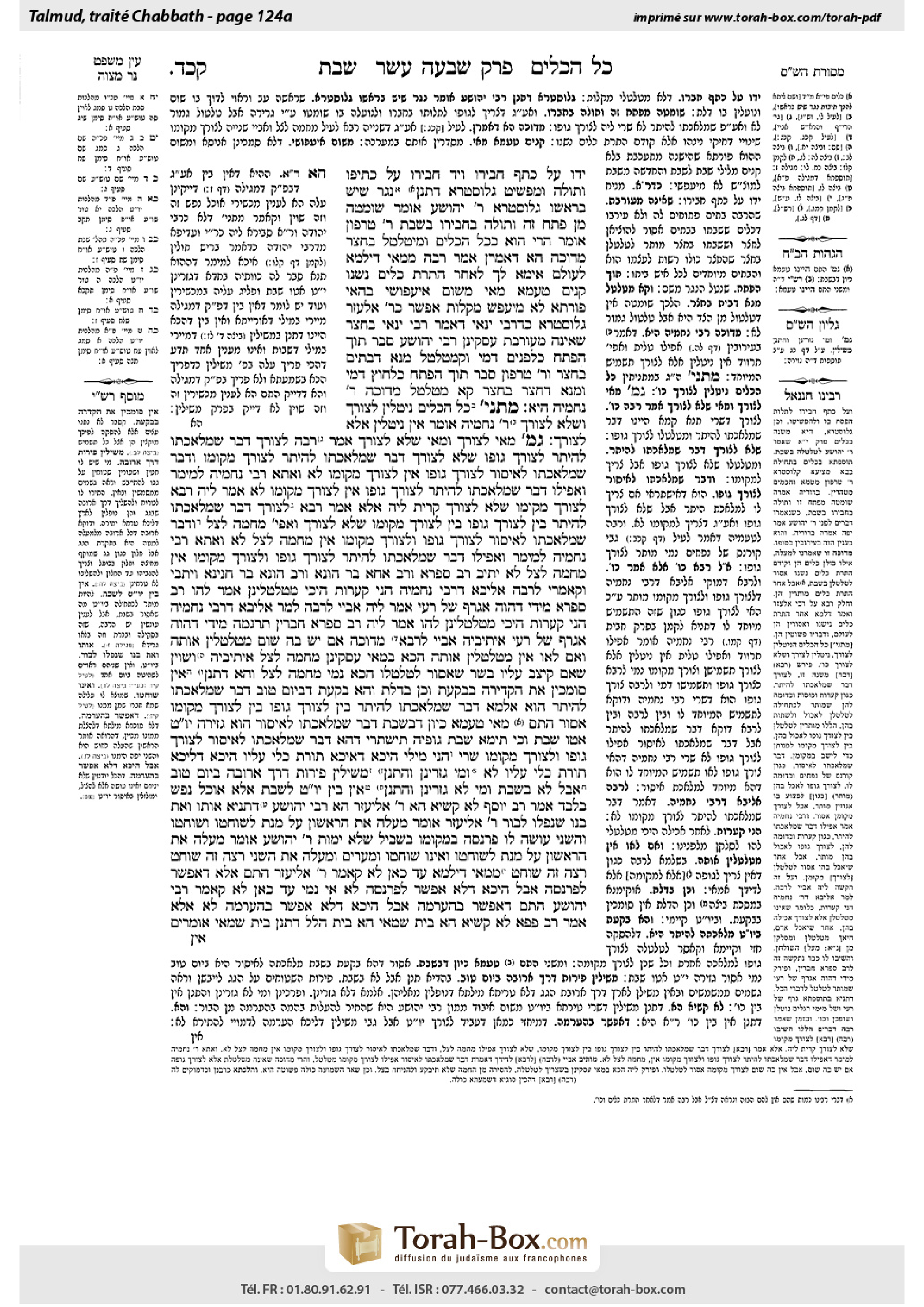
Shabbat 124a: Talmud study for Daf Yomi
Daf Yomi is the daily study of one Talmud folio. Explore 37 tractates with scans, Hebrew text, Sefaria English and AI-generated French translations where annotated.
Passage selection and English or AI-generated French translation are available where the scan has annotations. Daf Study is independent of Torah-Box and Sefaria.
Browse Shabbat · שבת · All tractatesShabbat 124a text and translations
This page of Shabbat includes the Aramaic text, an English translation and an AI-generated French translation, alongside the scan above.
שבת קכ״ד א · Aramaic and Hebrew text
יָדוֹ עַל כֶּתֶף חֲבֵירוֹ וְיַד חֲבֵירוֹ עַל כְּתֵיפוֹ, וְתוֹלֶה וּמַפְשִׁיט.
גְּלוֹסְטְרָא — דִּתְנַן: נֶגֶר שֶׁיֵּשׁ בְּרֹאשׁוֹ גְּלוֹסְטְרָא, רַבִּי יְהוֹשֻׁעַ אוֹמֵר: שׁוֹמְטָהּ מִן פֶּתַח זֶה וְתוֹלָהּ בַּחֲבֵירוֹ בְּשַׁבָּת. רַבִּי טַרְפוֹן אוֹמֵר: הֲרֵי הוּא כְּכׇל הַכֵּלִים וּמִיטַּלְטֵל בֶּחָצֵר.
מְדוֹכָה — הָא דַּאֲמַרַן. אָמַר רַבָּה: מִמַּאי, דִּילְמָא לְעוֹלָם אֵימָא לְךָ לְאַחַר הַתָּרַת כֵּלִים נִשְׁנוּ: קָנִים טַעְמָא מַאי — מִשּׁוּם אִיעַפּוֹשֵׁי, בְּהַאי פּוּרְתָּא לָא מִיעַפַּשׁ. מַקְלוֹת, אֶפְשָׁר כְּרַבִּי אֶלְעָזָר.
גְּלוֹסְטְרָא — כִּדְרַבִּי יַנַּאי, דַּאֲמַר רַבִּי יַנַּאי: בְּחָצֵר שֶׁאֵינָהּ מְעוֹרֶבֶת עָסְקִינַן, רַבִּי יְהוֹשֻׁעַ סָבַר: תּוֹךְ הַפֶּתַח כְּלִפְנִים דָּמֵי וְקָמְטַלְטֵל מָנָא דְבָתִּים בְּחָצֵר. וְרַבִּי טַרְפוֹן סָבַר: תּוֹךְ הַפֶּתַח כְּלַחוּץ דָּמֵי, וּמָנָא דְחָצֵר בְּחָצֵר קָא מְטַלְטֵל.
מְדוֹכָה — רַבִּי נְחֶמְיָה הִיא.
מַתְנִי׳ כׇּל הַכֵּלִים נִיטָּלִין לְצוֹרֶךְ וְשֶׁלֹּא לְצוֹרֶךְ. רַבִּי נְחֶמְיָה אוֹמֵר: אֵין נִיטָּלִין אֶלָּא לְצוֹרֶךְ.
גְּמָ׳ מַאי ״לְצוֹרֶךְ״ וּמַאי ״שֶׁלֹּא לְצוֹרֶךְ״?
אָמַר רַבָּה: ״לְצוֹרֶךְ״ — דָּבָר שֶׁמְּלַאכְתּוֹ לְהֶיתֵּר לְצוֹרֶךְ גּוּפוֹ. ״שֶׁלֹּא לְצוֹרֶךְ״ — דָּבָר שֶׁמְּלַאכְתּוֹ לְהֶיתֵּר לְצוֹרֶךְ מְקוֹמוֹ, וְדָבָר שֶׁמְּלַאכְתּוֹ לְאִיסּוּר, לְצוֹרֶךְ גּוּפוֹ — אִין, לְצוֹרֶךְ מְקוֹמוֹ — לָא. וַאֲתָא רַבִּי נְחֶמְיָה לְמֵימַר וַאֲפִילּוּ דָּבָר שֶׁמְּלַאכְתּוֹ לְהֶיתֵּר, לְצוֹרֶךְ גּוּפוֹ — אִין, לְצוֹרֶךְ מְקוֹמוֹ — לָא. אֲמַר לֵיהּ רָבָא: לְצוֹרֶךְ מְקוֹמוֹ, ״שֶׁלֹּא לְצוֹרֶךְ״ קָרֵית לֵיהּ?!
אֶלָּא אָמַר רָבָא: ״לְצוֹרֶךְ״ — דָּבָר שֶׁמְּלַאכְתּוֹ לְהֶיתֵּר, בֵּין לְצוֹרֶךְ גּוּפוֹ בֵּין לְצוֹרֶךְ מְקוֹמוֹ. ״שֶׁלֹּא לְצוֹרֶךְ״ — וַאֲפִילּוּ מֵחַמָּה לַצֵּל. וְדָבָר שֶׁמְּלַאכְתּוֹ לְאִיסּוּר, לְצוֹרֶךְ גּוּפוֹ וּלְצוֹרֶךְ מְקוֹמוֹ — אִין, מֵחַמָּה לַצֵּל — לָא. וַאֲתָא רַבִּי נְחֶמְיָה לְמֵימַר: וַאֲפִילּוּ דָּבָר שֶׁמְּלַאכְתּוֹ לְהֶיתֵּר, לְצוֹרֶךְ גּוּפוֹ וּלְצוֹרֶךְ מְקוֹמוֹ — אִין, מֵחַמָּה לַצֵּל — לָא.
יָתֵיב רַב סָפְרָא וְרַב אַחָא בַּר הוּנָא וְרַב הוּנָא בַּר חֲנִינָא, וְיָתְבִי וְקָאָמְרִי: לְרַבָּה אַלִּיבָּא דְּרַבִּי נְחֶמְיָה הָנֵי קְעָרוֹת הֵיכִי מְטַלְטְלִינַן? אֲמַר לְהוּ רַב סָפְרָא: מִידֵּי דְּהָוֵה אַגְּרָף שֶׁל רְעִי.
אֲמַר לֵיהּ אַבָּיֵי לְרַבָּה, לְמָר אַלִּיבָּא דְּרַבִּי נְחֶמְיָה, הָנֵי קְעָרוֹת הֵיכִי מְטַלְטְלִינַן לְהוּ? אֲמַר לֵיהּ: רַב סָפְרָא חַבְרִין תַּרְגְּמַהּ: מִידֵּי דְּהָוֵה אַגְּרָף שֶׁל רְעִי.
אֵיתִיבֵיהּ אַבָּיֵי: מְדוֹכָה, אִם יֵשׁ בָּהּ שׁוּם — מְטַלְטְלִין אוֹתָהּ, וְאִם לָאו — אֵין מְטַלְטְלִין אוֹתָהּ. הָכָא בְּמַאי עָסְקִינַן — מֵחַמָּה לַצֵּל. אֵיתִיבֵיהּ: וְשָׁוִין שֶׁאִם קִצֵּב עָלָיו בָּשָׂר שֶׁאָסוּר לְטַלְטְלוֹ! הָכָא נָמֵי מֵחַמָּה לַצֵּל.
וְהָא דִּתְנַן: אֵין סוֹמְכִין אֶת הַקְּדֵירָה בִּבְקַעַת וְכֵן בַּדֶּלֶת. וְהָא בְּקַעַת דִּבְיוֹם טוֹב דָּבָר שֶׁמְּלַאכְתּוֹ לְהֶיתֵּר הוּא, אַלְמָא דָּבָר שֶׁמְּלַאכְתּוֹ לְהֶיתֵּר בֵּין לְצוֹרֶךְ גּוּפוֹ בֵּין לְצוֹרֶךְ מְקוֹמוֹ — אָסוּר! הָתָם מַאי טַעְמָא — כֵּיוָן דִּבְשַׁבָּת דָּבָר שֶׁמְּלַאכְתּוֹ לְאִיסּוּר הוּא, גְּזֵירָה יוֹם טוֹב אַטּוּ שַׁבָּת.
וְכִי תֵּימָא: שַׁבָּת גּוּפֵיהּ תִּישְׁתְּרֵי, דְּהָא דָּבָר שֶׁמְּלַאכְתּוֹ לְאִיסּוּר, לְצוֹרֶךְ גּוּפוֹ וּלְצוֹרֶךְ מְקוֹמוֹ שְׁרֵי — הָנֵי מִילֵּי הֵיכָא דְּאִיכָּא תּוֹרַת כְּלִי עָלָיו, הֵיכָא דְּלֵיכָּא תּוֹרַת כְּלִי עָלָיו — לָא.
וּמִי גָּזְרִינַן? וְהָתְנַן: מַשִּׁילִין פֵּירוֹת דֶּרֶךְ אֲרוּבָּה בְּיוֹם טוֹב, אֲבָל לֹא בְּשַׁבָּת!
וּמִי לָא גָּזְרִינַן? וְהָתְנַן: אֵין בֵּין יוֹם טוֹב לַשַּׁבָּת אֶלָּא אוֹכֶל נֶפֶשׁ בִּלְבָד!
אָמַר רַב יוֹסֵף, לָא קַשְׁיָא: הָא — רַבִּי אֱלִיעֶזֶר, הָא — רַבִּי יְהוֹשֻׁעַ. דְּתַנְיָא: ״אוֹתוֹ וְאֶת בְּנוֹ״ שֶׁנָּפְלוּ לְבוֹר, רַבִּי אֱלִיעֶזֶר אוֹמֵר: מַעֲלֶה אֶת הָרִאשׁוֹן עַל מְנָת לְשׁוֹחְטוֹ, וְשׁוֹחֲטוֹ. וְהַשֵּׁנִי — עוֹשֶׂה לוֹ פַּרְנָסָה בִּמְקוֹמוֹ בִּשְׁבִיל שֶׁלֹּא יָמוּת. רַבִּי יְהוֹשֻׁעַ אוֹמֵר: מַעֲלֶה אֶת הָרִאשׁוֹן עַל מְנָת לְשׁוֹחְטוֹ, וְאֵינוֹ שׁוֹחֲטוֹ, וּמַעֲרִים וּמַעֲלֶה אֶת הַשֵּׁנִי, רָצָה — זֶה שׁוֹחֵט, רָצָה — זֶה שׁוֹחֵט.
מִמַּאי? דִּילְמָא עַד כָּאן לָא קָאָמַר רַבִּי אֱלִיעֶזֶר הָתָם אֶלָּא דְּאֶפְשָׁר בְּפַרְנָסָה, אֲבָל הֵיכָא דְּלָא אֶפְשָׁר בְּפַרְנָסָה לָא.
אִי נָמֵי, עַד כָּאן לָא קָאָמַר רַבִּי יְהוֹשֻׁעַ הָתָם דְּאֶפְשָׁר בְּהַעֲרָמָה, אֲבָל הֵיכָא דְּלָא אֶפְשָׁר בְּהַעֲרָמָה — לָא!
אֶלָּא אָמַר רַב פָּפָּא: לָא קַשְׁיָא, הָא — בֵּית שַׁמַּאי, הָא — בֵּית הִלֵּל. דִּתְנַן, בֵּית שַׁמַּאי אוֹמְרִים:
Shabbat 124a · English translation
his hand on the shoulder of another, and the other’s hand on his shoulder, and suspends the lamb and flays its hide.
The source for the thick end of a bolt is as we learned in a mishna: With regard to a bolt used in a door lock which has a thick end at the head of the bolt, Rabbi Yehoshua says: One may drag it from this doorway and hang it in another doorway on Shabbat, but he may not move it with his hands, because it was considered to be set-aside. Rabbi Tarfon says: It is like all the other utensils and may be moved in a courtyard.
The case of a mortar is that which we said above. Rabba said: From what does that conclusion ensue? Perhaps, actually I could say to you that these mishnayot were taught after permission to move utensils on Shabbat was adopted, and nevertheless, the prohibitions can be understood. With regard to the rods for the showbread, what is the reason that they are used? They are used due to concern that the bread will decay. In that brief period until the conclusion of Shabbat it will not decay. With regard to poles, why may they not be used on Passover eve? It is prohibited because it is possible to flay the lamb in accordance with the opinion of Rabbi Elazar. Use of the pole is superfluous, and therefore it is set-aside.
In the case of the thick end of the bolt in the door, why was it prohibited to move it by hand? It was prohibited in accordance with the opinion of Rabbi Yanai, as Rabbi Yanai says: We are dealing with a courtyard for which a joining of courtyards [eiruv] was not established. Rabbi Yehoshua holds that inside the doorway is considered to be like inside the house, and therefore, he is moving utensils of the houses in the courtyard. Since there is no joining of the courtyards, one may not move a vessel from the house to the courtyard. And Rabbi Tarfon holds that inside the doorway is considered to be like outside the house, and therefore, he is moving utensils of the courtyard in the courtyard, which is permitted.
With regard to a mortar, the halakha is in accordance with the opinion of Rabbi Neḥemya, who holds that a vessel may only be moved on Shabbat for the purpose of its designated use.
MISHNA: All vessels may be moved for a specific purpose and not for a specific purpose. Rabbi Neḥemya says: Vessels may only be moved for a specific purpose.
GEMARA: The Gemara asks: What is the meaning of: For a specific purpose, and what is the meaning of: Not for a specific purpose?
Rabba said: For a specific purpose means: Moving an object whose primary function is for a permitted use for the purpose of utilizing the object itself. Not for a specific purpose means: Moving an object whose primary function is for a permitted use for the purpose of utilizing its place. And an object whose primary function is for a prohibited use, for the purpose of utilizing the object itself, yes, it is permitted; for the purpose of utilizing its place, no, it is prohibited. And Rabbi Neḥemya came to say: And even an object whose primary function is for a permitted use, moving it for the purpose of utilizing the object itself, yes; for the purpose of utilizing its place, no. Rava said to him: Do you call for the purpose of utilizing its place, not for a specific purpose? It is for a purpose.
Rather, Rava said: For a specific purpose means: Moving an object whose primary function is for a permitted use both for the purpose of utilizing the object itself and for the purpose of utilizing its place. Not for a specific purpose means: Moving it even from the sun to the shade. And an object whose primary function is for a prohibited use, both for the purpose of utilizing the object itself and for the purpose of utilizing its place, yes, it is permitted; moving it from the sun to the shade, no, it is prohibited. And Rabbi Neḥemya came to say: Even an object whose primary function is for a permitted use, moving it for the purpose of utilizing the object itself and for the purpose of utilizing its place, yes, it is permitted; moving it from the sun to the shade, no, it is prohibited.
It is told that Rav Safra and Rav Aḥa bar Huna and Rav Huna bar Ḥanina sat together and they sat and they said: According to Rabba’s explanation in accordance with the opinion of Rabbi Neḥemya that it is prohibited to move an object whose primary function is for a permitted use for the purpose of utilizing its place, these empty bowls, how do we carry them? Rav Safra said to them: You may move them, just as is the case of a chamber pot containing waste that may be moved because it is disgusting.
Abaye said this same matter to Rabba: According to the Master’s explanation in accordance with the opinion of Rabbi Neḥemya, these empty bowls, how do we carry them? He said to him: Our colleague Rav Safra interpreted it: Just as is the case of a chamber pot.
Abaye raised an objection to Rava’s opinion from that which was taught: With regard to a mortar, if it has garlic in it, one may move it on Shabbat, and if not, one may not move it on Shabbat. According to Rava’s opinion that all utensils may be moved, why is it prohibited to move the mortar? Rava responded: With what we are dealing here? We are dealing with a case of moving the mortar from the sun to the shade, which Rava prohibited. Abaye raised an objection to Rava’s opinion from that which was taught: Beit Shammai and Beit Hillel agree that if one cut meat on it for the purpose of the Festival that it is then prohibited to move it because there is no further need for it on the Festival. According to Rava’s opinion, all utensils may be moved. He answered him: Here, too, we are dealing with a case of moving the mortar from the sun to the shade.
And Abaye raised another objection with regard to that which we learned in a mishna: One may not prop a pot with a piece of wood, and so too, one may not prop a door on a piece of wood. Isn’t a piece of wood on a Festival an object whose primary function is for a permitted use, since it is permitted to move it to light an oven? Apparently, there is an opinion that moving an object whose primary function is for a permitted use, both for the purpose of utilizing the object itself and for the purpose of utilizing its place is prohibited, and according to Rabba, even Rabbi Neḥemya does not hold that this is so. Rava answers: There, what is the reason for the prohibition? It is because on Shabbat it is an object whose primary function is for a prohibited use. Since the wood is set aside from use on Shabbat, the Sages issued a decree prohibiting moving it on a Festival, due to Shabbat.
And if you say: Moving the wood should be permitted on Shabbat itself because an object whose primary function is for a prohibited use is permitted both for the purpose of utilizing the object itself and for the purpose of utilizing its place, that assertion is rejected. This ruling, which permits moving an object whose primary use is prohibited, applies only in a case where the status of a vessel applies to it; in a case where the status of a vessel does not apply to it, no, it is prohibited.
The Gemara asks: And do we issue decrees prohibiting actions on Festivals due to the fact that they are prohibited on Shabbat? Didn’t we learn in a mishna: One may drop fruits from the roof through a skylight on a Festival, but not on Shabbat. Apparently, the Sages do not prohibit on a Festival all of the actions that are prohibited on Shabbat.
The Gemara asks on the contrary: And do we not issue decrees on a Festival due to Shabbat? Didn’t we learn in a mishna: The only difference between a Festival and Shabbat is with regard to the preparation of food alone. In all other matters the Sages established that the halakhot of Shabbat and Festivals are the same.
Rav Yosef says: This is not difficult. This mishna, which rules that it is prohibited, is in accordance with the opinion of Rabbi Eliezer; that mishna, which rules that it is permitted, is in accordance with the opinion of Rabbi Yehoshua. As it was taught in a baraita: It is prohibited to slaughter a mother animal and its offspring on the same day, as it is stated: “You shall not slaughter it and its offspring both in one day” (Leviticus 22:28). With regard to it and its offspring that fell into a pit on a Festival, Rabbi Eliezer says: One may raise the first in order to slaughter it, and then slaughter it; and with regard to the second one, one may provide it sustenance in its place in the pit so that it will not die. Rabbi Yehoshua says: One may raise the first in order to slaughter it, and then reconsider and not slaughter it, and then employ artifice and say that he reconsidered and wants to slaughter the other, and raise the second. If he so desires, he slaughters this one; if he so desires, he slaughters that one. Apparently, Rabbi Yehoshua permits certain actions on a Festival due to financial considerations, and does not issue decrees in those cases.
The Gemara rejects this: From what does that conclusion ensue? Perhaps Rabbi Eliezer only stated that he may not raise the second animal there, in a case where it is possible to save the animal by feeding it in the pit; however, in a case where it is impossible to save it by feeding it in the pit, no, he would permit raising the animal.
Alternatively, Rabbi Yehoshua only said that he may raise the second animal in a case where it is possible to employ artifice; however, in a case where it is not possible to employ artifice, no, he would not permit doing so.
Rather Rav Pappa said: This is not difficult. This mishna is in accordance with the opinion of Beit Shammai, and that mishna is in accordance with the opinion of Beit Hillel. As we learned in a mishna that Beit Shammai say:
Shabbat 124a · Traduction française (IA)
sa main sur l’épaule d’un autre, et la main de l’autre sur son épaule ; puis il suspend l’agneau et lui retire la peau.
La source concernant l’extrémité épaisse d’un verrou est une Michna que nous avons apprise : à propos d’un verrou servant à fermer une porte et dont la tête est épaisse, Rabbi Yehoshua dit : « On peut le traîner de cette porte et le suspendre à une autre porte le Chabbat, mais on ne peut pas le déplacer à la main », car il était considéré comme mouktsé. Rabbi Tarfon dit : « Il est comme tous les autres ustensiles et peut être déplacé dans une cour. »
Le cas du mortier est celui que nous avons évoqué plus haut. Rabba dit : « De quoi cette conclusion découle-t-elle ? Peut-être pourrais-je plutôt te dire que ces Michnayot ont été enseignées après l’adoption de l’autorisation de déplacer des ustensiles le Chabbat ; pourtant, les interdictions peuvent s’expliquer. Pourquoi utilise-t-on les baguettes du pain de proposition ? On les utilise par crainte que le pain ne se gâte. Durant le bref laps de temps qui reste jusqu’à la fin du Chabbat, il ne se gâtera pas. Quant aux perches, pourquoi ne peut-on pas les utiliser la veille de Pessa’h ? C’est interdit parce qu’il est possible de dépouiller l’agneau conformément à l’opinion de Rabbi Elazar. L’usage de la perche est superflu et elle est donc mouktsé. »
Dans le cas de l’extrémité épaisse du verrou de la porte, pourquoi était-il interdit de le déplacer à la main ? C’était interdit conformément à l’opinion de Rabbi Yanai, car Rabbi Yanai dit : « Nous parlons d’une cour pour laquelle aucun érouv des cours [eiruv] n’a été établi. » Rabbi Yehoshua considère que l’intérieur de la porte est assimilé à l’intérieur de la maison ; il déplace donc dans la cour des ustensiles de la maison. Puisqu’il n’y a pas d’érouv des cours, on ne peut pas déplacer un ustensile de la maison vers la cour. Rabbi Tarfon, lui, considère que l’intérieur de la porte est assimilé à l’extérieur de la maison ; il déplace donc dans la cour des ustensiles de la cour, ce qui est permis.
Pour le mortier, la halakha suit l’opinion de Rabbi Neḥemya, selon laquelle un ustensile ne peut être déplacé le Chabbat que pour l’usage auquel il est destiné.
MICHNA : Tous les ustensiles peuvent être déplacés pour un usage déterminé ou sans usage déterminé. Rabbi Neḥemya dit : Les ustensiles ne peuvent être déplacés que pour un usage déterminé.
GUEMARA : La Guemara demande : Que signifie « pour un usage déterminé », et que signifie « sans usage déterminé » ?
Rabba dit : « Pour un usage déterminé » signifie déplacer un objet dont l’usage principal est permis afin d’utiliser l’objet lui-même. « Sans usage déterminé » signifie déplacer un objet dont l’usage principal est permis afin d’utiliser l’endroit qu’il occupe. Quant à un objet dont l’usage principal est interdit, le déplacer afin d’utiliser l’objet lui-même, oui, cela est permis ; afin d’utiliser l’endroit qu’il occupe, non, cela est interdit. Rabbi Neḥemya vient enseigner que même pour un objet dont l’usage principal est permis, le déplacer afin d’utiliser l’objet lui-même, oui ; afin d’utiliser l’endroit qu’il occupe, non. Rava lui dit : « Appelles-tu “sans usage déterminé” le fait de vouloir utiliser l’endroit qu’occupe l’objet ? C’est pourtant bien un usage. »
Rava dit plutôt : « Pour un usage déterminé » signifie déplacer un objet dont l’usage principal est permis, aussi bien afin d’utiliser l’objet lui-même que afin d’utiliser l’endroit qu’il occupe. « Sans usage déterminé » signifie le déplacer même du soleil à l’ombre. Quant à un objet dont l’usage principal est interdit, le déplacer afin d’utiliser l’objet lui-même ou l’endroit qu’il occupe, oui, cela est permis ; le déplacer du soleil à l’ombre, non, cela est interdit. Rabbi Neḥemya vient enseigner que même pour un objet dont l’usage principal est permis, le déplacer afin d’utiliser l’objet lui-même ou l’endroit qu’il occupe, oui, cela est permis ; le déplacer du soleil à l’ombre, non, cela est interdit. »
Il est rapporté que Rav Safra, Rav Aḥa bar Huna et Rav Huna bar Ḥanina étaient assis ensemble et discutaient : « Selon l’explication de Rabba, conformément à l’opinion de Rabbi Neḥemya, qui interdit de déplacer un objet dont l’usage principal est permis afin d’utiliser l’endroit qu’il occupe, comment transportons-nous ces bols vides ? » Rav Safra leur dit : « Vous pouvez les déplacer, comme un pot de chambre contenant des déchets, que l’on peut déplacer parce qu’il est répugnant. »
Abaye posa cette même question à Rabba : « Selon l’explication du Maître, conformément à l’opinion de Rabbi Neḥemya, comment transportons-nous ces bols vides ? » Il lui répondit : « Notre collègue Rav Safra l’a expliqué : c’est comme dans le cas d’un pot de chambre. »
Abaye objecta à l’opinion de Rava en citant ce qui a été enseigné : « S’il y a de l’ail dans un mortier, on peut le déplacer le Chabbat ; sinon, on ne peut pas le déplacer le Chabbat. » Selon l’opinion de Rava, d’après laquelle on peut déplacer tous les ustensiles, pourquoi est-il interdit de déplacer le mortier ? Rava lui répondit : « De quel cas s’agit-il ici ? Il s’agit de déplacer le mortier du soleil à l’ombre, ce que Rava a interdit. » Abaye objecta encore à l’opinion de Rava en citant ce qui a été enseigné : « Beit Shammai et Beit Hillel conviennent que si l’on y a découpé de la viande pour les besoins de la fête, il est alors interdit de le déplacer, car on n’en a plus besoin pendant la fête. » Selon l’opinion de Rava, on peut déplacer tous les ustensiles. Il lui répondit : « Ici aussi, il s’agit de déplacer le mortier du soleil à l’ombre. »
Abaye objecta encore en citant ce que nous avons appris dans une Michna : « On ne peut pas caler une marmite avec un morceau de bois, et de même, on ne peut pas caler une porte avec un morceau de bois. » Un morceau de bois, lors d’une fête, n’est-il pas un objet dont l’usage principal est permis, puisqu’il est permis de le déplacer pour allumer un four ? Il semblerait donc qu’il existe une opinion selon laquelle il est interdit de déplacer un objet dont l’usage principal est permis, aussi bien pour utiliser l’objet lui-même que pour utiliser l’endroit qu’il occupe ; or, selon Rabba, même Rabbi Neḥemya ne soutient pas cela. Rava répond : « Là-bas, quelle est la raison de l’interdiction ? C’est que le Chabbat, il s’agit d’un objet dont l’usage principal est interdit. Puisque le bois est mis à l’écart de tout usage le Chabbat, les Sages ont décrété qu’il était interdit de le déplacer lors d’une fête, par crainte du Chabbat. »
Et si tu dis : « Le déplacement du bois devrait être permis le Chabbat même, puisqu’un objet dont l’usage principal est interdit peut être déplacé aussi bien pour utiliser l’objet lui-même que pour utiliser l’endroit qu’il occupe », cette affirmation est rejetée. Cette règle, qui autorise le déplacement d’un objet dont l’usage principal est interdit, ne s’applique que lorsqu’il a le statut d’un ustensile ; s’il n’a pas le statut d’un ustensile, son déplacement est interdit.
La Guemara demande : « Interdit-on donc par décret, pendant les fêtes, des actes parce qu’ils sont interdits le Chabbat ? » N’avons-nous pas appris dans une Michna : « On peut faire tomber des fruits du toit par une lucarne pendant une fête, mais pas le Chabbat » ? Il semblerait donc que les Sages n’interdisent pas pendant une fête tous les actes interdits le Chabbat.
La Guemara demande au contraire : « N’édicte-t-on donc pas de décrets pour une fête en raison du Chabbat ? » N’avons-nous pas appris dans une Michna : « La seule différence entre une fête et le Chabbat concerne la préparation des aliments » ? Pour toutes les autres questions, les Sages ont établi que les halakhot du Chabbat et des fêtes sont identiques.
Rav Yosef dit : « Il n’y a pas de difficulté. Cette Michna, qui statue que c’est interdit, suit l’opinion de Rabbi Eliezer ; l’autre Michna, qui statue que c’est permis, suit l’opinion de Rabbi Yehoshua. En effet, il a été enseigné dans une baraïta : Il est interdit d’abattre une mère et son petit le même jour, comme il est dit : “Tu ne l’abattras pas avec son petit le même jour” (Lévitique 22, 28). S’agissant d’une mère et de son petit qui sont tombés dans une fosse pendant une fête, Rabbi Eliezer dit : “On peut faire monter le premier pour l’abattre, puis l’abattre ; quant au second, on peut le nourrir sur place, dans la fosse, afin qu’il ne meure pas.” Rabbi Yehoshua dit : “On peut faire monter le premier pour l’abattre, puis changer d’avis et ne pas l’abattre ; ensuite, on peut user d’un stratagème et dire qu’on a changé d’avis et qu’on veut abattre l’autre, puis faire monter le second. Si on le souhaite, on abat celui-ci ; si on le souhaite, on abat celui-là.” Il semblerait donc que Rabbi Yehoshua autorise certains actes pendant une fête pour des considérations financières et n’édicte pas de décrets dans ces cas-là. »
La Guemara rejette cette conclusion : « De quoi cette conclusion découle-t-elle ? Peut-être Rabbi Eliezer a-t-il seulement dit qu’on ne pouvait pas faire monter le second animal dans un cas où il est possible de le sauver en le nourrissant dans la fosse ; mais dans un cas où il est impossible de le sauver en le nourrissant dans la fosse, il autoriserait à le faire monter. »
Autre possibilité : Rabbi Yehoshua a seulement dit qu’on pouvait faire monter le second animal dans un cas où il est possible d’user d’un stratagème ; mais dans un cas où il est impossible d’user d’un stratagème, il ne l’autoriserait pas.
Rav Pappa dit plutôt : « Il n’y a pas de difficulté. Cette Michna suit l’opinion de Beit Shammai, et l’autre Michna suit l’opinion de Beit Hillel. En effet, nous avons appris dans une Michna que Beit Shammai disent : »
Traduction française générée par IA à partir de l’édition anglaise de Sefaria. Vérifie toujours un passage avec le texte source.
Text from Sefaria: William Davidson Edition - Vocalized Aramaic (CC BY NC); William Davidson Edition - English (CC BY NC).