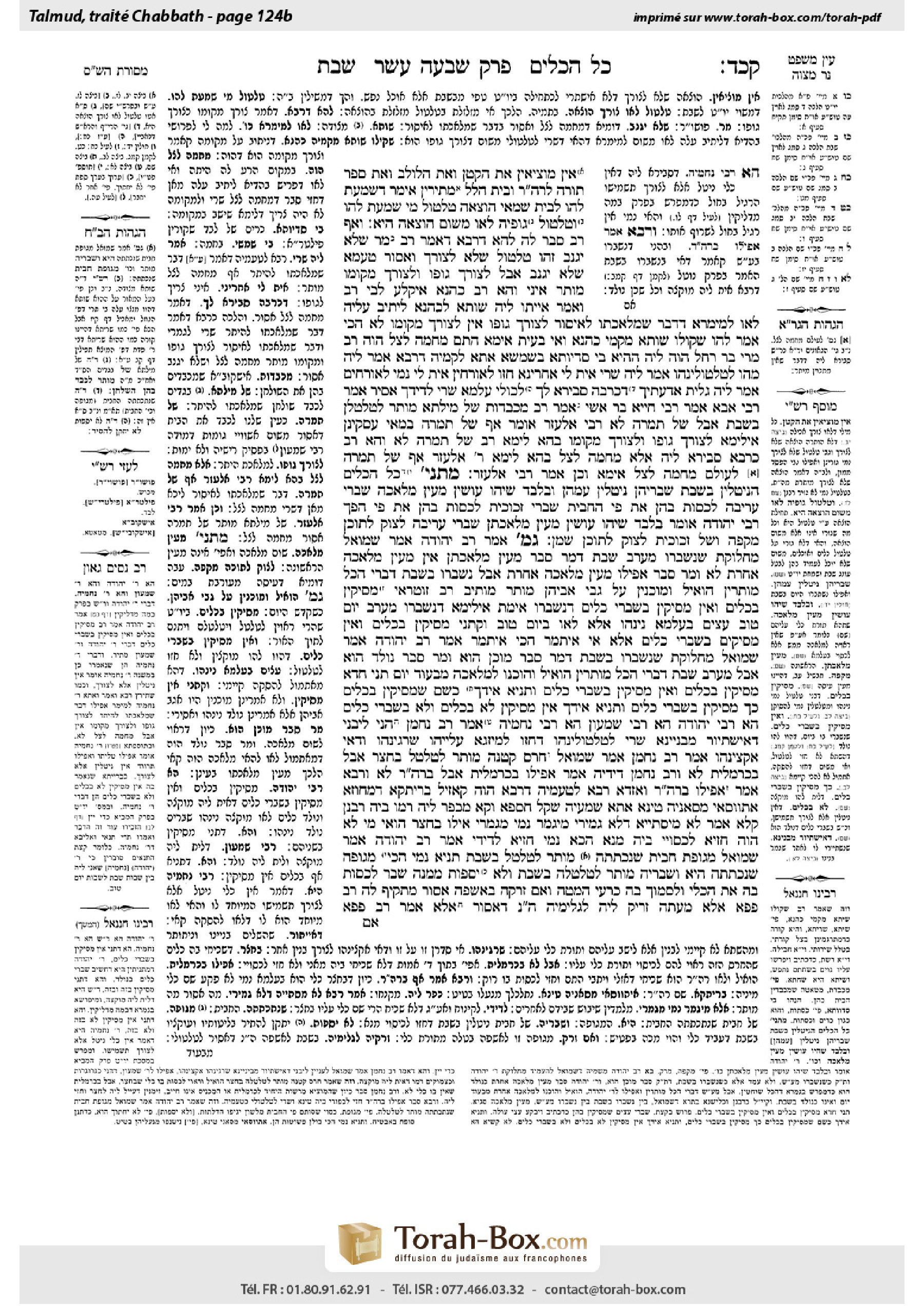
Shabbat 124b: Talmud study for Daf Yomi
Daf Yomi is the daily study of one Talmud folio. Explore 37 tractates with scans, Hebrew text, Sefaria English and AI-generated French translations where annotated.
Passage selection and English or AI-generated French translation are available where the scan has annotations. Daf Study is independent of Torah-Box and Sefaria.
Browse Shabbat · שבת · All tractatesShabbat 124b text and translations
This page of Shabbat includes the Aramaic text, an English translation and an AI-generated French translation, alongside the scan above.
שבת קכ״ד ב · Aramaic and Hebrew text
אֵין מוֹצִיאִין אֶת הַקָּטָן וְאֶת הַלּוּלָב וְאֶת סֵפֶר תּוֹרָה לִרְשׁוּת הָרַבִּים, וּבֵית הִלֵּל מַתִּירִין.
אֵימַר דְּשָׁמְעַתְּ לְהוּ לְבֵית שַׁמַּאי הוֹצָאָה, טִלְטוּל מִי שָׁמְעַתְּ לְהוּ? וְטִלְטוּל גּוּפֵיהּ לָאו מִשּׁוּם הוֹצָאָה הִיא?!
וְאַף רַב סָבַר לַהּ לְהָא דְּרָבָא. דְּאָמַר רַב: מָר שֶׁלֹּא יִגָּנֵב — זֶהוּ טִלְטוּל שֶׁלֹּא לְצוֹרֶךְ, וְאָסוּר. טַעְמָא שֶׁלֹּא יִגָּנֵב, אֲבָל לְצוֹרֶךְ גּוּפוֹ וּלְצוֹרֶךְ מְקוֹמוֹ — מוּתָּר.
אִינִי?! וְהָא רַב כָּהֲנָא אִיקְּלַע לְבֵי רַב, וַאֲמַר: אַיְיתוֹ לֵיהּ שׁוּתָא לְכָהֲנָא לִיתִּיב עֲלַהּ. לָאו לְמֵימְרָא דְּדָבָר שֶׁמְּלַאכְתּוֹ לְאִיסּוּר, לְצוֹרֶךְ גּוּפוֹ — אִין, לְצוֹרֶךְ מְקוֹמוֹ — לָא!
הָכִי אֲמַר לְהוּ: שְׁקוּלוּ שׁוּתָא מִקַּמֵּי כָּהֲנָא. וְאִי בָּעֵית אֵימָא: הָתָם מֵחַמָּה לַצֵּל הֲוָה.
רַב מָרִי בַּר רָחֵל הֲוָה לֵיהּ הָהוּא בֵּי סַדְיְוָתָא בְּשִׁמְשָׁא. אֲתָא לְקַמֵּיהּ דְּרָבָא, אֲמַר לֵיהּ: מַהוּ לְטַלְטוֹלִינְהוּ? אֲמַר לֵיהּ: שְׁרֵי. אִית לִי אַחֲרִינָא. חֲזוּ לְאוֹרְחִין. אִית לִי נָמֵי לְאוֹרְחִים. אֲמַר לֵיהּ: גַּלִּית אַדַּעְתָּיךְ דִּכְרַבָּה סְבִירָא לָךְ. לְכוּלֵּי עָלְמָא שְׁרֵי, לְדִידָךְ אֲסִיר.
אָמַר רַבִּי אַבָּא אָמַר רַבִּי חִיָּיא בַּר אָשֵׁי אָמַר רַב: מַכְבֵּדוֹת שֶׁל מֵילָת — מוּתָּר לְטַלְטְלָן בְּשַׁבָּת, אֲבָל שֶׁל תְּמָרָה — לָא.
רַבִּי אֶלְעָזָר אוֹמֵר: אַף שֶׁל תְּמָרָה. בְּמַאי עָסְקִינַן? אִילֵימָא לְצוֹרֶךְ גּוּפוֹ וּלְצוֹרֶךְ מְקוֹמוֹ — בְּהָא לֵימָא רַב שֶׁל תְּמָרָה לָא? וְהָא רַב כְּרָבָא סְבִירָא לֵיהּ. אֶלָּא מֵחַמָּה לַצֵּל: בְּהָא לֵימָא רַבִּי אֶלְעָזָר אַף שֶׁל תְּמָרָה? לְעוֹלָם מֵחַמָּה לַצֵּל, אֵימָא: וְכֵן אָמַר רַבִּי אֶלְעָזָר.
מַתְנִי׳ כׇּל הַכֵּלִים הַנִּיטָּלִין בַּשַּׁבָּת — שִׁבְרֵיהֶן נִיטָּלִין עִמָּהֶן, וּבִלְבַד שֶׁיְּהוּ עוֹשִׂין מֵעֵין מְלָאכָה.
שִׁבְרֵי עֲרֵיבָה לְכַסּוֹת בָּהֶן אֶת פִּי הֶחָבִית, שִׁבְרֵי זְכוּכִית לְכַסּוֹת בָּהֶן אֶת פִּי הַפַּךְ.
רַבִּי יְהוּדָה אוֹמֵר: בִּלְבַד שֶׁיְּהוּ עוֹשִׂין מֵעֵין מְלַאכְתָּן: שִׁבְרֵי עֲרֵיבָה לָצוּק לְתוֹכָן מִקְפָּה, וְשֶׁל זְכוּכִית לָצוּק לְתוֹכָן שֶׁמֶן.
גְּמָ׳ אָמַר רַב יְהוּדָה אָמַר שְׁמוּאֵל: מַחֲלוֹקֶת שֶׁנִּשְׁבְּרוּ מֵעֶרֶב שַׁבָּת, דְּמָר סָבַר מֵעֵין מְלַאכְתָּן — אִין, מֵעֵין מְלָאכָה אַחֶרֶת — לָא. וּמָר סָבַר: אֲפִילּוּ מֵעֵין מְלָאכָה אַחֶרֶת.
אֲבָל נִשְׁבְּרוּ בְּשַׁבָּת — דִּבְרֵי הַכֹּל מוּתָּרִין. הוֹאִיל וּמוּכָנִין עַל גַּבֵּי אֲבִיהֶן — מוּתָּר.
מוֹתֵיב רַב זוּטְרָא: מַסִּיקִין בְּכֵלִים, וְאֵין מַסִּיקִין בְּשִׁבְרֵי כֵלִים.
דְּנִשְׁבְּרוּ אֵימַת? אִילֵּימָא דְּנִשְׁבְּרוּ מֵעֶרֶב יוֹם טוֹב? — עֵצִים בְּעָלְמָא נִינְהוּ! אֶלָּא לָאו בְּיוֹם טוֹב, וְקָתָנֵי: מַסִּיקִין בְּכֵלִים וְאֵין מַסִּיקִים בְּשִׁבְרֵי כֵלִים!
אֶלָּא אִי אִיתְּמַר, הָכִי אִיתְּמַר: אָמַר רַב יְהוּדָה אָמַר שְׁמוּאֵל מַחֲלוֹקֶת שֶׁנִּשְׁבְּרוּ בְּשַׁבָּת, דְּמָר סָבַר מוּכָן הוּא, וּמָר סָבַר נוֹלָד הוּא, אֲבָל מֵעֶרֶב שַׁבָּת — דִּבְרֵי הַכֹּל מוּתָּרִין, הוֹאִיל וְהוּכְנוּ לִמְלָאכָה מִבְּעוֹד יוֹם.
תָּנֵי חֲדָא: מַסִּיקִין בְּכֵלִים, וְאֵין מַסִּיקִין בְּשִׁבְרֵי כֵלִים. וְתַנְיָא אִידַּךְ: כְּשֵׁם שֶׁמַּסִּיקִין בְּכֵלִים, כָּךְ מַסִּיקִין בְּשִׁבְרֵי כֵלִים. וְתַנְיָא אִידַּךְ: אֵין מַסִּיקִין לֹא בְּכֵלִים וְלָא בְּשִׁבְרֵי כֵלִים.
הָא — רַבִּי יְהוּדָה. הָא — רַבִּי שִׁמְעוֹן. הָא — רַבִּי נְחֶמְיָה.
אָמַר רַב נַחְמָן: הָנֵי לִיבְנֵי דְּאִישְׁתַּיּוּר מִבִּנְיָינָא — שְׁרֵי לְטַלְטוֹלִינְהוּ, דַּחֲזוּ לְמִיזְגָּא עֲלַיְיהוּ. שַׁרְגִינְהוּ וַדַּאי אַקְצִינְהוּ.
אָמַר רַב נַחְמָן אָמַר שְׁמוּאֵל: חֶרֶס קְטַנָּה — מוּתָּר לְטַלְטְלָהּ בֶּחָצֵר, אֲבָל בְּכַרְמְלִית — לֹא. וְרַב נַחְמָן דִּידֵיהּ אָמַר: אֲפִילּוּ בְּכַרְמְלִית, אֲבָל בִּרְשׁוּת הָרַבִּים — לֹא. וְרָבָא אָמַר: אֲפִילּוּ בִּרְשׁוּת הָרַבִּים.
וְאַזְדָּא רָבָא לְטַעְמֵיהּ. דְּרָבָא הֲוָה קָאָזֵיל בְּרִיתְקָא דְמָחוֹזָא, אִתַּוַּוס מְסָאנֵיהּ טִינָא. אֲתָא שַׁמָּעֵיהּ, שְׁקַל חַסְפָּא וְקָא מְכַפַּר לֵיהּ. רְמוֹ בֵּיהּ רַבָּנַן קָלָא. אָמַר: לָא מִיסָּתְיָיא דְּלָא גְּמִירִי, מִיגְמָר נָמֵי מַגְמְרִי?! אִילּוּ בְּחָצֵר הֲוַאי מִי לָא הֲוָה חַזְיָא לְכַסּוֹיֵי בַּיהּ מָנָא? הָכָא נָמֵי — חַזְיָא לְדִידִי.
אָמַר רַב יְהוּדָה אָמַר שְׁמוּאֵל: מְגוּפַת חָבִית שֶׁנִּכְתְּתָה — מוּתָּר לְטַלְטֵל בְּשַׁבָּת. תַּנְיָא נָמֵי הָכִי: מְגוּפָה שֶׁנִּכְתְּתָה — הִיא וּשְׁבָרֶיהָ מוּתָּר לְטַלְטְלָהּ בְּשַׁבָּת. וְלֹא יִסְפּוֹת מִמֶּנָּה שֶׁבֶר לְכַסּוֹת בָּהּ אֶת הַכְּלִי וְלִסְמוֹךְ בָּהּ כַּרְעֵי הַמִּטָּה. וְאִם זְרָקָהּ בָּאַשְׁפָּה — אָסוּר.
מַתְקִיף לַהּ רַב פָּפָּא: אֶלָּא מֵעַתָּה, זָרֵיק לֵיהּ לִגְלִימֵיהּ הָכִי נָמֵי דְּאָסוּר?! אֶלָּא אָמַר רַב פָּפָּא:
Shabbat 124b · English translation
One may neither carry a child nor a lulav nor a Torah scroll out to the public domain on a Festival, and Beit Hillel permit doing so. Beit Hillel permit carrying objects from one domain to another on a Festival for purposes other than preparing food.
The Gemara rejects this: Say that you heard Beit Shammai prohibit carrying out an object from one domain to another; did you hear that they prohibited moving an object? The Gemara rejects that distinction: And isn’t the prohibition of moving itself a decree issued due to the prohibition of carrying out? One who prohibits carrying out certainly prohibits moving an object as well.
The Gemara adds: And even Rav holds in accordance with this halakha of Rava, as Rav said: Moving a hoe so that it will not be stolen; that is an example of moving an object not for a specific purpose, and it is prohibited. The Gemara infers: The reason that it is prohibited is that it is moved so it will not be stolen; however, for the purpose of utilizing the object itself and for the purpose of utilizing its place, it is permitted.
The Gemara asks: Is that so? Didn’t Rav Kahana happen to come to the house of Rav, and he said: Bring a net for Kahana so that he may sit on it? Is that not to say that with regard to an object whose primary function is prohibited, for the purpose of utilizing the object itself, yes, it is permitted to move it; and for the purpose of utilizing its place, no, it is prohibited?
The Gemara answers that this is what he said to them: Remove the net from before Kahana. That is a case of moving for the purpose of utilizing its place. And if you wish, say instead: There, it was a case of moving the object from the sun to the shade, as it was in a place where it could have been damaged. One might have mistakenly concluded that this was the reason that they were moving the net. Rav specified that the net was being moved for the purpose of utilizing the object itself, not to indicate that moving it for the purpose of utilizing its place is prohibited, but to indicate that moving from the sun to the shade is prohibited.
The Gemara relates that Rav Mari bar Raḥel, had felt cushions in the sun on Shabbat. Rav Mari came before Rava and said to him: What is the ruling with regard to carrying them? Rava said to him: It is permitted. Rav Mari said to Rava: I have others, and I do not need these cushions specifically. Rava said to him: Even so, these cushions are suitable for guests. Rav Mari said to him: I also have others for guests and therefore would be moving the cushions so that they would not be ruined in the sun. Rava said to him: You have revealed your opinion that you hold in accordance with the opinion of Rabba. For everyone else, it is permitted to move the cushions in this situation; however, for you, it is prohibited, as it is inappropriate to permit one to perform an action that he considers prohibited.
Rabbi Abba said that Rabbi Ḥiyya bar Ashi said that Rav said: With regard to brooms made of fine wool garments, it is permitted to move them on Shabbat because it is permitted to use them. However, brooms made of date-palm fronds, no, they may not be moved. It is prohibited to fill holes in the ground.
Rabbi Elazar says: It is permitted to move even those made of date-palm fronds. The Gemara asks: With what are we dealing? If you say that this is referring to moving it for the purpose of utilizing the object itself and for the purpose of utilizing its place, would Rav say a broom made of date-palm fronds, no, it may not be moved? Doesn’t Rav hold in accordance with the opinion of Rava? Rather, this is referring to moving the broom from the sun to the shade, and that these brooms are in a place where they can be damaged. However, it is still puzzling: In this case, would Rabbi Elazar say that even brooms made from date-palm fronds may be moved? The Gemara answers: Actually, this is referring to moving them from the sun, where they will be damaged, to the shade. Emend this and say: And so too, Rabbi Elazar said, like Rav, that it is prohibited.
MISHNA: All vessels that may be moved on Shabbat, their shards may be moved along with them, as long as they are suited for some purpose.
Shards of a large bowl may be used to cover the mouth of a barrel. Shards of a glass vessel may be used to cover the mouth of a cruse.
Rabbi Yehuda says: As long as they are suited for a purpose similar to their original use. Shards of a large bowl must be suited to pour soup into them, and shards of a glass vessel must be suited to pour oil into them.
GEMARA: Rav Yehuda said that Shmuel said: This dispute in the mishna is only with regard to a case where the vessels broke on Shabbat eve, as this Sage, Rabbi Yehuda, holds that if they are suited for a purpose similar to their original use, yes, it is permitted, and for some other use, no, it is prohibited. And this Sage, the Rabbis, hold: Even if they are suited for some other use, it is also permitted.
But if the vessels broke on Shabbat, everyone agrees they are permitted. The reason for this is since they were designated for Shabbat use and consequently considered prepared at the onset of Shabbat due to their original vessels, it is permitted to move the shards as well.
Rav Zutrai raised an objection from a baraita: One may kindle a fire on a Festival with whole vessels, but one may not kindle a fire with shards of vessels.
The Gemara seeks to clarify: Vessels that were broken when? If you say that they were broken before the Festival, why is it prohibited to light a fire with them? They are pieces of ordinary wood. Isn’t this referring to a case where they broke on the Festival, and it is taught: One may kindle a fire on a Festival with whole vessels, but one may not kindle a fire with shards of vessels. The legal status of a vessel broken on a Festival, and all the more so one broken on Shabbat, is more stringent, not less.
Rather, if it was stated, it was stated as follows. Rav Yehuda said that Shmuel said: This dispute in the mishna is only with regard to a case where the vessels broke on Shabbat, as this Sage, the Rabbis, holds it was prepared before Shabbat as part of the original vessel, and this Sage, Rabbi Yehuda, holds that it is an item that came into being on Shabbat. Since they were not shards before Shabbat, they are a new entity and are set-aside. However, if they were broken from before the onset of Shabbat everyone agrees that it is permitted to move them, since they were prepared to serve some function while it was still day, before the onset of Shabbat.
With regard to the halakhot of Festivals, it was taught in one baraita: One may kindle a fire with whole vessels, but one may not kindle a fire with shards of vessels. And it was taught in the other baraita: Just as one may kindle a fire with vessels, so too, one may kindle a fire with shards of vessels. And it was taught in yet another baraita: One may neither kindle a fire with vessels nor with shards of vessels.
The Gemara resolves the apparent contradiction between the baraitot: This baraita, which distinguishes between vessels and broken vessels, is in accordance with the opinion of Rabbi Yehuda, who holds that there is a prohibition of set-aside on a Festival. That baraita, which permits kindling with both vessels and shards, is in accordance with the opinion of Rabbi Shimon, who holds that there is no prohibition of set-aside on a Festival. This third baraita, which prohibits kindling with both vessels and shards, is in accordance with the opinion of Rabbi Neḥemya, who prohibits moving a vessel for any purpose other than its designated function.
Rav Naḥman said: With regard to these bricks that remained from the building after construction was completed, it is permitted to move them on Shabbat, because they are suited for one to sit on them. And if one arranged them in a pile, he certainly thereby set them aside from his consciousness, and it is prohibited to move them.
Rav Naḥman said that Shmuel said: With regard to a small earthenware shard, it is permitted to move it on Shabbat in the courtyard, because there are vessels there that need to be covered; but in a karmelit, no, one may not move it, because typically there are no vessels there and there would be no use for the shard. And Rav Naḥman himself said: Even in a karmelit it is permitted, but in the public domain, no, it is prohibited. And Rava said: Even in the public domain, it is permitted.
And Rava follows his regular line of reasoning, as Rava was walking in the street of Meḥoza and his shoes became dirty with clay. His servant came, took a shard of earthenware from the street, and wiped the clay off. The Sages raised their voice at him to reprimand him. Rava said: Is it not enough for them that they did not learn, but they are also teaching others? If the shard was in a courtyard, wouldn’t it be suited to cover a vessel with it? Here too, the shard is also suited to me, and moving it should not be prohibited.
Rav Yehuda said that Shmuel said: With regard to the clay seal of a jug that was broken, it is permitted to move it on Shabbat. That was also taught in a baraita: With regard to the clay seal that was broken, it is permitted to move it, and its shards are permitted to be carried on Shabbat. And one may not break a shard from it to cover a vessel with it or to support the legs of a bed with it. And if one threw it into the garbage dump, it is prohibited to move it because he set it aside from his consciousness.
Rav Pappa strongly objects to this: If that is so, if one throws his cloak into the garbage dump, would you also say that it is prohibited to move it because it is set-aside? Isn’t the cloak still fit for use, and its status is not dependent on his intention? Rather, Rav Pappa said:Rav Mari bar Raḥel, had felt
Shabbat 124b · Traduction française (IA)
On ne peut transporter un enfant, un loulav ni un rouleau de Torah vers le domaine public pendant un jour de fête, mais Beit Hillel le permettent. Beit Hillel permettent de transporter des objets d’un domaine à un autre pendant un jour de fête, même à des fins autres que la préparation des aliments.
La Guemara rejette cette hypothèse : tu as entendu que Beit Shammaï interdisent de transporter un objet d’un domaine à un autre ; as-tu entendu qu’ils en interdisent le déplacement ? La Guemara rejette cette distinction : l’interdiction de déplacer un objet n’est-elle pas elle-même un décret pris en raison de l’interdiction de le transporter ? Celui qui interdit de transporter interdit certainement aussi de déplacer un objet.
La Guemara ajoute : Rav lui-même suit cette halakha de Rava, car Rav a dit : « Déplacer une houe pour qu’elle ne soit pas volée » est un exemple de déplacement d’un objet sans motif précis, et c’est interdit. La Guemara en déduit que si c’est interdit, c’est parce qu’on la déplace pour qu’elle ne soit pas volée ; en revanche, la déplacer afin d’utiliser l’objet lui-même ou l’espace qu’il occupe est permis.
La Guemara demande : Est-ce bien le cas ? Rav Kahana n’est-il pas venu par hasard chez Rav, qui lui a dit : « Apportez un filet pour que Kahana puisse s’asseoir dessus » ? Cela ne montre-t-il pas que, s’agissant d’un objet dont l’usage principal est interdit, on peut le déplacer afin d’utiliser l’objet lui-même, mais qu’il est interdit de le déplacer afin d’utiliser l’espace qu’il occupe ?
La Guemara répond qu’il leur a dit ceci : « Retirez le filet de devant Kahana. » Il s’agit là d’un déplacement destiné à utiliser l’espace qu’il occupe. Et si tu préfères, dis plutôt que, dans ce cas, l’objet était déplacé du soleil vers l’ombre, car il se trouvait à un endroit où il risquait d’être abîmé. On aurait pu conclure à tort que c’était la raison pour laquelle ils déplaçaient le filet. Rav précisa que le filet était déplacé afin d’utiliser l’objet lui-même, non pas pour indiquer qu’il est interdit de le déplacer afin d’utiliser l’espace qu’il occupe, mais pour indiquer qu’il est interdit de le déplacer du soleil vers l’ombre.
La Guemara rapporte que Rav Mari bar Raḥel avait des coussins de feutre au soleil, pendant Chabbat. Rav Mari se présenta devant Rava et lui demanda : « Quelle est la halakha concernant leur déplacement ? » Rava lui répondit : « C’est permis. » Rav Mari lui dit : « J’en ai d’autres et je n’ai pas besoin précisément de ces coussins. » Rava lui répondit : « Même ainsi, ces coussins peuvent servir à accueillir des invités. » Rav Mari lui dit : « J’en ai aussi d’autres pour les invités ; je déplacerais donc ces coussins pour qu’ils ne soient pas abîmés au soleil. » Rava lui dit : « Tu as révélé que tu suis l’opinion de Rabba. Pour tous les autres, il est permis de déplacer les coussins dans cette situation ; mais pour toi, c’est interdit, car il ne convient pas d’autoriser quelqu’un à accomplir un acte qu’il considère comme interdit. »
Rabbi Abba a dit que Rabbi Ḥiyya bar Ashi a dit que Rav a dit : « Les balais faits de vêtements de laine fine peuvent être déplacés pendant Chabbat, car leur usage est permis. En revanche, les balais faits de palmes de dattier ne peuvent pas être déplacés. » Il est interdit de combler des trous dans le sol.
Rabbi Elazar dit qu’il est permis de déplacer même ceux qui sont faits de palmes de dattier. La Guemara demande : De quoi parlons-nous ? Si tu dis qu’il s’agit de les déplacer afin d’utiliser l’objet lui-même ou l’espace qu’il occupe, Rav dirait-il qu’un balai fait de palmes de dattier ne peut pas être déplacé ? Rav ne suit-il pas l’opinion de Rava ? Il s’agit plutôt de déplacer le balai du soleil vers l’ombre, alors que ces balais se trouvent à un endroit où ils risquent d’être abîmés. Mais cela reste étonnant : dans ce cas, Rabbi Elazar dirait-il que même les balais faits de palmes de dattier peuvent être déplacés ? La Guemara répond : En réalité, il s’agit de les déplacer du soleil, où ils risquent d’être abîmés, vers l’ombre. Corrige le texte et lis : « Et de même, Rabbi Elazar a dit, comme Rav, que c’est interdit. »
MICHNA : Tous les ustensiles qu’il est permis de déplacer pendant Chabbat, ainsi que leurs tessons, peuvent être déplacés, pourvu qu’ils puissent servir à quelque usage.
Les tessons d’un grand bol peuvent servir à couvrir l’ouverture d’un tonneau. Les tessons d’un récipient en verre peuvent servir à couvrir l’ouverture d’une fiole.
Rabbi Yehouda dit : Pourvu qu’ils puissent servir à un usage semblable à leur usage initial. Les tessons d’un grand bol doivent pouvoir servir à y verser de la soupe, et ceux d’un récipient en verre doivent pouvoir servir à y verser de l’huile.
GUEMARA : Rav Yehouda a dit que Shmuel a dit : Cette controverse de la Michna ne concerne que le cas où les ustensiles se sont brisés la veille de Chabbat. En effet, ce Sage, Rabbi Yehouda, estime qu’il est permis de les déplacer s’ils peuvent servir à un usage semblable à leur usage initial, mais qu’il est interdit de les déplacer à une autre fin. L’autre Sage, les rabbins, estime qu’il est également permis de les déplacer même s’ils peuvent servir à un autre usage.
Mais si les ustensiles se sont brisés pendant Chabbat, tous sont d’accord qu’il est permis de les déplacer. En effet, ils étaient destinés à être utilisés pendant Chabbat et, du fait de leurs récipients d’origine, étaient donc considérés comme préparés dès le début de Chabbat ; il est donc également permis de déplacer les tessons.
Rav Zutrai a soulevé une objection à partir d’une baraïta : On peut allumer un feu pendant un jour de fête avec des ustensiles entiers, mais on ne peut pas en allumer un avec des tessons d’ustensiles.
La Guemara cherche à préciser : Quand les ustensiles se sont-ils brisés ? Si tu dis qu’ils se sont brisés avant le jour de fête, pourquoi est-il interdit d’allumer un feu avec eux ? Ce ne sont que des morceaux de bois ordinaires. Ne s’agit-il pas d’un cas où ils se sont brisés pendant le jour de fête ? Or, il est enseigné : On peut allumer un feu pendant un jour de fête avec des ustensiles entiers, mais on ne peut pas en allumer un avec des tessons d’ustensiles. Le statut d’un ustensile brisé pendant un jour de fête, et à plus forte raison celui d’un ustensile brisé pendant Chabbat, est plus strict, et non moins strict.
En revanche, si cette tradition a été transmise, elle l’a été ainsi : Rav Yehouda a dit que Shmuel a dit : Cette controverse de la Michna ne concerne que le cas où les ustensiles se sont brisés pendant Chabbat. En effet, ce Sage, les rabbins, estime qu’ils avaient été préparés avant Chabbat en tant que partie intégrante de l’ustensile d’origine ; tandis que l’autre Sage, Rabbi Yehouda, estime qu’il s’agit d’un objet apparu pendant Chabbat. Puisqu’il ne s’agissait pas de tessons avant Chabbat, ils constituent une nouvelle entité et sont mouktsé. Mais s’ils s’étaient brisés avant le début de Chabbat, tous sont d’accord qu’il est permis de les déplacer, puisqu’ils avaient été préparés pour servir à quelque usage alors qu’il faisait encore jour, avant le début de Chabbat.
Concernant les halakhot des jours de fête, une baraïta enseigne : On peut allumer un feu avec des ustensiles entiers, mais on ne peut pas en allumer un avec des tessons d’ustensiles. Une autre baraïta enseigne : De même qu’on peut allumer un feu avec des ustensiles, on peut aussi en allumer un avec des tessons d’ustensiles. Et une autre baraïta encore enseigne : On ne peut allumer un feu ni avec des ustensiles ni avec des tessons d’ustensiles.
La Guemara résout la contradiction apparente entre les baraïtot : cette baraïta, qui distingue les ustensiles des ustensiles brisés, suit l’opinion de Rabbi Yehouda, qui estime qu’il existe une interdiction de mouktsé pendant un jour de fête. L’autre baraïta, qui permet d’allumer un feu aussi bien avec des ustensiles qu’avec des tessons, suit l’opinion de Rabbi Shimon, qui estime qu’il n’existe pas d’interdiction de mouktsé pendant un jour de fête. Cette troisième baraïta, qui interdit d’allumer un feu aussi bien avec des ustensiles qu’avec des tessons, suit l’opinion de Rabbi Neḥemya, qui interdit de déplacer un ustensile pour tout usage autre que celui auquel il est destiné.
Rav Naḥman a dit : Quant aux briques restées après l’achèvement de la construction, il est permis de les déplacer pendant Chabbat, car on peut s’asseoir dessus. Mais si on les a disposées en tas, on les a certainement ainsi écartées de son esprit, et il est interdit de les déplacer.
Rav Naḥman a dit que Shmuel a dit : Quant à un petit tesson de terre cuite, il est permis de le déplacer pendant Chabbat dans une cour, car il s’y trouve des ustensiles qu’il faut couvrir ; mais dans une karmelit, non, il ne faut pas le déplacer, car il ne s’y trouve généralement pas d’ustensiles et le tesson n’y serait d’aucune utilité. Rav Naḥman lui-même a dit : Même dans une karmelit, il est permis de le déplacer ; mais dans le domaine public, non, c’est interdit. Et Rava a dit : Même dans le domaine public, il est permis de le déplacer.
Et Rava suit sa ligne de raisonnement habituelle : il marchait dans une rue de Meḥoza et ses chaussures se sont salies de boue. Son serviteur vint, ramassa un tesson de terre cuite dans la rue et essuya la boue. Les Sages élevèrent la voix contre lui pour le réprimander. Rava dit : « Ne leur suffit-il pas de ne pas avoir étudié, faut-il encore qu’ils enseignent aux autres ? Si le tesson se trouvait dans une cour, ne pourrait-on pas s’en servir pour couvrir un ustensile ? Ici aussi, ce tesson peut me servir ; il ne devrait donc pas être interdit de le déplacer. »
Rav Yehouda a dit que Shmuel a dit : Quant au sceau d’argile d’une cruche qui s’est brisé, il est permis de le déplacer pendant Chabbat. Cela a également été enseigné dans une baraïta : Si le sceau d’argile s’est brisé, il est permis de le déplacer, et ses tessons peuvent être transportés pendant Chabbat. Mais on ne peut pas en détacher un tesson pour couvrir un ustensile ou pour soutenir les pieds d’un lit. Et si on l’a jeté dans le dépotoir, il est interdit de le déplacer, car on l’a écarté de son esprit.
Rav Pappa objecte vivement à cela : Si tel était le cas, dirais-tu aussi que si quelqu’un jette son manteau dans le dépotoir, il est interdit de le déplacer parce qu’il est mouktsé ? Le manteau n’est-il pas toujours utilisable, son statut ne dépendant pas de son intention ? Rav Pappa dit plutôt : Rav Mari bar Raḥel avait des coussins de feutre
Traduction française générée par IA à partir de l’édition anglaise de Sefaria. Vérifie toujours un passage avec le texte source.
Text from Sefaria: William Davidson Edition - Vocalized Aramaic (CC BY NC); William Davidson Edition - English (CC BY NC).