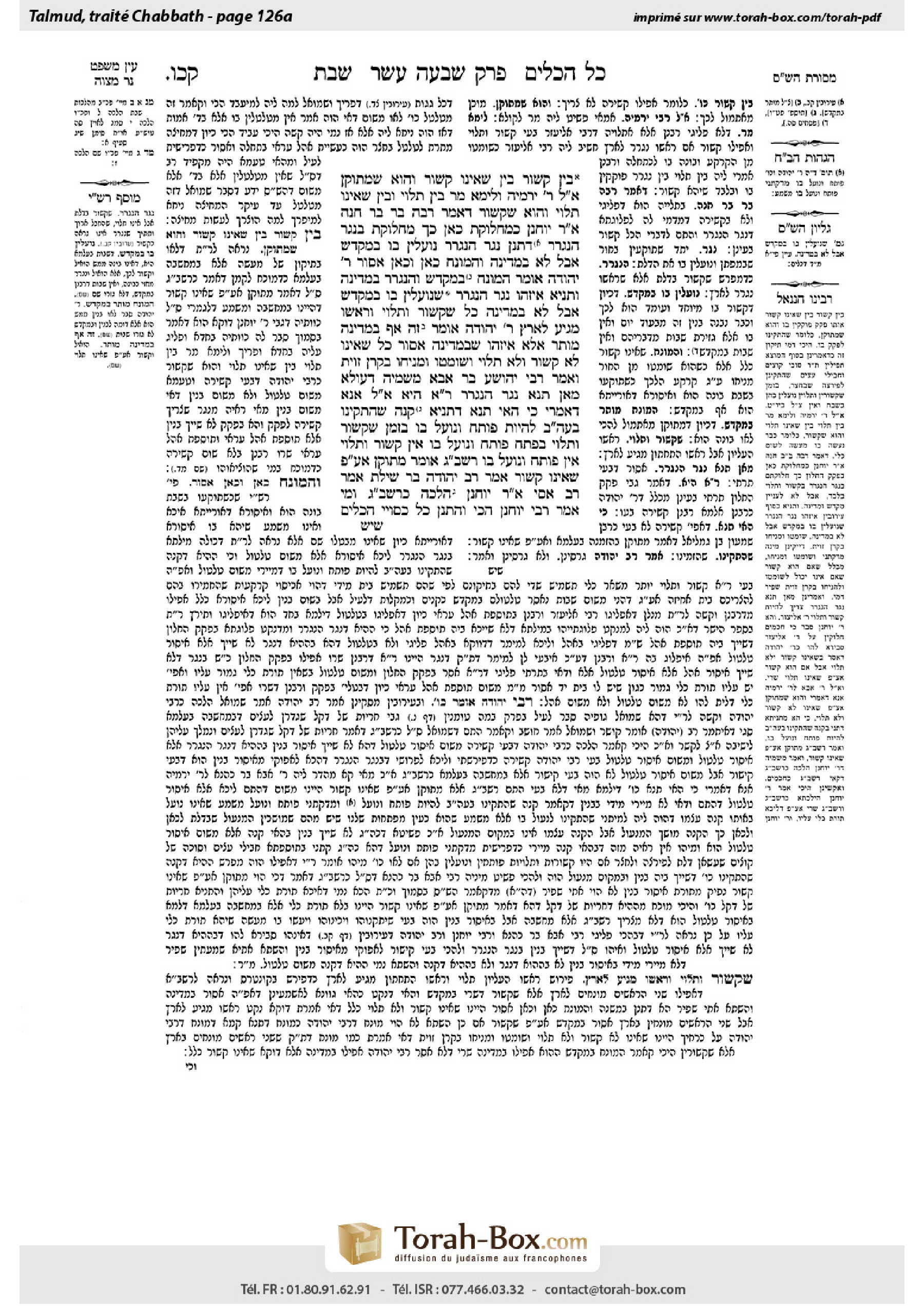
Shabbat 126a: Talmud study for Daf Yomi
Daf Yomi is the daily study of one Talmud folio. Explore 37 tractates with scans, Hebrew text, Sefaria English and AI-generated French translations where annotated.
Passage selection and English or AI-generated French translation are available where the scan has annotations. Daf Study is independent of Torah-Box and Sefaria.
Browse Shabbat · שבת · All tractatesShabbat 126a text and translations
This page of Shabbat includes the Aramaic text, an English translation and an AI-generated French translation, alongside the scan above.
שבת קכ״ו א · Aramaic and Hebrew text
בֵּין קָשׁוּר בֵּין שֶׁאֵינוֹ קָשׁוּר, וְהוּא שֶׁמְּתוּקָּן.
אֲמַר לֵיהּ רַבִּי יִרְמְיָה, וְלֵימָא מָר: בֵּין תָּלוּי וּבֵין שֶׁאֵינוֹ תָּלוּי, וְהוּא שֶׁקָּשׁוּר! דְּאָמַר רַבָּה בַּר בַּר חָנָה אָמַר רַבִּי יוֹחָנָן: כְּמַחֲלוֹקֶת כָּאן, כָּךְ מַחֲלוֹקֶת בַּנֶּגֶר הַנִּגְרָר. דִּתְנַן: נֶגֶר הַנִּגְרָר, נוֹעֲלִין בּוֹ בַּמִּקְדָּשׁ, אֲבָל לֹא בִּמְדִינָה. וְהַמּוּנָּח, כָּאן וְכָאן, אָסוּר. רַבִּי יְהוּדָה אוֹמֵר: הַמּוּנָּח בְּמִקְדָּשׁ וְהַנִּגְרָר בַּמְּדִינָה.
וְתַנְיָא: אֵיזֶהוּ נֶגֶר הַנִּגְרָר שֶׁנּוֹעֲלִין בּוֹ בַּמִּקְדָּשׁ אֲבָל לֹא בִּמְדִינָה? כׇּל שֶׁקָּשׁוּר וְתָלוּי וְרֹאשׁוֹ מַגִּיעַ לָאָרֶץ. רַבִּי יְהוּדָה אוֹמֵר: זֶה אַף בַּמְּדִינָה מוּתָּר. אֶלָּא אֵיזֶהוּ שֶׁבַּמְּדִינָה אָסוּר — כֹּל שֶׁאֵינוֹ לֹא קָשׁוּר וְלָא תָּלוּי, וְשׁוֹמְטוֹ וּמַנִּיחוֹ בְּקֶרֶן זָוִית.
וְאָמַר רַבִּי יְהוֹשֻׁעַ בַּר אַבָּא מִשְּׁמֵיהּ דְּעוּלָּא: מַאן תַּנָּא נֶגֶר הַנִּגְרָר — רַבִּי אֱלִיעֶזֶר הִיא!
אֲמַר לֵיהּ: אֲנָא דַּאֲמַרִי כִּי הַאי תַּנָּא דְּתַנְיָא: קָנֶה שֶׁהִתְקִינוֹ בַּעַל הַבַּיִת לִהְיוֹת פּוֹתֵחַ וְנוֹעֵל בּוֹ, בִּזְמַן שֶׁקָּשׁוּר וְתָלוּי בַּפֶּתַח — פּוֹתֵחַ וְנוֹעֵל בּוֹ, אֵין קָשׁוּר וְתָלוּי — אֵין פּוֹתֵחַ וְנוֹעֵל בּוֹ. רַבָּן שִׁמְעוֹן בֶּן גַּמְלִיאֵל אוֹמֵר: מְתוּקָּן, אַף עַל פִּי שֶׁאֵינוֹ קָשׁוּר.
אָמַר רַב יְהוּדָה בַּר שִׁילַת אָמַר רַב אַסִּי אָמַר רַבִּי יוֹחָנָן: הֲלָכָה כְּרַבָּן שִׁמְעוֹן בֶּן גַּמְלִיאֵל.
וּמִי אָמַר רַבִּי יוֹחָנָן הָכִי? וְהָתְנַן: כׇּל כִּסּוּיֵי הַכֵּלִים
Shabbat 126a · English translation
Both if it is tied and if it is not tied it is permitted, and that is only if it is prepared for this purpose beforehand.
Rabbi Yirmeya said to Rabbi Abba: And let the Master say it in this way: Both if it is hanging and if it is not hanging, and that is only if it is tied, as Rabba bar bar Ḥana said that Rabbi Yoḥanan said: Like the dispute here with regard to the window shutter, so too is the dispute with regard to a bolt that was dragged, which refers to a pole that was stuck through a hole in the door and into the ground in order to hold the door in place. As we learned in a mishna: With regard to a bolt that is dragged, which is not a part of the door itself but is attached to it and is dragged on the ground, one locks with it in the Temple on Shabbat, because the rabbinic decrees are not in effect in the Temple, but not in the rest of the country outside the Temple. And a bolt that is placed alongside the door and not attached, here, in the Temple, and there, outside the Temple, it is prohibited to lock with it on Shabbat. Rabbi Yehuda says: One that was placed is permitted in the Temple and one that is dragged is permitted even in the rest of the country.
And it was taught in a baraita: What is a bolt that is dragged that one locks with it in the Temple but not in the rest of the country? Any bolt that is tied and hangs from the door and one of its edges reaches the ground. Rabbi Yehuda says: That is permitted even in the rest of the country. Rather, what is prohibited in the rest of the country? Any bolt that is neither tied nor hung, and one removes it from the door and places it in a corner.
And Rabbi Yehoshua bar Abba said in the name of Ulla: Who is the tanna who taught the halakha of a bolt that is dragged? The tanna is Rabbi Eliezer, whose opinion in this case is identical to his opinion in the mishna with regard to the window shutter. It is certainly referring to a shutter that is attached. If it is not attached, Rabbi Eliezer holds that it is prohibited for use even in the Temple.
Rabbi Abba said to Rabbi Yirmeya: It is I who say that this case is in accordance with the opinion of this tanna, as it was taught in the Tosefta: With regard to a reed that the homeowner installed to open and lock the door with it like a bolt, when it is tied and hanging in the entrance, one may open and lock the door with it on Shabbat, and when it is not tied and hanging, one may not open and lock the door with it. Rabban Shimon ben Gamliel says: If it was prepared for that use, it is permitted to use it even if it is not tied. There is an opinion that holds that a bolt need not be attached, and preparation is sufficient to permit its use.
Rav Yehuda bar Sheilat said that Rav Asi said that Rabbi Yoḥanan said: The halakha in this case is in accordance with the opinion of Rabban Shimon ben Gamliel.
The Gemara asks: Did Rabbi Yoḥanan really say this? Didn’t we learn in the mishna: All covers of vessels
Shabbat 126a · Traduction française (IA)
Qu’il soit attaché ou non, cela est permis, à condition seulement qu’il ait été préparé à cet usage au préalable.
Rabbi Yirmeya dit à Rabbi Abba : « Que le Maître le formule ainsi : qu’il soit suspendu ou non, cela est permis, à condition seulement qu’il soit attaché. » Car Rabba bar bar Ḥana a dit au nom de Rabbi Yoḥanan : « De même qu’il y a ici une controverse au sujet du volet de fenêtre, de même y a-t-il une controverse au sujet d’un verrou traîné », c’est-à-dire une barre passée dans un trou de la porte et enfoncée dans le sol afin de maintenir la porte en place. En effet, nous avons appris dans une Michna : « Avec un verrou traîné, qui ne fait pas partie de la porte elle-même, mais y est attaché et traîne au sol, on verrouille dans le Temple le Chabbat, car les décrets rabbiniques n’y sont pas en vigueur, mais pas dans le reste du pays, hors du Temple. Quant à un verrou posé à côté de la porte sans y être attaché, il est interdit de verrouiller avec lui le Chabbat, aussi bien ici, dans le Temple, que là, hors du Temple. Rabbi Yehuda dit : un verrou posé est permis dans le Temple, et un verrou traîné est permis même dans le reste du pays. »
Et il a été enseigné dans une baraïta : « Qu’est-ce qu’un verrou traîné avec lequel on verrouille dans le Temple, mais pas dans le reste du pays ? Tout verrou qui est attaché et suspendu à la porte, et dont l’une des extrémités touche le sol. Rabbi Yehuda dit : cela est permis même dans le reste du pays. Alors, qu’est-ce qui est interdit dans le reste du pays ? Tout verrou qui n’est ni attaché ni suspendu, que l’on retire de la porte et que l’on pose dans un coin. »
Et Rabbi Yehoshua bar Abba a dit au nom d’Ulla : « Qui est le tanna qui a enseigné la halakha du verrou traîné ? C’est Rabbi Eliezer, dont l’opinion dans ce cas est identique à celle qu’il exprime dans la Michna au sujet du volet de fenêtre. Il s’agit nécessairement d’un volet attaché. S’il n’est pas attaché, Rabbi Eliezer considère qu’il est interdit de l’utiliser, même dans le Temple. »
Rabbi Abba dit à Rabbi Yirmeya : « C’est moi qui dis que ce cas est conforme à l’opinion de ce tanna, comme cela a été enseigné dans la Tosefta : À propos d’un roseau que le maître de maison a installé pour ouvrir et fermer la porte avec, comme avec un verrou, s’il est attaché et suspendu dans l’entrée, on peut ouvrir et fermer la porte avec lui le Chabbat ; s’il n’est ni attaché ni suspendu, on ne peut pas ouvrir et fermer la porte avec lui. Rabban Shimon ben Gamliel dit : s’il a été préparé à cet usage, il est permis de l’utiliser même s’il n’est pas attaché. » Il y a donc une opinion selon laquelle un verrou n’a pas besoin d’être attaché : sa préparation suffit à en permettre l’usage.
Rav Yehuda bar Sheilat a dit au nom de Rav Asi, qui l’a dit au nom de Rabbi Yoḥanan : « La halakha dans ce cas est conforme à l’opinion de Rabban Shimon ben Gamliel. »
La Guemara demande : « Rabbi Yoḥanan a-t-il vraiment dit cela ? N’avons-nous pas appris dans la Michna : “Tous les couvercles des récipients…” ? »
Traduction française générée par IA à partir de l’édition anglaise de Sefaria. Vérifie toujours un passage avec le texte source.
Text from Sefaria: William Davidson Edition - Vocalized Aramaic (CC BY NC); William Davidson Edition - English (CC BY NC).