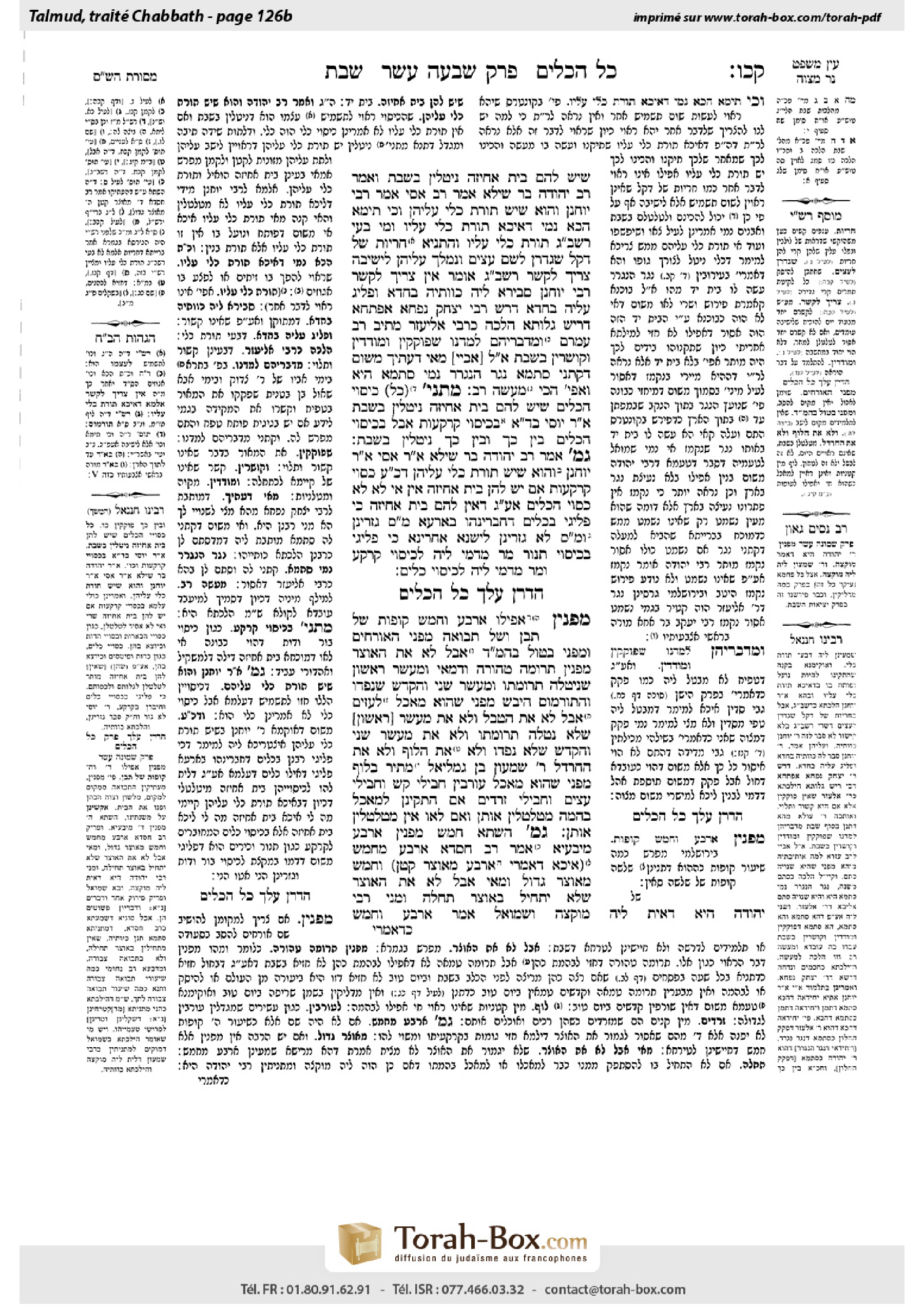
Shabbat 126b: Talmud study for Daf Yomi
Daf Yomi is the daily study of one Talmud folio. Explore 37 tractates with scans, Hebrew text, Sefaria English and AI-generated French translations where annotated.
Passage selection and English or AI-generated French translation are available where the scan has annotations. Daf Study is independent of Torah-Box and Sefaria.
Browse Shabbat · שבת · All tractatesShabbat 126b text and translations
This page of Shabbat includes the Aramaic text, an English translation and an AI-generated French translation, alongside the scan above.
שבת קכ״ו ב · Aramaic and Hebrew text
שֶׁיֵּשׁ לָהֶם בֵּית אֲחִיזָה נִיטָּלִין בַּשַּׁבָּת. וְאָמַר רַב יְהוּדָה בַּר שֵׁילָא אָמַר רַב אַסִּי אָמַר רַבִּי יוֹחָנָן: וְהוּא שֶׁיֵּשׁ תּוֹרַת כְּלִי עֲלֵיהֶן.
וְכִי תֵּימָא: הָכָא נָמֵי דְּאִיכָּא תּוֹרַת כְּלִי עָלָיו, וּמִי בָּעֵי רַבָּן שִׁמְעוֹן בֶּן גַּמְלִיאֵל תּוֹרַת כְּלִי עָלָיו? וְהָתַנְיָא: חֲרִיּוֹת שֶׁל דֶּקֶל שֶׁגְּדָרָן לְשֵׁם עֵצִים, וְנִמְלַךְ עֲלֵיהֶן לִישִׁיבָה — צָרִיךְ לְקַשֵּׁר. רַבָּן שִׁמְעוֹן בֶּן גַּמְלִיאֵל אוֹמֵר: אֵין צָרִיךְ לְקַשֵּׁר.
רַבִּי יוֹחָנָן סְבִירָא לֵיהּ כְּווֹתֵיהּ בַּחֲדָא וּפְלִיג עֲלֵיהּ בַּחֲדָא.
דְּרַשׁ רַבִּי יִצְחָק נַפָּחָא אַפִּתְחָא דְרֵישׁ גָּלוּתָא: הֲלָכָה כְּרַבִּי אֱלִיעֶזֶר. מֵתִיב רַב עַמְרָם: וּמִדִּבְרֵיהֶם לָמַדְנוּ שֶׁפּוֹקְקִין וּמוֹדְדִין וְקוֹשְׁרִין בְּשַׁבָּת!
אֲמַר לֵיהּ [אַבָּיֵי]: מַאי דַּעְתָּיךְ — מִשּׁוּם דְּקָתָנֵי סְתָמָא, נֶגֶר הַנִּגְרָר נָמֵי סְתָמָא הִיא. וַאֲפִילּוּ הָכִי — מַעֲשֶׂה רַב.
מַתְנִי׳ כׇּל כִּיסּוּיֵי הַכֵּלִים שֶׁיֵּשׁ לָהֶם בֵּית אֲחִיזָה — נִיטָּלִין בַּשַּׁבָּת. אָמַר רַבִּי יוֹסֵי: בַּמֶּה דְּבָרִים אֲמוּרִים — בְּכִיסּוּי קַרְקָעוֹת, אֲבָל בְּכִיסּוּי הַכֵּלִים — בֵּין כָּךְ וּבֵין כָּךְ נִיטָּלִין בַּשַּׁבָּת.
גְּמָ׳ אָמַר רַב יְהוּדָה בַּר שֵׁילָא אָמַר רַבִּי אַסִּי אָמַר רַבִּי יוֹחָנָן: וְהוּא שֶׁיֵּשׁ תּוֹרַת כְּלִי עֲלֵיהֶן. דְּכוּלֵּי עָלְמָא כִּסּוּי קַרְקָעוֹת, אִם יֵשׁ לָהֶן בֵּית אֲחִיזָה — אִין, אִי לָא — לָא. כִּסּוּי הַכֵּלִים, אַף עַל גַּב דְּאֵין לָהֶם בֵּית אֲחִיזָה.
כִּי פְּלִיגִי בְּכֵלִים דְּחַבְּרִינְהוּ בְּאַרְעָא. מָר סָבַר גָּזְרִינַן, וּמָר סָבַר לָא גָּזְרִינַן.
לִישָּׁנָא אַחֲרִינָא: כִּי פְּלִיגִי בְּכִיסּוּי תַּנּוּר, מָר מְדַמֵּי לֵיהּ לְכִיסּוּי קַרְקַע, וּמָר מְדַמֵּי לֵיהּ לְכִיסּוּי כֵּלִים.
הדרן עלך כל הכלים
מַתְנִי׳ מְפַנִּין אֲפִילּוּ אַרְבַּע וְחָמֵשׁ קוּפּוֹת שֶׁל תֶּבֶן וְשֶׁל תְּבוּאָה מִפְּנֵי הָאוֹרְחִים, וּמִפְּנֵי בִּטּוּל בֵּית הַמִּדְרָשׁ. אֲבָל לֹא אֶת הָאוֹצָר.
מְפַנִּין תְּרוּמָה טְהוֹרָה, וּדְמַאי, וּמַעֲשֵׂר רִאשׁוֹן שֶׁנִּיטְלָהּ תְּרוּמָתוֹ, וּמַעֲשֵׂר שֵׁנִי וְהֶקְדֵּשׁ שֶׁנִּפְדּוּ, וְהַתּוֹרְמוֹס הַיָּבֵשׁ מִפְּנֵי שֶׁהוּא מַאֲכָל לְעִזִּים.
אֲבָל לֹא אֶת הַטֶּבֶל, וְלֹא אֶת מַעֲשֵׂר [רִאשׁוֹן] שֶׁלֹּא נִטְּלָה תְּרוּמָתוֹ, וְלֹא אֶת מַעֲשֵׂר שֵׁנִי וְהֶקְדֵּשׁ שֶׁלֹּא נִפְדּוּ, וְלֹא אֶת הַלּוּף, וְלָא אֶת הַחַרְדָּל. רַבִּי שִׁמְעוֹן בֶּן גַּמְלִיאֵל מַתִּיר בַּלּוּף, מִפְּנֵי שֶׁהוּא מַאֲכַל עוֹרְבִין.
חֲבִילֵי קַשׁ וַחֲבִילֵי עֵצִים וַחֲבִילֵי זְרָדִים, אִם הִתְקִינָן לְמַאֲכַל בְּהֵמָה — מְטַלְטְלִין אוֹתָן. וְאִם לָאו — אֵין מְטַלְטְלִין אוֹתָן.
גְּמָ׳ הַשְׁתָּא חָמֵשׁ מְפַנִּין, אַרְבַּע מִיבַּעְיָא?!
אָמַר רַב חִסְדָּא: אַרְבַּע מֵחָמֵשׁ, (אִיכָּא דְאָמְרִי: אַרְבַּע מֵאוֹצָר קָטָן) וְחָמֵשׁ מֵאוֹצָר גָּדוֹל.
וּמַאי ״אֲבָל לֹא אֶת הָאוֹצָר״ — שֶׁלֹּא יַתְחִיל בָּאוֹצָר תְּחִלָּה, וּמַנִּי — רַבִּי יְהוּדָה הִיא, דְּאִית לֵיהּ מוּקְצֶה.
וּשְׁמוּאֵל אָמַר: אַרְבַּע וְחָמֵשׁ
Shabbat 126b · English translation
that have a handle may be moved on Shabbat. And Rav Yehuda bar Sheila said that Rav Asi said that Rabbi Yoḥanan said: And that is specifically when the status of a vessel applies to them, i.e., when the cover itself is suited for use as a vessel. This is contrary to the opinion of Rabban Shimon ben Gamliel, who holds that preparation alone is sufficient.
And if you say: Here, too, Rabban Shimon ben Gamliel is referring to a case where the status of a vessel applies to the reed, does Rabban Shimon ben Gamliel require that the status of a vessel apply to it? Wasn’t it taught in a baraita: With regard to hard branches of a palm tree that one cut for firewood or for construction and then he reconsidered their designation and decided to use them for sitting, he must tie the branches together on Shabbat eve so that they will not be set-aside. Rabban Shimon ben Gamliel says: He need not tie them together, and nevertheless, it is permitted to move them. Rabban Shimon ben Gamliel does not require that one render it a vessel. Thought is sufficient.
The Gemara answers: Rabbi Yoḥanan holds in accordance with the opinion of Rabban Shimon ben Gamliel in one matter and disagrees with him in one matter.
Rabbi Yitzḥak taught at the entrance of the house of the Exilarch: The halakha is in accordance with the opinion of Rabbi Eliezer in the matter of a window shutter. Rav Amram raised an objection from that we learned explicitly in a mishna: And from their statements and their actions, we derived that one may seal a window, and measure, and tie a knot on Shabbat. Apparently, one may shutter the window under any circumstances, not only when the shutter was prepared for use, as Rabbi Eliezer said.
Abaye said to Rav Amram: What is your opinion, that the proof is decisive because it was taught in the mishna unattributed and the halakha is in accordance with an unattributed mishna? The mishna with regard to a bolt that is dragged is also an unattributed mishna. The halakha should be in accordance with that mishna as well. The Gemara concludes: And even so, an action is greater. Even though the two mishnayot are of equal weight, since one of them not only cites an unattributed opinion but also relates an incident where the Sages shuttered a window, that source is decisive.
MISHNA: All covers of vessels that have a handle may be moved on Shabbat. Rabbi Yosei said: In what case is this statement said? In the case of a cover for the ground, i.e., the cover of a pit; however, with regard to covers of vessels, both in this case and in that case, even if they do not have handles, they may be moved on Shabbat.
GEMARA: Rav Yehuda bar Sheila said that Rabbi Asi said that Rabbi Yoḥanan said: And this applies specifically when the status of a vessel applies to them and they are suited for some use. The Gemara adds: Everyone holds that with regard to a cover for the ground, if it has a handle, yes, it is permitted to move it, and if not, no, it is prohibited to move it; with regard to a cover of a vessel, even if it does not have a handle, it is permitted to move it.
When they disagree in the mishna, it is with regard to vessels that one attached to the ground. This Sage, the first tanna, holds that we issue a decree according to which it is prohibited to move the cover of a vessel attached to the ground due to the concern that one will move a cover for the ground itself, and that Sage, Rabbi Yosei, holds that we do not issue a decree.
Another version of this statement: When they disagree in the mishna, it is with regard to the cover of an oven; this Sage likens it to a cover for the ground, and this Sage likens it to a cover of a vessel.
MISHNA: On Shabbat, one may move even four or five baskets of straw and baskets of produce, due to the guests, who require that place to sit, and due to suspension of Torah study in the study hall, where space is required to seat the students. However, one may not move these items to create space in the storeroom.
One may move ritually pure teruma, although it may only be eaten by a priest; and doubtfully tithed produce [demai], which may not be eaten until tithes are separated from it due to concern that an am ha’aretz did not separate its tithes; and first tithe whose teruma of the tithe has already been taken and given to priests; and second tithe and consecrated items that were redeemed; and even dry lupine, which is not fit for consumption by a person, because it is goat food.
However, one may neither move untithed produce, nor first tithe whose teruma has not been taken, nor second tithe and consecrated items that were not redeemed, nor raw arum and raw mustard, as all of these items are not fit for consumption and are therefore set aside. Rabban Shimon ben Gamliel permits moving in the case of arum because it is food for ravens.
With regard to bundles of straw, and bundles of wood, and bundles of twigs, if one prepared them on Shabbat eve for animal food, one may move them. And if not, one may not move them.
GEMARA: The Gemara asks: Now that the mishna stated that one may move five baskets, is mentioning four baskets necessary?
Rav Ḥisda said: The mishna means that one may move four out of five baskets, but not all of them. Some say: It is permitted to move four baskets from a small storeroom and five baskets from a large storeroom.
The Gemara asks: And what then is the meaning of: However, one may not move these items to create space in the storeroom? It means that one may not use the storeroom for the first time. If he has never taken supplies from this storeroom, he may not begin moving baskets from it. And whose opinion is cited in this mishna? It is the opinion of Rabbi Yehuda, who is of the opinion that this constitutes a prohibition of set-aside. The contents of a storeroom that was never used are set-aside.
And Shmuel says: The difficulty in the mishna should be explained as a figure of speech: Four and five,
Shabbat 126b · Traduction française (IA)
qui ont une poignée peuvent être déplacés pendant Chabbat. Rav Yehouda bar Sheila dit au nom de Rav Assi, qui dit au nom de Rabbi Yoḥanan : cela ne vaut que lorsqu’ils ont le statut d’un ustensile, c’est-à-dire lorsque le couvercle lui-même peut servir d’ustensile. Cela va à l’encontre de l’opinion de Rabban Shimon ben Gamliel, selon lequel une simple préparation suffit.
Et si tu dis qu’ici aussi, Rabban Shimon ben Gamliel parle d’un cas où le roseau a le statut d’un ustensile, Rabban Shimon ben Gamliel exige-t-il vraiment qu’il ait le statut d’un ustensile ? N’a-t-il pas été enseigné dans une baraïta : au sujet de branches dures de palmier qu’une personne a coupées pour en faire du bois de chauffage ou des matériaux de construction, puis dont elle a reconsidéré la destination et décidé de les utiliser comme sièges, elle doit attacher les branches ensemble la veille de Chabbat afin qu’elles ne soient pas mises à l’écart. Rabban Shimon ben Gamliel dit : il n’est pas nécessaire de les attacher ensemble et, néanmoins, il est permis de les déplacer. Rabban Shimon ben Gamliel n’exige pas qu’on en fasse un ustensile. L’intention suffit.
La Guemara répond : Rabbi Yoḥanan suit l’opinion de Rabban Shimon ben Gamliel sur un point et la conteste sur un autre.
Rabbi Yitzḥak enseigna à l’entrée de la maison de l’Exilarque : la halakha suit l’opinion de Rabbi Eliezer au sujet d’un volet de fenêtre. Rav Amram souleva une objection à partir de ce que nous avons appris explicitement dans une Michna : de leurs paroles et de leurs actes, nous avons déduit qu’on peut boucher une fenêtre, mesurer et nouer un nœud pendant Chabbat. Apparemment, on peut fermer la fenêtre en toutes circonstances, et pas seulement lorsque le volet a été préparé à cet effet, comme l’a dit Rabbi Eliezer.
Abayé dit à Rav Amram : Que penses-tu ? Que la preuve est décisive parce que cet avis est rapporté sans attribution dans la Michna et que la halakha suit une Michna anonyme ? La Michna concernant un verrou qu’on traîne est elle aussi anonyme. La halakha devrait donc suivre également cette Michna. La Guemara conclut : malgré tout, un acte a plus de poids. Bien que les deux Michnayot aient la même autorité, puisque l’une d’elles ne se contente pas de rapporter un avis anonyme, mais relate aussi un épisode où les Sages ont fermé une fenêtre, cette source est décisive.
MICHNA : Tous les couvercles d’ustensiles munis d’une poignée peuvent être déplacés pendant Chabbat. Rabbi Yosei dit : dans quel cas cette déclaration s’applique-t-elle ? Dans le cas d’un couvercle couvrant une ouverture dans le sol, c’est-à-dire le couvercle d’une fosse. En revanche, pour les couvercles d’ustensiles, dans un cas comme dans l’autre, même s’ils n’ont pas de poignée, ils peuvent être déplacés pendant Chabbat.
GUEMARA : Rav Yehouda bar Sheila dit au nom de Rabbi Asi, qui dit au nom de Rabbi Yoḥanan : cela ne vaut que lorsqu’ils ont le statut d’un ustensile et peuvent servir à quelque chose. La Guemara ajoute : tous reconnaissent que, pour un couvercle couvrant une ouverture dans le sol, s’il a une poignée, il est permis de le déplacer, et s’il n’en a pas, il est interdit de le déplacer ; pour un couvercle d’ustensile, même s’il n’a pas de poignée, il est permis de le déplacer.
Le désaccord dans la Michna porte sur des ustensiles fixés au sol. Le premier tanna estime qu’on décrète qu’il est interdit de déplacer le couvercle d’un ustensile fixé au sol, de crainte qu’on ne déplace le couvercle d’une ouverture dans le sol elle-même ; Rabbi Yosei, lui, estime qu’on ne décrète pas cela.
Autre version de cette déclaration : le désaccord dans la Michna porte sur le couvercle d’un four. Ce Sage l’assimile à un couvercle couvrant une ouverture dans le sol, tandis que cet autre Sage l’assimile à un couvercle d’ustensile.
MICHNA : Pendant Chabbat, on peut déplacer jusqu’à quatre ou cinq paniers de paille et de produits, à cause des invités, qui ont besoin de cette place pour s’asseoir, et pour permettre la reprise de l’étude de la Torah dans la maison d’étude, où il faut de la place pour asseoir les élèves. Cependant, on ne peut pas déplacer ces objets pour faire de la place dans le cellier.
On peut déplacer de la terouma rituellement pure, bien qu’elle ne puisse être consommée que par un prêtre ; des produits dont le prélèvement des dîmes est incertain [demai], qu’on ne peut pas consommer avant d’en avoir prélevé les dîmes, par crainte qu’un am ha’aretz ne les ait pas prélevées ; la première dîme dont la terouma de la dîme a déjà été prélevée et donnée aux prêtres ; la seconde dîme et les biens consacrés qui ont été rachetés ; et même des lupins secs, impropres à la consommation humaine, car ils servent de nourriture aux chèvres.
Cependant, on ne peut déplacer ni des produits dont les dîmes n’ont pas été prélevées, ni la première dîme dont la terouma n’a pas été prélevée, ni la seconde dîme et les biens consacrés qui n’ont pas été rachetés, ni du colocase cru ni de la moutarde crue, car aucun de ces aliments n’est propre à la consommation et ils sont donc mis à l’écart. Rabban Shimon ben Gamliel permet de déplacer le colocase, car il sert de nourriture aux corbeaux.
Pour les bottes de paille, les bottes de bois et les bottes de brindilles, si on les a préparées la veille de Chabbat comme nourriture pour les animaux, on peut les déplacer. Sinon, on ne peut pas les déplacer.
GUEMARA : La Guemara demande : puisque la Michna a dit qu’on peut déplacer cinq paniers, était-il nécessaire d’en mentionner quatre ?
Rav Ḥisda dit : la Michna signifie qu’on peut déplacer quatre paniers sur cinq, mais pas les cinq. Certains disent : il est permis de déplacer quatre paniers d’un petit cellier et cinq paniers d’un grand cellier.
La Guemara demande : que signifie alors « cependant, on ne peut pas déplacer ces objets pour faire de la place dans le cellier » ? Cela signifie qu’on ne peut pas utiliser le cellier pour la première fois. Si l’on n’a jamais pris de provisions dans ce cellier, on ne peut pas commencer à en déplacer les paniers. Et quelle opinion cette Michna rapporte-t-elle ? Celle de Rabbi Yehouda, qui estime que cela relève de l’interdiction de mouqtsé. Le contenu d’un cellier qui n’a jamais été utilisé est mouqtsé.
Et Shmuel dit : la difficulté que présente la Michna doit s’expliquer comme une façon de parler : quatre ou cinq,
Traduction française générée par IA à partir de l’édition anglaise de Sefaria. Vérifie toujours un passage avec le texte source.
Text from Sefaria: William Davidson Edition - Vocalized Aramaic (CC BY NC); William Davidson Edition - English (CC BY NC).