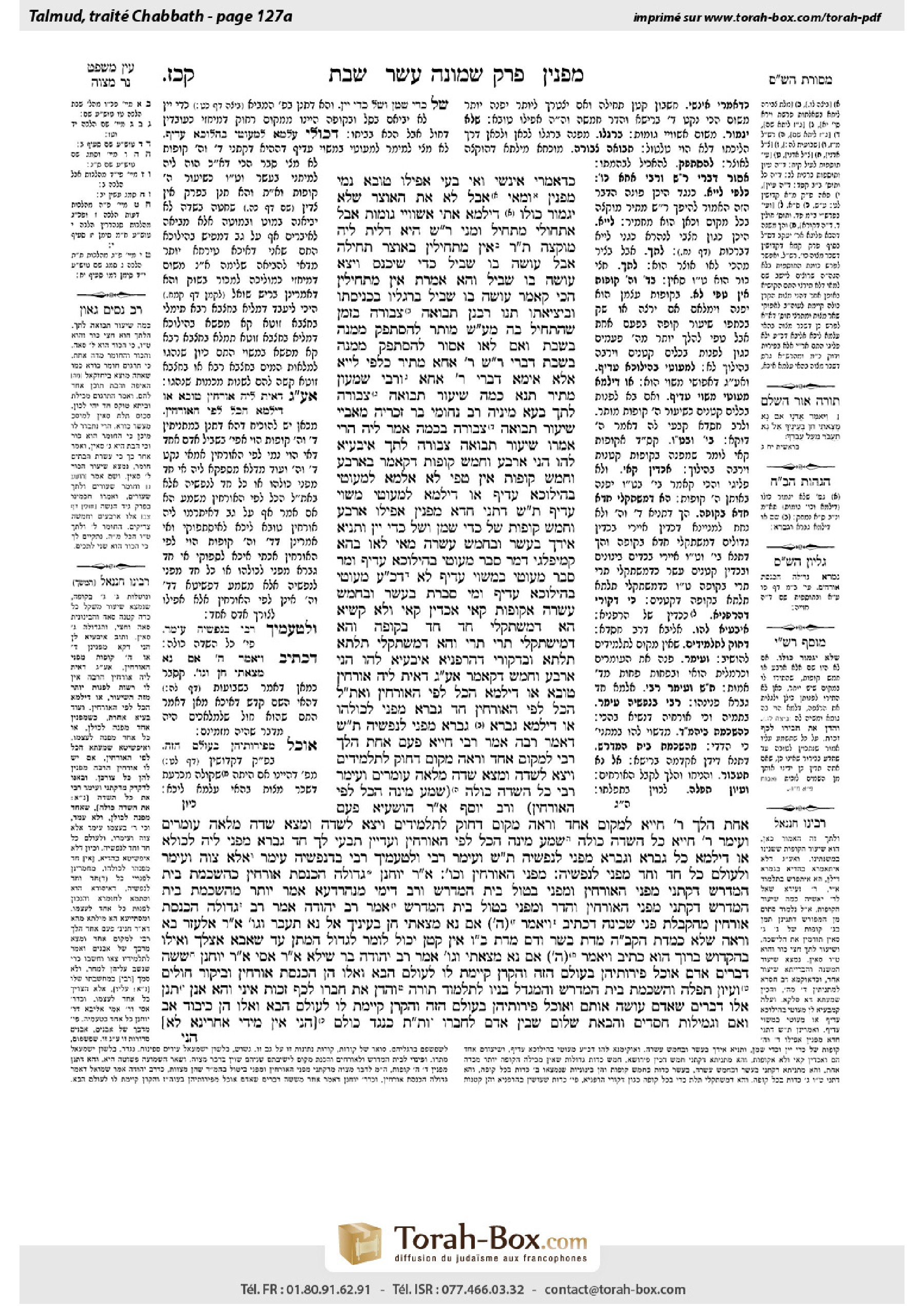
Shabbat 127a: Talmud study for Daf Yomi
Daf Yomi is the daily study of one Talmud folio. Explore 37 tractates with scans, Hebrew text, Sefaria English and AI-generated French translations where annotated.
Passage selection and English or AI-generated French translation are available where the scan has annotations. Daf Study is independent of Torah-Box and Sefaria.
Browse Shabbat · שבת · All tractatesShabbat 127a text and translations
This page of Shabbat includes the Aramaic text, an English translation and an AI-generated French translation, alongside the scan above.
שבת קכ״ז א · Aramaic and Hebrew text
כִּדְאָמְרִי אִינָשֵׁי, וְאִי בָּעֵי אֲפִילּוּ טוּבָא נָמֵי מְפַנִּין. וּמַאי ״אֲבָל לֹא אֶת הָאוֹצָר״ — שֶׁלֹּא יִגְמוֹר כּוּלּוֹ, דִּילְמָא אָתֵי לְאַשְׁווֹיֵי גּוּמּוֹת. אֲבָל אַתְחוֹלֵי מַתְחִיל. וּמַנִּי — רַבִּי שִׁמְעוֹן הִיא, דְּלֵית לֵיהּ מוּקְצֶה.
תָּנוּ רַבָּנַן: אֵין מַתְחִילִין בָּאוֹצָר תְּחִילָּה, אֲבָל עוֹשֶׂה בּוֹ שְׁבִיל כְּדֵי שֶׁיִּכָּנֵס וְיֵצֵא. עוֹשֶׂה בּוֹ שְׁבִיל?! וְהָא אָמְרַתְּ אֵין מַתְחִילִין! הָכִי קָאָמַר: עוֹשֶׂה בּוֹ שְׁבִיל בְּרַגְלָיו בִּכְנִיסָתוֹ וּבִיצִיאָתוֹ.
תָּנוּ רַבָּנַן: תְּבוּאָה צְבוּרָה, בִּזְמַן שֶׁהִתְחִיל בָּהּ מֵעֶרֶב שַׁבָּת — מוּתָּר לְהִסְתַּפֵּק מִמֶּנָּה בְּשַׁבָּת, וְאִם לָאו — אָסוּר לְהִסְתַּפֵּק מִמֶּנָּה בְּשַׁבָּת, דִּבְרֵי רַבִּי שִׁמְעוֹן. רַבִּי אַחָא מַתִּיר: כְּלַפֵּי לְיָיא! אֶלָּא אֵימָא: דִּבְרֵי רַבִּי אַחָא, וְרַבִּי שִׁמְעוֹן מַתִּיר.
תָּנָא: כַּמָּה שִׁיעוּר תְּבוּאָה צְבוּרָה — לֶתֶךְ. בְּעָא מִינֵּיהּ רַב נְחוּמִי בַּר זְכַרְיָה מֵאַבָּיֵי: שִׁיעוּר תְּבוּאָה צְבוּרָה בְּכַמָּה? אֲמַר לֵיהּ הֲרֵי אָמְרוּ: שִׁיעוּר תְּבוּאָה צְבוּרָה — לֶתֶךְ.
אִיבַּעְיָא לְהוּ: הָנֵי אַרְבַּע וְחָמֵשׁ קוּפּוֹת דְּקָאָמַר, בְּאַרְבַּע וְחָמֵשׁ קוּפּוֹת — אִין, טְפֵי — לָא, אַלְמָא לְמַעוֹטֵי בְּהִילּוּכָא עֲדִיף, אוֹ דִילְמָא לְמַעוֹטֵי מַשּׂוֹי עֲדִיף.
תָּא שְׁמַע, דְּתָנֵי חֲדָא: מְפַנִּין אֲפִילּוּ אַרְבַּע וְחָמֵשׁ קוּפּוֹת שֶׁל כַּדֵּי שֶׁמֶן וְשֶׁל כַּדֵּי יַיִן. וְתַנְיָא אִידַּךְ: בְּעֶשֶׂר וּבַחֲמֵשׁ עֶשְׂרֵה. מַאי לָאו בְּהָא קָמִיפַּלְגִי, דְּמָר סָבַר מַעוֹטֵי בְּהִילּוּכָא עָדִיף, וּמָר סָבַר מַעוֹטֵי בְּמַשּׂוֹי עֲדִיף?
לָא, דְּכוּלֵּי עָלְמָא מַעוֹטֵי בְּהִילּוּכָא עֲדִיף, וּמִי סָבְרַתְּ ״בְּעֶשֶׂר וּבַחֲמֵשׁ עֶשְׂרֵה״ אַקּוּפּוֹת קָאֵי? אַכַּדִּין קָאֵי, וְלָא קַשְׁיָא: הָא דְּמִשְׁתַּקְלִי חַד חַד בְּקוּפָּה, וְהָא דְּמִישְׁתַּקְלִי תְּרֵי תְּרֵי, וְהָא דְּמִשְׁתַּקְלִי תְּלָתָא תְּלָתָא — וּבִדְקוּרֵי דְהַרְפַּנְיָא.
אִיבַּעְיָא לְהוּ: הָנֵי אַרְבַּע וְחָמֵשׁ דְּקָאָמַר, אַף עַל גַּב דְּאִית לֵיהּ אוֹרְחִין טוּבָא, אוֹ דִילְמָא הַכֹּל לְפִי הָאוֹרְחִין? וְאִם תִּמְצֵי לוֹמַר הַכֹּל לְפִי הָאוֹרְחִין, חַד גַּבְרָא מְפַנֵּי לְכוּלְּהוּ, אוֹ דִילְמָא גַּבְרָא גַּבְרָא מְפַנֵּי לְנַפְשֵׁיהּ?
תָּא שְׁמַע, דְּאָמַר רַבָּה אָמַר רַבִּי חִיָּיא: פַּעַם אַחַת הָלַךְ רַבִּי לְמָקוֹם אֶחָד, וְרָאָה מָקוֹם דָּחוּק לַתַּלְמִידִים, וְיָצָא לַשָּׂדֶה וּמָצָא שָׂדֶה מְלֵאָה עוֹמָרִים, וְעִימֵּר רַבִּי כׇּל הַשָּׂדֶה כּוּלָּהּ. (שְׁמַע מִינַּהּ: הַכֹּל לְפִי הָאוֹרְחִין.)
וְרַב יוֹסֵף אָמַר רַבִּי הוֹשַׁעְיָא: פַּעַם אַחַת הָלַךְ רַבִּי חִיָּיא לְמָקוֹם אֶחָד וְרָאָה מָקוֹם דָּחוּק לַתַּלְמִידִים, וְיָצָא לַשָּׂדֶה וּמָצָא שָׂדֶה מְלֵאָה עוֹמָרִים, וְעִימֵּר רַבִּי חִיָּיא כׇּל הַשָּׂדֶה כּוּלָּהּ. שְׁמַע מִינַּהּ: הַכֹּל לְפִי הָאוֹרְחִין.
וַעֲדַיִין תִּבְּעֵי לָךְ: חַד גַּבְרָא מְפַנֵּי (לֵיהּ) לְכוּלְּהוּ, אוֹ דִילְמָא כׇּל גַּבְרָא וְגַבְרָא מְפַנֵּי לְנַפְשֵׁיהּ?
תָּא שְׁמַע: וְעִימֵּר רַבִּי. וּלְטַעְמָיךְ, רַבִּי בְּדִנְפָשֶׁיהָ עִימֵּר?! אֶלָּא צִוָּה וְעִימֵּר, וּלְעוֹלָם כׇּל חַד וְחַד מְפַנֵּי לְנַפְשֵׁיהּ.
מִפְּנֵי הָאוֹרְחִין וְכוּ׳. אָמַר רַבִּי יוֹחָנָן: גְּדוֹלָה הַכְנָסַת אוֹרְחִין כְּהַשְׁכָּמַת בֵּית הַמִּדְרָשׁ, דְּקָתָנֵי: ״מִפְּנֵי הָאוֹרְחִין וּמִפְּנֵי בִּטּוּל בֵּית הַמִּדְרָשׁ״. וְרַב דִּימִי מִנְּהַרְדְּעָא אָמַר: יוֹתֵר מֵהַשְׁכָּמַת בֵּית הַמִּדְרָשׁ, דְּקָתָנֵי ״מִפְּנֵי הָאוֹרְחִין״, וַהֲדַר ״וּמִפְּנֵי בִּטּוּל בֵּית הַמִּדְרָשׁ״. אָמַר רַב יְהוּדָה אָמַר רַב: גְּדוֹלָה הַכְנָסַת אוֹרְחִין מֵהַקְבָּלַת פְּנֵי שְׁכִינָה, דִּכְתִיב: ״וַיֹּאמַר ה׳ אִם נָא מָצָאתִי חֵן בְּעֵינֶיךָ אַל נָא תַעֲבֹר וְגוֹ׳״. אָמַר רַבִּי אֶלְעָזָר: בֹּא וּרְאֵה שֶׁלֹּא כְּמִדַּת הַקָּדוֹשׁ בָּרוּךְ הוּא מִדַּת בָּשָׂר וָדָם. מִדַּת בָּשָׂר וְדָם, אֵין קָטָן יָכוֹל לוֹמַר לַגָּדוֹל ״הַמְתֵּן עַד שֶׁאָבֹא אֶצְלְךָ״, וְאִילּוּ בְּהַקָּדוֹשׁ בָּרוּךְ הוּא כְּתִיב ״וַיֹּאמַר ה׳ אִם נָא מָצָאתִי וְגוֹ׳״.
אָמַר רַב יְהוּדָה בַּר שֵׁילָא אָמַר רַבִּי אַסִּי אָמַר רַבִּי יוֹחָנָן: שִׁשָּׁה דְּבָרִים אָדָם אוֹכֵל פֵּירוֹתֵיהֶן בָּעוֹלָם הַזֶּה וְהַקֶּרֶן קַיֶּימֶת לוֹ לָעוֹלָם הַבָּא, וְאֵלּוּ הֵן: הַכְנָסַת אוֹרְחִין, וּבִיקּוּר חוֹלִים, וְעִיּוּן תְּפִלָּה, וְהַשְׁכָּמַת בֵּית הַמִּדְרָשׁ, וְהַמְגַדֵּל בָּנָיו לְתַלְמוּד תּוֹרָה, וְהַדָּן אֶת חֲבֵרוֹ לְכַף זְכוּת.
אִינִי?! וְהָא אֲנַן תְּנַן: אֵלּוּ דְּבָרִים שֶׁאָדָם עוֹשֶׂה אוֹתָם וְאוֹכֵל פֵּירוֹתֵיהֶן בָּעוֹלָם הַזֶּה, וְהַקֶּרֶן קַיֶּימֶת לוֹ לָעוֹלָם הַבָּא, וְאֵלּוּ הֵן: כִּיבּוּד אָב וָאֵם, וּגְמִילוּת חֲסָדִים, וַהֲבָאַת שָׁלוֹם שֶׁבֵּין אָדָם לַחֲבֵרוֹ, וְתַלְמוּד תּוֹרָה כְּנֶגֶד כּוּלָּם [הָנֵי — אִין, מִידֵּי אַחֲרִינָא — לָא]!
Shabbat 127a · English translation
as people who are not so precise in their formulation say: Four or five. And if one so desires, he may clear even more. And what then is the meaning of: However, one may not move these items to create space in the storeroom? It means that one may not finish moving the baskets out of the entire storeroom, lest he come to level the floor by filling the holes. However, one may begin removing baskets from the storeroom. And whose opinion is cited in this mishna? It is the opinion of Rabbi Shimon, who is not of the opinion that there is a prohibition of set-aside.
The Sages taught in a baraita: One may not use the storeroom for the first time. If one has never taken supplies from this storeroom, he may not begin moving baskets from it. However, he makes a path in it, so that he will be able to enter and exit. The Gemara asks: He makes a path in it? Did you not say: One may not use the storeroom for the first time? The Gemara answers that the baraita is saying as follows: He makes a path in it by moving baskets with his feet, as he enters the storehouse and as he exits. He may not move the basket with his hand.
The Sages taught in a baraita: With regard to piled grain, if one had started to take grain from the pile on Shabbat eve, it is permitted to satisfy his needs from it on Shabbat, and if not, it is prohibited to satisfy his needs from it on Shabbat; this is the statement of Rabbi Shimon. Rabbi Aḥa permits doing so in any case. The Gemara raises a difficulty: On the contrary; it is Rabbi Shimon who is lenient with regard to the halakhot of set-aside. Rather, emend the baraita and say: This is the statement of Rabbi Aḥa. Rabbi Shimon permits doing so in any case.
It was taught: How much is the measure of piled grain needed to confer the legal status of a storeroom? A half-kor. Rav Naḥumi bar Zekharya raised a dilemma before Abaye: The measure of piled grain, how much is it? Abaye said to him that they said: The measure of piled grain is a half-kor.
A dilemma was raised before the Sages: These four or five baskets, which the tanna stated in the mishna, is he saying the following: Four or five baskets, yes, one may move them, more baskets, no, one may not move them? This would indicate that it is preferable to minimize the walking distance because fewer baskets results in less walking in and out of the storeroom. Or perhaps it is preferable to minimize the size of the burden by carrying smaller baskets, as long as the total measure of all that one carries does not exceed the capacity of five large baskets?
Come and hear a resolution to this dilemma, as one baraita taught: One may move even four or five baskets containing jugs of oil and jugs of wine. And it was taught in another baraita: One may move them even in ten and in fifteen baskets. What, is it not that the two baraitot disagree concerning the following matter, as this Sage in the first baraita holds that it is preferable to minimize the walking distance by moving fewer, heavier baskets, and this Sage in the second baraita holds that it is preferable to minimize the size of the burden by moving lighter baskets over the course of several trips.
The Gemara rejects this: No, everyone agrees that it is preferable to minimize the walking distance. And do you hold that: In ten and in fifteen, is referring to baskets? It is referring to jugs, and there is no dispute between the baraitot. And this is not difficult: This baraita, which spoke of moving five, is referring to a case in which the jugs are taken one by one in each basket. And that baraita, which speaks of moving ten, is referring to a case in which the jugs are taken two by two in each basket. And that baraita, which speaks of moving fifteen, is referring to a case in which the jugs are taken three by three, e.g., in the case of the small jugs of Harpanya.
A dilemma was raised before the Sages: These four or five baskets, which the tanna stated in the mishna, is he saying that one may move only four or five baskets even though he has many guests? Or perhaps, it is all according to the number of guests, and if there are more guests one may move more baskets. And if you say it is all according to the number of guests, does one man move the baskets to make room for all of them, or perhaps each and every man moves a basket to make room for himself?
Come and hear a resolution to this dilemma from that which Rabba said that Rav Ḥiyya said: Once Rabbi Yehuda HaNasi went to a certain place and saw that the place was too crowded for the students. And he went to the field and found a field full of bundles of grain, and Rabbi Yehuda HaNasi cleared the bundles from the whole field in its entirety. Conclude from it that the quantity that can be moved is all according to the number of guests.
And Rav Yosef said that Rav Hoshaya said: Once Rabbi Ḥiyya went to a certain place and saw that the place was too crowded for the students. And he went to the field and found a field full of bundles of grain, and Rabbi Ḥiyya cleared the bundles from the whole field in its entirety. Conclude from it that the quantity that can be moved is all according to the number of guests.
The Gemara continues: And still you have a dilemma. Does one man move the baskets to make room for all of them, or perhaps each and every man moves baskets to make room for himself?
Come and hear a resolution to this question. We learned: And Rabbi Yehuda HaNasi cleared the bundles. Apparently, one person moved the bundles to make room for the others. The Gemara rejects the proof: And according to your reasoning, your opinion, do you think Rabbi Yehuda HaNasi, the spiritual leader of his generation, cleared the bundles himself? Rather, he ordered others to do so, and he thereby cleared the bundles. And actually, each and every one moves a bundle to make room for himself.
We learned in the mishna: One may move baskets of produce due to the guests and in order to prevent the suspension of Torah study in the study hall. Rabbi Yoḥanan said: Hospitality toward guests is as great as rising early to go to the study hall, as the mishna equates them and teaches: Due to the guests and due to suspension of Torah study in the study hall. And Rav Dimi from Neharde’a says: Hospitality toward guests is greater than rising early to the study hall, as it teaches: Due to the guests, and only afterward: And due to suspension of Torah study in the study hall. Rav Yehuda said that Rav said on a related note: Hospitality toward guests is greater than receiving the Divine Presence, as when Abraham invited his guests it is written: “And he said: Lord, if now I have found favor in Your sight, please pass not from Your servant” (Genesis 18:3). Abraham requested that God, the Divine Presence, wait for him while he tended to his guests appropriately. Rabbi Elazar said: Come and see that the attribute of the Holy One, Blessed be He, is not like that of flesh and blood. The attribute of flesh and blood people is such that a less significant person is unable to say to a more significant person: Wait until I come to you, while with regard to the Holy One, Blessed be He, it is written: “And he said: Lord, if now I have found favor in Your sight, please pass not from Your servant.” Abraham requested that God wait for him due to his guests.
Rav Yehuda bar Sheila said that Rabbi Asi said that Rabbi Yoḥanan said: There are six matters a person enjoys the profits of in this world, and nevertheless the principal exists for him for the World-to-Come, and they are: Hospitality toward guests, and visiting the sick, and consideration during prayer, and rising early to the study hall, and one who raises his sons to engage in Torah study, and one who judges another favorably, giving him the benefit of the doubt.
The Gemara asks: Is that so? And did we not learn in a mishna: These are the matters that a person does them and enjoys their profits in this world, and nevertheless the principal exists for him for the World-to-Come, and they are: Honoring one’s father and mother, and acts of loving kindness, and bringing peace between a person and another, and Torah study is equal to all of them. By inference: These matters, yes, one enjoys their profits in this world and the principal exists for him in the World-to-Come; other matters, no.
Shabbat 127a · Traduction française (IA)
comme disent ceux qui ne s’expriment pas avec beaucoup de précision : « quatre ou cinq ». Et si l’on veut, on peut en dégager encore davantage. Que signifie alors : « Toutefois, on ne peut pas déplacer ces objets pour faire de la place dans le cellier » ? Cela signifie qu’on ne peut pas finir de vider entièrement le cellier de ses paniers, de peur d’en venir à niveler le sol en comblant les trous. Toutefois, on peut commencer à sortir des paniers du cellier. Et de qui cette Michna rapporte-t-elle l’opinion ? De Rabbi Shimon, qui ne reconnaît pas d’interdiction de mouktsé.
Les Sages ont enseigné dans une baraïta : On ne peut pas utiliser le cellier pour la première fois. Si l’on n’a jamais pris de provisions dans ce cellier, on ne peut pas commencer à en déplacer les paniers. Toutefois, on y aménage un passage afin de pouvoir entrer et sortir. La Guemara demande : On y aménage un passage ? N’as-tu pas dit : « On ne peut pas utiliser le cellier pour la première fois » ? La Guemara répond que la baraïta veut dire ceci : on aménage un passage en déplaçant les paniers avec les pieds, lorsqu’on entre dans le cellier et lorsqu’on en sort. On ne peut pas déplacer le panier avec la main.
Les Sages ont enseigné dans une baraïta : Concernant un tas de céréales, si l’on avait commencé à en prélever des grains la veille de Chabbat, il est permis de s’en servir selon ses besoins pendant Chabbat ; sinon, il est interdit de s’en servir pendant Chabbat. Telle est l’opinion de Rabbi Shimon. Rabbi Aḥa le permet dans tous les cas. La Guemara soulève une difficulté : Au contraire, c’est Rabbi Shimon qui est indulgent en matière de halakhot du mouktsé ! Il faut plutôt corriger la baraïta et dire : Telle est l’opinion de Rabbi Aḥa ; Rabbi Shimon le permet dans tous les cas.
Il a été enseigné : Quelle quantité de céréales entassées confère le statut de cellier ? Un demi-kor. Rav Naḥumi bar Zekharya souleva une question devant Abaye : Quelle est la quantité de céréales entassées ? Abaye lui répondit qu’ils ont dit : la quantité de céréales entassées est d’un demi-kor.
Une question fut soulevée devant les Sages : Lorsque le tanna mentionne dans la Michna ces quatre ou cinq paniers, veut-il dire qu’on peut déplacer quatre ou cinq paniers, mais pas davantage ? Cela indiquerait qu’il vaut mieux réduire la distance à parcourir, car moins de paniers entraînent moins d’allées et venues dans le cellier. Ou peut-être vaut-il mieux réduire le poids de la charge en transportant des paniers plus petits, pourvu que la quantité totale transportée ne dépasse pas la capacité de cinq grands paniers ?
Viens et entends une réponse à cette question : une baraïta enseigne qu’on peut déplacer même quatre ou cinq paniers contenant des cruches d’huile et des cruches de vin. Une autre baraïta enseigne qu’on peut les déplacer même en dix ou quinze paniers. N’est-ce pas que les deux baraïtot sont en désaccord sur le point suivant : selon le Sage de la première baraïta, il vaut mieux réduire la distance à parcourir en déplaçant moins de paniers, mais plus lourds ; tandis que selon le Sage de la seconde baraïta, il vaut mieux réduire le poids de la charge en déplaçant des paniers plus légers au cours de plusieurs trajets ?
La Guemara rejette cette interprétation : Non, tous sont d’accord qu’il vaut mieux réduire la distance à parcourir. Et penses-tu que « en dix ou quinze » désigne des paniers ? Cela désigne des cruches, et il n’y a pas de désaccord entre les baraïtot. Il n’y a pas de difficulté : la baraïta qui parle d’en déplacer cinq concerne un cas où les cruches sont transportées une par une dans chaque panier ; celle qui parle d’en déplacer dix concerne un cas où elles sont transportées deux par deux dans chaque panier ; et celle qui parle d’en déplacer quinze concerne un cas où elles sont transportées trois par trois, par exemple dans le cas des petites cruches de Harpanya.
Une question fut soulevée devant les Sages : Lorsque le tanna mentionne dans la Michna ces quatre ou cinq paniers, veut-il dire qu’on peut déplacer seulement quatre ou cinq paniers, même s’il y a beaucoup d’invités ? Ou peut-être cela dépend-il du nombre d’invités, de sorte que s’il y en a davantage, on peut déplacer davantage de paniers ? Et si tu dis que cela dépend du nombre d’invités, un seul homme déplace-t-il les paniers pour faire de la place à tous, ou bien chacun déplace-t-il un panier pour se faire de la place ?
Viens et entends une réponse à cette question, tirée de ce que Rabba a dit au nom de Rav Ḥiyya : Un jour, Rabbi Yehuda HaNasi se rendit dans un certain endroit et vit que les élèves y étaient trop à l’étroit. Il se rendit dans un champ, qu’il trouva rempli de gerbes de céréales, et Rabbi Yehuda HaNasi dégagea les gerbes dans tout le champ. Conclus-en que la quantité qu’on peut déplacer dépend du nombre d’invités.
Et Rav Yosef a dit au nom de Rav Hoshaya : Un jour, Rabbi Ḥiyya se rendit dans un certain endroit et vit que les élèves y étaient trop à l’étroit. Il se rendit dans un champ, qu’il trouva rempli de gerbes de céréales, et Rabbi Ḥiyya dégagea les gerbes dans tout le champ. Conclus-en que la quantité qu’on peut déplacer dépend du nombre d’invités.
La Guemara poursuit : Une question demeure : un seul homme déplace-t-il les paniers pour faire de la place à tous, ou bien chacun déplace-t-il des paniers pour se faire de la place ?
Viens et entends une réponse à cette question. Nous avons appris : « Et Rabbi Yehuda HaNasi dégagea les gerbes. » Apparemment, une seule personne déplaça les gerbes pour faire de la place aux autres. La Guemara rejette cette preuve : Mais, selon ton raisonnement, penses-tu que Rabbi Yehuda HaNasi, le dirigeant spirituel de sa génération, a dégagé lui-même les gerbes ? Il a plutôt ordonné à d’autres de le faire, et c’est ainsi qu’il a fait dégager les gerbes. En réalité, chacun déplace une gerbe pour se faire de la place.
Nous avons appris dans la Michna : On peut déplacer des paniers de produits agricoles à cause des invités et afin d’éviter l’interruption de l’étude de la Torah dans la maison d’étude. Rabbi Yoḥanan a dit : L’hospitalité envers les invités est aussi importante que le fait de se lever tôt pour aller à la maison d’étude, puisque la Michna les met sur un pied d’égalité et enseigne : « À cause des invités et à cause de l’interruption de l’étude de la Torah dans la maison d’étude. » Rav Dimi de Neharde’a dit : L’hospitalité envers les invités est plus importante que le fait de se lever tôt pour aller à la maison d’étude, puisqu’il est enseigné : « À cause des invités », puis seulement ensuite : « Et à cause de l’interruption de l’étude de la Torah dans la maison d’étude. » Rav Yehuda a dit au nom de Rav, à ce propos : L’hospitalité envers les invités est plus importante que l’accueil de la Présence divine, car, lorsque Abraham invita ses hôtes, il est écrit : « Et il dit : Seigneur, si j’ai trouvé grâce à tes yeux, je t’en prie, ne passe pas loin de ton serviteur » (Genèse 18:3). Abraham demanda à Dieu, la Présence divine, de l’attendre pendant qu’il s’occupait convenablement de ses invités. Rabbi Elazar a dit : Viens et vois que la manière d’agir du Saint, béni soit-Il, n’est pas celle des êtres de chair et de sang. Les êtres de chair et de sang sont tels qu’une personne de moindre importance ne peut pas dire à une personne de plus grande importance : « Attends que je vienne à toi » ; tandis qu’au sujet du Saint, béni soit-Il, il est écrit : « Et il dit : Seigneur, si j’ai trouvé grâce à tes yeux, je t’en prie, ne passe pas loin de ton serviteur. » Abraham demanda à Dieu de l’attendre à cause de ses invités.
Rav Yehuda bar Sheila a dit au nom de Rabbi Asi, qui a dit au nom de Rabbi Yoḥanan : Il y a six choses dont une personne goûte les fruits en ce monde, tandis que le capital lui reste pour le Monde à venir : l’hospitalité envers les invités, la visite aux malades, le recueillement dans la prière, le fait de se lever tôt pour aller à la maison d’étude, le fait d’élever ses fils pour qu’ils se consacrent à l’étude de la Torah, et le fait de juger autrui favorablement, en lui accordant le bénéfice du doute.
La Guemara demande : Est-ce vraiment ainsi ? N’avons-nous pas appris dans une Michna : « Voici les choses dont une personne accomplit les actes et goûte les fruits en ce monde, tandis que le capital lui reste pour le Monde à venir : honorer son père et sa mère, accomplir des actes de bonté, faire la paix entre une personne et une autre ; et l’étude de la Torah équivaut à toutes ces choses. » Il ressort de là que ces choses-là, oui, donnent à goûter leurs fruits en ce monde, tandis que le capital reste pour le Monde à venir ; les autres choses, non.
Traduction française générée par IA à partir de l’édition anglaise de Sefaria. Vérifie toujours un passage avec le texte source.
Text from Sefaria: William Davidson Edition - Vocalized Aramaic (CC BY NC); William Davidson Edition - English (CC BY NC).