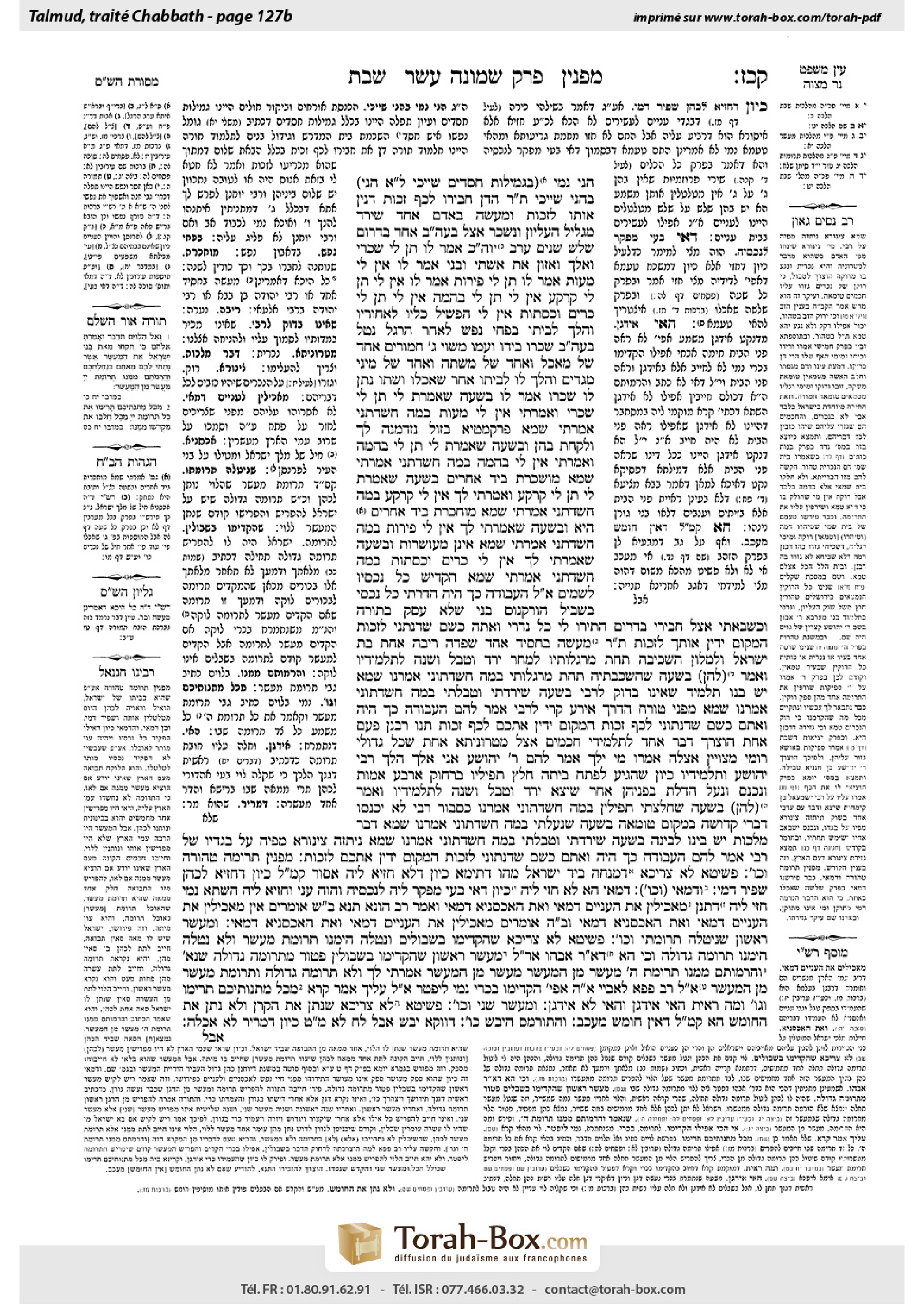
Shabbat 127b: Talmud study for Daf Yomi
Daf Yomi is the daily study of one Talmud folio. Explore 37 tractates with scans, Hebrew text, Sefaria English and AI-generated French translations where annotated.
Passage selection and English or AI-generated French translation are available where the scan has annotations. Daf Study is independent of Torah-Box and Sefaria.
Browse Shabbat · שבת · All tractatesShabbat 127b text and translations
This page of Shabbat includes the Aramaic text, an English translation and an AI-generated French translation, alongside the scan above.
שבת קכ״ז ב · Aramaic and Hebrew text
הָנֵי נָמֵי, (בִּגְמִילוּת חֲסָדִים שָׁיְיכִי. לִישָּׁנָא אַחֲרִינָא: הָנֵי) בְּהָנֵי שָׁיְיכִי.
תָּנוּ רַבָּנַן: הַדָּן חֲבֵירוֹ לְכַף זְכוּת — דָּנִין אוֹתוֹ לִזְכוּת. וּמַעֲשֶׂה בְּאָדָם אֶחָד שֶׁיָּרַד מִגָּלִיל הָעֶלְיוֹן וְנִשְׂכַּר אֵצֶל בַּעַל הַבַּיִת אֶחָד בַּדָּרוֹם שָׁלֹשׁ שָׁנִים. עֶרֶב יוֹם הַכִּפּוּרִים אָמַר לוֹ: תֵּן לִי שְׂכָרִי, וְאֵלֵךְ וְאָזוּן אֶת אִשְׁתִּי וּבָנַי. אָמַר לוֹ: אֵין לִי מָעוֹת. אָמַר לוֹ: תֵּן לִי פֵּירוֹת. אָמַר לוֹ: אֵין לִי. תֵּן לִי קַרְקַע — אֵין לִי. תֵּן לִי בְּהֵמָה — אֵין לִי. תֵּן לִי כָּרִים וּכְסָתוֹת — אֵין לִי. הִפְשִׁיל כֵּלָיו לַאֲחוֹרָיו, וְהָלַךְ לְבֵיתוֹ בְּפַחֵי נֶפֶשׁ.
לְאַחַר הָרֶגֶל נָטַל בַּעַל הַבַּיִת שְׂכָרוֹ בְּיָדוֹ, וְעִמּוֹ מַשּׂוֹי שְׁלֹשָׁה חֲמוֹרִים, אֶחָד שֶׁל מַאֲכָל, וְאֶחָד שֶׁל מִשְׁתֶּה, וְאֶחָד שֶׁל מִינֵי מְגָדִים, וְהָלַךְ לוֹ לְבֵיתוֹ. אַחַר שֶׁאָכְלוּ וְשָׁתוּ נָתַן לוֹ שְׂכָרוֹ.
אָמַר לוֹ: בְּשָׁעָה שֶׁאָמַרְתָּ לִי ״תֵּן לִי שְׂכָרִי״ וְאָמַרְתִּי ״אֵין לִי מָעוֹת״, בַּמֶּה חֲשַׁדְתַּנִי? אָמַרְתִּי: שֶׁמָּא פְּרַקְמַטְיָא בְּזוֹל נִזְדַּמְּנָה לְךָ, וְלָקַחְתָּ בָּהֶן. וּבְשָׁעָה שֶׁאָמַרְתָּ לִי ״תֵּן לִי בְּהֵמָה״, וְאָמַרְתִּי ״אֵין לִי בְּהֵמָה״, בַּמֶּה חֲשַׁדְתַּנִי? אָמַרְתִּי: שֶׁמָּא מוּשְׂכֶּרֶת בְּיַד אֲחֵרִים. בְּשָׁעָה שֶׁאָמַרְתָּ לִי ״תֵּן לִי קַרְקַע״, וְאָמַרְתִּי לְךָ ״אֵין לִי קַרְקַע״, בַּמֶּה חֲשַׁדְתַּנִי? אָמַרְתִּי: שֶׁמָּא מוּחְכֶּרֶת בְּיַד אֲחֵרִים הִיא. וּבְשָׁעָה שֶׁאָמַרְתִּי לְךָ ״אֵין לִי פֵּירוֹת״ בַּמֶּה חֲשַׁדְתַּנִי? אָמַרְתִּי: שֶׁמָּא אֵינָן מְעוּשָּׂרוֹת. וּבְשָׁעָה שֶׁאָמַרְתִּי לְךָ ״אֵין לִי כָּרִים וּכְסָתוֹת״ בַּמֶּה חֲשַׁדְתַּנִי? אָמַרְתִּי: שֶׁמָּא הִקְדִּישׁ כָּל נְכָסָיו לַשָּׁמַיִם.
אָמַר לוֹ: הָעֲבוֹדָה! כָּךְ הָיָה. הִדַּרְתִּי כׇּל נְכָסַי בִּשְׁבִיל הוּרְקָנוֹס בְּנִי שֶׁלֹּא עָסַק בַּתּוֹרָה. וּכְשֶׁבָּאתִי אֵצֶל חֲבֵירַי בַּדָּרוֹם הִתִּירוּ לִי כָּל נְדָרַי. וְאַתָּה, כְּשֵׁם שֶׁדַּנְתַּנִי לִזְכוּת, הַמָּקוֹם יָדִין אוֹתְךָ לִזְכוּת.
תָּנוּ רַבָּנַן: מַעֲשֶׂה בְּחָסִיד אֶחָד שֶׁפָּדָה רִיבָה אַחַת בַּת יִשְׂרָאֵל, וְלַמָּלוֹן הִשְׁכִּיבָהּ תַּחַת מַרְגְּלוֹתָיו. לְמָחָר יָרַד וְטָבַל וְשָׁנָה לְתַלְמִידָיו.
וְאָמַר לָהֶן: בְּשָׁעָה שֶׁהִשְׁכַּבְתִּיהָ תַּחַת מַרְגְּלוֹתַי, בַּמֶּה חֲשַׁדְתּוּנִי? אָמַרְנוּ: שֶׁמָּא יֵשׁ בָּנוּ תַּלְמִיד שֶׁאֵינוֹ בָּדוּק לְרַבִּי.
בְּשָׁעָה שֶׁיָּרַדְתִּי וְטָבַלְתִּי, בַּמֶּה חֲשַׁדְתּוּנִי? אָמַרְנוּ: שֶׁמָּא מִפְּנֵי טוֹרַח הַדֶּרֶךְ אֵירַע קֶרִי לְרַבִּי. אָמַר לָהֶם: הָעֲבוֹדָה! כָּךְ הָיָה. וְאַתֶּם, כְּשֵׁם שֶׁדַּנְתּוּנִי לְכַף זְכוּת, הַמָּקוֹם יָדִין אֶתְכֶם לְכַף זְכוּת.
תָּנוּ רַבָּנַן: פַּעַם אַחַת הוּצְרַךְ דָּבָר אֶחָד לְתַלְמִידֵי חֲכָמִים אֵצֶל מַטְרוֹנִיתָא אַחַת שֶׁכׇּל גְּדוֹלֵי רוֹמִי מְצוּיִין אֶצְלָהּ. אָמְרוּ: מִי יֵלֵךְ? אָמַר לָהֶם רַבִּי יְהוֹשֻׁעַ: אֲנִי אֵלֵךְ.
הָלַךְ רַבִּי יְהוֹשֻׁעַ וְתַלְמִידָיו. כֵּיוָן שֶׁהִגִּיעַ לְפֶתַח בֵּיתָהּ, חָלַץ תְּפִילָּיו בְּרִחוּק אַרְבַּע אַמּוֹת, וְנִכְנַס וְנָעַל הַדֶּלֶת בִּפְנֵיהֶן. אַחַר שֶׁיָּצָא, יָרַד וְטָבַל וְשָׁנָה לְתַלְמִידָיו.
וְאָמַר לָהֶן: בְּשָׁעָה שֶׁחָלַצְתִּי תְּפִילִּין, בַּמֶּה חֲשַׁדְתּוּנִי? אָמַרְנוּ: כְּסָבוּר רַבִּי, לֹא יִכָּנְסוּ דִּבְרֵי קְדוּשָּׁה בִּמְקוֹם טוּמְאָה.
בְּשָׁעָה שֶׁנָּעַלְתִּי, בַּמֶּה חֲשַׁדְתּוּנִי? אָמַרְנוּ: שֶׁמָּא דְּבַר מַלְכוּת יֵשׁ בֵּינוֹ לְבֵינָהּ.
בְּשָׁעָה שֶׁיָּרַדְתִּי וְטָבַלְתִּי בַּמֶּה חֲשַׁדְתּוּנִי, אָמַרְנוּ: שֶׁמָּא נִיתְּזָה צִינּוֹרָא מִפִּיהָ עַל בְּגָדָיו שֶׁל רַבִּי. אָמַר לָהֶם: הָעֲבוֹדָה! כָּךְ הָיָה. וְאַתֶּם, כְּשֵׁם שֶׁדַּנְתּוּנִי לִזְכוּת, הַמָּקוֹם יָדִין אֶתְכֶם לִזְכוּת.
מְפַנִּין תְּרוּמָה טְהוֹרָה וְכוּ׳. פְּשִׁיטָא! לָא צְרִיכָא, דְּמַנְּחָה בְּיַד יִשְׂרָאֵל. מַהוּ דְּתֵימָא: כֵּיוָן דְּלָא חַזְיָא לֵיהּ — אָסוּר, קָא מַשְׁמַע לַן כֵּיוָן דְּחַזְיָא לְכֹהֵן — שַׁפִּיר דָּמֵי.
וּדְמַאי וְכוּ׳. דְּמַאי, הָא לָא חֲזֵי לֵיהּ! כֵּיוָן דְּאִי בָּעֵי מַפְקַר לֵיהּ לְנִכְסֵיהּ וְהָוֵה עָנִי, וַחֲזֵי לֵיהּ, הַשְׁתָּא נָמֵי חֲזֵי לֵיהּ. דִּתְנַן: מַאֲכִילִין אֶת הָעֲנִיִּים דְּמַאי וְאֶת הָאַכְסַנְיָא דְּמַאי. וְאָמַר רַב הוּנָא: תָּנָא, בֵּית שַׁמַּאי אוֹמְרִים: אֵין מַאֲכִילִין אֶת הָעֲנִיִּים דְּמַאי וְאֶת הָאַכְסַנְיָא דְּמַאי. וּבֵית הִלֵּל אוֹמְרִים: מַאֲכִילִין אֶת הָעֲנִיִּים דְּמַאי וְאֶת הָאַכְסַנְיָא דְּמַאי.
וּמַעֲשֵׂר רִאשׁוֹן שֶׁנִּיטְּלָה תְּרוּמָתוֹ וְכוּ׳. פְּשִׁיטָא! לָא צְרִיכָא שֶׁהִקְדִּימוֹ בְּשִׁבּוֹלִים, וְנִטְּלָה הֵימֶנּוּ תְּרוּמַת מַעֲשֵׂר, וְלֹא נִטְּלָה הֵימֶנּוּ תְּרוּמָה גְּדוֹלָה.
וְכִי הָא דְּאָמַר רַבִּי אֲבָהוּ אָמַר רֵישׁ לָקִישׁ: מַעֲשֵׂר רִאשׁוֹן שֶׁהִקְדִּימוֹ בְּשִׁבּוֹלִין — פָּטוּר מִתְּרוּמָה גְּדוֹלָה, שֶׁנֶּאֱמַר: ״וַהֲרֵמוֹתֶם מִמֶּנּוּ תְּרוּמַת ה׳ מַעֲשֵׂר מִן הַמַּעֲשֵׂר״. מַעֲשֵׂר מִן הַמַּעֲשֵׂר אָמַרְתִּי לְךָ, וְלֹא תְּרוּמָה גְּדוֹלָה וּתְרוּמַת מַעֲשֵׂר מִן הַמַּעֲשֵׂר.
אֲמַר לֵיהּ רַב פָּפָּא לְאַבָּיֵי: אִי הָכִי, אֲפִילּוּ הִקְדִּימוֹ בִּכְרִי נָמֵי לִיפְּטַר! אֲמַר לֵיהּ: עָלֶיךָ אָמַר קְרָא: ״מִכֹּל מַתְּנוֹתֵיכֶם תָּרִימוּ וְגוֹ׳״.
וּמָה רָאִיתָ? הַאי אִידְּגַן, וְהַאי לָא אִידְּגַן.
וּמַעֲשֵׂר שֵׁנִי וְכוּ׳. פְּשִׁיטָא! לָא צְרִיכָא שֶׁנָּתַן אֶת הַקֶּרֶן וְלֹא נָתַן אֶת הַחוֹמֶשׁ. הָא קָא מַשְׁמַע לַן דְּאֵין חוֹמֶשׁ מְעַכֵּב.
וְהַתּוֹרְמוֹס הַיָּבֵשׁ כּוּ׳. דַּוְוקָא יָבֵשׁ, אֲבָל לַח — לָא. מַאי טַעְמָא? כֵּיוָן דְּמָרִיר לָא אָכְלָה.
Shabbat 127b · English translation
The Gemara answers: These too, hospitality toward guests and visiting the sick, are in the category of acts of loving-kindness. A different version of that answer: These matters on the longer list are attributable to those, the matters on the shorter list.
The Sages taught in a baraita: One who judges another favorably is himself judged favorably. And there was an incident involving a certain person who descended from the Upper Galilee and was hired to work for a certain homeowner in the South for three years. On the eve of the Day of Atonement, he said to the homeowner: Give me my wages, and I will go and feed my wife and children. The homeowner said to him: I have no money. He said to him: In that case, give me my wages in the form of produce. He said to him: I have none. The worker said to him: Give me my wages in the form of land. The homeowner said to him: I have none. The worker said to him: Give me my wages in the form of animals. He said to him: I have none. The worker said to him: Give me cushions and blankets. He said to him: I have none. The worker slung his tools over his shoulder behind him and went to his home in anguish.
After the festival of Sukkot, the homeowner took the worker’s wages in his hand, along with a burden that required three donkeys, one laden with food, one laden with drink, and one laden with types of sweets, and went to the worker’s home. After they ate and drank, the homeowner gave him his wages.
The homeowner said to him: When you said to me: Give me my wages, and I said: I have no money, of what did you suspect me? Why did you not suspect me of trying to avoid paying you? The worker answered, I said: Perhaps the opportunity to purchase merchandise [perakmatya] inexpensively presented itself, and you purchased it with the money that you owed me, and therefore you had no money available. The homeowner asked: And when you said to me: Give me animals, and I said: I have no animals, of what did you suspect me? The worker answered: I said: Perhaps the animals are hired to others. The homeowner asked: When you said to me: Give me land, and I said: I have no land, of what did you suspect me? The worker answered: I said: Perhaps the land is leased to others, and you cannot take the land from the lessees. The homeowner asked: And when you said to me: Give me produce, and I said: I have no produce, of what did you suspect me? The worker answered: I said: Perhaps they are not tithed, and that was why you could not give them to me. The homeowner asked: And when I said: I have no cushions or blankets, of what did you suspect me? The worker answered: I said: Perhaps he consecrated all his property to Heaven and therefore has nothing available at present.
The homeowner said to him: I swear by the Temple service that it was so. I had no money available at the time because I vowed and consecrated all my property on account of Hyrcanus, my son, who did not engage in Torah study. The homeowner sought to avoid leaving an inheritance for his son. And when I came to my colleagues in the South, the Sages of that generation, they dissolved all my vows. At that point, the homeowner had immediately gone to pay his worker. Now the homeowner said: And you, just as you judged favorably, so may God judge you favorably.
On a similar note, the Gemara relates that the Sages taught in a baraita: There was an incident involving a certain pious man who redeemed a young Jewish woman from captivity. When they arrived at the inn he had her lie beneath his feet. The next day, he descended, and immersed in a ritual bath to purify himself before Torah study and prayer, and taught his students. This conduct could arouse suspicion that the pious man kept the maiden for himself, as immersion in the morning is customary for men who have experienced a seminal emission by engaging in sexual relations.
And the pious man said to his students: When I had her lie beneath my feet, of what did you suspect me? They said to him: We said: Perhaps there is a student among us whose conduct is not established before the rabbi, and he wanted to make certain that this student would not inappropriately accost the young woman. Therefore, the rabbi kept the woman close by.
He said to them: When I descended and immersed, of what did you suspect me? They answered: Perhaps due to the exertion of travel, a seminal emission befell the rabbi. He said to them: I swear by the Temple service that it was so. And you, just as you judged me favorably, so may God judge you favorably.
The Sages taught a similar baraita: Once there was a certain matter needed by Torah scholars. They wanted to discuss an issue with a certain matron whose company was kept by all the prominent people of Rome. The Torah scholars wanted to address the government on behalf of the Jewish people, and they sought the matron’s advice. They said: Who will go? Rabbi Yehoshua said to them: I shall go.
Rabbi Yehoshua and his students went to her. When he arrived with his students at the entrance of her house, he removed his phylacteries at a distance of four cubits from the door, and entered, and locked the door before them. After he emerged, he descended and immersed in a ritual bath, and taught his students. Here too, this was conduct that could arouse suspicion that something improper transpired.
And he said to his students: When I removed the phylacteries, of what did you suspect me? They said to him, we said: The rabbi must hold that sacred items may not enter a place of impurity. Therefore, it would have been inappropriate to enter the house with phylacteries.
He asked: When I locked the door, of what did you suspect me? They said to him: We said: Perhaps there is a discreet royal matter that must be discussed between him and her and should not be revealed.
Rabbi Yehoshua asked: When I descended and immersed, of what did you suspect me? They said to him, we said: Perhaps a bit of spittle sprayed from her mouth onto the rabbi’s clothes. The Sages decreed that the legal status of a gentile is like that of a zav; their bodily fluids transmit ritual impurity. Rabbi Yehoshua said to them: I swear by the Temple service that it was so. And you, just as you judged favorably, so may God judge you favorably.
We learned in the mishna: One may move ritually pure teruma on Shabbat. The Gemara objects: That is obvious. The Gemara answers: It is necessary to teach this only in a case in which it is placed in Israelite hands. Lest you say: Since it is not suitable for the Israelite to eat, he is prohibited to move it on Shabbat; therefore, it teaches us that since it is suitable for a priest to eat, one may well move it on Shabbat.
And we also learned in the mishna: One may move doubtfully tithed produce. The Gemara asks: With regard to doubtfully tithed produce, why may one move it? It is not suitable for him to eat. The Gemara answers: Since if he so desires, he may renounce all his property, declaring it ownerless, and he would then be poor, and the doubtfully tithed produce would be suitable for him, now too it is suitable for him. A pauper may eat doubtfully tithed produce, as we learned in a mishna: One may feed the poor doubtfully tithed produce and soldiers [akhsanya] doubtfully tithed produce. And Rav Huna said that it was taught: Beit Shammai say: One may neither feed the poor doubtfully tithed produce nor feed soldiers doubtfully tithed produce. And Beit Hillel say: One may feed the poor doubtfully tithed produce and feed soldiers doubtfully tithed produce. The halakha is in accordance with the opinion of Beit Hillel.
We learned in the mishna: And one may move first tithe whose teruma of the tithe has already been taken. The Gemara poses a question: It is obvious that if the teruma was already tithed it is non-sacred produce in every sense. The Gemara explains: It was necessary to teach this halakha only in the following case: A Levite preceded the priest while the grain was still on the stalks and brought it to the threshing floor, and before the grain was threshed, the teruma of the tithes was taken and the teruma gedola was not taken.
And the above mentioned halakha is in accordance with the opinion of Rabbi Abbahu, as Rabbi Abbahu said that Reish Lakish said: With regard to first tithe, in a case in which the Levite preceded the priest while the grain was still on the stalks, one is exempt from separating teruma gedola from it, as it is stated: “And you shall set apart from it a gift for the Lord, even a tenth part of the tithe” (Numbers 18:26). By inference: A tenth part of the tithe, i.e., the teruma of the tithe, I, God, said to you that you must take, and not both teruma gedola and the teruma of the tithe.
Rav Pappa said to Abaye: If so, even if the Levite preceded the priest after the kernels of grain were removed from the stalks and placed in a pile, the Levite should also be exempt from taking teruma gedola. Abaye said to him: With regard to your claim, the verse states: “From all that is given to you, you shall set apart that which is the Lord’s teruma” (Numbers 18:29). God’s teruma, i.e., teruma gedola, must be taken from all the Levites’ gifts.
The Gemara asks: What did you see that led you to require teruma gedola from first tithe that was taken from grain in piles, and not from first tithe that was taken from grain on stalks? Abaye answers: This, stalks that were threshed and placed into piles, are completely processed and have become grain, and that, grains that have remained on the stalk, have not yet become grain. The verse states the following with regard to teruma gedola: “The first of your grain” (Deuteronomy 18:4) is given to the priest. Once it is considered grain, the rights of the priest take effect and the Levite is required to separate teruma gedola.
We learned in the mishna: One may move second tithe that was redeemed. The Gemara asks: This is obvious. The Gemara answers: It was necessary to teach this halakha only in a case where the consecrated property was not completely redeemed, i.e., where one gave payment for the principal, the value of the tithe, but he did not give payment for the fifth that he must add when redeeming items that he consecrated. And the mishna teaches us that failure to add the fifth does not invalidate the redemption, and the second tithe assumes non-sacred status from the moment that one pays the principal.
And we learned in the mishna: One may move even dry lupine, which is not fit for consumption by a person, because it is goat food. The Gemara comments: This applies only when lupine is dry. However, when it is moist, no it is prohibited to move it. What is the reason for this prohibition? Since lupine is extremely bitter when wet, an animal will not eat it.
Shabbat 127b · Traduction française (IA)
La Guemara répond : Ces actes aussi — l’hospitalité envers les hôtes et la visite aux malades — relèvent des actes de bonté. Selon une autre version de cette réponse, les éléments de la liste la plus longue sont inclus dans ceux de la liste la plus courte.
Les Sages ont enseigné dans une baraïta : Celui qui juge autrui favorablement est lui-même jugé favorablement. Un jour, un homme descendit de Haute-Galilée et fut engagé pour travailler pendant trois ans chez un propriétaire du Sud. La veille du Jour des expiations, il dit au propriétaire : « Donne-moi mon salaire, afin que je puisse partir nourrir ma femme et mes enfants. » Le propriétaire lui répondit : « Je n’ai pas d’argent. » L’ouvrier lui dit : « Dans ce cas, donne-moi mon salaire en produits. » Le propriétaire répondit : « Je n’en ai pas. » L’ouvrier lui dit : « Donne-moi mon salaire en terres. » Le propriétaire répondit : « Je n’en ai pas. » L’ouvrier lui dit : « Donne-moi mon salaire en animaux. » Le propriétaire répondit : « Je n’en ai pas. » L’ouvrier lui dit : « Donne-moi des coussins et des couvertures. » Le propriétaire répondit : « Je n’en ai pas. » L’ouvrier passa ses outils sur son épaule, derrière lui, et rentra chez lui, accablé.
Après la fête de Souccot, le propriétaire prit avec lui le salaire de l’ouvrier, ainsi qu’un chargement nécessitant trois ânes : l’un chargé de nourriture, le deuxième de boissons et le troisième de friandises de toutes sortes, puis se rendit chez l’ouvrier. Après qu’ils eurent mangé et bu, le propriétaire lui remit son salaire.
Le propriétaire lui dit : « Quand tu m’as dit : “Donne-moi mon salaire”, et que je t’ai répondu : “Je n’ai pas d’argent”, que t’es-tu dit ? Pourquoi ne m’as-tu pas soupçonné de vouloir éviter de te payer ? » L’ouvrier répondit : « Je me suis dit : Peut-être s’est présentée une occasion d’acheter des marchandises [perakmatya] à bas prix, et tu les as achetées avec l’argent que tu me devais ; c’est pourquoi tu n’avais pas d’argent disponible. » Le propriétaire demanda : « Et quand tu m’as dit : “Donne-moi des animaux”, et que je t’ai répondu : “Je n’ai pas d’animaux”, que t’es-tu dit ? » L’ouvrier répondit : « Je me suis dit : Peut-être les animaux sont-ils loués à d’autres. » Le propriétaire demanda : « Quand tu m’as dit : “Donne-moi des terres”, et que je t’ai répondu : “Je n’ai pas de terres”, que t’es-tu dit ? » L’ouvrier répondit : « Je me suis dit : Peut-être les terres sont-elles affermées à d’autres, et tu ne peux pas les reprendre aux fermiers. » Le propriétaire demanda : « Et quand tu m’as dit : “Donne-moi des produits”, et que je t’ai répondu : “Je n’ai pas de produits”, que t’es-tu dit ? » L’ouvrier répondit : « Je me suis dit : Peut-être n’ont-ils pas été soumis à la dîme, et c’est pourquoi tu ne pouvais pas me les donner. » Le propriétaire demanda : « Et quand je t’ai dit : “Je n’ai ni coussins ni couvertures”, que t’es-tu dit ? » L’ouvrier répondit : « Je me suis dit : Peut-être a-t-il consacré tous ses biens au Ciel et n’a-t-il donc rien à sa disposition pour le moment. »
Le propriétaire lui dit : « Je le jure par le service du Temple, c’était bien cela. Je n’avais pas d’argent disponible à ce moment-là, car j’avais fait vœu de consacrer tous mes biens à cause de mon fils Hyrcanus, qui ne s’adonnait pas à l’étude de la Torah. » Le propriétaire avait voulu éviter de laisser un héritage à son fils. « Lorsque je suis allé trouver mes collègues du Sud, les Sages de cette génération, ils ont annulé tous mes vœux. » À ce moment-là, le propriétaire était aussitôt parti payer son ouvrier. Il lui dit alors : « Et toi, de même que tu m’as jugé favorablement, puisse Dieu te juger favorablement. »
Dans le même ordre d’idées, la Guemara rapporte que les Sages ont enseigné dans une baraïta : Un jour, un homme pieux racheta une jeune Juive de captivité. Lorsqu’ils arrivèrent à l’auberge, il la fit s’allonger à ses pieds. Le lendemain, il descendit, s’immergea dans un bain rituel afin de se purifier avant l’étude de la Torah et la prière, puis enseigna à ses élèves. Cette conduite pouvait éveiller le soupçon que l’homme pieux avait gardé la jeune femme pour lui, car les hommes qui ont eu une émission séminale après des relations sexuelles ont coutume de s’immerger le matin.
L’homme pieux dit à ses élèves : « Quand je l’ai fait s’allonger à mes pieds, que vous êtes-vous dit ? » Ils lui répondirent : « Nous nous sommes dit : Peut-être y a-t-il parmi nous un élève dont le rabbi ne connaît pas bien la conduite, et il a voulu s’assurer que cet élève ne s’en prendrait pas de manière inconvenante à la jeune femme. C’est pourquoi le rabbi l’a gardée près de lui. »
Il leur dit : « Quand je suis descendu et que je me suis immergé, que vous êtes-vous dit ? » Ils répondirent : « Nous nous sommes dit : Peut-être le rabbi a-t-il eu une émission séminale en raison de la fatigue du voyage. » Il leur dit : « Je le jure par le service du Temple, c’était bien cela. Et vous, de même que vous m’avez jugé favorablement, puisse Dieu vous juger favorablement. »
Les Sages ont enseigné une baraïta semblable : Un jour, les érudits de la Torah eurent une affaire à régler. Ils souhaitaient discuter d’une question avec une certaine matrone, que fréquentaient tous les notables de Rome. Ils voulaient s’adresser au gouvernement au nom du peuple juif et cherchèrent conseil auprès de la matrone. Ils dirent : « Qui ira ? » Rabbi Yehoshua leur répondit : « J’irai. »
Rabbi Yehoshua et ses élèves se rendirent chez elle. Lorsqu’il arriva avec ses élèves à l’entrée de sa maison, il retira ses téfilines à quatre coudées de la porte, entra et ferma la porte derrière lui. Lorsqu’il ressortit, il descendit, s’immergea dans un bain rituel, puis enseigna à ses élèves. Là encore, cette conduite pouvait éveiller le soupçon qu’il s’était passé quelque chose d’inconvenant.
Il dit à ses élèves : « Quand j’ai retiré mes téfilines, que vous êtes-vous dit ? » Ils lui répondirent : « Nous nous sommes dit : Le rabbi doit considérer que les objets sacrés ne peuvent pas entrer dans un lieu impur. Il aurait donc été inconvenant d’entrer dans la maison avec les téfilines. »
Il demanda : « Quand j’ai fermé la porte, que vous êtes-vous dit ? » Ils lui répondirent : « Nous nous sommes dit : Peut-être y a-t-il une affaire confidentielle concernant le pouvoir royal, qui doit être discutée entre lui et elle sans être divulguée. »
Rabbi Yehoshua demanda : « Quand je suis descendu et que je me suis immergé, que vous êtes-vous dit ? » Ils lui répondirent : « Nous nous sommes dit : Peut-être un peu de salive a-t-elle jailli de sa bouche et a-t-elle éclaboussé les vêtements du rabbi. » Les Sages ont décrété que le statut juridique d’un non-Juif est celui d’un zav ; ses fluides corporels transmettent l’impureté rituelle. Rabbi Yehoshua leur dit : « Je le jure par le service du Temple, c’était bien cela. Et vous, de même que vous avez jugé favorablement, puisse Dieu vous juger favorablement. »
Nous avons appris dans la Michna : On peut déplacer de la terouma pure le Chabbat. La Guemara objecte : Cela va de soi. La Guemara répond : Cette règle devait être enseignée uniquement dans le cas où la terouma se trouve entre les mains d’un Israélite. De peur que tu ne dises : puisqu’il ne peut pas la manger, il lui est interdit de la déplacer le Chabbat, la Michna nous enseigne que, puisqu’un prêtre peut la manger, on peut bel et bien la déplacer le Chabbat.
Nous avons également appris dans la Michna : On peut déplacer des produits dont le statut quant à la dîme est incertain. La Guemara demande : Pourquoi peut-on les déplacer ? Cette personne ne peut pas les manger. La Guemara répond : Puisqu’elle peut, si elle le souhaite, renoncer à tous ses biens en les déclarant sans propriétaire et devenir ainsi pauvre — auquel cas ces produits lui conviendraient —, ils lui conviennent aussi maintenant. Un pauvre peut manger des produits dont le statut quant à la dîme est incertain, comme nous l’avons appris dans une Michna : On peut donner aux pauvres des produits dont le statut quant à la dîme est incertain, et en donner aux soldats [akhsanya]. Rav Houna a dit que cela a été enseigné : Beit Shammaï disent qu’on ne peut donner de tels produits ni aux pauvres ni aux soldats. Beit Hillel disent qu’on peut en donner aux pauvres et aux soldats. La halakha suit l’opinion de Beit Hillel.
Nous avons appris dans la Michna : On peut déplacer la première dîme dont la terouma de la dîme a déjà été prélevée. La Guemara demande : Cela va de soi : une fois la terouma prélevée, il s’agit à tous égards de produits non consacrés. La Guemara explique : Cette règle devait être enseignée uniquement dans le cas suivant : un Lévite a devancé le prêtre alors que le grain était encore sur pied et l’a apporté à l’aire de battage ; avant que le grain ne soit battu, la terouma de la dîme a été prélevée, mais pas la terouma gedola.
La règle mentionnée plus haut est conforme à l’opinion de Rabbi Abbahou, car Rabbi Abbahou a dit au nom de Reish Lakish : En ce qui concerne la première dîme, si le Lévite a devancé le prêtre alors que le grain était encore sur pied, on est dispensé d’en prélever la terouma gedola, comme il est dit : « Vous en prélèverez une offrande pour le Seigneur : un dixième de la dîme » (Nombres 18,26). On en déduit : « Un dixième de la dîme », c’est-à-dire la terouma de la dîme, voilà ce que moi, Dieu, vous ai ordonné de prélever, et non à la fois la terouma gedola et la terouma de la dîme.
Rav Pappa dit à Abaye : « Si c’est ainsi, même si le Lévite a devancé le prêtre après que les grains ont été détachés des épis et rassemblés en tas, il devrait lui aussi être dispensé de prélever la terouma gedola. » Abaye lui répondit : « À l’appui de ton argument, le verset dit : “Sur tout ce qui vous est donné, vous prélèverez l’offrande du Seigneur” (Nombres 18,29). L’offrande du Seigneur, c’est-à-dire la terouma gedola, doit être prélevée sur tous les dons qui vous sont faits. »
La Guemara demande : Qu’est-ce qui t’a conduit à exiger la terouma gedola de la première dîme prélevée sur du grain rassemblé en tas, mais pas de celle prélevée sur du grain encore sur pied ? Abaye répond : Dans le premier cas, les épis ont été battus et le grain rassemblé en tas ; le produit est entièrement transformé et est devenu du grain. Dans l’autre cas, le grain est encore sur pied et n’est pas encore devenu du grain. Le verset dit au sujet de la terouma gedola : « Le premier de ton blé » (Deutéronome 18,4) revient au prêtre. Dès lors que le produit est considéré comme du grain, les droits du prêtre prennent effet et le Lévite doit prélever la terouma gedola.
Nous avons appris dans la Michna : On peut déplacer la seconde dîme qui a été rachetée. La Guemara demande : Cela va de soi. La Guemara répond : Cette règle devait être enseignée uniquement dans le cas où le produit consacré n’a pas été entièrement racheté : la personne a payé le principal, c’est-à-dire la valeur de la dîme, mais n’a pas payé le cinquième qu’elle doit ajouter lorsqu’elle rachète des biens qu’elle a consacrés. La Michna nous enseigne que le défaut de paiement du cinquième n’invalide pas le rachat et que la seconde dîme acquiert le statut de produit non consacré dès que le principal est payé.
Nous avons appris dans la Michna : On peut déplacer même des lupins secs, qui ne sont pas propres à la consommation humaine, car ils servent de nourriture aux chèvres. La Guemara précise : Cela ne s’applique qu’aux lupins secs. En revanche, lorsqu’ils sont humides, il est interdit de les déplacer. Pour quelle raison ? Parce que, lorsqu’ils sont humides, les lupins sont extrêmement amers et les animaux ne les mangent pas.
Traduction française générée par IA à partir de l’édition anglaise de Sefaria. Vérifie toujours un passage avec le texte source.
Text from Sefaria: William Davidson Edition - Vocalized Aramaic (CC BY NC); William Davidson Edition - English (CC BY NC).