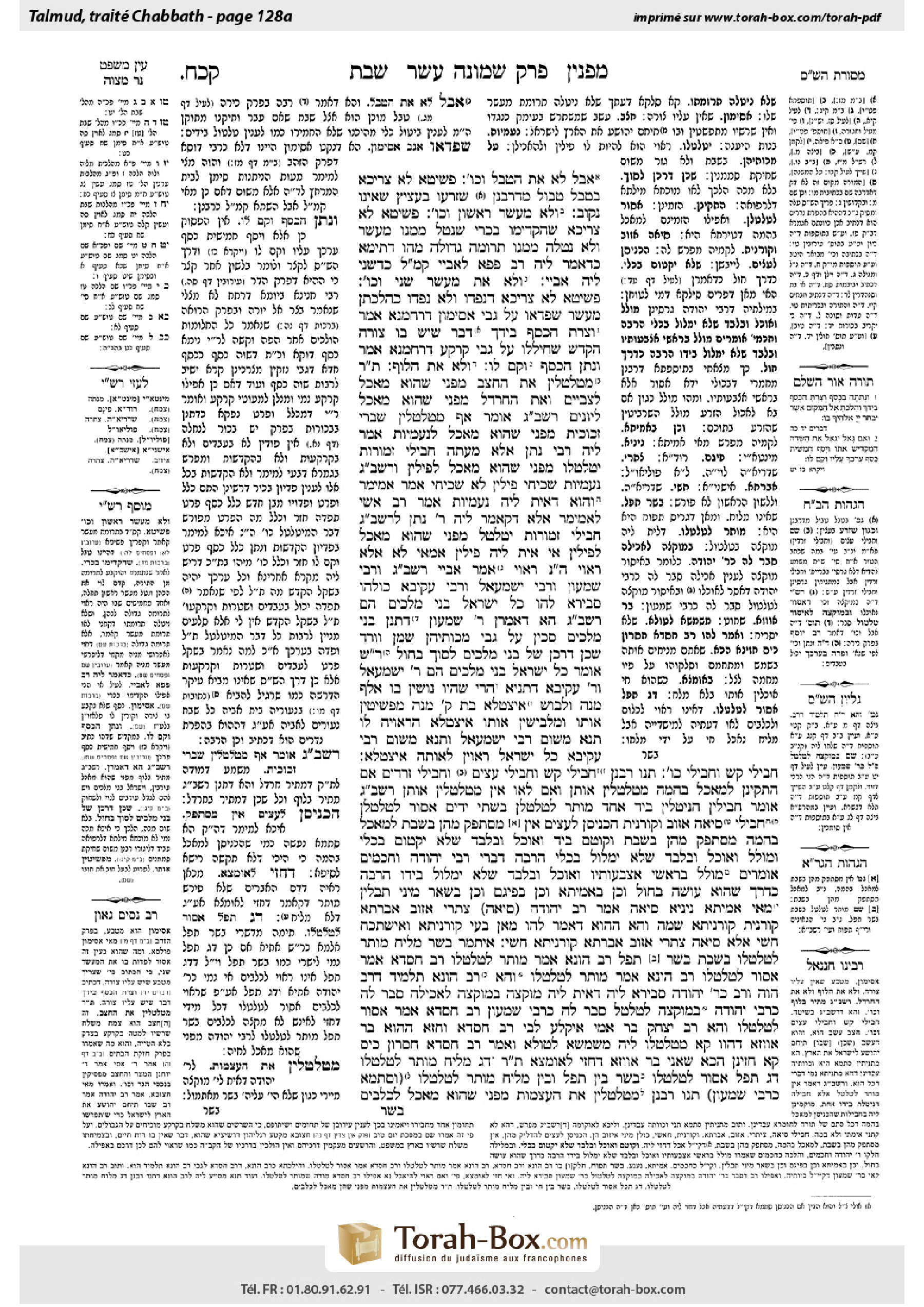
Shabbat 128a: Talmud study for Daf Yomi
Daf Yomi is the daily study of one Talmud folio. Explore 37 tractates with scans, Hebrew text, Sefaria English and AI-generated French translations where annotated.
Passage selection and English or AI-generated French translation are available where the scan has annotations. Daf Study is independent of Torah-Box and Sefaria.
Browse Shabbat · שבת · All tractatesShabbat 128a text and translations
This page of Shabbat includes the Aramaic text, an English translation and an AI-generated French translation, alongside the scan above.
שבת קכ״ח א · Aramaic and Hebrew text
אֲבָל לֹא אֶת הַטֶּבֶל וְכוּ׳. פְּשִׁיטָא! לָא צְרִיכָא בְּטֶבֶל טָבוּל מִדְּרַבָּנַן, שֶׁזְּרָעוֹ בְּעָצִיץ שֶׁאֵינוֹ נָקוּב.
וְלֹא מַעֲשֵׂר רִאשׁוֹן וְכוּ׳. פְּשִׁיטָא! לָא צְרִיכָא, שֶׁהִקְדִּימוֹ בִּכְרִי, שֶׁנָּטַל מִמֶּנּוּ מַעֲשֵׂר וְלֹא נִטְּלָה מִמֶּנּוּ תְּרוּמָה גְּדוֹלָה. מַהוּ דְתֵימָא כְּדַאֲמַר לֵיהּ רַב פָּפָּא לְאַבָּיֵי, קָא מַשְׁמַע לַן כִּדְשַׁנִּי לֵיהּ אַבָּיֵי.
וְלֹא אֶת מַעֲשֵׂר שֵׁנִי וְכוּ׳. פְּשִׁיטָא! לָא צְרִיכָא דְּנִפְדּוּ וְלֹא נִפְדּוּ כְּהִלְכָתָן. מַעֲשֵׂר — שֶׁפְּדָאוֹ עַל גַּבֵּי אֲסִימוֹן, דְּרַחֲמָנָא אָמַר ״וְצַרְתָּ הַכֶּסֶף בְּיָדְךָ״, דָּבָר שֶׁיֵּשׁ בּוֹ צוּרָה. הֶקְדֵּשׁ — שֶׁחִילְּלוֹ עַל גַּבֵּי קַרְקַע, דְּרַחֲמָנָא אָמַר ״וְנָתַן הַכֶּסֶף וְקָם לוֹ״.
וְלֹא אֶת הַלּוּף. תָּנוּ רַבָּנַן: מְטַלְטְלִין אֶת הֶחָצָב מִפְּנֵי שֶׁהוּא מַאֲכָל לִצְבָיִים, וְאֶת הַחַרְדָּל מִפְּנֵי שֶׁהוּא מַאֲכָל לְיוֹנִים. רַבָּן שִׁמְעוֹן בֶּן גַּמְלִיאֵל אוֹמֵר: אַף מְטַלְטְלִין שִׁבְרֵי זְכוּכִית מִפְּנֵי שֶׁהוּא מַאֲכָל לְנַעֲמִיּוֹת.
אֲמַר לֵיהּ רַבִּי נָתָן: אֶלָּא מֵעַתָּה חֲבִילֵי זְמוֹרוֹת יְטַלְטְלוּ מִפְּנֵי שֶׁהוּא מַאֲכָל לְפִילִין! וְרַבָּן שִׁמְעוֹן בֶּן גַּמְלִיאֵל: נַעֲמִיּוֹת — שְׁכִיחִי, פִּילִין — לָא שְׁכִיחִי.
אָמַר אַמֵּימָר: וְהוּא דְּאִית לֵיהּ נַעֲמִיּוֹת. אָמַר רַב אָשֵׁי לְאַמֵּימָר: אֶלָּא דְּקָאֲמַר לֵיהּ רַבִּי נָתָן לְרַבָּן שִׁמְעוֹן בֶּן גַּמְלִיאֵל חֲבִילֵי זְמוֹרוֹת יְטַלְטֵל מִפְּנֵי שֶׁהוּא מַאֲכָל לְפִילִין, אִי אִית לֵיהּ פִּילִין — אַמַּאי לָא? אֶלָּא רָאוּי, הָכָא נָמֵי רָאוּי.
אָמַר אַבָּיֵי: רַבָּן שִׁמְעוֹן בֶּן גַּמְלִיאֵל וְרַבִּי שִׁמְעוֹן וְרַבִּי יִשְׁמָעֵאל וְרַבִּי עֲקִיבָא כּוּלְּהוּ סְבִירָא לְהוּ כׇּל יִשְׂרָאֵל בְּנֵי מְלָכִים הֵם.
רַבָּן שִׁמְעוֹן בֶּן גַּמְלִיאֵל — הָא דַּאֲמַרַן.
רַבִּי שִׁמְעוֹן — דִּתְנַן: בְּנֵי מְלָכִים סָכִין עַל גַּבֵּי מַכּוֹתֵיהֶן שֶׁמֶן וֶורֶד, שֶׁכֵּן דַּרְכָּן שֶׁל בְּנֵי מְלָכִים לָסוּךְ בַּחוֹל. רַבִּי שִׁמְעוֹן אוֹמֵר: כׇּל יִשְׂרָאֵל בְּנֵי מְלָכִים הֵם.
רַבִּי יִשְׁמָעֵאל וְרַבִּי עֲקִיבָא — דְּתַנְיָא: הֲרֵי שֶׁהָיוּ נוֹשִׁין בּוֹ אֶלֶף מָנֶה וְלָבוּשׁ אִיצְטְלָא בַּת מֵאָה מָנֶה — מַפְשִׁיטִין אוֹתוֹ, וּמַלְבִּישִׁין אוֹתוֹ אִיצְטְלָא הָרְאוּיָה לוֹ. תָּנָא מִשּׁוּם רַבִּי יִשְׁמָעֵאל וּמִשּׁוּם רַבִּי עֲקִיבָא: כׇּל יִשְׂרָאֵל רְאוּיִן לְאוֹתָהּ אִיצְטְלָא.
חֲבִילֵי קַשׁ וַחֲבִילֵי כּוּ׳. תָּנוּ רַבָּנַן: חֲבִילֵי קַשׁ וַחֲבִילֵי עֵצִים וַחֲבִילֵי זְרָדִים, אִם הִתְקִינָן לְמַאֲכַל בְּהֵמָה — מְטַלְטְלִין אוֹתָן, וְאִם לָאו — אֵין מְטַלְטְלִין אוֹתָן. רַבָּן שִׁמְעוֹן בֶּן גַּמְלִיאֵל אוֹמֵר: חֲבִילִין הַנִּיטָּלִין בְּיָד אַחַת — מוּתָּר לְטַלְטְלָן, בִּשְׁתֵּי יָדַיִם — אָסוּר לְטַלְטְלָן.
חֲבִילֵי סִיאָה אֵזוֹב וְקוֹרָנִית, הִכְנִיסָן לְעֵצִים — אֵין מִסְתַּפֵּק מֵהֶן בְּשַׁבָּת, לְמַאֲכַל בְּהֵמָה — מִסְתַּפֵּק מֵהֶן בְּשַׁבָּת.
וְקוֹטֵם בַּיָּד וְאוֹכֵל, וּבִלְבַד שֶׁלֹּא יִקְטוֹם בִּכְלִי. וּמוֹלֵל וְאוֹכֵל, וּבִלְבַד שֶׁלֹּא יִמְלוֹל בִּכְלִי הַרְבֵּה, דִּבְרֵי רַבִּי יְהוּדָה. וַחֲכָמִים אוֹמְרִים: מוֹלֵל בְּרָאשֵׁי אֶצְבְּעוֹתָיו וְאוֹכֵל, וּבִלְבַד שֶׁלֹּא יִמְלוֹל בְּיָדוֹ הַרְבֵּה כְּדֶרֶךְ שֶׁהוּא עוֹשֶׂה בַּחוֹל.
וְכֵן בְּאַמִּיתָא וְכֵן בְּפֵיגָם וְכֵן בִּשְׁאָר מִינֵי תַּבְלִין. מַאי אַמִּיתָא? ״נִינְיָא״. סִיאָה? אָמַר רַב יְהוּדָה: (סִיאָה) ״צִתְרִי״. אֵזוֹב — ״אַבְרָתָא״. קוֹרָנִית — ״קוֹרָנִיתָא״ שְׁמָהּ.
וְהָא הָהוּא דַּאֲמַר לְהוּ: מַאן בָּעֵי קוֹרָנִיתָא? וְאִישְׁתְּכַח חָשֵׁי! אֶלָּא: סִיאָה צִתְרִי, אֵזוֹב אַבְרָתָא, קוֹרָנִיתָא חָשֵׁי.
אִיתְּמַר: בָּשָׂר מָלִיחַ מוּתָּר לְטַלְטְלוֹ בְּשַׁבָּת. בָּשָׂר תָּפֵל, רַב הוּנָא אָמַר: מוּתָּר לְטַלְטְלוֹ, רַב חִסְדָּא אָמַר: אָסוּר לְטַלְטְלוֹ.
רַב הוּנָא אָמַר מוּתָּר לְטַלְטְלוֹ? וְהָא רַב הוּנָא תַּלְמִיד דְּרַב הֲוָה, וְרַב כְּרַבִּי יְהוּדָה סְבִירָא לֵיהּ דְּאִית לֵיהּ מוּקְצֶה?!
בְּמוּקְצֶה לַאֲכִילָה — סָבַר לַהּ כְּרַבִּי יְהוּדָה, בְּמוּקְצֶה לְטַלְטֵל — סָבַר לַהּ כְּרַבִּי שִׁמְעוֹן.
רַב חִסְדָּא אָמַר אָסוּר לְטַלְטְלוֹ. וְהָא רַב יִצְחָק בַּר אַמֵּי אִיקְּלַע לְבֵי רַב חִסְדָּא, וַחֲזָא הָהוּא בַּר אֲווֹזָא דַּהֲווֹ קָא מְטַלְטְלוּ לֵיהּ מִשִּׁמְשָׁא לְטוּלָּא, וְאָמַר רַב חִסְדָּא: חֶסְרוֹן כִּיס קָא חָזֵינַן הָכָא! שָׁאנֵי בַּר אֲווֹזָא, דַּחֲזֵי לְאוּמְצָא.
תָּנוּ רַבָּנַן: דָּג מָלִיחַ — מוּתָּר לְטַלְטְלוֹ, דָּג תָּפֵל — אָסוּר לְטַלְטְלוֹ. בָּשָׂר, בֵּין תָּפֵל וּבֵין מָלִיחַ — מוּתָּר לְטַלְטְלוֹ, וּסְתָמָא כְּרַבִּי שִׁמְעוֹן.
תָּנוּ רַבָּנַן: מְטַלְטְלִין אֶת הָעֲצָמוֹת מִפְּנֵי שֶׁהוּא מַאֲכָל לִכְלָבִים.
Shabbat 128a · English translation
We learned in the mishna: However, one may not move untithed produce on Shabbat. The Gemara asks: This is obvious. The Gemara answers: It was only necessary to teach this halakha with regard to a case in which the produce is permitted by Torah law, but is considered untithed produce only by rabbinic law. What are the circumstances? It is referring to a case where the produce grew in an unperforated flowerpot. The legal status of produce that grows in an unperforated flowerpot is not like that of produce that grows in the ground.
We learned in the mishna: Nor may one move first tithe from which teruma has not been taken. The Gemara asks: This is obvious. The Gemara answers: It was only necessary for the mishna to teach this halakha for a case in which the Levite preceded the priest after the kernels of grain were placed in a pile, where first tithe was taken and teruma gedola was not taken. Lest you say concerning this case, as Rav Pappa said to Abaye, here too, the produce should be exempt from the obligation to separate teruma gedola, the tanna of the mishna teaches us as Abaye responded to Rav Pappa: There is a difference between the case in which the grain was on the stalks and the case in which the grain was in a pile.
We learned in the mishna: Nor may one move second tithe and consecrated items that were not redeemed. The Gemara asks: This is obvious. It was only necessary for the mishna to teach this halakha with regard to a case where they were redeemed but not redeemed properly. When the mishna lists the second tithe, it is referring to that which was redeemed with an unminted coin [asimon], i.e., a silver bullion that had not been engraved. And God, in the Torah, states in the case of second tithe: “And bind up [vetzarta] the money in your hand” (Deuteronomy 14:25). The Sages interpreted this as follows: Vetzarta is money that has a form [tzura] engraved upon it. When the mishna lists consecrated property, it is referring to that which was redeemed by exchanging it for land instead of money. And God, in the Torah, states with regard to this: He will give the money “and it will be assured to him” (Leviticus 27:19). Money and not land may be used in redeeming consecrated property.
We learned in the mishna: Nor may one move arum on Shabbat. The Sages taught in a Tosefta: One may move squill on Shabbat because it is food for deer and mustard because it is food for doves. Rabban Shimon ben Gamliel says: One may even move glass shards because they are food for ostriches.
Rabbi Natan said to Rabban Shimon ben Gamliel: If that is so, even bundles of grapevines one should be permitted to move because they are food for elephants. The Gemara answers that Rabban Shimon ben Gamliel responded: Ostriches are common, whereas elephants are not common.
Ameimar said: And Rabban Shimon ben Gamliel permits moving glass shards only in a case where one has ostriches. Rav Ashi said to Ameimar: However, with regard to that which Rabbi Natan said to Rabban Shimon ben Gamliel: If that is so, even bundles of grapevines one should be permitted to move because they are food for elephants. If one has elephants, why would he not feed them? The relevant criterion to permit moving the animal food is not whether or not one owns an elephant, but rather whether or not the food is suitable as food for elephants. Here too, in the case of glass shards, the criterion is whether or not they are suitable as food for ostriches, not whether or not one owns an ostrich.
Abaye said: Rabban Shimon ben Gamliel, Rabbi Shimon, Rabbi Yishmael, and Rabbi Akiva all hold that all Jewish people are princes. There is nothing that is unsuitable for them due to its extravagance. How do we know that all of them hold this position?
Rabban Shimon ben Gamliel: From that which we said in the mishna, that it is permitted to move arum, this is because arum is food for ravens, and it is as if every Jew owns ravens.
Rabbi Shimon: As we learned in a mishna: Princes may smear rose oil on their wounds on Shabbat, as it is the way of princes to smear it on during the week, even without the purpose of healing a wound. Rabbi Shimon says: All the Jewish people are princes, and it is permitted for them to smear themselves with rose oil on Shabbat.
Rabbi Yishmael and Rabbi Akiva: From that which was taught in a baraita: One from whom his creditors were demanding repayment of a debt of a thousand times one hundred dinar [maneh] and he was wearing a cloak [itztela] worth one hundred times one hundred dinar, they strip him of that cloak and sell it, and dress him with a cloak worthy of him based on his wealth. It was taught in the name of Rabbi Yishmael, and it was taught in the name of Rabbi Akiva: All the Jewish people are worthy of that more expensive cloak, and it cannot be said that one is unworthy of it. Rather, the coat is treated like any other vital garment. The principle that one need not sell his vital garments to pay off a debt applies to it.
We learned in the mishna: With regard to bundles of straw, and bundles of wood, and bundles of twigs, if one prepared them on Shabbat eve for animal food, one may move them. If not, one may not move them. The Sages taught in a Tosefta: With regard to bundles of straw, and bundles of wood, and bundles of twigs, if one prepared them on Shabbat eve for animal food, one may move them. And if not, one may not move them. Rabban Shimon ben Gamliel says: Bundles that are taken in one hand, it is permitted to move them, as no exertion is involved. However, if they can only be taken in two hands, it is prohibited to move them.
With regard to bundles of savory, hyssop, and thyme, fragrant plants suitable as food for people, if one brought them in for use as firewood, he may not supply himself from them on Shabbat for food. If he brought them in for use as food for animals, he too may supply himself from them on Shabbat.
And one may pick them with his hand and eat, as long as he does not pick them with a vessel. And one may crush and remove the seeds with his hand and eat them, as long as he does not crush a lot with a vessel; this is the statement of Rabbi Yehuda. And the Rabbis say: One may crush them only with the ends of his fingers, in an atypical manner, as long as he does not crush a lot with his hand in the manner that he does during the week.
And that too is the halakha with regard to amita, and with regard to rue [peigam], and with regard to all the other types of spices. The Sages asked: What is amita? They answered: It is mint [ninya]. What is sia? Rav Yehuda says: Sia is savory. Ezov is hyssop. Koranit is called koranita, i.e., it is not known to us by any other name.
The Gemara asks: The one who came to sell and said to them: Who wants koranita? And he was found to be selling thyme. Therefore, we see that koranita is in fact a plant that is known to us. Rather, it should be explained: Sia is savory, ezov is hyssop, and koranita is thyme.
It was stated: It is permitted to move salted meat on Shabbat, as it is fit for consumption. With regard to unsalted meat, Rav Huna said: It is permitted to move it. Rav Ḥisda said: It is prohibited to move it.
The Gemara asks: Did Rav Huna say that it is permitted to move it? Wasn’t Rav Huna a student of Rav, and Rav holds in accordance with the opinion of Rabbi Yehuda, who is of the opinion that there is a prohibition of set-aside for salted meat? How could Rav Huna disagree with the opinion of his teacher?
The Gemara answers: With regard to a food item set aside from eating, Rav holds in accordance with the opinion of Rabbi Yehuda, that it may not be eaten. With regard to an item set aside from moving, he holds in accordance with the opinion of Rabbi Shimon, who is not of the opinion that there is a prohibition of set-aside, and moving it is permitted.
Rav Ḥisda said: It is prohibited to move unsalted meat on Shabbat. The Gemara asks: Didn’t Rav Yitzḥak bar Ami happen to come to Rav Ḥisda’s house, and he saw the meat of that duck? He saw that they were moving it from the sun to the shade so that it would not spoil. And Rav Ḥisda said to the members of his household: We see a case of monetary loss here. One must make certain that the meat does not stay in the sun and spoil. Apparently, Rav Ḥisda holds that it is permitted to move inedible meat. The Gemara answers: The meat of a duck is different, as it is fit to be eaten as raw meat.
The Sages taught in a baraita: With regard to salted fish, it is permitted to move it on Shabbat. With regard to unsalted fish, it is prohibited to move it. Meat, both unsalted meat and salted meat, it is permitted to carry it. And this unattributed baraita is in accordance with the opinion of Rabbi Shimon.
The Sages taught: One may move bones on Shabbat, because they are food for dogs.
Shabbat 128a · Traduction française (IA)
Nous avons appris dans la Michna : Toutefois, on ne peut pas déplacer des produits dont les prélèvements n’ont pas été effectués le Chabbat. La Guemara demande : Cela va de soi. La Guemara répond : Cette halakha devait être enseignée à propos d’un cas où, selon la Torah, les produits sont permis, mais ne sont considérés comme non prélevés qu’en vertu du droit rabbinique. Dans quelles circonstances ? Il s’agit de produits qui ont poussé dans un pot de fleurs non percé. Le statut juridique des produits qui poussent dans un pot non percé n’est pas le même que celui des produits qui poussent en pleine terre.
Nous avons appris dans la Michna : On ne peut pas non plus déplacer la première dîme dont la terouma n’a pas été prélevée. La Guemara demande : Cela va de soi. La Guemara répond : La Michna devait enseigner cette halakha dans le cas où le Lévite a devancé le prêtre après que les grains eurent été mis en tas : la première dîme a été prélevée, mais la grande terouma ne l’a pas été. De peur que l’on dise, à propos de ce cas, comme Rav Pappa l’a dit à Abaye, qu’ici aussi les produits devraient être exempts de l’obligation de prélever la grande terouma, le tanna de la Michna nous enseigne la réponse qu’Abaye a faite à Rav Pappa : il y a une différence entre le cas où le grain se trouve encore sur les tiges et celui où il est en tas.
Nous avons appris dans la Michna : On ne peut pas non plus déplacer la seconde dîme ni les biens consacrés qui n’ont pas été rachetés. La Guemara demande : Cela va de soi. La Michna devait enseigner cette halakha à propos d’un cas où ils ont été rachetés, mais pas correctement. Lorsqu’elle mentionne la seconde dîme, elle parle de ce qui a été racheté au moyen d’une pièce non frappée [asimon], c’est-à-dire d’un lingot d’argent qui n’a pas été gravé. Or, dans la Torah, Dieu dit au sujet de la seconde dîme : « Tu lieras [vetzarta] l’argent dans ta main » (Deutéronome 14:25). Les Sages interprètent cela ainsi : vetzarta désigne de l’argent portant une empreinte [tzura]. Lorsque la Michna mentionne les biens consacrés, elle parle de ce qui a été racheté en l’échangeant contre un terrain plutôt que contre de l’argent. Or, à ce sujet, Dieu dit dans la Torah : « Il lui sera acquis » contre de l’argent (Lévitique 27:19). Seul l’argent, et non un terrain, peut servir à racheter des biens consacrés.
Nous avons appris dans la Michna : On ne peut pas non plus déplacer de l’arum le Chabbat. Les Sages ont enseigné dans une baraïta : On peut déplacer de la scille le Chabbat, car elle sert de nourriture aux cerfs, et de la moutarde, car elle sert de nourriture aux colombes. Rabban Shimon ben Gamliel dit : On peut même déplacer des éclats de verre, car ils servent de nourriture aux autruches.
Rabbi Natan dit à Rabban Shimon ben Gamliel : Si c’est ainsi, on devrait aussi pouvoir déplacer des fagots de sarments de vigne, car ils servent de nourriture aux éléphants. La Guemara répond que Rabban Shimon ben Gamliel lui a rétorqué : Les autruches sont courantes, contrairement aux éléphants.
Ameimar dit : Rabban Shimon ben Gamliel n’autorise le déplacement des éclats de verre que dans le cas où l’on possède des autruches. Rav Ashi dit à Ameimar : Pourtant, à propos de ce que Rabbi Natan a dit à Rabban Shimon ben Gamliel — « Si c’est ainsi, on devrait aussi pouvoir déplacer des fagots de sarments de vigne, car ils servent de nourriture aux éléphants » —, s’il possède des éléphants, pourquoi ne les nourrirait-il pas ? Le critère pertinent pour autoriser le déplacement de nourriture destinée aux animaux n’est pas de savoir si l’on possède un éléphant, mais si cette nourriture convient aux éléphants. De même ici, dans le cas des éclats de verre, le critère est de savoir s’ils conviennent aux autruches, et non si l’on possède une autruche.
Abaye dit : Rabban Shimon ben Gamliel, Rabbi Shimon, Rabbi Yishmael et Rabbi Akiva considèrent tous que tous les Juifs sont des princes. Rien ne leur est inadapté en raison de son caractère luxueux. Comment sait-on qu’ils soutiennent tous cette position ?
Rabban Shimon ben Gamliel : D’après ce que nous avons dit dans la Michna, à savoir qu’il est permis de déplacer de l’arum, cela s’explique parce que l’arum sert de nourriture aux corbeaux, et c’est comme si chaque Juif possédait des corbeaux.
Rabbi Shimon : Comme nous l’avons appris dans une Michna : Les princes peuvent s’enduire les plaies d’huile de rose le Chabbat, car ils ont coutume de s’en enduire pendant la semaine, même sans chercher à soigner une plaie. Rabbi Shimon dit : Tous les Juifs sont des princes, et il leur est permis de s’enduire d’huile de rose le Chabbat.
Rabbi Yishmael et Rabbi Akiva : D’après ce qui a été enseigné dans une baraïta : Si les créanciers d’un homme réclament le remboursement d’une dette de mille fois cent dinars [maneh] et qu’il porte un manteau [itztela] qui vaut cent fois cent dinars, on lui retire ce manteau, on le vend et on l’habille d’un manteau correspondant à sa fortune. Cela a été enseigné au nom de Rabbi Yishmael et au nom de Rabbi Akiva : Tous les Juifs méritent ce manteau plus coûteux, et on ne peut pas dire qu’il soit inadapté à l’un d’eux. Le manteau est plutôt considéré comme tout autre vêtement indispensable. Le principe selon lequel on n’est pas tenu de vendre ses vêtements indispensables pour rembourser une dette s’applique à lui.
Nous avons appris dans la Michna : Pour les bottes de paille, les bottes de bois et les bottes de brindilles, si on les a préparées la veille du Chabbat pour nourrir les animaux, on peut les déplacer. Sinon, on ne peut pas les déplacer. Les Sages ont enseigné dans une baraïta : Pour les bottes de paille, les bottes de bois et les bottes de brindilles, si on les a préparées la veille du Chabbat pour nourrir les animaux, on peut les déplacer. Sinon, on ne peut pas les déplacer. Rabban Shimon ben Gamliel dit : On peut déplacer les bottes que l’on peut saisir d’une seule main, car cela ne demande aucun effort. En revanche, si on ne peut les saisir qu’à deux mains, il est interdit de les déplacer.
Pour les bottes de sarriette, d’hysope et de thym, des plantes aromatiques qui conviennent à l’alimentation humaine, si on les a apportées pour s’en servir de bois de chauffage, on ne peut pas en prendre pour se nourrir le Chabbat. Si on les a apportées pour nourrir les animaux, on peut également en prendre pour se nourrir le Chabbat.
On peut les cueillir à la main et les manger, à condition de ne pas les cueillir avec un ustensile. On peut en écraser les graines et les retirer à la main pour les manger, à condition de ne pas en écraser une grande quantité avec un ustensile ; telle est l’opinion de Rabbi Yehuda. Les Rabbins disent : On ne peut les écraser qu’avec le bout des doigts, de manière inhabituelle, à condition de ne pas en écraser une grande quantité à la main comme on le fait pendant la semaine.
Il en va de même selon la halakha pour l’amita, pour la rue [peigam] et pour toutes les autres sortes d’épices. Les Sages demandèrent : Qu’est-ce que l’amita ? Ils répondirent : C’est la menthe [ninya]. Qu’est-ce que le sia ? Rav Yehuda dit : Le sia est la sarriette. L’ezov est l’hysope. La koranit est appelée koranita, c’est-à-dire que nous ne la connaissons pas sous un autre nom.
La Guemara demande : Pourtant, un homme est venu vendre et leur a demandé : « Qui veut de la koranita ? » Or, il s’est avéré qu’il vendait du thym. Nous voyons donc que la koranita est bien une plante que nous connaissons. Il faut plutôt expliquer ainsi : le sia est la sarriette, l’ezov est l’hysope et la koranita est le thym.
Il a été dit : Il est permis de déplacer de la viande salée le Chabbat, car elle est propre à la consommation. Au sujet de la viande non salée, Rav Huna dit : Il est permis de la déplacer. Rav Ḥisda dit : Il est interdit de la déplacer.
La Guemara demande : Rav Huna a-t-il dit qu’il est permis de la déplacer ? Rav Huna n’était-il pas un élève de Rav, lequel suit l’opinion de Rabbi Yehuda, selon laquelle la viande salée est soumise à l’interdit des objets mis de côté ? Comment Rav Huna aurait-il pu être en désaccord avec l’opinion de son maître ?
La Guemara répond : En ce qui concerne un aliment mis de côté pour être mangé, Rav suit l’opinion de Rabbi Yehuda, selon laquelle on ne peut pas le manger. En ce qui concerne un objet mis de côté pour être déplacé, il suit l’opinion de Rabbi Shimon, qui ne reconnaît pas l’interdit des objets mis de côté ; il est donc permis de le déplacer.
Rav Ḥisda dit : Il est interdit de déplacer de la viande non salée le Chabbat. La Guemara demande : Rav Yitzḥak bar Ami n’est-il pas arrivé par hasard chez Rav Ḥisda et n’a-t-il pas vu la viande de ce canard ? Il vit qu’on la déplaçait du soleil vers l’ombre pour qu’elle ne s’abîme pas. Rav Ḥisda dit alors aux membres de sa maisonnée : « Nous voyons ici un cas de perte financière. Il faut veiller à ce que la viande ne reste pas au soleil et ne s’abîme pas. » Il apparaît donc que Rav Ḥisda considère qu’il est permis de déplacer de la viande impropre à la consommation. La Guemara répond : La viande de canard est différente, car elle peut être consommée crue.
Les Sages ont enseigné dans une baraïta : Il est permis de déplacer du poisson salé le Chabbat. Il est interdit de déplacer du poisson non salé. Quant à la viande, qu’elle soit salée ou non, il est permis de la déplacer. Cette baraïta anonyme suit l’opinion de Rabbi Shimon.
Les Sages ont enseigné : On peut déplacer des os le Chabbat, car ils servent de nourriture aux chiens.
Traduction française générée par IA à partir de l’édition anglaise de Sefaria. Vérifie toujours un passage avec le texte source.
Text from Sefaria: William Davidson Edition - Vocalized Aramaic (CC BY NC); William Davidson Edition - English (CC BY NC).