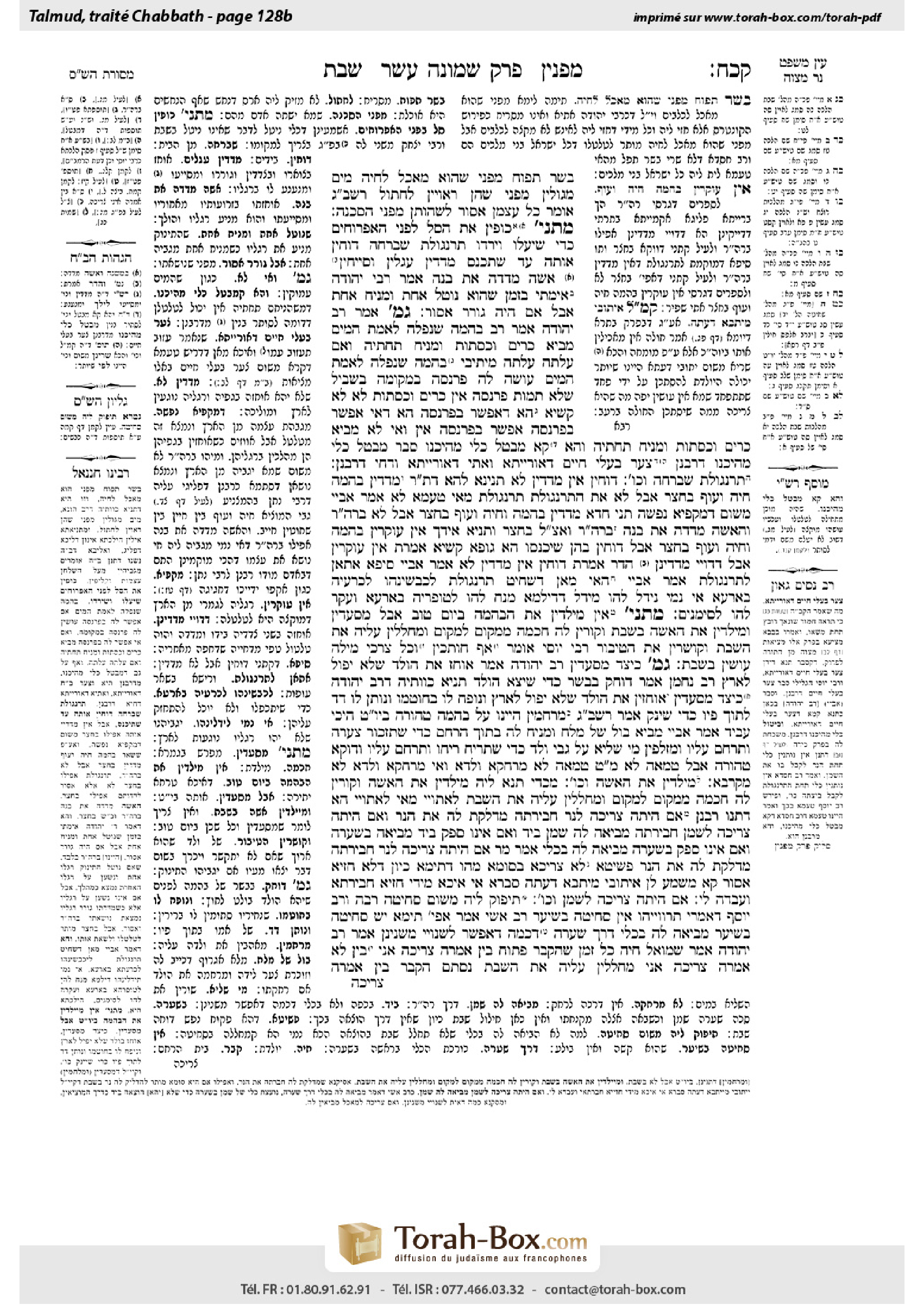
Shabbat 128b: Talmud study for Daf Yomi
Daf Yomi is the daily study of one Talmud folio. Explore 37 tractates with scans, Hebrew text, Sefaria English and AI-generated French translations where annotated.
Passage selection and English or AI-generated French translation are available where the scan has annotations. Daf Study is independent of Torah-Box and Sefaria.
Browse Shabbat · שבת · All tractatesShabbat 128b text and translations
This page of Shabbat includes the Aramaic text, an English translation and an AI-generated French translation, alongside the scan above.
שבת קכ״ח ב · Aramaic and Hebrew text
בָּשָׂר תָּפוּחַ — מִפְּנֵי שֶׁהוּא מַאֲכָל לְחַיָּה, מַיִם מְגוּלִּין — מִפְּנֵי שֶׁהֵן רְאוּיִין לְחָתוּל. רַבָּן שִׁמְעוֹן בֶּן גַּמְלִיאֵל אוֹמֵר: כׇּל עַצְמָן אָסוּר לְשַׁהוֹתָן מִפְּנֵי הַסַּכָּנָה.
מַתְנִי׳ כּוֹפִין אֶת הַסַּל לִפְנֵי הָאֶפְרוֹחִים כְּדֵי שֶׁיַּעֲלוּ וְיֵרְדוּ. תַּרְנְגוֹלֶת שֶׁבָּרְחָה — דּוֹחִין אוֹתָהּ עַד שֶׁתִּכָּנֵס.
מְדַדִּין עֲגָלִין וּסְיָיחִין. אִשָּׁה מְדַדָּה אֶת בְּנָהּ. אָמַר רַבִּי יְהוּדָה: אֵימָתַי — בִּזְמַן שֶׁהוּא נוֹטֵל אַחַת וּמַנִּיחַ אַחַת, אֲבָל אִם הָיָה גּוֹרֵר — אָסוּר.
גְּמָ׳ אָמַר רַב יְהוּדָה אָמַר רַב: בְּהֵמָה שֶׁנָּפְלָה לְאַמַּת הַמַּיִם — מֵבִיא כָּרִים וּכְסָתוֹת וּמַנִּיחַ תַּחְתֶּיהָ, וְאִם עָלְתָה — עָלְתָה.
מֵיתִיבִי: בְּהֵמָה שֶׁנָּפְלָה לְאַמַּת הַמַּיִם — עוֹשֶׂה לָהּ פַּרְנָסָה בִּמְקוֹמָהּ בִּשְׁבִיל שֶׁלֹּא תָּמוּת. פַּרְנָסָה — אִין, כָּרִים וּכְסָתוֹת — לָא!
לָא קַשְׁיָא, הָא — דְּאֶפְשָׁר בְּפַרְנָסָה, הָא — דְּאִי אֶפְשָׁר בְּפַרְנָסָה. אֶפְשָׁר בְּפַרְנָסָה — אִין, וְאִי לָא — מֵבִיא כָּרִים וּכְסָתוֹת וּמַנִּיחַ תַּחְתֶּיהָ.
וְהָא קָא מְבַטֵּל כְּלִי מֵהֵיכֵנוֹ! סָבַר מְבַטֵּל כְּלִי מֵהֵיכֵנוֹ דְּרַבָּנַן, צַעַר בַּעֲלֵי חַיִּים דְּאוֹרָיְיתָא, וְאָתֵי דְּאוֹרָיְיתָא וְדָחֵי דְּרַבָּנַן.
תַּרְנְגוֹלֶת שֶׁבָּרְחָה וְכוּ׳. דּוֹחִין — אִין, מְדַדִּין — לָא. תְּנֵינָא לְהָא, דְתָנוּ רַבָּנַן: מְדַדִּין בְּהֵמָה חַיָּה וָעוֹף בֶּחָצֵר, אֲבָל לֹא אֶת הַתַּרְנְגוֹלֶת.
תַּרְנְגוֹלֶת מַאי טַעְמָא לָא? אָמַר אַבָּיֵי: מִשּׁוּם דְּמַקְפְּיָא נַפְשָׁהּ.
תָּנֵי חֲדָא: מְדַדִּין בְּהֵמָה וְחַיָּה וָעוֹף בֶּחָצֵר אֲבָל לֹא בִּרְשׁוּת הָרַבִּים, וְהָאִשָּׁה מְדַדָּה אֶת בְּנָהּ בִּרְשׁוּת הָרַבִּים, וְאֵין צָרִיךְ לוֹמַר בֶּחָצֵר. וְתַנְיָא אִידַּךְ: אֵין עוֹקְרִין בְּהֵמָה וְחַיָּה וָעוֹף בֶּחָצֵר, אֲבָל דּוֹחִין בָּהֶן שֶׁיִּכָּנְסוּ.
הָא גוּפָא קַשְׁיָא: אָמְרַתְּ אֵין עוֹקְרִין, אֲבָל דַּדּוֹיֵי — מְדַדִּינַן, הֲדַר אָמְרַתְּ: דּוֹחִין אִין, מְדַדִּין — לָא! אָמַר אַבָּיֵי: סֵיפָא אֲתָאן לְתַרְנְגוֹלֶת.
אָמַר אַבָּיֵי: הַאי מַאן דְּשָׁחֵיט תַּרְנְגוֹלְתָּא — לִכְבְּשִׁינְהוּ לְכַרְעֵיהּ בְּאַרְעָא, אִי נָמֵי נֵידֵל לְהוּ מֵידֵל, דְּדִילְמָא מַנַּח לְהוּ לְטוּפְרֵיהּ בְּאַרְעָא, וְעָקַר לְהוּ לְסִימָנִים.
מַתְנִי׳ אֵין מְיַלְּדִין אֶת הַבְּהֵמָה בְּיוֹם טוֹב, אֲבָל מְסַעֲדִין. וּמְיַלְּדִין אֶת הָאִשָּׁה בְּשַׁבָּת, וְקוֹרִין לָהּ חֲכָמָה מִמָּקוֹם לְמָקוֹם, וּמְחַלְּלִין עָלֶיהָ אֶת הַשַּׁבָּת, וְקוֹשְׁרִין אֶת הַטִּיבּוּר. רַבִּי יוֹסֵי אוֹמֵר: אַף חוֹתְכִין. וְכׇל צׇרְכֵי מִילָּה עוֹשִׂין בְּשַׁבָּת.
גְּמָ׳ כֵּיצַד מְסַעֲדִין? רַב יְהוּדָה אָמַר: אוֹחֵז אֶת הַוָּלָד שֶׁלֹּא יִפּוֹל לָאָרֶץ, רַב נַחְמָן אָמַר: דּוֹחֵק בַּבָּשָׂר כְּדֵי שֶׁיֵּצֵא הַוָּלָד.
תַּנְיָא כְּווֹתֵיהּ דְּרַב יְהוּדָה: כֵּיצַד מְסַעֲדִין? אוֹחֲזִין אֶת הַוָּלָד שֶׁלֹּא יִפּוֹל לָאָרֶץ, וְנוֹפֵחַ לוֹ בְּחוֹטְמוֹ, וְנוֹתֵן לוֹ דַּד לְתוֹךְ פִּיו כְּדֵי שֶׁיִּינַק.
אָמַר רַבָּן שִׁמְעוֹן בֶּן גַּמְלִיאֵל: מְרַחֲמִין הָיִינוּ עַל בְּהֵמָה טְהוֹרָה בְּיוֹם טוֹב. הֵיכִי עָבֵיד? אָמַר אַבָּיֵי: מֵבִיא בּוּל שֶׁל מֶלַח וּמַנִּיחַ לָהּ בְּתוֹךְ הָרֶחֶם, כְּדֵי שֶׁתִּזְכּוֹר צַעֲרָהּ וּתְרַחֵם עָלָיו. וּמְזַלְּפִין מֵי שִׁלְיָא עַל גַּבֵּי וָלָד, כְּדֵי שֶׁתָּרִיחַ רֵיחוֹ וּתְרַחֵם עָלָיו. וְדַוְקָא טְהוֹרָה, אֲבָל טְמֵאָה — לָא.
מַאי טַעְמָא? טְמֵאָה לָא מְרַחֲקָא וְלָדָא, וְאִי מְרַחֲקָא וְלָדָא — לָא מְקָרְבָא.
מְיַלְּדִין אֶת הָאִשָּׁה וְכוּ׳. מִכְּדֵי תְּנָא לֵיהּ: מְיַלְּדִין אֶת הָאִשָּׁה וְקוֹרִין לָהּ חֲכָמָה מִמָּקוֹם לְמָקוֹם, ״וּמְחַלְּלִין עָלֶיהָ אֶת הַשַּׁבָּת״ לְאֵתוֹיֵי מַאי?
לְאֵתוֹיֵי הָא דְּתָנוּ רַבָּנַן: אִם הָיְתָה צְרִיכָה לְנֵר — חֲבֶירְתָּהּ מַדְלֶקֶת לָהּ אֶת הַנֵּר. וְאִם הָיְתָה צְרִיכָה לְשֶׁמֶן — חֲבֶירְתָּהּ מְבִיאָה לָהּ שֶׁמֶן בַּיָּד, וְאִם אֵינוֹ סֹפֵק בַּיָּד — מְבִיאָה בִּשְׂעָרָהּ, וְאִם אֵינוֹ סֹפֵק בִּשְׂעָרָהּ — מְבִיאָה לָהּ בִּכְלִי.
אָמַר מָר: אִם הָיְתָה צְרִיכָה לְנֵר — חֲבֶירְתָּהּ מַדְלֶקֶת לָהּ אֶת הַנֵּר. פְּשִׁיטָא! לָא צְרִיכָא בְּסוּמָא, מַהוּ דְּתֵימָא: כֵּיוָן דְּלָא חַזְיָא — אֲסִיר, קָא מַשְׁמַע לַן אִיַּתּוֹבֵי מִיַּתְּבָא דַּעְתַּהּ, סָבְרָא: אִי אִיכָּא מִידֵּי — חַזְיָא חֲבִירְתַּאי וְעָבְדָה לִי.
אִם הָיְתָה צְרִיכָה לְשֶׁמֶן וְכוּ׳. תִּיפּוֹק לֵיהּ מִשּׁוּם סְחִיטָה!
רַבָּה וְרַב יוֹסֵף דְּאָמְרִי תַּרְוַויְיהוּ: אֵין סְחִיטָה בְּשֵׂיעָר. רַב אָשֵׁי אָמַר: אֲפִילּוּ תֵּימָא יֵשׁ סְחִיטָה בְּשֵׂיעָר, מְבִיאָה לָהּ בִּכְלִי דֶּרֶךְ שְׂעָרָהּ, דְּכַמָּה דְּאֶפְשָׁר לְשַׁנּוֹיֵי — מְשַׁנִּינַן.
אָמַר רַב יְהוּדָה אָמַר שְׁמוּאֵל: חַיָּה כׇּל זְמַן שֶׁהַקֶּבֶר פָּתוּחַ, בֵּין אָמְרָה ״צְרִיכָה אֲנִי״, בֵּין לֹא אָמְרָה ״צְרִיכָה אֲנִי״ — מְחַלְּלִין עָלֶיהָ אֶת הַשַּׁבָּת.
נִסְתַּם הַקֶּבֶר, בֵּין אָמְרָה
Shabbat 128b · English translation
With regard to swollen meat that began to putrefy, it is permitted to move it because it is food for non-domesticated animals. With regard to exposed water, from which a snake might have drunk and into which it injected its venom, it is permitted to move it because it is suitable for a cat, which is somewhat immune to snake venom. Rabban Shimon ben Gamliel says: Exposed water itself may not be kept due to the danger that one may inadvertently drink it.
MISHNA: One may overturn a basket in front of the chicks so that they can climb on and climb off of it. Likewise, with regard to a hen that fled that one seeks to retrieve, one may push it even with his hands until it reenters the house.
One may help calves and foals to walk, and likewise a woman may help her son to walk. Rabbi Yehuda said: When is it permitted? When her son picks one foot up and puts one foot down by himself. However, if her son were dragging both his feet, it would be prohibited because it would be like carrying him in the public domain.
GEMARA: Rav Yehuda said that Rav said: With regard to an animal that fell into an aqueduct, one brings cushions and blankets, and throws them into the water ditch, and places them beneath the animal in the aqueduct. And if the animal thereby emerges, it emerges.
The Gemara raises an objection from a Tosefta: With regard to an animal that fell into an aqueduct on Shabbat, one provides it with sustenance in its place so that it will not die. This implies that providing it with sustenance, yes, that is permitted, providing it with cushions and blankets, no, that it is prohibited.
The Gemara answers: This is not difficult, as there is room to distinguish between the cases. This, the Tosefta in which it was taught that one provides the animal with sustenance, is referring to a case where it is possible to provide it with sustenance. That, the mishna in which Rav said that one brings cushions and blankets, is referring to a case where it is impossible to provide it with sustenance. Where it is possible to provide it with sustenance, yes, he does so. And if it is not possible to provide it with sustenance, he brings cushions and blankets and places them beneath the animal.
The Gemara asks: Does he not, by placing the cushions and blankets, negate a vessel’s preparedness? The cushions and blankets are no longer fit for their designated use on Shabbat, and this negation of their designated use is similar to the prohibited labor of dismantling. The Gemara answers: Rav holds that negating a vessel’s preparedness is prohibited by rabbinic law. Causing a living creature to suffer is a Torah prohibition. And a matter prohibited by Torah law comes and overrides a matter prohibited by rabbinic law.
We learned in the mishna: With regard to a hen that fled that one seeks to retrieve, he may push it back to its place. By inference: Push the hen, yes, it is permitted, help it to walk, no, it is prohibited. The Gemara comments: We already learned this, as the Sages taught: One may help domesticated animals, non-domesticated animals, and fowl walk in the courtyard on Shabbat, but not hens.
The Gemara asks: With regard to a hen, what is the reason that one may not help it walk? Abaye says: It is prohibited because the hen lifts itself off the ground. As a result, one actually carries it.
It was taught in one baraita: One may help domesticated animals, non-domesticated animals, and fowl walk in the courtyard, but not in the public domain. And a woman may help her son walk in the public domain, and, needless to say, it is permitted in the courtyard. And it was taught in another baraita: One may not lift domesticated animals, non-domesticated animals, and fowl off the ground in the courtyard, but one may push them so that they will enter.
The Gemara first seeks to clarify the second baraita. This baraita itself is difficult. On the one hand, you said that one may not lift, from which it may be inferred, however, that one may help it walk. Then you said: Push, yes, it is permitted, help walk, no, it is prohibited. Abaye said: The latter clause, which states that one may not help it walk, we came to the halakha of a hen, which, as mentioned above, one may not help it walk.
Having mentioned moving the hen, the Gemara cites that which Abaye said: One who slaughters a hen should force its legs into the ground, or alternatively lift it entirely into the air. Failure to do so leads to the concern lest the hen place its claws into the ground and convulse during the slaughter and dislocate the signs, the trachea and gullet. This would invalidate the slaughter and render the hen an unslaughtered animal carcass.
MISHNA: One may not birth an animal on a Festival, and all the more one may not birth it on Shabbat. However, one may assist it to give birth. And one may birth a woman even on Shabbat, and call a midwife for her to travel from place to place, even when the midwife’s travel involves the desecration of Shabbat. And one may desecrate Shabbat for a woman giving birth. And one may tie the umbilical cord of a child born on Shabbat. Rabbi Yosei says: One may even cut the umbilical cord. And all the requirements of circumcision may be performed for a baby whose eighth day of life occurs on Shabbat.
GEMARA: The Gemara asks: How may one assist in the birth of an animal? Rav Yehuda said: One holds the newborn so that it will not fall to the ground. Rav Naḥman says: One presses the flesh around the womb so that the newborn will emerge.
It was taught in a baraita in accordance with the opinion of Rav Yehuda: How may one assist in the birth of an animal? One holds the newborn so that it will not fall to the ground, and he blows into its nostrils to remove mucus obstructing the air passages, enabling the offspring to breathe, and he places the mother’s teat into its mouth so that it will suckle.
Rabban Shimon ben Gamliel says: We would have mercy on kosher animals on a Festival, to help the offspring. The Gemara asks: How does one have mercy? Abaye said: If the mother does not draw her offspring near and tend to it, one may bring a lump of salt and place it in the animal’s womb, so that it will suffer, remember its suffering while giving birth, and have mercy on the offspring. And one may pour fluids of the afterbirth on the offspring so that the mother will smell it and have mercy on it, her offspring. And this may be done specifically for a kosher animal, but for a non-kosher animal, no, it may not be done.
The Gemara asks: What is the reason one may not do so for a non-kosher animal? The Gemara answers: A non-kosher animal does not distance its offspring, and if it does distance its offspring, it will not draw it near again. No purpose is served by taking these steps with a non-kosher animal.
We learned in the mishna: And one may birth a woman even when that involves the desecration of Shabbat The Gemara asks: After all, it was taught explicitly in the mishna: And one may birth a woman even on Shabbat, and call a midwife for her to travel from place to place. The phrase: And one may desecrate Shabbat for a woman giving birth, what does it come to include? All the possible acts of desecrating Shabbat for the birthing woman were already listed.
The Gemara answers: It comes to include that which the Sages taught with regard to this issue: If a woman giving birth were to need a lamp, her friend lights the lamp for her on Shabbat. And if she were to need oil, her friend brings her oil via the public domain in an atypical manner, carrying it in the palm of her hand but not in a vessel. And if the oil that her friend brings in her hand is not enough, she brings oil in her hair. And if oil that she brings in her hair is not enough, she brings oil for her in the typical manner, in a vessel.
The Master said in the baraita: If a woman giving birth were to need a lamp, her friend would light the lamp for her on Shabbat. The Gemara asks: This is obvious. The Gemara answers: It is necessary to teach this halakha only in the case of a blind woman giving birth. Lest you say: Since she cannot see even with the light it is prohibited to bring a lamp for her, it teaches us that lighting the lamp is permitted to settle her mind. The blind woman thinks: If there is something that needs to be done in the course of childbirth, the lamp will enable my friend to see and she will do it for me.
We learned in the mishna: And if she needed oil, her friend brings her oil in her hair. The Gemara asks: What good is this advice? Derive that it is prohibited due to the prohibited labor of wringing. The friend will need to wring her hair in order to extract the oil for the birthing woman.
It was Rabba and Rav Yosef who both said: There is no prohibition of wringing with regard to hair, since hair does not absorb liquids like other materials. Rav Ashi said: Even if you say that there is a prohibition of wringing with regard to hair, here the friend does not actually bring the oil in her hair. Rather, she brings it in a vessel tied through her hair. She does this because as much as it is possible to change the manner in which one performs a labor that is being done to save a life, we change it.
Rav Yehuda said that Shmuel said: With regard to a woman in childbirth, as long as the womb is open, whether she said: I need Shabbat to be desecrated, or whether she did not say: I need Shabbat to be desecrated, one desecrates Shabbat for her. Generally, a woman in childbirth is in danger, and prohibited labors may be performed in life-threatening circumstances.
Once the womb closed after birth, whether the woman who gave birth said:
Shabbat 128b · Traduction française (IA)
À propos d’une viande gonflée qui a commencé à se putréfier, il est permis de la déplacer, car elle sert de nourriture aux animaux sauvages. Quant à l’eau laissée à découvert, dans laquelle un serpent a pu boire et injecter son venin, il est permis de la déplacer, car elle convient à un chat, quelque peu immunisé contre le venin des serpents. Rabban Chimon ben Gamliel dit : L’eau laissée à découvert ne peut pas être conservée, en raison du danger qu’on la boive par inadvertance.
MICHNA : On peut renverser une corbeille devant les poussins afin qu’ils puissent y monter et en descendre. De même, lorsqu’une poule s’est enfuie et qu’on veut la ramener, on peut la pousser, même avec les mains, jusqu’à ce qu’elle rentre dans la maison.
On peut aider des veaux et des poulains à marcher, et de même, une femme peut aider son fils à marcher. Rabbi Yehouda dit : Dans quel cas cela est-il permis ? Lorsque son fils lève un pied et pose l’autre de lui-même. Mais si son fils traînait les deux pieds, ce serait interdit, car cela reviendrait à le porter dans le domaine public.
GUEMARA : Rav Yehouda a dit au nom de Rav : Si un animal est tombé dans un canal, on apporte des coussins et des couvertures, on les jette dans le canal et on les place sous l’animal. Si celui-ci en sort ainsi, il en sort.
La Guemara soulève une objection tirée d’une baraïta : Si un animal est tombé dans un canal pendant Chabbat, on lui fournit de la nourriture là où il se trouve afin qu’il ne meure pas. Cela implique que lui fournir de la nourriture, oui, est permis, mais lui fournir des coussins et des couvertures, non, cela est interdit.
La Guemara répond : Il n’y a pas de difficulté, car les cas peuvent être distingués. La baraïta, qui enseigne qu’on fournit de la nourriture à l’animal, concerne un cas où il est possible de lui en fournir. La Michna, où Rav dit qu’on apporte des coussins et des couvertures, concerne un cas où il est impossible de lui fournir de la nourriture. Lorsqu’il est possible de lui en fournir, oui, on le fait ; et s’il est impossible de lui en fournir, on apporte des coussins et des couvertures et on les place sous l’animal.
La Guemara demande : En plaçant les coussins et les couvertures, ne rend-on pas un ustensile inutilisable pour son usage prévu ? Ces coussins et couvertures ne peuvent alors plus servir à l’usage auquel ils sont destinés pendant Chabbat, et cette annulation de leur usage prévu ressemble au travail interdit de démolir. La Guemara répond : Rav considère que rendre un ustensile inutilisable pour son usage prévu est interdit par décret rabbinique. Faire souffrir un être vivant est interdit par la Torah. Or, une interdiction de la Torah vient et l’emporte sur une interdiction rabbinique.
Nous avons appris dans la Michna : Lorsqu’une poule s’est enfuie et qu’on veut la ramener, on peut la repousser vers sa place. Par déduction : pousser la poule, oui, est permis ; l’aider à marcher, non, est interdit. La Guemara fait remarquer : Nous avons déjà appris cela, car les Sages ont enseigné : On peut aider des animaux domestiques, des animaux sauvages et des oiseaux à marcher dans la cour pendant Chabbat, mais pas des poules.
La Guemara demande : Pourquoi ne peut-on pas aider une poule à marcher ? Abayé dit : C’est interdit parce que la poule se soulève du sol. Par conséquent, on la porte véritablement.
Il a été enseigné dans une baraïta : On peut aider des animaux domestiques, des animaux sauvages et des oiseaux à marcher dans la cour, mais pas dans le domaine public. Une femme peut aider son fils à marcher dans le domaine public ; à plus forte raison, cela est permis dans la cour. Et il a été enseigné dans une autre baraïta : On ne peut pas soulever du sol des animaux domestiques, des animaux sauvages et des oiseaux dans la cour, mais on peut les pousser pour qu’ils y entrent.
La Guemara cherche d’abord à clarifier la seconde baraïta. Cette baraïta elle-même présente une difficulté. D’un côté, tu as dit qu’on ne peut pas les soulever, ce qui permettrait toutefois d’en déduire qu’on peut les aider à marcher. Puis tu as dit : Les pousser, oui, est permis ; les aider à marcher, non, est interdit. Abayé dit : La dernière clause, qui stipule qu’on ne peut pas les aider à marcher, concerne la halakha relative à une poule, qu’on ne peut pas aider à marcher, comme cela a été mentionné plus haut.
Puisqu’il a été question de déplacer la poule, la Guemara rapporte ce qu’a dit Abayé : Celui qui abat une poule doit lui enfoncer les pattes dans le sol ou, à défaut, la soulever entièrement en l’air. Sinon, on pourrait craindre que la poule plante ses griffes dans le sol et se débatte pendant l’abattage, déboîtant ainsi les signes, la trachée et l’œsophage. L’abattage serait alors invalide et la poule deviendrait une carcasse d’animal non abattu rituellement.
MICHNA : On ne peut pas faire mettre bas un animal un jour de fête, et à plus forte raison, on ne peut pas le faire pendant Chabbat. Toutefois, on peut l’aider à mettre bas. On peut faire accoucher une femme, même pendant Chabbat, et appeler une sage-femme pour qu’elle se déplace d’un endroit à l’autre, même si ce déplacement implique la profanation de Chabbat. On peut profaner Chabbat pour une femme qui accouche. On peut nouer le cordon ombilical d’un enfant né pendant Chabbat. Rabbi Yossi dit : On peut même couper le cordon ombilical. Et on peut accomplir toutes les opérations requises pour la circoncision d’un bébé dont le huitième jour de vie tombe pendant Chabbat.
GUEMARA : La Guemara demande : Comment peut-on aider un animal à mettre bas ? Rav Yehouda dit : On retient le nouveau-né afin qu’il ne tombe pas au sol. Rav Naḥman dit : On appuie sur la chair autour de la matrice afin que le nouveau-né en sorte.
Une baraïta a été enseignée conformément à l’avis de Rav Yehouda : Comment peut-on aider un animal à mettre bas ? On retient le nouveau-né afin qu’il ne tombe pas au sol, on souffle dans ses narines pour dégager le mucus qui obstrue ses voies respiratoires et lui permettre de respirer, puis on place la mamelle de sa mère dans sa bouche afin qu’il tète.
Rabban Chimon ben Gamliel dit : Les jours de fête, nous avions pitié des animaux cachères et aidions leur petit. La Guemara demande : Comment leur témoigne-t-on de la pitié ? Abayé dit : Si la mère ne rapproche pas son petit et ne s’en occupe pas, on peut apporter un morceau de sel et le placer dans la matrice de l’animal, afin qu’elle souffre, se souvienne de sa souffrance lors de la mise bas et prenne son petit en pitié. On peut aussi verser sur le petit des liquides du placenta, afin que sa mère le sente et ait pitié de lui, son petit. Cela se fait précisément pour un animal cachère, mais pas pour un animal non cachère.
La Guemara demande : Pourquoi ne peut-on pas agir ainsi pour un animal non cachère ? La Guemara répond : Un animal non cachère ne s’éloigne pas de son petit ; et s’il s’en éloigne, il ne le rapproche pas de nouveau. Ces mesures ne servent donc à rien avec un animal non cachère.
Nous avons appris dans la Michna : On peut faire accoucher une femme, même si cela implique la profanation de Chabbat. La Guemara demande : Cela a pourtant été enseigné explicitement dans la Michna : On peut faire accoucher une femme, même pendant Chabbat, et appeler une sage-femme pour qu’elle se déplace d’un endroit à l’autre. Que vient donc inclure la formule : « On peut profaner Chabbat pour une femme qui accouche » ? Tous les actes possibles de profanation de Chabbat en faveur de la femme qui accouche ont déjà été énumérés.
La Guemara répond : Cela vient inclure ce que les Sages ont enseigné à ce sujet : Si une femme qui accouche a besoin d’une lampe, son amie l’allume pour elle pendant Chabbat. Si elle a besoin d’huile, son amie lui en apporte par le domaine public d’une manière inhabituelle, en la portant dans la paume de sa main et non dans un récipient. Si la quantité d’huile apportée dans sa main ne suffit pas, elle en apporte dans ses cheveux. Et si la quantité d’huile apportée dans ses cheveux ne suffit pas, elle lui en apporte de la manière habituelle, dans un récipient.
Le Maître a dit dans la baraïta : Si une femme qui accouche a besoin d’une lampe, son amie l’allume pour elle pendant Chabbat. La Guemara demande : N’est-ce pas évident ? La Guemara répond : Cette halakha est nécessaire uniquement dans le cas d’une femme aveugle qui accouche. On pourrait croire que, puisqu’elle ne peut pas voir, même avec la lumière, il est interdit de lui apporter une lampe. L’enseignement nous apprend que l’allumer est permis afin de la rassurer. La femme aveugle pense : S’il y a quelque chose à faire pendant l’accouchement, la lampe permettra à mon amie de voir et de le faire pour moi.
Nous avons appris dans la Michna : Si elle a besoin d’huile, son amie lui en apporte dans ses cheveux. La Guemara demande : En quoi ce conseil est-il utile ? On devrait en déduire que cela est interdit en raison du travail interdit d’essorer. L’amie devra essorer ses cheveux pour en extraire l’huile destinée à la femme qui accouche.
C’est Rabba et Rav Yossef qui ont tous deux dit : Il n’y a pas d’interdiction d’essorer les cheveux, car ceux-ci n’absorbent pas les liquides comme les autres matières. Rav Ashi dit : Même si l’on considère qu’il est interdit d’essorer les cheveux, ici, l’amie n’apporte pas l’huile dans ses cheveux à proprement parler. Elle l’apporte plutôt dans un récipient attaché à travers ses cheveux. Elle agit ainsi parce que, dans la mesure du possible, on modifie la manière d’accomplir un travail effectué pour sauver une vie.
Rav Yehouda a dit au nom de Chmouel : Pour une femme en couches, tant que l’utérus est ouvert, qu’elle dise : « J’ai besoin que Chabbat soit profané », ou qu’elle ne le dise pas, on profane Chabbat pour elle. En règle générale, une femme en couches est en danger, et les travaux interdits peuvent être accomplis lorsqu’une vie est en jeu.
Une fois que l’utérus s’est refermé après l’accouchement, que la femme qui a accouché ait dit :
Traduction française générée par IA à partir de l’édition anglaise de Sefaria. Vérifie toujours un passage avec le texte source.
Text from Sefaria: William Davidson Edition - Vocalized Aramaic (CC BY NC); William Davidson Edition - English (CC BY NC).