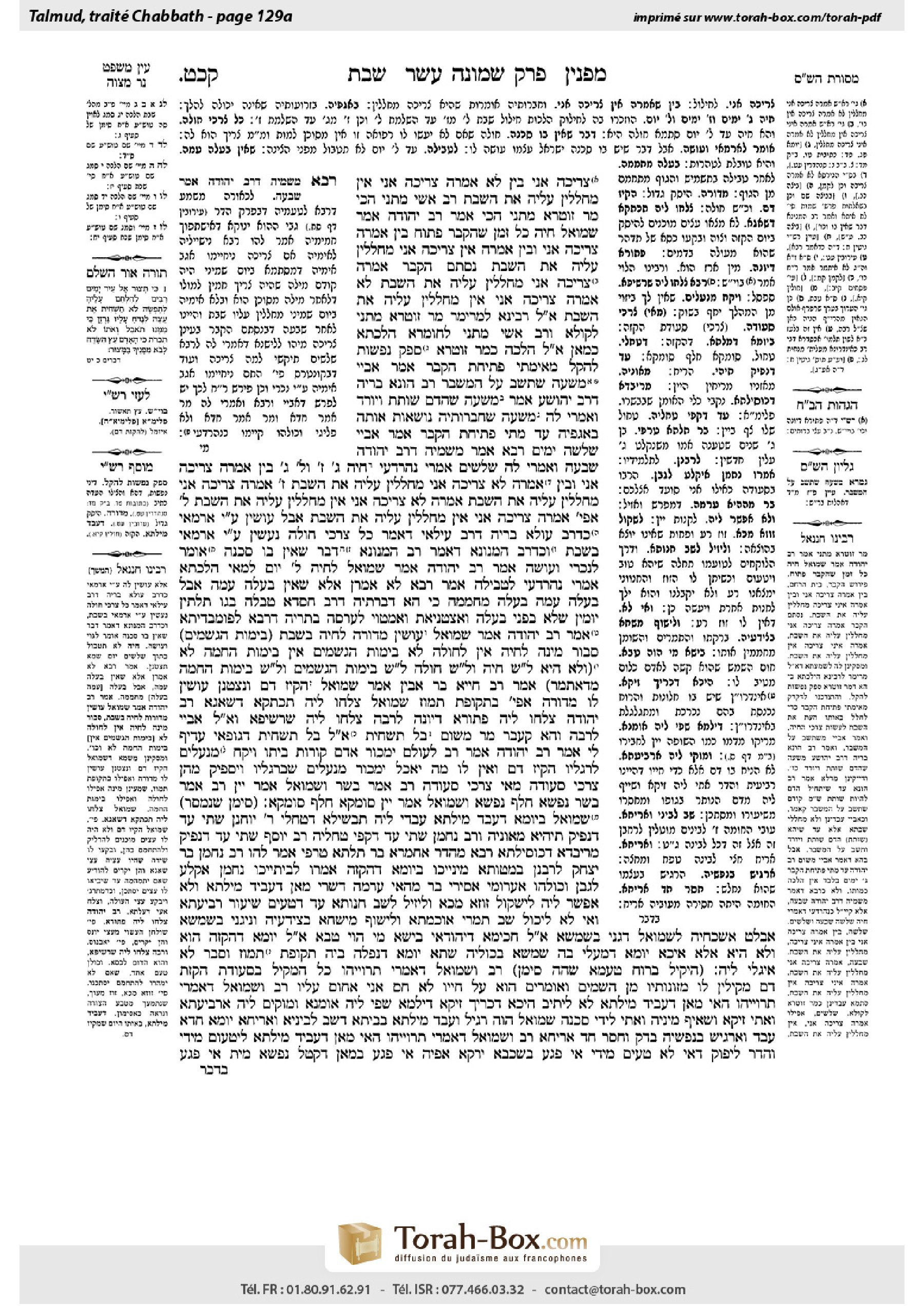
Shabbat 129a: Talmud study for Daf Yomi
Daf Yomi is the daily study of one Talmud folio. Explore 37 tractates with scans, Hebrew text, Sefaria English and AI-generated French translations where annotated.
Passage selection and English or AI-generated French translation are available where the scan has annotations. Daf Study is independent of Torah-Box and Sefaria.
Browse Shabbat · שבת · All tractatesShabbat 129a text and translations
This page of Shabbat includes the Aramaic text, an English translation and an AI-generated French translation, alongside the scan above.
שבת קכ״ט א · Aramaic and Hebrew text
״צְרִיכָה אֲנִי״, בֵּין לֹא אָמְרָה ״צְרִיכָה אֲנִי״ — אֵין מְחַלְּלִין עָלֶיהָ אֶת הַשַּׁבָּת.
רַב אָשֵׁי מַתְנֵי הָכִי. מָר זוּטְרָא מַתְנֵי הָכִי: אָמַר רַב יְהוּדָה אָמַר שְׁמוּאֵל: חַיָּה כׇּל זְמַן שֶׁהַקֶּבֶר פָּתוּחַ, בֵּין אָמְרָה ״צְרִיכָה אֲנִי״, וּבֵין אָמְרָה ״אֵין צְרִיכָה אֲנִי״ — מְחַלְּלִין עָלֶיהָ אֶת הַשַּׁבָּת. נִסְתַּם הַקֶּבֶר, אָמְרָה ״צְרִיכָה אֲנִי״ — מְחַלְּלִין עָלֶיהָ אֶת הַשַּׁבָּת. לֹא אָמְרָה ״צְרִיכָה אֲנִי״ — אֵין מְחַלְּלִין עָלֶיהָ אֶת הַשַּׁבָּת.
אֲמַר לֵיהּ רָבִינָא לְמָרִימָר: מָר זוּטְרָא מַתְנֵי לְקוּלָּא, וְרַב אָשֵׁי מַתְנֵי לְחוּמְרָא, הִלְכְתָא כְּמַאן? אֲמַר לֵיהּ: הֲלָכָה כְּמָר זוּטְרָא, סָפֵק נְפָשׁוֹת לְהָקֵל.
מֵאֵימָתַי פְּתִיחַת הַקֶּבֶר? אָמַר אַבָּיֵי: מִשָּׁעָה שֶׁתֵּשֵׁב עַל הַמַּשְׁבֵּר. רַב הוּנָא בְּרֵיהּ דְּרַב יְהוֹשֻׁעַ אָמַר: מִשָּׁעָה שֶׁהַדָּם שׁוֹתֵת וְיוֹרֵד, וְאָמְרִי לַהּ מִשָּׁעָה שֶׁחַבְרוֹתֶיהָ נוֹשְׂאוֹת אוֹתָהּ בַּאֲגַפֶּיהָ.
עַד מָתַי פְּתִיחַת הַקֶּבֶר? אָמַר אַבָּיֵי: שְׁלֹשָׁה יָמִים. רָבָא אָמַר מִשְּׁמֵיהּ דְּרַב יְהוּדָה: שִׁבְעָה, וְאָמְרִי לַהּ: שְׁלֹשִׁים.
אָמְרִי נְהַרְדָּעֵי: חַיָּה שְׁלֹשָׁה שִׁבְעָה וּשְׁלֹשִׁים. שְׁלֹשָׁה, בֵּין אָמְרָה ״צְרִיכָה אֲנִי״, וּבֵין אָמְרָה ״לֹא צְרִיכָה אֲנִי״ — מְחַלְּלִין עָלֶיהָ אֶת הַשַּׁבָּת. שִׁבְעָה, אָמְרָה ״צְרִיכָה אֲנִי״ — מְחַלְּלִין עָלֶיהָ אֶת הַשַּׁבָּת, אָמְרָה ״לֹא צְרִיכָה אֲנִי״ — אֵין מְחַלְּלִין עָלֶיהָ אֶת הַשַּׁבָּת. שְׁלֹשִׁים, אֲפִילּוּ אָמְרָה ״צְרִיכָה אֲנִי״ — אֵין מְחַלְּלִין עָלֶיהָ אֶת הַשַּׁבָּת, אֲבָל עוֹשִׂין עַל יְדֵי אַרְמַאי.
כִּדְרַב עוּלָּא בְּרֵיהּ דְּרַב עִילַּאי, דְּאָמַר: כׇּל צׇרְכֵי חוֹלֶה נַעֲשִׂין עַל יְדֵי אַרְמַאי בְּשַׁבָּת, וְכִדְרַב הַמְנוּנָא, דְּאָמַר רַב הַמְנוּנָא: דָּבָר שֶׁאֵין בּוֹ סַכָּנָה — אוֹמֵר לְגוֹי וְעוֹשֶׂה.
אָמַר רַב יְהוּדָה אָמַר שְׁמוּאֵל: לְחַיָּה שְׁלֹשִׁים יוֹם. לְמַאי הִלְכְתָא? אָמְרִי נְהַרְדָּעֵי: לִטְבִילָה.
אָמַר רָבָא: לָא אֲמַרַן אֶלָּא שֶׁאֵין בַּעְלָהּ עִמָּהּ, אֲבָל בַּעְלָהּ עִמָּהּ — בַּעְלָהּ מְחַמְּמָה. כִּי הָא דִּבְרַתֵּיה דְּרַב חִסְדָּא טְבַלָה בְּגוֹ תְּלָתִין יוֹמִין שֶׁלֹּא בִּפְנֵי בַּעְלָהּ וְאִצְטְנִיאַת, וְאַמְטְיוּהָא לְעַרְסַהּ בָּתְרֵיהּ דְּרָבָא לְפוּמְבְּדִיתָא.
אָמַר רַב יְהוּדָה אָמַר שְׁמוּאֵל: עוֹשִׂין מְדוּרָה לְחַיָּה בְּשַׁבָּת בִּימוֹת הַגְּשָׁמִים. סְבוּר מִינָּה לְחַיָּה — אִין, לַחוֹלֶה — לָא, בִּימוֹת הַגְּשָׁמִים — אִין, בִּימוֹת הַחַמָּה — לָא. וְלָא הִיא, לָא שְׁנָא חַיָּה וְלָא שְׁנָא חוֹלֶה, לָא שְׁנָא בִּימוֹת הַגְּשָׁמִים וְלָא שְׁנָא בִּימוֹת הַחַמָּה. מִדְּאִתְּמַר, אָמַר רַב חִיָּיא בַּר אָבִין אָמַר שְׁמוּאֵל: הִקִּיז דָּם וְנִצְטַנֵּן — עוֹשִׂין לוֹ מְדוּרָה אֲפִילּוּ בִּתְקוּפַת תַּמּוּז.
שְׁמוּאֵל צַלַּחוּ לֵיהּ תַּכְתָּקָא דְשָׁאגָא, רַב יְהוּדָה צַלַּחוּ לֵיהּ פָּתוּרָא דְיוֹנָה, לְרַבָּה צַלַּחוּ לֵיהּ שַׁרְשִׁיפָא.
וַאֲמַר לֵיהּ אַבָּיֵי לְרַבָּה: וְהָא קָעָבַר מָר מִשּׁוּם ״בַּל תַּשְׁחִית״! אֲמַר לֵיהּ: ״בַּל תַּשְׁחִית״ דְּגוּפַאי עֲדִיף לִי.
אָמַר רַב יְהוּדָה אָמַר רַב: לְעוֹלָם יִמְכּוֹר אָדָם קוֹרוֹת בֵּיתוֹ וְיִקַּח מִנְעָלִים לְרַגְלָיו. הִקִּיז דָּם וְאֵין לוֹ מַה יֹּאכַל — יִמְכּוֹר מִנְעָלִים שֶׁבְּרַגְלָיו וְיַסְפִּיק מֵהֶן צׇרְכֵי סְעוּדָה.
מַאי צׇרְכֵי סְעוּדָה? רַב אָמַר: בָּשָׂר, וּשְׁמוּאֵל אָמַר: יַיִן. רַב אָמַר: בָּשָׂר — נַפְשָׁא חֲלַף נַפְשָׁא. וּשְׁמוּאֵל אָמַר: יַיִן — סוּמָּקָא חֲלַף סוּמָּקָא.
(סִימָן ״שֶׁנִּמְסַר״).
שְׁמוּאֵל בְּיוֹמָא דַּעֲבַד מִילְּתָא, עָבְדִי לֵיהּ תַּבְשִׁילָא דִטְחָלֵי. רַבִּי יוֹחָנָן שָׁתֵי עַד דְּנָפֵיק תִּיהְיָא מֵאוּנֵּיהּ. וְרַב נַחְמָן שָׁתֵי עַד דְּקָפֵי טְחָלֵיהּ. רַב יוֹסֵף שָׁתֵי עַד דְּנָפֵיק מֵרִיבְדָּא דְכוּסִילְתָּא. רָבָא מְהַדַּר אַחַמְרָא בַּר תְּלָתָא טַרְפֵי.
אֲמַר לְהוּ רַב נַחְמָן בַּר יִצְחָק לְרַבָּנַן: בְּמָטוּתָא מִינַּיְיכוּ, בְּיוֹמָא דְהַקָּזָה אֱמַרוּ לְבֵיתַיְיכוּ: נַחְמָן אִקְּלַע לְגַבַּן.
וְכוּלְּהוּ אִעָרוֹמֵי אֲסִירִי, בַּר מֵהַאי עׇרְמָה דִּשְׁרֵי: מַאן דְּעָבֵיד מִילְּתָא וְלָא אֶפְשָׁר לֵיהּ, לִישְׁקוֹל זוּזָא מָכָא וְלֵיזִיל לְשַׁב חַנְוָאתָא, עַד דְּטָעֵים שִׁיעוּר רְבִיעֲתָא. וְאִי לָא — לֵיכוֹל שַׁב תַּמְרֵי אוּכָּמָתָא, וְלֵישׁוּף מִישְׁחָא בְּצִידְעֵיהּ, וְנִיגְנֵי בְּשִׁמְשָׁא.
אַבְלֵט אַשְׁכְּחֵיהּ לִשְׁמוּאֵל דְּגָנֵי בְּשִׁמְשָׁא. אֲמַר לֵיהּ: חַכִּימָא דִיהוּדָאֵי, בִּישָׁא מִי הָוֵי טָבָא?! אֲמַר לֵיהּ: יוֹמָא דְהַקָּזָה הוּא.
וְלָא הִיא, אֶלָּא אִיכָּא יוֹמָא דִּמְעַלֵּי בֵּהּ שִׁמְשָׁא בְּכוּלַּהּ שַׁתָּא — יוֹמָא דְּנָפְלָה בֵּיהּ תְּקוּפַת תַּמּוּז. וְסָבַר: לָא אֱיגַלֵּי לֵיהּ.
(הֵיקֵיל בְּרוּחַ טַעְמָא שָׁהָה — סִימָן) רַב וּשְׁמוּאֵל דְּאָמְרִי תַּרְוַיְיהוּ: כׇּל הַמַּקֵּיל בִּסְעוּדַת הַקָּזַת דָּם — מְקִילִּין לוֹ מְזוֹנוֹתָיו מִן הַשָּׁמַיִם, וְאוֹמְרִים: הוּא עַל חַיָּיו לֹא חָס, אֲנִי אָחוּס עָלָיו?!
רַב וּשְׁמוּאֵל דְּאָמְרִי תַּרְוַיְיהוּ: הַאי מַאן דְּעָבֵיד מִילְּתָא — לָא לִיתִּיב הֵיכָא דִּכְרִיךְ זִיקָא, דִּילְמָא שָׁפֵי לֵיהּ אוּמָּנָא וּמוֹקֵים לֵיהּ אַרְבִיעֵתָא, וְאָתֵי זִיקָא וְשָׁאֵיף מִינֵּיהּ, וְאָתֵי לִידֵי סַכָּנָה.
שְׁמוּאֵל הֲוָה רְגִיל דְּעָבֵיד מִילְּתָא בְּבֵיתָא דְּשַׁב לִבְנֵי וְאַרְחָא. יוֹמָא חֲדָא עֲבַד, וְאַרְגִּישׁ בְּנַפְשֵׁיהּ. בְּדַק וַחֲסַר חַד אַרְחָא.
רַב וּשְׁמוּאֵל דְּאָמְרִי תַּרְוַיְיהוּ: הַאי מַאן דְּעָבֵיד מִילְּתָא — לִיטְעוֹם מִידֵּי וַהֲדַר לִיפּוֹק. דְּאִי לָא טָעֵים מִידֵּי, אִי פָּגַע בְּשָׁכְבָא — יָרְקִי אַפֵּיהּ. אִי פָּגַע בְּמַאן דְּקָטֵל נַפְשָׁא — מָיֵת. אִי פָּגַע
Shabbat 129a · English translation
I need Shabbat to be desecrated, or whether she did not say: I need Shabbat to be desecrated, one does not desecrate Shabbat for her.
That is how Rav Ashi taught it. This is how Mar Zutra taught it: Rav Yehuda said that Shmuel said: With regard to a woman in childbirth, as long as the womb is open, whether she said: I need Shabbat to be desecrated, or whether she did not say: I need Shabbat to be desecrated, one desecrates Shabbat for her. Once the womb closed after birth, if she said: I need Shabbat to be desecrated, one desecrates Shabbat for her. If she did not say: I need Shabbat to be desecrated, and all the more so if she said: I do not need Shabbat to be desecrated, one does not desecrate Shabbat for her.
Ravina said to Mareimar: Since Mar Zutra teaches leniently, and Rav Ashi teaches stringently, in accordance with whose opinion is the halakha? Mareimar said to him: The halakha is in accordance with the opinion of Mar Zutra, based on the following principle: In cases of uncertainty concerning a life-threatening situation, the halakha is lenient.
With regard to the matter of the open womb, the Gemara asks: From when is it considered that the opening of the womb has begun? Abaye says: It begins from when the woman sits on the travailing chair. Rav Huna, son of Rav Yehoshua, said: It begins from when the blood flows and descends; and others say when her friends need to carry her by her arms, as she can no longer walk on her own.
The Gemara asks: Until when does the opening of the womb continue? Abaye said: It lasts three days. Rava said in the name of Rav Yehuda: It lasts seven days. And others say: It lasts thirty days.
The Sages of Neharde’a say: For a woman in childbirth, there are halakhic distinctions between three, seven, and thirty days after she gives birth. The Gemara elaborates: During the first three days after birth, whether she said: I need Shabbat to be desecrated, or whether she did not say: I need Shabbat to be desecrated, one desecrates Shabbat for her. Between three and seven days after birth, if she said: I need Shabbat to be desecrated, one desecrates Shabbat for her. If she did not say: I need Shabbat to be desecrated, one does not desecrate Shabbat for her. Between seven and thirty days after birth, even if she said: I need Shabbat to be desecrated, one does not desecrate Shabbat for her; however, we perform all necessary prohibited labors by means of a gentile.
This ruling is in accordance with the statement of Rav Ulla, son of Rav Ilai, who said: All needs of a sick person whose life is not in danger are performed by means of a gentile on Shabbat. And this ruling is in accordance with the opinion of Rav Hamnuna, as Rav Hamnuna says: With regard to a matter in which there is no danger, but only potential illness, one says to the gentile to perform the act, and the gentile performs the act.
Rav Yehuda said that Shmuel said: For a woman in childbirth, there is a halakha of thirty days. The Gemara asks: With regard to what halakha was this stated? The Sages of Neharde’a say: It was stated with regard to the halakha of immersion. A woman does not purify herself through ritual immersion within thirty days of giving birth because she is in a weakened state and susceptible to catching cold.
Rava said: We say that the ruling that she does not immerse during that period applies only when her husband is not with her. However, if her husband is with her, her husband warms her by engaging in relations with her, and she is not susceptible to catching cold, as is illustrated in this incident involving the daughter of Rav Ḥisda, Rava’s wife. She immersed within thirty days of giving birth, not in the presence of her husband, and caught cold, and afterward they brought her funeral bier after Rava to Pumbedita.
Rav Yehuda said that Shmuel said: One builds a fire for a woman in childbirth on Shabbat during the rainy season. The Sages thought to infer from here the following: For a woman in childbirth, yes, one builds a fire; for sick people, no, he does not build a fire. In the rainy season, yes, one builds a fire; in the summer, no, he does not build a fire. And the Gemara concludes: That is not the case. There is no difference between a woman in childbirth and a sick person, and there is no difference between the rainy season and the summer. In all of these cases one may build a fire on Shabbat. This conclusion emerges from that which was stated: Rav Ḥiyya bar Avin said that Shmuel said: With regard to one who let blood and caught cold, one makes a fire for him even during the season of Tammuz, i.e., the summer. Failure to do so could result in serious illness.
The Gemara relates that after Shmuel underwent bloodletting, they broke for him a wooden armchair made of teak [shaga] to build a fire. Similarly, for the sake of Rav Yehuda they broke a wooden table made of ebony [yavna], and for Rabba they broke a bench. They needed to build a fire due to the potential danger to Rabba. Since they could not find firewood, they kindled the fire with the furniture.
And Abaye said to Rabba: In breaking the bench, didn’t the Master violate the prohibition, “Do not destroy” (Deuteronomy 20:19)? It is prohibited to destroy objects of value. Rabba said to him: Do not destroy also with regard to destruction of my body. Preventing illness and danger is preferable to me.
With regard to the danger of bloodletting, the Gemara cites that which Rav Yehuda said that Rav said: One should always sell the beams of his house and purchase shoes for his feet with the proceeds, as shoes protect him from stepping on obstacles and from catching cold. If he let blood and has nothing to eat after the bloodletting, he should even sell the shoes on his feet, and from the proceeds provide the needs of a meal. After bloodletting, a meal is more crucial to one’s well-being than shoes are.
The Gemara asks: What are these special needs of a meal? Rav said: It is referring to meat. And Shmuel said: It is referring to wine. The Gemara explains: Rav says: It is referring to meat because the soul replaces the soul, i.e., the meat replenishes the person’s strength. And Shmuel said: It is referring to wine because the red replaces the red, i.e., red wine substitutes for red blood.
A mnemonic for the names of the Sages cited in the following discussion is the word shenimsar; shin for Shmuel, nun for Rabbi Yoḥanan, mem for Rav Naḥman, samekh for Rav Yosef, reish for Rava.
The Gemara relates the following about bloodletting and drinking wine. Shmuel, on the day on which he would perform the practice of bloodletting, they would prepare for him a dish of cooked spleen. Rabbi Yoḥanan would drink wine after bloodletting until the odor emerged from his ears. And Rav Naḥman would drink until his spleen floated in wine. Rav Yosef would drink until the wine would emerge from the bloodletting incision. Rava would search for wine that was sufficiently aged such that three leaves had already grown over three years on the vine from which the grapes were picked (Rashash).
Rav Naḥman bar Yitzhak said to the Sages: I beg of you, on the day that you undergo bloodletting, tell your households, your wives: Naḥman bar Yitzhak happened to come to visit us. Due to the visit of the important guest, the women will prepare a large meal. The husbands will eat well, recover from the lost blood, and avoid endangering themselves.
And Rav Naḥman bar Yitzhak said: All types of artifice that come at the expense of others are prohibited except for this artifice, which is permitted. One who performed the practice of bloodletting and it is not possible for him to purchase food due to lack of means, let him take a worn zuz coin and go to seven stores. In each store, he tastes the wine as one who seeks to buy wine would. After tasting, he hands the zuz to the storekeeper, who will not accept it because it is worn. He then proceeds to do the same in all the stores until he has tasted the measure of a quarter of a log of wine. And if doing so is not possible, let him eat seven black dates and smear oil on his temple and lie in the sun.
The Gemara relates: The gentile scholar, Ablat, found Shmuel lying in the sun. Ablat said to Shmuel: Wise man of the Jews, a matter that is evil, can it become good? Are there any circumstances in which the heat of the sun, which is harmful, can be beneficial? Shmuel said to him: It happens on a day of bloodletting, for which the heat of the sun is beneficial.
The Gemara comments: And actually, that is not what occurred. Rather, there is a day on which the sun is beneficial more than the entire year, and that is the day on which the Tammuz solstice, the longest day of the year, occurs. And Shmuel thought: I will not reveal this remedy to him.
Indifferent, in wind, taste, waited are a mnemonic for the following matters. It was Rav and Shmuel who both said: Anyone who is indifferent and not vigilant with regard to the meal eaten after bloodletting, they are indifferent with regard to providing his food from the Heavens. And they say in the name of Heaven: He took no pity on his life, will I take pity on him?
Similarly, it was Rav and Shmuel who both said: One who performs the practice of bloodletting should not sit where the wind is blowing, due to the concern that perhaps the blood letter let too much blood from him and established the amount of remaining blood at a quarter of a log. And there is concern the wind will come and draw out a little more blood from him, and he will be endangered.
The Gemara relates: Shmuel would customarily perform the practice of bloodletting in a house whose walls were seven and a half bricks thick. One day he performed bloodletting and felt himself weakened. He examined and discovered that one half-brick was lacking from the thickness of the walls. The resultant chill caused his weakness.
It was Rav and Shmuel who both said: One who performs the practice of bloodletting should taste something and then go outside, since if he does not taste anything, if he encounters a corpse, his face will turn green. If he encounters one who killed a person, he will die. If he encounters
Shabbat 129a · Traduction française (IA)
« J’ai besoin que Chabbat soit profané », ou qu’elle ne l’ait pas dit, on ne profane pas Chabbat pour elle.
C’est ainsi que Rav Achi l’a enseigné. Mar Zutra l’a enseigné ainsi : Rav Yehouda a dit au nom de Chmouel : Pour une femme en couches, tant que l’utérus est ouvert, qu’elle ait dit : « J’ai besoin que Chabbat soit profané » ou non, on profane Chabbat pour elle. Une fois que l’utérus s’est refermé après l’accouchement, si elle a dit : « J’ai besoin que Chabbat soit profané », on profane Chabbat pour elle. Si elle ne l’a pas dit, et à plus forte raison si elle a dit : « Je n’ai pas besoin que Chabbat soit profané », on ne profane pas Chabbat pour elle.
Ravina dit à Mareimar : Puisque Mar Zutra enseigne une position indulgente et que Rav Achi enseigne une position rigoureuse, selon l’avis de qui la halakha est-elle fixée ? Mareimar lui répondit : La halakha suit l’avis de Mar Zutra, conformément au principe suivant : en cas de doute concernant une situation où la vie est en danger, la halakha est indulgente.
À propos de l’utérus ouvert, la Guemara demande : À partir de quand considère-t-on que l’ouverture de l’utérus a commencé ? Abaye dit : À partir du moment où la femme s’assoit sur le siège d’accouchement. Rav Houna, fils de Rav Yehoshoua, dit : À partir du moment où le sang coule et descend. D’autres disent : Lorsque ses compagnes doivent la soutenir par les bras, car elle ne peut plus marcher seule.
La Guemara demande : Jusqu’à quand l’ouverture de l’utérus se poursuit-elle ? Abaye dit : Elle dure trois jours. Rava dit au nom de Rav Yehouda : Elle dure sept jours. D’autres disent : Elle dure trente jours.
Les Sages de Nehardéa disent : Pour une femme en couches, il existe des distinctions halakhiques entre les trois, les sept et les trente jours suivant l’accouchement. La Guemara précise : Durant les trois premiers jours après l’accouchement, qu’elle ait dit : « J’ai besoin que Chabbat soit profané » ou non, on profane Chabbat pour elle. Entre le troisième et le septième jour après l’accouchement, si elle a dit : « J’ai besoin que Chabbat soit profané », on profane Chabbat pour elle. Si elle ne l’a pas dit, on ne profane pas Chabbat pour elle. Entre le septième et le trentième jour après l’accouchement, même si elle a dit : « J’ai besoin que Chabbat soit profané », on ne profane pas Chabbat pour elle ; toutefois, on accomplit tous les travaux interdits nécessaires par l’intermédiaire d’un non-Juif.
Cette décision est conforme à l’enseignement de Rav Oula, fils de Rav Ilaï, qui a dit : Tous les besoins d’un malade dont la vie n’est pas en danger sont pris en charge par l’intermédiaire d’un non-Juif pendant Chabbat. Cette décision est également conforme à l’avis de Rav Hamnouna, car Rav Hamnouna dit : Lorsqu’il n’y a pas de danger, mais seulement un risque de maladie, on demande au non-Juif d’accomplir l’acte, et il l’accomplit.
Rav Yehouda a dit au nom de Chmouel : Pour une femme en couches, il existe une halakha des trente jours. La Guemara demande : À quelle halakha cela se rapporte-t-il ? Les Sages de Nehardéa disent : Il s’agit de la halakha de l’immersion. Une femme ne se purifie pas par immersion rituelle dans les trente jours suivant l’accouchement, car elle est affaiblie et susceptible de prendre froid.
Rava dit : Nous disons que la règle selon laquelle elle ne s’immerge pas durant cette période ne s’applique que lorsque son mari n’est pas auprès d’elle. En revanche, si son mari est auprès d’elle, il la réchauffe en ayant des relations avec elle, et elle n’est pas susceptible de prendre froid. Cela est illustré par l’incident concernant la fille de Rav Hisda, l’épouse de Rava. Elle s’immergea dans les trente jours suivant l’accouchement alors que son mari n’était pas auprès d’elle, prit froid, puis on transporta son cercueil derrière Rava jusqu’à Poumbedita.
Rav Yehouda a dit au nom de Chmouel : On allume un feu pour une femme en couches pendant Chabbat, durant la saison des pluies. Les Sages pensèrent en déduire ce qui suit : pour une femme en couches, oui, on allume un feu ; pour les malades, non, on n’en allume pas. Durant la saison des pluies, oui, on allume un feu ; en été, non, on n’en allume pas. La Guemara conclut : Il n’en est pas ainsi. Il n’y a pas de différence entre une femme en couches et un malade, ni entre la saison des pluies et l’été. Dans tous ces cas, on peut allumer un feu pendant Chabbat. Cette conclusion ressort de l’enseignement suivant : Rav Hiya bar Avin a dit au nom de Chmouel : Pour quelqu’un qui a subi une saignée et pris froid, on allume un feu même durant le mois de Tamouz, c’est-à-dire en été. Ne pas le faire pourrait entraîner une maladie grave.
La Guemara rapporte qu’après que Chmouel eut subi une saignée, on brisa pour lui un fauteuil en teck [shaga] afin d’allumer un feu. De même, pour Rav Yehouda, on brisa une table en ébène [yavna], et pour Rabba, un banc. Il fallait allumer un feu en raison du danger potentiel encouru par Rabba. Comme on ne trouvait pas de bois de chauffage, on alluma le feu avec les meubles.
Abaye dit à Rabba : En brisant le banc, le Maître n’a-t-il pas transgressé l’interdiction : « Tu ne détruiras pas » (Deutéronome 20,19) ? Il est interdit de détruire des objets de valeur. Rabba lui répondit : Ne détruis pas non plus mon corps. Mieux vaut prévenir la maladie et le danger.
À propos des dangers liés à la saignée, la Guemara cite l’enseignement de Rav Yehouda au nom de Rav : Il faut toujours vendre les poutres de sa maison et acheter avec le produit de la vente des chaussures pour ses pieds, car elles le protègent des obstacles sur lesquels il pourrait marcher et du froid. S’il a subi une saignée et n’a rien à manger ensuite, qu’il vende même les chaussures qu’il porte et qu’il se procure avec le produit de la vente de quoi prendre un repas. Après une saignée, un repas est plus essentiel à son bien-être que des chaussures.
La Guemara demande : Quels sont ces besoins particuliers liés au repas ? Rav dit : Il s’agit de viande. Chmouel dit : Il s’agit de vin. La Guemara explique : Selon Rav, il s’agit de viande, car l’âme remplace l’âme, c’est-à-dire que la viande restaure les forces de la personne. Selon Chmouel, il s’agit de vin, car le rouge remplace le rouge, c’est-à-dire que le vin rouge se substitue au sang rouge.
Un moyen mnémotechnique pour retenir les noms des Sages cités dans la discussion qui suit est le mot shenimsar : shin pour Chmouel, noun pour Rabbi Yohanan, mem pour Rav Nahman, samekh pour Rav Yossef, reish pour Rava.
La Guemara rapporte ce qui suit au sujet de la saignée et de la consommation de vin. Le jour où Chmouel se faisait saigner, on lui préparait un plat de rate cuite. Rabbi Yohanan buvait du vin après la saignée jusqu’à ce que l’odeur lui sorte par les oreilles. Rav Nahman buvait jusqu’à ce que sa rate flotte dans le vin. Rav Yossef buvait jusqu’à ce que le vin s’écoule par l’incision de la saignée. Rava cherchait du vin suffisamment vieux pour que trois feuilles aient déjà poussé, en trois ans, sur la vigne dont les raisins avaient été cueillis (Rashash).
Rav Nahman bar Yitzhak dit aux Sages : Je vous en prie, le jour où vous vous faites saigner, dites à vos femmes : « Nahman bar Yitzhak est venu nous rendre visite. » Grâce à la visite de cet hôte important, les femmes prépareront un grand repas. Les maris mangeront bien, reprendront des forces après la perte de sang et éviteront de se mettre en danger.
Rav Nahman bar Yitzhak dit également : Toutes les sortes de ruses qui se font aux dépens d’autrui sont interdites, à l’exception de celle-ci, qui est permise. Celui qui a subi une saignée et n’a pas les moyens d’acheter de la nourriture, qu’il prenne une pièce de zouz usée et se rende dans sept boutiques. Dans chaque boutique, il goûte le vin comme le ferait quelqu’un qui souhaite en acheter. Après avoir goûté, il tend le zouz au commerçant, qui le refusera parce qu’il est usé. Il procède de même dans toutes les boutiques, jusqu’à avoir goûté la mesure d’un quart de log de vin. Si cela n’est pas possible, qu’il mange sept dattes noires, s’enduisse la tempe d’huile et s’étende au soleil.
La Guemara rapporte : Le savant non juif Ablat trouva Chmouel étendu au soleil. Ablat lui dit : Sage des Juifs, une chose mauvaise peut-elle devenir bonne ? La chaleur du soleil, qui est nuisible, peut-elle être bénéfique dans certaines circonstances ? Chmouel lui répondit : Cela arrive le jour d’une saignée, où la chaleur du soleil est bénéfique.
La Guemara fait remarquer : En réalité, ce n’est pas ce qui s’est passé. Il existe plutôt un jour où le soleil est plus bénéfique que durant toute l’année : le jour du solstice de Tamouz, le plus long jour de l’année. Chmouel pensa : « Je ne lui révélerai pas ce remède. »
Indifférent, vent, goûter, attendre : ces mots servent de moyen mnémotechnique pour les enseignements suivants. Rav et Chmouel ont tous deux dit : Quiconque se montre indifférent et négligent à l’égard du repas pris après une saignée, le Ciel se montre indifférent lorsqu’il s’agit de lui procurer sa nourriture. Et l’on dit au nom du Ciel : « Il n’a pas eu pitié de sa propre vie ; aurais-je pitié de lui ? »
De même, Rav et Chmouel ont tous deux dit : Celui qui subit une saignée ne doit pas s’asseoir dans un endroit exposé au vent, car on craint que le saigneur ne lui ait prélevé trop de sang et que la quantité de sang qui lui reste ne soit plus que d’un quart de log. On craint alors que le vent ne lui fasse perdre encore un peu de sang et qu’il ne soit en danger.
La Guemara rapporte : Chmouel avait coutume de se faire saigner dans une maison dont les murs avaient sept briques et demie d’épaisseur. Un jour, après une saignée, il se sentit affaibli. Il examina les murs et découvrit qu’il leur manquait une demi-brique d’épaisseur. Le froid qui en résultait provoqua son affaiblissement.
Rav et Chmouel ont tous deux dit : Celui qui subit une saignée doit goûter quelque chose avant de sortir, car s’il ne goûte rien et rencontre un cadavre, son visage deviendra vert. S’il rencontre quelqu’un qui a tué une personne, il mourra. S’il rencontre
Traduction française générée par IA à partir de l’édition anglaise de Sefaria. Vérifie toujours un passage avec le texte source.
Text from Sefaria: William Davidson Edition - Vocalized Aramaic (CC BY NC); William Davidson Edition - English (CC BY NC).