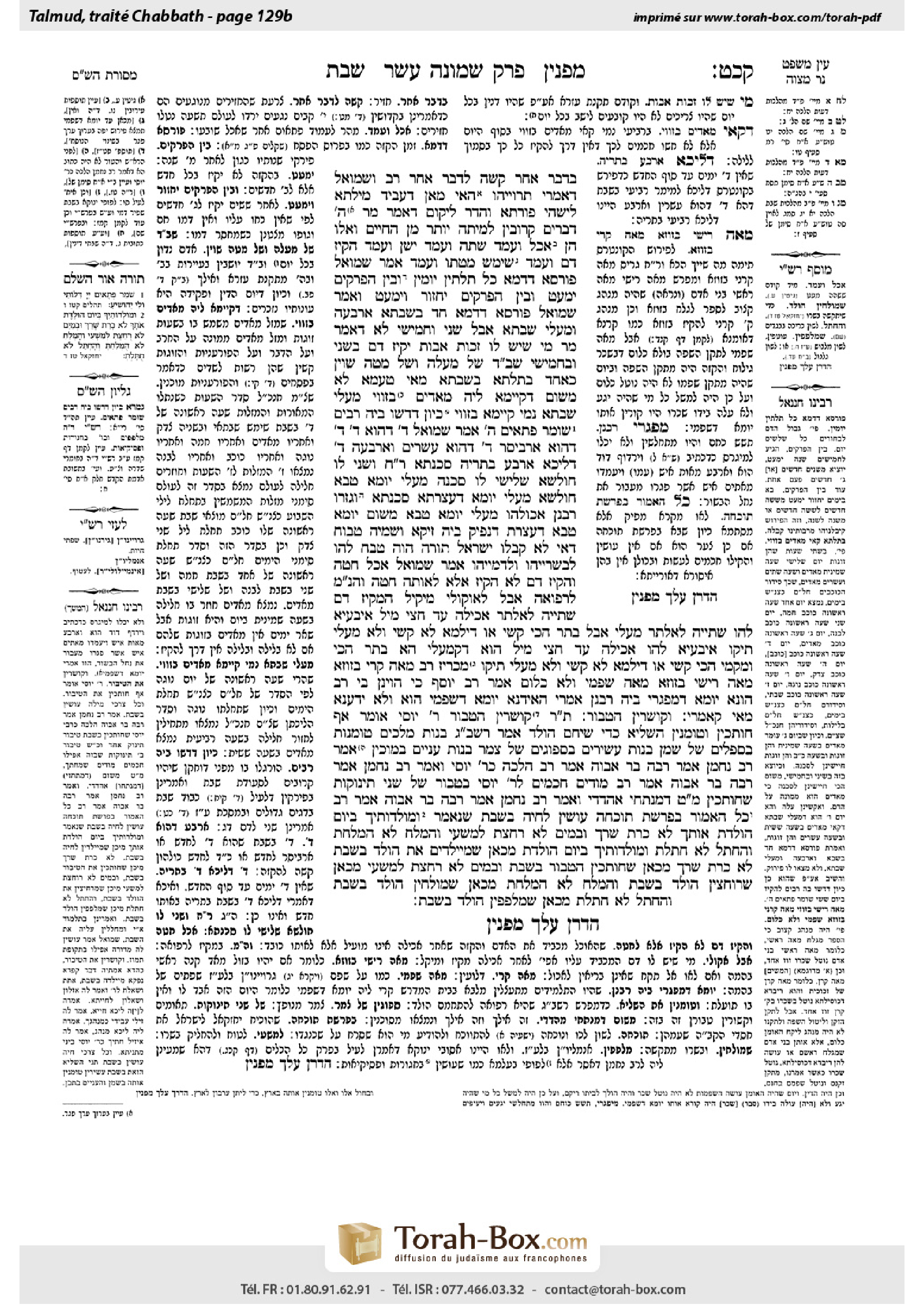
Shabbat 129b: Talmud study for Daf Yomi
Daf Yomi is the daily study of one Talmud folio. Explore 37 tractates with scans, Hebrew text, Sefaria English and AI-generated French translations where annotated.
Passage selection and English or AI-generated French translation are available where the scan has annotations. Daf Study is independent of Torah-Box and Sefaria.
Browse Shabbat · שבת · All tractatesShabbat 129b text and translations
This page of Shabbat includes the Aramaic text, an English translation and an AI-generated French translation, alongside the scan above.
שבת קכ״ט ב · Aramaic and Hebrew text
בְּדָבָר אַחֵר — קָשֶׁה לְדָבָר אַחֵר.
רַב וּשְׁמוּאֵל דְּאָמְרִי תַּרְוַיְיהוּ: הַאי מַאן דְּעָבֵיד מִילְּתָא — לִישְׁהֵי פּוּרְתָּא וַהֲדַר לֵיקוּם — דְּאָמַר מָר: חֲמִשָּׁה דְּבָרִים קְרוֹבִין לְמִיתָה יוֹתֵר מִן הַחַיִּים, וְאֵלּוּ הֵן: אָכַל וְעָמַד, שָׁתָה וְעָמַד, יָשֵׁן וְעָמַד, הִקִּיז דָּם וְעָמַד, שִׁימֵּשׁ מִטָּתוֹ וְעָמַד.
אָמַר שְׁמוּאֵל: פּוּרְסָא דִדְמָא — כׇּל תְּלָתִין יוֹמִין. וּבֵין הַפְּרָקִים — יְמַעֵט, וּבֵין הַפְּרָקִים יַחְזוֹר וִימַעֵט.
וְאָמַר שְׁמוּאֵל: פּוּרְסָא דִדְמָא — חַד בְּשַׁבְּתָא, אַרְבָּעָה, וּמַעֲלֵי שַׁבְּתָא, אֲבָל שֵׁנִי וַחֲמִישִׁי — לָא. דְּאָמַר מָר: מִי שֶׁיֵּשׁ לוֹ זְכוּת אָבוֹת יַקִּיז דָּם בְּשֵׁנִי וּבַחֲמִישִׁי, שֶׁבֵּית דִּין שֶׁל מַעְלָה וְשֶׁל מַטָּה שָׁוִין כְּאֶחָד.
בִּתְלָתָא בְּשַׁבְּתָא מַאי טַעְמָא לָא? מִשּׁוּם דְּקָיְימָא לֵיהּ מַאְדִּים בְּזָוֵוי. מַעֲלֵי שַׁבְּתָא נָמֵי קָיְימָא בְּזָוֵוי! כֵּיוָן דְּדָשׁוּ בֵּיהּ רַבִּים — ״שׁוֹמֵר פְּתָאִים ה׳״.
אָמַר שְׁמוּאֵל: אַרְבַּע דְּהוּא אַרְבַּע, אַרְבַּע דְּהוּא אַרְבֵּיסַר, אַרְבַּע דְּהוּא עֶשְׂרִים וְאַרְבְּעָה, אַרְבַּע דְּלֵיכָּא אַרְבַּע בָּתְרֵיהּ — סַכַּנְתָּא.
רֹאשׁ חוֹדֶשׁ וְשֵׁנִי לוֹ — חוּלְשָׁא. שְׁלִישִׁי לוֹ — סַכָּנָה. מַעֲלֵי יוֹמָא טָבָא — חוּלְשָׁא. מַעֲלֵי יוֹמָא דַעֲצַרְתָּא — סַכַּנְתָּא. וּגְזַרוּ רַבָּנַן אַכּוּלְּהוּ מַעֲלֵי יוֹמָא טָבָא מִשּׁוּם יוֹמָא (טָבָא) דַעֲצַרְתָּא, דְּנָפֵיק בֵּיהּ זִיקָא וּשְׁמֵיהּ ״טָבוֹחַ״, דְּאִי לָא קַבִּלוּ יִשְׂרָאֵל תּוֹרָה — הֲוָה טָבַח לְהוּ לְבִשְׂרַיְיהוּ וְלִדְמַיְיהוּ.
אָמַר שְׁמוּאֵל: אָכַל חִטָּה וְהִקִּיז דָּם — לֹא הִקִּיז אֶלָּא לְאוֹתָהּ חִטָּה. וְהָנֵי מִילֵּי לִרְפוּאָה, אֲבָל אַקּוֹלֵי — מֵיקֵיל.
הַמַּקִּיז דָּם, שְׁתִיָּיה — לְאַלְתַּר. אֲכִילָה — עַד חֲצִי מִיל.
אִיבַּעְיָא לְהוּ: שְׁתִיָּיה לְאַלְתַּר מְעַלֵּי, אֲבָל בָּתַר הָכִי קָשֵׁי, אוֹ דִילְמָא לָא קָשֵׁי וְלָא מְעַלֵּי? תֵּיקוּ.
אִיבַּעְיָא לְהוּ: אֲכִילָה עַד חֲצִי מִיל הוּא דְּקָמְעַלֵּי, הָא בָּתַר הָכִי וּמִקַּמֵּי הָכִי — קָשֵׁי, אוֹ דִילְמָא לָא קָשֵׁי וְלָא מְעַלֵּי? תֵּיקוּ.
מַכְרִיז רַב: מֵאָה קַרֵי בְּזוּזָא, מֵאָה רֵישֵׁי בְּזוּזָא, מֵאָה שְׂפָמֵי וְלָא כְלוּם. אָמַר רַב יוֹסֵף: כִּי הֲוֵינַן בֵּי רַב הוּנָא, יוֹמָא דִּמְפַגְּרִי בֵּיהּ רַבָּנַן, אָמְרִי: הָאִידָּנָא יוֹמָא דִשְׂפָמֵי הוּא, וְלָא יָדַעְנָא מַאי קָאָמְרִי.
וְקוֹשְׁרִין הַטַּבּוּר. תָּנוּ רַבָּנַן: קוֹשְׁרִין הַטַּבּוּר. רַבִּי יוֹסֵי אוֹמֵר: אַף חוֹתְכִין. וְטוֹמְנִין הַשִּׁלְיָא כְּדֵי שֶׁיֵּחַם הַוָּלָד. אָמַר רַבָּן שִׁמְעוֹן בֶּן גַּמְלִיאֵל: בְּנוֹת מְלָכִים — טוֹמְנוֹת בִּסְפָלִים שֶׁל שֶׁמֶן, בְּנוֹת עֲשִׁירִים — בִּסְפוֹגִים שֶׁל צֶמֶר, בְּנוֹת עֲנִיִּים בְּמוֹכִין.
אָמַר רַב נַחְמָן אָמַר רַבָּה בַּר אֲבוּהּ אָמַר רַב: הֲלָכָה כְּרַבִּי יוֹסֵי.
וְאָמַר רַב נַחְמָן אָמַר רַבָּה בַּר אֲבוּהּ אָמַר רַב: מוֹדִים חֲכָמִים לְרַבִּי יוֹסֵי בְּטַבּוּר שֶׁל שְׁנֵי תִינוֹקוֹת, שֶׁחוֹתְכִין. מַאי טַעְמָא? דִּמְנַתְּחִי אַהֲדָדֵי.
וְאָמַר רַב נַחְמָן אָמַר רַבָּה בַּר אֲבוּהּ אָמַר רַב: כׇּל הָאָמוּר בְּפָרָשַׁת תּוֹכָחָה עוֹשִׂין לְחַיָּה בְּשַׁבָּת. שֶׁנֶּאֱמַר: ״וּמוֹלְדוֹתַיִךְ בְּיוֹם הוּלֶּדֶת אוֹתָךְ לֹא כׇרַּת שׇׁרֵּךְ וּבְמַיִם לֹא רֻחַצְתְּ לְמִשְׁעִי וְהׇמְלֵחַ לֹא הֻמְלַחַתְּ וְהׇחְתֵּל לֹא חֻתָּלְתְּ״.
״וּמוֹלְדוֹתַיִךְ בְּיוֹם הוּלֶּדֶת״ — מִכָּאן שֶׁמְיַילְּדִים אֶת הַוָּלָד בְּשַׁבָּת. ״לֹא כׇרַּת שׇׁרֵּךְ״ — מִכָּאן שֶׁחוֹתְכִין הַטַּבּוּר בְּשַׁבָּת. ״וּבְמַיִם לֹא רֻחַצְתְּ לְמִשְׁעִי״ — מִכָּאן שֶׁרוֹחֲצִין הַוָּלָד בְּשַׁבָּת. ״וְהׇמְלֵחַ לֹא הֻמְלַחַתְּ״ — מִכָּאן שֶׁמּוֹלְחִין הַוָּלָד בְּשַׁבָּת. ״וְהׇחְתֵּל לֹא חֻתָּלְתְּ״ — מִכָּאן שֶׁמְּלַפְּפִין הַוָּלָד בְּשַׁבָּת.
הדרן עלך מפנין
Shabbat 129b · English translation
something else, a euphemism for a pig, it is harmful with regard to something else, a euphemism for leprosy.
It was Rav and Shmuel who both said: With regard to one who performs the practice of bloodletting, let him wait a bit and then let him rise, as the Master said: There are five matters that render one closer to death than life, and they are these: If one ate and immediately rose, if one drank and rose, if one slept and immediately rose, if one let blood and rose, if one engaged in conjugal relations and rose.
Shmuel said: The interval for bloodletting is every thirty days. And during the middle periods of one’s life, he should decrease the frequency of bloodletting; and during the later periods, he should decrease its frequency again.
And Shmuel said: The times for bloodletting are the first day of the week, the fourth day of the week and Shabbat eve. However, on the second and the fifth days of the week, no, one should not let blood, as the Master said: Only one who has the merit of his ancestors and relies on it should let blood on the second and on the fifth days of the week, as the court on High, in the heavens, and the court below are equal. The courts in the cities convene on Mondays and Thursdays, as does the heavenly court. Letting blood on a day of judgment is dangerous. If one is judged unfavorably all his blood could flow out.
The Gemara explains: On the third day of the week, what is the reason that one does not let blood? It is because the planet Mars is dominant during the even hours. Since it is a planet of blood, and the even hours are a bad omen, that combination gives cause for concern. The Gemara asks: On Shabbat eve, Mars also dominates during the even hours. The Gemara answers: Since the multitudes have already become accustomed to letting blood on Shabbat eve, the verse: “The Lord protects the simple-hearted” (Psalms 116:6) applies in this case.
Similarly, Shmuel says: On the fourth day of the week that is the fourth day of the month; on the fourth day of the week that is the fourteenth of the month; on the fourth day of the week that is the twenty-fourth of the month; and on the fourth day of the week after which there are not four days remaining in the month it is dangerous to let blood.
Bloodletting on the New Moon and on the second day of the month causes weakness; bloodletting on the third day of the month leads to danger. Bloodletting on the eve of a Festival causes weakness; bloodletting on the eve of the festival of Shavuot leads to danger. And the Sages issued a decree prohibiting bloodletting on the eve of every Festival due to the festival of Shavuot. On Shavuot, an evil spirit named Tibbuaḥ, from the Hebrew word meaning slaughter, emerges, as had the Jewish people not accepted the Torah on the festival of Shavuot, Tibbuaḥ would have slaughtered their flesh and their blood. Consequently, it remains a dangerous day.
Shmuel said: If one ate wheat and afterward let blood, he only let that wheat. The bloodletting was ineffective as the wheat replaced any blood that was let. And this ineffectiveness applies only if he let blood to cure an illness; however, to relieve discomfort, bloodletting after eating wheat relieves one’s discomfort.
One who lets blood should engage in drinking immediately; he should not engage in eating until the time that it takes to walk half a mil has elapsed.
A dilemma was raised before the Sages: When they said that one should engage in drinking immediately, does that mean that drinking immediately is beneficial; however, thereafter, it is injurious? Or perhaps, thereafter it is neither injurious nor beneficial. No resolution is found for this dilemma, therefore it stands unresolved.
Similarly, a dilemma was raised before the Sages: When they said one should not engage in eating until the time that it takes to walk half a mil has elapsed, does that mean that only at that time it is beneficial, however, after that time or before that time it is injurious? Or perhaps, before and after that time it is neither injurious nor beneficial. No resolution is found for this dilemma, therefore it too stands unresolved.
Rav would announce: One hundred bloodlettings for a zuz; cutting the hair on one hundred heads for a zuz; grooming one hundred moustaches does not cost anything (ge’onim). Blood letters typically served as barbers as well and did not charge for grooming a moustache. If one hundred men happened to arrive one day to have their moustaches groomed, the barber would work all day without receiving any pay. Rav Yosef said: When we were students in Rav Huna’s school, on a day when the Sages were sluggish in their studies, they would say: Today is the day of the moustaches, and I did not know what they were saying. Now that I heard Rav’s statement, I understand that they meant that it was a day without purpose.
We learned in the mishna: And one may tie the umbilical cord of a child born on Shabbat. The Sages taught similarly in the Tosefta and even added to it: One may tie the umbilical cord of a child born on Shabbat. Rabbi Yosei said: One may even cut the umbilical cord. And one may insulate the placenta as a healing remedy so as to warm the newborn. Rabban Shimon ben Gamliel said: Princesses insulate the placenta in mugs of oil; the daughters of the wealthy do so in combed wool; the daughters of the poor in soft rags.
Rav Naḥman said that Rabba bar Avuh said that Rav said: The halakha is in accordance with the opinion of Rabbi Yosei that it is even permitted to cut the umbilical cord on Shabbat.
And Rav Naḥman said that Rabba bar Avuh said that Rav said: The Rabbis concede to Rabbi Yosei with regard to the umbilical cord attached to twin babies that one may cut it on Shabbat. What is the reason for this? In that case, leaving the cord attached is dangerous. Since the attached twins will try to disengage from each other, they could potentially rip each other’s cords.
And Rav Naḥman said that Rabba bar Avuh said that Rav said: Everything stated in the passage of rebuke (Ezekiel 16) one may perform for a woman in childbirth on Shabbat. Since that chapter speaks of the dangerous birth of an abandoned child, for all other children, these issues should be addressed. As it is stated there: “And as for your birth, on the day you were born, your navel was not cut, and you were not washed in water for cleansing, and you were not salted, nor were you swaddled” (Ezekiel 16:4).
The Gemara explains: “And as for your birth, on the day you were born”; from here it is derived that one delivers the newborn on Shabbat. “Your navel was not cut”; from here it is derived that one cuts the umbilical cord on Shabbat. “And you were not washed in water for cleansing”; from here it is derived that one washes the newborn on Shabbat. “And you were not salted”; from here it is derived that one salts the newborn on Shabbat. “Nor were you swaddled”; from here it is derived that one swaddles the newborn on Shabbat.
Shabbat 129b · Traduction française (IA)
autre chose, euphémisme désignant un porc ; cela est nuisible à autre chose, euphémisme désignant la lèpre.
C’est Rav et Chmouel qui ont tous deux dit : Celui qui se fait saigner doit attendre un peu, puis se lever, car le Maître a dit : Cinq choses rapprochent davantage de la mort que de la vie, les voici : manger puis se lever aussitôt ; boire puis se lever ; dormir puis se lever aussitôt ; se faire saigner puis se lever ; avoir des relations conjugales puis se lever.
Chmouel a dit : L’intervalle entre les saignées doit être de trente jours. Au milieu de la vie, il faut réduire la fréquence des saignées ; et dans les dernières années, il faut la réduire encore.
Chmouel a également dit : Les jours propices aux saignées sont le premier jour de la semaine, le quatrième jour de la semaine et la veille de Chabbat. En revanche, les deuxième et cinquième jours de la semaine, non, il ne faut pas se faire saigner, car le Maître a dit : Seul celui qui a le mérite de ses ancêtres et s’appuie sur lui doit se faire saigner les deuxième et cinquième jours de la semaine, car le tribunal céleste, dans les cieux, et le tribunal terrestre siègent au même moment. Les tribunaux des villes siègent les lundis et les jeudis, tout comme le tribunal céleste. Se faire saigner un jour de jugement est dangereux. Si l’on est jugé défavorablement, tout son sang pourrait s’écouler.
La Guemara explique : Pourquoi ne se fait-on pas saigner le troisième jour de la semaine ? Parce que la planète Mars domine pendant les heures paires. Comme c’est la planète du sang et que les heures paires sont de mauvais augure, cette combinaison est inquiétante. La Guemara demande : La veille de Chabbat aussi, Mars domine pendant les heures paires. La Guemara répond : Puisque les foules ont déjà pris l’habitude de se faire saigner la veille de Chabbat, le verset « L’Éternel protège les simples » (Psaumes 116, 6) s’applique en l’occurrence.
De même, Chmouel dit : Il est dangereux de se faire saigner le quatrième jour de la semaine lorsqu’il tombe le quatrième, le quatorzième ou le vingt-quatrième jour du mois, ainsi que le quatrième jour de la semaine après lequel il reste moins de quatre jours dans le mois.
Se faire saigner à la nouvelle lune ou le deuxième jour du mois provoque une faiblesse ; se faire saigner le troisième jour du mois entraîne un danger. Se faire saigner la veille d’une fête provoque une faiblesse ; se faire saigner la veille de la fête de Chavouot entraîne un danger. Les Sages ont décrété qu’il est interdit de se faire saigner la veille de toutes les fêtes, à cause de la fête de Chavouot. À Chavouot apparaît un mauvais esprit nommé Tibbuaḥ, nom issu du mot hébreu signifiant « abattage » : si le peuple juif n’avait pas accepté la Torah lors de la fête de Chavouot, Tibbuaḥ aurait abattu leur chair et fait couler leur sang. Ce jour reste donc dangereux.
Chmouel a dit : Si quelqu’un a mangé du blé puis s’est fait saigner, il n’a fait que saigner ce blé. La saignée était inefficace, puisque le blé avait remplacé le sang qui avait été retiré. Cette inefficacité ne vaut que si la saignée visait à guérir une maladie ; en revanche, lorsqu’elle vise à soulager un malaise, se faire saigner après avoir mangé du blé soulage ce malaise.
Celui qui se fait saigner doit boire immédiatement ; il ne doit pas manger avant que se soit écoulé le temps nécessaire pour parcourir un demi-mil.
Une question fut posée aux Sages : lorsqu’ils ont dit qu’il faut boire immédiatement, cela signifie-t-il que boire immédiatement est bénéfique, mais que boire par la suite est nuisible ? Ou peut-être que, par la suite, ce n’est ni nuisible ni bénéfique ? Cette question reste sans réponse et demeure donc irrésolue.
De même, une question fut posée aux Sages : lorsqu’ils ont dit qu’il ne faut pas manger avant que se soit écoulé le temps nécessaire pour parcourir un demi-mil, cela signifie-t-il que manger seulement à ce moment-là est bénéfique, tandis que manger avant ou après ce délai est nuisible ? Ou peut-être que, avant comme après ce délai, manger n’est ni nuisible ni bénéfique ? Cette question reste sans réponse et demeure donc elle aussi irrésolue.
Rav annonçait : Cent saignées pour un zouz ; couper les cheveux de cent personnes pour un zouz ; entretenir cent moustaches ne coûte rien (ge’onim). Ceux qui pratiquaient les saignées faisaient généralement aussi office de barbiers et ne faisaient pas payer l’entretien des moustaches. Si cent hommes se présentaient un jour pour se faire tailler la moustache, le barbier travaillait toute la journée sans rien gagner. Rav Yossef a dit : Lorsque nous étions étudiants dans l’école de Rav Houna, les jours où les Sages manquaient d’entrain dans leurs études, ils disaient : « Aujourd’hui, c’est le jour des moustaches », et je ne savais pas ce qu’ils voulaient dire. Maintenant que j’ai entendu la déclaration de Rav, je comprends qu’ils désignaient ainsi une journée sans but.
Nous avons appris dans la Michna : On peut ligaturer le cordon ombilical d’un enfant né le Chabbat. Les Sages ont enseigné de même dans la Tosefta, et ont même ajouté : On peut ligaturer le cordon ombilical d’un enfant né le Chabbat. Rabbi Yossi a dit : On peut même couper le cordon ombilical. On peut aussi envelopper le placenta pour le protéger comme remède, afin de réchauffer le nouveau-né. Rabban Chimon ben Gamliel a dit : Les princesses enveloppent le placenta dans des coupes d’huile ; les filles des riches le font dans de la laine cardée ; les filles des pauvres, dans de doux chiffons.
Rav Naḥman a dit au nom de Rabba bar Avouha, qui a dit au nom de Rav : La halakha suit l’opinion de Rabbi Yossi, selon laquelle il est même permis de couper le cordon ombilical le Chabbat.
Rav Naḥman a dit au nom de Rabba bar Avouha, qui a dit au nom de Rav : Les Rabbins reconnaissent à Rabbi Yossi que l’on peut couper le Chabbat le cordon ombilical reliant des jumeaux. Pour quelle raison ? Dans ce cas, laisser le cordon attaché est dangereux. Comme les jumeaux reliés tenteront de se séparer, ils pourraient se déchirer mutuellement le cordon.
Rav Naḥman a dit au nom de Rabba bar Avouha, qui a dit au nom de Rav : Tout ce qui est mentionné dans le passage de réprimande (Ézéchiel 16) peut être fait pour une femme en couches le Chabbat. Puisque ce chapitre parle de la naissance dangereuse d’un enfant abandonné, il faut accomplir ces gestes pour tous les autres enfants. En effet, il est dit là : « Quant à ta naissance, le jour où tu es née, ton cordon ombilical ne fut pas coupé, tu ne fus pas lavée dans l’eau pour être purifiée, tu ne fus pas frottée de sel et tu ne fus pas enveloppée » (Ézéchiel 16, 4).
La Guemara explique : « Quant à ta naissance, le jour où tu es née » : on en déduit que l’on peut faire naître un nouveau-né le Chabbat. « Ton cordon ombilical ne fut pas coupé » : on en déduit que l’on peut couper le cordon ombilical le Chabbat. « Tu ne fus pas lavée dans l’eau pour être purifiée » : on en déduit que l’on peut laver le nouveau-né le Chabbat. « Tu ne fus pas frottée de sel » : on en déduit que l’on peut saler le nouveau-né le Chabbat. « Et tu ne fus pas enveloppée » : on en déduit que l’on peut emmailloter le nouveau-né le Chabbat.
Traduction française générée par IA à partir de l’édition anglaise de Sefaria. Vérifie toujours un passage avec le texte source.
Text from Sefaria: William Davidson Edition - Vocalized Aramaic (CC BY NC); William Davidson Edition - English (CC BY NC).