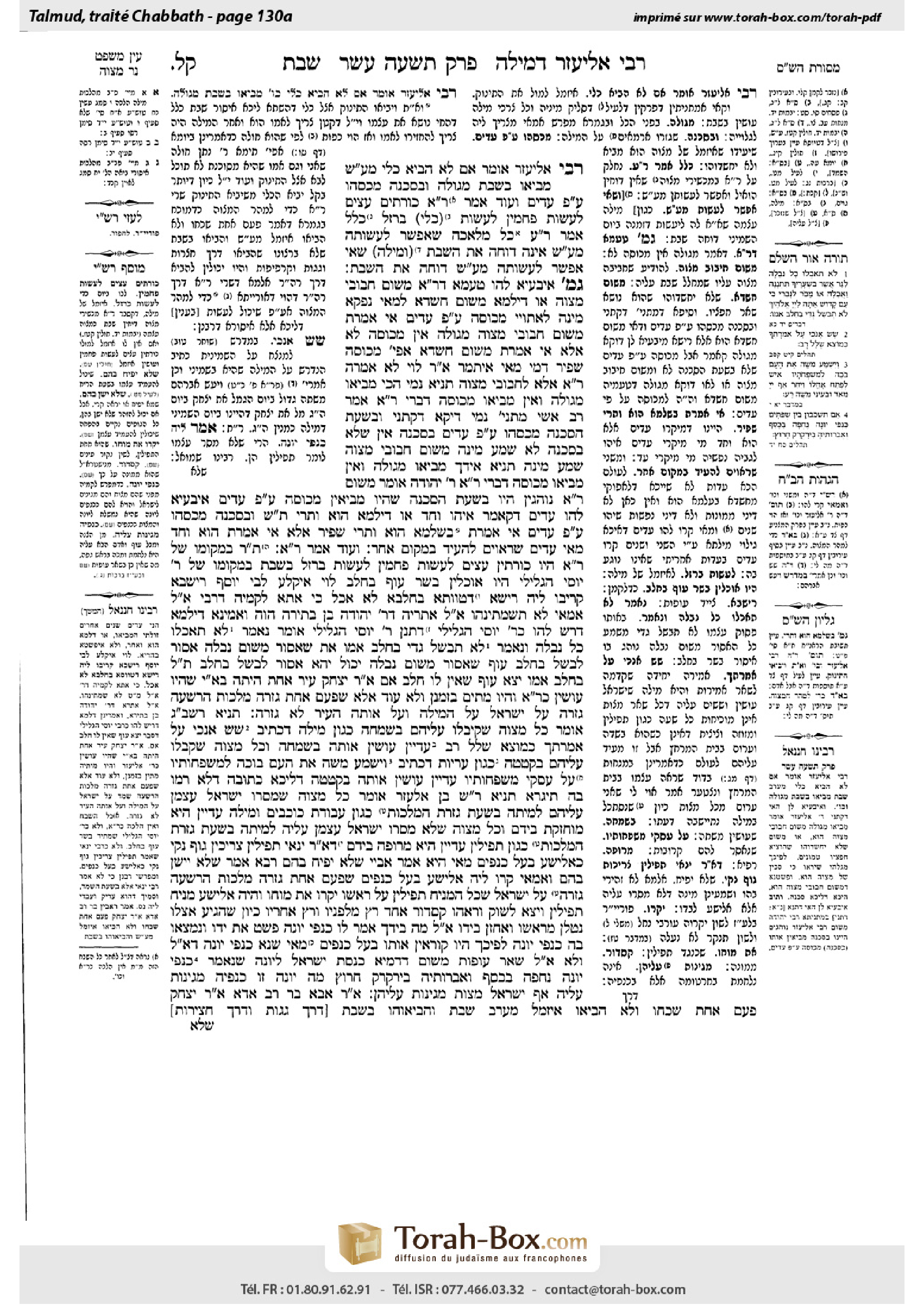
Shabbat 130a: Talmud study for Daf Yomi
Daf Yomi is the daily study of one Talmud folio. Explore 37 tractates with scans, Hebrew text, Sefaria English and AI-generated French translations where annotated.
Passage selection and English or AI-generated French translation are available where the scan has annotations. Daf Study is independent of Torah-Box and Sefaria.
Browse Shabbat · שבת · All tractatesShabbat 130a text and translations
This page of Shabbat includes the Aramaic text, an English translation and an AI-generated French translation, alongside the scan above.
שבת ק״ל א · Aramaic and Hebrew text
מַתְנִי׳ רַבִּי אֱלִיעֶזֶר אוֹמֵר: אִם לֹא הֵבִיא כְּלִי מֵעֶרֶב שַׁבָּת — מְבִיאוֹ בְּשַׁבָּת מְגוּלֶּה, וּבַסַּכָּנָה מְכַסֵּהוּ עַל פִּי עֵדִים.
וְעוֹד אָמַר רַבִּי אֱלִיעֶזֶר: כּוֹרְתִים עֵצִים לַעֲשׂוֹת פֶּחָמִין לַעֲשׂוֹת (כְּלִי) בַּרְזֶל.
כְּלָל אָמַר רַבִּי עֲקִיבָא: כׇּל מְלָאכָה שֶׁאֶפְשָׁר לַעֲשׂוֹתָהּ מֵעֶרֶב שַׁבָּת — אֵינָהּ דּוֹחָה אֶת הַשַּׁבָּת, וּמִילָה שֶׁאִי אֶפְשָׁר לַעֲשׂוֹתָהּ מֵעֶרֶב שַׁבָּת דּוֹחָה אֶת הַשַּׁבָּת.
גְּמָ׳ אִיבַּעְיָא לְהוּ: טַעְמָא דְּרַבִּי אֱלִיעֶזֶר מִשּׁוּם חַבּוֹבֵי מִצְוָה, אוֹ דִילְמָא מִשּׁוּם חֲשָׁדָא. לְמַאי נָפְקָא מִינַּהּ? לְאֵתוֹיֵי מְכוּסֶּה עַל פִּי עֵדִים. אִי אָמְרַתְּ מִשּׁוּם חַבּוֹבֵי מִצְוָה, מְגוּלֶּה — אִין, מְכוּסֶּה — לָא. אֶלָּא אִי אָמְרַתְּ מִשּׁוּם חֲשָׁדָא — אֲפִילּוּ מְכוּסֶּה, שַׁפִּיר דָּמֵי. מַאי?
אִיתְּמַר אָמַר רַבִּי לֵוִי: לֹא אֲמָרָהּ רַבִּי אֱלִיעֶזֶר אֶלָּא לְחַבּוֹבֵי מִצְוָה. תַּנְיָא נָמֵי הָכִי: מְבִיאוֹ מְגוּלֶּה וְאֵין מְבִיאוֹ מְכוּסֶּה, דִּבְרֵי רַבִּי אֱלִיעֶזֶר. אָמַר רַב אָשֵׁי: מַתְנִיתִין נָמֵי דַּיְקָא, דְּקָתָנֵי: וּבִשְׁעַת הַסַּכָּנָה מְכַסֵּהוּ עַל פִּי עֵדִים, בְּסַכָּנָה — אִין, שֶׁלֹּא בְּסַכָּנָה — לָא, שְׁמַע מִינַּהּ מִשּׁוּם חַבּוֹבֵי מִצְוָה. שְׁמַע מִינַּהּ.
תַּנְיָא אִידַּךְ: מְבִיאוֹ מְגוּלֶּה וְאֵין מְבִיאוֹ מְכוּסֶּה, דִּבְרֵי רַבִּי אֱלִיעֶזֶר, רַבִּי יְהוּדָה אוֹמֵר מִשּׁוּם רַבִּי אֱלִיעֶזֶר: נוֹהֲגִין הָיוּ בִּשְׁעַת הַסַּכָּנָה שֶׁהָיוּ מְבִיאִין מְכוּסֶּה עַל פִּי עֵדִים.
אִיבַּעְיָא לְהוּ, עֵדִים דְּקָאָמַר: אִיהוּ וְחַד, אוֹ דִילְמָא: הוּא וּתְרֵי.
תָּא שְׁמַע: וּבַסַּכָּנָה מְכַסֵּהוּ עַל פִּי עֵדִים. אִי אָמְרַתְּ בִּשְׁלָמָא הוּא וּתְרֵי — שַׁפִּיר, אֶלָּא אִי אָמְרַתְּ הוּא וְחַד, מַאי ״עֵדִים״? שֶׁרְאוּיִם לְהָעִיד בִּמְקוֹם אַחֵר.
וְעוֹד אָמַר רַבִּי אֱלִיעֶזֶר, תָּנוּ רַבָּנַן: בִּמְקוֹמוֹ שֶׁל רַבִּי אֱלִיעֶזֶר הָיוּ כּוֹרְתִין עֵצִים לַעֲשׂוֹת פֶּחָמִין לַעֲשׂוֹת בַּרְזֶל בְּשַׁבָּת, בִּמְקוֹמוֹ שֶׁל רַבִּי יוֹסֵי הַגְּלִילִי הָיוּ אוֹכְלִין בְּשַׂר עוֹף בְּחָלָב.
לֵוִי אִיקְּלַע לְבֵי יוֹסֵף רִישְׁבָּא. קָרִיבוּ לֵיהּ רֵישָׁא דְטַוּוֹסָא בַּחֲלָבָא, לָא אֲכַל. כִּי אֲתָא לְקַמֵּיהּ דְּרַבִּי אֲמַר לֵיהּ: אַמַּאי לָא תְּשַׁמְּתִינְהוּ? אֲמַר לֵיהּ: אַתְרֵיהּ דְּרַבִּי יְהוּדָה בֶּן בְּתִירָה הֲוָה, וְאָמֵינָא: דִּילְמָא דְּרַשׁ לְהוּ כְּרַבִּי יוֹסֵי הַגְּלִילִי.
דִּתְנַן, רַבִּי יוֹסֵי הַגְּלִילִי אוֹמֵר: נֶאֱמַר ״לֹא תֹאכְלוּ כׇל נְבֵלָה״, וְנֶאֱמַר ״לֹא תְבַשֵּׁל גְּדִי בַּחֲלֵב אִמּוֹ״. אֶת שֶׁאָסוּר מִשּׁוּם נְבֵלָה — אָסוּר לְבַשֵּׁל בְּחָלָב. עוֹף שֶׁאָסוּר מִשּׁוּם נְבֵלָה, יָכוֹל יְהֵא אָסוּר לְבַשֵּׁל בְּחָלָב — תַּלְמוּד לוֹמַר: ״בַּחֲלֵב אִמּוֹ״, יָצָא עוֹף שֶׁאֵין לוֹ חֲלֵב אֵם.
אָמַר רַבִּי יִצְחָק: עִיר אַחַת הָיְתָה בְּאֶרֶץ יִשְׂרָאֵל שֶׁהָיוּ עוֹשִׂין כְּרַבִּי אֱלִיעֶזֶר וְהָיוּ מֵתִים בִּזְמַנָּן. וְלֹא עוֹד, אֶלָּא שֶׁפַּעַם אַחַת גָּזְרָה מַלְכוּת הָרְשָׁעָה גְּזֵרָה עַל יִשְׂרָאֵל עַל הַמִּילָה, וְעַל אוֹתָהּ הָעִיר לָא גָּזְרָה.
תַּנְיָא, רַבָּן שִׁמְעוֹן בֶּן גַּמְלִיאֵל אוֹמֵר: כׇּל מִצְוָה שֶׁקִּיבְּלוּ עֲלֵיהֶם בְּשִׂמְחָה, כְּגוֹן מִילָה, דִּכְתִיב: ״שָׂשׂ אָנֹכִי עַל אִמְרָתֶךָ כְּמוֹצֵא שָׁלָל רָב״ — עֲדַיִין עוֹשִׂין אוֹתָהּ בְּשִׂמְחָה. וְכׇל מִצְוָה שֶׁקִּבְּלוּ עֲלֵיהֶם בִּקְטָטָה, כְּגוֹן עֲרָיוֹת, דִּכְתִיב: ״וַיִּשְׁמַע מֹשֶׁה אֶת הָעָם בּוֹכֶה לְמִשְׁפְּחוֹתָיו״, עַל עִסְקֵי מִשְׁפְּחוֹתָיו — עֲדַיִין עוֹשִׂין אוֹתָהּ בִּקְטָטָה, דְּלֵיכָּא כְּתוּבָּה דְּלָא רָמוּ בַּהּ תִּיגְרָא.
תַּנְיָא, רַבִּי שִׁמְעוֹן בֶּן אֶלְעָזָר אוֹמֵר: כׇּל מִצְוָה שֶׁמָּסְרוּ יִשְׂרָאֵל עַצְמָן עֲלֵיהֶם לְמִיתָה בִּשְׁעַת גְּזֵרַת הַמַּלְכוּת, כְּגוֹן עֲבוֹדָה זָרָה וּמִילָה — עֲדַיִין הִיא מוּחְזֶקֶת בְּיָדָם, וְכׇל מִצְוָה שֶׁלֹּא מָסְרוּ יִשְׂרָאֵל עַצְמָן עָלֶיהָ לְמִיתָה בִּשְׁעַת גְּזֵרַת הַמַּלְכוּת, כְּגוֹן תְּפִילִּין — עֲדַיִין הִיא מְרוּפָּה בְּיָדָם.
דְּאָמַר רַבִּי יַנַּאי: תְּפִילִּין צְרִיכִין גּוּף נָקִי כֶּאֱלִישָׁע בַּעַל כְּנָפַיִם. מַאי הִיא? אָמַר אַבָּיֵי: שֶׁלֹּא יָפִיחַ בָּהֶם, רָבָא אָמַר: שֶׁלֹּא יִישַׁן בָּהֶם.
וְאַמַּאי קָרוּ לֵיהּ ״אֱלִישָׁע בַּעַל כְּנָפַיִם״? שֶׁפַּעַם אַחַת גָּזְרָה מַלְכוּת הָרְשָׁעָה גְּזֵרָה עַל יִשְׂרָאֵל שֶׁכׇּל הַמַּנִּיחַ תְּפִילִּין עַל רֹאשׁוֹ — יִקְּרוּ אֶת מוֹחוֹ, וְהָיָה אֱלִישָׁע מַנִּיחַ תְּפִילִּין וְיָצָא לַשּׁוּק, וְרָאָהוּ קַסְדּוֹר אֶחָד. רָץ מִלְּפָנָיו וְרָץ אַחֲרָיו. כֵּיוָן שֶׁהִגִּיעַ אֶצְלוֹ, נְטָלָן מֵרֹאשׁוֹ וַאֲחָזָן בְּיָדוֹ. אָמַר לוֹ: מַה בְּיָדְךָ? אָמַר לוֹ: כַּנְפֵי יוֹנָה. פָּשַׁט אֶת יָדוֹ וְנִמְצְאוּ בָּהּ כַּנְפֵי יוֹנָה. לְפִיכָךְ הָיוּ קוֹרְאִין אוֹתוֹ ״בַּעַל כְּנָפַיִם״.
מַאי שְׁנָא כַּנְפֵי יוֹנָה דַּאֲמַר לֵיהּ, וְלָא אֲמַר לֵיהּ שְׁאָר עוֹפוֹת? מִשּׁוּם דְּדָמְיָא כְּנֶסֶת יִשְׂרָאֵל לְיוֹנָה, שֶׁנֶּאֱמַר: ״כַּנְפֵי יוֹנָה נֶחְפָּה בַכֶּסֶף וְאֶבְרוֹתֶיהָ בִּירַקְרַק חָרוּץ״ — מַה יּוֹנָה זוֹ כְּנָפֶיהָ מְגִינּוֹת עָלֶיהָ, אַף יִשְׂרָאֵל מִצְוֹת מְגִינּוֹת עֲלֵיהֶן.
אָמַר רַבִּי אַבָּא בַּר רַב אַדָּא אָמַר רַבִּי יִצְחָק: פַּעַם אַחַת שָׁכְחוּ וְלֹא הֵבִיאוּ אִיזְמֵל מֵעֶרֶב שַׁבָּת, וֶהֱבִיאוּהוּ בְּשַׁבָּת [דֶּרֶךְ גַּגּוֹת וְדֶרֶךְ חֲצֵירוֹת]
Shabbat 130a · English translation
MISHNA: As a continuation to the discussion at the end of the previous chapter, which mentioned circumcision in the context of a discussion of the halakhot of childbirth on Shabbat, the mishna continues to address the halakhot of circumcision. Rabbi Eliezer says: If he did not bring an implement for circumcising the child on Shabbat eve, he brings it on Shabbat itself uncovered so that it will be clear to all that he is bringing a circumcision scalpel. And in times of danger, when decrees of persecution prohibit Jews from circumcising their children, one covers it in the presence of witnesses who can testify that he transported the scalpel to perform a mitzva.
And furthermore, Rabbi Eliezer said with regard to this issue: One may even cut down trees to prepare charcoal in order to fashion iron tools for the purpose of circumcision.
Rabbi Eliezer’s approach was not universally accepted, and a principle was stated by Rabbi Akiva: Any prohibited labor that can be performed on Shabbat eve does not override Shabbat, including transporting the circumcision scalpel. However, any prohibited labor involved in the mitzva of circumcision itself that cannot be performed on Shabbat eve overrides Shabbat.
GEMARA: A dilemma was raised before the Sages: Is the reason for Rabbi Eliezer’s opinion that the scalpel must be uncovered due to affection for the mitzva and the desire to publicize it, or perhaps it is due to avoiding suspicion? The Gemara asks: What practical difference is there between the two reasons suggested for Rabbi Eliezer’s opinion? The Gemara answers: The difference is with regard to the question of whether or not it is permitted to bring the scalpel covered in the presence of witnesses who are aware that one is bringing the scalpel for the purpose of circumcision. If you say the reason is due to affection for the mitzva, then if it is uncovered, yes, there is a display of affection for the mitzva. If it is covered, no, there is no display of affection. However, if you say the reason for this ruling is due to avoiding suspicion, even if it is covered he may well do so, because the witnesses are aware that a circumcision will be performed. What is the resolution of this dilemma?
It was stated that Rabbi Levi said: Rabbi Eliezer only stated this ruling to express affection for the mitzva. That opinion was also taught in a baraita: If a child is to be circumcised on Shabbat and they failed to bring the scalpel on Shabbat eve, one brings it on Shabbat uncovered, but he does not bring it covered; this is the statement of Rabbi Eliezer. Rav Ashi said: The language of the mishna is also precise in support of this opinion, as it teaches: And in a time of danger he covers it in the presence of witnesses. By inference, in a time of danger, yes, he covers it; when it is not a time of danger, no, he does not cover it. Conclude from this that the scalpel is uncovered due to affection for the mitzva. The Gemara states: Indeed, conclude from this.
It was taught in another baraita: He brings the scalpel uncovered, and he does not bring it covered; this is the statement of Rabbi Eliezer. Rabbi Yehuda says in the name of Rabbi Eliezer: In a time of danger they would customarily bring the scalpel covered in the presence of witnesses.
With regard to these witnesses, a dilemma was raised before the Sages: The necessary witnesses that he is saying, do they include he who is bringing the scalpel and one other witness? Or perhaps they include he who brought the scalpel and two other witnesses to testify on his behalf.
Come and hear a resolution to this dilemma from the language of the mishna, which stated: And in times of danger he covers it in the presence of witnesses. Granted, if you say it is referring to him and two other witnesses, it works out well; the wording is appropriate. However, if you say it is referring to him and one other witness, what is to be made of the use of the term witnesses in the plural when there is only one other witness? The Gemara refutes this proof: They may still be called witnesses, in the plural, because they, i.e., he and the other witness, are fit to testify elsewhere.
We learned in our mishna: And furthermore, Rabbi Eliezer said: One may even cut down trees to prepare charcoal for the purpose of circumcision on Shabbat. With regard to this issue, the Sages taught in a baraita: In the locale of Rabbi Eliezer, where they would follow his ruling, they would even cut down trees on Shabbat to prepare charcoal from it in order to fashion iron tools with which to circumcise a child on Shabbat. On a related note, the baraita relates: In the locale of Rabbi Yosei HaGelili they would eat poultry meat in milk, as Rabbi Yosei HaGelili held that the prohibition of meat in milk does not include poultry.
The Gemara relates: Levi happened to come to the house of Yosef the hunter. They served him the head of a peacock [tavsa] in milk and he did not eat. When Levi came before Rabbi Yehuda HaNasi, the latter said to him: Why did you not excommunicate these people who eat poultry in milk, contrary to the decree of the Sages? Levi said to him: It was in the locale of Rabbi Yehuda ben Beteira, and I said: Perhaps he taught them that the halakha is in accordance with the opinion of Rabbi Yosei HaGelili, who permits the eating of poultry meat in milk. Given the possibility that their rabbi rules that it is permitted, I cannot come and prohibit it, and I certainly cannot excommunicate them for it.
As we learned in a mishna, Rabbi Yosei HaGelili says: It is stated in the verse: “You shall not eat anything that dies of itself; to the stranger at your gates you may give it, that he may eat it; or you may sell it to a foreigner; for you are a holy people to the Lord your God” (Deuteronomy 14:21), and it is stated later in the same verse: “You shall not cook a kid in its mother’s milk.” From the juxtaposition of the two issues it is derived: That which is prohibited due to the prohibition against eating an unslaughtered animal, it is prohibited to cook it in milk. The prohibition against cooking a creature in milk is not limited to only a kid. If so, with regard to poultry, which is prohibited due to the prohibition against eating an unslaughtered animal, I might have thought it should be prohibited to cook it in milk; therefore, the verse states: “In its mother’s milk.” This excludes poultry, which does not have mother’s milk and is therefore not included in the prohibition.
Rabbi Yitzḥak said: There was one city in Eretz Yisrael where they would act in accordance with the opinion of Rabbi Eliezer with regard to circumcision, and they would die at their appointed time and not earlier, as a reward for their affection for this mitzva. And not only that, but on one occasion the wicked empire, Rome, issued a decree against the Jewish people prohibiting circumcision; but against that city it did not issue the decree.
Apropos affection for the mitzva of circumcision, the Gemara cites a baraita in which it was taught that Rabban Shimon ben Gamliel says: Every mitzva that the Jews initially accepted upon themselves with joy, such as circumcision, as it is written: “I rejoice at Your word as one who finds great spoil” (Psalms 119:162), and as the Sages explained, this “word” refers to the mitzva of circumcision, over which they rejoiced, they still perform it with joy. And every mitzva that the Jews initially accepted upon themselves with contentiousness and regret, such as the prohibition against incestuous relations, as it is written: “And Moses heard the people weeping, family by family” (Numbers 11:10), and as the Sages interpreted homiletically: They wept over matters pertaining to their families, as they were prohibited at that time from marrying family members, they still perform with contentiousness. The fact is that there is no marriage contract and wedding in which contentiousness does not arise, as there is inevitably some conflict between the parties. The baraita asserts that this is because, initially, the Jews did not accept the laws governing marriage and family relationships willingly.
It was taught in a baraita that Rabbi Shimon ben Elazar says in praise of the observance of the mitzva of circumcision: Any mitzva for which the Jews sacrificed their lives at the time of the decrees of the wicked empire, such as the prohibition of idolatry and the mitzva of circumcision, is still steadfastly observed. And any mitzva for which the Jews did not sacrifice their lives at the time of the decrees of the wicked empire, such as phylacteries, is still casually observed, meaning that they are not as careful in its fulfillment as they should be.
The Gemara cites proof that the mitzva of phylacteries was not fulfilled properly at the time of the decrees, based upon an incident related to the following halakha. As Rabbi Yannai said: Donning phylacteries requires a clean body like that of Elisha, Man of Wings. What is included in the requirement to have a clean body? Abaye said: That one may not pass wind in them. Rava said: That one may not sleep in them.
The Gemara asks: And why did they call him Elisha, Man of Wings? Because on one occasion the wicked empire of Rome issued a decree against the Jewish people that, as punishment, they would pierce the brain of anyone who dons phylacteries on his head. Nevertheless, Elisha would don them and defiantly go out to the marketplace. One day, an official who was appointed to enforce the decree saw him. Elisha ran away from him, and the official ran after him. When the official reached him, Elisha removed the phylacteries from his head and held them in his hand. The officer asked him: What is in your hand? Elisha said to him: It is merely a dove’s wings. A miracle took place: He opened his hand, and, indeed, it was found to be a dove’s wings. Therefore, in commemoration of this miracle, they would call him Elisha, Man of Wings.
The Gemara asks: And what is different about a dove’s wings, that Elisha specifically told him that he was holding the wings of a dove and he did not tell him he was holding the wings of other birds? The Gemara answers: Because the congregation of Israel is likened to a dove, as it is stated: “You shall shine as the wings of a dove covered with silver and her pinions with yellow gold” (Psalms 68:14). Just as a dove has only its wings to protect it, so too, the Jewish people have only mitzvot to protect them. Apparently, Elisha Man of Wings was vigilant in fulfilling the mitzva of phylacteries in the face of the decree, whereas the rest of the people were not.
Rabbi Abba bar Rav Adda said that Rabbi Yitzḥak said as follows: On one occasion they were supposed to circumcise a baby on Shabbat, and they forgot and did not bring a scalpel with which to circumcise him on Shabbat eve, and they brought it on Shabbat via roofs and via courtyards,
Shabbat 130a · Traduction française (IA)
MICHNA : Dans le prolongement de la discussion à la fin du chapitre précédent, où la circoncision était évoquée dans le cadre des halakhot de l’accouchement le Chabbat, la Michna poursuit l’examen des halakhot de la circoncision. Rabbi Eliezer dit : Si l’on n’a pas apporté l’instrument nécessaire pour circoncire l’enfant la veille de Chabbat, on l’apporte le Chabbat même à découvert, afin que tous voient clairement qu’il s’agit d’un bistouri de circoncision. En période de danger, lorsque des décrets de persécution interdisent aux Juifs de circoncire leurs enfants, on le couvre en présence de témoins, qui pourront attester qu’on a transporté le bistouri pour accomplir une mitsva.
En outre, Rabbi Eliezer dit à ce sujet : On peut même abattre des arbres pour préparer du charbon afin de fabriquer des outils en fer destinés à la circoncision.
L’approche de Rabbi Eliezer ne fut pas unanimement acceptée, et Rabbi Akiva énonça un principe : Tout travail interdit qui peut être effectué la veille de Chabbat ne repousse pas Chabbat, y compris le transport du bistouri de circoncision. En revanche, tout travail interdit inhérent à la mitsva de la circoncision elle-même, qui ne peut pas être effectué la veille de Chabbat, repousse Chabbat.
Une question fut posée aux Sages : La raison pour laquelle, selon Rabbi Eliezer, le bistouri doit être à découvert est-elle l’attachement à la mitsva et le désir de la faire connaître, ou peut-être s’agit-il d’éviter les soupçons ? La Guemara demande : Quelle différence pratique y a-t-il entre ces deux raisons avancées pour expliquer l’avis de Rabbi Eliezer ? La Guemara répond : La différence porte sur la question de savoir s’il est permis d’apporter le bistouri couvert en présence de témoins qui savent qu’on le transporte pour la circoncision. Si l’on dit que la raison est l’attachement à la mitsva, alors, s’il est à découvert, oui, cela manifeste cet attachement ; s’il est couvert, non, cela ne le manifeste pas. En revanche, si l’on dit que la raison de cette règle est d’éviter les soupçons, on peut tout à fait l’apporter couvert, puisque les témoins savent qu’une circoncision aura lieu. Quelle est la réponse à cette question ?
Il fut enseigné que Rabbi Levi dit : Rabbi Eliezer n’a énoncé cette règle que pour exprimer l’attachement à la mitsva. Cet avis fut également enseigné dans une baraïta : Si un enfant doit être circoncis le Chabbat et que l’on a omis d’apporter le bistouri la veille de Chabbat, on l’apporte le Chabbat à découvert, mais on ne l’apporte pas couvert ; telle est la déclaration de Rabbi Eliezer. Rav Ashi dit : La formulation de la Michna est également précise et appuie cet avis, car elle enseigne : « En période de danger, on le couvre en présence de témoins. » Cela implique qu’en période de danger, oui, on le couvre ; hors période de danger, non, on ne le couvre pas. Conclus-en que le bistouri est apporté à découvert par attachement à la mitsva. La Guemara déclare : En effet, conclus-en ainsi.
Il fut enseigné dans une autre baraïta : On apporte le bistouri à découvert et on ne l’apporte pas couvert ; telle est la déclaration de Rabbi Eliezer. Rabbi Yehouda dit au nom de Rabbi Eliezer : En période de danger, on avait coutume d’apporter le bistouri couvert, en présence de témoins.
Au sujet de ces témoins, une question fut posée aux Sages : Les témoins nécessaires dont il parle comprennent-ils celui qui apporte le bistouri et un autre témoin ? Ou bien comprennent-ils celui qui a apporté le bistouri et deux autres témoins, chargés de témoigner en sa faveur ?
Viens entendre la réponse à cette question à partir de la formulation de la Michna, qui dit : « En période de danger, on le couvre en présence de témoins. » Il est logique que, si l’on dit qu’il s’agit de lui et de deux autres témoins, la formulation convienne. Mais si l’on dit qu’il s’agit de lui et d’un seul autre témoin, comment comprendre l’emploi du mot « témoins » au pluriel, alors qu’il n’y a qu’un seul autre témoin ? La Guemara réfute cette preuve : on peut néanmoins les appeler « témoins » au pluriel, car eux, c’est-à-dire lui et l’autre témoin, sont aptes à témoigner dans d’autres affaires.
Nous avons appris dans notre Michna : « En outre, Rabbi Eliezer dit : On peut même abattre des arbres afin de préparer du charbon pour la circoncision le Chabbat. » À ce sujet, les Sages enseignèrent dans une baraïta : Dans la localité de Rabbi Eliezer, où l’on suivait son avis, on abattait même des arbres le Chabbat pour en préparer du charbon, afin de fabriquer des outils en fer avec lesquels circoncire un enfant le Chabbat. Dans le même ordre d’idées, la baraïta rapporte : Dans la localité de Rabbi Yossei HaGelili, on mangeait de la volaille avec du lait, car Rabbi Yossei HaGelili estimait que l’interdiction de la viande et du lait ne s’applique pas à la volaille.
La Guemara rapporte : Levi se trouva un jour chez Yossef le chasseur. On lui servit une tête de paon [tavsa] au lait, et il n’en mangea pas. Lorsque Levi se présenta devant Rabbi Yehouda HaNassi, celui-ci lui dit : Pourquoi n’as-tu pas excommunié ces gens qui mangent de la volaille avec du lait, contrairement au décret des Sages ? Levi lui répondit : C’était dans la localité de Rabbi Yehouda ben Beteira, et je me suis dit : Peut-être leur a-t-il enseigné que la halakha suit l’avis de Rabbi Yossei HaGelili, qui autorise à manger de la volaille avec du lait. Puisqu’il est possible que leur maître statue que cela est permis, je ne peux pas venir le leur interdire, et à plus forte raison ne peux-je pas les excommunier pour cela.
Comme nous l’avons appris dans une Michna, Rabbi Yossei HaGelili dit : Il est écrit dans le verset : « Tu ne mangeras d’aucune bête morte ; tu la donneras à l’étranger qui se trouve dans tes portes, pour qu’il la mange, ou tu la vendras à un étranger ; car tu es un peuple saint pour le Seigneur ton Dieu » (Deutéronome 14, 21), et il est écrit plus loin dans le même verset : « Tu ne feras pas cuire un chevreau dans le lait de sa mère. » De la juxtaposition de ces deux sujets, on déduit que ce qui est interdit en vertu de l’interdiction de manger un animal qui n’a pas été abattu rituellement est également interdit à la cuisson dans du lait. L’interdiction de faire cuire une créature dans du lait ne se limite donc pas au seul chevreau. Dès lors, au sujet de la volaille, dont la consommation est interdite en vertu de l’interdiction de manger un animal qui n’a pas été abattu rituellement, j’aurais pu penser qu’il est interdit de la faire cuire dans du lait ; c’est pourquoi le verset dit : « dans le lait de sa mère ». Cela exclut la volaille, qui n’a pas de lait maternel et n’est donc pas incluse dans l’interdiction.
Rabbi Yitzhak dit : Il y avait une ville en Eretz Israël où l’on suivait l’avis de Rabbi Eliezer au sujet de la circoncision ; ses habitants mouraient au terme qui leur était fixé et non avant, en récompense de leur attachement à cette mitsva. Et ce n’est pas tout : un jour, le méchant empire, Rome, promulgua un décret contre le peuple juif interdisant la circoncision, mais il ne promulgua pas ce décret contre cette ville.
À propos de l’attachement à la mitsva de la circoncision, la Guemara cite une baraïta qui enseigne que Rabban Shimon ben Gamliel dit : Toute mitsva que les Juifs ont d’abord acceptée avec joie, telle que la circoncision, ils continuent à l’accomplir avec joie. Il est écrit : « Je me réjouis de ta parole comme celui qui trouve un grand butin » (Psaumes 119, 162). Les Sages ont expliqué que cette « parole » désigne la mitsva de la circoncision, dont ils se réjouissaient. Et toute mitsva que les Juifs ont d’abord acceptée avec contestation et regret, telle que l’interdiction des relations incestueuses, ils continuent à l’accomplir avec contestation. Il est écrit : « Moïse entendit le peuple pleurer, chaque famille à l’entrée de sa tente » (Nombres 11, 10), et les Sages l’ont interprété par voie homilétique : ils pleuraient au sujet de questions liées à leurs familles, car il leur était alors interdit d’épouser des membres de leur famille. En effet, il n’y a pas de contrat de mariage ni de mariage où ne surgisse une contestation, car il se produit inévitablement un conflit entre les parties. La baraïta affirme que cela tient au fait qu’à l’origine, les Juifs n’avaient pas accepté de plein gré les lois régissant le mariage et les relations familiales.
Il fut enseigné dans une baraïta que Rabbi Shimon ben Elazar dit, à la louange de l’observance de la mitsva de la circoncision : Toute mitsva pour laquelle les Juifs ont sacrifié leur vie à l’époque des décrets du méchant empire, comme l’interdiction de l’idolâtrie et la mitsva de la circoncision, continue d’être observée avec constance. Et toute mitsva pour laquelle les Juifs n’ont pas sacrifié leur vie à l’époque des décrets du méchant empire, comme celle des phylactères, continue d’être observée avec légèreté, c’est-à-dire qu’on n’est pas aussi scrupuleux qu’il le faudrait dans son accomplissement.
La Guemara apporte la preuve que la mitsva des phylactères n’était pas correctement accomplie à l’époque des décrets, à partir d’un incident lié à la halakha suivante. Rabbi Yannai a dit : Le port des phylactères exige d’avoir le corps aussi pur que celui d’Élicha, l’Homme aux Ailes. Que comprend l’exigence d’avoir un corps pur ? Abayé dit : Il ne faut pas émettre de gaz lorsqu’on les porte. Rava dit : Il ne faut pas dormir avec eux.
La Guemara demande : Pourquoi l’appelait-on Élicha, l’Homme aux Ailes ? Parce qu’un jour, le méchant empire de Rome promulgua un décret contre le peuple juif : en guise de punition, on percerait le crâne de toute personne portant des phylactères sur la tête. Malgré cela, Élicha en portait et sortait avec défi sur la place du marché. Un jour, un fonctionnaire chargé de faire appliquer le décret le vit. Élicha s’enfuit, et le fonctionnaire le poursuivit. Lorsque celui-ci le rattrapa, Élicha retira les phylactères de sa tête et les tint dans sa main. Le fonctionnaire lui demanda : Qu’as-tu dans la main ? Élicha lui répondit : Ce ne sont que des ailes de colombe. Un miracle se produisit : il ouvrit la main et l’on constata qu’il s’agissait bien d’ailes de colombe. En souvenir de ce miracle, on l’appelait donc Élicha, l’Homme aux Ailes.
La Guemara demande : En quoi les ailes d’une colombe se distinguent-elles, pour qu’Élicha lui ait précisément dit qu’il tenait des ailes de colombe, au lieu de lui dire qu’il tenait les ailes d’autres oiseaux ? La Guemara répond : C’est parce que la communauté d’Israël est comparée à une colombe, comme il est écrit : « Tu resplendis parmi les ailes de la colombe, couvertes d’argent, et ses rémiges d’or jaune » (Psaumes 68, 14). De même que la colombe n’a que ses ailes pour se protéger, de même le peuple juif n’a que les mitsvot pour le protéger. Il apparaît donc qu’Élicha, l’Homme aux Ailes, veillait scrupuleusement à accomplir la mitsva des phylactères malgré le décret, tandis que le reste du peuple ne le faisait pas.
Rabbi Abba bar Rav Adda dit au nom de Rabbi Yitzhak : Un jour, on devait circoncire un bébé le Chabbat, mais on oublia d’apporter la veille de Chabbat un bistouri pour le circoncire. On l’apporta donc le Chabbat en passant par les toits et les cours,
Traduction française générée par IA à partir de l’édition anglaise de Sefaria. Vérifie toujours un passage avec le texte source.
Text from Sefaria: William Davidson Edition - Vocalized Aramaic (CC BY NC); William Davidson Edition - English (CC BY NC).