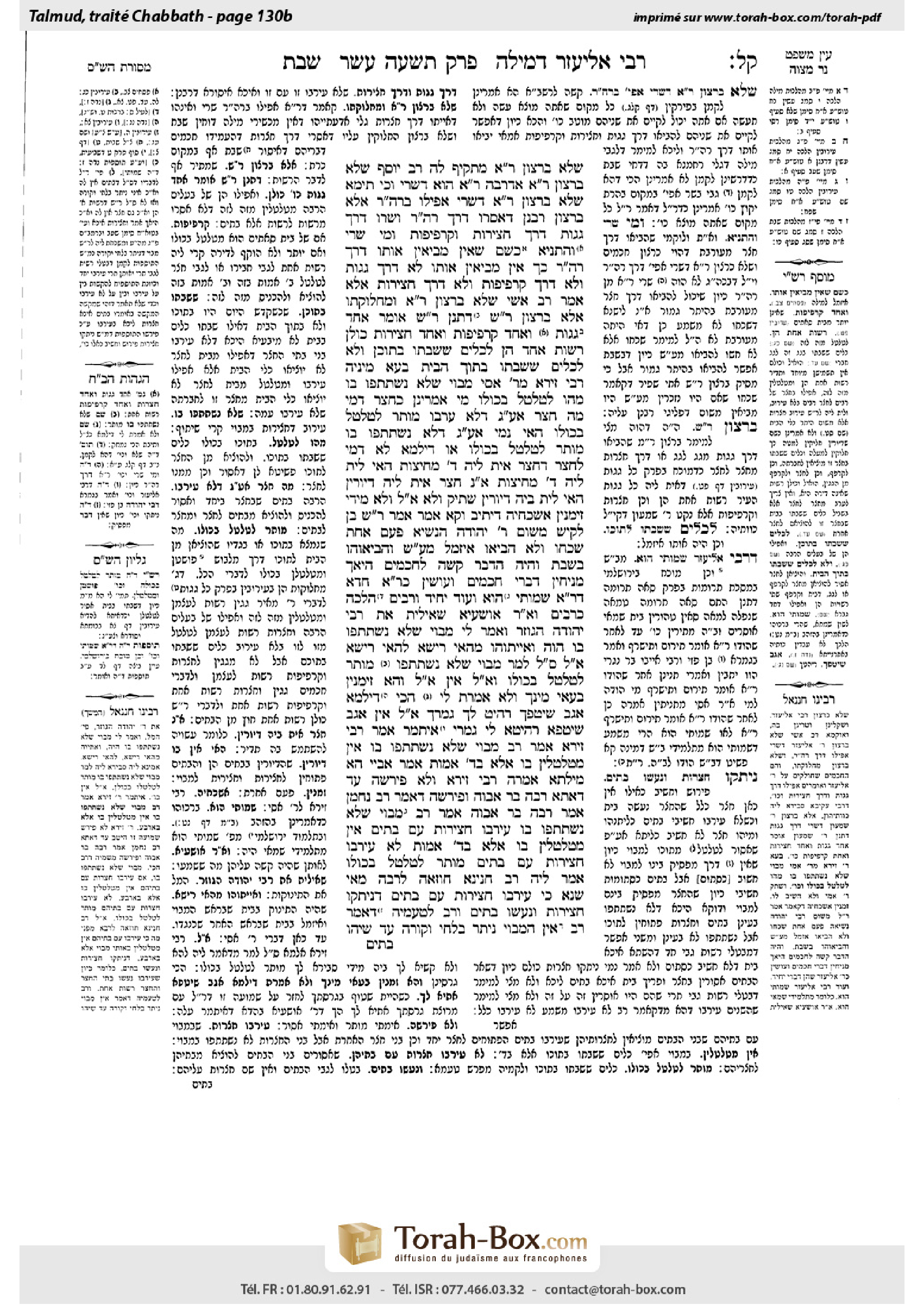
Shabbat 130b: Talmud study for Daf Yomi
Daf Yomi is the daily study of one Talmud folio. Explore 37 tractates with scans, Hebrew text, Sefaria English and AI-generated French translations where annotated.
Passage selection and English or AI-generated French translation are available where the scan has annotations. Daf Study is independent of Torah-Box and Sefaria.
Browse Shabbat · שבת · All tractatesShabbat 130b text and translations
This page of Shabbat includes the Aramaic text, an English translation and an AI-generated French translation, alongside the scan above.
שבת ק״ל ב · Aramaic and Hebrew text
שֶׁלֹּא בִּרְצוֹן רַבִּי אֱלִיעֶזֶר.
מַתְקִיף לַהּ רַב יוֹסֵף: שֶׁלֹּא בִּרְצוֹן רַבִּי אֱלִיעֶזֶר! אַדְּרַבָּה, רַבִּי אֱלִיעֶזֶר הוּא דְּשָׁרֵי! וְכִי תֵּימָא שֶׁלֹּא בִּרְצוֹן רַבִּי אֱלִיעֶזֶר דְּשָׁרֵי אֲפִילּוּ בִּרְשׁוּת הָרַבִּים, אֶלָּא בִּרְצוֹן רַבָּנַן דְּאָסְרִי דֶּרֶךְ רְשׁוּת הָרַבִּים, וְשָׁרוּ דֶּרֶךְ גַּגּוֹת דֶּרֶךְ חֲצֵירוֹת וְקַרְפֵּיפוֹת — וּמִי שָׁרוּ? וְהָתַנְיָא: כְּשֵׁם שֶׁאֵין מְבִיאִין אוֹתוֹ דֶּרֶךְ רְשׁוּת הָרַבִּים, כָּךְ אֵין מְבִיאִין אוֹתוֹ לֹא דֶּרֶךְ גַּגּוֹת וְלֹא דֶּרֶךְ קַרְפֵּיפוֹת וְלֹא דֶּרֶךְ חֲצֵירוֹת!
אֶלָּא אָמַר רַב אָשֵׁי: שֶׁלֹּא בִּרְצוֹן רַבִּי אֱלִיעֶזֶר וּמַחְלוּקְתּוֹ, אֶלָּא בִּרְצוֹן רַבִּי שִׁמְעוֹן. דִּתְנַן, רַבִּי שִׁמְעוֹן אוֹמֵר: אֶחָד גַּגּוֹת וְאֶחָד קַרְפֵּיפוֹת וְאֶחָד חֲצֵירוֹת — כּוּלָּן רְשׁוּת אֶחָד הֵן לְכֵלִים שֶׁשָּׁבְתוּ בְּתוֹכָן, וְלֹא לְכֵלִים שֶׁשָּׁבְתוּ בְּתוֹךְ הַבַּיִת.
בְּעָא מִינֵּיהּ רַבִּי זֵירָא מֵרַבִּי אַסִּי: מָבוֹי שֶׁלֹּא נִשְׁתַּתְּפוּ בּוֹ, מַהוּ לְטַלְטֵל בְּכוּלּוֹ? מִי אָמְרִינַן כֶּחָצֵר דָּמֵי: מָה חָצֵר, אַף עַל גַּב דְּלֹא עֵרְבוּ — מוּתָּר לְטַלְטֵל בְּכוּלּוֹ, הַאי נָמֵי, אַף עַל גַּב דְּלֹא נִשְׁתַּתְּפוּ בּוֹ — מוּתָּר לְטַלְטֵל בְּכוּלּוֹ, אוֹ דִילְמָא: לָא דָּמֵי לֶחָצֵר, דְּחָצֵר אִית לֵיהּ אַרְבַּע מְחִיצּוֹת, הַאי לֵית לֵיהּ אַרְבַּע מְחִיצּוֹת. אִי נָמֵי: חָצֵר אִית בֵּיהּ דָּיוֹרִין, הַאי לֵית בֵּיהּ דָּיוֹרִין? שְׁתִיק וְלָא אֲמַר לֵיהּ וְלָא מִידֵּי.
זִימְנִין אַשְׁכְּחֵיהּ דְּיָתֵיב וְקָא אָמַר, אָמַר רַבִּי שִׁמְעוֹן בֶּן לָקִישׁ מִשּׁוּם רַבִּי יְהוּדָה הַנָּשִׂיא: פַּעַם אַחַת שָׁכְחוּ וְלֹא הֵבִיאוּ אִיזְמֵל מֵעֶרֶב שַׁבָּת, וֶהֱבִיאוּהוּ בְּשַׁבָּת, וְהָיָה הַדָּבָר קָשֶׁה לַחֲכָמִים: הֵיאַךְ מַנִּיחִין דִּבְרֵי חֲכָמִים וְעוֹשִׂין כְּרַבִּי אֱלִיעֶזֶר. חֲדָא: דְּרַבִּי אֱלִיעֶזֶר שַׁמּוּתִי הוּא! וְעוֹד, יָחִיד וְרַבִּים — הֲלָכָה כְּרַבִּים!
וְאָמַר רַבִּי אוֹשַׁעְיָא: שְׁאֵילִית אֶת רַבִּי יְהוּדָה הַגּוֹזֵר וְאָמַר לִי: מָבוֹי שֶׁלֹּא נִשְׁתַּתְּפוּ בּוֹ הֲוָה, וְאַיְיתוּהוּ מֵהַאי רֵישָׁא לְהַאי רֵישָׁא. אֲמַר לֵיהּ: סְבִירָא לֵיהּ לְמָר מָבוֹי שֶׁלֹּא נִשְׁתַּתְּפוּ מוּתָּר לְטַלְטֵל בְּכוּלּוֹ? וַאֲמַר לֵיהּ: אִין. אֲמַר לֵיהּ: וְהָא זִימְנִין בְּעַאי מִינָּךְ וְלָא אֲמַרְתְּ לִי הָכִי! דִּילְמָא אַגַּב שִׁיטְפָךְ רְהִיט לְךָ גְּמָרָךְ? אֲמַר לֵיהּ: אִין, אַגַּב שִׁיטְפָא רְהִיט לִי גְּמָרַי.
אִיתְּמַר אָמַר רַבִּי זֵירָא אָמַר רַב: מָבוֹי שֶׁלֹּא נִשְׁתַּתְּפוּ בּוֹ — אֵין מְטַלְטְלִין בּוֹ אֶלָּא בְּאַרְבַּע אַמּוֹת.
אָמַר אַבָּיֵי: הָא מִילְּתָא אַמְרַהּ רַבִּי זֵירָא וְלָא פֵּירְשַׁהּ עַד דַּאֲתָא רַבָּה בַּר אֲבוּהּ וּפֵירְשַׁהּ. דְּאָמַר רַב נַחְמָן אָמַר רַבָּה בַּר אֲבוּהּ אָמַר רַב: מָבוֹי שֶׁלֹּא נִשְׁתַּתְּפוּ בּוֹ, עֵירְבוּ חֲצֵירוֹת עִם בָּתִּים — אֵין מְטַלְטְלִין בּוֹ אֶלָּא בְּאַרְבַּע אַמּוֹת. לֹא עֵירְבוּ חֲצֵירוֹת עִם בָּתִּים — מוּתָּר לְטַלְטֵל בְּכוּלּוֹ.
אֲמַר לֵיהּ רַב חֲנִינָא חוֹזָאָה לְרַבָּה: מַאי שְׁנָא כִּי עֵירְבוּ חֲצֵירוֹת עִם בָּתִּים — דְּנִיתְּקוּ חֲצֵירוֹת וְנַעֲשׂוּ בָּתִּים, וְרַב לְטַעְמֵיהּ, דַּאֲמַר רַב: אֵין הַמָּבוֹי נִיתָּר בְּלֶחִי וְקוֹרָה, עַד שֶׁיְּהוּ
Shabbat 130b · English translation
contrary to the wishes of Rabbi Eliezer. Even though the roofs and courtyards were not halakhically joined in a manner where it would be permitted to carry from one to the other, the Rabbis permitted carrying the scalpel in this manner.
Rav Yosef strongly objects to this: Contrary to the wishes of Rabbi Eliezer? On the contrary, it is Rabbi Eliezer who permits this, as he permits carrying the scalpel even through the public domain. And if you say that it means contrary to the wishes of Rabbi Eliezer, who permits carrying even in the public domain, but in accordance with the wishes of the Rabbis, who prohibited carrying via the public domain and only permitted carrying via roofs, via courtyards and enclosures, that is also difficult. And is it permitted according to the opinion of the Rabbis? Wasn’t it taught in a baraita: Just as one may not bring the circumcision knife via the public domain, so too, one may not bring it via roofs, via enclosures, or via courtyards?
Rather, Rav Ashi said: It means contrary to the wishes of Rabbi Eliezer and his disputants, but in accordance with the wishes of Rabbi Shimon. As we learned in a mishna that Rabbi Shimon says: Roofs, enclosures, and courtyards are all considered as one domain with regard to vessels that rested inside them at the beginning of Shabbat. Therefore, it is permitted to carry vessels that rested inside one to another. However, they are not considered the same domain with regard to vessels that rested inside the house at the beginning of Shabbat. If the homeowners did not join the courtyard by means of an eiruv, it is prohibited to carry vessels from their houses to the courtyard. Even if the houses in a courtyard were joined, it is prohibited to carry from the courtyard to an enclosure unless they were joined by means of an eiruv. In any case, there are circumstances in which Rabbi Shimon allows carrying via roofs, courtyards, and enclosures.
Rabbi Zeira raised a dilemma before Rabbi Asi: An alleyway whose residents did not merge together, what is its legal status with regard to carrying items in all of it according to Rabbi Shimon? Rabbi Zeira explains the dilemma: Do we say that it is like a courtyard, and just as with regard to a courtyard, even though they did not join the houses in it together and despite the fact that it is prohibited to carry out items from the houses to the courtyard, it is nonetheless permitted to carry in all of it? Therefore, in this alleyway too, even though they did not merge together, it is permitted to carry in all of it despite the fact that it is prohibited to carry items into the alleyway. Or, perhaps an alleyway is not similar in this regard to a courtyard, as a courtyard has four partitions, whereas this, the alleyway, does not have four partitions, but only three. Alternatively, there may be a different reason for the inferior status of an alleyway in this regard: A courtyard has residents and can therefore be considered like a house, which would allow carrying within it, whereas this alleyway does not have residents. Rabbi Asi was silent and did not say anything to him, as he was unable to provide a satisfactory response.
On another occasion Rabbi Zeira found Rabbi Asi sitting and saying: Rabbi Shimon ben Lakish said in the name of Rabbi Yehuda HaNasi: One time they forgot and did not bring a scalpel on Shabbat eve for the purpose of circumcising a child on Shabbat, and they brought it on Shabbat, and the matter was difficult in the eyes of the Rabbis: How can they abandon the words of the Rabbis, who prohibit doing so, and act in accordance with the opinion of Rabbi Eliezer? Why did they find this difficult? One reason was that Rabbi Eliezer was a Shammuti, i.e., a follower of the views of Beit Shammai (Jerusalem Talmud), and the halakha is generally in accordance with the opinion of Beit Hillel in their disputes with Beit Shammai. And furthermore, there is a general rule that in a dispute between an individual and the many, the halakha is in accordance with the opinion of the many. Here too, the halakha should certainly be in accordance with the opinion of the Rabbis, who disagree with Rabbi Eliezer.
And Rabbi Oshaya said: I asked Rabbi Yehuda the Cutter, i.e., the circumcisor, and he told me that this incident occurred in an alleyway whose residents did not merge together, and they brought the scalpel from this end of the alleyway to that end, where the baby was. That concludes Rabbi Asi’s account of the event. Rabbi Zeira said to Rabbi Asi: Since you related that story without expressing any reservations, it appears that the Master must hold that with regard to an alleyway whose residents did not merge together, it is permitted to carry in all of it. And Rabbi Asi said to him: Yes, that is the halakha. Rabbi Zeira said to him: But on a different occasion I raised a dilemma on this matter before you and you did not say so to me. Perhaps in the course of your studies your knowledge was restored to you? He said to him: Yes, in the course of my studies my knowledge was restored to me, and I remembered this halakha.
With regard to the very same halakha, it was stated as a principle that Rabbi Zeira said that Rav said: An alleyway that was not merged by the residents of the courtyards that open into it, it is only permitted to carry in it within four cubits.
Abaye said: This halakhic matter was stated by Rabbi Zeira, and he did not explain it. It remained enigmatic until Rabba bar Avuh came and explained it. As Rav Naḥman said that Rabba bar Avuh said that Rav said: With regard to an alleyway that was not merged by the residents of the courtyards that open into it, if they joined the courtyards with the houses, i.e., the homeowners within each courtyard joined together and are therefore permitted to carry within the courtyards themselves, it is only permitted to carry in it within four cubits, as in an intermediate domain [karmelit]. However, if they did not join the courtyards with the houses and it is prohibited to carry within the courtyards, it is permitted to carry in the entire alleyway.
Rav Ḥanina Ḥoza’a said to Rabba: What is different about a case where they joined the courtyards with the houses? Is it because the courtyards were detached and became like houses? And Rav follows his regular line of reasoning, for Rav said: An alleyway can only be made into a permitted area for carrying by means of a sidepole and a crossbeam, which is the standard halakha in a closed alleyway, if there are
Shabbat 130b · Traduction française (IA)
contrairement à l’avis de Rabbi Eliezer. Bien que les toits et les cours n’aient pas été réunis selon la halakha de façon à permettre de transporter des objets de l’un à l’autre, les Rabbins ont autorisé à transporter ainsi le bistouri.
Rav Yossef s’y oppose vivement : « Contrairement à l’avis de Rabbi Eliezer » ? Au contraire, c’est Rabbi Eliezer qui l’autorise, puisqu’il permet de transporter le bistouri même par le domaine public. Et si tu dis que cela signifie « contrairement à l’avis de Rabbi Eliezer », qui autorise le transport même par le domaine public, mais conformément à l’avis des Rabbins, qui interdisent le transport par le domaine public et ne l’autorisent que par les toits, les cours et les enclos, cela pose également difficulté. Est-ce donc permis selon l’avis des Rabbins ? N’a-t-on pas enseigné dans une baraïta : « De même qu’on ne peut pas apporter le couteau de circoncision par le domaine public, on ne peut pas non plus l’apporter par les toits, les enclos ou les cours » ?
Rav Ashi dit plutôt : cela signifie que l’on agit à l’encontre de l’avis de Rabbi Eliezer et de ses contradicteurs, mais conformément à celui de Rabbi Shimon. En effet, nous avons appris dans une Michna que Rabbi Shimon dit : « Les toits, les enclos et les cours sont tous considérés comme un seul domaine pour les ustensiles qui s’y trouvaient au début de Chabbat. » Il est donc permis de transporter d’un endroit à l’autre les ustensiles qui s’y trouvaient. Toutefois, ils ne sont pas considérés comme un seul domaine pour les ustensiles qui se trouvaient dans la maison au début de Chabbat. Si les propriétaires n’ont pas réuni la cour au moyen d’un érouv, il est interdit de transporter des ustensiles de leurs maisons vers la cour. Même si les maisons d’une cour ont été réunies, il est interdit de transporter des objets de la cour vers un enclos, à moins que ceux-ci n’aient été réunis au moyen d’un érouv. Quoi qu’il en soit, il existe des circonstances dans lesquelles Rabbi Shimon permet de transporter des objets par les toits, les cours et les enclos.
Rabbi Zeïra posa une question à Rabbi Assi : Quel est, selon Rabbi Shimon, le statut d’une ruelle dont les habitants n’ont pas fait de fusion, concernant le transport d’objets dans toute son étendue ? Rabbi Zeïra précisa sa question : Doit-on dire qu’elle est semblable à une cour ? De même que, dans une cour, bien que ses habitants n’aient pas réuni les maisons qui s’y trouvent et qu’il soit interdit d’en sortir des objets vers la cour, il est néanmoins permis d’y transporter des objets dans toute son étendue, de même, dans cette ruelle, bien que ses habitants n’aient pas fait de fusion, il serait permis d’y transporter des objets dans toute son étendue, alors même qu’il est interdit d’y apporter des objets. Ou peut-être une ruelle n’est-elle pas semblable à une cour à cet égard, car une cour est entourée de quatre parois, tandis que cette ruelle n’en a que trois. Il se peut aussi qu’une autre raison explique le statut inférieur de la ruelle à cet égard : une cour a des habitants et peut donc être considérée comme une maison, ce qui permettrait d’y transporter des objets, tandis que cette ruelle n’a pas d’habitants. Rabbi Assi garda le silence et ne lui répondit pas, car il était incapable de lui fournir une réponse satisfaisante.
Une autre fois, Rabbi Zeïra trouva Rabbi Assi assis et déclarant : « Rabbi Shimon ben Lakich a dit au nom de Rabbi Yehouda HaNassi : Un jour, on oublia d’apporter un bistouri à la veille de Chabbat pour circoncire un enfant pendant Chabbat. On l’apporta alors pendant Chabbat, et cela posa problème aux yeux des Rabbins : comment peuvent-ils délaisser les paroles des Rabbins, qui interdisent de le faire, et agir conformément à l’avis de Rabbi Eliezer ? » Pourquoi cela leur posa-t-il problème ? L’une des raisons était que Rabbi Eliezer était un Shammutaï, c’est-à-dire un adepte des opinions de Beit Shammaï (Talmud de Jérusalem), alors que, dans leurs controverses avec Beit Shammaï, la halakha suit généralement l’avis de Beit Hillel. En outre, il existe une règle générale selon laquelle, dans une controverse entre un individu et la majorité, la halakha suit l’avis de la majorité. Ici aussi, la halakha aurait certainement dû suivre l’avis des Rabbins, qui sont en désaccord avec Rabbi Eliezer.
Et Rabbi Oshaya a dit : « J’ai interrogé Rabbi Yehouda le circonciseur, et il m’a dit que cet incident s’était produit dans une ruelle dont les habitants n’avaient pas fait de fusion ; ils avaient apporté le bistouri d’une extrémité de la ruelle à l’autre, là où se trouvait le bébé. » Ainsi s’achève le récit de Rabbi Assi sur l’incident. Rabbi Zeïra dit à Rabbi Assi : « Puisque tu as raconté cette histoire sans émettre de réserve, il semble que le Maître estime que, dans une ruelle dont les habitants n’ont pas fait de fusion, il est permis de transporter des objets dans toute son étendue. » Rabbi Assi lui répondit : « Oui, telle est la halakha. » Rabbi Zeïra lui dit : « Pourtant, une autre fois, je t’ai posé une question à ce sujet et tu ne m’as pas répondu cela. Peut-être tes études t’ont-elles rendu ce savoir ? » Il lui répondit : « Oui, mes études m’ont rendu ce savoir, et je me suis souvenu de cette halakha. »
À propos de cette même halakha, Rabbi Zeïra a dit au nom de Rav : « Dans une ruelle qui n’a pas fait l’objet d’une fusion de la part des habitants des cours qui y débouchent, il est uniquement permis de transporter des objets dans un périmètre de quatre coudées. »
Abayé dit : « Rabbi Zeïra a énoncé cette halakha, mais ne l’a pas expliquée. Elle est restée énigmatique jusqu’à ce que Rabba bar Avouha vienne l’expliquer. En effet, Rav Naḥman a dit au nom de Rabba bar Avouha, qui l’a dit au nom de Rav : Dans une ruelle qui n’a pas fait l’objet d’une fusion de la part des habitants des cours qui y débouchent, si les habitants ont réuni les cours aux maisons, c’est-à-dire si les propriétaires de chaque cour ont établi un érouv entre eux et sont donc autorisés à transporter des objets dans les cours elles-mêmes, il n’est permis de transporter des objets dans la ruelle que dans un périmètre de quatre coudées, comme dans un domaine intermédiaire [karmelit]. En revanche, s’ils n’ont pas réuni les cours aux maisons et qu’il est interdit d’y transporter des objets, il est permis d’en transporter dans toute la ruelle. »
Rav Ḥanina Ḥoza’a dit à Rabba : « En quoi le cas où les cours ont été réunies aux maisons est-il différent ? Est-ce parce que les cours ont été détachées et sont devenues semblables à des maisons ? » Rav suit ici son raisonnement habituel, car Rav a dit : « Une ruelle ne peut être rendue permise au transport que par l’installation d’un poteau latéral et d’une poutre transversale, ce qui constitue la halakha habituelle pour une ruelle fermée, que s’il y a
Traduction française générée par IA à partir de l’édition anglaise de Sefaria. Vérifie toujours un passage avec le texte source.
Text from Sefaria: William Davidson Edition - Vocalized Aramaic (CC BY NC); William Davidson Edition - English (CC BY NC).