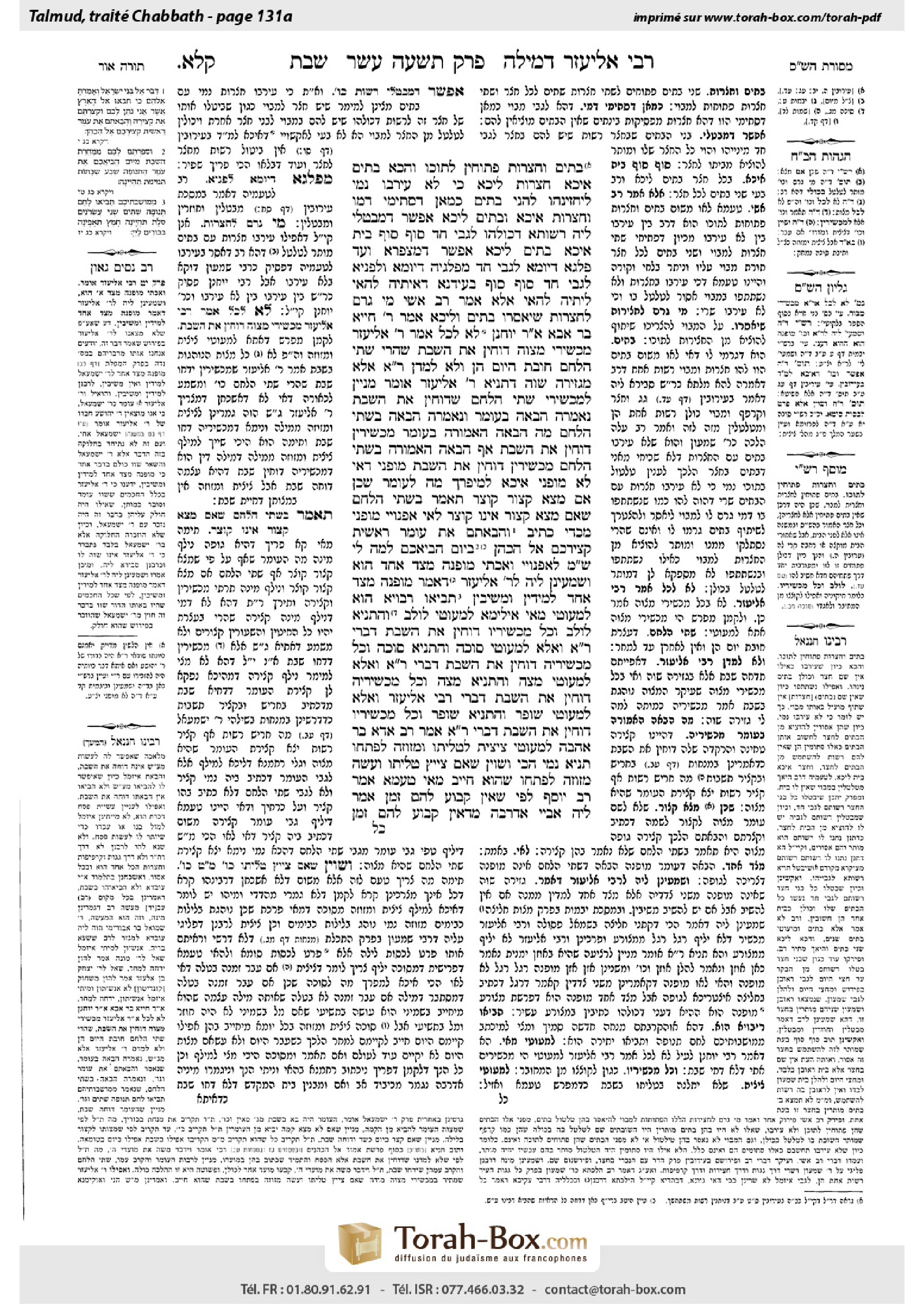
Shabbat 131a: Talmud study for Daf Yomi
Daf Yomi is the daily study of one Talmud folio. Explore 37 tractates with scans, Hebrew text, Sefaria English and AI-generated French translations where annotated.
Passage selection and English or AI-generated French translation are available where the scan has annotations. Daf Study is independent of Torah-Box and Sefaria.
Browse Shabbat · שבת · All tractatesShabbat 131a text and translations
This page of Shabbat includes the Aramaic text, an English translation and an AI-generated French translation, alongside the scan above.
שבת קל״א א · Aramaic and Hebrew text
בָּתִּים וַחֲצֵרוֹת פְּתוּחִין לְתוֹכוֹ, וְהָכָא בָּתִּים — אִיכָּא, חֲצֵרוֹת — לֵיכָּא. כִּי לֹא עֵירְבוּ נָמֵי, לֶיחְזִינְהוּ לְהָנֵי בָּתִּים כְּמַאן דִּסְתִימִי דָּמוּ, וַחֲצֵרוֹת אִיכָּא וּבָתִּים — לֵיכָּא!
אֶפְשָׁר דִּמְבַטְּלֵי לֵיהּ רְשׁוּתָא דְּכוּלְּהוּ לְגַבֵּי חַד. סוֹף סוֹף בַּיִת אִיכָּא בָּתִּים לֵיכָּא!
אֶפְשָׁר דְּמִצַּפְרָא וְעַד פַּלְגָא דְּיוֹמָא לְגַבֵּי חַד, מִפַּלְגֵיהּ דְּיוֹמָא וּלְפַנְיָא לְגַבֵּי חַד. סוֹף סוֹף בְּעִידָּנָא דְּאִיתֵיהּ לְהַאי, לֵיתֵיהּ לְהַאי? אֶלָּא אָמַר רַב אָשֵׁי: מִי גָּרַם לַחֲצֵרוֹת שֶׁיֵּאָסְרוּ — בָּתִּים, וְלֵיכָּא.
אָמַר רַבִּי חִיָּיא בַּר אַבָּא אָמַר רַבִּי יוֹחָנָן: לֹא לַכֹּל אָמַר רַבִּי אֱלִיעֶזֶר מַכְשִׁירֵי מִצְוָה דּוֹחִין אֶת הַשַּׁבָּת. שֶׁהֲרֵי שְׁתֵּי הַלֶּחֶם חוֹבַת הַיּוֹם הֵן, וְלֹא לְמָדָן רַבִּי אֱלִיעֶזֶר אֶלָּא מִגְּזֵירָה שָׁוָה. דְּתַנְיָא, רַבִּי אֱלִיעֶזֶר אוֹמֵר: מִנַּיִין לְמַכְשִׁירֵי שְׁתֵּי הַלֶּחֶם שֶׁדּוֹחִין אֶת הַשַּׁבָּת? — נֶאֶמְרָה הֲבָאָה בָּעוֹמֶר, וְנֶאֶמְרָה הֲבָאָה בִּשְׁתֵּי הַלֶּחֶם. מָה הֲבָאָה הָאֲמוּרָה בָּעוֹמֶר — מַכְשִׁירִין דּוֹחִין אֶת הַשַּׁבָּת. אַף הֲבָאָה הָאֲמוּרָה בִּשְׁתֵּי הַלֶּחֶם — מַכְשִׁירִין דּוֹחִין אֶת הַשַּׁבָּת.
מוּפְנֵי. דְּאִי לָא מוּפְנֵי, אִיכָּא לְמִיפְרַךְ: מָה לָעוֹמֶר, שֶׁכֵּן אִם מָצָא קָצוּר — קוֹצֵר, תֹּאמַר בִּשְׁתֵּי הַלֶּחֶם, שֶׁאִם מָצָא קָצוּר — אֵינוֹ קוֹצֵר. לָאיֵי אִפְּנוֹיֵי מוּפְנֵי: מִכְּדֵי כְּתִיב ״וַהֲבֵאתֶם אֶת עוֹמֶר רֵאשִׁית קְצִירְכֶם אֶל הַכֹּהֵן״, ״מִיּוֹם הֲבִיאֲכֶם״ לְמָה לִי? שְׁמַע מִינַּהּ לְאַפְנוֹיֵי.
וְאַכַּתִּי: מוּפְנֶה מִצַּד אֶחָד הוּא, וְשָׁמְעִינַן לֵיהּ לְרַבִּי אֱלִיעֶזֶר דְּאָמַר מוּפְנֶה מִצַּד אֶחָד לְמֵידִין וּמְשִׁיבִין! ״תָּבִיאוּ״ רִבּוּיָא הוּא.
לְמַעוֹטֵי מַאי, אִילֵּימָא לְמַעוֹטֵי לוּלָב — וְהָתַנְיָא: לוּלָב וְכׇל מַכְשִׁירָיו דּוֹחִין אֶת הַשַּׁבָּת, דִּבְרֵי רַבִּי אֱלִיעֶזֶר. וְאֶלָּא לְמַעוֹטֵי סוּכָּה — וְהָתַנְיָא: סוּכָּה וְכׇל מַכְשִׁירֶיהָ דּוֹחִין אֶת הַשַּׁבָּת, דִּבְרֵי רַבִּי אֱלִיעֶזֶר. וְאֶלָּא לְמַעוֹטֵי מַצָּה — וְהָתַנְיָא: מַצָּה וְכׇל מַכְשִׁירֶיהָ דּוֹחִין אֶת הַשַּׁבָּת, דִּבְרֵי רַבִּי אֱלִיעֶזֶר. וְאֶלָּא לְמַעוֹטֵי שׁוֹפָר — וְהָתַנְיָא: שׁוֹפָר וְכׇל מַכְשִׁירָיו דּוֹחִין אֶת הַשַּׁבָּת, דִּבְרֵי רַבִּי אֱלִיעֶזֶר!
אָמַר רַב אַדָּא בַּר אַהֲבָה: לְמַעוֹטֵי צִיצִית לְטַלִּיתוֹ וּמְזוּזָה לְפִתְחוֹ. תַּנְיָא נָמֵי הָכִי: וְשָׁוִין שֶׁאִם צִיֵּיץ טַלִּיתוֹ וְעָשָׂה מְזוּזָה לְפִתְחוֹ שֶׁהוּא חַיָּיב.
מַאי טַעְמָא? אָמַר רַב יוֹסֵף: לְפִי שֶׁאֵין קָבוּעַ לָהֶם זְמַן. אֲמַר לֵיהּ אַבָּיֵי: אַדְּרַבָּה, מִדְּאֵין קָבוּעַ לָהֶם זְמַן,
Shabbat 131a · English translation
houses and courtyards open to it, and each courtyard contains at least two houses, and there are at least two courtyards. And here, there are houses but there are no courtyards, and therefore the standard halakhot of a closed alleyway do not apply. However, if that is the case, when they did not join the courtyards with the houses too, let us consider these houses as though they were sealed, because their residents may not carry from their houses into the courtyards, and the houses should be considered irrelevant. Therefore, in that case too, there are courtyards but there are no houses.
The Gemara answers: In that case it is possible for them to renounce all of their property rights and transfer them to one person. Just as the residents of a courtyard can join together, thereby rendering it permitted to carry in the courtyard, they can also relinquish their property rights to a single resident. In that way, it is considered as though there is only one inhabited house in the courtyard, and it is therefore permitted to carry within the courtyard as well as between that particular house and the courtyard. The Gemara rejects this answer: Ultimately, even in that case, there is one house, yet there are not multiple houses, as it is possible to relinquish one’s privileges to only one homeowner and not to two. This would fail to meet the minimum requirement of two houses for the area to be considered a courtyard.
The Gemara answers: It is possible to resolve this: From morning until midday they can relinquish their rights to one, and from midday until evening they can relinquish their rights to another, and as a result there will be two houses. The Gemara rejects this answer: Ultimately, at the time when this house has the ownership rights, that house does not have them, as at any point in time there is only one house from which it is permitted to carry into the courtyard. Rather, Rav Ashi said: The explanation that there are no houses and courtyards here is rejected, and the explanation is: What caused the courtyards to be prohibited? It is the presence of the houses. Had there been no houses, it would have been permitted to carry from the courtyards into the alleyway, since they are one domain according to Rabbi Shimon. And here, it is considered as though there are no houses. Therefore, it is permitted to carry in the alleyway.
Rabbi Ḥiyya bar Abba said that Rabbi Yoḥanan said: Rabbi Eliezer did not say with regard to all mitzvot that actions that facilitate performance of a mitzva override Shabbat. This is not a fixed principle with regard to preparations for all mitzvot. Rather, each case must be considered on its own merits, and proof must be cited that this principle applies to a specific mitzva. As the two loaves offered on the festival of Shavuot are an obligation of that day, and Rabbi Eliezer only learned that the activities that facilitate their sacrifice override Shabbat from a special verbal analogy. As it was taught in a baraita, Rabbi Eliezer says: From where is it derived that the actions that facilitate the offering of the two loaves override Shabbat? The term bringing is stated in the verse with regard to the omer offering, and the term bringing is stated with regard to the two loaves. Just as in the case of the bringing stated with regard to the omer, all the actions that facilitate its offering override Shabbat, as the reaping of the omer, which facilitates its offering, overrides Shabbat, so too, in the case of the bringing stated with regard to the two loaves, actions that facilitate its offering override Shabbat.
With regard to this verbal analogy the Gemara comments: It must be that those terms are free, i.e., they are superfluous in their context and therefore available for the purpose of establishing a verbal analogy. As, if they are not free, the verbal analogy can be logically refuted, as it is possible to say: What is unique to the omer? That if one found reaped barley one must nevertheless reap more barley for the sake of the mitzva. Can you say the same with regard to the halakhot of the two loaves, where it is taught that if one found reaped grain one need not reap additional grain for the sacrifice? Apparently, the halakhot of the offering of the two loaves are not parallel to those of the omer. The same might be true with regard to actions that facilitate the performance of the mitzva. In truth, the verse is free for establishing the verbal analogy. The Gemara explains: Since the verse already states: “When you come to the land that I am giving to you, and you reap its harvest, then you shall bring the sheaf [omer], the first of your harvest to the priest” (Leviticus 23:10), when the verse restates, “And you shall count for yourselves from the morrow after the day of rest, from the day you have brought the sheaf of the waving, seven whole weeks they shall be” (Leviticus 23:15), why do I need this repetition? Conclude from this that the additional statement is there to render the term “bringing” free for establishing a verbal analogy.
And yet there is still a difficulty: The verbal analogy is free only from one side, as only the verse that mentions bringing in the context of the omer offering is superfluous in its context, and we heard Rabbi Eliezer, who said with regard to a verbal analogy that it is only free from one side, that one can derive from it, and one can also refute it logically. The Gemara answers: There is a superfluous usage of the term with regard to the two loaves as well, as in the verse: “From your dwelling places you shall bring the loaves of waving of two tenth parts of an ephah; they shall be of fine flour, they shall be baked with leaven for first-fruits unto the Lord” (Leviticus 23:17) the phrase: “You shall bring” is an amplification. Since it was mentioned in the previous verse it is superfluous in its context. Consequently, the verbal analogy is available from both sides.
The Gemara poses a question with regard to Rabbi Yoḥanan’s statement: Rabbi Eliezer did not say with regard to all mitzvot that actions that facilitate performance of a mitzva override Shabbat; to exclude actions that facilitate the performance of what mitzva was he referring?
If you say that it was to exclude actions that facilitate the performance of the mitzva of taking the palm branch [lulav] and the other three species on the festival of Sukkot, wasn’t it taught in a baraita: The mitzva of lulav and all its facilitators override Shabbat; this is the statement of Rabbi Eliezer?
Rather, say that it comes to exclude the mitzva to dwell in a sukka on Sukkot. Wasn’t it taught in a baraita: The mitzva of sukka and all its facilitators override Shabbat; this is the statement of Rabbi Eliezer?
Rather, say that it comes to exclude the mitzva to eat matza on Passover. Wasn’t it taught in a baraita: The mitzva of matza and all its facilitators override Shabbat; this is the statement of Rabbi Eliezer?
Rather, say that it comes to exclude the mitzva to sound the shofar on Rosh HaShana. But wasn’t it taught in a baraita: The mitzva of shofar and all its facilitators override Shabbat; this is the statement of Rabbi Eliezer?
Rav Adda bar Ahava said: The statement of Rabbi Yoḥanan comes to exclude attaching ritual fringes to his garment and affixing a mezuza to the doorway, which do not override Shabbat. The Gemara notes that that was also taught in a baraita: And they, Rabbi Eliezer and the Rabbis, agree that if one attached ritual fringes to his garment on Shabbat, and similarly, if one affixed a mezuza to his doorway on Shabbat, that he is liable.
The Gemara asks: What is the reason that Rabbi Eliezer concedes that actions that facilitate the performance of these mitzvot do not override Shabbat? Rav Yosef said: Because they have no fixed time and these mitzvot need not be performed on Shabbat. Abaye said to him: On the contrary, from the fact that they have no fixed time,
Shabbat 131a · Traduction française (IA)
des maisons et des cours qui y donnent accès, chaque cour contenant au moins deux maisons, et il y a au moins deux cours. Or, ici, il y a des maisons, mais pas de cours ; les règles ordinaires d’une impasse fermée ne s’appliquent donc pas. Toutefois, si tel est le cas, lorsque les habitants n’ont pas non plus associé les cours aux maisons, considérons ces maisons comme si elles étaient murées, puisque leurs habitants ne peuvent pas transporter d’objets de leurs maisons vers les cours, et tenons les maisons pour inexistantes. Ainsi, dans ce cas aussi, il y a des cours, mais pas de maisons.
La Guemara répond : Dans ce cas, ils peuvent renoncer à tous leurs droits de propriété et les transférer à une seule personne. De même que les habitants d’une cour peuvent s’associer, ce qui permet d’y transporter des objets, ils peuvent aussi céder leurs droits de propriété à un seul résident. On considère alors qu’il n’y a qu’une seule maison habitée dans la cour ; il est donc permis d’y transporter des objets, ainsi qu’entre cette maison et la cour. La Guemara rejette cette réponse : en définitive, même dans ce cas, il y a une maison, mais pas plusieurs, puisqu’on ne peut céder ses droits qu’à un seul propriétaire, et non à deux. La condition minimale de deux maisons pour que l’espace soit considéré comme une cour ne serait donc pas remplie.
La Guemara répond : On peut résoudre la difficulté ainsi : du matin jusqu’à midi, ils peuvent céder leurs droits à l’un, puis de midi au soir, ils peuvent les céder à un autre ; il y aura donc deux maisons. La Guemara rejette cette réponse : en définitive, lorsque cette maison détient les droits, l’autre maison ne les détient pas, car à tout moment, une seule maison permet de transporter des objets vers la cour. Rav Achi dit plutôt : l’explication selon laquelle il n’y a ici ni maisons ni cours est rejetée. Voici l’explication : Qu’est-ce qui rend les cours interdites ? La présence des maisons. S’il n’y avait pas de maisons, il serait permis de transporter des objets des cours vers l’impasse, puisqu’elles constituent un seul domaine selon Rabbi Chimon. Ici, on considère qu’il n’y a pas de maisons. Il est donc permis de transporter des objets dans l’impasse.
Rabbi Ḥiyya bar Abba a dit au nom de Rabbi Yoḥanan : Rabbi Eliezer n’a pas dit, à propos de toutes les mitsvot, que les actes qui en facilitent l’accomplissement repoussent le Chabbat. Ce n’est pas une règle fixe applicable aux préparatifs de toutes les mitsvot. Il faut plutôt examiner chaque cas séparément et apporter une preuve que ce principe s’applique à une mitsva particulière. En effet, les deux pains offerts lors de la fête de Chavouot sont une obligation de ce jour, et Rabbi Eliezer n’a appris que les actes qui facilitent leur offrande repoussent le Chabbat qu’au moyen d’une analogie verbale particulière. Comme il a été enseigné dans une baraïta : Rabbi Eliezer dit : D’où déduit-on que les actes qui facilitent l’offrande des deux pains repoussent le Chabbat ? Le terme « apporter » figure dans le verset relatif à l’offrande de l’omer, et le terme « apporter » figure dans celui relatif aux deux pains. De même que, dans le cas de l’apport de l’omer, tous les actes qui facilitent son offrande repoussent le Chabbat — car la moisson de l’omer, qui facilite son offrande, repousse le Chabbat —, de même, dans le cas de l’apport des deux pains, les actes qui facilitent leur offrande repoussent le Chabbat.
À propos de cette analogie verbale, la Guemara fait remarquer que ces termes doivent être disponibles, c’est-à-dire superflus dans leur contexte et, par conséquent, utilisables pour établir une analogie verbale. En effet, s’ils ne l’étaient pas, on pourrait réfuter l’analogie par un raisonnement logique : on pourrait dire que la particularité de l’omer est que, même si l’on trouve de l’orge déjà moissonnée, il faut néanmoins moissonner davantage d’orge pour accomplir la mitsva. Peut-on dire la même chose des règles relatives aux deux pains, alors qu’il est enseigné que, si l’on trouve du grain déjà moissonné, il n’est pas nécessaire d’en moissonner davantage pour l’offrande ? Apparemment, les règles de l’offrande des deux pains ne sont pas parallèles à celles de l’omer. Il pourrait en être de même pour les actes qui facilitent l’accomplissement de la mitsva. En réalité, le verset est disponible pour établir l’analogie verbale. La Guemara explique : Puisque le verset dit déjà : « Lorsque vous entrerez dans le pays que je vous donne, et que vous en moissonnerez la récolte, vous apporterez au prêtre la gerbe [omer], prémices de votre récolte » (Lévitique 23:10), pourquoi le verset répète-t-il : « Vous compterez pour vous-mêmes, à partir du lendemain du jour de repos, à partir du jour où vous aurez apporté la gerbe de l’offrande balancée, sept semaines complètes » (Lévitique 23:15) ? Il faut en conclure que cette mention supplémentaire rend le terme « apporter » disponible pour établir une analogie verbale.
Il reste pourtant une difficulté : le terme n’est disponible que d’un seul côté pour l’analogie verbale, car seul le verset qui mentionne « apporter » dans le contexte de l’offrande de l’omer est superflu dans son contexte. Or nous avons appris que Rabbi Eliezer a dit au sujet d’une analogie verbale disponible d’un seul côté qu’on peut en tirer une déduction, mais aussi la réfuter par un raisonnement logique. La Guemara répond : le terme est également employé de façon superflue au sujet des deux pains, dans le verset : « De vos lieux d’habitation, vous apporterez les pains de l’offrande balancée, faits de deux dixièmes d’épha ; ils seront de fleur de farine, cuits avec du levain, comme prémices pour le Seigneur » (Lévitique 23:17). L’expression « vous apporterez » constitue une amplification. Puisqu’elle figurait déjà dans le verset précédent, elle est superflue dans son contexte. Par conséquent, l’analogie verbale est disponible des deux côtés.
La Guemara pose une question au sujet de la déclaration de Rabbi Yoḥanan selon laquelle Rabbi Eliezer n’a pas dit, à propos de toutes les mitsvot, que les actes qui en facilitent l’accomplissement repoussent le Chabbat : les actes qui facilitent l’accomplissement de quelle mitsva cherchait-il à exclure ? Si tu dis qu’il cherchait à exclure les actes qui facilitent l’accomplissement de la mitsva de prendre la branche de palmier [lulav] et les trois autres espèces pendant la fête de Souccot, n’a-t-il pas été enseigné dans une baraïta : La mitsva du lulav et tous les actes qui en facilitent l’accomplissement repoussent le Chabbat ; telle est la déclaration de Rabbi Eliezer ? Dis plutôt qu’il cherchait à exclure la mitsva d’habiter dans une soukka pendant Souccot. N’a-t-il pas été enseigné dans une baraïta : La mitsva de la soukka et tous les actes qui en facilitent l’accomplissement repoussent le Chabbat ; telle est la déclaration de Rabbi Eliezer ? Dis plutôt qu’il cherchait à exclure la mitsva de manger de la matsa à Pessa’h. N’a-t-il pas été enseigné dans une baraïta : La mitsva de la matsa et tous les actes qui en facilitent l’accomplissement repoussent le Chabbat ; telle est la déclaration de Rabbi Eliezer ? Dis plutôt qu’il cherchait à exclure la mitsva de sonner du chofar à Roch Hachana. Mais n’a-t-il pas été enseigné dans une baraïta : La mitsva du chofar et tous les actes qui en facilitent l’accomplissement repoussent le Chabbat ; telle est la déclaration de Rabbi Eliezer ?
Rav Adda bar Ahava dit : La déclaration de Rabbi Yoḥanan vise à exclure le fait d’attacher des franges rituelles à son vêtement et de fixer une mezouza au montant de la porte, actes qui ne repoussent pas le Chabbat. La Guemara relève que cela a également été enseigné dans une baraïta : Rabbi Eliezer et les Rabbins conviennent que celui qui attache des franges rituelles à son vêtement pendant Chabbat, ou qui fixe une mezouza au montant de sa porte pendant Chabbat, est passible.
La Guemara demande : Pour quelle raison Rabbi Eliezer reconnaît-il que les actes qui facilitent l’accomplissement de ces mitsvot ne repoussent pas le Chabbat ? Rav Yossef dit : Parce qu’elles n’ont pas de date fixe et qu’il n’est pas nécessaire d’accomplir ces mitsvot le Chabbat. Abayé lui dit : Au contraire, du fait qu’elles n’ont pas de date fixe,
Traduction française générée par IA à partir de l’édition anglaise de Sefaria. Vérifie toujours un passage avec le texte source.
Text from Sefaria: William Davidson Edition - Vocalized Aramaic (CC BY NC); William Davidson Edition - English (CC BY NC).