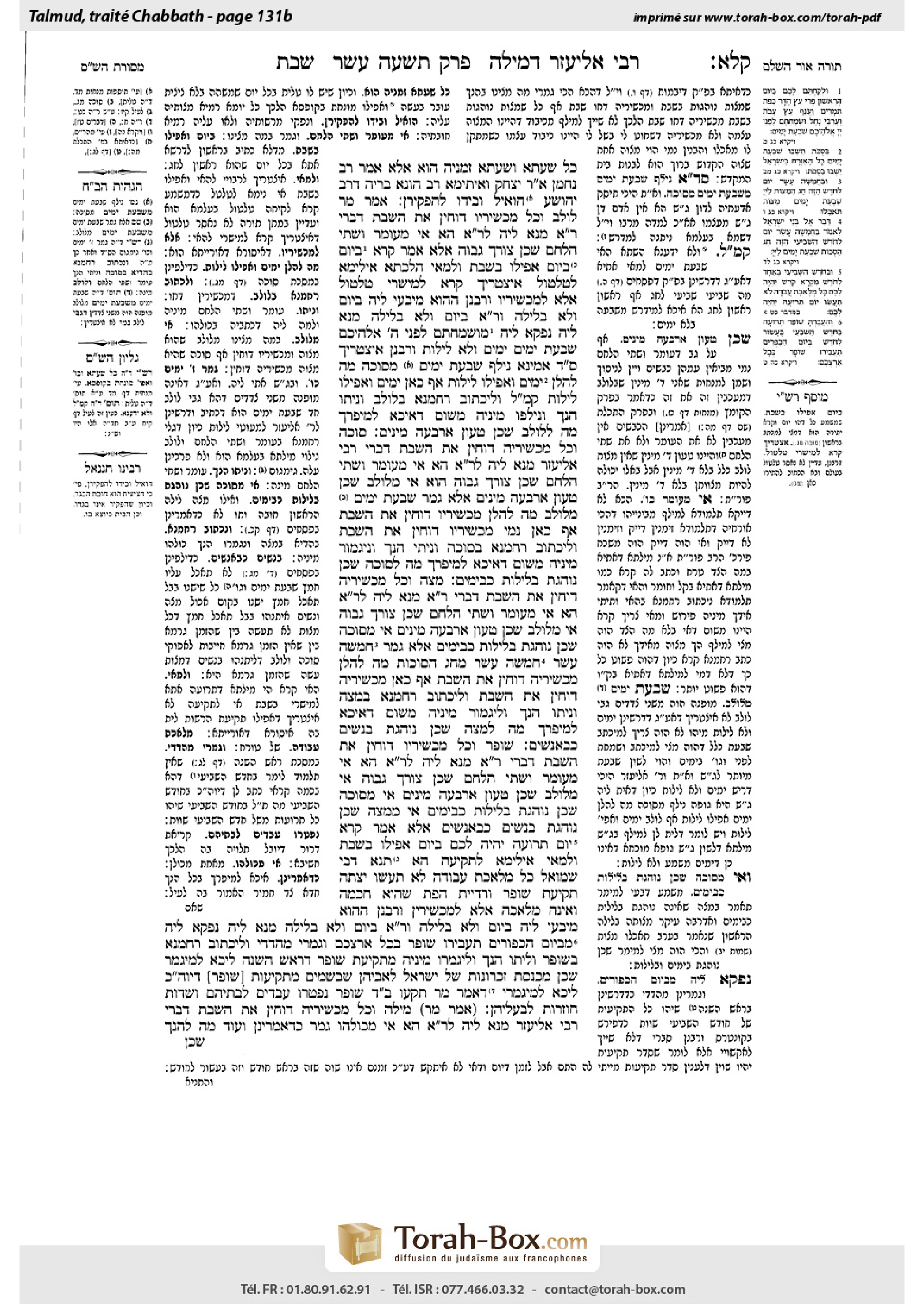
Shabbat 131b: Talmud study for Daf Yomi
Daf Yomi is the daily study of one Talmud folio. Explore 37 tractates with scans, Hebrew text, Sefaria English and AI-generated French translations where annotated.
Passage selection and English or AI-generated French translation are available where the scan has annotations. Daf Study is independent of Torah-Box and Sefaria.
Browse Shabbat · שבת · All tractatesShabbat 131b text and translations
This page of Shabbat includes the Aramaic text, an English translation and an AI-generated French translation, alongside the scan above.
שבת קל״א ב · Aramaic and Hebrew text
כֹּל שַׁעְתָּא וְשַׁעְתָּא זִמְנֵיהּ הוּא? אֶלָּא אָמַר רַב נַחְמָן אָמַר רַבִּי יִצְחָק, וְאִיתֵּימָא רַב הוּנָא בְּרֵיהּ דְּרַב יְהוֹשֻׁעַ: הוֹאִיל וּבְיָדוֹ לְהַפְקִירָן.
אָמַר מָר: לוּלָב וְכׇל מַכְשִׁירָיו דּוֹחִין אֶת הַשַּׁבָּת דִּבְרֵי רַבִּי אֱלִיעֶזֶר. מְנָא לֵיהּ לְרַבִּי אֱלִיעֶזֶר הָא? אִי מֵעוֹמֶר וּשְׁתֵּי הַלֶּחֶם, שֶׁכֵּן צוֹרֶךְ גָּבוֹהַּ! אֶלָּא אָמַר קְרָא: ״בַּיּוֹם״. ״בַּיּוֹם״ — אֲפִילּוּ בְּשַׁבָּת.
וּלְמַאי הִלְכְתָא? אִילֵּימָא לְטִלְטוּל — אִיצְטְרִיךְ קְרָא לְמִישְׁרֵי טִלְטוּל?! אֶלָּא לְמַכְשִׁירָיו.
וְרַבָּנַן? הַהוּא מִיבְּעֵי לֵיהּ בַּיּוֹם וְלֹא בַּלַּיְלָה.
וְרַבִּי אֱלִיעֶזֶר, בַּיּוֹם וְלֹא בַּלַּיְלָה מְנָא לֵיהּ? נָפְקָא לֵיהּ מִ״וּשְׂמַחְתֶּם לִפְנֵי ה׳ אֱלֹהֵיכֶם שִׁבְעַת יָמִים״ — יָמִים וְלֹא לֵילוֹת.
וְרַבָּנַן — אִיצְטְרִיךְ, סָלְקָא דַּעְתָּךְ אָמֵינָא נֵילַף שִׁבְעַת יָמִים מִסּוּכָּה: מָה לְהַלָּן יָמִים וַאֲפִילּוּ לֵילוֹת, אַף כָּאן יָמִים וַאֲפִילּוּ לֵילוֹת — קָא מַשְׁמַע לַן.
וְלִיכְתּוֹב רַחֲמָנָא בְּלוּלָב, וְנֵיתוֹ הָנָךְ וְנֵילְפוּ מִינֵּיהּ! מִשּׁוּם דְּאִיכָּא לְמִיפְרַךְ: מָה לְלוּלָב, שֶׁכֵּן טָעוּן אַרְבָּעָה מִינִים.
סוּכָּה וְכׇל מַכְשִׁירֶיהָ דּוֹחִין אֶת הַשַּׁבָּת, דִּבְרֵי רַבִּי אֱלִיעֶזֶר. מְנָא לֵיהּ לְרַבִּי אֱלִיעֶזֶר הָא? אִי מֵעוֹמֶר וּשְׁתֵּי הַלֶּחֶם — שֶׁכֵּן צוֹרֶךְ גָּבוֹהַּ הוּא. אִי מִלּוּלָב — שֶׁכֵּן טָעוּן אַרְבָּעָה מִינִים.
אֶלָּא גָּמַר ״שִׁבְעַת יָמִים״ מִלּוּלָב: מַה לְּהַלָּן מַכְשִׁירָיו דּוֹחִין אֶת הַשַּׁבָּת, אַף כָּאן נָמֵי מַכְשִׁירָיו דּוֹחִין אֶת הַשַּׁבָּת.
וְלִיכְתּוֹב רַחֲמָנָא בְּסוּכָּה, וְנֵיתֵי הָנָךְ וְלִיגְמְרוּ מִינֵּיהּ! מִשּׁוּם דְּאִיכָּא לְמִיפְרַךְ: מָה לְסוּכָּה שֶׁכֵּן נוֹהֶגֶת בַּלֵּילוֹת כְּבַיָּמִים.
מַצָּה וְכׇל מַכְשִׁירֶיהָ דּוֹחִין אֶת הַשַּׁבָּת, דִּבְרֵי רַבִּי אֱלִיעֶזֶר. מְנָא לֵיהּ לְרַבִּי אֱלִיעֶזֶר הָא? אִי מֵעוֹמֶר וּשְׁתֵּי הַלֶּחֶם — שֶׁכֵּן צוֹרֶךְ גָּבוֹהַּ. אִי מִלּוּלָב — שֶׁכֵּן טָעוּן אַרְבָּעָה מִינִים. אִי מִסּוּכָּה — שֶׁכֵּן נוֹהֶגֶת בַּלֵּילוֹת כְּבַיָּמִים.
אֶלָּא גָּמַר ״חֲמִשָּׁה עָשָׂר״ ״חֲמִשָּׁה עָשָׂר״ מֵחַג הַסּוּכּוֹת: מַה לְּהַלָּן, מַכְשִׁירֶיהָ דּוֹחִין אֶת הַשַּׁבָּת, אַף כָּאן מַכְשִׁירֶיהָ דּוֹחִין אֶת הַשַּׁבָּת.
וְלִיכְתּוֹב רַחֲמָנָא בְּמַצָּה, וְנֵיתוֹ הָנָךְ וְלִיגְמְרוּ מִינֵּיהּ! מִשּׁוּם דְּאִיכָּא לְמִיפְרַךְ: מָה לְמַצָּה שֶׁכֵּן נוֹהֶגֶת בְּנָשִׁים כְּבַאֲנָשִׁים.
שׁוֹפָר וְכׇל מַכְשִׁירָיו דּוֹחִין אֶת הַשַּׁבָּת, דִּבְרֵי רַבִּי אֱלִיעֶזֶר. מְנָא לֵיהּ לְרַבִּי אֱלִיעֶזֶר הָא? אִי מֵעוֹמֶר וּשְׁתֵּי הַלֶּחֶם — שֶׁכֵּן צוֹרֶךְ גָּבוֹהַּ. אִי מִלּוּלָב — שֶׁכֵּן טָעוּן אַרְבָּעָה מִינִים. אִי מִסּוּכָּה — שֶׁכֵּן נוֹהֶגֶת בַּלֵּילוֹת כְּבַיָּמִים. אִי מִמַּצָּה — שֶׁכֵּן נוֹהֶגֶת בַּנָּשִׁים כְּבָאֲנָשִׁים. אֶלָּא אָמַר קְרָא: ״יוֹם תְּרוּעָה יִהְיֶה לָכֶם״. ״יוֹם״ — אֲפִילּוּ בְּשַׁבָּת.
וּלְמַאי? אִילֵימָא לִתְקִיעָה, הָא תָּנָא דְּבֵי שְׁמוּאֵל ״כׇּל מְלֶאכֶת עֲבוֹדָה לֹא תַעֲשׂוּ״ — יָצְתָה תְּקִיעַת שׁוֹפָר וּרְדִיַּית הַפַּת שֶׁהִיא חָכְמָה וְאֵינָהּ מְלָאכָה. אֶלָּא לְמַכְשִׁירִין.
וְרַבָּנַן? הַהוּא מִיבְּעֵי לֵיהּ בַּיּוֹם וְלֹא בַּלַּיְלָה. וְרַבִּי אֱלִיעֶזֶר בַּיּוֹם וְלֹא בַּלַּיְלָה מְנָא לֵיהּ? נָפְקָא לֵיהּ מִ״בְּיוֹם הַכִּפּוּרִים תַּעֲבִירוּ שׁוֹפָר בְּכׇל אַרְצְכֶם״, וְגָמְרִי מֵהֲדָדֵי.
וְלִיכְתּוֹב רַחֲמָנָא בְּשׁוֹפָר וְלֵיתוֹ הָנָךְ וְלִיגְמְרוּ מִינֵּיהּ! מִתְּקִיעַת שׁוֹפָר דְּרֹאשׁ הַשָּׁנָה לֵיכָּא לְמִיגְמַר — שֶׁכֵּן מַכְנֶסֶת זִכְרוֹנוֹת שֶׁל יִשְׂרָאֵל לַאֲבִיהֶן שֶׁבַּשָּׁמַיִם. מִתְּקִיעָה דְּיוֹם הַכִּפּוּרִים לֵיכָּא לְמִיגְמַר — דְּאָמַר מָר: תָּקְעוּ בֵּית דִּין שׁוֹפָר, נִפְטְרוּ עֲבָדִים לְבָתֵּיהֶם וְשָׂדוֹת חוֹזְרוֹת לְבַעֲלֵיהֶן.
אָמַר מָר: מִילָה וְכׇל מַכְשִׁירֶיהָ דּוֹחִין אֶת הַשַּׁבָּת, דִּבְרֵי רַבִּי אֱלִיעֶזֶר. מְנָא לֵיהּ לְרַבִּי אֱלִיעֶזֶר הָא? אִי מִכּוּלְּהוּ גָּמַר — כִּדְאָמְרִינַן. וְעוֹד: מָה לְהָנָךְ
Shabbat 131b · English translation
it can be said that each and every moment is its proper time. The obligation to fulfill the mitzva is perpetual and one may not neglect it. Why should it be prohibited for him to perform actions that facilitate the performance of the mitzva on Shabbat? Rather, Rav Naḥman said that Rav Yitzḥak said, and some say that he said that Rav Huna, son of Rav Yehoshua, said: The actions that facilitate the performance of these mitzvot do not override Shabbat, since one can render the relevant objects ownerless. One is only required to perform these mitzvot if the objects, i.e., the garment and the house, belong to him. If he renders them ownerless, he is no longer obligated to perform these mitzvot.
It was taught that the Master said in a baraita: The mitzva of lulav and all its facilitators override Shabbat; this is the statement of Rabbi Eliezer. The Gemara poses a question: From where does Rabbi Eliezer derive this halakha? If you say he derives it from the mitzvot of the omer and the two loaves, whose facilitators override Shabbat, this can be refuted by saying that the performance of facilitating actions is permitted on Shabbat in these cases because they are for the necessities of Temple service to God on High, as they are connected to the sacrificial service, which proceeds even on Shabbat. Rather, we can say that he derives it from the fact that the verse states: “And you shall take for yourselves on the first day, the fruit of goodly trees, branches of palm trees, boughs of thick-leaved trees, and willows of the river, and you shall rejoice before the Lord your God seven days” (Leviticus 23:40), from which he infers: “On the first day,” meaning that one is obligated to take it on the first day even if it occurs on Shabbat.
The Gemara clarifies: And with regard to what halakha is this emphasis stated? In what way would the laws of Shabbat have prohibited fulfilling the mitzva of lulav? If you say that it comes to permit moving the lulav despite the prohibition against moving set-aside items, is a verse required in order to permit moving the lulav? The prohibition to move items that are set-aside is not a Torah prohibition. The Torah would not come to permit an action prohibited by the Sages. Rather, it must be that the verse is coming to permit violation of Shabbat prohibitions for the facilitators of the lulav.
The Gemara asks: And how do the Rabbis who disagree with Rabbi Eliezer understand the verse’s emphasis that the mitzva must be performed on that day? The Gemara answers: According to the Rabbis, that expression in the verse is necessary to teach that this mitzva must be performed by day and not by night.
The Gemara asks: And from where does Rabbi Eliezer derive that this mitzva must be performed by day and not by night? The Gemara answers: He derives this halakha from the phrase: “And you shall rejoice before the Lord your God seven days,” as this indicates that the mitzva applies during the days and not the nights.
The Gemara asks: And how do the Rabbis respond to this? The Gemara answers: The previous derivation was necessary because it might have entered your mind to say that we should derive the seven days stated here from the seven days stated with regard to sukka, and say: Just as there, the mitzva of sukka applies not only during the days but even the nights, so too here, the mitzva of lulav applies not only during the days but even the nights. Therefore, the derivation teaches us that the mitzva only applies during the day based upon the original expression: “On the first day.”
The Gemara asks: And according to Rabbi Eliezer’s approach, let the Torah write this principle only with regard to lulav, and let these, the mitzva of the omer and similar cases, be derived from it. The Gemara answers: Because the analogy can be refuted. What is unique about lulav? That it requires four species, as the Torah demands that three other species be taken along with the lulav. Therefore, lulav cannot serve as a paradigm for other mitzvot that do not share this characteristic.
Earlier, it was taught in a baraita: The mitzva of sukka and all its facilitators override Shabbat; this is the statement of Rabbi Eliezer. The Gemara asks: From where does Rabbi Eliezer derive this matter? If you say he derives it from the halakha with regard to the omer and the two loaves, this can be refuted by saying that the performance of facilitators is permitted on Shabbat in these cases as these are the necessities of Temple service to God on High. If you say he derives it from the halakha with regard to lulav, this too can be refuted, as lulav requires four species and therefore has special significance.
Rather, he derived it through the following verbal analogy based upon the expression “seven days,” which is stated with regard to both the mitzva of sukka and the mitzva of lulav. Just as below, with regard to the mitzva of lulav, its facilitators override Shabbat, so too here, with regard to the mitzva of sukka, its facilitators override Shabbat.
The Gemara asks: And let the Torah write only that actions that facilitate the performance of the mitzva override the halakhot of Shabbat, and let us bring these other mitzvot and derive their halakhot from sukka. The Gemara answers: Because this suggestion can be refuted: What is unique about the mitzva of sukka? That it applies during the nights just as it applies during the days, whereas the others apply only during the day.
Earlier it was taught in a baraita: The mitzva of matza and all its facilitators override Shabbat; this is the statement of Rabbi Eliezer. The Gemara asks: From where does Rabbi Eliezer derive this matter? If you say he derives it from the halakha with regard to the omer and the two loaves, this can be refuted, as these are the necessities of Temple service to God on High. If you say he derives it from the halakha with regard to lulav, this too can be refuted, as it requires four species. If you say he derives it from the precedent of sukka, this too can be refuted, as it applies during the nights just as it applies during the days.
Rather, Rabbi Eliezer derived it by means of a verbal analogy based upon the word fifteenth stated with regard to the mitzva of matza, and the word fifteenth stated with regard to the festival of Sukkot: Just as below, with regard to the mitzva to dwell in a sukka on the festival of Sukkot, which is on the fifteenth of the month, its facilitators override Shabbat, so too here, with regard to the mitzva to eat matza on the fifteenth of the month, its facilitators override Shabbat.
The Gemara asks: And let the Torah write this principle with regard to matza, and let us bring these other mitzvot and derive their halakhot from matza. The Gemara answers: Because this suggestion can be refuted: What is unique about the mitzva of matza? That it applies to women as it does to men. It is therefore different from the other mitzvot under discussion, which only apply to men.
It was also taught in the baraita: The mitzva of shofar and all its facilitators override Shabbat; this is the statement of Rabbi Eliezer. The Gemara asks: From where does Rabbi Eliezer derive this matter? If you say he derives it from the halakha with regard to the omer and the two loaves, this can be refuted, as these are the necessities of Temple service to God on High. If you say he derives it from the halakha with regard to lulav, this too can be refuted, as it requires four species. If you say he derives it from the precedent of sukka, this too can be refuted, as it applies during the nights just as it applies during the days. If you say he derives it from matza, this too can be refuted, as it applies to women just as it applies to men. Rather, Rabbi Eliezer derives it from the fact that the verse stated: “And in the seventh month, on the first of the month, a holy calling it shall be to you; any prohibited labor of work you shall not perform; a day of sounding the shofar it shall be for you” (Numbers 29:1). The verse’s emphasis that the shofar must be sounded on that day teaches us that it applies even on Shabbat.
And for what purpose was this emphasized? If you say it is in order to permit sounding the shofar, this has already been taught by one of the Sages of the school of Shmuel with regard to the verse that prohibits performing prohibited labor on Festivals: “Any prohibited labor of work you shall not perform” (Numbers 29:1), which comes to exclude from the category of prohibited labors the sounding of the shofar and the removal of bread from the oven, which are skills and not labors. Rather, it is necessary to teach with regard to actions that facilitate the performance of the mitzva.
The Gemara asks: And how do the Rabbis understand the verse’s emphasis that the mitzva must be performed on that day? The Gemara answers: That expression in the verse is necessary according to the Rabbis in order to teach that this mitzva must be performed by day and not by night. The Gemara asks: And from where does Rabbi Eliezer derive that this mitzva must be performed by day and not by night? The Gemara answers: He derives this halakha from the verse with regard to the laws of the Jubilee Year: “And you shall pass a shofar of sounding in the seventh month, on the tenth of the month, on the Day of Atonement you shall pass a shofar throughout your land” (Leviticus 25:9), and the laws of all instances of sounding the shofar during the seventh month are derived from each other. Therefore, just as on Yom Kippur the shofar is sounded during the day, as emphasized by the fact that the verse uses the phrase Day of Atonement, the same applies on Rosh HaShana.
The Gemara asks: And according to Rabbi Eliezer’s approach, let the Torah write this principle only with regard to shofar, and let us bring these other mitzvot and derive their halakhot from shofar. The Gemara answers: From the sounding of the shofar of Rosh HaShana, the principle that actions that facilitate the performance of a mitzva override Shabbat cannot be derived, because it has special significance in that it introduces the remembrances of the Jewish people before their Father in heaven. From the sounding of the shofar of Yom Kippur, the principle that actions that facilitate the performance of a mitzva override Shabbat cannot be derived, as this shofar sounding also has special significance, as the Master said: Once the court sounds the shofar on Yom Kippur in the Jubilee Year, the declaration of freedom applies at once. Slaves may take leave of their masters and go to their homes, and fields that had been sold return to their ancestral owners. Therefore, other mitzvot cannot be derived from the sounding of the shofar of Yom Kippur.
Earlier it was taught that the Master said in the baraita: The mitzva of circumcision and all its facilitators override Shabbat; this is the statement of Rabbi Eliezer. The Gemara asks: From where does Rabbi Eliezer derive this halakha? If he derives it from all of the other mitzvot cited above, we can refute it, as we have already said that each one of them includes a unique aspect of severity or significance. And furthermore, there is another difficulty: What is unique about these mitzvot
Shabbat 131b · Traduction française (IA)
On peut dire que chaque instant est le moment approprié. L’obligation d’accomplir la mitsva est permanente et on ne peut pas la négliger. Pourquoi lui serait-il interdit d’effectuer, pendant Chabbat, les actes qui facilitent l’accomplissement de la mitsva ? Rav Naḥman dit donc au nom de Rav Yitzḥak — et certains disent qu’il a dit au nom de Rav Huna, fils de Rav Yehoshua : les actes qui facilitent l’accomplissement de ces mitsvot ne repoussent pas Chabbat, puisqu’on peut rendre les objets concernés sans propriétaire. On n’est tenu d’accomplir ces mitsvot que si les objets — c’est-à-dire le vêtement et la maison — nous appartiennent. Si on les rend sans propriétaire, on n’est plus tenu d’accomplir ces mitsvot.
Il a été enseigné que le Maître a dit dans une baraïta : la mitsva du loulav et tous les actes qui en facilitent l’accomplissement repoussent Chabbat ; telle est l’opinion de Rabbi Eliezer. La Guemara demande : de quelle source Rabbi Eliezer déduit-il cette halakha ? Si l’on dit qu’il la déduit des mitsvot de l’omer et des deux pains, dont les actes préparatoires repoussent Chabbat, on peut réfuter cela en disant que, dans ces cas, les actes préparatoires sont permis pendant Chabbat parce qu’ils sont nécessaires au service divin dans le Temple, puisqu’ils sont liés au service sacrificiel, qui se poursuit même pendant Chabbat. On peut plutôt dire qu’il la déduit du verset : « Vous prendrez pour vous, le premier jour, le fruit d’un bel arbre, des branches de palmier, des rameaux d’arbres touffus et des saules de rivière, et vous vous réjouirez devant le Seigneur votre Dieu pendant sept jours » (Lévitique 23:40). Il en déduit : « Le premier jour », ce qui signifie qu’on est tenu de le prendre le premier jour, même si celui-ci tombe Chabbat.
La Guemara précise : à propos de quelle halakha cette insistance est-elle formulée ? En quoi les lois de Chabbat auraient-elles interdit d’accomplir la mitsva du loulav ? Si l’on dit que le verset vient autoriser le déplacement du loulav malgré l’interdiction de déplacer les objets mouktsé, faut-il un verset pour autoriser ce déplacement ? L’interdiction de déplacer des objets mouktsé n’est pas une interdiction de la Torah. La Torah ne viendrait pas autoriser un acte interdit par les Sages. Le verset doit donc venir autoriser la transgression des interdits de Chabbat pour les actes qui facilitent l’accomplissement de la mitsva du loulav.
La Guemara demande : comment les rabbins qui ne sont pas d’accord avec Rabbi Eliezer comprennent-ils l’insistance du verset sur le fait que la mitsva doit être accomplie ce jour-là ? La Guemara répond : selon les rabbins, cette expression du verset est nécessaire pour enseigner que cette mitsva doit être accomplie le jour et non la nuit.
La Guemara demande : de quelle source Rabbi Eliezer déduit-il que cette mitsva doit être accomplie le jour et non la nuit ? La Guemara répond : il déduit cette halakha de l’expression « et vous vous réjouirez devant le Seigneur votre Dieu pendant sept jours », qui indique que la mitsva s’applique pendant les jours et non les nuits.
La Guemara demande : que répondent les rabbins ? La Guemara répond : la déduction précédente était nécessaire, car on aurait pu penser qu’il fallait déduire les sept jours mentionnés ici des sept jours mentionnés à propos de la soukka, et dire : de même que, là, la mitsva de la soukka s’applique non seulement le jour, mais aussi la nuit, de même, ici, la mitsva du loulav s’applique non seulement le jour, mais aussi la nuit. La déduction nous enseigne donc que la mitsva s’applique seulement le jour, en se fondant sur l’expression initiale : « Le premier jour ».
La Guemara demande : selon l’approche de Rabbi Eliezer, que la Torah énonce ce principe uniquement à propos du loulav, et que l’on en déduise les autres cas, c’est-à-dire la mitsva de l’omer et les cas semblables. La Guemara répond : cette analogie peut être réfutée. Qu’est-ce qui distingue le loulav ? Le fait qu’il requiert quatre espèces, puisque la Torah demande que trois autres espèces soient prises avec le loulav. Celui-ci ne peut donc pas servir de modèle pour d’autres mitsvot qui ne présentent pas cette caractéristique.
Il a été enseigné précédemment dans une baraïta : la mitsva de la soukka et tous les actes qui en facilitent l’accomplissement repoussent Chabbat ; telle est l’opinion de Rabbi Eliezer. La Guemara demande : de quelle source Rabbi Eliezer déduit-il cette règle ? Si l’on dit qu’il la déduit de la halakha relative à l’omer et aux deux pains, on peut réfuter cela en disant que les actes préparatoires sont permis pendant Chabbat dans ces cas parce qu’ils sont nécessaires au service divin dans le Temple. Si l’on dit qu’il la déduit de la halakha relative au loulav, on peut aussi réfuter cela, car le loulav requiert quatre espèces et revêt donc une importance particulière.
Il la déduit plutôt par l’analogie verbale fondée sur l’expression « sept jours », mentionnée à propos de la mitsva de la soukka et de celle du loulav. De même que, plus haut, à propos de la mitsva du loulav, les actes qui en facilitent l’accomplissement repoussent Chabbat, de même ici, à propos de la mitsva de la soukka, les actes qui en facilitent l’accomplissement repoussent Chabbat.
La Guemara demande : que la Torah énonce seulement que les actes qui facilitent l’accomplissement de la mitsva repoussent les lois de Chabbat, et que l’on déduise de la soukka les halakhot relatives aux autres mitsvot. La Guemara répond : cette proposition peut être réfutée. Qu’est-ce qui distingue la mitsva de la soukka ? Le fait qu’elle s’applique la nuit aussi bien que le jour, tandis que les autres ne s’appliquent que le jour.
Il a été enseigné précédemment dans une baraïta : la mitsva de la matsa et tous les actes qui en facilitent l’accomplissement repoussent Chabbat ; telle est l’opinion de Rabbi Eliezer. La Guemara demande : de quelle source Rabbi Eliezer déduit-il cette règle ? Si l’on dit qu’il la déduit de la halakha relative à l’omer et aux deux pains, on peut réfuter cela, car ceux-ci sont nécessaires au service divin dans le Temple. Si l’on dit qu’il la déduit de la halakha relative au loulav, on peut aussi réfuter cela, car celui-ci requiert quatre espèces. Si l’on dit qu’il la déduit du précédent de la soukka, on peut aussi réfuter cela, car celle-ci s’applique la nuit aussi bien que le jour.
Rabbi Eliezer la déduit plutôt par une analogie verbale fondée sur le mot « quinzième », mentionné à propos de la mitsva de la matsa, et sur le mot « quinzième », mentionné à propos de la fête de Souccot : de même que, plus haut, à propos de la mitsva d’habiter dans une soukka pendant la fête de Souccot, qui tombe le quinzième du mois, les actes qui en facilitent l’accomplissement repoussent Chabbat, de même ici, à propos de la mitsva de manger de la matsa le quinzième du mois, les actes qui en facilitent l’accomplissement repoussent Chabbat.
La Guemara demande : que la Torah énonce ce principe à propos de la matsa, et que l’on en déduise les halakhot des autres mitsvot. La Guemara répond : cette proposition peut être réfutée. Qu’est-ce qui distingue la mitsva de la matsa ? Le fait qu’elle s’applique aux femmes comme aux hommes. Elle diffère donc des autres mitsvot en question, qui ne s’appliquent qu’aux hommes.
Il a également été enseigné dans la baraïta : la mitsva du chofar et tous les actes qui en facilitent l’accomplissement repoussent Chabbat ; telle est l’opinion de Rabbi Eliezer. La Guemara demande : de quelle source Rabbi Eliezer déduit-il cette règle ? Si l’on dit qu’il la déduit de la halakha relative à l’omer et aux deux pains, on peut réfuter cela, car ceux-ci sont nécessaires au service divin dans le Temple. Si l’on dit qu’il la déduit de la halakha relative au loulav, on peut aussi réfuter cela, car celui-ci requiert quatre espèces. Si l’on dit qu’il la déduit du précédent de la soukka, on peut aussi réfuter cela, car celle-ci s’applique la nuit aussi bien que le jour. Si l’on dit qu’il la déduit de la matsa, on peut aussi réfuter cela, car elle s’applique aux femmes comme aux hommes. Rabbi Eliezer la déduit plutôt du fait que le verset dit : « Au septième mois, le premier jour du mois, il y aura pour vous une convocation sainte ; vous n’accomplirez aucun travail interdit ; ce sera pour vous un jour de sonnerie du chofar » (Nombres 29:1). L’insistance du verset sur le fait que le chofar doit être sonné ce jour-là nous enseigne que cela s’applique même pendant Chabbat.
Pourquoi cette insistance est-elle nécessaire ? Si l’on dit qu’elle vise à autoriser la sonnerie du chofar, cela a déjà été enseigné par l’un des Sages de l’école de Shmuel à propos du verset qui interdit d’accomplir un travail interdit pendant les fêtes : « Vous n’accomplirez aucun travail interdit » (Nombres 29:1). Ce verset exclut de la catégorie des travaux interdits la sonnerie du chofar et le fait de retirer le pain du four, qui sont des savoir-faire et non des travaux. Il est donc nécessaire de l’enseigner à propos des actes qui facilitent l’accomplissement de la mitsva.
La Guemara demande : comment les rabbins comprennent-ils l’insistance du verset sur le fait que la mitsva doit être accomplie ce jour-là ? La Guemara répond : selon les rabbins, cette expression du verset est nécessaire pour enseigner que cette mitsva doit être accomplie le jour et non la nuit. La Guemara demande : de quelle source Rabbi Eliezer déduit-il que cette mitsva doit être accomplie le jour et non la nuit ? La Guemara répond : il déduit cette halakha du verset relatif aux lois de l’année jubilaire : « Tu feras retentir un chofar de sonnerie au septième mois, le dixième du mois ; le jour de Kippour, vous ferez retentir un chofar dans tout votre pays » (Lévitique 25:9). Les lois de toutes les sonneries du chofar du septième mois sont déduites les unes des autres. Par conséquent, de même que le chofar est sonné pendant la journée à Yom Kippour — comme le souligne l’expression « le jour de Kippour » employée par le verset —, il en va de même à Roch Hachana.
La Guemara demande : selon l’approche de Rabbi Eliezer, que la Torah énonce ce principe uniquement à propos du chofar, et que l’on en déduise les halakhot des autres mitsvot. La Guemara répond : on ne peut pas déduire de la sonnerie du chofar de Roch Hachana le principe selon lequel les actes qui facilitent l’accomplissement d’une mitsva repoussent Chabbat, car cette sonnerie revêt une importance particulière : elle fait comparaître les souvenirs du peuple juif devant son Père céleste. On ne peut pas non plus déduire ce principe de la sonnerie du chofar de Yom Kippour, car cette sonnerie revêt elle aussi une importance particulière, comme l’a dit le Maître : dès que le tribunal sonne le chofar à Yom Kippour pendant l’année jubilaire, la proclamation de la liberté prend effet immédiatement. Les esclaves peuvent quitter leurs maîtres et rentrer chez eux, et les champs qui avaient été vendus retournent à leurs propriétaires ancestraux. On ne peut donc pas déduire les autres mitsvot de la sonnerie du chofar de Yom Kippour.
Il a été enseigné précédemment que le Maître a dit dans la baraïta : la mitsva de la circoncision et tous les actes qui en facilitent l’accomplissement repoussent Chabbat ; telle est l’opinion de Rabbi Eliezer. La Guemara demande : de quelle source Rabbi Eliezer déduit-il cette halakha ? S’il la déduit de toutes les autres mitsvot citées plus haut, on peut réfuter cela, car nous avons déjà dit que chacune d’elles présente un aspect particulier de rigueur ou d’importance. Il y a en outre une autre difficulté : qu’est-ce qui distingue ces mitsvot
Traduction française générée par IA à partir de l’édition anglaise de Sefaria. Vérifie toujours un passage avec le texte source.
Text from Sefaria: William Davidson Edition - Vocalized Aramaic (CC BY NC); William Davidson Edition - English (CC BY NC).