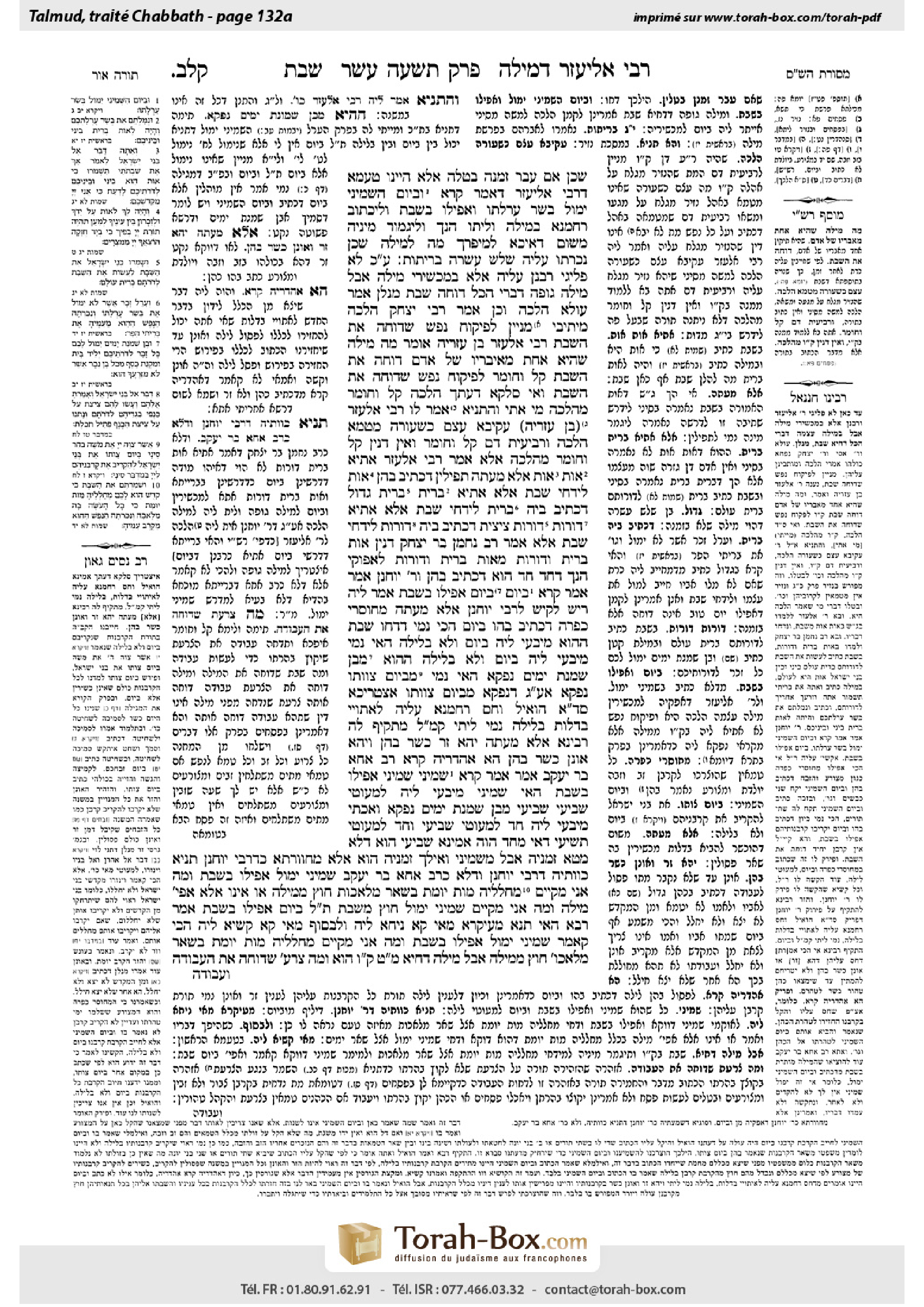
Shabbat 132a: Talmud study for Daf Yomi
Daf Yomi is the daily study of one Talmud folio. Explore 37 tractates with scans, Hebrew text, Sefaria English and AI-generated French translations where annotated.
Passage selection and English or AI-generated French translation are available where the scan has annotations. Daf Study is independent of Torah-Box and Sefaria.
Browse Shabbat · שבת · All tractatesShabbat 132a text and translations
This page of Shabbat includes the Aramaic text, an English translation and an AI-generated French translation, alongside the scan above.
שבת קל״ב א · Aramaic and Hebrew text
שֶׁכֵּן אִם עָבַר זְמַנָּהּ בָּטְלָה. אֶלָּא הַיְינוּ טַעְמָא דְּרַבִּי אֱלִיעֶזֶר, דְּאָמַר קְרָא: ״וּבַיּוֹם הַשְּׁמִינִי יִמּוֹל בְּשַׂר עׇרְלָתוֹ״, וַאֲפִילּוּ בְּשַׁבָּת.
וְלִיכְתּוֹב רַחֲמָנָא בְּמִילָה, וְלֵיתוֹ הָנָךְ וְלִיגְמְרוּ מִינֵּיהּ! מִשּׁוּם דְּאִיכָּא לְמִיפְרַךְ: מָה לְמִילָה שֶׁכֵּן נִכְרְתוּ עָלֶיהָ שְׁלֹשׁ עֶשְׂרֵה בְּרִיתוֹת.
עַד כָּאן לָא פְּלִיגִי רַבָּנַן עֲלֵיהּ אֶלָּא בְּמַכְשִׁירֵי מִילָה, אֲבָל מִילָה גּוּפַהּ דִּבְרֵי הַכֹּל דּוֹחָה שַׁבָּת, מְנָלַן? אֲמַר עוּלָּא: הֲלָכָה. וְכֵן אָמַר רַבִּי יִצְחָק הֲלָכָה.
מֵיתִיבִי: מִנַּיִין לְפִיקּוּחַ נֶפֶשׁ שֶׁדּוֹחֶה אֶת הַשַּׁבָּת? רַבִּי אֶלְעָזָר בֶּן עֲזַרְיָה אוֹמֵר: מָה מִילָה שֶׁהִיא אַחַת מֵאֵיבָרָיו שֶׁל אָדָם דּוֹחָה אֶת הַשַּׁבָּת — קַל וָחוֹמֶר לְפִיקּוּחַ נֶפֶשׁ שֶׁדּוֹחֶה אֶת הַשַּׁבָּת.
וְאִי סָלְקָא דַּעְתָּךְ הֲלָכָה — קַל וָחוֹמֶר מֵהֲלָכָה מִי אָתֵי? וְהָתַנְיָא, אָמַר לוֹ רַבִּי אֶלְעָזָר בֶּן עֲזַרְיָה: עֲקִיבָא, עֶצֶם כִּשְׂעוֹרָה (מְטַמֵּא) הֲלָכָה, וּרְבִיעִית דָּם קַל וָחוֹמֶר, וְאֵין דָּנִין קַל וָחוֹמֶר מֵהֲלָכָה.
אֶלָּא אָמַר רַבִּי אֶלְעָזָר: אָתְיָא ״אוֹת״ ״אוֹת״.
אֶלָּא מֵעַתָּה, תְּפִילִּין דִּכְתִיב בְּהוּ ״אוֹת״, לִידְחֵי שַׁבָּת!
אֶלָּא אָתְיָא ״בְּרִית״ ״בְּרִית״.
גָּדוֹל, דִּכְתִיב בֵּיהּ ״בְּרִית״, לִידְחֵי שַׁבָּת!
אֶלָּא אָתְיָא ״דּוֹרוֹת״ ״דּוֹרוֹת״.
צִיצִית, דִּכְתִיב בֵּיהּ ״דּוֹרוֹת״, לִידְחֵי שַׁבָּת!
אֶלָּא אָמַר רַב נַחְמָן בַּר יִצְחָק: דָּנִין ״אוֹת״ ״בְּרִית״ וְ״דוֹרוֹת״ מֵ״אוֹת״ ״בְּרִית״ וְ״דוֹרוֹת״ — לְאַפּוֹקֵי הָנָךְ, דְּחַד חַד הוּא דִּכְתִיב בָּהֶן.
וְרַבִּי יוֹחָנָן אָמַר: אָמַר קְרָא ״בַּיּוֹם״. ״בַּיּוֹם״, אֲפִילּוּ בְּשַׁבָּת.
אֲמַר לֵיהּ רֵישׁ לָקִישׁ לְרַבִּי יוֹחָנָן: אֶלָּא מֵעַתָּה מְחוּסְּרֵי כַּפָּרָה, דִּכְתִיב בְּהוּ ״בַּיּוֹם״, הָכִי נָמֵי דְּדָחוּ שַׁבָּת?! הַהוּא מִיבְּעֵי לֵיהּ בַּיּוֹם וְלֹא בַּלַּיְלָה.
הַאי נָמֵי, מִיבְּעֵי לֵיהּ בַּיּוֹם וְלֹא בַּלַּיְלָה! הָהוּא מִ״בֶּן שְׁמֹנַת יָמִים״ נָפְקָא.
הַאי נָמֵי, מִ״בְּיוֹם צַוּוֹתוֹ״ נָפְקָא!
אַף עַל גַּב דְּנָפְקָא מִ״בְּיוֹם צַוּוֹתוֹ״, אִצְטְרִיכָא. סָלְקָא דַּעְתָּךְ אָמֵינָא: הוֹאִיל וְחָס רַחֲמָנָא עֲלֵיהּ לְאֵתוֹיֵי בְּדַלּוּת, בַּלַּיְלָה נָמֵי לַיְתֵי, קָא מַשְׁמַע לַן.
מַתְקֵיף לַהּ רָבִינָא: אֶלָּא מֵעַתָּה, יְהֵא זָר כָּשֵׁר בָּהֶן, וִיהֵא אוֹנֵן כָּשֵׁר בָּהֶן! הָא אַהְדְּרֵיהּ קְרָא.
רַב אַחָא בַּר יַעֲקֹב אָמַר: אָמַר קְרָא: ״שְׁמִינִי״. ״שְׁמִינִי״, אֲפִילּוּ בְּשַׁבָּת.
הַאי ״שְׁמִינִי״ מִיבְּעֵי לֵיהּ לְמַעוֹטֵי שְׁבִיעִי! שְׁבִיעִי מִ״בֶּן שְׁמֹנַת יָמִים״ נָפְקָא.
וְאַכַּתִּי מִיבְּעֵי לֵיהּ, חַד לְמַעוֹטֵי שְׁבִיעִי, וְחַד לְמַעוֹטֵי תְּשִׁיעִי. דְּאִי מֵחַד, הֲוָה אָמֵינָא: שְׁבִיעִי הוּא דְּלָא מְטָא זִמְנֵיהּ, אֲבָל מִשְּׁמִינִי וְאֵילָךְ זִמְנֵיהּ הוּא! אֶלָּא מְחַוַּורְתָּא כִּדְרַבִּי יוֹחָנָן.
תַּנְיָא כְּווֹתֵיהּ דְּרַבִּי יוֹחָנָן, וּדְלָא כְּרַב אַחָא בַּר יַעֲקֹב: ״שְׁמִינִי יִמּוֹל״ — אֲפִילּוּ בְּשַׁבָּת, וּמָה אֲנִי מְקַיֵּים ״מְחַלְּלֶיהָ מוֹת יוּמָת״ — בִּשְׁאָר מְלָאכוֹת חוּץ מִמִּילָה. אוֹ אֵינוֹ אֶלָּא אֲפִילּוּ מִילָה, וּמָה אֲנִי מְקַיֵּים ״שְׁמִינִי יִמּוֹל״ — חוּץ מִשַּׁבָּת, תַּלְמוּד לוֹמַר: ״בַּיּוֹם״ — אֲפִילּוּ בְּשַׁבָּת.
אָמַר רָבָא: הַאי תַּנָּא מֵעִיקָּרָא מַאי קָא נִיחָא לֵיהּ, וּלְבַסּוֹף מַאי קָא קַשְׁיָא לֵיהּ?
הָכִי קָאָמַר: ״שְׁמִינִי יִמּוֹל״ — אֲפִילּוּ בְּשַׁבָּת. וּמָה אֲנִי מְקַיֵּים ״מְחַלְּלֶיהָ מוֹת יוּמָת״ — בִּשְׁאָר מְלָאכוֹת חוּץ מִמִּילָה, אֲבָל מִילָה דָּחֲיָא,
מַאי טַעְמָא? — קַל וָחוֹמֶר הוּא: וּמָה צָרַעַת שֶׁדּוֹחֶה אֶת הָעֲבוֹדָה,
Shabbat 132a · English translation
in each, as if its time passed, it is void, unlike the mitzva of circumcision, which can be fulfilled at a later date if the child is not circumcised on the eighth day. Rather, this is the reason for the opinion of Rabbi Eliezer, as the verse says: “And on the eighth day the flesh of his foreskin shall be circumcised” (Leviticus 12:3), indicating that he is circumcised on the eighth day even if it falls on Shabbat.
The Gemara asks: And let the Torah write this principle only with regard to the mitzva of circumcision, and let these other mitzvot come and derive their halakhot from it. The Gemara answers: Because this suggestion can be refuted: What is unique about the mitzva of circumcision? That thirteen covenants were established over it, as the word covenant is mentioned thirteen times in the passage dealing with the circumcision of Abraham (Genesis 17). Owing to its great significance, other mitzvot cannot be derived from it.
The Gemara departs from the facilitators of circumcision to the halakha of circumcision itself and asks: The Rabbis only disagree with Rabbi Eliezer with regard to actions that facilitate circumcision, which, in their view, do not override Shabbat; however, with regard to circumcision itself, everyone agrees that it overrides Shabbat. From where do we derive this halakha? Ulla said: This is a halakha transmitted to Moses from Sinai, but there is no biblical basis for it. And so too, Rabbi Yitzḥak said: It is a halakha transmitted to Moses from Sinai.
The Gemara raises an objection from that which was taught in the Tosefta: From where is it derived that saving a life overrides Shabbat? Rabbi Elazar ben Azarya says it is derived from the mitzva of circumcision: Just as circumcision, which pertains to only one of a person’s limbs, overrides Shabbat, all the more so it is an a fortiori inference that saving a life, which is a mitzva that pertains to the entire person, overrides Shabbat.
And if it should enter your mind to say that circumcision may be performed on Shabbat based on a halakha transmitted to Moses from Sinai, is an a fortiori inference derived from a halakha transmitted to Moses from Sinai? Wasn’t it taught explicitly in a baraita that an a fortiori inference cannot be derived from a halakha transmitted to Moses from Sinai? Rabbi Akiva sought to derive that a nazirite who comes into contact with a quarter log of blood from a corpse becomes ritually impure and is required to shave his hair. He sought to do this based on an a fortiori inference from the halakha of the bone from a dead person the size of a grain of barley, as he had a received tradition that a nazirite is required to shave his hair due to that contact. Rabbi Elazar ben Azarya said to him: Akiva, the halakha that a bone the size of a grain of barley transmits ritual impurity is a halakha transmitted to Moses from Sinai, and you would derive from it that a quarter of a log of blood transmits ritual impurity based upon an a fortiori inference, and one does not derive an a fortiori inference from a halakha transmitted to Moses from Sinai. The Tosefta explicitly states that Rabbi Elazar ben Azarya himself derived an a fortiori inference from the halakha of circumcision on Shabbat. Clearly, then, it is derived from the Torah itself and not from a halakha transmitted to Moses from Sinai.
Rather, Rabbi Elazar said: This halakha is derived by means of a verbal analogy between the word sign that appears with regard to circumcision: “And you shall be circumcised in the flesh of your foreskin; and it shall be a sign of the covenant between Me and you” (Genesis 17:11), and sign that appears with regard to Shabbat: “However, you shall keep My Shabbatot, for it is a sign between Me and you throughout your generations” (Exodus 31:13). From this verbal analogy, it is derived that circumcision, which is a sign, may be performed even on Shabbat, which is itself a sign.
The Gemara asks: But if what you say is so, phylacteries, with regard to which the term sign is also written: “And it shall be for a sign on your hand and for frontlets between your eyes” (Exodus 13:16), should also override Shabbat, and they should be donned on that day.
Rather, this principle is derived by means of a different verbal analogy from the word covenant that appears with regard to circumcision: “And you shall be circumcised in the flesh of your foreskin; and it shall be a sign of the covenant between Me and you” (Genesis 17:11), and the word covenant that appears with regard to Shabbat: “The children of Israel shall keep the Shabbat, to observe the Shabbat throughout their generations for a perpetual covenant” (Exodus 31:16).
The Gemara raises a difficulty: If this is so, then the circumcision of an adult should also be permitted on Shabbat and it should not be limited to a child on the eighth day, as the term covenant is written with regard to him as well, as it applies to any Jewish male not yet circumcised. Therefore, let his circumcision override Shabbat. The halakha, however, is that only circumcision at its proper time on the eighth day overrides Shabbat.
Rather, this halakha is derived by means of a verbal analogy between the word generations that appears with regard to Shabbat: “Throughout their generations for a perpetual covenant” (Exodus 31:16), and the word generations that appears with regard to circumcision: “And I shall establish My covenant between Me and you, and between your seed after you throughout their generations, for an everlasting covenant” (Genesis 17:7).
The Gemara asks: If so, let ritual fringes too, with regard to which the term generations is also written, override Shabbat, and it should be permitted to affix ritual fringes to a garment on Shabbat.
Rather, Rav Naḥman bar Yitzḥak said: This halakha is derived not from one common word alone, but one derives it based upon the three words sign, covenant, and generations that appear with regard to circumcision, from sign, covenant, and generations that appear with regard to Shabbat, to the exclusion of these, i.e., ritual fringes and phylacteries, that with regard to each of them, one of these is written but not all three words together.
And Rabbi Yoḥanan said: The verse says: “And on the eighth day…shall be circumcised” (Leviticus 12:3), which means that the child is circumcised on the eighth day whenever it occurs, even on Shabbat.
Reish Lakish said to Rabbi Yoḥanan: But if what you say is so, then, with regard to those lacking atonement, such as a zav or a healed leper, who must after their immersion still bring an atonement offering in order to complete their purification process, with regard to whom the term on the day is also written, as in the verse: “And on the eighth day he shall take two he-lambs without blemish, and one ewe-lamb of the first year without blemish” (Leviticus 14:10), sacrificing their atonement offerings should also override Shabbat. Rabbi Yoḥanan responded: That verse is necessary to teach that the sacrifice must be brought during the day and not at night.
Reish Lakish asked: This verse with regard to the mitzva of circumcision is also necessary to teach that circumcision must be performed during the day and not at night. Rabbi Yoḥanan replied: That is derived from a different verse, which states: “And he that is eight days old shall be circumcised among you throughout your generations” (Genesis 17:12). That circumcision must take place during the day is derived from that verse.
Reish Lakish says: That matter, that the atonement offering must be sacrificed during the day, can also be derived from a different verse, as it is stated: “This is the law of the burnt-offering, of the meal-offering, and of the sin-offering, and of the guilt-offering, and of the consecration-offering, and of the sacrifice of the peace-offerings; which the Lord commanded Moses at Mount Sinai on the day He commanded the children of Israel to present their offerings to the Lord in the wilderness of Sinai” (Leviticus 7:37–38), and from here it is derived that all offerings are sacrificed by day and not at night.
The Gemara answers: Although this halakha is derived from: “On the day He commanded,” an additional source is necessary for those lacking atonement. It might have entered your mind to say that since the Torah shows him mercy by allowing him to bring an offering of poverty, as if one cannot afford to sacrifice the regular atonement offering, the Torah enables him to sacrifice a less costly one, let him also bring it at night, as perhaps the Torah shows him mercy and allows him to hasten his atonement. Therefore, it teaches us that he too must bring his offering only by day and not at night.
Ravina strongly objects to this reasoning: But if what you say is so, that the Torah has compassion on a person lacking atonement and is lenient with regard to the halakhot of the atonement offering, a non-priest should be fit to sacrifice them, and similarly, a priest who is an acute mourner, i.e., one whose relative died that same day and has not yet been buried, should be fit to sacrifice them. The Gemara answers: The verse has restored this. The additional verse that teaches that even one lacking atonement must sacrifice during the day, also teaches that the Torah was lenient with regard to this offering only in the ways explicitly stated in the Torah.
Rav Aḥa bar Ya’akov said: There is a different proof from the Torah that circumcision is performed even on Shabbat, for the verse said: “On the eighth day,” underscoring that circumcision is performed specifically on the eighth day and indicating that it is performed even on Shabbat.
The Gemara raises a difficulty: This usage of the term eighth is necessary to exclude the seventh day, i.e., a child may not be circumcised before the eighth day. The Gemara answers: The fact that one may not circumcise on the seventh day is derived from a different verse, as it is stated: “And he that is eight days old shall be circumcised among you throughout your generations” (Genesis 17:12).
The Gemara raises a further difficulty: Both verses are still necessary, one to exclude the seventh day and one to exclude the ninth day. As if it were derived from one verse alone, I would have said: It is on the seventh day that one may not circumcise, since the time to circumcise this child has not yet arrived and the obligation of circumcision is not yet in effect; however, from the eighth day and onward is its time, and therefore it is permissible to postpone a circumcision until the ninth day. No answer was found to this question, and the Gemara concludes: Rather, the derivation is clear according to Rabbi Yoḥanan.
It was taught in a baraita in accordance with the opinion of Rabbi Yoḥanan and not in accordance with the opinion of Rav Aḥa bar Ya’akov, as the tanna interprets the phrase: “On the eighth day he shall be circumcised” to mean that the circumcision must be performed even on Shabbat. And how do I fulfill the prohibition against performing prohibited labor explicit in the Torah in the verse: “And you shall guard the Shabbat, for it is holy to you; he who desecrates it shall surely die” (Exodus 31:14)? That is referring to other prohibited labors besides circumcision. The tanna questions his previous statement: Or perhaps that is not the case, and the prohibition of performing prohibited labor on Shabbat includes even circumcision, and, on the contrary, how do I fulfill the verse: “On the eighth day he shall be circumcised”? It applies when the eighth day is any day other than Shabbat. The verse states: “On the day,” meaning on that very day when he turns eight days old, even on Shabbat. The tanna of this baraita rejects Rav Aḥa bar Ya’akov’s proof and accepts Rabbi Yoḥanan’s assertion that the phrase “On the day” conclusively establishes that circumcision is performed even on Shabbat.
With regard to this baraita, Rava said: Initially, what did this tanna find acceptable, and ultimately, what did he find difficult? Initially he suggested that: “On the eighth day he shall be circumcised” is a valid source for the fact that circumcision overrides Shabbat, but ultimately, he deemed that difficult and turned to an alternative source, yet provided no reason, neither for his initial statement nor for his second statement.
Rather, we can explain that this is what he is saying: “On the eighth day he shall be circumcised” applies even on Shabbat. And how do I fulfill: “He who desecrates it shall surely die”? That is referring to the other prohibited labors besides circumcision; however, circumcision overrides Shabbat.
What is the reason for this? It is derived by means of an a fortiori inference: Just as leprosy, which overrides the Temple service, as a priest who is a leper may not serve in the Temple and it is prohibited to cut off the symptoms of leprosy,
Shabbat 132a · Traduction française (IA)
dans chaque cas, si le moment prescrit est passé, la mitsva ne peut plus être accomplie, contrairement à la mitsva de la circoncision, qui peut être accomplie ultérieurement si l’enfant n’est pas circoncis le huitième jour. La raison de l’opinion de Rabbi Eliezer est plutôt la suivante : le verset dit : « Le huitième jour, la chair de son prépuce sera circoncise » (Lévitique 12, 3), ce qui indique qu’il est circoncis le huitième jour, même si celui-ci tombe un Chabbat.
La Guemara demande : Que la Torah n’énonce ce principe qu’à propos de la mitsva de la circoncision, et que les autres mitsvot en déduisent leurs halakhot. La Guemara répond : Cette proposition peut être réfutée : qu’est-ce qui distingue la mitsva de la circoncision ? Treize alliances ont été conclues à son sujet, car le mot « alliance » est mentionné treize fois dans le passage consacré à la circoncision d’Abraham (Genèse 17). En raison de son importance exceptionnelle, on ne peut pas en déduire les règles applicables aux autres mitsvot.
La Guemara abandonne la question des actes facilitant la circoncision pour examiner la halakha de la circoncision elle-même, et demande : Les Rabbins ne sont en désaccord avec Rabbi Eliezer qu’au sujet des actes facilitant la circoncision, qui, selon eux, ne l’emportent pas sur le Chabbat ; mais, concernant la circoncision elle-même, tous conviennent qu’elle l’emporte sur le Chabbat. D’où déduisons-nous cette halakha ? Oulla dit : C’est une halakha transmise à Moïse au Sinaï, mais qui n’a pas de fondement dans la Torah écrite. De même, Rabbi Yitsḥak dit : C’est une halakha transmise à Moïse au Sinaï.
La Guemara soulève une objection à partir de ce qui a été enseigné dans la Tosefta : D’où déduit-on que sauver une vie l’emporte sur le Chabbat ? Rabbi Elazar ben Azarya dit que cela se déduit de la mitsva de la circoncision : de même que la circoncision, qui ne concerne qu’un seul membre de la personne, l’emporte sur le Chabbat, à plus forte raison peut-on déduire que sauver une vie, mitsva qui concerne la personne tout entière, l’emporte sur le Chabbat.
Et si l’on devait penser que la circoncision peut être pratiquée le Chabbat en vertu d’une halakha transmise à Moïse au Sinaï, pourrait-on tirer un raisonnement a fortiori d’une halakha transmise à Moïse au Sinaï ? N’a-t-on pas enseigné explicitement dans une baraïta qu’on ne peut pas tirer de raisonnement a fortiori d’une halakha transmise à Moïse au Sinaï ? Rabbi Akiva cherchait à déduire qu’un nazir qui entre en contact avec un quart de log de sang provenant d’un cadavre devient rituellement impur et doit se raser les cheveux. Il voulait le déduire par un raisonnement a fortiori à partir de la halakha concernant un os humain de la taille d’un grain d’orge, car il avait reçu la tradition selon laquelle un nazir doit se raser les cheveux à la suite d’un tel contact. Rabbi Elazar ben Azarya lui dit : « Akiva, la halakha selon laquelle un os de la taille d’un grain d’orge transmet l’impureté rituelle est une halakha transmise à Moïse au Sinaï, et tu en déduirais, par un raisonnement a fortiori, qu’un quart de log de sang transmet l’impureté rituelle ? Or, on ne tire pas de raisonnement a fortiori d’une halakha transmise à Moïse au Sinaï. » La Tosefta affirme explicitement que Rabbi Elazar ben Azarya lui-même a tiré un raisonnement a fortiori de la halakha selon laquelle la circoncision l’emporte sur le Chabbat. Il est donc clair que cette halakha se déduit de la Torah elle-même et non d’une halakha transmise à Moïse au Sinaï.
Rabbi Elazar dit plutôt : cette halakha se déduit par une analogie verbale entre le mot « signe », employé à propos de la circoncision : « Vous serez circoncis dans la chair de votre prépuce ; ce sera un signe de l’alliance entre Moi et vous » (Genèse 17, 11), et le mot « signe », employé à propos du Chabbat : « Toutefois, vous observerez Mes Chabbatot, car c’est un signe entre Moi et vous, pour vos générations » (Exode 31, 13). Cette analogie verbale enseigne que la circoncision, qui est un signe, peut être pratiquée même le Chabbat, qui est lui-même un signe.
La Guemara demande : Mais si ce que tu dis est exact, les phylactères, à propos desquels le terme « signe » est également employé : « Ce sera un signe sur ta main et des fronteaux entre tes yeux » (Exode 13, 16), devraient eux aussi l’emporter sur le Chabbat, et on devrait les porter ce jour-là.
La règle se déduit plutôt d’une autre analogie verbale, fondée sur le mot « alliance » employé à propos de la circoncision : « Vous serez circoncis dans la chair de votre prépuce ; ce sera un signe de l’alliance entre Moi et vous » (Genèse 17, 11), et sur le mot « alliance » employé à propos du Chabbat : « Les enfants d’Israël observeront le Chabbat, en célébrant le Chabbat au fil de leurs générations comme une alliance perpétuelle » (Exode 31, 16).
La Guemara soulève une difficulté : Si tel est le cas, la circoncision d’un adulte devrait elle aussi être permise le Chabbat, et la règle ne devrait pas être limitée à la circoncision d’un enfant le huitième jour, puisque le terme « alliance » est également employé à son sujet, car il s’applique à tout homme juif qui n’a pas encore été circoncis. Sa circoncision devrait donc l’emporter sur le Chabbat. Or, la halakha est que seule la circoncision pratiquée au moment prescrit, le huitième jour, l’emporte sur le Chabbat.
Cette halakha se déduit plutôt par une analogie verbale entre le mot « générations », employé à propos du Chabbat : « au fil de leurs générations comme une alliance perpétuelle » (Exode 31, 16), et le mot « générations », employé à propos de la circoncision : « J’établirai Mon alliance entre Moi et toi, et avec ta descendance après toi, au fil de leurs générations, comme une alliance éternelle » (Genèse 17, 7).
La Guemara demande : Si tel est le cas, les franges rituelles, à propos desquelles le terme « générations » est également employé, devraient elles aussi l’emporter sur le Chabbat, et il devrait être permis de fixer des franges rituelles à un vêtement le Chabbat.
Rav Naḥman bar Yitsḥak dit plutôt : cette halakha ne se déduit pas d’un seul mot commun, mais des trois mots « signe », « alliance » et « générations », employés à propos de la circoncision, mis en regard des mots « signe », « alliance » et « générations » employés à propos du Chabbat. Cela exclut les franges rituelles et les phylactères, car, pour chacun d’eux, un seul de ces termes est employé, et non les trois à la fois.
Et Rabbi Yoḥanan dit : Le verset dit : « Le huitième jour… il sera circoncis » (Lévitique 12, 3), ce qui signifie que l’enfant est circoncis le huitième jour, quel que soit le jour où celui-ci tombe, même un Chabbat.
Reish Lakish dit à Rabbi Yoḥanan : Mais si ce que tu dis est exact, alors les personnes qui doivent encore obtenir l’expiation, comme un zav ou un lépreux guéri, qui doivent, après leur immersion, apporter encore un sacrifice expiatoire pour achever leur processus de purification, devraient elles aussi pouvoir offrir leurs sacrifices expiatoires le Chabbat, puisque le terme « le jour » est également employé à leur sujet, comme dans le verset : « Le huitième jour, il prendra deux agneaux sans défaut et une agnelle d’un an sans défaut » (Lévitique 14, 10). Rabbi Yoḥanan répondit : Ce verset est nécessaire pour enseigner que le sacrifice doit être offert pendant la journée et non la nuit.
Reish Lakish demanda : Ce verset relatif à la mitsva de la circoncision est lui aussi nécessaire pour enseigner que la circoncision doit être pratiquée le jour et non la nuit. Rabbi Yoḥanan répondit : Cela se déduit d’un autre verset, qui dit : « Celui qui aura huit jours sera circoncis parmi vous au fil de vos générations » (Genèse 17, 12). C’est de ce verset que l’on déduit que la circoncision doit avoir lieu le jour.
Reish Lakish dit : On peut également déduire d’un autre verset que le sacrifice expiatoire doit être offert le jour, comme il est dit : « Telle est la loi de l’holocauste, de l’offrande de farine, du sacrifice expiatoire, du sacrifice de culpabilité, du sacrifice d’investiture et du sacrifice des offrandes de paix, que l’Éternel ordonna à Moïse sur le mont Sinaï, le jour où Il ordonna aux enfants d’Israël de présenter leurs offrandes à l’Éternel dans le désert du Sinaï » (Lévitique 7, 37-38). On déduit de là que toutes les offrandes sont offertes le jour et non la nuit.
La Guemara répond : Bien que cette halakha se déduise des mots « le jour où Il ordonna », une source supplémentaire est nécessaire concernant les personnes qui doivent encore obtenir l’expiation. On aurait pu penser que, puisque la Torah fait preuve de compassion envers une telle personne en lui permettant d’apporter une offrande de pauvre — c’est-à-dire que si elle n’a pas les moyens d’offrir le sacrifice expiatoire habituel, la Torah lui permet d’en apporter un moins coûteux —, elle peut également l’apporter la nuit, car peut-être la Torah fait-elle preuve de compassion envers elle en lui permettant d’obtenir plus rapidement l’expiation. Le verset nous enseigne donc qu’elle aussi doit apporter son offrande uniquement le jour et non la nuit.
Ravina soulève une forte objection à ce raisonnement : Mais si ce que tu dis est exact, si la Torah a de la compassion pour celui qui doit encore obtenir l’expiation et se montre indulgente quant aux halakhot du sacrifice expiatoire, un non-prêtre devrait pouvoir l’offrir ; de même, un prêtre en deuil aigu, c’est-à-dire dont un proche est mort ce jour-là et n’a pas encore été enterré, devrait pouvoir l’offrir. La Guemara répond : Le verset a rétabli la règle. Le verset supplémentaire, qui enseigne que même celui qui doit encore obtenir l’expiation doit offrir son sacrifice le jour, enseigne également que la Torah ne s’est montrée indulgente quant aux règles de cette offrande que dans les cas qu’elle énonce explicitement.
Rav Aḥa bar Ya’akov dit : Il existe une autre preuve tirée de la Torah que la circoncision se pratique même le Chabbat, car le verset dit : « Le huitième jour », soulignant que la circoncision se pratique précisément le huitième jour et indiquant ainsi qu’elle se pratique même le Chabbat.
La Guemara soulève une difficulté : L’emploi du terme « huitième » est nécessaire pour exclure le septième jour, c’est-à-dire qu’on ne peut pas circoncire un enfant avant le huitième jour. La Guemara répond : L’interdiction de circoncire le septième jour se déduit d’un autre verset, comme il est dit : « Celui qui aura huit jours sera circoncis parmi vous au fil de vos générations » (Genèse 17, 12).
La Guemara soulève une autre difficulté : Les deux versets restent nécessaires, l’un pour exclure le septième jour et l’autre pour exclure le neuvième jour. En effet, si cela se déduisait d’un seul verset, j’aurais dit qu’on ne peut pas circoncire le septième jour, puisque le moment de circoncire cet enfant n’est pas encore arrivé et que l’obligation de circoncision n’est pas encore en vigueur ; toutefois, à partir du huitième jour, le moment est venu, et il est donc permis de reporter la circoncision au neuvième jour. Aucune réponse n’a été trouvée à cette question, et la Guemara conclut : La déduction est donc claire selon Rabbi Yoḥanan.
Une baraïta a été enseignée conformément à l’opinion de Rabbi Yoḥanan, et non à celle de Rav Aḥa bar Ya’akov, car le tanna interprète l’expression « Le huitième jour, il sera circoncis » comme signifiant que la circoncision doit être pratiquée même le Chabbat. Comment alors comprendre l’interdiction d’accomplir les travaux interdits, explicitée dans la Torah par le verset : « Vous observerez le Chabbat, car il est saint pour vous ; celui qui le profane sera mis à mort » (Exode 31, 14) ? Cela concerne les autres travaux interdits, à l’exclusion de la circoncision. Le tanna remet en question ce qu’il vient de dire : Ou peut-être n’en est-il pas ainsi, et l’interdiction d’accomplir des travaux interdits le Chabbat inclut-elle également la circoncision ? Au contraire, comment comprendre alors le verset : « Le huitième jour, il sera circoncis » ? Il s’applique lorsque le huitième jour tombe un jour autre que le Chabbat. Le verset dit : « Le jour », c’est-à-dire ce jour même où il atteint l’âge de huit jours, même si c’est un Chabbat. Le tanna de cette baraïta rejette la preuve de Rav Aḥa bar Ya’akov et accepte l’affirmation de Rabbi Yoḥanan, selon laquelle l’expression « le jour » établit de façon concluante que la circoncision se pratique même le Chabbat.
À propos de cette baraïta, Rava dit : Qu’est-ce que ce tanna a trouvé acceptable au début, et qu’est-ce qui lui a finalement posé problème ? Il avait d’abord proposé que l’expression « Le huitième jour, il sera circoncis » constitue une source valable pour établir que la circoncision l’emporte sur le Chabbat, mais il a ensuite jugé cela problématique et s’est tourné vers une autre source, sans fournir de raison ni pour son affirmation initiale ni pour la seconde.
On peut plutôt expliquer qu’il dit ceci : « Le huitième jour, il sera circoncis » s’applique même le Chabbat. Et comment comprendre : « Celui qui le profane sera mis à mort » ? Cela concerne les autres travaux interdits, à l’exclusion de la circoncision ; la circoncision, elle, l’emporte sur le Chabbat.
Quelle en est la raison ? Cela se déduit par un raisonnement a fortiori : de même que la lèpre l’emporte sur le service au Temple, puisqu’un prêtre lépreux ne peut pas officier au Temple et qu’il est interdit de couper les signes de la lèpre,
Traduction française générée par IA à partir de l’édition anglaise de Sefaria. Vérifie toujours un passage avec le texte source.
Text from Sefaria: William Davidson Edition - Vocalized Aramaic (CC BY NC); William Davidson Edition - English (CC BY NC).