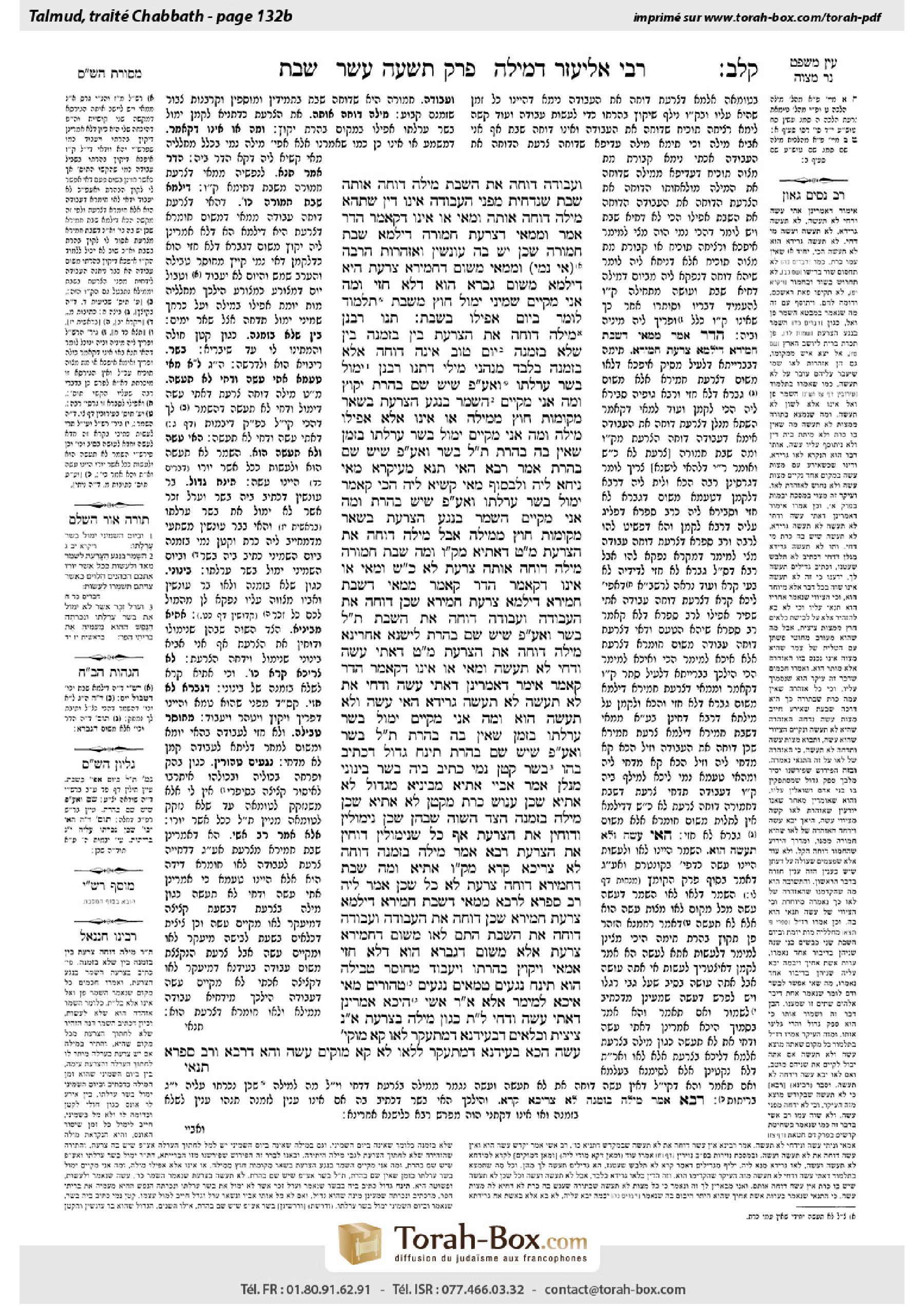
Shabbat 132b: Talmud study for Daf Yomi
Daf Yomi is the daily study of one Talmud folio. Explore 37 tractates with scans, Hebrew text, Sefaria English and AI-generated French translations where annotated.
Passage selection and English or AI-generated French translation are available where the scan has annotations. Daf Study is independent of Torah-Box and Sefaria.
Browse Shabbat · שבת · All tractatesShabbat 132b text and translations
This page of Shabbat includes the Aramaic text, an English translation and an AI-generated French translation, alongside the scan above.
שבת קל״ב ב · Aramaic and Hebrew text
וַעֲבוֹדָה דּוֹחָה אֶת הַשַּׁבָּת — מִילָה דּוֹחָה אוֹתָהּ. שַׁבָּת שֶׁנִּדְחֵית מִפְּנֵי הָעֲבוֹדָה, אֵינוֹ דִּין שֶׁתְּהֵא מִילָה דּוֹחָה אוֹתָהּ?
וּמַאי ״אוֹ אֵינוֹ״ דְּקָאָמַר — הֲדַר אָמַר: וּמִמַּאי דְּצָרַעַת חֲמוּרָה? דִילְמָא שַׁבָּת חֲמוּרָה, שֶׁכֵּן יֵשׁ בָּהּ עוֹנָשִׁין וְאַזְהָרוֹת הַרְבֵּה. אִי נָמֵי: וּמִמַּאי מִשּׁוּם דַּחֲמִירָא צָרַעַת הִיא, דִּילְמָא מִשּׁוּם גַּבְרָא הוּא דְּלָא חֲזֵי. וּמָה אֲנִי מְקַיֵּים ״שְׁמִינִי יִמּוֹל״ — חוּץ מִשַּׁבָּת. תַּלְמוּד לוֹמַר: ״בַּיּוֹם״ — אֲפִילּוּ בְּשַׁבָּת.
תָּנוּ רַבָּנַן: מִילָה דּוֹחָה אֶת הַצָּרַעַת, בֵּין בִּזְמַנָּהּ בֵּין שֶׁלֹּא בִּזְמַנָּהּ. יוֹם טוֹב אֵינָהּ דּוֹחָה אֶלָּא בִּזְמַנָּהּ בִּלְבַד.
מְנָהָנֵי מִילֵּי? דְּתָנוּ רַבָּנַן: ״יִמּוֹל בְּשַׂר עׇרְלָתוֹ״, וְאַף עַל פִּי שֶׁיֵּשׁ שָׁם בַּהֶרֶת, יָקוֹץ. וּמָה אֲנִי מְקַיֵּים ״הִשָּׁמֶר בְּנֶגַע הַצָּרַעַת״ — בִּשְׁאָר מְקוֹמוֹת חוּץ מִמִּילָה.
אוֹ אֵינוֹ אֶלָּא אֲפִילּוּ מִילָה, וּמָה אֲנִי מְקַיֵּים ״יִמּוֹל בְּשַׂר עׇרְלָתוֹ״ — בִּזְמַן שֶׁאֵין בָּהּ בַּהֶרֶת. תַּלְמוּד לוֹמַר: ״בָּשָׂר״, וְאַף עַל פִּי שֶׁיֵּשׁ שָׁם בַּהֶרֶת.
אָמַר רָבָא: הַאי תַּנָּא מֵעִיקָּרָא מַאי נִיחָא לֵיהּ וּלְבַסּוֹף מַאי קַשְׁיָא לֵיהּ?
הָכִי קָאָמַר: ״יִמּוֹל בְּשַׂר עׇרְלָתוֹ״ — וְאַף עַל פִּי שֶׁיֵּשׁ [שָׁם] בַּהֶרֶת, וּמָה אֲנִי מְקַיֵּים ״הִשָּׁמֶר בְּנֶגַע הַצָּרַעַת״ — בִּשְׁאָר מְקוֹמוֹת חוּץ מִמִּילָה. אֲבָל מִילָה דּוֹחָה אֶת הַצָּרַעַת, מַאי טַעְמָא? דְּאָתְיָא מִקַּל וְחוֹמֶר: וּמָה שַׁבָּת חֲמוּרָה, מִילָה דּוֹחָה אוֹתָהּ, צָרַעַת לֹא כׇּל שֶׁכֵּן.
וּמַאי ״אוֹ אֵינוֹ״ דְּקָאָמַר — הֲדַר קָאָמַר: מִמַּאי דְּשַׁבָּת חֲמִירָא? דִילְמָא צָרַעַת חֲמִירָא, שֶׁכֵּן דּוֹחָה אֶת הָעֲבוֹדָה, וַעֲבוֹדָה דּוֹחָה אֶת הַשַּׁבָּת! תַּלְמוּד לוֹמַר: ״בָּשָׂר״ — וְאַף עַל פִּי שֶׁיֵּשׁ שָׁם בַּהֶרֶת.
לִישָּׁנָא אַחֲרִינָא. מִילָה דּוֹחָה אֶת הַצָּרַעַת, מַאי טַעְמָא? דְּאָתֵי עֲשֵׂה וְדָחֵי לֹא תַעֲשֶׂה. וּמַאי ״אוֹ אֵינוֹ״ דְּקָאָמַר — הֲדַר קָאָמַר: אֵימַר דְּאָמְרִינַן דְּאָתֵי עֲשֵׂה וְדָחֵי אֶת לֹא תַעֲשֶׂה — לֹא תַעֲשֶׂה גְּרֵידָא, הַאי עֲשֵׂה וְלֹא תַעֲשֶׂה הוּא. וּמָה אֲנִי מְקַיֵּים ״יִמּוֹל בְּשַׂר עׇרְלָתוֹ״ — בִּזְמַן שֶׁאֵין בָּהּ בַּהֶרֶת, תַּלְמוּד לוֹמַר: ״בָּשָׂר״ — וְאַף עַל פִּי שֶׁיֵּשׁ שָׁם בַּהֶרֶת.
תִּינַח גָּדוֹל, דִּכְתִיב בֵּיהּ ״בָּשָׂר״. קָטָן נָמֵי, כְּתִיב בֵּיהּ ״בָּשָׂר״. בֵּינוֹנִי מְנָלַן?
אָמַר אַבָּיֵי, אָתְיָא מִבֵּינַיָּא: מִגָּדוֹל לָא אָתְיָא, שֶׁכֵּן עָנוּשׁ כָּרֵת. מִקָּטָן לָא אָתְיָא, שֶׁכֵּן מִילָה בִּזְמַנָּהּ. הַצַּד הַשָּׁוֶה שֶׁבָּהֶן — שֶׁכֵּן נִימּוֹלִין וְדוֹחִין אֶת הַצָּרַעַת, אַף כֹּל שֶׁנִּימּוֹלִין — דּוֹחִין אֶת הַצָּרַעַת.
רָבָא אָמַר: מִילָה בִּזְמַנָּהּ דּוֹחָה לָא צְרִיכָא קְרָא, מִקַּל וָחוֹמֶר אָתְיָא: וּמָה שַׁבָּת דַּחֲמִירָא דּוֹחָה — צָרַעַת לֹא כׇּל שֶׁכֵּן.
אֲמַר לֵיהּ רַב סָפְרָא לְרָבָא: מִמַּאי דְּשַׁבָּת חֲמִירָא? דִּילְמָא צָרַעַת חֲמִירָא, שֶׁכֵּן דּוֹחָה אֶת הָעֲבוֹדָה, וַעֲבוֹדָה דּוֹחָה אֶת הַשַּׁבָּת! הָתָם, לָאו מִשּׁוּם דַּחֲמִירָא צָרַעַת, אֶלָּא מִשּׁוּם דְּגַבְרָא הוּא דְּלָא חֲזִי. אַמַּאי: וְיָקוֹץ בַּהַרְתּוֹ וְיַעֲבוֹד! מְחוּסָּר טְבִילָה הוּא.
תִּינַח נְגָעִים טְמֵאִים. נְגָעִים טְהוֹרִים, מַאי אִיכָּא לְמֵימַר?
אֶלָּא אָמַר רַב אָשֵׁי: הֵיכָא אָמְרִינַן דְּאָתֵי עֲשֵׂה וְדָחֵי לֹא תַעֲשֶׂה — כְּגוֹן מִילָה בְּצָרַעַת, אִי נָמֵי צִיצִית וְכִלְאַיִם, דִּבְעִידָּנָא דְּמִתְעֲקַר לָאו — קָא מוֹקֵים עֲשֵׂה. הָכָא, בְּעִידָּנָא דְּמִתְעֲקַר לְלָאו — לָא קָא מוֹקֵים עֲשֵׂה.
וְהָא, דְּרָבָא וְרַב סָפְרָא
Shabbat 132b · English translation
and the Temple service overrides Shabbat, as Shabbat offerings are sacrificed at their appointed time, and nevertheless circumcision overrides leprosy, i.e., if there were symptoms of leprosy on the foreskin of the baby, one circumcises the child even though he thereby violates the prohibition to cut off symptoms of leprosy; therefore, with regard to Shabbat, which is overridden by the Temple service, is it not logical that circumcision, which is so stringent that it overrides leprosy, overrides Shabbat as well? This was the tanna’s reasoning at the outset.
And what was the reason the tanna said: Or perhaps, and questioned his previous statement? He reconsidered and said: And from where do we know that leprosy is more stringent than Shabbat? Perhaps Shabbat is more stringent, as it includes the severe punishments of karet and execution by stoning, and numerous warnings pertaining to it throughout the Torah. Alternatively, and from where do we know that the reason the Temple service does not override the prohibition of leprosy is specifically because leprosy is more stringent than the Temple service? Perhaps the Temple service does not override the prohibition of leprosy because a man afflicted with leprosy is unfit to perform the Temple service and not due to the stringency of the prohibition to remove symptoms of leprosy from one’s body. And if so, how do I establish the verse: “And on the eighth day the flesh of his foreskin shall be circumcised” (Leviticus 12:3)? That it applies to days other than Shabbat. Consequently, the tanna cited additional proof from that which the Torah states: “On the day,” indicating that circumcision is performed even on Shabbat.
The Sages taught: Circumcision overrides leprosy. The foreskin is cut even if it has symptoms of leprosy on it, despite the fact that there is a Torah prohibition to cut off symptoms of leprosy. This is the halakha both when the circumcision takes place at its appointed time, on the eighth day, or when it is not performed at its appointed time but after the eighth day. However, circumcision overrides a Festival only when performed at its appointed time.
The Gemara asks: From where are these matters derived? As the Sages taught in a baraita with regard to the verse: “And on the eighth day the flesh of his foreskin shall be circumcised” (Leviticus 12:3), since this verse is stated in general terms, it teaches that even though there is a bright white leprous spot there, he should cut it. And how do I establish the verse: “Take care with regard to the plague of leprosy to take great care and to perform in accordance with all that the priests, the Levites, instruct you; as I commanded them you shall take care to perform” (Deuteronomy 24:8)? Does usage of the term “take care” indicate that there is a negative mitzva that prohibits cutting off symptoms of leprosy? We establish this prohibition as applying in other places, other than the place of a circumcision.
The tanna asks: Or perhaps that is not the case; rather, this prohibition applies even in the place of circumcision, and how do I validate the verse: “The flesh of his foreskin shall be circumcised”? It applies when there is no bright white leprous spot on the foreskin. So that we will not interpret the verse that way, the verse states the superfluous word flesh. It would have been sufficient to state: His foreskin shall be circumcised, but instead the verse stated: “The flesh of his foreskin shall be circumcised,” indicating that the foreskin must be removed even though there is a bright white spot there.
Rava said: Initially, what did this tanna find acceptable, and ultimately, what did he find difficult? At first he assumed that the mitzva of circumcision is more stringent, but he ultimately rejected this assumption with no explanation.
Rather, this is what he is saying: Initially he held that the phrase: The flesh of his foreskin shall be circumcised teaches that it is permitted to remove the foreskin even though there is a bright white spot there. And how do I validate the following verse: Take care with regard to the plague of leprosy? It applies in other places, aside from the place of circumcision, but circumcision overrides leprosy. What is the reason for this? It is derived by means of an a fortiori inference: Just as Shabbat is stringent and nevertheless circumcision overrides it, all the more so that circumcision overrides leprosy, which is less stringent than Shabbat.
And what was the reason for the term or perhaps that the tanna is saying to question his previous statement? He reconsidered and said: From where do we know that Shabbat is more stringent? Perhaps leprosy is more stringent, as leprosy overrides the Temple service, as stated earlier, and the Temple service overrides Shabbat. Therefore, the verse states the additional word flesh, to teach that the foreskin is removed even though there is a bright white leprous spot there.
The Gemara cites another version of Rava’s comments. Initially the tanna thought that circumcision overrides leprosy. What is the reason for this? He relied on the principle that a positive mitzva comes and overrides a negative mitzva. And what was the reason the tanna is saying: Or perhaps to question his previous statement? He reconsidered and said: Say that we say that a positive mitzva comes and overrides a negative mitzva when there is a negative mitzva alone. However, this cutting off leprosy is prohibited by both a positive mitzva and a negative mitzva. And how do I establish the verse: The flesh of his foreskin shall be circumcised? It applies only when there is no bright white spot on the foreskin. Therefore, the verse states the additional word flesh in order to emphasize that the foreskin is removed, even though there is a bright white spot there.
The Gemara questions the derivation from the word flesh: This works out well with regard to the circumcision of an adult who has not yet been circumcised, as the word flesh is written with regard to adults in the verse: “And an uncircumcised male who will not circumcise the flesh of his foreskin, that soul shall be cut off from its people; My covenant he has broken” (Genesis 17:14). Similarly, it works out well with regard to a minor who is circumcised on the eighth day, as the superfluous word flesh is also written with regard to him. However, with regard to a person at an intermediate stage of life, i.e., a child who was not circumcised on the eighth day but has not yet reached majority, from where do we derive that his circumcision overrides leprosy? The Torah explicitly mandates his circumcision: “Circumcise for yourselves every male” (Genesis 17:10). However, that verse does not employ the term flesh.
Abaye said: It is derived from a combination of the two sources about the status of a child at the intermediate stage, from the common denominator between an eight-day-old and one who reached majority. From an adult alone, the halakha with regard to an intermediate child cannot be derived, as an adult is punishable by karet if he fails to circumcise himself, but an intermediate child is not punishable by karet. Likewise, from the case of an eight-day-old child, the case of an intermediate child cannot be derived; since the circumcision at its time overrides Shabbat it may also override leprosy. However, the common denominator between an eight-day-old and an adult is that they are circumcised and their circumcision overrides leprosy. So too, all who are circumcised, including those in the intermediate stage, override leprosy.
Rava said: No verse is required to teach that circumcision at its appointed time overrides leprosy, as it is derived by means of an a fortiori inference: Just as circumcision overrides Shabbat, which is more stringent than leprosy, all the more so that circumcision overrides leprosy.
Rav Safra said to Rava: From where do we know that Shabbat is more stringent? Perhaps leprosy is more stringent, as leprosy overrides the Temple service, and the Temple service overrides Shabbat. Rava answered: There, when leprosy overrides the Temple service, it is not because leprosy is more stringent; rather, it is because the man afflicted with leprosy is unfit for the Temple service. Rav Safra asked: Why is he unfit? Let him cut off his bright white leprous spot and serve. Rava answered: He would remain unfit to serve, as he is lacking immersion. In order to purify himself for service in the Temple, he must immerse himself and wait until the following day. In the meantime he is unfit.
Rav Safra raised a difficulty: It works out well if we are referring to impure symptoms of leprosy, as even one who removes them must immerse afterward. However, with regard to pure symptoms of leprosy, there is a prohibition to cut off the symptoms even though there is no impurity. They have the legal status of blemishes that invalidate a priest from serving until it is cured. Once the bright white spot is removed, he may immediately serve in the Temple without immersion. What is there to say in that case?
Rather, Rav Ashi said that this is the reason that leprosy overrides the Temple service: Where do we say that a positive mitzva overrides a negative mitzva? It is in cases like circumcision in a case of leprosy, or alternatively, ritual fringes and diverse kinds of wool and linen, as at the time the negative mitzva is uprooted, the positive mitzva is fulfilled in the very same action, e.g., when the ritual fringes are woolen and will be attached to a linen garment, a prohibited mixture is created. However, here, in the case of a person afflicted with pure symptoms of leprosy cutting off his symptoms to enable his involvement in the Temple service, it is different, at the time the negative mitzva is uprooted, the positive mitzva is not yet fulfilled, as cutting off the symptoms is only a preliminary action that enables him to serve. In that case, the positive mitzva does not override the negative one.
The Gemara points out that this disagreement between Rava and Rav Safra
Shabbat 132b · Traduction française (IA)
et le service du Temple l’emporte sur Chabbat, puisque les sacrifices de Chabbat sont offerts au moment fixé ; pourtant, la circoncision l’emporte sur la lèpre : si des signes de lèpre se trouvent sur le prépuce du bébé, on le circoncit, même si cela revient à transgresser l’interdiction de couper des signes de lèpre. Dès lors, en ce qui concerne Chabbat, qui est écarté par le service du Temple, n’est-il pas logique que la circoncision, qui est si rigoureuse qu’elle l’emporte sur la lèpre, l’emporte également sur Chabbat ? Tel était le raisonnement initial du tanna.
Et pourquoi le tanna a-t-il dit : « Ou peut-être… », remettant ainsi en question son affirmation précédente ? Il a reconsidéré la question et s’est dit : D’où savons-nous que la lèpre est plus rigoureuse que Chabbat ? Peut-être Chabbat est-il plus rigoureux, puisqu’il comporte les graves sanctions du retranchement et de la lapidation, et que la Torah contient à son sujet de nombreux avertissements. Par ailleurs, d’où savons-nous que si le service du Temple ne l’emporte pas sur l’interdiction relative à la lèpre, c’est précisément parce que la lèpre est plus rigoureuse que le service du Temple ? Peut-être le service du Temple ne l’emporte-t-il pas sur l’interdiction relative à la lèpre parce qu’un homme atteint de lèpre est inapte au service du Temple, et non en raison de la rigueur de l’interdiction de retirer de son corps des signes de lèpre. Et, dans ce cas, comment faut-il comprendre le verset : « Le huitième jour, on circoncira la chair de son prépuce » (Lévitique 12,3) ? Il s’applique aux jours autres que Chabbat. Par conséquent, le tanna apporte une preuve supplémentaire de ce que dit la Torah : « Le jour », ce qui indique que la circoncision se pratique même Chabbat.
Les Sages ont enseigné : la circoncision l’emporte sur la lèpre. On coupe le prépuce même s’il porte des signes de lèpre, bien que la Torah interdise de couper de tels signes. Cette halakha s’applique que la circoncision ait lieu au moment fixé, le huitième jour, ou qu’elle soit pratiquée après le huitième jour, hors du moment fixé. En revanche, la circoncision ne l’emporte sur un jour de fête que lorsqu’elle est pratiquée au moment fixé.
La Guemara demande : De quoi déduit-on ces règles ? Les Sages ont enseigné dans une baraïta, à propos du verset : « Le huitième jour, on circoncira la chair de son prépuce » (Lévitique 12,3), que, puisque ce verset est formulé de manière générale, il enseigne que, même s’il y a là une tache blanche éclatante de lèpre, on doit la couper. Et comment faut-il comprendre le verset : « Prends garde à la plaie de lèpre, veille soigneusement à agir conformément à tout ce que vous enseigneront les prêtres lévites ; comme je le leur ai ordonné, vous veillerez à agir » (Deutéronome 24,8) ? Le terme « prends garde » indique-t-il qu’il existe une mitsva négative interdisant de couper des signes de lèpre ? Nous établissons que cette interdiction s’applique ailleurs, c’est-à-dire dans les endroits autres que celui de la circoncision.
Le tanna demande : Ou peut-être n’en est-il pas ainsi ; cette interdiction s’applique également à l’endroit de la circoncision. Comment faut-il alors comprendre le verset : « On circoncira la chair de son prépuce » ? Il s’applique lorsqu’il n’y a pas de tache blanche éclatante de lèpre sur le prépuce. Pour éviter cette interprétation, le verset emploie le mot superflu « chair ». Il aurait suffi de dire : « On circoncira son prépuce » ; or, le verset dit : « On circoncira la chair de son prépuce », indiquant qu’il faut retirer le prépuce même s’il y a là une tache blanche éclatante.
Rava a dit : Qu’est-ce que ce tanna a d’abord jugé acceptable, et qu’est-ce qui lui a finalement posé problème ? Au début, il a supposé que la mitsva de la circoncision était plus rigoureuse, mais il a ensuite rejeté cette supposition sans explication.
Mais voici ce qu’il veut dire : au début, il estimait que l’expression « la chair de son prépuce sera circoncise » enseigne qu’il est permis de retirer le prépuce même s’il y a là une tache blanche éclatante. Et comment faut-il comprendre le verset suivant : « Prends garde à la plaie de lèpre » ? Il s’applique ailleurs qu’à l’endroit de la circoncision ; la circoncision l’emporte donc sur la lèpre. Pour quelle raison ? On le déduit par raisonnement a fortiori : puisque Chabbat est rigoureux et que la circoncision l’emporte néanmoins sur lui, à plus forte raison la circoncision l’emporte-t-elle sur la lèpre, qui est moins rigoureuse que Chabbat.
Et pourquoi le tanna dit-il « ou peut-être… », remettant ainsi en question son affirmation précédente ? Il a reconsidéré la question et s’est dit : D’où savons-nous que Chabbat est plus rigoureux ? Peut-être la lèpre est-elle plus rigoureuse, puisqu’elle l’emporte sur le service du Temple, comme cela a été dit précédemment, tandis que le service du Temple l’emporte sur Chabbat. Le verset emploie donc le mot supplémentaire « chair » pour enseigner qu’on retire le prépuce même s’il porte une tache blanche éclatante de lèpre.
La Guemara rapporte une autre version des propos de Rava. Au début, le tanna pensait que la circoncision l’emportait sur la lèpre. Pour quelle raison ? Il s’appuyait sur le principe selon lequel une mitsva positive vient écarter une mitsva négative. Et pourquoi le tanna dit-il : « Ou peut-être… », remettant en question son affirmation précédente ? Il a reconsidéré la question et s’est dit : Admettons que nous disions qu’une mitsva positive vient écarter une mitsva négative lorsqu’il n’y a qu’une mitsva négative. Mais ici, couper des signes de lèpre est interdit à la fois par une mitsva positive et par une mitsva négative. Et comment faut-il comprendre le verset : « On circoncira la chair de son prépuce » ? Il ne s’applique que lorsqu’il n’y a pas de tache blanche éclatante sur le prépuce. Le verset emploie donc le mot supplémentaire « chair » pour souligner qu’on retire le prépuce même s’il y a là une tache blanche éclatante.
La Guemara conteste la déduction fondée sur le mot « chair » : cela convient pour la circoncision d’un adulte qui n’a pas encore été circoncis, car le mot « chair » apparaît au sujet des adultes dans le verset : « Un mâle incirconcis qui ne circoncira pas la chair de son prépuce, cette personne sera retranchée de son peuple ; il a rompu Mon alliance » (Genèse 17,14). Cela convient également pour un mineur circoncis le huitième jour, puisque le mot superflu « chair » apparaît aussi à son sujet. Mais, pour une personne à un stade intermédiaire de la vie, c’est-à-dire un enfant qui n’a pas été circoncis le huitième jour et n’a pas encore atteint la majorité, d’où déduit-on que sa circoncision l’emporte sur la lèpre ? La Torah ordonne explicitement sa circoncision : « Vous circoncirez tout mâle » (Genèse 17,10). Toutefois, ce verset n’emploie pas le mot « chair ».
Abayé a dit : On le déduit de la combinaison des deux sources concernant le statut d’un enfant à ce stade intermédiaire, à partir du dénominateur commun entre un enfant de huit jours et une personne ayant atteint la majorité. On ne peut déduire le cas de l’enfant à ce stade intermédiaire du seul cas de l’adulte, car l’adulte est passible du retranchement s’il ne se circoncit pas, contrairement à cet enfant. De même, on ne peut déduire le cas de l’enfant à ce stade intermédiaire de celui d’un enfant de huit jours : puisque la circoncision pratiquée au moment fixé l’emporte sur Chabbat, elle pourrait également l’emporter sur la lèpre. Mais le dénominateur commun entre l’enfant de huit jours et l’adulte est qu’ils sont circoncis et que leur circoncision l’emporte sur la lèpre. De même, tous ceux qui sont circoncis, y compris ceux qui sont à ce stade intermédiaire, l’emportent sur la lèpre.
Rava a dit : Aucun verset n’est nécessaire pour enseigner que la circoncision pratiquée au moment fixé l’emporte sur la lèpre, car on le déduit par raisonnement a fortiori : puisque la circoncision l’emporte sur Chabbat, qui est plus rigoureux que la lèpre, à plus forte raison l’emporte-t-elle sur la lèpre.
Rav Safra a dit à Rava : D’où savons-nous que Chabbat est plus rigoureux ? Peut-être la lèpre est-elle plus rigoureuse, puisqu’elle l’emporte sur le service du Temple, et que celui-ci l’emporte sur Chabbat. Rava lui répondit : Dans ce cas, lorsque la lèpre l’emporte sur le service du Temple, ce n’est pas parce qu’elle est plus rigoureuse ; c’est parce que l’homme atteint de lèpre est inapte au service du Temple. Rav Safra demanda : Pourquoi est-il inapte ? Qu’il coupe sa tache blanche éclatante de lèpre et accomplisse le service. Rava répondit : Il resterait inapte au service, car il n’a pas encore été immergé. Pour se purifier en vue du service du Temple, il doit s’immerger et attendre le lendemain. Entre-temps, il est inapte.
Rav Safra souleva une difficulté : cela convient si l’on parle de signes de lèpre qui rendent impur, car même celui qui les retire doit ensuite s’immerger. Mais, pour des signes de lèpre qui ne rendent pas impur, il est interdit de les couper bien qu’ils n’entraînent aucune impureté. Ils ont le statut de défauts qui empêchent un prêtre d’accomplir le service tant qu’ils n’ont pas disparu. Une fois la tache blanche éclatante retirée, il peut immédiatement servir au Temple, sans immersion. Que peut-on répondre dans ce cas ?
Rav Achi dit plutôt que voici la raison pour laquelle la lèpre l’emporte sur le service du Temple : dans quels cas disons-nous qu’une mitsva positive écarte une mitsva négative ? Dans des cas tels que la circoncision en présence de lèpre, ou encore les franges rituelles et le mélange de laine et de lin, car au moment où la mitsva négative est écartée, la mitsva positive est accomplie par la même action. Par exemple, lorsque les franges rituelles sont en laine et doivent être fixées à un vêtement de lin, un mélange interdit est créé. Mais ici, dans le cas d’une personne atteinte de signes de lèpre qui ne rendent pas impur et qui les coupe afin de pouvoir participer au service du Temple, c’est différent : au moment où la mitsva négative est écartée, la mitsva positive n’est pas encore accomplie, car couper les signes n’est qu’une action préliminaire qui lui permet d’accomplir le service. Dans ce cas, la mitsva positive n’écarte pas la mitsva négative.
La Guemara signale que ce désaccord entre Rava et Rav Safra
Traduction française générée par IA à partir de l’édition anglaise de Sefaria. Vérifie toujours un passage avec le texte source.
Text from Sefaria: William Davidson Edition - Vocalized Aramaic (CC BY NC); William Davidson Edition - English (CC BY NC).