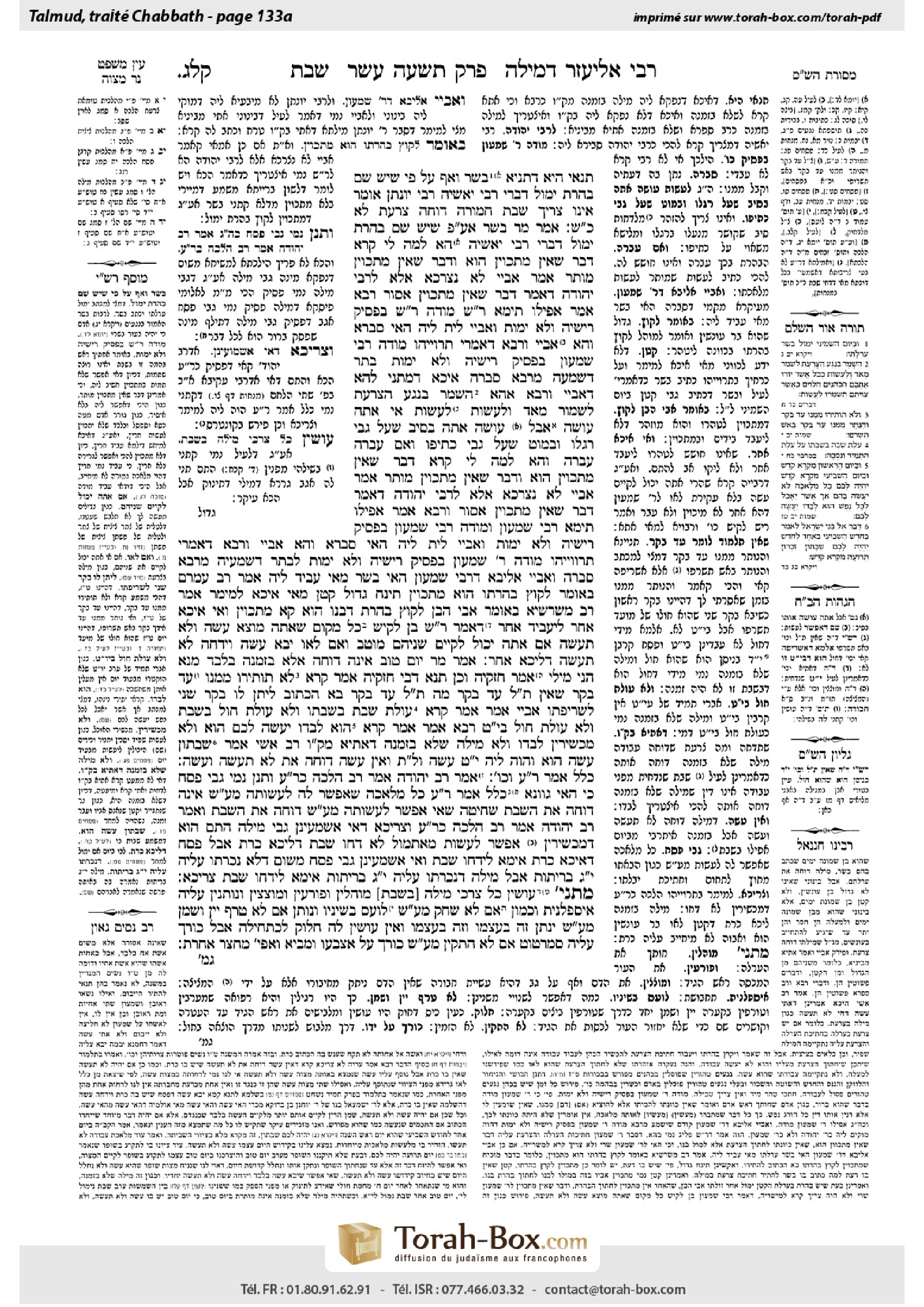
Shabbat 133a: Talmud study for Daf Yomi
Daf Yomi is the daily study of one Talmud folio. Explore 37 tractates with scans, Hebrew text, Sefaria English and AI-generated French translations where annotated.
Passage selection and English or AI-generated French translation are available where the scan has annotations. Daf Study is independent of Torah-Box and Sefaria.
Browse Shabbat · שבת · All tractatesShabbat 133a text and translations
This page of Shabbat includes the Aramaic text, an English translation and an AI-generated French translation, alongside the scan above.
שבת קל״ג א · Aramaic and Hebrew text
תַּנָּאֵי הִיא, דְּתַנְיָא: ״בָּשָׂר״ וְאַף עַל פִּי שֶׁיֵּשׁ שָׁם בַּהֶרֶת — ״יִמּוֹל״, דִּבְרֵי רַבִּי יֹאשִׁיָּה. רַבִּי יוֹנָתָן אוֹמֵר: אֵינוֹ צָרִיךְ, שַׁבָּת חֲמוּרָה — דּוֹחָה, צָרַעַת — לֹא כׇּל שֶׁכֵּן.
אָמַר מָר: ״בָּשָׂר״, אַף עַל פִּי שֶׁיֵּשׁ שָׁם בַּהֶרֶת — ״יִמּוֹל״, דִּבְרֵי רַבִּי יֹאשִׁיָּה. הָא לְמָה לִי קְרָא, דָּבָר שֶׁאֵין מִתְכַּוֵּין הוּא, וְדָבָר שֶׁאֵין מִתְכַּוֵּין — מוּתָּר!
אָמַר אַבָּיֵי: לָא נִצְרְכָא אֶלָּא לְרַבִּי יְהוּדָה, דְּאָמַר דָּבָר שֶׁאֵין מִתְכַּוֵּין — אָסוּר. רָבָא אָמַר: אֲפִילּוּ תֵּימָא רַבִּי שִׁמְעוֹן, מוֹדֶה רַבִּי שִׁמְעוֹן בִּ״פְסִיק רֵישֵׁיהּ וְלָא יְמוּת״. וְאַבָּיֵי לֵית לֵיהּ הַאי סְבָרָא? וְהָא אַבָּיֵי וְרָבָא דְּאָמְרִי תַּרְוַיְיהוּ: מוֹדֶה רַבִּי שִׁמְעוֹן בִּ״פְסִיק רֵישֵׁיהּ וְלָא יְמוּת״! בָּתַר דְּשַׁמְעַהּ מֵרָבָא סַבְרַהּ.
אִיכָּא דְּמַתְנֵי לְהָא דְּאַבָּיֵי וְרָבָא אַהָא: ״הִשָּׁמֶר בְּנֶגַע הַצָּרַעַת לִשְׁמֹר מְאֹד וְלַעֲשׂוֹת״, לַעֲשׂוֹת אִי אַתָּה עוֹשֶׂה, אֲבָל עוֹשֶׂה אַתָּה בְּסִיב שֶׁעַל גַּבֵּי רַגְלוֹ, וּבְמוֹט שֶׁעַל גַּבֵּי כְּתֵיפוֹ, וְאִם עָבְרָה — עָבְרָה.
וְהָא לְמָה לִי קְרָא, דָּבָר שֶׁאֵין מִתְכַּוֵּין הוּא, וְדָבָר שֶׁאֵין מִתְכַּוֵּין — מוּתָּר! אָמַר אַבָּיֵי: לֹא נִצְרְכָה אֶלָּא לְרַבִּי יְהוּדָה דְּאָמַר: דָּבָר שֶׁאֵין מִתְכַּוֵּין — אָסוּר. וְרָבָא אָמַר אֲפִילּוּ תֵּימָא רַבִּי שִׁמְעוֹן, מוֹדֶה רַבִּי שִׁמְעוֹן בִּ״פְסִיק רֵישֵׁיהּ וְלָא יְמוּת״. וְאַבָּיֵי לֵית לֵיהּ הַאי סְבָרָא? וְהָא אַבָּיֵי וְרָבָא דְּאָמְרִי תַּרְוַויְיהוּ: מוֹדֶה רַבִּי שִׁמְעוֹן בִּ״פְסִיק רֵישֵׁיהּ וְלָא יְמוּת״! לְבָתַר דְּשַׁמְעֵיהּ מֵרָבָא סַבְרַהּ.
וְאַבָּיֵי אַלִּיבָּא דְּרַבִּי שִׁמְעוֹן, הַאי ״בְּשַׂר״ מַאי עָבֵיד לֵיהּ? אָמַר רַב עַמְרָם: בְּאוֹמֵר לָקוֹץ בַּהַרְתּוֹ הוּא מִתְכַּוֵּין.
תִּינַח גָּדוֹל, קָטָן מַאי אִיכָּא לְמֵימַר? אָמַר רַב מְשַׁרְשְׁיָא: בְּאוֹמֵר אֲבִי הַבֵּן לָקוֹץ בַּהֶרֶת דִּבְנוֹ הוּא קָא מִתְכַּוֵּין.
וְאִי אִיכָּא אַחֵר, לֶיעְבֵּיד אַחֵר! דְּאָמַר רַבִּי שִׁמְעוֹן בֶּן לָקִישׁ: כׇּל מָקוֹם שֶׁאַתָּה מוֹצֵא עֲשֵׂה וְלֹא תַעֲשֶׂה — אִם אַתָּה יָכוֹל לְקַיֵּים שְׁנֵיהֶם מוּטָב, וְאִם לָאו — יָבֹא עֲשֵׂה וְיִדְחֶה לֹא תַעֲשֶׂה. דְּלֵיכָּא אַחֵר.
אָמַר מָר: יוֹם טוֹב אֵינָהּ דּוֹחָה אֶלָּא בִּזְמַנָּהּ בִּלְבַד. מְנָא הָנֵי מִילֵּי?
אָמַר חִזְקִיָּה, וְכֵן תָּנָא דְּבֵי חִזְקִיָּה, אָמַר קְרָא: ״לֹא תוֹתִירוּ מִמֶּנּוּ עַד בֹּקֶר״, שֶׁאֵין תַּלְמוּד לוֹמַר ״עַד בֹּקֶר״, מַה תַּלְמוּד לוֹמַר ״עַד בֹּקֶר״ — בָּא הַכָּתוּב לִיתֵּן לוֹ בֹּקֶר שֵׁנִי לִשְׂרֵיפָתוֹ.
אַבָּיֵי אָמַר, אָמַר קְרָא: ״עוֹלַת שַׁבָּת בְּשַׁבַּתּוֹ״, וְלֹא עוֹלַת חוֹל בְּשַׁבָּת, וְלֹא עוֹלַת חוֹל בְּיוֹם טוֹב.
רָבָא אָמַר, אָמַר קְרָא: ״הוּא לְבַדּוֹ יֵעָשֶׂה לָכֶם״, ״הוּא״ — וְלֹא מַכְשִׁירִין. ״לְבַדּוֹ״ — וְלֹא מִילָה שֶׁלֹּא בִּזְמַנָּהּ, דְּאָתְיָא מִקַּל וָחוֹמֶר.
רַב אָשֵׁי אָמַר: ״שַׁבָּתוֹן״ — עֲשֵׂה הוּא, וְהָוֵה לֵיהּ יוֹם טוֹב עֲשֵׂה וְלֹא תַעֲשֶׂה, וְאֵין עֲשֵׂה דּוֹחֶה אֶת לֹא תַעֲשֶׂה וַעֲשֵׂה.
כְּלָל אָמַר רַבִּי עֲקִיבָא וְכוּ׳. אָמַר רַב יְהוּדָה אָמַר רַב: הֲלָכָה כְּרַבִּי עֲקִיבָא.
וּתְנַן נָמֵי גַּבֵּי פֶסַח כִּי הַאי גַוְונָא: כְּלָל אָמַר רַבִּי עֲקִיבָא: כׇּל מְלָאכָה שֶׁאֶפְשָׁר לָהּ לַעֲשׂוֹתָהּ מֵעֶרֶב שַׁבָּת — אֵינָהּ דּוֹחָה אֶת הַשַּׁבָּת. שְׁחִיטָה שֶׁאִי אֶפְשָׁר לַעֲשׂוֹתָהּ מֵעֶרֶב שַׁבָּת — דּוֹחָה אֶת הַשַּׁבָּת. וְאָמַר רַב יְהוּדָה אָמַר רַב: הֲלָכָה כְּרַבִּי עֲקִיבָא.
וּצְרִיכָא, דְּאִי אַשְׁמְעִינַן גַּבֵּי מִילָה: הָתָם הוּא דְּמַכְשִׁירִין אֶפְשָׁר לַעֲשׂוֹת מֵאֶתְמוֹל לָא דָּחוּ שַׁבָּת דְּלֵיכָּא כָּרֵת, אֲבָל פֶּסַח דְּאִיכָּא כָּרֵת — אֵימָא לִידְחוֹ שַׁבָּת.
וְאִי אַשְׁמְעִינַן גַּבֵּי פֶסַח, מִשּׁוּם דְּלֹא נִכְרְתוּ עָלֶיהָ שְׁלֹשׁ עֶשְׂרֵה בְּרִיתוֹת. אֲבָל מִילָה דְּנִכְרְתוּ עָלֶיהָ שְׁלֹשׁ עֶשְׂרֵה בְּרִיתוֹת — אֵימָא לִידְחוֹ שַׁבָּת, צְרִיכָא.
מַתְנִי׳ עוֹשִׂין כׇּל צׇרְכֵי מִילָה [בְּשַׁבָּת]: מוֹהֲלִין וּפוֹרְעִין וּמוֹצְצִין וְנוֹתְנִין עָלֶיהָ אִיסְפְּלָנִית וְכַמּוֹן.
אִם לֹא שָׁחַק מֵעֶרֶב שַׁבָּת — לוֹעֵס בְּשִׁינָּיו וְנוֹתֵן. אִם לֹא טָרַף יַיִן וָשֶׁמֶן מֵעֶרֶב שַׁבָּת — נוֹתֵן זֶה בְּעַצְמוֹ וְזֶה בְּעַצְמוֹ.
וְאֵין עוֹשִׂין לָהּ חָלוּק לְכַתְּחִילָּה, אֲבָל כּוֹרֵךְ עָלֶיהָ סְמַרְטוּט. אִם לֹא הִתְקִין מֵעֶרֶב שַׁבָּת — כּוֹרֵךְ עַל אֶצְבָּעוֹ וּמֵבִיא, וַאֲפִילּוּ מֵחָצֵר אַחֶרֶת.
Shabbat 133a · English translation
is a dispute of tanna’im, as it was taught in a baraita: The term flesh comes to teach that even though there is a bright white spot there, one should circumcise; this is the statement of Rabbi Yoshiya. Rabbi Yonatan says: There is no need for this derivation from the word flesh in the verse. Rather, the same law can be derived by means of an a fortiori inference: If circumcision overrides Shabbat, which is stringent, all the more so that it overrides leprosy.
We earlier learned that the Master said: When the verse states the term flesh, it comes to teach that even though there is a bright white spot there, one should circumcise; this is the statement of Rabbi Yoshiya. Rabbi Yonatan agrees with this halakha, albeit for a different reason. The Gemara addresses the fundamental question: Why do I need a verse to derive this? The removal of leprous skin is an unintentional act. One does not intend to cut the symptom of leprosy; he intended to circumcise the baby. And the general rule is that an unintentional act is permitted. Consequently, there is no need for a special derivation in this case.
Abaye said: This derivation is only necessary according to the opinion of Rabbi Yehuda, who said that an unintentional act is prohibited. Rava said: Even if you say that it is according to the opinion of Rabbi Shimon, who holds that an unintentional act is permitted, as Rabbi Shimon concedes to Rabbi Yehuda in the case of: Cut off its head and will it not die, i.e., an unintentional act from which a prohibited labor ensued as an inevitable consequence. In that case, the one who performs the action cannot claim that the outcome was unintended. In the case of circumcising a leprous foreskin, the removal of leprosy is an inevitable consequence of the circumcision. The Gemara asks: And does Abaye not accept this reasoning? Wasn’t it Abaye and Rava who both say that Rabbi Shimon concedes to Rabbi Yehuda that in the case of: If you cut off its head will it not die? The Gemara answers: After Abaye heard this principle from Rava, he accepted it.
Some teach that which Abaye and Rava said as referring to this baraita. The verse states: “Take heed with regard to the plague of leprosy that you observe diligently and do in accordance with all that the priests, the Levites, instruct you; as I commanded them you shall take care to do” (Deuteronomy 24:8). The Sages derived from here that to do something in order to remove leprosy directly, you may not do; but you may do something that will indirectly remove one’s symptom, such as tying a thick rope on his foot, and placing a rod on his shoulder. This is permitted even though there is a bright white spot present, and if the bright white spot is thereby removed, it is removed.
The Gemara asks: Why do I need a verse to address this? It is an unintentional act, and an unintentional act is permitted. Abaye said: This derivation is only necessary according to the opinion of Rabbi Yehuda, who said that an unintentional act is prohibited. Rava said: Even if you say that it is according to the opinion of Rabbi Shimon, who holds that an unintentional act is permitted, as Rabbi Shimon concedes to Rabbi Yehuda in the case of: If you cut off its head will it not die? The Gemara asks: And does Abaye not accept this reasoning? Wasn’t it Abaye and Rava who both say that Rabbi Shimon concedes to Rabbi Yehuda that in the case of: Cut off its head and will it not die? The Gemara answers: After Abaye heard this principle from Rava, he accepted it.
The Gemara clarifies: According to Abaye’s initial understanding of the halakha in accordance with the opinion of Rabbi Shimon, i.e., even the inevitable consequence of an unintended act is permitted, what does he do with this term flesh, which appears in the verse with regard to circumcision? Rav Amram said: This term teaches that even in a case where the person who is circumcising himself says explicitly that his intention is also to cut off the bright white spot, the circumcision nonetheless overrides the prohibition to remove symptoms of leprosy.
The Gemara asks: This works out well in the case of an adult who intends to perform the prohibited act. With regard to the circumcision of a minor, who has no intention at all, what is there to say, i.e., how does this teaching apply? Rav Mesharshiya said: The teaching applies in a case where the father of the circumcised child says that his intention is to cut off his son’s bright white leprous spot.
The Gemara asks: In that case, if there is another person present who can circumcise the child, let the other person perform the circumcision. Presumably the other person will not intend to excise the bright white spot but rather will intend to fulfill the mitzva of circumcision, and no transgression will be committed, as Rabbi Shimon ben Lakish said: Any place that you find positive and negative mitzvot that clash with one another, if you can find some way to fulfill both, that is preferable; and if that is not possible, the positive mitzva will come and override the negative mitzva. Here it is possible to fulfill both the positive and negative mitzvot by having another person perform the circumcision. The Gemara answers: This is a case where there is no other person to perform circumcision; only the boy’s father can circumcise him. Therefore, a particular verse is needed to teach us that the mitzva of circumcision overrides the prohibition to cut off symptoms of leprosy.
We learned earlier that the Master said that circumcision only overrides a Festival when the circumcision takes place at its proper time, on the eighth day after birth. The Gemara asks: From where are these matters derived?
Ḥizkiya said, and likewise one of the Sages of the school of Ḥizkiya taught: The verse states with regard to the Paschal lamb: “And you shall not leave any of it until morning; but that which remains of it until morning you shall burn with fire” (Exodus 12:10). This verse contains a superfluous phrase, as the Torah did not need to state until morning the second time; it would have been sufficient to state: But that which remains of it you shall burn with fire. Rather, why does the Torah state until morning? The verse comes to provide him with the second morning for burning. Leftover meat of the Paschal lamb is not burned on the following morning, which is a Festival, but rather on the following day, the first of the intermediate days of the Festival. Even though the labor of kindling a fire is not entirely prohibited on a Festival, as one may cook and bake, it is derived from here that kindling a fire is permitted only for the purpose of preparing food for the immediate needs of the day and not for purposes that can be postponed until the intermediate days. Similarly, since circumcision involves a prohibited labor, it is permitted on the eighth day only when there is no option of postponing it. Otherwise, doing so is prohibited.
Abaye said there is a different source for the fact that only circumcision on the eighth day overrides the Festival, as the verse stated: “The burnt-offering of each Shabbat on its Shabbat in addition to the continual burnt-offering and its libation” (Numbers 28:10). This verse teaches that one may not sacrifice the burnt-offering of a weekday on Shabbat, and one may not sacrifice the burnt-offering of a weekday on a Festival. Although slaughtering is permitted on a Festival for sustenance, it is nevertheless prohibited to slaughter animals for sacrifices other than those specifically mandated on the Festival. Temple service only overrides prohibited labor in the case of Temple service that is an essential obligation of that day. Similarly, circumcision only overrides the prohibition of labor when it is an essential obligation of that day, which is the case only on the eighth day; it is not the case after the eighth day.
Rava said there is a different proof, as the verse states with regard to Festivals: “And in the first day there shall be to you a holy convocation, and in the seventh day a holy convocation; no manner of work shall be done in them, save that which every man must eat; that alone may be done for you” (Exodus 12:16). The superfluous term “that” in the verse teaches the following: That which is necessary for food preparation itself is permitted and not actions that facilitate food preparation or which prepare utensils necessary for eating. Similarly, “that alone may be done” teaches: Only food preparation may be performed and not circumcision that is not at its appointed time, which could have been derived through an a fortiori inference. Therefore, the verse emphasizes that “that alone” may be performed, to teach that prohibited labors are permitted for sustenance on a Festival, and are not permitted for other mitzvot.
Rav Ashi said: The mitzvot of a Festival include not only a negative mitzva but also a positive one. There is a prohibition of labor as well as Shabbaton, an obligation to engage in solemn rest, which is a positive mitzva, and therefore the observance of a Festival constitutes both a positive mitzva and a negative mitzva. And there is a principle that a positive mitzva does not override both a negative mitzva and a positive mitzva.
We learned in the mishna: A principle was stated by Rabbi Akiva: Any prohibited labor that can be performed on Shabbat eve does not override Shabbat; however, any prohibited labor that cannot be performed on Shabbat eve overrides Shabbat. Rav Yehuda said that Rav said: The halakha is in accordance with the opinion of Rabbi Akiva in this matter.
And we also learned in a mishna pertaining to the Paschal lamb, in a similar vein: A principle was stated by Rabbi Akiva: Any prohibited labor that can be performed on Shabbat eve does not override Shabbat. By contrast, the slaughtering of the Paschal lamb, which cannot be performed on Shabbat eve, as it has a fixed time from the Torah, overrides Shabbat. And Rav Yehuda said that Rav said: The halakha is in accordance with Rabbi Akiva.
The Gemara comments: And both statements that the halakha is in accordance with Rabbi Akiva were necessary. As had Rav taught us that the halakha is in accordance with Rabbi Akiva only with regard to circumcision, the conclusion would have been: It is specifically there that facilitators that can be performed the day before do not override Shabbat, as there is no punishment of karet if the circumcision is delayed, as liability for karet only applies when the child becomes obligated in mitzvot and chooses not to circumcise himself. However, with regard to the Paschal lamb, where there is karet for one who fails to offer the sacrifice at its proper time, one would say that those facilitators should override Shabbat. Therefore, it was necessary for Rav to state that the halakha is in accordance with the opinion of Rabbi Akiva with regard to the Paschal lamb.
And if Rav had taught us that the halakha is in accordance with Rabbi Akiva only with regard to the Paschal lamb, the conclusion would have been that the reason that facilitators that can be performed on the eve of the Festival do not override the Festival is because thirteen covenants were not established upon the Paschal lamb, and it is therefore not so significant. However, with regard to circumcision, upon which thirteen covenants were established, the conclusion would have been that even actions that facilitate the mitzva that could have been performed on Shabbat eve should override Shabbat. It was therefore necessary to teach that the halakha is in accordance with Rabbi Akiva in both cases.
MISHNA: When the eighth day of a baby’s life occurs on Shabbat, he must be circumcised on that day. Therefore, one performs all the necessities of the circumcision, even on Shabbat: One circumcises the foreskin, and uncovers the skin by removing the thin membrane beneath the foreskin, and sucks the blood from the wound, and places on it both a bandage [ispelanit] and cumin as a salve.
If one did not grind the cumin from Shabbat eve, he chews it with his teeth and places it on the place of circumcision as a salve. If he did not mix wine and oil on Shabbat eve, a mixture designed to heal and strengthen the child, this, the wine, is placed on the wound by itself and that, the oil, is placed by itself.
And on Shabbat one may not make a pouch to place over the circumcision as a bandage ab initio, but he may wrap a rag over it as a dressing. If he did not prepare the bandage on Shabbat eve by bringing it to the place where the circumcision was performed, he wraps the bandage on his finger and brings it on Shabbat, even from a different courtyard. While the Sages permitted it to be brought, they required that it be performed in an unusual fashion, by wearing it in the manner of a garment.
Shabbat 133a · Traduction française (IA)
Il s’agit d’une controverse entre tannaïm, comme il est enseigné dans une baraïta : Le terme « chair » vient enseigner que, même s’il y a là une tache d’un blanc éclatant, il faut pratiquer la circoncision ; telle est l’opinion de Rabbi Yoshiya. Rabbi Yonatan dit : Il n’est pas nécessaire de tirer cette déduction du mot « chair » dans le verset. On peut plutôt déduire la même halakha par un raisonnement a fortiori : si la circoncision repousse le Chabbat, qui est strict, à plus forte raison repousse-t-elle la lèpre.
Nous avons appris plus haut que le Maître a dit : Lorsque le verset emploie le terme « chair », il vient enseigner que, même s’il y a là une tache d’un blanc éclatant, il faut pratiquer la circoncision ; telle est l’opinion de Rabbi Yoshiya. Rabbi Yonatan reconnaît cette halakha, mais pour une autre raison. La Guemara aborde la question fondamentale : pourquoi faut-il un verset pour déduire cela ? L’ablation de la peau atteinte de lèpre est un acte involontaire. On ne cherche pas à couper le signe de la lèpre ; on a l’intention de circoncire le bébé. Or, la règle générale veut qu’un acte involontaire soit permis. Par conséquent, il n’est pas nécessaire d’avoir une déduction particulière dans ce cas.
Abaye dit : Cette déduction n’est nécessaire que selon l’opinion de Rabbi Yehouda, qui dit qu’un acte involontaire est interdit. Rava dit : Même si l’on affirme que cela suit l’opinion de Rabbi Shimon, selon laquelle un acte involontaire est permis, Rabbi Shimon reconnaît néanmoins l’avis de Rabbi Yehouda dans le cas de « coupe-lui la tête, et ne mourra-t-il pas ? », c’est-à-dire lorsqu’un acte involontaire entraîne inévitablement un travail interdit. Dans ce cas, celui qui accomplit l’action ne peut prétendre que le résultat n’était pas voulu. Lorsqu’on circoncit un prépuce atteint de lèpre, l’élimination de la lèpre est une conséquence inévitable de la circoncision. La Guemara demande : Abaye n’accepte-t-il donc pas ce raisonnement ? Abaye et Rava ne disent-ils pas tous deux que Rabbi Shimon reconnaît l’avis de Rabbi Yehouda dans le cas de « si tu lui coupes la tête, ne mourra-t-il pas ? » La Guemara répond : Après avoir entendu ce principe de Rava, Abaye l’a accepté.
Certains enseignent que les propos d’Abaye et de Rava se rapportent à cette baraïta. Le verset dit : « Prends garde à la plaie de la lèpre, afin d’observer avec soin et d’agir selon tout ce que les prêtres, les Lévites, vous enseigneront ; vous veillerez à agir conformément à ce que je leur ai ordonné » (Deutéronome 24:8). Les Sages en déduisent qu’on ne peut pas accomplir une action dans le but direct d’éliminer la lèpre, mais qu’on peut accomplir une action qui éliminera indirectement le signe de quelqu’un, par exemple en attachant une grosse corde à son pied et en plaçant une perche sur son épaule. Cela est permis même si une tache d’un blanc éclatant est présente ; si la tache est ainsi éliminée, elle l’est.
La Guemara demande : Pourquoi faut-il un verset pour traiter cette question ? Il s’agit d’un acte involontaire, et un acte involontaire est permis. Abaye dit : Cette déduction n’est nécessaire que selon l’opinion de Rabbi Yehouda, qui dit qu’un acte involontaire est interdit. Rava dit : Même si l’on affirme que cela suit l’opinion de Rabbi Shimon, selon laquelle un acte involontaire est permis, Rabbi Shimon reconnaît néanmoins l’avis de Rabbi Yehouda dans le cas de « si tu lui coupes la tête, ne mourra-t-il pas ? » La Guemara demande : Abaye n’accepte-t-il donc pas ce raisonnement ? Abaye et Rava ne disent-ils pas tous deux que Rabbi Shimon reconnaît l’avis de Rabbi Yehouda dans le cas de « coupe-lui la tête, et ne mourra-t-il pas ? » La Guemara répond : Après avoir entendu ce principe de Rava, Abaye l’a accepté.
La Guemara précise : Selon la compréhension initiale qu’Abaye avait de la halakha, conformément à l’opinion de Rabbi Shimon — à savoir que même la conséquence inévitable d’un acte involontaire est permise —, que fait-il du terme « chair », qui apparaît dans le verset relatif à la circoncision ? Rav Amram dit : Ce terme enseigne que même si celui qui pratique la circoncision déclare explicitement qu’il a également l’intention de couper la tache d’un blanc éclatant, la circoncision repousse néanmoins l’interdiction d’éliminer les signes de la lèpre.
La Guemara demande : Cela convient dans le cas d’un adulte qui a l’intention d’accomplir l’acte interdit. Mais qu’en est-il de la circoncision d’un mineur, qui n’a absolument aucune intention ? Comment appliquer cet enseignement ? Rav Mesharshiya dit : Cet enseignement s’applique dans le cas où le père de l’enfant à circoncire dit qu’il a l’intention de couper la tache lépreuse d’un blanc éclatant de son fils.
La Guemara demande : Dans ce cas, s’il y a une autre personne présente qui peut circoncire l’enfant, que cette autre personne le fasse. On peut supposer qu’elle n’aura pas l’intention d’enlever la tache d’un blanc éclatant, mais seulement d’accomplir la mitsva de la circoncision ; aucune transgression ne sera donc commise. En effet, Rabbi Shimon ben Lakish a dit : Chaque fois que des mitsvot positives et négatives entrent en conflit, si l’on peut trouver un moyen de les accomplir toutes les deux, c’est préférable ; si cela n’est pas possible, la mitsva positive vient repousser la mitsva négative. Ici, il est possible d’accomplir les deux mitsvot en faisant pratiquer la circoncision par une autre personne. La Guemara répond : Il s’agit d’un cas où aucune autre personne ne peut pratiquer la circoncision ; seul le père du garçon peut le circoncire. Un verset particulier est donc nécessaire pour nous enseigner que la mitsva de la circoncision repousse l’interdiction de couper les signes de la lèpre.
Nous avons appris plus haut que le Maître a dit que la circoncision ne repousse un jour de fête que lorsqu’elle est pratiquée au moment prescrit, le huitième jour après la naissance. La Guemara demande : D’où tire-t-on ces règles ?
Ḥizkiya a dit, et l’un des Sages de l’école de Ḥizkiya a également enseigné : Le verset dit au sujet de l’agneau pascal : « Vous n’en laisserez rien jusqu’au matin ; ce qui en restera jusqu’au matin, vous le brûlerez au feu » (Exode 12:10). Ce verset contient une expression superflue, car la Torah n’avait pas besoin de répéter « jusqu’au matin » ; il aurait suffi de dire : « Ce qui en restera, vous le brûlerez au feu. » Pourquoi la Torah dit-elle donc « jusqu’au matin » ? Le verset vient lui fournir un second matin pour la combustion. Les restes de viande de l’agneau pascal ne sont pas brûlés le lendemain matin, qui est un jour de fête, mais le jour suivant, le premier jour des jours intermédiaires de la fête. Même si l’allumage d’un feu n’est pas totalement interdit un jour de fête, puisqu’on peut cuisiner et faire cuire au four, on déduit de là que l’allumage d’un feu n’est permis que pour préparer de la nourriture destinée aux besoins immédiats de la journée, et non pour des tâches qui peuvent attendre les jours intermédiaires. De même, puisque la circoncision implique un travail interdit, elle n’est permise le huitième jour que lorsqu’il n’est pas possible de la reporter. Sinon, elle est interdite.
Abaye dit qu’il existe une autre source établissant que seule la circoncision pratiquée le huitième jour repousse un jour de fête, car le verset dit : « L’holocauste de chaque Chabbat, en son Chabbat, en plus de l’holocauste perpétuel et de sa libation » (Nombres 28:10). Ce verset enseigne qu’on ne peut pas offrir l’holocauste d’un jour de semaine le Chabbat, ni un jour de fête. Bien que l’abattage soit permis un jour de fête pour assurer la subsistance, il est néanmoins interdit d’abattre des animaux destinés à des sacrifices autres que ceux expressément prescrits pour ce jour de fête. Le service du Temple ne repousse les travaux interdits que lorsqu’il constitue une obligation essentielle de ce jour. De même, la circoncision ne repousse l’interdiction de travailler que lorsqu’elle constitue une obligation essentielle de ce jour, ce qui n’est le cas que le huitième jour, et non après.
Rava dit qu’il existe une autre preuve, car le verset dit au sujet des jours de fête : « Le premier jour, vous aurez une sainte assemblée, et le septième jour, une sainte assemblée ; aucun travail ne sera fait ces jours-là, sauf ce que chacun doit manger ; cela seulement pourra être fait pour vous » (Exode 12:16). Le terme superflu « cela » dans le verset enseigne ceci : ce qui est nécessaire à la préparation même de la nourriture est permis, mais non les actions qui facilitent la préparation des aliments ou qui préparent les ustensiles nécessaires pour manger. De même, l’expression « cela seulement pourra être fait » enseigne que seule la préparation de nourriture peut être accomplie, et non une circoncision qui n’a pas lieu au moment prescrit, ce qu’on aurait pu déduire par un raisonnement a fortiori. Le verset précise donc « cela seulement » pour enseigner que les travaux interdits sont permis un jour de fête pour assurer la subsistance, mais pas pour d’autres mitsvot.
Rav Ashi dit : Les mitsvot d’un jour de fête comprennent non seulement une mitsva négative, mais aussi une mitsva positive. Il y a une interdiction de travailler ainsi que le Shabbaton, l’obligation de respecter un repos solennel, qui est une mitsva positive ; observer un jour de fête constitue donc à la fois une mitsva positive et une mitsva négative. Or, selon un principe, une mitsva positive ne repousse pas à la fois une mitsva négative et une mitsva positive.
Nous avons appris dans la Michna : Rabbi Akiva a énoncé un principe : tout travail interdit qui peut être accompli la veille du Chabbat ne repousse pas le Chabbat ; en revanche, tout travail interdit qui ne peut pas être accompli la veille du Chabbat repousse le Chabbat. Rav Yehouda a dit au nom de Rav : La halakha suit l’opinion de Rabbi Akiva sur ce point.
Nous avons également appris dans une Michna relative à l’agneau pascal, dans le même esprit : Rabbi Akiva a énoncé un principe : tout travail interdit qui peut être accompli la veille du Chabbat ne repousse pas le Chabbat. En revanche, l’abattage de l’agneau pascal, qui ne peut pas être accompli la veille du Chabbat puisqu’il a un moment fixé par la Torah, repousse le Chabbat. Rav Yehouda a dit au nom de Rav : La halakha suit l’opinion de Rabbi Akiva.
La Guemara commente : Les deux déclarations selon lesquelles la halakha suit l’opinion de Rabbi Akiva étaient nécessaires. En effet, si Rav nous avait enseigné que la halakha suit l’opinion de Rabbi Akiva uniquement au sujet de la circoncision, on aurait conclu que c’est précisément dans ce cas que les préparatifs pouvant être accomplis la veille ne repoussent pas le Chabbat, car le retard de la circoncision n’entraîne pas de peine de retranchement (karet) : cette peine ne s’applique que lorsque l’enfant devient tenu d’accomplir les mitsvot et choisit de ne pas se circoncire lui-même. Mais, au sujet de l’agneau pascal, où celui qui ne l’offre pas au moment prescrit encourt le karet, on aurait dit que ces préparatifs devraient repousser le Chabbat. Il était donc nécessaire que Rav enseigne que la halakha suit l’opinion de Rabbi Akiva au sujet de l’agneau pascal.
Et si Rav nous avait enseigné que la halakha suit l’opinion de Rabbi Akiva uniquement au sujet de l’agneau pascal, on aurait conclu que la raison pour laquelle les préparatifs pouvant être accomplis la veille du jour de fête ne repoussent pas le jour de fête est que treize alliances n’ont pas été conclues au sujet de l’agneau pascal, qui n’a donc pas une importance aussi grande. Mais, au sujet de la circoncision, à propos de laquelle treize alliances ont été conclues, on aurait conclu que même les actions préparatoires à la mitsva qui auraient pu être accomplies la veille du Chabbat devraient repousser le Chabbat. Il était donc nécessaire d’enseigner que la halakha suit l’opinion de Rabbi Akiva dans les deux cas.
MICHNA : Lorsque le huitième jour de la vie d’un bébé tombe un Chabbat, il faut le circoncire ce jour-là. On accomplit donc tous les actes nécessaires à la circoncision, même le Chabbat : on coupe le prépuce, on découvre la peau en retirant la fine membrane située sous le prépuce, on aspire le sang de la plaie, puis on y applique un pansement [ispelanit] ainsi que du cumin en guise de pommade.
Si l’on n’a pas broyé le cumin la veille du Chabbat, on le mâche avec les dents et on l’applique en guise de pommade sur l’endroit de la circoncision. Si l’on n’a pas mélangé le vin et l’huile la veille du Chabbat — mélange destiné à guérir et à fortifier l’enfant —, on applique séparément celui-ci, le vin, sur la plaie, et séparément celle-là, l’huile.
Le Chabbat, on ne peut pas confectionner d’emblée une pochette à placer sur la circoncision en guise de pansement, mais on peut l’envelopper d’un chiffon comme pansement. Si l’on n’a pas préparé le pansement la veille du Chabbat en l’apportant à l’endroit où la circoncision a été pratiquée, on l’enroule autour du doigt et on l’apporte le Chabbat, même depuis une autre cour. Bien que les Sages aient permis de l’apporter, ils ont exigé que cela se fasse de manière inhabituelle, en le portant comme un vêtement.
Traduction française générée par IA à partir de l’édition anglaise de Sefaria. Vérifie toujours un passage avec le texte source.
Text from Sefaria: William Davidson Edition - Vocalized Aramaic (CC BY NC); William Davidson Edition - English (CC BY NC).