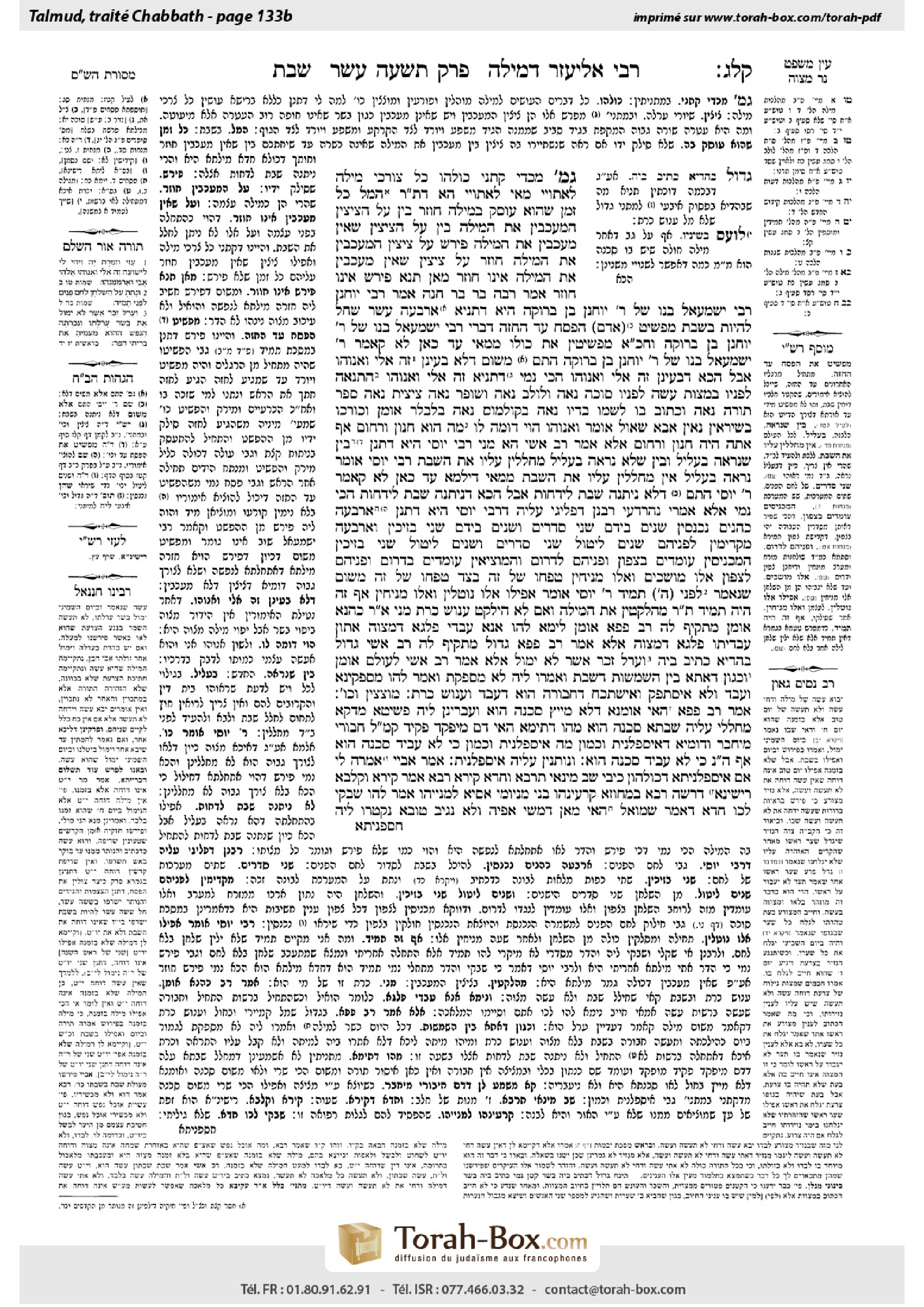
Shabbat 133b: Talmud study for Daf Yomi
Daf Yomi is the daily study of one Talmud folio. Explore 37 tractates with scans, Hebrew text, Sefaria English and AI-generated French translations where annotated.
Passage selection and English or AI-generated French translation are available where the scan has annotations. Daf Study is independent of Torah-Box and Sefaria.
Browse Shabbat · שבת · All tractatesShabbat 133b text and translations
This page of Shabbat includes the Aramaic text, an English translation and an AI-generated French translation, alongside the scan above.
שבת קל״ג ב · Aramaic and Hebrew text
גְּמָ׳ מִכְּדֵי קָתָנֵי כּוּלְּהוּ, ״כׇּל צוֹרְכֵי מִילָה״ לְאֵתוֹיֵי מַאי?
לְאֵתוֹיֵי הָא דְּתָנוּ רַבָּנַן: הַמָּל, כׇּל זְמַן שֶׁהוּא עוֹסֵק בַּמִּילָה — חוֹזֵר בֵּין עַל הַצִּיצִין הַמְעַכְּבִין אֶת הַמִּילָה בֵּין עַל הַצִּיצִין שֶׁאֵין מְעַכְּבִין אֶת הַמִּילָה. פֵּירַשׁ, עַל צִיצִין הַמְעַכְּבִין אֶת הַמִּילָה — חוֹזֵר, עַל צִיצִין שֶׁאֵין מְעַכְּבִין אֶת הַמִּילָה — אֵינוֹ חוֹזֵר.
מַאן תַּנָּא פֵּירַשׁ אֵינוֹ חוֹזֵר? אָמַר רַבָּה בַּר בַּר חָנָה אָמַר רַבִּי יוֹחָנָן: רַבִּי יִשְׁמָעֵאל בְּנוֹ שֶׁל רַבִּי יוֹחָנָן בֶּן בְּרוֹקָה הִיא. דְּתַנְיָא: אַרְבָּעָה עָשָׂר שֶׁחָל לִהְיוֹת בְּשַׁבָּת — מַפְשִׁיט אָדָם הַפֶּסַח עַד הֶחָזֶה, דִּבְרֵי רַבִּי יִשְׁמָעֵאל בְּנוֹ שֶׁל רַבִּי יוֹחָנָן בֶּן בְּרוֹקָה. וַחֲכָמִים אוֹמְרִים: מַפְשִׁיטִין אֶת כּוּלּוֹ.
מִמַּאי? עַד כָּאן לָא קָאָמַר רַבִּי יִשְׁמָעֵאל בְּנוֹ שֶׁל רַבִּי יוֹחָנָן בֶּן בְּרוֹקָה הָתָם — מִשּׁוּם דְּלָא בָּעֵינַן ״זֶה אֵלִי וְאַנְוֵהוּ״. אֲבָל הָכָא — דְּבָעֵינַן ״זֶה אֵלִי וְאַנְוֵהוּ״, הָכִי נָמֵי.
דְּתַנְיָא: ״זֶה אֵלִי וְאַנְוֵהוּ״, הִתְנָאֵה לְפָנָיו בְּמִצְוֹת: עֲשֵׂה לְפָנָיו סוּכָּה נָאָה, וְלוּלָב נָאֶה, וְשׁוֹפָר נָאֶה, צִיצִית נָאָה, סֵפֶר תּוֹרָה נָאֶה, וּכְתוֹב בּוֹ לִשְׁמוֹ בִּדְיוֹ נָאֶה, בְּקוּלְמוֹס נָאֶה, בְּלַבְלָר אוּמָּן, וְכוֹרְכוֹ בְּשִׁירָאִין נָאִין.
אַבָּא שָׁאוּל אוֹמֵר: ״וְאַנְוֵהוּ״ — הֱוֵי דּוֹמֶה לוֹ, מָה הוּא חַנּוּן וְרַחוּם — אַף אַתָּה הֱיֵה חַנּוּן וְרַחוּם.
אֶלָּא אָמַר רַב אָשֵׁי: הָא מַנִּי — רַבִּי יוֹסֵי הִיא, דִּתְנַן: בֵּין שֶׁנִּרְאָה בַּעֲלִיל, וּבֵין שֶׁלֹּא נִרְאָה בַּעֲלִיל — מְחַלְּלִין עָלָיו אֶת הַשַּׁבָּת. רַבִּי יוֹסֵי אוֹמֵר: נִרְאָה בַּעֲלִיל — אֵין מְחַלְּלִין עָלָיו אֶת הַשַּׁבָּת.
מִמַּאי? דִּילְמָא עַד כָּאן לָא קָאָמַר רַבִּי יוֹסֵי הָתָם, דְּלֹא נִיתְּנָה שַׁבָּת לִידָּחוֹת, אֲבָל הָכָא דְּנִיתְּנָה שַׁבָּת לִידָּחוֹת — הָכִי נָמֵי.
אֶלָּא אָמְרִי נְהַרְדָּעֵי: רַבָּנַן דִּפְלִיגִי עֲלֵיהּ דְּרַבִּי יוֹסֵי הִיא. דִּתְנַן: אַרְבָּעָה כֹּהֲנִים נִכְנָסִין: שְׁנַיִם בְּיָדָם שְׁנֵי סְדָרִים, וּשְׁנַיִם בְּיָדָם שְׁנֵי בָזִיכִּין. וְאַרְבָּעָה מַקְדִּימִין לִפְנֵיהֶם: שְׁנַיִם לִיטּוֹל שְׁנֵי סְדָרִים, וּשְׁנַיִם לִיטּוֹל שְׁנֵי בָזִיכִּין. הַמַּכְנִיסִין עוֹמְדִים בַּצָּפוֹן וּפְנֵיהֶם לַדָּרוֹם, וְהַמּוֹצִיאִין עוֹמְדִים בַּדָּרוֹם וּפְנֵיהֶם לַצָּפוֹן. אֵלּוּ מוֹשְׁכִים, וְאֵלּוּ מַנִּיחִין, טִפְחוֹ שֶׁל זֶה בְּצַד טִפְחוֹ שֶׁל זֶה, מִשּׁוּם שֶׁנֶּאֱמַר ״לִפְנֵי ה׳ תָּמִיד״.
רַבִּי יוֹסֵי אוֹמֵר: אֲפִילּוּ אֵלּוּ נוֹטְלִין וְאֵלּוּ מַנִּיחִין אַף זֶה הָיָה ״תָּמִיד״.
תָּנוּ רַבָּנַן: מְהַלְקְטִין אֶת הַמִּילָה, וְאִם לֹא הִילְקֵט — עָנוּשׁ כָּרֵת. מַנִּי? אָמַר רַב כָּהֲנָא: אוּמָּן.
מַתְקֵיף לָהּ רַב פָּפָּא: אוּמָּן לֵימָא לְהוּ ״אֲנָא עֲבַדִי פַּלְגָא דְמִצְוָה, אַתּוּן [נָמֵי] עֲבִידוּ פַּלְגָא דְמִצְוָה״! אֶלָּא אָמַר רַב פָּפָּא: גָּדוֹל.
מַתְקֵיף לָהּ רַב אָשֵׁי: גָּדוֹל בְּהֶדְיָא כְּתִיב בֵּיהּ: ״וְעָרֵל זָכָר אֲשֶׁר לֹא יִמּוֹל״. אֶלָּא אָמַר רַב אָשֵׁי: לְעוֹלָם אוּמָּן, וּכְגוֹן דַּאֲתָא בֵּין הַשְּׁמָשׁוֹת דְּשַׁבָּת, וַאֲמַרוּ לֵיהּ: לָא מַסְפְּקַתְּ, וַאֲמַר לְהוּ: מַסְפְּקֵינָא, וַעֲבַד וְלָא אִיסְתַּפַּק, וְאִישְׁתְּכַח דְּחַבּוּרָה הוּא דַּעֲבַד, וְעָנוּשׁ כָּרֵת.
מוֹצְצִין וְכוּ׳. אָמַר רַב פָּפָּא: הַאי אוּמָּנָא דְּלָא מָיֵיץ — סַכָּנָה הוּא וּמְעַבְּרִינַן לֵיהּ.
פְּשִׁיטָא, מִדְּקָא מְחַלְּלִי עֲלֵיהּ שַׁבְּתָא סַכָּנָה הוּא! מַהוּ דְתֵימָא הַאי דָּם מִיפְקָד פְּקִיד, קָא מַשְׁמַע לַן חַבּוֹרֵי מִיחַבַּר.
וְדוּמְיָא דְּאִיסְפְּלָנִית וְכַמּוֹן: מָה אִיסְפְּלָנִית וְכַמּוֹן כִּי לָא עָבֵיד סַכָּנָה הוּא, אַף הָכָא נָמֵי, כִּי לָא עָבֵיד סַכָּנָה הוּא.
וְנוֹתְנִין עָלֶיהָ אִיסְפְּלָנִית. אָמַר אַבָּיֵי, אֲמַרָה לִי אֵם: אִיסְפְּלָנִיתָא דְּכוּלְּהוֹן כִּיבֵי — שַׁב מָאנֵי תַּרְבָּא, וַחֲדָא קִירָא. רָבָא אָמַר: קִירָא וְקַלְבָּא.
דַּרְשַׁהּ רָבָא בְּמָחוֹזָא, קַרְעִינְהוּ בְּנֵי מִנְיוֹמֵי אָסְיָא לְמָנַיְיהוּ. אֲמַר לְהוּ: שְׁבַקִי לְכוּ חֲדָא. דַּאֲמַר שְׁמוּאֵל: הַאי מַאן דְּמָשֵׁי אַפֵּיהּ וְלָא מִנַּגֵּיב טוּבָא — נִקְטְרוּ לֵיהּ
Shabbat 133b · English translation
GEMARA: The Gemara asks: Since the mishna is teaching all of them, i.e., enumerated all the requirements of circumcision, when the mishna added: One performs all the requirements of circumcision even on Shabbat, what did it come to include?
The Gemara answers: It comes to include that which the Sages taught in a baraita: One who circumcises on Shabbat, as long as he is engaged in the circumcision, he may return and remove shreds of skin that were not cut properly. This is the ruling both for shreds of skin and flesh that invalidate the circumcision if they are not cut, i.e., the child is not considered circumcised if they remain, and for shreds that do not invalidate the circumcision if they are not cut. But if the circumcisor has withdrawn from engaging in the mitzva of circumcision, he may return for shreds that invalidate the circumcision if they were not cut, as the mitzva has not yet been properly performed, but he may not return for shreds that do not invalidate the circumcision if they are not cut. Consequently, when the mishna refers to all the requirements of circumcision, it means that as long as one is still involved in the act of circumcision, one may go back and remove even pieces of skin that do not invalidate the circumcision.
With regard to this law, the Gemara asks: Who is the tanna who holds that if one has already withdrawn from a mitzva he may not return to engage in its performance? Which tanna asserts that as long as a person is involved in a mitzva whose performance overrides Shabbat, he may complete it; however, if he is no longer involved in the mitzva, he may not exceed the minimum requirements if doing so would desecrate Shabbat? Rabba bar bar Ḥana said that Rabbi Yoḥanan said: It is Rabbi Yishmael, son of Rabbi Yoḥanan ben Beroka, as it was taught in a baraita: In a case of the fourteenth of Nisan, the day the Paschal lamb is sacrificed, that occurs on Shabbat, one flays the Paschal lamb until he exposes the breast, in order to remove the portions that are offered on the altar, but one does not flay anymore, as it is not necessary for the mitzva of the day; this is the statement of Rabbi Yishmael, son of Rabbi Yoḥanan ben Beroka. And the Rabbis say: One may even flay the entire hide.
The Gemara raises a difficulty: From where do you draw this comparison? Perhaps Rabbi Yishmael, son of Rabbi Yoḥanan ben Beroka, only stated his opinion that one may do no more than the minimum requirement there, with regard to the Paschal lamb, because we do not need to fulfill the mitzva of: “This is my God and I will glorify Him” (Exodus 15:2). The manner in which the animal is flayed does not impact the mitzva of the sacrifice. However, here, with regard to circumcision, where we need to fulfill the mitzva of: “This is my God and I will glorify Him,” which requires performing the circumcision in a beautiful manner, indeed, Rabbi Yishmael would agree that the mitzva must be performed as aesthetically as possible.
What is the source for the requirement of: “This is my God and I will glorify Him”? As it was taught in a baraita with regard to the verse: “This is my God and I will glorify Him [anveihu], the Lord of my father and I will raise Him up.” The Sages interpreted anveihu homiletically as linguistically related to noi, beauty, and interpreted the verse: Beautify yourself before Him in mitzvot. Even if one fulfills the mitzva by performing it simply, it is nonetheless proper to perform the mitzva as beautifully as possible. Make before Him a beautiful sukka, a beautiful lulav, a beautiful shofar, beautiful ritual fringes, beautiful parchment for a Torah scroll, and write in it in His name in beautiful ink, with a beautiful quill by an expert scribe, and wrap the scroll in beautiful silk fabric.
Abba Shaul says: Ve’anveihu should be interpreted as if it were written in two words: Ani vaHu, me and Him [God]. Be similar, as it were, to Him, the Almighty: Just as He is compassionate and merciful, so too should you be compassionate and merciful. In any case, there is no proof from Rabbi Yishmael’s statement with regard to the Paschal lamb that he would say the same with regard to circumcision, as in that case, he might agree that fulfilling the mitzva beautifully justifies overriding Shabbat.
Rather, Rav Ashi said: This should be understood differently. In accordance with whose opinion is this baraita with regard to circumcision? It is in accordance with the opinion of Rabbi Yosei. As we learned in a mishna: Whether the new moon was clearly seen by everyone or whether it was not clearly seen, one may desecrate Shabbat in order to sanctify the New Moon. Eyewitnesses who saw the appearance of the moon may desecrate Shabbat in order to go to court and testify. Rabbi Yosei says: If the moon was clearly seen, they may not desecrate Shabbat for it, since other witnesses, located nearer to the court, will certainly testify. If these distant witnesses go to court to testify, they will desecrate Shabbat unnecessarily. Apparently, Rabbi Yosei holds that if the basic requirements of a mitzva have already been fulfilled, one may no longer desecrate Shabbat in its performance.
The Gemara rejects this: From where do you draw this comparison? Perhaps Rabbi Yosei only stated his opinion there, in the case of sanctification of the New Moon, because there no allowance was made for Shabbat to be overridden. Given that the moon was clearly seen and testimony to that effect could have been delivered easily, there was no need for additional witnesses to come and desecrate Shabbat, and the prohibition to desecrate Shabbat remained in place. However, here, in the case of circumcision, where allowance was made for Shabbat desecration, as it is permitted and required to perform circumcision on Shabbat at its appointed time, indeed, it would be permitted to complete the circumcision even according to Rabbi Yosei.
Rather, the Sages of Neharde’a say: This ruling is in accordance with the opinion of the Rabbis, who disagree with Rabbi Yosei. As we learned in a mishna: Four priests would enter the Sanctuary every Shabbat to arrange the showbread, two of whom had two orders of six loaves each in their hands, and two had two bowls of frankincense in their hands. And four priests would precede them; two came to take the two orders of bread left on the table from the previous week, and two came to take the two bowls of frankincense. Next, those bringing the loaves and bowls into the Sanctuary would stand in the north of the Sanctuary, facing south, while those carrying the loaves and bowls out would stand in the south of the Sanctuary, facing north. These slide the old bread along the table, and these place the new bread on the table, and as a result, the handbreadth of this one would be alongside the handbreadth of that one, so that the requisite amount of bread would always be present on the table, as it is stated: “And you shall place on the table showbread before Me continuously” (Exodus 25:30).
Rabbi Yosei said: Even if these priests were first to take the old bread off the table entirely, and only afterward were these priests to place the new ones on the table, this too would fulfill the requirement that the showbread be on the table continuously. It is unnecessary to ensure the uninterrupted presence of the showbread on the table. Apparently, the Rabbis hold that even a moment’s break in the performance of a mitzva is deemed an interruption. The same principle applies to circumcision. Once one withdrew and is no longer engaged in its performance, it is as though he completed the mitzva and he may no longer return to it.
The Sages taught: We complete the cutting of the foreskin, and if he did not complete the cutting he is punishable by karet. The Gemara asks: Who is punishable by karet? Rav Kahana said: The craftsman, i.e., the circumcisor. If he failed to complete the circumcision properly on Shabbat he is punishable by karet, as he wounded the baby on Shabbat without fulfilling the mitzva circumcision.
Rav Pappa strongly objects to this: Why should the craftsman be liable? Let him say to those present: I performed half the mitzva; now you perform the other half of the mitzva. I am not liable, as I was engaged in performance of a mitzva, even though I did not complete it. Rather, Rav Pappa said: The reference here is not to circumcision on Shabbat, but rather to the mitzva of circumcision in general. The one liable for karet is an adult whose circumcision was not completed. He is not considered to have been circumcised according to halakha. Therefore, he is punishable by karet, like one who was not circumcised at all.
Rav Ashi strongly objects to this: This cannot be, as if so what is the baraita teaching? The fact that an adult is liable for karet is explicitly written in the verse: “And an uncircumcised male who will not circumcise the flesh of his foreskin, that soul shall be cut off from its people; My covenant he has broken” (Genesis 17:14). Rather, Rav Ashi said: Actually, it refers to the craftsman who performed the partial circumcision on Shabbat, and it is a case where he came to perform the circumcision at twilight on Shabbat day, just before the conclusion of Shabbat, and those present said to him: You will not manage to complete the circumcision before the conclusion of Shabbat, and he said to them: I will manage. And he performed the circumcision and did not manage to complete the mitzva before Shabbat ended. It turns out that he made a wound in the child but did not fulfill the mitzva. And since he was forewarned not to do so, he is therefore punishable by karet like anyone who violates Shabbat not for the purpose of performing a mitzva.
We learned in the mishna that one sucks blood from the wound after the circumcision was performed on Shabbat. Rav Pappa said: A craftsman who does not suck the blood after every circumcision is a danger to the child undergoing circumcision, and we remove him from his position as circumcisor.
The Gemara comments: This is obvious. Given that one desecrates Shabbat to suck the blood, which involves performance of a prohibited labor, obviously, failure to do so poses a danger. Desecration of Shabbat would not be permitted if it was not a life-threatening situation. The Gemara answers: This is not an absolute proof. Lest you say that this blood is collected and contained in place, and one who removes that which is pooled in its place does not perform the subcategory of the prohibited labor of threshing on Shabbat, i.e., drawing blood; that is the reason sucking the blood is permitted, not due to any danger involved in failing to do so. Therefore, the mishna teaches us that this blood is attached and flowing and not merely pooled. One who draws it out performs an act that is generally prohibited by Torah law on Shabbat, and it is nonetheless permitted due to danger to the child.
And it is similar to the halakhot of a bandage and cumin stated in the mishna. Just as in the case of a bandage and cumin, failure to do what is necessary with these items poses a danger to the child, here too, if he does not perform the sucking after circumcision, it poses a danger to the child; Shabbat is overridden in cases of danger.
We learned in the mishna: And on Shabbat one places on the wound from the circumcision a bandage. Abaye said: My nurse said to me: A bandage for all wounds should be made from seven parts fat and one part wax. Rava said: A bandage should be made from wax and sap of a tree.
When Rava taught this cure in Meḥoza, the sons of Manyomei the doctor tore their clothes in misery, as he taught everyone how to make a bandage, and their services would no longer be required. Rava said to them: I left you one cure that I did not reveal, with which you can make a profit, for Shmuel said: One who washes his face and does not wipe it a lot will develop
Shabbat 133b · Traduction française (IA)
GUEMARA : La Guemara demande : Puisque la Michna enseigne toutes ces choses, c’est-à-dire qu’elle énumère toutes les exigences de la circoncision, qu’ajoute-t-elle en précisant : « On accomplit toutes les exigences de la circoncision, même le Chabbat » ?
La Guemara répond : Cela inclut ce que les Sages ont enseigné dans une baraïta : Celui qui pratique une circoncision le Chabbat peut, tant qu’il est occupé à la circoncision, revenir et retirer les lambeaux de peau qui n’ont pas été correctement coupés. Cela vaut aussi bien pour les lambeaux de peau et de chair qui invalident la circoncision s’ils ne sont pas coupés — c’est-à-dire que l’enfant n’est pas considéré comme circoncis s’ils restent — que pour les lambeaux qui ne l’invalident pas s’ils ne sont pas coupés. Mais si celui qui pratique la circoncision a cessé de s’occuper de la mitsva, il peut revenir retirer les lambeaux qui invalident la circoncision s’ils n’ont pas été coupés, puisque la mitsva n’a pas encore été correctement accomplie ; en revanche, il ne peut pas revenir retirer ceux qui ne l’invalident pas. Ainsi, lorsque la Michna parle de toutes les exigences de la circoncision, cela signifie que tant qu’on est encore occupé à l’acte de circoncision, on peut revenir retirer même des morceaux de peau qui n’invalident pas la circoncision.
À propos de cette règle, la Guemara demande : Quel est le tanna qui estime que si l’on a déjà cessé de s’occuper d’une mitsva, on ne peut pas revenir pour l’accomplir ? Quel tanna affirme que tant qu’une personne est occupée à une mitsva dont l’accomplissement repousse le Chabbat, elle peut la mener à son terme ; mais que si elle ne s’en occupe plus, elle ne peut pas dépasser les exigences minimales si cela entraîne une profanation du Chabbat ? Rabba bar bar Ḥana a dit au nom de Rabbi Yoḥanan : C’est Rabbi Yishmael, fils de Rabbi Yoḥanan ben Beroka, comme il a été enseigné dans une baraïta : Lorsque le quatorze Nissan, jour où l’on sacrifie l’agneau pascal, tombe un Chabbat, on dépouille l’agneau pascal jusqu’à dégager sa poitrine, afin d’en retirer les portions offertes sur l’autel, mais on ne continue pas davantage, car cela n’est pas nécessaire à la mitsva du jour. Telle est l’opinion de Rabbi Yishmael, fils de Rabbi Yoḥanan ben Beroka. Les Sages disent : On peut même dépouiller toute la peau.
La Guemara soulève une difficulté : Sur quoi fondez-vous cette comparaison ? Peut-être Rabbi Yishmael, fils de Rabbi Yoḥanan ben Beroka, a-t-il déclaré qu’on ne peut pas faire davantage que le strict minimum uniquement dans ce cas, au sujet de l’agneau pascal, parce qu’il n’est pas nécessaire d’accomplir la mitsva de « C’est mon Dieu et je Le glorifierai » (Exode 15, 2). La manière dont l’animal est dépouillé n’a aucune incidence sur la mitsva du sacrifice. Mais ici, au sujet de la circoncision, où il faut accomplir la mitsva de « C’est mon Dieu et je Le glorifierai », qui exige de pratiquer la circoncision avec beauté, Rabbi Yishmael conviendrait effectivement que la mitsva doit être accomplie de la manière la plus esthétique possible.
Quelle est la source de l’exigence de « C’est mon Dieu et je Le glorifierai » ? Comme il a été enseigné dans une baraïta au sujet du verset : « C’est mon Dieu et je Le glorifierai [anveihu], le Dieu de mon père et je L’exalterai. » Les Sages ont interprété le terme anveihu par homilétique, comme apparenté au mot noi, « beauté », et ont expliqué le verset ainsi : Embellis-toi devant Lui par les mitsvot. Même si l’on peut accomplir une mitsva de manière simple, il convient néanmoins de l’accomplir de la manière la plus belle possible. Prépare devant Lui une belle soukka, un beau loulav, un beau chofar, de beaux tsitsit, un beau parchemin pour un rouleau de Torah, et écris dessus en Son nom avec une belle encre et une belle plume, par un scribe expert ; enveloppe ensuite le rouleau dans une belle étoffe de soie.
Abba Shaoul dit : Il faut interpréter Ve’anveihu comme si le terme était écrit en deux mots : Ani vaHu, « moi et Lui » [Dieu]. Sois, pour ainsi dire, semblable à Lui, le Tout-Puissant : de même qu’Il est compatissant et miséricordieux, toi aussi, sois compatissant et miséricordieux. En tout état de cause, la déclaration de Rabbi Yishmael au sujet de l’agneau pascal ne prouve pas qu’il dirait la même chose à propos de la circoncision, car dans ce cas, il pourrait estimer que l’accomplissement de la mitsva avec beauté justifie de repousser le Chabbat.
Rav Ashi dit plutôt : Il faut comprendre les choses différemment. Selon l’opinion de qui cette baraïta au sujet de la circoncision est-elle formulée ? Selon l’opinion de Rabbi Yosei. En effet, nous avons appris dans une Michna : Que la nouvelle lune ait été clairement aperçue de tous ou non, on peut profaner le Chabbat afin de sanctifier la nouvelle lune. Les témoins qui ont vu l’apparition de la lune peuvent profaner le Chabbat pour se rendre au tribunal et témoigner. Rabbi Yosei dit : Si la lune a été clairement aperçue, ils ne peuvent pas profaner le Chabbat à cette fin, car d’autres témoins, plus proches du tribunal, témoigneront certainement. Si ces témoins éloignés se rendent au tribunal pour témoigner, ils profaneront inutilement le Chabbat. Il apparaît que, selon Rabbi Yosei, si les exigences essentielles d’une mitsva ont déjà été satisfaites, on ne peut plus profaner le Chabbat pour l’accomplir.
La Guemara rejette cette comparaison : Sur quoi fondez-vous ce rapprochement ? Peut-être Rabbi Yosei n’a-t-il exprimé cette opinion que dans le cas de la sanctification de la nouvelle lune, parce qu’aucune permission n’avait été accordée de repousser le Chabbat. Puisque la lune avait été clairement aperçue et qu’un témoignage en ce sens pouvait facilement être présenté, il n’était pas nécessaire que d’autres témoins viennent profaner le Chabbat ; l’interdiction de profaner le Chabbat restait donc en vigueur. Mais ici, dans le cas de la circoncision, où la profanation du Chabbat a été autorisée, puisqu’il est permis et nécessaire de pratiquer la circoncision le Chabbat au moment fixé, il serait effectivement permis de mener la circoncision à son terme, même selon Rabbi Yosei.
Les Sages de Neharde’a disent plutôt : Cette règle est conforme à l’opinion des Sages, qui ne sont pas d’accord avec Rabbi Yosei. En effet, nous avons appris dans une Michna : Quatre prêtres entraient chaque Chabbat dans le Sanctuaire pour disposer le pain de proposition ; deux portaient chacun deux rangées de six pains, et deux portaient chacun deux bols d’encens. Quatre prêtres les précédaient : deux venaient prendre les deux rangées de pain laissées sur la table la semaine précédente, et deux venaient prendre les deux bols d’encens. Ensuite, ceux qui apportaient les pains et les bols dans le Sanctuaire se tenaient au nord, face au sud, tandis que ceux qui emportaient les pains et les bols se tenaient au sud, face au nord. Les uns faisaient glisser l’ancien pain le long de la table, et les autres y posaient le nouveau pain ; ainsi, la largeur d’une main des uns se trouvait à côté de la largeur d’une main des autres, de sorte que la quantité requise de pain était toujours présente sur la table, comme il est dit : « Tu placeras sur la table le pain de proposition devant Moi, continuellement » (Exode 25, 30).
Rabbi Yosei dit : Même si ces prêtres retiraient d’abord complètement l’ancien pain de la table et que les autres n’y posaient les nouveaux pains qu’ensuite, cela satisferait également à l’exigence que le pain de proposition se trouve continuellement sur la table. Il n’est pas nécessaire d’assurer sa présence ininterrompue sur la table. Il apparaît que, selon les Sages, même une interruption d’un instant dans l’accomplissement d’une mitsva est considérée comme une interruption. Le même principe s’applique à la circoncision. Dès lors qu’on a cessé de s’en occuper, c’est comme si l’on avait achevé la mitsva, et l’on ne peut plus y revenir.
Les Sages ont enseigné : On achève l’excision du prépuce, et si l’on ne l’achève pas, on est passible de karet. La Guemara demande : Qui est passible de karet ? Rav Kahana a dit : L’artisan, c’est-à-dire celui qui pratique la circoncision. S’il n’a pas correctement achevé la circoncision le Chabbat, il est passible de karet, car il a blessé le bébé le Chabbat sans accomplir la mitsva de la circoncision.
Rav Pappa s’y oppose vivement : Pourquoi l’artisan serait-il passible ? Qu’il dise aux personnes présentes : « J’ai accompli la moitié de la mitsva ; maintenant, accomplissez-en l’autre moitié. Je ne suis pas passible, puisque j’étais occupé à accomplir une mitsva, même si je ne l’ai pas achevée. » Rav Pappa dit plutôt : Il ne s’agit pas ici d’une circoncision le Chabbat, mais de la mitsva de la circoncision en général. Celui qui est passible de karet est un adulte dont la circoncision n’a pas été achevée. Selon la halakha, il n’est pas considéré comme circoncis. Il est donc passible de karet, comme quelqu’un qui n’a pas du tout été circoncis.
Rav Ashi s’y oppose vivement : Cela ne peut pas être le cas, car, si c’était ainsi, qu’enseignerait la baraïta ? Le fait qu’un adulte soit passible de karet est explicitement écrit dans le verset : « Un mâle incirconcis qui ne circoncira pas la chair de son prépuce, cette âme sera retranchée de son peuple ; il a rompu Mon alliance » (Genèse 17, 14). Rav Ashi dit plutôt : En réalité, il s’agit de l’artisan qui a pratiqué une circoncision partielle le Chabbat. Le cas est celui où il est venu pratiquer la circoncision au crépuscule du Chabbat, juste avant la fin du Chabbat. Les personnes présentes lui ont dit : « Tu n’auras pas le temps d’achever la circoncision avant la fin du Chabbat », et il leur a répondu : « J’y arriverai. » Il a pratiqué la circoncision, mais n’a pas réussi à achever la mitsva avant la fin du Chabbat. Il s’avère qu’il a blessé l’enfant sans accomplir la mitsva. Comme on l’avait averti de ne pas agir ainsi, il est passible de karet, comme quiconque profane le Chabbat sans le faire pour accomplir une mitsva.
Nous avons appris dans la Michna qu’après avoir pratiqué la circoncision le Chabbat, on aspire le sang de la plaie. Rav Pappa a dit : Un artisan qui n’aspire pas le sang après chaque circoncision met en danger l’enfant circoncis ; il faut donc le démettre de sa fonction de mohel.
La Guemara fait remarquer : C’est évident. Puisqu’on profane le Chabbat pour aspirer le sang, ce qui implique l’accomplissement d’un travail interdit, il est évident que ne pas le faire présente un danger. On ne serait pas autorisé à profaner le Chabbat si la situation ne mettait pas la vie en danger. La Guemara répond : Ce n’est pas une preuve absolue. À supposer que tu dises que ce sang s’accumule et reste contenu à un endroit, celui qui retire ce qui s’y est amassé n’accomplit pas la sous-catégorie du travail interdit de battre le blé le Chabbat, c’est-à-dire d’en extraire le sang. Si l’aspiration du sang est permise, ce serait pour cette raison, et non parce que s’abstenir de le faire présente un danger. La Michna nous enseigne donc que ce sang reste attaché et s’écoule, et qu’il ne fait pas que s’accumuler. Celui qui le fait sortir accomplit un acte généralement interdit par la Torah le Chabbat, mais cela reste permis en raison du danger pour l’enfant.
Cela est comparable aux règles relatives au pansement et au cumin mentionnés dans la Michna. De même que, dans le cas du pansement et du cumin, ne pas faire ce qui est nécessaire avec ces éléments met l’enfant en danger, de même, ici, s’il n’aspire pas le sang après la circoncision, cela met l’enfant en danger ; le Chabbat est repoussé en cas de danger.
Nous avons appris dans la Michna : Le Chabbat, on pose un pansement sur la plaie de la circoncision. Abaye a dit : Ma nourrice m’a dit qu’un pansement pour toutes les plaies doit être composé de sept parts de graisse et d’une part de cire. Rava a dit : Un pansement doit être composé de cire et de sève d’arbre.
Lorsque Rava enseigna ce remède à Meḥoza, les fils de Manyomei, le médecin, déchirèrent leurs vêtements de désespoir, car il apprenait à tout le monde à préparer un pansement et leurs services ne seraient plus nécessaires. Rava leur dit : « Je vous ai laissé un remède que je n’ai pas révélé, grâce auquel vous pourrez gagner votre vie, car Shmuel a dit : Celui qui se lave le visage et ne l’essuie pas abondamment développera
Traduction française générée par IA à partir de l’édition anglaise de Sefaria. Vérifie toujours un passage avec le texte source.
Text from Sefaria: William Davidson Edition - Vocalized Aramaic (CC BY NC); William Davidson Edition - English (CC BY NC).