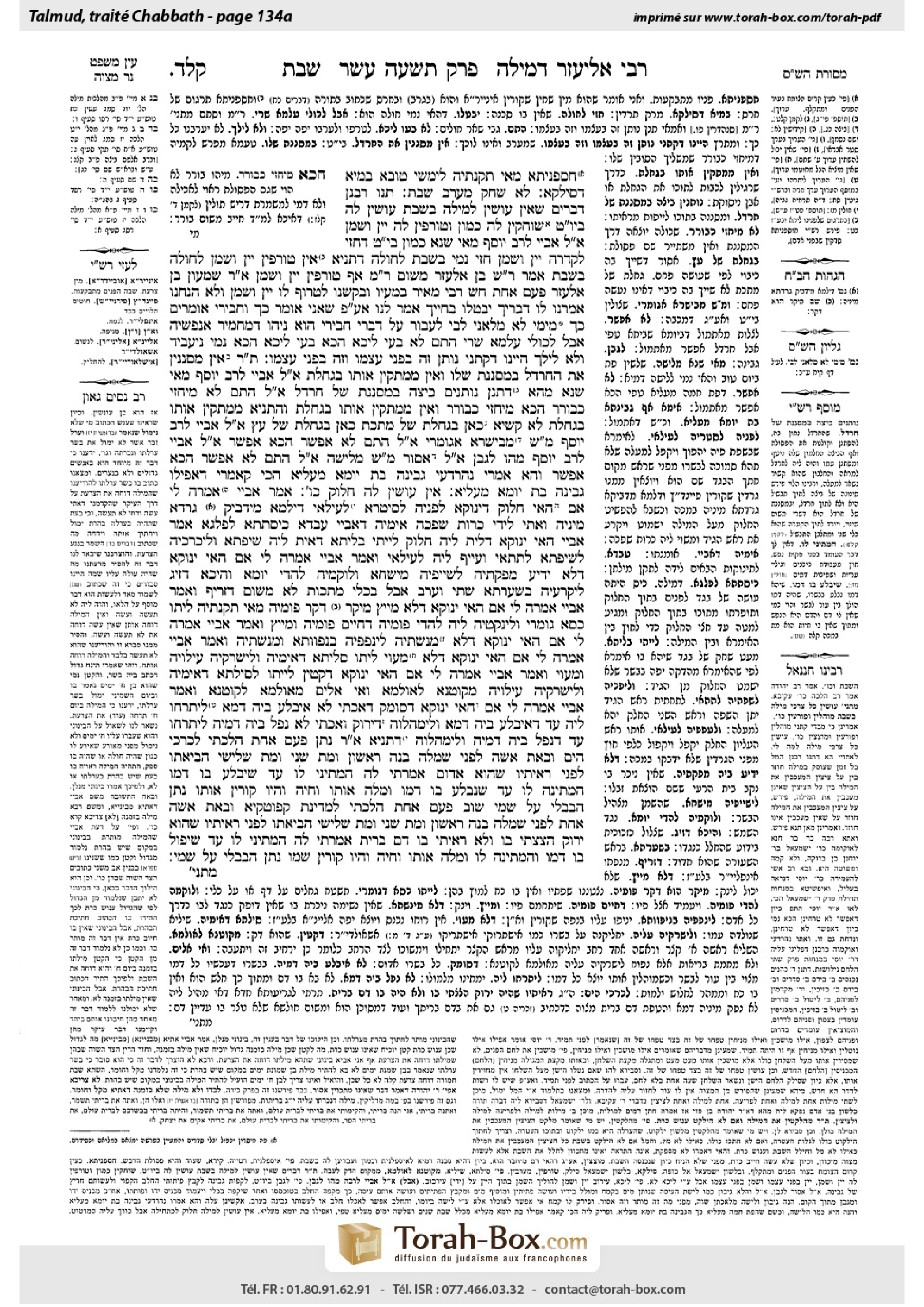
Shabbat 134a: Talmud study for Daf Yomi
Daf Yomi is the daily study of one Talmud folio. Explore 37 tractates with scans, Hebrew text, Sefaria English and AI-generated French translations where annotated.
Passage selection and English or AI-generated French translation are available where the scan has annotations. Daf Study is independent of Torah-Box and Sefaria.
Browse Shabbat · שבת · All tractatesShabbat 134a text and translations
This page of Shabbat includes the Aramaic text, an English translation and an AI-generated French translation, alongside the scan above.
שבת קל״ד א · Aramaic and Hebrew text
חַסְפָּנִיתָא. מַאי תַּקַּנְתֵּיהּ — לִימְשֵׁי טוּבָא בְּמַיָּא דְסִילְקָא.
לֹא שָׁחַק מֵעֶרֶב שַׁבָּת. תָּנוּ רַבָּנַן: דְּבָרִים שֶׁאֵין עוֹשִׂין לַמִּילָה בְּשַׁבָּת — עוֹשִׂין לָהּ בְּיוֹם טוֹב. שׁוֹחֲקִין לָהּ כַּמּוֹן, וְטוֹרְפִין לָהּ יַיִן וָשֶׁמֶן.
אֲמַר לֵיהּ אַבָּיֵי לְרַב יוֹסֵף: מַאי שְׁנָא כַּמּוֹן בְּיוֹם טוֹב — דַּחֲזֵי לִקְדֵרָה, יַיִן וָשֶׁמֶן חֲזֵי נָמֵי בְּשַׁבָּת לְחוֹלֶה, דְּתַנְיָא: אֵין טוֹרְפִין יַיִן וָשֶׁמֶן לַחוֹלֶה בְּשַׁבָּת. אָמַר רַבִּי שִׁמְעוֹן בֶּן אֶלְעָזָר מִשּׁוּם רַבִּי מֵאִיר: אַף טוֹרְפִין יַיִן וָשֶׁמֶן.
אָמַר רַבִּי שִׁמְעוֹן בֶּן אֶלְעָזָר: פַּעַם אַחַת חָשׁ רַבִּי מֵאִיר בְּמֵעָיו, וּבִקַּשְׁנוּ לִטְרוֹף לוֹ יַיִן וָשֶׁמֶן וְלֹא הִנִּיחָנוּ. אָמַרְנוּ לוֹ: דְּבָרֶיךָ יִבְטְלוּ בְּחַיֶּיךָ?! אָמַר לָנוּ: אַף עַל פִּי שֶׁאֲנִי אוֹמֵר כָּךְ וַחֲבֵירַי אוֹמְרִים כָּךְ — מִיָּמַי לֹא מְלָאַנִי לִבִּי לַעֲבוֹר עַל דִּבְרֵי חֲבֵירַי. הוּא נִיהוּ דְּמַחְמִיר אַנַּפְשֵׁיהּ, אֲבָל לְכוּלֵּי עָלְמָא — שְׁרֵי!
הָתָם — לָא בָּעֵי לִיכָּא, הָכָא בָּעֵי לִיכָּא. הָכָא נָמֵי נֶיעְבֵּיד וְלָא לֵילֵךְ! הַיְינוּ דְּקָתָנֵי: נוֹתֵן זֶה בִּפְנֵי עַצְמוֹ וְזֶה בִּפְנֵי עַצְמוֹ.
תָּנוּ רַבָּנַן: אֵין מְסַנְּנִין אֶת הַחַרְדָּל בִּמְסַנֶּנֶת שֶׁלּוֹ, וְאֵין מְמַתְּקִין אוֹתוֹ בְּגַחֶלֶת. אֲמַר לֵיהּ אַבָּיֵי לְרַב יוֹסֵף: מַאי שְׁנָא מֵהָא דִּתְנַן: נוֹתְנִים בֵּיצָה בִּמְסַנֶּנֶת שֶׁל חַרְדָּל?
אֲמַר לֵיהּ: הָתָם — לָא מִיחְזֵי כְּבוֹרֵר, הָכָא — מִיחְזֵי כְּבוֹרֵר.
וְאֵין מְמַתְּקִין אוֹתוֹ בְּגַחֶלֶת. וְהָתַנְיָא: מְמַתְּקִין אוֹתוֹ בְּגַחֶלֶת! לָא קַשְׁיָא: כָּאן בְּגַחֶלֶת שֶׁל מַתֶּכֶת, כָּאן בְּגַחֶלֶת שֶׁל עֵץ.
אֲמַר לֵיהּ אַבָּיֵי לְרַב יוֹסֵף: מַאי שְׁנָא מִבִּישְׂרָא אַגּוּמְרֵי! אֲמַר לֵיהּ: הָתָם לָא אֶפְשָׁר, הָכָא אֶפְשָׁר.
אֲמַר לֵיהּ אַבָּיֵי לְרַב יוֹסֵף: מַהוּ לְגַבֵּן? אֲמַר לֵיהּ: אָסוּר. מַאי שְׁנָא מִלִּישָׁה? אֲמַר לֵיהּ: הָתָם לָא אֶפְשָׁר, הָכָא אֶפְשָׁר.
וְהָא אָמְרִי נְהַרְדָּעֵי: גְּבִינָה בַּת יוֹמָא מְעַלְּיָא! הָכִי קָאָמְרִי: דַּאֲפִילּוּ גְּבִינָה בַּת יוֹמָא מְעַלְּיָא.
אֵין עוֹשִׂין לָהּ חָלוּק כּוּ׳. אָמַר אַבָּיֵי, אֲמַרָה לִי אֵם: הַאי חָלוּק דְּיָנוֹקָא, לַפְּכֵיהּ לְסִיטְרֵיהּ לְעִילַּאי, דִּילְמָא מִידְּבִיק גִּרְדָּא מִינֵּיהּ, וְאָתֵי לִידֵי כְּרוּת שׇׁפְכָה. אִימֵּיהּ דְּאַבָּיֵי עָבְדָא כִּיסְתָּא לְפַלְגָא. אָמַר אַבָּיֵי: הַאי יָנוֹקָא דְּלֵית לֵיהּ חָלוּק — לַיְיתֵי בְּלִיתָא דְּאִית לֵיהּ שִׂיפְתָּא, וְלִיכְרְכֵיהּ לְשִׂיפְתָּא לְתַתַּאי, וְעָיֵיף לֵיהּ לְעִילַּאי.
וְאָמַר אַבָּיֵי, אֲמַרָה לִי אֵם: הַאי יָנוֹקָא דְּלָא יְדִיעַ מַפַּקְתֵּיהּ, לְשַׁיְיפֵיהּ מִישְׁחָא וְלוֹקְמֵיהּ לַהֲדֵי יוֹמָא, וְהֵיכָא דְּזִיג — לִיקְרְעֵיהּ בִּשְׂעָרְתָּא שְׁתִי וָעֵרֶב. אֲבָל בִּכְלִי מַתָּכוֹת — לָא, מִשּׁוּם דְּזָרֵיף. וְאָמַר אַבָּיֵי, אֲמַרָה לִי אֵם: הַאי יָנוֹקָא דְּלָא מָיֵיץ, מֵיקַר [הוּא] דְּקָר פּוּמֵּיהּ. מַאי תַּקַּנְתֵּיהּ? לַיְתוֹ כָּסָא גּוּמְרֵי, וְלַינְקְטֵיהּ לֵיהּ לַהֲדֵי פּוּמֵּיהּ, דְּחָיֵים פּוּמֵּיהּ וּמָיֵיץ. וְאָמַר אַבָּיֵי, אֲמַרָה לִי אֵם: הַאי יָנוֹקָא דְּלָא מִנַּשְׁתֵּים — לִינְפְּפֵיהּ בְּנָפְווֹתָא וּמִנַּשְׁתֵּים.
וְאָמַר אַבָּיֵי, אֲמַרָה לִי אֵם: הַאי יָנוֹקָא דְּלָא מְעַוֵּי — לַיְתוֹ סִילְתָּא דְאִימֵּיהּ וְלִישְׁרְקֵיהּ עִילָּוֵיהּ, וּמְעַוֵּי. וְאָמַר אַבָּיֵי, אֲמַרָה לִי אֵם: הַאי יָנוֹקָא דְּקַטִּין, לַיְיתוֹ לְסִילְתָּא דְאִימֵּיהּ, וְלִישְׁרְקֵיהּ עִילָּוֵיהּ מִקּוּטְנָא לְאוּלְמָא. וְאִי אַלִּים — מֵאוּלְמָא לְקוּטְנָא. וְאָמַר אַבָּיֵי, אֲמַרָה לִי אֵם: הַאי יָנוֹקָא דְּסוּמָּק — דְּאַכַּתִּי לָא אִיבְּלַע בֵּיהּ דְּמֵיהּ — לִיתָּרְחוּ לֵיהּ עַד דְּמִיבְּלַע בֵּיהּ דְּמֵיהּ, וְלִימְהֲלוּהּ. דְּיָרוֹק, דְּאַכַּתִּי לָא נְפַל בֵּיהּ דְּמֵיהּ — לִיתָּרְחוּ עַד דְּנָפֵל בֵּיהּ דְּמֵיהּ, וְלִימְהֲלוּהּ.
דְּתַנְיָא, אָמַר רַבִּי נָתָן: פַּעַם אַחַת הָלַכְתִּי לִכְרַכֵּי הַיָּם, וּבָאת אִשָּׁה אַחַת לְפָנַי שֶׁמָּלָה בְּנָהּ רִאשׁוֹן וָמֵת, שֵׁנִי וָמֵת, שְׁלִישִׁי, הֱבִיאַתּוּ לְפָנַי, רְאִיתִיו שֶׁהוּא אָדוֹם. אָמַרְתִּי לָהּ: הַמְתִּינִי לוֹ עַד שֶׁיִּבָּלַע בּוֹ דָּמוֹ, הִמְתִּינָה לוֹ עַד שֶׁנִּבְלַע בּוֹ דָּמוֹ, וּמָלָה אוֹתוֹ וְחָיָה, וְהָיוּ קוֹרִין אוֹתוֹ ״נָתָן הַבַּבְלִי״ עַל שְׁמִי.
שׁוּב פַּעַם אַחַת הָלַכְתִּי לִמְדִינַת קַפּוֹטְקְיָא, וּבָאת אִשָּׁה אַחַת לְפָנַי שֶׁמָּלָה בְּנָהּ רִאשׁוֹן וָמֵת, שֵׁנִי וָמֵת, שְׁלִישִׁי הֱבִיאַתּוּ לְפָנַי, רְאִיתִיו שֶׁהוּא יָרוֹק. הֵצַצְתִּי בּוֹ וְלֹא רָאִיתִי בּוֹ דַּם בְּרִית. אָמַרְתִּי לָהּ: הַמְתִּינִי לוֹ עַד שֶׁיִּפּוֹל בּוֹ דָּמוֹ, וְהִמְתִּינָה לוֹ וּמָלָה אוֹתוֹ וְחָיָה, וְהָיוּ קוֹרִין שְׁמוֹ ״נָתָן הַבַּבְלִי״ עַל שְׁמִי.
Shabbat 134a · English translation
sores on his flesh. What is his remedy? Let him wash extensively in beet water, in which beets have been boiled.
We learned in the mishna: If one did not grind the cumin from Shabbat eve, he chews it with his teeth and places it on the place of circumcision as a salve. The Sages taught: There are actions that may not be performed in preparation for a circumcision on Shabbat but may be performed in preparation for it on a Festival. For example: One grinds cumin for it, and one mixes wine and oil for it.
Abaye said to Rav Yosef: What is different about cumin that makes it permissible to grind it on a Festival? The fact that it is suitable for use to spice a pot, in cooking. Based on that explanation, mixed wine and oil are also suitable for use on Shabbat for a sick person, as it was taught in a baraita: One may not mix wine and oil for a sick person on Shabbat. Rabbi Shimon ben Elazar said in the name of Rabbi Meir: One may even mix wine and oil on Shabbat.
Rabbi Shimon ben Elazar said: It happened on one occasion that Rabbi Meir had intestinal pain on Shabbat, and we sought to mix wine and oil for him as treatment and he did not let us do so. We said to him: Will your statement be negated in your lifetime? You permit mixing these ingredients for a sick person. He said to us: Even though I say this and my colleagues say that, and I do not retract my statement, still, in all my days I have never been so presumptuous as to violate the statements of my colleagues and act in accordance with my opinion. Apparently, it was he who was stringent with regard to himself, but for everyone it is permitted.
The Gemara answers that there is a distinction between the cases: There, for medicinal purposes, it need not be beaten, whereas here, for circumcision, it must be beaten. The Gemara asks: Here too, let us prepare the mixture but not beat it. The Gemara answers: That is in fact the custom, and that is what the mishna teaches: He places this by itself and that by itself, meaning that he may mix the wine and oil, but he may not beat them.
The Sages taught with regard to labor on a Festival: One may not strain mustard in its strainer, and one may not sweeten it with coal. Abaye said to Rav Yosef: In what way is this different from that which we learned in a mishna: One may place an egg in a mustard strainer on Shabbat?
Rav Yosef said to him: There is a distinction between the cases, that there, in the case of the egg, the act does not appear like selecting, whereas here, in the case of the mustard, the act appears like selecting. Straining an egg does not actually separate it into its component parts. Straining mustard does.
We learned that one may not sweeten the mustard with coal. The Gemara asks: Wasn’t it taught in a baraita: One may sweeten it with coal. The Gemara answers: This is not difficult, as there is a distinction: There, where it is permitted, it is referring to the case of a metal coal, as extinguishing metal coals is not prohibited by Torah law, whereas here, where it is prohibited, it is referring to the case of a wooden coal.
Abaye said to Rav Yosef: In what way is mustard placed on coals, which is prohibited, different from meat placed on coals, which is permitted even if the coals are extinguished by the blood dripping from the meat? Rav Yosef said to Abaye: The two cases are not similar, as there, with regard to meat, it is not possible to accomplish this in any other way, but here, with regard to mustard, it is possible to accomplish this in another way.
Abaye said to Rav Yosef: What is the halakha with regard to whether it is permissible to curdle cheese on a Festival? He said to him: It is prohibited. Abaye asked: In what way is this different from kneading dough, which is permitted on a Festival? Rav Yosef said to him: There, with regard to dough, it is not possible to bake bread before a Festival, as day-old bread is inferior to fresh bread. Therefore, kneading dough to bake bread on a Festival is permitted. Here, with regard to cheese, it is possible to curdle cheese before a Festival and it will not deteriorate in any way.
Abaye challenged this distinction: Didn’t the Sages of Neharde’a say that one-day-old cheese is excellent? Curdling cheese on a Festival should be permitted? Rav Yosef responded: This is what they are saying: Even one-day-old cheese is excellent; however, cheese that aged longer is better. Therefore, they did not permit curdling cheese on a Festival, as it is not necessary for the Festival.
We learned in the mishna: And on Shabbat one may not make a pouch to place over the circumcision as a bandage ab initio. Abaye said: My mother, actually his foster mother who was the nursemaid who raised him, told me: With regard to that pouch, placed as a bandage over the circumcision of a baby, let one place it on the upper side with the threads below, lest a thread from it stick to the place of circumcision and cause the baby to become one with a severed urethra. The Gemara relates that Abaye’s mother would make a pouch that covered half the place of circumcision so that it would not be damaged through contact with the threads emerging from the edge of the pouch. Abaye said: If this baby does not have a pouch to put on the place of the circumcision, let one bring a worn-out garment with a hem, and wrap the hem under, and fold the garment over, so that the threads from the worn-out garment will not adhere to the wound.
And Abaye also said: My mother told me: In the case of a baby the location of whose exit, i.e., anus, is unknown, as it is obscured by skin, let one rub it with oil and stand it before the light of the day. And where it appears transparent, let one tear it with a barley grain widthwise and lengthwise. However, one may not tear it with a metal implement because it causes infection and swelling. And Abaye said that my mother told me: If a baby refuses to nurse, that is because its mouth is cold and it is unable to nurse. What is his remedy? They should bring a cup of coals and place it near his mouth, so that his mouth will warm and he will nurse. And Abaye said that my mother told me: A baby that does not urinate, let one place him in a sieve and shake him, and he will urinate.
And Abaye said: My nurse told me: If a baby is not breathing, let them bring his mother’s placenta and place the placenta on him, and the baby will breathe. And Abaye said that my mother told me: If a baby is too small, let them bring his mother’s placenta and rub the baby with it from the narrow end to the wide end of the placenta. And if the baby is strong, i.e., too large, let them rub the baby from the wide end of the placenta to the narrow end. And Abaye said that my mother told me: If a baby is red, that is because the blood has not yet been absorbed in him. In that case, let them wait until his blood is absorbed and then circumcise him. Likewise, if a baby is pale and his blood has not yet entered him, let them wait until his blood enters him and then circumcise him.
As it was taught in a baraita, Rabbi Natan said: On one occasion, I went to the coastal cities, and one woman came before me who circumcised her first son and he died, and she circumcised her second son and he died, and since she feared circumcising the third due to concern that he might die as well, she brought him before me. I saw that he was red. I said to her: Wait until his blood is absorbed into him. She waited until his blood was absorbed into him and then circumcised him, and he lived. And they would call him Natan the Babylonian after my name.
Rabbi Natan further related: On another occasion I went to the state of Cappadocia, and a woman came before me who circumcised her first son and he died, and she circumcised her second son and he died. Since she feared circumcising the third due to concern that he might die as well, she brought him before me. I saw that he was pale. I looked at him and I could not see in him the blood of the covenant, i.e., he had a blood deficiency. I said to her: Wait until blood enters him. And she waited and then circumcised him, and he lived. And they would call his name Natan the Babylonian after my name.
Shabbat 134a · Traduction française (IA)
des plaies sur sa chair. Quel est son remède ? Qu’il se lave abondamment avec de l’eau de betteraves, dans laquelle des betteraves ont bouilli.
Nous avons appris dans la Michna : si l’on n’a pas broyé le cumin depuis la veille de Chabbat, on le mâche avec les dents et on l’applique en onguent sur le lieu de la circoncision. Les Sages ont enseigné : certaines préparations interdites en vue d’une circoncision le Chabbat sont permises en vue de celle-ci un jour de fête. Par exemple, on broie du cumin pour la circoncision et on y mélange du vin et de l’huile.
Abayé dit à Rav Yossef : En quoi le cumin est-il différent, pour qu’il soit permis de le broyer un jour de fête ? C’est qu’il peut servir à assaisonner un plat en cours de cuisson. Selon cette explication, le mélange de vin et d’huile peut lui aussi servir le Chabbat pour un malade, car il a été enseigné dans une baraïta : on ne mélange pas de vin et d’huile pour un malade le Chabbat. Rabbi Chimon ben Elazar a dit au nom de Rabbi Meïr : on peut même mélanger du vin et de l’huile le Chabbat.
Rabbi Chimon ben Elazar a dit : Il arriva un jour que Rabbi Meïr souffrit de douleurs intestinales le Chabbat. Nous voulûmes lui mélanger du vin et de l’huile comme traitement, mais il ne nous laissa pas faire. Nous lui dîmes : « Votre déclaration sera-t-elle démentie de votre vivant ? Vous autorisez le mélange de ces ingrédients pour un malade. » Il nous répondit : « Même si je dis cela et que mes collègues disent le contraire, et même si je ne rétracte pas ma déclaration, je n’ai pourtant jamais été assez présomptueux, de toute ma vie, pour transgresser les paroles de mes collègues et agir selon mon opinion. » Il apparaît donc qu’il était strict envers lui-même, mais que cela est permis à tous.
La Guemara répond qu’il y a une distinction entre les cas : dans le cas d’un usage médical, il n’est pas nécessaire de piler le mélange, tandis qu’ici, pour la circoncision, il faut le piler. La Guemara demande : ici aussi, qu’on prépare le mélange sans le piler. La Guemara répond : c’est effectivement la pratique, et c’est ce qu’enseigne la Michna : il place celui-ci à part et celui-là à part, c’est-à-dire qu’il peut mélanger le vin et l’huile, mais ne peut pas les battre.
Les Sages ont enseigné au sujet des travaux un jour de fête : on ne peut pas passer la moutarde dans son tamis, ni l’adoucir avec du charbon. Abayé dit à Rav Yossef : en quoi cela diffère-t-il de ce que nous avons appris dans une Michna : on peut placer un œuf dans un tamis à moutarde le Chabbat ?
Rav Yossef lui répondit : il y a une distinction entre les cas. Dans le cas de l’œuf, le geste ne ressemble pas à un tri, tandis qu’ici, dans le cas de la moutarde, il ressemble à un tri. Passer un œuf au tamis ne le sépare pas réellement en ses éléments constitutifs, contrairement à la moutarde.
Nous avons appris qu’on ne peut pas adoucir la moutarde avec du charbon. La Guemara demande : n’a-t-il pas été enseigné dans une baraïta qu’on peut l’adoucir avec du charbon ? La Guemara répond que ce n’est pas difficile, car il y a une distinction : là où cela est permis, il s’agit d’un charbon de métal, car éteindre des charbons de métal n’est pas interdit par la Torah ; ici, où cela est interdit, il s’agit d’un charbon de bois.
Abayé dit à Rav Yossef : en quoi le fait de placer de la moutarde sur des charbons, ce qui est interdit, diffère-t-il du fait de placer de la viande sur des charbons, ce qui est permis même si les charbons sont éteints par le sang qui s’écoule de la viande ? Rav Yossef dit à Abayé : les deux cas ne sont pas comparables, car, pour la viande, il est impossible de procéder autrement, tandis que, pour la moutarde, c’est possible.
Abayé dit à Rav Yossef : quelle est la halakha concernant le fait de faire cailler du fromage un jour de fête ? Il lui répondit : c’est interdit. Abayé demanda : en quoi cela diffère-t-il du pétrissage de la pâte, qui est permis un jour de fête ? Rav Yossef lui dit : dans le cas de la pâte, il est impossible de faire cuire du pain avant la fête, car le pain d’un jour est de qualité inférieure au pain frais. C’est pourquoi il est permis de pétrir de la pâte pour faire cuire du pain un jour de fête. Ici, dans le cas du fromage, on peut le faire cailler avant la fête, et il ne se détériorera aucunement.
Abayé contesta cette distinction : les Sages de Nehardéa n’ont-ils pas dit qu’un fromage d’un jour est excellent ? Il devrait donc être permis de faire cailler du fromage un jour de fête. Rav Yossef répondit : voici ce qu’ils veulent dire : même un fromage d’un jour est excellent ; toutefois, un fromage qui a vieilli davantage est meilleur. Ils n’ont donc pas permis de faire cailler du fromage un jour de fête, car cela n’est pas nécessaire pour la fête.
Nous avons appris dans la Michna : le Chabbat, on ne peut pas confectionner d’emblée une poche à placer comme pansement sur la circoncision. Abayé dit : « Ma mère — en réalité, sa mère adoptive, la nourrice qui l’avait élevé — m’a dit : pour cette poche placée comme pansement sur la circoncision d’un bébé, qu’on la place avec le côté supérieur vers le haut et les fils en dessous, de peur qu’un fil ne s’accroche au lieu de la circoncision et que le bébé ne se retrouve avec l’urètre sectionné. » La Guemara rapporte que la mère d’Abayé confectionnait une poche qui ne couvrait que la moitié du lieu de la circoncision, afin que celui-ci ne soit pas abîmé par le contact avec les fils qui dépassaient du bord de la poche. Abayé dit : « Si ce bébé n’a pas de poche à placer sur le lieu de la circoncision, qu’on apporte un vêtement usé avec un ourlet, qu’on replie l’ourlet en dessous et qu’on rabatte le vêtement par-dessus, afin que les fils du vêtement usé n’adhèrent pas à la plaie. »
Abayé dit également : « Ma mère m’a dit : dans le cas d’un bébé dont l’orifice de sortie, c’est-à-dire l’anus, est introuvable parce qu’il est recouvert par la peau, qu’on le frotte avec de l’huile et qu’on le tienne devant la lumière du jour. À l’endroit où la peau devient translucide, qu’on l’incise dans les deux sens, sur une largeur d’un grain d’orge. Toutefois, on ne doit pas l’inciser avec un instrument métallique, car cela provoque une infection et un gonflement. » Abayé dit aussi que sa mère lui avait dit : « Si un bébé refuse de téter, c’est parce que sa bouche est froide et qu’il ne peut pas téter. Quel est son remède ? Qu’on apporte une coupe de charbons et qu’on la place près de sa bouche, afin que celle-ci se réchauffe et qu’il tète. » Abayé dit encore que sa mère lui avait dit : « Si un bébé n’urine pas, qu’on le place dans un tamis et qu’on le secoue ; il urinera. »
Abayé dit aussi : « Ma nourrice m’a dit : si un bébé ne respire pas, qu’on apporte le placenta de sa mère et qu’on le pose sur lui ; le bébé respirera. » Abayé dit que sa mère lui avait dit : « Si un bébé est trop petit, qu’on apporte le placenta de sa mère et qu’on le frotte avec celui-ci, de l’extrémité étroite vers l’extrémité large du placenta. Si le bébé est vigoureux, c’est-à-dire trop grand, qu’on le frotte de l’extrémité large du placenta vers l’extrémité étroite. » Abayé dit encore que sa mère lui avait dit : « Si un bébé est rouge, c’est parce que son sang ne s’est pas encore absorbé en lui. Dans ce cas, qu’on attende que son sang s’absorbe, puis qu’on le circoncise. De même, si un bébé est pâle et que son sang n’est pas encore entré en lui, qu’on attende que son sang y entre, puis qu’on le circoncise. »
Comme il a été enseigné dans une baraïta, Rabbi Natan a dit : « Un jour, je me rendis dans les villes côtières. Une femme vint me trouver ; elle avait circoncis son premier fils, qui était mort, puis son deuxième fils, qui était mort lui aussi. Comme elle craignait de circoncire le troisième, de peur qu’il ne meure également, elle me l’amena. Je vis qu’il était rouge. Je lui dis : “Attends que son sang s’absorbe en lui.” Elle attendit que son sang s’absorbe en lui, puis le circoncit, et il vécut. On l’appelait Natan le Babylonien, d’après mon nom. »
Rabbi Natan rapporta encore : « Une autre fois, je me rendis dans la province de Cappadoce. Une femme vint me trouver ; elle avait circoncis son premier fils, qui était mort, puis son deuxième fils, qui était mort lui aussi. Comme elle craignait de circoncire le troisième, de peur qu’il ne meure également, elle me l’amena. Je vis qu’il était pâle. Je l’examinai et ne distinguai pas en lui le sang de l’alliance, c’est-à-dire qu’il souffrait d’un manque de sang. Je lui dis : “Attends que le sang entre en lui.” Elle attendit, puis le circoncit, et il vécut. On l’appela Natan le Babylonien, d’après mon nom. »
Traduction française générée par IA à partir de l’édition anglaise de Sefaria. Vérifie toujours un passage avec le texte source.
Text from Sefaria: William Davidson Edition - Vocalized Aramaic (CC BY NC); William Davidson Edition - English (CC BY NC).