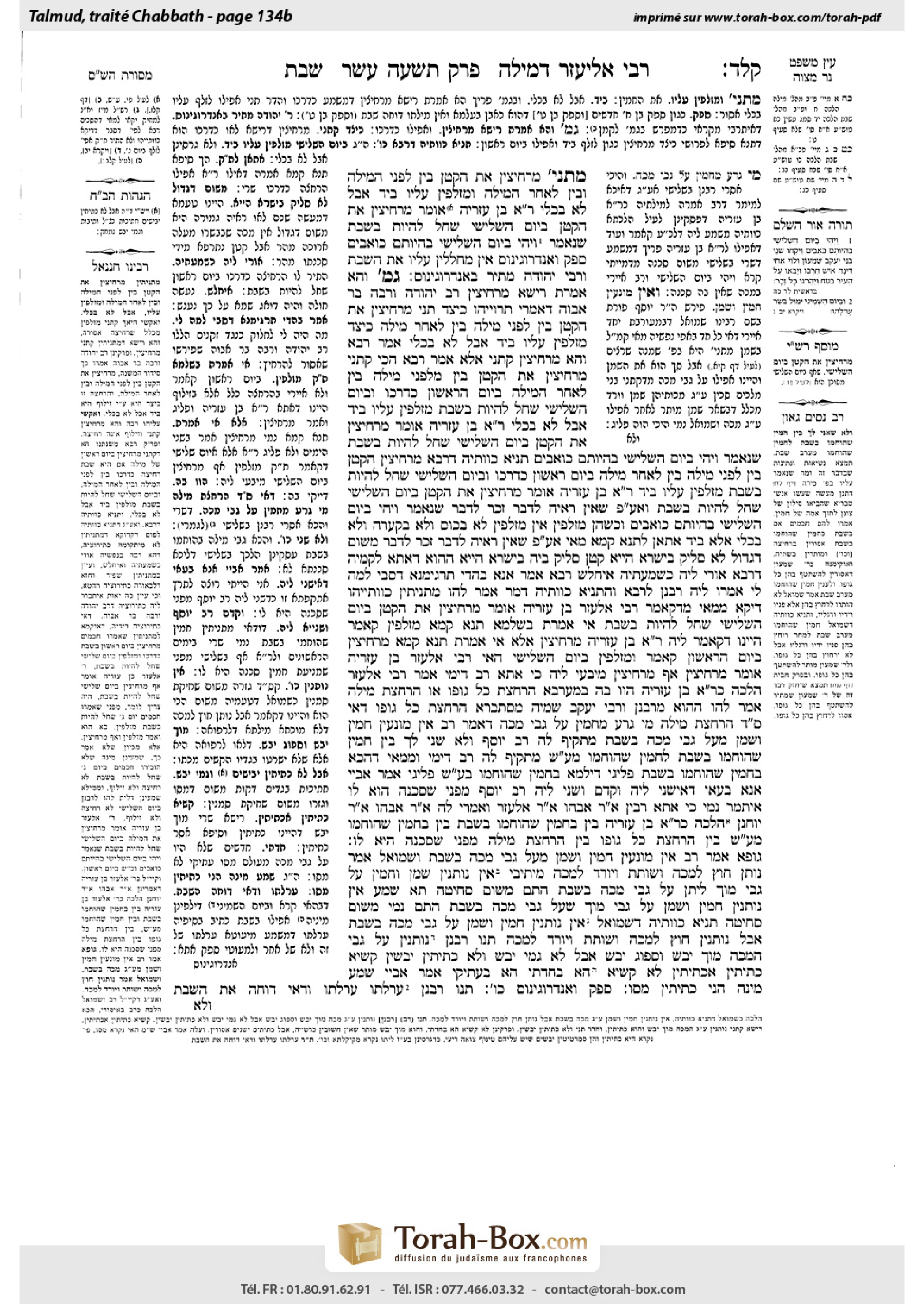
Shabbat 134b: Talmud study for Daf Yomi
Daf Yomi is the daily study of one Talmud folio. Explore 37 tractates with scans, Hebrew text, Sefaria English and AI-generated French translations where annotated.
Passage selection and English or AI-generated French translation are available where the scan has annotations. Daf Study is independent of Torah-Box and Sefaria.
Browse Shabbat · שבת · All tractatesShabbat 134b text and translations
This page of Shabbat includes the Aramaic text, an English translation and an AI-generated French translation, alongside the scan above.
שבת קל״ד ב · Aramaic and Hebrew text
מַתְנִי׳ מַרְחִיצִין אֶת הַקָּטָן בֵּין לִפְנֵי הַמִּילָה וּבֵין לְאַחַר הַמִּילָה, וּמְזַלְּפִין עָלָיו בַּיָּד, אֲבָל לֹא בִּכְלִי. רַבִּי אֶלְעָזָר בֶּן עֲזַרְיָה אוֹמֵר: מַרְחִיצִין אֶת הַקָּטָן בַּיּוֹם הַשְּׁלִישִׁי שֶׁחָל לִהְיוֹת בְּשַׁבָּת, שֶׁנֶּאֱמַר: ״וַיְהִי בַיּוֹם הַשְּׁלִישִׁי בִּהְיוֹתָם כּוֹאֲבִים״.
סָפֵק וְאַנְדְּרוֹגִינוֹס — אֵין מְחַלְּלִין עָלָיו אֶת הַשַּׁבָּת. וְרַבִּי יְהוּדָה מַתִּיר בְּאַנְדְּרוֹגִינוֹס.
גְּמָ׳ וְהָא אָמְרַתְּ רֵישָׁא מַרְחִיצִין!
רַב יְהוּדָה וְרַבָּה בַּר אֲבוּהּ דְאָמְרִי תַּרְוַיְיהוּ ״כֵּיצַד״ תָּנֵי: מַרְחִיצִין אֶת הַקָּטָן בֵּין לִפְנֵי מִילָה בֵּין לְאַחַר מִילָה. כֵּיצַד? — מְזַלְּפִין עָלָיו בַּיָּד אֲבָל לֹא בִּכְלִי.
אָמַר רָבָא: וְהָא ״מַרְחִיצִין״ קָתָנֵי! אֶלָּא אָמַר רָבָא, הָכִי קָתָנֵי: מַרְחִיצִין אֶת הַקָּטָן בֵּין מִלִּפְנֵי מִילָה בֵּין לְאַחַר הַמִּילָה, בַּיּוֹם הָרִאשׁוֹן — כְּדַרְכּוֹ, וּבַיּוֹם הַשְּׁלִישִׁי שֶׁחָל לִהְיוֹת בְּשַׁבָּת — מְזַלְּפִין עָלָיו בַּיָּד, אֲבָל לֹא בִּכְלִי. רַבִּי אֶלְעָזָר בֶּן עֲזַרְיָה אוֹמֵר: מַרְחִיצִין אֶת הַקָּטָן בַּיּוֹם הַשְּׁלִישִׁי שֶׁחָל לִהְיוֹת בְּשַׁבָּת, שֶׁנֶּאֱמַר: ״וַיְהִי בַיּוֹם הַשְּׁלִישִׁי בִּהְיוֹתָם כּוֹאֲבִים״.
תַּנְיָא כְּווֹתֵיהּ דְּרָבָא: מַרְחִיצִין הַקָּטָן בֵּין לִפְנֵי מִילָה בֵּין לְאַחַר מִילָה, בְּיוֹם הָרִאשׁוֹן — כְּדַרְכּוֹ, וּבַיּוֹם הַשְּׁלִישִׁי שֶׁחָל לִהְיוֹת בְּשַׁבָּת — מְזַלְּפִין עָלָיו בַּיָּד. רַבִּי אֶלְעָזָר בֶּן עֲזַרְיָה אוֹמֵר: מַרְחִיצִין אֶת הַקָּטָן בַּיּוֹם הַשְּׁלִישִׁי שֶׁחָל לִהְיוֹת בְּשַׁבָּת. וְאַף עַל פִּי שֶׁאֵין רְאָיָה לַדָּבָר זֵכֶר לַדָּבָר, שֶׁנֶּאֱמַר: ״וַיְהִי בַיּוֹם הַשְּׁלִישִׁי בִּהְיוֹתָם כּוֹאֲבִים״.
וּכְשֶׁהֵן מְזַלְּפִין — אֵין מְזַלְּפִין לֹא בְּכוֹס וְלֹא בִּקְעָרָה וְלֹא בִּכְלִי, אֶלָּא בַּיָּד. אֲתָאן לְתַנָּא קַמָּא.
מַאי ״אַף עַל פִּי שֶׁאֵין רְאָיָה לַדָּבָר זֵכֶר לַדָּבָר״? מִשּׁוּם דְּגָדוֹל לָא סָלֵיק בִּישְׂרֵיהּ הַיָּיא, קָטָן סָלֵיק (בֵּיהּ) בִּישְׂרֵיהּ הַיָּיא.
הָהוּא דַּאֲתָא לְקַמֵּיהּ דְּרָבָא, אוֹרִי לֵיהּ כִּשְׁמַעְתֵּיהּ. אִיחֲלַשׁ רָבָא, אָמַר: אֲנָא בַּהֲדֵי תַּרְגּוּמָא דְסָבֵי לְמָה לִי.
אֲמַרוּ לֵיהּ רַבָּנַן לְרָבָא: וְהָתַנְיָא כְּווֹתֵיהּ דְּמָר? אֲמַר לְהוּ: מַתְנִיתִין כְּווֹתַיְיהוּ דַּיְקָא.
מִמַּאי — מִדְּקָאָמַר רַבִּי אֶלְעָזָר בֶּן עֲזַרְיָה אוֹמֵר: מַרְחִיצִין אֶת הַקָּטָן בְּיוֹם הַשְּׁלִישִׁי שֶׁחָל לִהְיוֹת בְּשַׁבָּת. אִי אָמְרַתְּ בִּשְׁלָמָא תַּנָּא קַמָּא ״מְזַלְּפִין״ קָאָמַר — הַיְינוּ דְּקָאֲמַר לֵיהּ רַבִּי אֶלְעָזָר בֶּן עֲזַרְיָה ״מַרְחִיצִין״. אֶלָּא אִי אָמְרַתְּ תַּנָּא קַמָּא מַרְחִיצִין בְּיוֹם הָרִאשׁוֹן קָאָמַר, וּמְזַלְּפִין בְּיוֹם הַשְּׁלִישִׁי, הַאי רַבִּי אֶלְעָזָר בֶּן עֲזַרְיָה אוֹמֵר מַרְחִיצִין — ״אַף מַרְחִיצִין״ מִיבְּעֵי לֵיהּ?
כִּי אֲתָא רַב דִּימִי אָמַר רַבִּי אֶלְעָזָר: הֲלָכָה כְּרַבִּי אֶלְעָזָר בֶּן עֲזַרְיָה.
הֲווֹ בַּהּ בְּמַעְרְבָא: הַרְחָצַת כׇּל גּוּפוֹ אוֹ הַרְחָצַת מִילָה?
אֲמַר לְהוּ הַהוּא מֵרַבָּנַן, וְרַבִּי יַעֲקֹב שְׁמֵיהּ: מִסְתַּבְּרָא הַרְחָצַת כׇּל גּוּפוֹ, דְּאִי סָלְקָא דַּעְתָּךְ הַרְחָצַת מִילָה, מִי גָּרַע מֵחַמִּין עַל גַּבֵּי מַכָּה, דְּאָמַר רַב: אֵין מוֹנְעִין חַמִּין וָשֶׁמֶן מֵעַל גַּבֵּי מַכָּה בְּשַׁבָּת!
מַתְקֵיף לַהּ רַב יוֹסֵף: וְלָא שָׁנֵי לָךְ בֵּין חַמִּין שֶׁהוּחַמּוּ בְּשַׁבָּת לְחַמִּין שֶׁהוּחַמּוּ מֵעֶרֶב שַׁבָּת?
מַתְקֵיף לַהּ רַב דִּימִי: וּמִמַּאי דְּהָכָא בְּחַמִּין שֶׁהוּחַמּוּ בְּשַׁבָּת פְּלִיגִי? דִילְמָא בְּחַמִּין שֶׁהוּחַמּוּ בְּעֶרֶב שַׁבָּת פְּלִיגִי?! אָמַר אַבָּיֵי: אֲנָא בְּעַאי דֶּאֱישַׁנֵּי לֵיהּ, וּקְדַם וְשַׁנִּי לֵיהּ רַב יוֹסֵף: מִפְּנֵי שֶׁסַּכָּנָה הוּא לוֹ.
אִיתְּמַר נָמֵי, כִּי אֲתָא רָבִין אָמַר רַבִּי אֲבָהוּ אָמַר רַבִּי אֶלְעָזָר, וְאָמְרִי לַהּ אָמַר רַבִּי אֲבָהוּ אָמַר רַבִּי יוֹחָנָן: הֲלָכָה כְּרַבִּי אֶלְעָזָר בֶּן עֲזַרְיָה בֵּין בְּחַמִּין שֶׁהוּחַמּוּ בְּשַׁבָּת, בֵּין בְּחַמִּין שֶׁהוּחַמּוּ מֵעֶרֶב שַׁבָּת, בֵּין הַרְחָצַת כׇּל גּוּפוֹ, בֵּין הַרְחָצַת מִילָה, מִפְּנֵי שֶׁסַּכָּנָה הִיא לוֹ.
גּוּפָא. אָמַר רַב: אֵין מוֹנְעִין חַמִּין וָשֶׁמֶן מֵעַל גַּבֵּי מַכָּה בְּשַׁבָּת. וּשְׁמוּאֵל אָמַר: נוֹתֵן חוּץ לַמַּכָּה, וְשׁוֹתֵת וְיוֹרֵד לַמַּכָּה.
מֵיתִיבִי: אֵין נוֹתְנִין שֶׁמֶן וְחַמִּין עַל גַּבֵּי מוֹךְ לִיתֵּן עַל גַּבֵּי מַכָּה בַּשַּׁבָּת! הָתָם מִשּׁוּם סְחִיטָה.
תָּא שְׁמַע: אֵין נוֹתְנִין חַמִּין וָשֶׁמֶן עַל גַּבֵּי מוֹךְ, שֶׁעַל גַּבֵּי מַכָּה בַּשַּׁבָּת. הָתָם נָמֵי מִשּׁוּם סְחִיטָה.
תַּנְיָא כְּווֹתֵיהּ דִּשְׁמוּאֵל: אֵין נוֹתְנִין חַמִּין וָשֶׁמֶן עַל גַּבֵּי מַכָּה בַּשַּׁבָּת, אֲבָל נוֹתְנִין חוּץ לַמַּכָּה וְשׁוֹתֵת וְיוֹרֵד לַמַּכָּה.
תָּנוּ רַבָּנַן: נוֹתְנִין עַל גַּבֵּי הַמַּכָּה מוֹךְ יָבֵשׁ וּסְפוֹג יָבֵשׁ, אֲבָל לֹא גֶּמִי יָבֵשׁ וְלֹא כְּתִיתִין יְבֵשִׁין. קַשְׁיָא כְּתִיתִין אַכְּתִיתִין! לָא קַשְׁיָא: הָא בְּחַדְתֵי, הָא בְּעַתִּיקֵי. אָמַר אַבָּיֵי: שְׁמַע מִינַּהּ הָנֵי כְּתִיתִין מַסּוּ.
סָפֵק וְאַנְדְּרוֹגִינוֹס כּוּ׳. תָּנוּ רַבָּנַן: ״עׇרְלָתוֹ״ — עׇרְלָתוֹ וַדַּאי דּוֹחֶה אֶת הַשַּׁבָּת,
Shabbat 134b · English translation
MISHNA: One may wash the baby on Shabbat, both before the circumcision and after the circumcision. And one may sprinkle hot water on him by hand but not with a vessel, in order to depart from the usual manner in which this is done. Rabbi Elazar ben Azarya says: One may wash the baby on the third day following his circumcision, even if that third day occurs on Shabbat. On the third day following circumcision, the baby is considered to be in danger, as it is stated with regard to the men of Shekhem, who were circumcised: “And it came to pass on the third day, when they were in pain” (Genesis 34:25). This teaches us that on the third day the pain of circumcision poses a danger.
If there is uncertainty whether or not to circumcise a baby, and likewise in the case of a hermaphrodite [androginos] baby, who possesses both male and female genitals, one does not desecrate Shabbat to perform the circumcision, since it is not certain that the circumcision is required. And Rabbi Yehuda permits doing so for a hermaphrodite baby.
GEMARA: The Gemara questions the mishna’s statement that one may sprinkle hot water on the baby only by hand: Didn’t you say in the first clause of the mishna that one may wash him? If it is permissible to wash the baby, it is certainly permitted to sprinkle water on him with a vessel.
It was Rav Yehuda and Rabba bar Avuh who both said that this mishna is taught employing the style known as: How. In this style, the latter clause clarifies the former. It should be understood as follows: One may wash the baby both before circumcision and after circumcision. How may one wash him? One sprinkles water on him by hand, but not with a vessel.
Rava said: Doesn’t it teach the phrase one may wash, and washing is not sprinkling. Rather, Rava said that this is what the mishna is teaching: One may wash the baby, both before circumcision and after circumcision. On the first day, one may wash him in his usual manner. However, on the third day following his circumcision, if that third day occurs on Shabbat, one may sprinkle water on him only by hand, but not with a vessel, and one may certainly not wash him. Rabbi Elazar ben Azarya says: One may even wash the baby on the third day following his circumcision, if that third day occurs on Shabbat, because the baby is considered to be in a state of danger, as it is stated: “And it came to pass on the third day, when they were in pain.”
A baraita was taught in accordance with the opinion of Rava: One may wash the baby, both before circumcision and after circumcision. On the first day, the baby is washed in its usual manner; and on the third day that occurs on Shabbat, one sprinkles water on him by hand but not with a vessel, and one may not wash him. Rabbi Elazar ben Azarya says: One may even wash the baby on the third day that occurs on Shabbat. And although there is no absolute proof for this matter, there is an allusion to this matter, as it is stated: “And it came to pass on the third day, when they were in pain.”
The baraita continues: And when one sprinkles water, he may not sprinkle it with a cup or with a bowl or with any other vessel; rather, he does so by hand. The Gemara comments: We have arrived at the opinion of the first tanna, as this clarification of how the sprinkling was performed is not in accordance with the opinion of Rabbi Elazar ben Azarya. Rather, it is an elaboration of the statement of the first tanna.
The Gemara comments: What is the meaning of the baraita’s statement: And although there is no absolute proof for this matter, there is an allusion to this matter? Why does the baraita refer to it as a mere allusion when it appears to offer absolute proof that the pain of circumcision is significant on the third day? The Gemara answers: Indeed, it is not a complete proof, because an adult’s flesh does not heal immediately, but a child’s flesh heals immediately. Perhaps a baby is not considered to be in danger on the third day.
The Gemara relates: A certain person came before Rava to ask a question with regard to washing a baby after circumcision. Rava ruled in accordance with its halakhic ruling, that everyone agrees that it is permitted to wash the baby on the first day. Afterward, Rava became ill. He said: Why did I involve myself in the opinions of the Elders? The Sages of the previous generation, Rav Yehuda and Rabba bar Avuh, articulated the halakha in a different, more stringent manner. Rava felt that his illness was divine punishment for taking their opinions lightly.
The Sages said to Rava: Wasn’t it taught in the baraita in accordance with the opinion of the Master, so why are you concerned with regard to your ruling, which is correct? Rava said to them: The language of the mishna is precise according to their opinion.
From where can this be concluded? From the fact that it is stated: Rabbi Elazar ben Azarya says: One may wash the baby on the third day that occurs on Shabbat. Granted, if you say that the first tanna is saying only that one may sprinkle, but prohibited washing the baby even on the first day, that explains what Rabbi Elazar ben Azarya said to him in response: One may wash. However, if you say that the first tanna is saying one may wash on the first day and one may sprinkle on the third day, this statement: Rabbi Elazar ben Azarya says that one may wash, is imprecise. Rather, he should have said that one may even wash on the third day. Rabbi Elazar ben Azarya is not disputing whether it is ever permitted to wash the baby, as the first tanna also agrees that it is permitted on the first day; the dispute is whether or not that leniency extends to the third day as well. Since a precise reading of the mishna supports the opinion of Rav Yehuda and Rabba bar Avuh, the baraita supporting Rava’s opinion is not sufficiently authoritative to supplant that understanding.
When Rav Dimi came from Eretz Yisrael to Babylonia, he said that Rabbi Elazar said: The halakha is in accordance with the opinion of Rabbi Elazar ben Azarya.
They discussed the following question in the West, in Eretz Yisrael: Is this referring to washing the entire body of the baby, or to washing the place of the circumcision?
One of the Sages, named Rabbi Ya’akov, said to them: It stands to reason that it is referring to washing his entire body, as if it should enter your mind that the dispute is with regard to washing the place of the circumcision, is this washing any worse than placing hot water on a wound? Rav said: One does not prevent placing hot water and oil on a wound on Shabbat. Therefore, it should certainly be permissible to wash the place of the circumcision.
Rav Yosef strongly objects to this proof: And is there no difference for you between hot water heated on Shabbat and hot water heated on Shabbat eve? Placing hot water heated on Shabbat eve on a wound violates only the rabbinic decree prohibiting healing; whereas heating hot water on Shabbat violates a Torah prohibition.
Rav Dimi strongly objects to Rav Yosef’s point: And from where do you know that here it is with regard to hot water heated on Shabbat that they disagree? Perhaps it is with regard to hot water heated on Shabbat eve that they disagree. Abaye said: I wanted to answer him, but Rav Yosef answered him first: The dispute is certainly with regard to heating water on Shabbat, because failure to do so poses a danger for the baby.
It was also stated that when Ravin came to Babylonia from Eretz Yisrael, he said that Rabbi Abbahu said that Rabbi Elazar said, and others say that Rabbi Abbahu said that Rabbi Yoḥanan said: The halakha is in accordance with the opinion of Rabbi Elazar ben Azarya, both with regard to hot water heated on Shabbat and with regard to hot water heated on Shabbat eve; both with regard to washing the entire body and with regard to washing the place of the circumcision alone, because failure to do so poses a danger for the baby.
Rav’s statement with regard to the treatment of a wound on Shabbat was mentioned in passing. The Gemara proceeds to discuss the matter itself. Rav said: One does not prevent placing hot water and oil on a wound on Shabbat. And Shmuel said: It is prohibited to place hot water or oil directly onto the wound, because it appears to be medical treatment. Rather, one places the hot water or the oil outside the wound, above it, and it flows and descends to the wound itself.
The Gemara raises an objection from that which was taught in a baraita: One may not place oil or hot water on soft material to place it on a wound on Shabbat. This supports the opinion of Shmuel, who prohibits performing actions that appear to be medical treatment. However, that ruling contradicts the opinion of Rav. The Gemara answers: There, the baraita prohibited placing oil or hot water on a rag, not because it appears to be medical treatment; rather, it is prohibited due to concern that one might perform the prohibited labor of squeezing.
The Gemara cites an additional proof. Come and hear that which was taught in a similar baraita: One may not place oil or hot water on soft material that is on a wound on Shabbat. This baraita supports the opinion of Shmuel. The Gemara answers: There too, it is prohibited due to concern for squeezing.
A baraita was taught explicitly in accordance with the opinion of Shmuel: One may not place oil or hot water on a wound on Shabbat; however, one may place it outside the wound so it flows and descends to the wound.
The Sages taught another baraita: One may place a dry compress and a dry sponge on a wound, but not a dry reed and not dry rags. The Gemara comments: This is difficult, as the first statement with regard to rags, i.e., a dry compress which is a type of rag, contradicts the second statement with regard to rags, as the baraita first permitted placing rags on a wound and then prohibited doing so. The Gemara answers: This is not difficult. This statement, which prohibits placing rags on a wound, is referring to new rags, which heal the wound; that statement, which permits placing rags on a wound, is referring to old rags, which are not effective in healing. Abaye said: Conclude from this that these rags heal, which is useful information with regard to the treatment of wounds.
We learned in the mishna: If there is uncertainty whether or not to circumcise a baby, and likewise in the case of a hermaphrodite baby, one does not desecrate Shabbat to perform the circumcision of a hermaphrodite, even on the eighth day following the birth. The Sages taught in a baraita: The verse states: “And on the eighth day the flesh of his foreskin shall be circumcised” (Leviticus 12:3), and they interpreted the verse: “His foreskin” indicates that only the circumcision of his halakhically certain foreskin overrides Shabbat,
Shabbat 134b · Traduction française (IA)
MICHNA : On peut laver le bébé pendant Chabbat, aussi bien avant la circoncision qu’après. On peut lui asperger de l’eau chaude à la main, mais pas à l’aide d’un récipient, afin de procéder autrement qu’à l’accoutumée. Rabbi Elazar ben Azarya dit : On peut laver le bébé le troisième jour suivant sa circoncision, même si ce jour tombe Chabbat. Le troisième jour après la circoncision, le bébé est considéré comme étant en danger, comme il est écrit au sujet des hommes de Sichem, qui avaient été circoncis : « Or, le troisième jour, comme ils étaient en douleur » (Genèse 34,25). Cela nous enseigne que, le troisième jour, la douleur de la circoncision constitue un danger.
S’il y a un doute quant à la nécessité de circoncire un bébé, et de même dans le cas d’un bébé androgyne [androginos], qui possède à la fois des organes génitaux masculins et féminins, on ne profane pas Chabbat pour procéder à la circoncision, car il n’est pas certain qu’elle soit requise. Rabbi Yehuda le permet toutefois dans le cas d’un bébé androgyne.
GUEMARA : La Guemara s’interroge sur la déclaration de la Michna selon laquelle on ne peut asperger le bébé d’eau chaude qu’à la main : n’est-il pas dit dans la première partie de la Michna qu’on peut le laver ? Si l’on peut laver le bébé, on peut certainement l’asperger d’eau à l’aide d’un récipient.
Rav Yehuda et Rabba bar Avuh ont tous deux dit que cette Michna est formulée selon le procédé appelé « comment », dans lequel la proposition suivante précise la précédente. Il faut la comprendre ainsi : On peut laver le bébé aussi bien avant qu’après la circoncision. Comment peut-on le laver ? On l’asperge d’eau à la main, mais pas à l’aide d’un récipient.
Rava dit : N’est-il pas écrit « on peut laver », alors que laver n’est pas asperger ? Rava dit plutôt que voici ce qu’enseigne la Michna : On peut laver le bébé aussi bien avant qu’après la circoncision. Le premier jour, on peut le laver de la manière habituelle. En revanche, le troisième jour suivant sa circoncision, si ce jour tombe Chabbat, on peut l’asperger d’eau uniquement à la main, mais pas à l’aide d’un récipient, et on ne peut certainement pas le laver. Rabbi Elazar ben Azarya dit : On peut même laver le bébé le troisième jour suivant sa circoncision, si ce jour tombe Chabbat, car il est considéré comme étant en danger, comme il est écrit : « Or, le troisième jour, comme ils étaient en douleur. »
Une baraïta fut enseignée conformément à l’opinion de Rava : On peut laver le bébé aussi bien avant qu’après la circoncision. Le premier jour, on le lave de la manière habituelle ; le troisième jour, s’il tombe Chabbat, on l’asperge d’eau à la main, mais pas à l’aide d’un récipient, et on ne peut pas le laver. Rabbi Elazar ben Azarya dit : On peut même laver le bébé le troisième jour, s’il tombe Chabbat. Et bien qu’il n’y ait pas de preuve absolue à cet égard, il existe une allusion à la question, comme il est écrit : « Or, le troisième jour, comme ils étaient en douleur. »
La baraïta poursuit : Lorsqu’on l’asperge d’eau, on ne peut le faire avec une coupe, un bol ou tout autre récipient ; on le fait plutôt à la main. La Guemara fait remarquer : Nous en sommes revenus à l’opinion du premier tanna, car cette précision sur la manière d’asperger n’est pas conforme à l’opinion de Rabbi Elazar ben Azarya. Il s’agit plutôt d’un développement de la déclaration du premier tanna.
La Guemara fait remarquer : Que signifie la déclaration de la baraïta : « Et bien qu’il n’y ait pas de preuve absolue à cet égard, il existe une allusion à la question » ? Pourquoi la baraïta parle-t-elle d’une simple allusion, alors qu’elle semble apporter une preuve absolue que la douleur liée à la circoncision est importante le troisième jour ? La Guemara répond : En réalité, ce n’est pas une preuve complète, car la chair d’un adulte ne guérit pas immédiatement, tandis que celle d’un enfant guérit immédiatement. Peut-être un bébé n’est-il donc pas considéré comme étant en danger le troisième jour.
La Guemara rapporte : Un homme se présenta devant Rava pour lui poser une question au sujet du lavage d’un bébé après la circoncision. Rava trancha conformément à la règle halakhique selon laquelle tous conviennent qu’il est permis de laver le bébé le premier jour. Par la suite, Rava tomba malade. Il dit : « Pourquoi me suis-je mêlé des opinions des Anciens ? » Les Sages de la génération précédente, Rav Yehuda et Rabba bar Avuh, avaient formulé la halakha différemment, de manière plus rigoureuse. Rava estima que sa maladie était une punition divine pour avoir pris leurs opinions à la légère.
Les Sages dirent à Rava : « N’a-t-il pas été enseigné dans la baraïta conformément à l’opinion du Maître ? Pourquoi t’inquiètes-tu donc au sujet de ta décision, qui est correcte ? » Rava leur répondit : « La formulation de la Michna est précise selon leur opinion. »
Comment peut-on le déduire ? Du fait qu’il est écrit : « Rabbi Elazar ben Azarya dit : On peut laver le bébé le troisième jour, s’il tombe Chabbat. » Il est logique, si tu dis que le premier tanna affirme seulement qu’on peut l’asperger, mais qu’il interdit de laver le bébé même le premier jour, que Rabbi Elazar ben Azarya lui réponde : « On peut le laver. » En revanche, si tu dis que le premier tanna autorise à le laver le premier jour et à l’asperger le troisième jour, cette formulation — « Rabbi Elazar ben Azarya dit qu’on peut le laver » — manque de précision. Il aurait plutôt dû dire qu’on peut même le laver le troisième jour. Rabbi Elazar ben Azarya ne conteste pas qu’il soit jamais permis de laver le bébé, puisque le premier tanna convient lui aussi que cela est permis le premier jour ; le désaccord porte sur la question de savoir si cette permission s’étend également au troisième jour. Puisqu’une lecture précise de la Michna étaye l’opinion de Rav Yehuda et de Rabba bar Avuh, la baraïta qui appuie l’opinion de Rava n’a pas une autorité suffisante pour remplacer cette interprétation.
Lorsque Rav Dimi vint d’Eretz Israël en Babylonie, il rapporta que Rabbi Elazar avait dit : « La halakha est conforme à l’opinion de Rabbi Elazar ben Azarya. »
En Occident, c’est-à-dire en Eretz Israël, on examina la question suivante : S’agit-il du lavage de tout le corps du bébé ou du lavage de l’endroit de la circoncision ?
L’un des Sages, Rabbi Ya’akov, leur dit : « Il est logique qu’il s’agisse du lavage de tout son corps. En effet, si tu devais penser que le désaccord porte sur le lavage de l’endroit de la circoncision, ce lavage serait-il plus problématique que le fait de poser de l’eau chaude sur une plaie ? Rav a dit qu’on n’interdit pas de poser de l’eau chaude et de l’huile sur une plaie pendant Chabbat. Il devrait donc certainement être permis de laver l’endroit de la circoncision. »
Rav Yosef s’oppose vivement à cette preuve : « Ne fais-tu donc aucune distinction entre l’eau chaude chauffée pendant Chabbat et celle chauffée la veille de Chabbat ? Poser sur une plaie de l’eau chaude chauffée la veille de Chabbat ne viole que le décret rabbinique interdisant les soins médicaux ; en revanche, chauffer de l’eau pendant Chabbat constitue une violation d’une interdiction de la Torah. »
Rav Dimi s’oppose vivement à l’argument de Rav Yosef : « Et d’où sais-tu qu’ici, leur désaccord porte sur de l’eau chaude chauffée pendant Chabbat ? Peut-être porte-t-il sur de l’eau chaude chauffée la veille de Chabbat. » Abaye dit : « Je voulais lui répondre, mais Rav Yosef lui répondit avant moi : le désaccord porte certainement sur le chauffage de l’eau pendant Chabbat, car ne pas le faire mettrait le bébé en danger. »
Il fut également enseigné que, lorsque Ravin vint en Babylonie depuis Eretz Israël, il rapporta que Rabbi Abbahu avait dit au nom de Rabbi Elazar — et certains disent que Rabbi Abbahu l’avait dit au nom de Rabbi Yoḥanan — que la halakha est conforme à l’opinion de Rabbi Elazar ben Azarya, aussi bien pour l’eau chaude chauffée pendant Chabbat que pour celle chauffée la veille de Chabbat, et aussi bien pour le lavage de tout le corps que pour celui du seul endroit de la circoncision, car ne pas le faire mettrait le bébé en danger.
La déclaration de Rav concernant le traitement d’une plaie pendant Chabbat a été mentionnée incidemment. La Guemara en vient à examiner la question elle-même. Rav dit : « On n’interdit pas de poser de l’eau chaude et de l’huile sur une plaie pendant Chabbat. » Shmuel dit : « Il est interdit de poser directement de l’eau chaude ou de l’huile sur la plaie, car cela ressemble à un traitement médical. On pose plutôt l’eau chaude ou l’huile à l’extérieur de la plaie, au-dessus d’elle, afin qu’elles coulent jusqu’à la plaie elle-même. »
La Guemara soulève une objection à partir de ce qui a été enseigné dans une baraïta : « On ne peut pas mettre de l’huile ou de l’eau chaude sur un tissu souple pour le poser sur une plaie pendant Chabbat. » Cela appuie l’opinion de Shmuel, qui interdit les actes ayant l’apparence d’un traitement médical. Toutefois, cette règle contredit l’opinion de Rav. La Guemara répond : Dans ce cas, la baraïta interdit de mettre de l’huile ou de l’eau chaude sur un chiffon, non parce que cela ressemble à un traitement médical, mais par crainte que l’on en vienne à accomplir le travail interdit d’essorer.
La Guemara apporte une preuve supplémentaire. Écoute ce qui a été enseigné dans une baraïta similaire : « On ne peut pas mettre de l’huile ou de l’eau chaude sur un tissu souple posé sur une plaie pendant Chabbat. » Cette baraïta appuie l’opinion de Shmuel. La Guemara répond : Là aussi, l’interdiction est motivée par la crainte qu’on en vienne à essorer.
Une baraïta fut enseignée explicitement conformément à l’opinion de Shmuel : « On ne peut pas poser d’huile ni d’eau chaude sur une plaie pendant Chabbat ; on peut toutefois les poser à l’extérieur de la plaie, afin qu’elles coulent jusqu’à celle-ci. »
Les Sages enseignèrent une autre baraïta : « On peut poser une compresse sèche et une éponge sèche sur une plaie, mais pas un roseau sec ni des chiffons secs. » La Guemara fait remarquer : Cela pose une difficulté, car la première déclaration au sujet des chiffons — c’est-à-dire la compresse sèche, qui est une sorte de chiffon — contredit la seconde déclaration à leur sujet : la baraïta autorise d’abord à poser des chiffons sur une plaie, puis l’interdit. La Guemara répond : Il n’y a pas de difficulté. La déclaration qui interdit de poser des chiffons sur une plaie concerne des chiffons neufs, qui contribuent à la guérison de la plaie ; celle qui l’autorise concerne des chiffons usagés, qui ne sont pas efficaces pour la guérison. Abaye dit : « Déduis-en que ces chiffons favorisent la guérison », ce qui constitue une information utile pour le traitement des plaies.
Nous avons appris dans la Michna : S’il y a un doute quant à la nécessité de circoncire un bébé, et de même dans le cas d’un bébé androgyne, on ne profane pas Chabbat pour procéder à la circoncision de l’androgyne, même le huitième jour après sa naissance. Les Sages enseignèrent dans une baraïta : Le verset dit : « Le huitième jour, la chair de son prépuce sera circoncise » (Lévitique 12,3), et ils l’interprétèrent ainsi : « Son prépuce » indique que seule la circoncision d’un prépuce dont le statut halakhique est certain repousse Chabbat,
Traduction française générée par IA à partir de l’édition anglaise de Sefaria. Vérifie toujours un passage avec le texte source.
Text from Sefaria: William Davidson Edition - Vocalized Aramaic (CC BY NC); William Davidson Edition - English (CC BY NC).