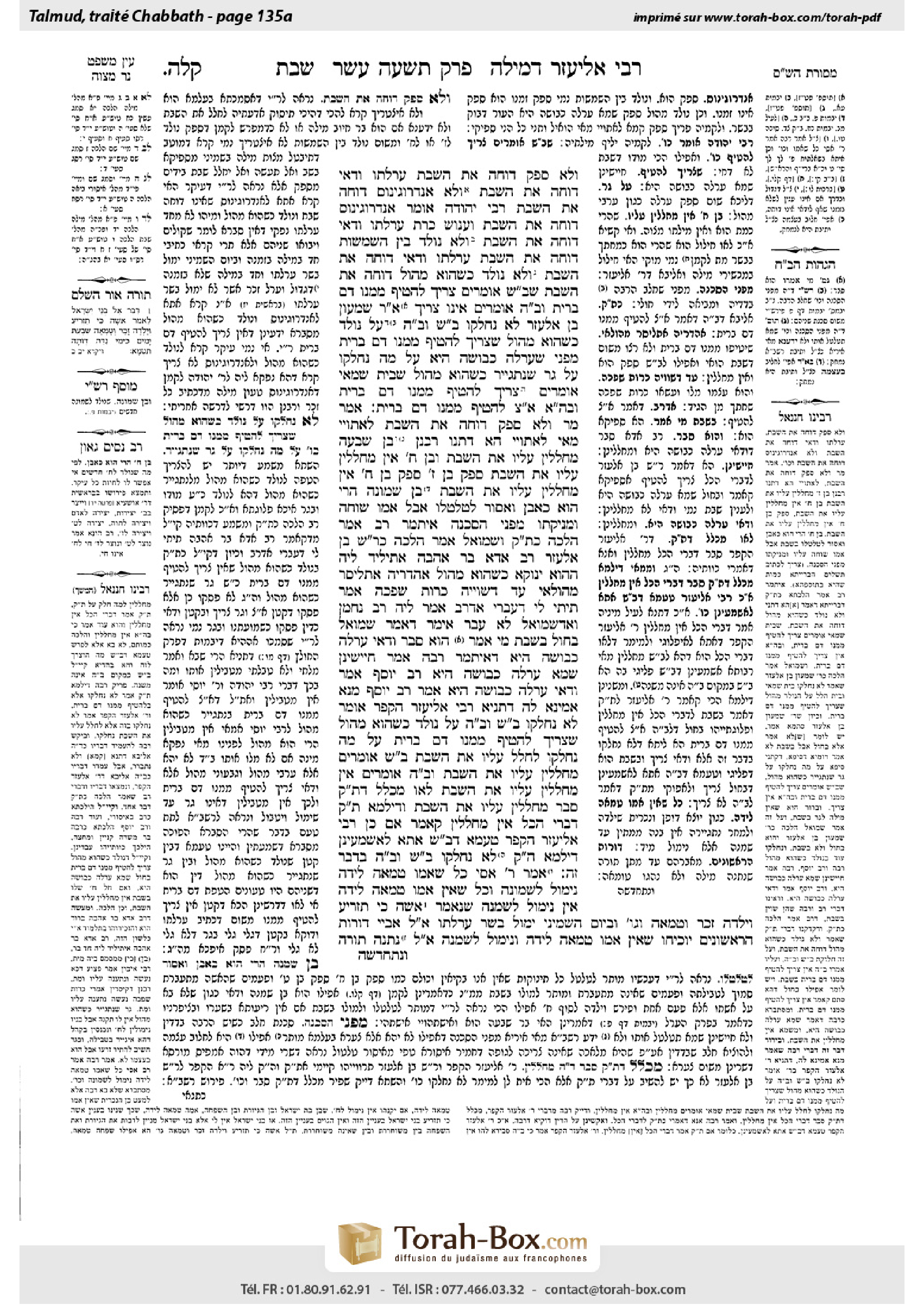
Shabbat 135a: Talmud study for Daf Yomi
Daf Yomi is the daily study of one Talmud folio. Explore 37 tractates with scans, Hebrew text, Sefaria English and AI-generated French translations where annotated.
Passage selection and English or AI-generated French translation are available where the scan has annotations. Daf Study is independent of Torah-Box and Sefaria.
Browse Shabbat · שבת · All tractatesShabbat 135a text and translations
This page of Shabbat includes the Aramaic text, an English translation and an AI-generated French translation, alongside the scan above.
שבת קל״ה א · Aramaic and Hebrew text
וְלֹא סָפֵק דּוֹחֶה אֶת הַשַּׁבָּת. ״עׇרְלָתוֹ״ — וַדַּאי דּוֹחֶה אֶת הַשַּׁבָּת, וְלֹא אַנְדְּרוֹגִינוֹס דּוֹחֶה אֶת הַשַּׁבָּת.
רַבִּי יְהוּדָה אוֹמֵר: אַנְדְּרוֹגִינוֹס דּוֹחֶה אֶת הַשַּׁבָּת, וְעָנוּשׁ כָּרֵת. ״עׇרְלָתוֹ״ — וַדַּאי דּוֹחֶה אֶת הַשַּׁבָּת, וְלֹא נוֹלָד בֵּין הַשְּׁמָשׁוֹת דּוֹחֶה אֶת הַשַּׁבָּת. ״עׇרְלָתוֹ״ — וַדַּאי דּוֹחֶה אֶת הַשַּׁבָּת, וְלֹא נוֹלָד כְּשֶׁהוּא מָהוּל דּוֹחֶה אֶת הַשַּׁבָּת. שֶׁבֵּית שַׁמַּאי אוֹמְרִים: צָרִיךְ לְהַטִּיף מִמֶּנּוּ דַּם בְּרִית, וּבֵית הִלֵּל אוֹמְרִים: אֵינוֹ צָרִיךְ.
אָמַר רַבִּי שִׁמְעוֹן בֶּן אֶלְעָזָר: לֹא נֶחְלְקוּ בֵּית שַׁמַּאי וּבֵית הִלֵּל עַל נוֹלָד כְּשֶׁהוּא מָהוּל שֶׁצָּרִיךְ לְהַטִּיף מִמֶּנּוּ דַּם בְּרִית, מִפְּנֵי שֶׁעׇרְלָה כְּבוּשָׁה הִיא. עַל מַה נֶּחְלְקוּ — עַל גֵּר שֶׁנִּתְגַּיֵּיר כְּשֶׁהוּא מָהוּל, שֶׁבֵּית שַׁמַּאי אוֹמְרִים: צָרִיךְ לְהַטִּיף מִמֶּנּוּ דַּם בְּרִית, וּבֵית הִלֵּל אוֹמְרִים: אֵין צָרִיךְ לְהַטִּיף מִמֶּנּוּ דַּם בְּרִית.
אָמַר מָר: וְלֹא סָפֵק דּוֹחֶה אֶת הַשַּׁבָּת. לְאֵתוֹיֵי מַאי? לְאֵתוֹיֵי הָא דְּתָנוּ רַבָּנַן: בֶּן שִׁבְעָה, מְחַלְּלִין עָלָיו אֶת הַשַּׁבָּת. וּבֶן שְׁמוֹנָה, אֵין מְחַלְּלִין עָלָיו אֶת הַשַּׁבָּת. סָפֵק בֶּן שִׁבְעָה סָפֵק בֶּן שְׁמוֹנָה — אֵין מְחַלְּלִין עָלָיו אֶת הַשַּׁבָּת.
בֶּן שְׁמוֹנָה — הֲרֵי הוּא כְּאֶבֶן, וְאָסוּר לְטַלְטְלוֹ. אֲבָל אִמּוֹ שׁוֹחָה וּמְנִיקָתוֹ מִפְּנֵי הַסַּכָּנָה.
אִיתְּמַר, רַב אָמַר: הֲלָכָה כְּתַנָּא קַמָּא, וּשְׁמוּאֵל אָמַר: הֲלָכָה כְּרַבִּי שִׁמְעוֹן בֶּן אֶלְעָזָר.
רַב אַדָּא בַּר אַהֲבָה אִתְיְלִיד לֵיהּ הָהוּא יָנוֹקָא כְּשֶׁהוּא מָהוּל. אַהְדְּרֵיהּ אַתְּלֵיסַר מָהוֹלָאֵי, עַד דְּשַׁוְּיֵיהּ כְּרוּת שָׁפְכָה. אֲמַר: תֵּיתֵי לִי, דַּעֲבַרִי אַדְּרַב.
אֲמַר לֵיהּ רַב נַחְמָן: וְאַדִּשְׁמוּאֵל לָא עֲבַר?! אֵימַר דְּאָמַר שְׁמוּאֵל בַּחוֹל, בְּשַׁבָּת מִי אָמַר? הוּא סָבַר, וַדַּאי עׇרְלָה כְּבוּשָׁה הִיא. דְּאִיתְּמַר, רַבָּה אָמַר: חָיְישִׁינַן שֶׁמָּא עׇרְלָה כְּבוּשָׁה הִיא. רַב יוֹסֵף אָמַר: וַדַּאי עׇרְלָה כְּבוּשָׁה הִיא.
אָמַר רַב יוֹסֵף: מְנָא אָמֵינָא לַהּ — דְּתַנְיָא, רַבִּי אֱלִיעֶזֶר הַקַּפָּר אוֹמֵר: לֹא נֶחְלְקוּ בֵּית שַׁמַּאי וּבֵית הִלֵּל עַל נוֹלָד כְּשֶׁהוּא מָהוּל — שֶׁצָּרִיךְ לְהַטִּיף מִמֶּנּוּ דַּם בְּרִית, עַל מָה נֶחְלְקוּ — לְחַלֵּל עָלָיו אֶת הַשַּׁבָּת. בֵּית שַׁמַּאי אוֹמְרִים מְחַלְּלִין עָלָיו אֶת הַשַּׁבָּת, וּבֵית הִלֵּל אוֹמְרִים: אֵין מְחַלְּלִין עָלָיו אֶת הַשַּׁבָּת. לָאו מִכְּלָל דְּתַנָּא קַמָּא סָבַר מְחַלְּלִין עָלָיו אֶת הַשַּׁבָּת?!
וְדִילְמָא תַּנָּא קַמָּא דִּבְרֵי הַכֹּל אֵין מְחַלְּלִין קָאָמַר! אִם כֵּן — רַבִּי אֱלִיעֶזֶר הַקַּפָּר טַעְמָא דְבֵית שַׁמַּאי אֲתָא לְאַשְׁמוֹעִינַן? דִילְמָא הָכִי קָאָמַר: לֹא נֶחְלְקוּ בֵּית שַׁמַּאי וּבֵית הִלֵּל בְּדָבָר זֶה.
אָמַר רַבִּי אַסִּי כׇּל שֶׁאִמּוֹ טְמֵאָה לֵידָה — נִימּוֹל לִשְׁמוֹנָה, וְכֹל שֶׁאֵין אִמּוֹ טְמֵאָה לֵידָה — אֵין נִימּוֹל לִשְׁמֹנָה, שֶׁנֶּאֱמַר: ״אִשָּׁה כִּי תַזְרִיעַ וְיָלְדָה זָכָר וְטָמְאָה וְגוֹ׳ וּבַיּוֹם הַשְּׁמִינִי יִמּוֹל בְּשַׂר עׇרְלָתוֹ״.
אֲמַר לֵיהּ אַבָּיֵי: דּוֹרוֹת הָרִאשׁוֹנִים יוֹכִיחוּ, שֶׁאֵין אִמּוֹ טְמֵאָה לֵידָה, וְנִימּוֹל לִשְׁמֹנָה!
אֲמַר לֵיהּ: נִתְּנָה תּוֹרָה,
Shabbat 135a · English translation
and the circumcision of a halakhically uncertain foreskin does not override Shabbat. And by means of the same inference from the term his foreskin, derive that circumcision of his definite foreskin overrides Shabbat, and circumcising the foreskin of a hermaphrodite baby, with regard to whom there is uncertainty whether or not circumcision is required, does not override Shabbat.
Rabbi Yehuda says: The circumcision of a hermaphrodite overrides Shabbat, and if he is not circumcised, when he reaches majority he is punishable by karet. Rabbi Yehuda interprets the verse in the following manner: His definite foreskin overrides Shabbat; however, the circumcision of one born at twilight does not override Shabbat. And likewise, his definite foreskin overrides Shabbat; however, the circumcision of one who was born circumcised, i.e., without a foreskin, does not override Shabbat. With regard to a child in that condition, there is a dispute between Beit Shammai and Beit Hillel, as Beit Shammai say: It is necessary to drip covenantal blood from him, in lieu of circumcision of the foreskin, and Beit Hillel say: It is not necessary, as he is already circumcised.
Rabbi Shimon ben Elazar said: That was not the subject of their dispute, as Beit Shammai and Beit Hillel did not disagree over the fact that from one who was born circumcised, it is necessary to drip covenantal blood, because they agree that it is a case of a concealed foreskin. The child is not actually circumcised; it is just that his foreskin is not visible. With regard to what did they disagree? With regard to a convert who for some reason was circumcised when he was a gentile and converted when he was already circumcised, as Beit Shammai say: Dripping covenantal blood from him is necessary, and Beit Hillel say: Dripping covenantal blood from him is not necessary, and he needs only a ritual immersion to complete his conversion.
The Gemara cited above that the Master said: The circumcision of a halakhically uncertain foreskin does not override Shabbat. The Gemara asks: What case of uncertainty does this statement come to include? The Gemara answers: It comes to include that which the Sages taught: To circumcise a child born after seven months of pregnancy, one desecrates Shabbat, as it will likely live. However, to circumcise a child born after eight months of pregnancy, with regard to whom the presumption was that he would not survive, one may not desecrate Shabbat. And even for the circumcision of a child with regard to whom there is uncertainty whether the child was born after seven months and uncertainty whether the child was born after eight months, one may not desecrate Shabbat.
And the Sages taught: A child born after eight months is like a stone with regard to the halakhot of set-aside [muktze], and it is prohibited to move him. However, his mother may bend over the child and nurse him due to the danger that failure to nurse will cause her to fall ill.
With regard to the halakhic ruling in the case of a child born circumcised, it is stated that the Sages disagree. Rav said: The halakha is in accordance with the explanation of the first tanna, i.e., in accordance with Rabbi Yehuda’s explanation of the dispute between Beit Shammai and Beit Hillel, that they disagree with regard to one born circumcised. Since we rule in accordance with the opinion of Beit Hillel, it is not necessary to drip covenantal blood from a child born circumcised. And Shmuel said: The halakha is in accordance with the explanation of Rabbi Shimon ben Elazar, that Beit Shammai and Beit Hillel do not disagree with regard to one born circumcised, and that everyone agrees that it is necessary to drip covenantal blood from him.
The Gemara relates that to Rav Adda bar Ahava there was this child that was born circumcised, and the time for his circumcision was on Shabbat. He inquired after thirteen ritual circumcisors, but they refused to circumcise him, until ultimately, he circumcised his son himself and rendered him one with a severed urethra. He did not know how to perform a circumcision and made too deep an incision. Rav Adda bar Ahava said: I have it coming to me, i.e., I deserve to be punished, as I violated the ruling of Rav, who ruled that one born circumcised does not even need covenantal blood drawn.
Rav Naḥman said to him: And did he not violate the ruling of Shmuel? Say that Shmuel said that one is required to drip covenantal blood during the week, on Shabbat, did he say so? Certainly one does not desecrate Shabbat in that case. The Gemara explains that Rav Adda bar Ahava held differently, that in that case there is not merely a concern that perhaps there is a concealed foreskin. In that case, that there is definitely a concealed foreskin. Therefore, a form of circumcision must be performed on the child, and it overrides Shabbat. As it was stated that there is an amoraic dispute as to whether or not it is permitted to drip covenantal blood on Shabbat from a child born circumcised. Rabba said: We are concerned lest there is a concealed foreskin, and therefore there is uncertainty whether or not he is considered uncircumcised, and therefore it is prohibited to circumcise him on Shabbat. Rav Yosef said: In that case, there is certainly a concealed foreskin and therefore, it is permitted to circumcise him even on Shabbat.
Rav Yosef said: From where do I say this line of reasoning? As it was taught in a baraita: Rabbi Eliezer HaKappar says: There is a tradition that Beit Shammai and Beit Hillel did not disagree with regard to a child who was born circumcised, that one is required to drip covenantal blood from him. With regard to what did they disagree? With regard to whether or not to desecrate Shabbat on his behalf. Beit Shammai say: One desecrates Shabbat in order to circumcise him, and Beit Hillel say: One does not desecrate Shabbat in order to circumcise him. Rav Yosef concludes: Does this not prove by inference that the first tanna, whose opinion Rabbi Eliezer HaKappar disputes, holds that everyone agrees that one desecrates Shabbat on his behalf, and Rabbi Eliezer HaKappar disagrees and states that Beit Shammai and Beit Hillel dispute that very matter?
The Gemara refutes this: And perhaps the first tanna is saying that everyone agrees that one may not desecrate Shabbat in that case, and Rabbi Eliezer HaKappar disagrees and holds that there is a dispute in this regard. The Gemara immediately rejects this assertion: If that is so, that Rabbi Eliezer HaKappar is coming to introduce an opinion that allows desecrating Shabbat to perform circumcision in this case, that is the opinion of Beit Shammai; did Rabbi Eliezer HaKappar come to teach us the reasoning of Beit Shammai? Their opinion is rejected as halakha, and there would be no purpose in making a statement simply to explain the opinion of Beit Shammai. The Gemara answers that proof is not absolute; perhaps this is what he is saying: Beit Shammai and Beit Hillel did not disagree with regard to this matter of circumcision of a baby born circumcised on Shabbat. They disagree with regard to the requirement to drip covenantal blood on a weekday.
Rabbi Asi stated a principle: Any child whose birth renders his mother ritually impure due to childbirth is circumcised at eight days; and any child whose birth does not render his mother ritually impure due to childbirth, e.g., the birth was not natural, but by caesarean section, is not necessarily circumcised at eight days. As it is stated: “If a woman bears seed and gives birth to a male, she shall be impure seven days…and on the eighth day the flesh of his foreskin shall be circumcised” (Leviticus 12:2–3). This verse draws a parallel between the two issues, indicating that only a child whose birth renders his mother impure is circumcised on the eighth day.
Abaye said to him: The early generations, from Abraham through the revelation at Sinai, will prove that the principle is not valid, as the birth of a male during that era did not render his mother ritually impure due to childbirth, as the halakhot of the impurity of childbirth were commanded at Sinai, and nevertheless, the child was circumcised at eight days, as stated in the Torah, in the book of Genesis.
Rabbi Asi said to him: There is no proof from here, as when the Torah was later given,
Shabbat 135a · Traduction française (IA)
et la circoncision d’un prépuce dont le statut halakhique est incertain ne repousse pas le Chabbat. Par la même déduction fondée sur le terme « son prépuce », on déduit que la circoncision de son prépuce, lorsque celui-ci est certain, repousse le Chabbat, tandis que la circoncision du prépuce d’un bébé androgyne, pour lequel on ne sait pas avec certitude si la circoncision est requise, ne repousse pas le Chabbat.
Rabbi Yehouda dit : La circoncision d’un androgyne repousse le Chabbat et, s’il n’est pas circoncis, il encourt le karèt lorsqu’il atteint sa majorité. Rabbi Yehouda interprète le verset de la manière suivante : son prépuce, lorsqu’il est certain, repousse le Chabbat ; en revanche, la circoncision de celui qui est né au crépuscule ne repousse pas le Chabbat. De même, son prépuce, lorsqu’il est certain, repousse le Chabbat ; en revanche, la circoncision de celui qui est né circoncis, c’est-à-dire sans prépuce, ne repousse pas le Chabbat. Au sujet d’un enfant dans cette situation, Beit Shammaï et Beit Hillel sont en désaccord : Beit Shammaï disent qu’il faut faire couler de lui du sang de l’alliance, en lieu et place de la circoncision du prépuce, et Beit Hillel disent que ce n’est pas nécessaire, puisqu’il est déjà circoncis.
Rabbi Shimon ben Elazar dit : Ce n’était pas là l’objet de leur désaccord, car Beit Shammaï et Beit Hillel ne sont pas en désaccord sur le fait qu’il faut faire couler du sang de l’alliance de celui qui est né circoncis, puisqu’ils reconnaissent qu’il s’agit d’un prépuce dissimulé. L’enfant n’est pas réellement circoncis ; simplement, son prépuce n’est pas visible. Sur quoi étaient-ils en désaccord ? Sur le cas d’un converti qui, pour une raison ou une autre, avait été circoncis alors qu’il était non-Juif, puis s’était converti alors qu’il était déjà circoncis. Beit Shammaï disent qu’il faut faire couler de lui du sang de l’alliance, tandis que Beit Hillel disent que ce n’est pas nécessaire et qu’il lui suffit de s’immerger rituellement pour achever sa conversion.
La Guemara a cité plus haut ce que le maître a dit : La circoncision d’un prépuce dont le statut halakhique est incertain ne repousse pas le Chabbat. La Guemara demande : Quel cas d’incertitude cette déclaration vient-elle inclure ? La Guemara répond : Elle inclut ce que les Sages ont enseigné : pour circoncire un enfant né après sept mois de grossesse, on profane le Chabbat, car il est probable qu’il survivra. En revanche, pour circoncire un enfant né après huit mois de grossesse, dont on présume qu’il ne survivra pas, on ne peut pas profaner le Chabbat. Même pour la circoncision d’un enfant dont on ne sait pas s’il est né après sept ou huit mois, on ne peut pas profaner le Chabbat.
Et les Sages ont enseigné : Un enfant né après huit mois est comme une pierre au regard des halakhot relatives aux objets mis de côté [muktze], et il est interdit de le déplacer. Toutefois, sa mère peut se pencher sur lui et l’allaiter, par crainte que le fait de ne pas l’allaiter ne la rende malade.
Concernant la décision halakhique dans le cas d’un enfant né circoncis, il est rapporté que les Sages sont en désaccord. Rav dit : La halakha suit l’explication du premier tanna, c’est-à-dire l’explication de Rabbi Yehouda au sujet du désaccord entre Beit Shammaï et Beit Hillel : ils sont en désaccord à propos de celui qui est né circoncis. Puisque nous tranchons selon l’opinion de Beit Hillel, il n’est pas nécessaire de faire couler du sang de l’alliance d’un enfant né circoncis. Shmuel dit : La halakha suit l’explication de Rabbi Shimon ben Elazar : Beit Shammaï et Beit Hillel ne sont pas en désaccord à propos de celui qui est né circoncis, et tous reconnaissent qu’il faut faire couler de lui du sang de l’alliance.
La Guemara rapporte que Rav Adda bar Ahava avait un enfant né circoncis, dont la circoncision devait avoir lieu un Chabbat. Il fit appel à treize circonciseurs rituels, mais ils refusèrent de le circoncire ; finalement, il circoncit lui-même son fils et lui trancha l’urètre. Il ne savait pas pratiquer la circoncision et fit une incision trop profonde. Rav Adda bar Ahava dit : Cela me retombe dessus, c’est-à-dire que je mérite d’être puni, car j’ai enfreint la décision de Rav, qui avait statué que celui qui est né circoncis n’a même pas besoin qu’on lui fasse couler du sang de l’alliance.
Rav Naḥman lui dit : Mais n’a-t-il pas enfreint la décision de Shmuel ? Même si l’on dit que Shmuel a déclaré qu’il faut faire couler du sang de l’alliance, l’a-t-il dit au sujet du Chabbat ? Certainement, on ne profane pas le Chabbat dans ce cas. La Guemara explique que Rav Adda bar Ahava avait une autre opinion : dans ce cas, il ne s’agit pas seulement de craindre qu’il y ait peut-être un prépuce dissimulé ; il y a certainement un prépuce dissimulé. Par conséquent, il faut accomplir une forme de circoncision sur l’enfant, et cela repousse le Chabbat. Car il a été rapporté un désaccord entre amoraïm sur la question de savoir s’il est permis de faire couler du sang de l’alliance, le Chabbat, d’un enfant né circoncis. Rabba dit : Nous craignons qu’il y ait un prépuce dissimulé ; il est donc incertain qu’il soit considéré comme non circoncis, et il est par conséquent interdit de le circoncire le Chabbat. Rav Yossef dit : Dans ce cas, il y a certainement un prépuce dissimulé et, par conséquent, il est permis de le circoncire même le Chabbat.
Rav Yossef dit : D’où tiens-je ce raisonnement ? De ce qui a été enseigné dans une baraïta : Rabbi Eliezer HaKappar dit : La tradition rapporte que Beit Shammaï et Beit Hillel ne sont pas en désaccord au sujet d’un enfant né circoncis : il faut lui faire couler du sang de l’alliance. Sur quoi étaient-ils en désaccord ? Sur la question de savoir s’il faut ou non profaner le Chabbat pour lui. Beit Shammaï disent qu’on profane le Chabbat pour le circoncire, et Beit Hillel disent qu’on ne profane pas le Chabbat pour le circoncire. Rav Yossef conclut : N’en déduit-on pas que, selon le premier tanna, dont Rabbi Eliezer HaKappar conteste l’opinion, tous reconnaissent qu’on profane le Chabbat pour lui, tandis que Rabbi Eliezer HaKappar est en désaccord et affirme que Beit Shammaï et Beit Hillel sont précisément en désaccord sur ce point ?
La Guemara réfute cela : Peut-être le premier tanna dit-il que tous reconnaissent qu’on ne peut pas profaner le Chabbat dans ce cas, tandis que Rabbi Eliezer HaKappar est en désaccord et soutient qu’il existe un désaccord à ce sujet. La Guemara rejette aussitôt cette hypothèse : si Rabbi Eliezer HaKappar venait introduire l’opinion selon laquelle il est permis de profaner le Chabbat pour pratiquer la circoncision dans ce cas, ce serait l’opinion de Beit Shammaï. Rabbi Eliezer HaKappar serait-il venu nous enseigner le raisonnement de Beit Shammaï ? Leur opinion étant rejetée comme halakha, il n’y aurait aucune raison de faire une déclaration dans le seul but d’expliquer l’opinion de Beit Shammaï. La Guemara répond que la preuve n’est pas absolue ; peut-être veut-il dire ceci : Beit Shammaï et Beit Hillel ne sont pas en désaccord sur la circoncision, le Chabbat, d’un bébé né circoncis. Ils sont en désaccord sur l’obligation de faire couler du sang de l’alliance un jour de semaine.
Rabbi Asi a énoncé un principe : Tout enfant dont la naissance rend sa mère rituellement impure en raison de l’accouchement est circoncis au bout de huit jours ; tout enfant dont la naissance ne rend pas sa mère rituellement impure en raison de l’accouchement, par exemple parce que la naissance n’a pas eu lieu naturellement, mais par césarienne, n’est pas nécessairement circoncis au bout de huit jours. Car il est dit : « Si une femme conçoit et enfante un garçon, elle sera impure pendant sept jours… et le huitième jour, on circoncira la chair de son prépuce » (Lévitique 12, 2-3). Ce verset établit un parallèle entre les deux questions, indiquant que seul un enfant dont la naissance rend sa mère impure est circoncis le huitième jour.
Abayé lui dit : Les premières générations, depuis Abraham jusqu’à la révélation au Sinaï, prouvent que ce principe n’est pas valable : à cette époque, la naissance d’un garçon ne rendait pas sa mère rituellement impure en raison de l’accouchement, car les halakhot relatives à l’impureté liée à l’accouchement n’ont été commandées qu’au Sinaï. Pourtant, l’enfant était circoncis au bout de huit jours, comme il est indiqué dans la Torah, dans le livre de la Genèse.
Rabbi Asi lui dit : Il n’y a pas là de preuve, car lorsque la Torah fut donnée par la suite,
Traduction française générée par IA à partir de l’édition anglaise de Sefaria. Vérifie toujours un passage avec le texte source.
Text from Sefaria: William Davidson Edition - Vocalized Aramaic (CC BY NC); William Davidson Edition - English (CC BY NC).