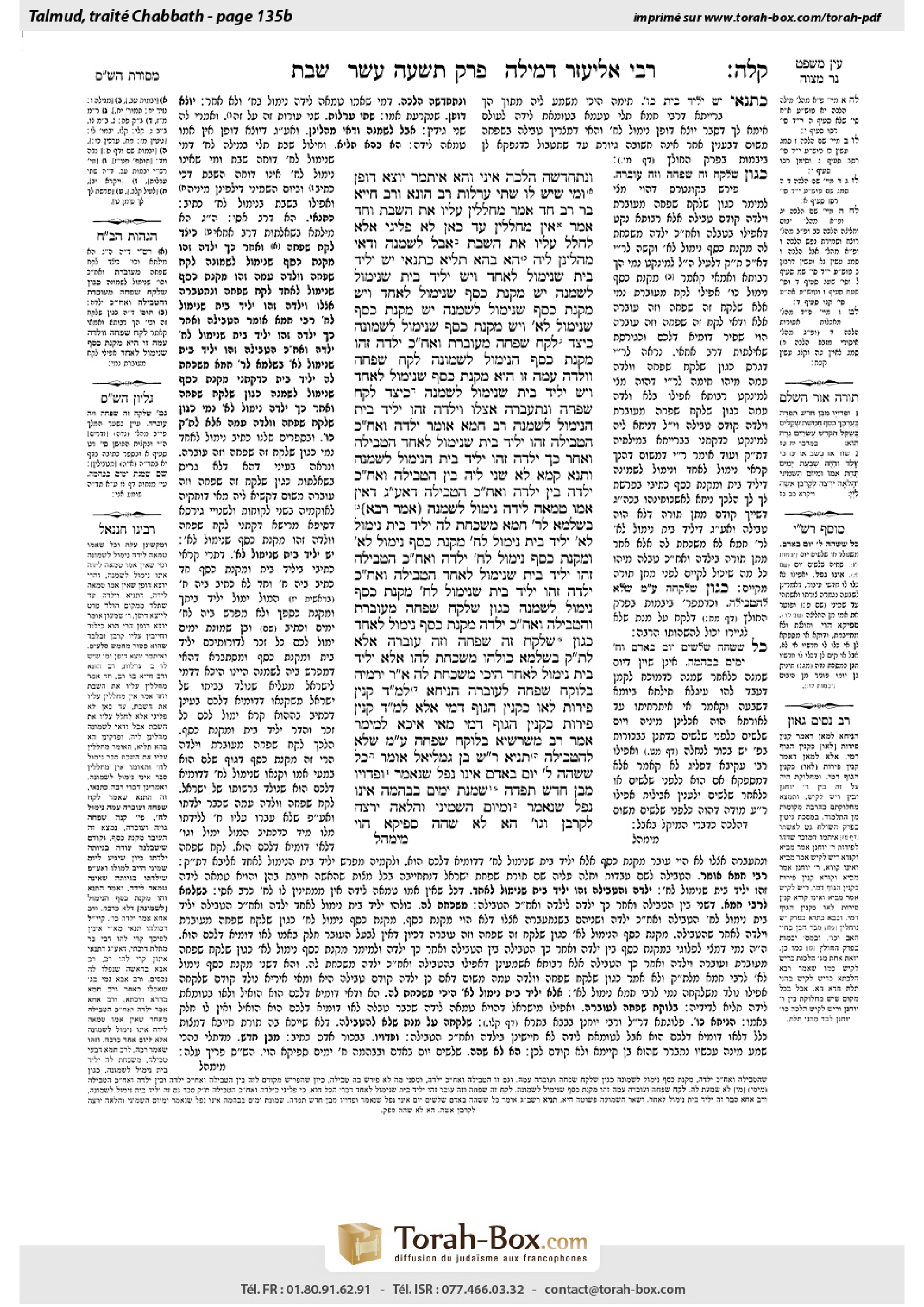
Shabbat 135b: Talmud study for Daf Yomi
Daf Yomi is the daily study of one Talmud folio. Explore 37 tractates with scans, Hebrew text, Sefaria English and AI-generated French translations where annotated.
Passage selection and English or AI-generated French translation are available where the scan has annotations. Daf Study is independent of Torah-Box and Sefaria.
Browse Shabbat · שבת · All tractatesShabbat 135b text and translations
This page of Shabbat includes the Aramaic text, an English translation and an AI-generated French translation, alongside the scan above.
שבת קל״ה ב · Aramaic and Hebrew text
וְנִתְחַדְּשָׁה הֲלָכָה.
אִינִי? וְהָא אִיתְּמַר: יוֹצֵא דּוֹפֶן וּמִי שֶׁיֵּשׁ לוֹ שְׁתֵּי עֲרָלוֹת, רַב הוּנָא וְרַב חִיָּיא בַּר רַב, חַד אָמַר: מְחַלְּלִין עָלָיו אֶת הַשַּׁבָּת. וְחַד אָמַר: אֵין מְחַלְּלִין. עַד כָּאן לָא פְּלִיגִי אֶלָּא לְחַלֵּל עָלָיו אֶת הַשַּׁבָּת, אֲבָל לִשְׁמֹנָה — וַדַּאי מָהֲלִינַן לֵיהּ! הָא בְּהָא תַּלְיָא.
כְּתַנָּאֵי: יֵשׁ יְלִיד בַּיִת שֶׁנִּימּוֹל לְאֶחָד וְיֵשׁ יְלִיד בַּיִת שֶׁנִּימּוֹל לִשְׁמֹנָה, יֵשׁ מִקְנַת כֶּסֶף שֶׁנִּימּוֹל לְאֶחָד וְיֵשׁ מִקְנַת כֶּסֶף שֶׁנִּימּוֹל לִשְׁמֹנָה.
יֵשׁ מִקְנַת כֶּסֶף שֶׁנִּימּוֹל לְאֶחָד וְיֵשׁ מִקְנַת כֶּסֶף שֶׁנִּימּוֹל לִשְׁמוֹנָה, כֵּיצַד? לָקַח שִׁפְחָה מְעוּבֶּרֶת וְאַחַר כָּךְ יָלְדָה — זֶהוּ מִקְנַת כֶּסֶף הַנִּימּוֹל לִשְׁמוֹנָה. לָקַח שִׁפְחָה וּוְלָדָהּ עִמָּהּ — זוֹ הִיא מִקְנַת כֶּסֶף שֶׁנִּימּוֹל לְאֶחָד.
וְיֵשׁ יְלִיד בַּיִת שֶׁנִּימּוֹל לִשְׁמֹנָה, כֵּיצַד? לָקַח שִׁפְחָה וְנִתְעַבְּרָה אֶצְלוֹ וְיָלְדָה — זֶהוּ יְלִיד בַּיִת הַנִּימּוֹל לִשְׁמֹנָה. רַב חָמָא אוֹמֵר: יָלְדָה וְאַחַר כָּךְ הִטְבִּילָהּ — זֶהוּ יְלִיד בַּיִת שֶׁנִּימּוֹל לְאֶחָד. הִטְבִּילָהּ וְאַחַר כָּךְ יָלְדָה — זֶהוּ יְלִיד בַּיִת הַנִּימּוֹל לִשְׁמֹנָה.
וְתַנָּא קַמָּא לָא שָׁנֵי לֵיהּ בֵּין הִטְבִּילָהּ וְאַחַר כָּךְ יָלְדָה בֵּין יָלְדָה וְאַחַר כָּךְ הִטְבִּילָהּ, דְּאַף עַל גַּב דְּאֵין אִמּוֹ טְמֵאָה לֵידָה, נִימּוֹל לִשְׁמֹנָה.
אָמַר רָבָא: בִּשְׁלָמָא לְרַבִּי חָמָא, מַשְׁכַּחַתְּ לַהּ יְלִיד בַּיִת נִימּוֹל לְאֶחָד, יְלִיד בַּיִת נִימּוֹל לִשְׁמוֹנָה, מִקְנַת כֶּסֶף נִימּוֹל לְאֶחָד וּמִקְנַת כֶּסֶף נִימּוֹל לִשְׁמוֹנָה: יָלְדָה וְאַחַר כָּךְ הִטְבִּילָהּ — זֶהוּ יְלִיד בַּיִת שֶׁנִּימּוֹל לְאֶחָד. הִטְבִּילָהּ וְאַחַר כָּךְ יָלְדָה — זֶהוּ יְלִיד בַּיִת שֶׁנִּימּוֹל לִשְׁמוֹנָה.
מִקְנַת כֶּסֶף נִימּוֹל לִשְׁמֹנָה — כְּגוֹן שֶׁלָּקַח שִׁפְחָה מְעוּבֶּרֶת וְהִטְבִּילָהּ וְאַחַר כָּךְ יָלְדָה. מִקְנַת כֶּסֶף נִימּוֹל לְאֶחָד — כְּגוֹן שֶׁלָּקַח זֶה שִׁפְחָה, וְזֶה עוּבָּרָהּ.
אֶלָּא לְתַנָּא קַמָּא, בִּשְׁלָמָא כּוּלְּהוּ מַשְׁכַּחַתְּ לְהוּ, אֶלָּא יְלִיד בַּיִת נִימּוֹל לְאֶחָד הֵיכִי מַשְׁכַּחַתְּ לַהּ?
אָמַר רַבִּי יִרְמְיָה: בְּלוֹקֵחַ שִׁפְחָה לְעוּבָּרָהּ.
הָנִיחָא לְמַאן דְּאָמַר קִנְיַן פֵּירוֹת לָאו כְּקִנְיַן הַגּוּף דָּמֵי. אֶלָּא לְמַאן דְּאָמַר קִנְיַן פֵּירוֹת כְּקִנְיַן הַגּוּף דָּמֵי מַאי אִיכָּא לְמֵימַר?
אָמַר רַב מְשַׁרְשְׁיָא: בְּלוֹקֵחַ שִׁפְחָה עַל מְנָת שֶׁלֹּא לְהַטְבִּילָהּ.
תַּנְיָא: רַבָּן שִׁמְעוֹן בֶּן גַּמְלִיאֵל אוֹמֵר: כׇּל שֶׁשָּׁהָה שְׁלֹשִׁים יוֹם, בָּאָדָם — אֵינוֹ נֵפֶל, שֶׁנֶּאֱמַר: ״וּפְדוּיָו מִבֶּן חֹדֶשׁ תִּפְדֶּה״. שְׁמֹנַת יָמִים בַּבְּהֵמָה — אֵינוֹ נֵפֶל, שֶׁנֶּאֱמַר: ״וּמִיּוֹם הַשְּׁמִינִי וָהָלְאָה יֵרָצֶה לְקׇרְבַּן וְגוֹ׳״.
הָא לֹא שָׁהָה — סְפֵיקָא הָוֵי,
Shabbat 135b · English translation
halakha was introduced. No proof can be cited from the observance of mitzvot prior to the revelation at Sinai.
The Gemara asks: Is that so? Wasn’t it stated that there is a dispute with regard to this halakha? As it was taught with regard to a child born by caesarean section and one who has two foreskins, Rav Huna and Rav Ḥiyya bar Rav disputed their status. One said: One desecrates Shabbat on his behalf and performs the circumcision; and one said: One does not desecrate Shabbat on his behalf. They only disagree with regard to whether or not it is permissible to desecrate Shabbat on his behalf; however, with regard to circumcising him at eight days, in principle, we certainly circumcise him, even though the birth of a child by caesarean section does not render his mother ritually impure due to childbirth. The Gemara answers: The two disputes are interdependent. The one who holds that one desecrates Shabbat for this child’s circumcision also holds that one must circumcise him on the eighth day. The one who holds that one may not desecrate Shabbat for this child’s circumcision holds that one need not circumcise him on the eighth day.
The Gemara comments: The issue of Rabbi Asi’s statement that the obligation to circumcise after eight days depends upon whether or not his birth renders his mother ritually impure due to childbirth is parallel to a tannaitic dispute, as we learned: There is a home-born child of a Canaanite maidservant born in a Jewish home, who has the legal status of a Canaanite slave and his Jewish owner is obligated to circumcise him, who is circumcised at the age of one day, i.e., immediately after birth; and there is a home-born child circumcised at eight days. And there is a slave purchased in a money transaction who is circumcised at one day, and there is a slave purchased in a money transaction who is circumcised at eight days.
The baraita explains: There is a home-born child who is circumcised at one; and there is a home-born child circumcised at eight. How so? If a Jew purchased a pregnant maidservant and she then gave birth to a child while in his possession; that is a slave purchased in a money transaction who is circumcised at eight days, as the fetus was purchased along with the maidservant. If he purchased a maidservant who had already given birth and purchased her child along with her, he is obligated to circumcise the child as soon as the child enters his possession; this is a slave purchased in a money transaction, who is circumcised at one day.
And likewise, there is a home-born child circumcised at eight days. How so? If he bought a maidservant and she became pregnant in his possession and gave birth; that is a home-born child circumcised at eight days. Rav Ḥama says there is a distinction: If the maidservant gave birth and he subsequently had her immerse for the purpose of becoming a maidservant, that is a home-born child circumcised at one day. But if he had her immerse and she then gave birth; that is a home-born child circumcised at eight days.
And the first tanna does not distinguish between whether he had her immerse and she then gave birth, or whether she gave birth and he then had her immerse. Apparently, even though the child’s birth does not render his mother ritually impure due to childbirth, as she is not obligated in mitzvot before immersing and she is not susceptible to ritual impurity of childbirth, he is circumcised at eight days. The dispute between Rabbi Ḥama and the first tanna revolves around the halakha stated by Rabbi Asi.
With regard to the dispute between the tanna’im, Rava said: Granted, according to the opinion of Rabbi Ḥama, cases can be found of a home-born child circumcised at one day, a home-born child circumcised at eight days, a slave purchased in a money transaction circumcised at one day, and a slave purchased in a money transaction circumcised at eight days, in the following manner: If a maidservant gave birth and he subsequently had her immerse, that is the case of a home-born child circumcised at one day. If he had her immerse and she then gave birth, that is the case of a home-born child circumcised at eight days.
A slave purchased in a money transaction is circumcised at eight days in a case where a Jew purchased a pregnant maidservant and thereby paid for and purchased the fetus as well, and then had her immerse, and she then gave birth. A slave purchased in a money transaction is circumcised at one day in a case where that person purchased a maidservant, and that person, i.e., someone else, bought her fetus; since the owner of the fetus has no share in its mother, the child may be circumcised immediately after birth.
However, according to the opinion of the first tanna, granted that all the cases can be found; however, how can the case of a home-born child circumcised at one day be found?
Rabbi Yirmeya said: It can be found in the case of one who purchases a maidservant for the purpose of purchasing rights to her fetus without purchasing the maidservant herself.
The Gemara asks: This works out well according to the opinion of the one who said that a transaction to purchase an item for its product is not a transaction to purchase the item itself, i.e., one who purchased a field for its fruit did not purchase the field itself. However, according to the opinion of the one who said that a transaction to purchase an item for its product is a transaction to purchase the item itself, what can be said, as he does not distinguish between the purchase of the maidservant herself and the purchase of the children that she bears?
Rav Mesharshiya said: According to this opinion, it must be explained as referring to one who purchases a maidservant on condition that he will not have her immerse. They can stipulate that he will not have her immerse as a maidservant and that she will remain a gentile. In that case, the child is a slave born to a Jew, and the mitzva of circumcision is in effect immediately upon birth.
The Gemara cites a related baraita where it was taught that Rabban Shimon ben Gamliel says: With regard to people, any child that remains alive thirty days after birth is no longer suspected of being a stillborn, and is assumed to be a regular child who will go on living. Proof is cited from that which is stated with regard to the laws of redemption and valuations: “And their redemption, from a month old you shall redeem according to your valuation, five shekels of silver, according to the shekel of the Sanctuary; it is twenty gera” (Numbers 18:16), indicating that no value is ascribed to an infant less than a month old, as its viability is uncertain. Likewise, a newborn animal that survives for eight days is no longer suspected of being a stillborn, as it is stated: “When a bullock or a sheep or a goat is born, it shall be seven days under its mother; and from the eighth day and onward it may be accepted for an offering made by fire to the Lord” (Leviticus 22:27).
The Gemara asks: Is that to say by inference: If the child did not yet remain alive for thirty days, it is considered an uncertainty whether or not it is a stillborn with regard to several halakhot?
Shabbat 135b · Traduction française (IA)
La halakha fut introduite. On ne peut tirer aucune preuve de l’observance des mitsvot avant la révélation au Sinaï.
La Guemara demande : Est-ce vraiment le cas ? N’a-t-on pas enseigné qu’il existe une controverse à propos de cette halakha ? En effet, au sujet d’un enfant né par césarienne et d’un enfant qui a deux prépuces, Rav Houna et Rav Ḥiyya bar Rav ont divergé quant à leur statut. L’un dit : on profane le Chabbat pour lui afin de le circoncire ; l’autre dit : on ne profane pas le Chabbat pour lui. Ils ne divergent que sur la question de savoir s’il est permis ou non de profaner le Chabbat pour lui ; mais quant à le circoncire à huit jours, en principe, nous le circoncisons certainement, bien que la naissance d’un enfant par césarienne ne rende pas sa mère rituellement impure à cause de l’accouchement. La Guemara répond : Les deux controverses sont interdépendantes. Celui qui soutient qu’on profane le Chabbat pour circoncire cet enfant soutient également qu’il faut le circoncire le huitième jour. Celui qui soutient qu’on ne peut pas profaner le Chabbat pour circoncire cet enfant soutient qu’il n’est pas nécessaire de le circoncire le huitième jour.
La Guemara fait remarquer : La question soulevée par la déclaration de Rabbi Assi, selon laquelle l’obligation de circoncire après huit jours dépend du fait que sa naissance rende ou non sa mère rituellement impure à cause de l’accouchement, correspond à une controverse entre tannaïm, comme nous l’avons appris : il y a un enfant né dans la maison, issu d’une servante cananéenne et né dans une maison juive, qui a le statut juridique d’un esclave cananéen et que son maître juif est tenu de circoncire, et qui est circoncis à l’âge d’un jour, c’est-à-dire immédiatement après la naissance ; et il y a un enfant né dans la maison qui est circoncis à huit jours. Il y a aussi un esclave acheté par une transaction monétaire qui est circoncis à un jour, et un esclave acheté par une transaction monétaire qui est circoncis à huit jours.
La baraïta explique : il y a un enfant né dans la maison qui est circoncis à un jour, et un enfant né dans la maison qui est circoncis à huit jours. Comment cela ? Si un Juif a acheté une servante enceinte et qu’elle a ensuite accouché alors qu’elle était en sa possession, il s’agit d’un esclave acheté par une transaction monétaire qui est circoncis à huit jours, car le fœtus a été acheté avec la servante. S’il a acheté une servante qui avait déjà accouché et qu’il a acheté son enfant avec elle, il est tenu de circoncire l’enfant dès que celui-ci entre en sa possession ; il s’agit d’un esclave acheté par une transaction monétaire, qui est circoncis à un jour.
De même, il y a un enfant né dans la maison qui est circoncis à huit jours. Comment cela ? Si un homme a acheté une servante, qu’elle est tombée enceinte alors qu’elle était en sa possession et qu’elle a accouché, il s’agit d’un enfant né dans la maison qui est circoncis à huit jours. Rav Ḥama dit qu’il y a une distinction : si la servante a accouché et qu’il l’a ensuite fait immerger pour qu’elle devienne servante, il s’agit d’un enfant né dans la maison qui est circoncis à un jour. Mais s’il l’a fait immerger et qu’elle a ensuite accouché, il s’agit d’un enfant né dans la maison qui est circoncis à huit jours.
Le premier tanna ne distingue pas selon qu’il l’a fait immerger avant qu’elle accouche ou qu’elle ait accouché avant qu’il la fasse immerger. Apparemment, bien que la naissance de l’enfant ne rende pas sa mère rituellement impure à cause de l’accouchement, puisqu’elle n’est pas tenue d’accomplir les mitsvot avant l’immersion et qu’elle n’est pas susceptible de devenir rituellement impure à cause de l’accouchement, il est circoncis à huit jours. La controverse entre Rabbi Ḥama et le premier tanna porte sur la halakha énoncée par Rabbi Assi.
À propos de la controverse entre les tannaïm, Rava dit : Certes, selon l’opinion de Rabbi Ḥama, on peut trouver des cas d’un enfant né dans la maison circoncis à un jour, d’un enfant né dans la maison circoncis à huit jours, d’un esclave acheté par une transaction monétaire circoncis à un jour et d’un esclave acheté par une transaction monétaire circoncis à huit jours, de la manière suivante : si une servante a accouché et qu’il l’a ensuite fait immerger, c’est le cas d’un enfant né dans la maison circoncis à un jour. S’il l’a fait immerger et qu’elle a ensuite accouché, c’est le cas d’un enfant né dans la maison circoncis à huit jours.
Un esclave acheté par une transaction monétaire est circoncis à huit jours dans le cas où un Juif a acheté une servante enceinte, acquérant ainsi aussi le fœtus, puis l’a fait immerger, et qu’elle a ensuite accouché. Un esclave acheté par une transaction monétaire est circoncis à un jour dans le cas où cette personne a acheté une servante et qu’une autre personne a acheté son fœtus ; puisque le propriétaire du fœtus n’a aucun droit sur sa mère, l’enfant peut être circoncis immédiatement après la naissance.
Cependant, selon l’opinion du premier tanna, certes, on peut trouver tous les cas ; mais comment trouver le cas d’un enfant né dans la maison circoncis à un jour ?
Rabbi Yirmeya dit : On peut le trouver dans le cas de quelqu’un qui achète une servante dans le but d’acquérir des droits sur son fœtus, sans acheter la servante elle-même.
La Guemara demande : Cela convient selon l’opinion de celui qui dit qu’une transaction visant à acheter un bien pour en acquérir les produits ne constitue pas une transaction d’achat du bien lui-même, c’est-à-dire que celui qui a acheté un champ pour en récolter les fruits n’a pas acheté le champ lui-même. Mais selon l’opinion de celui qui dit qu’une transaction visant à acheter un bien pour en acquérir les produits constitue une transaction d’achat du bien lui-même, que peut-on dire, puisqu’il ne distingue pas l’achat de la servante elle-même de l’achat des enfants qu’elle met au monde ?
Rav Mesharshiya dit : Selon cette opinion, il faut expliquer qu’il s’agit de quelqu’un qui achète une servante à condition qu’il ne la fasse pas immerger. Ils peuvent stipuler qu’il ne la fera pas immerger en tant que servante et qu’elle restera non juive. Dans ce cas, l’enfant est un esclave né d’un Juif, et la mitsva de la circoncision s’applique dès sa naissance.
La Guemara cite une baraïta apparentée, dans laquelle il est enseigné que Rabban Shimon ben Gamliel dit : En ce qui concerne les humains, tout enfant qui reste en vie trente jours après sa naissance n’est plus considéré comme pouvant être un mort-né ; on présume qu’il s’agit d’un enfant ordinaire qui continuera à vivre. La preuve est tirée de ce qui est dit au sujet des lois du rachat et des évaluations : « Et leur rachat, à partir d’un mois, tu les rachèteras selon ton estimation, pour cinq sicles d’argent, selon le sicle du sanctuaire ; il vaut vingt guéras » (Nombres 18:16). Cela indique qu’aucune valeur n’est attribuée à un nourrisson de moins d’un mois, car sa viabilité est incertaine. De même, un animal nouveau-né qui survit huit jours n’est plus considéré comme pouvant être un mort-né, comme il est dit : « Quand un taureau, un agneau ou un chevreau naît, il restera sept jours auprès de sa mère ; à partir du huitième jour et ensuite, il pourra être agréé comme offrande consumée par le feu pour l’Éternel » (Lévitique 22:27).
La Guemara demande : Faut-il en déduire que si l’enfant n’a pas encore vécu trente jours, on considère comme incertain, pour plusieurs halakhot, qu’il soit ou non mort-né ?
Traduction française générée par IA à partir de l’édition anglaise de Sefaria. Vérifie toujours un passage avec le texte source.
Text from Sefaria: William Davidson Edition - Vocalized Aramaic (CC BY NC); William Davidson Edition - English (CC BY NC).