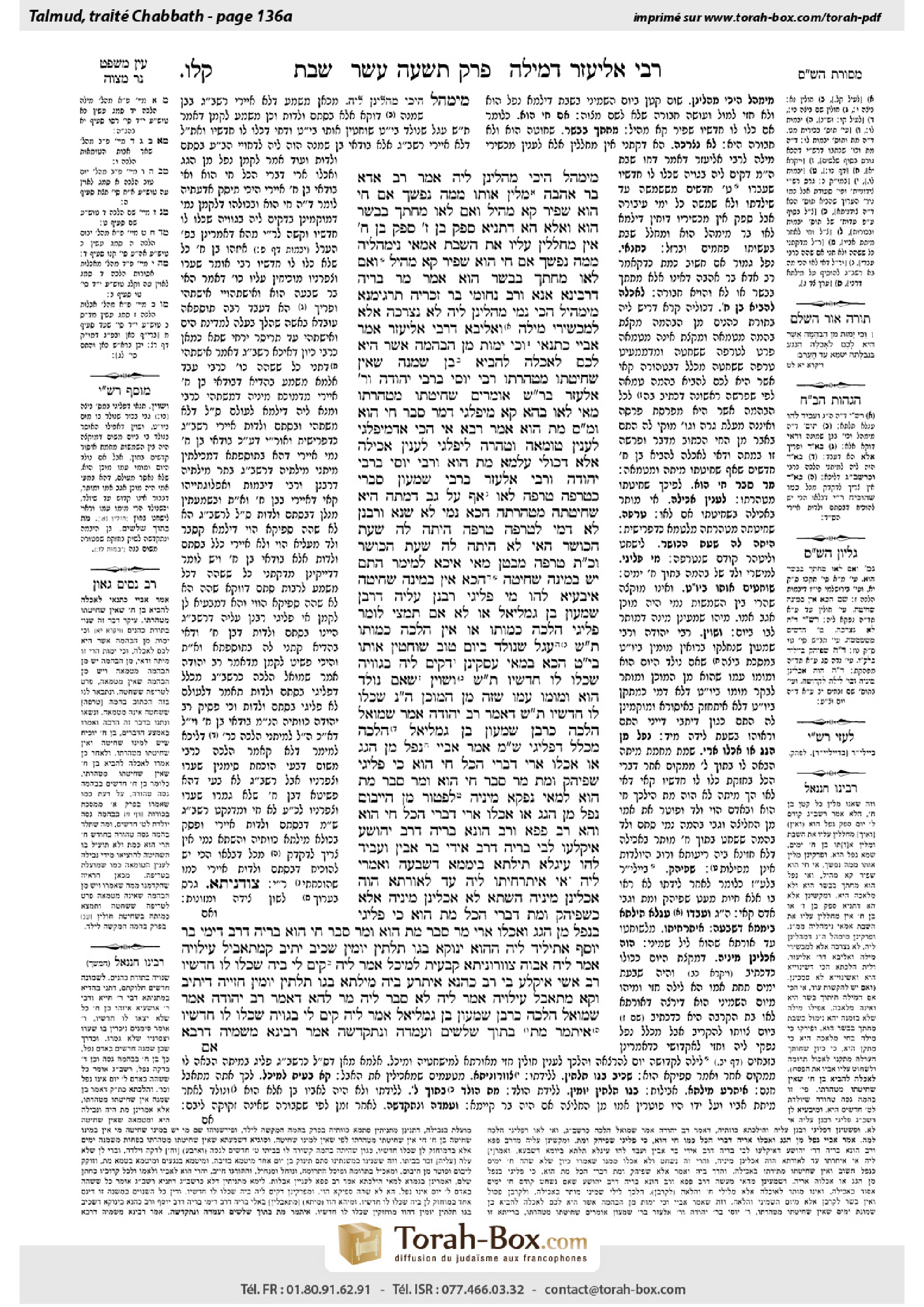
Shabbat 136a: Talmud study for Daf Yomi
Daf Yomi is the daily study of one Talmud folio. Explore 37 tractates with scans, Hebrew text, Sefaria English and AI-generated French translations where annotated.
Passage selection and English or AI-generated French translation are available where the scan has annotations. Daf Study is independent of Torah-Box and Sefaria.
Browse Shabbat · שבת · All tractatesShabbat 136a text and translations
This page of Shabbat includes the Aramaic text, an English translation and an AI-generated French translation, alongside the scan above.
שבת קל״ו א · Aramaic and Hebrew text
מִימְהָל הֵיכִי מָהֲלִינַן לֵיהּ!
אָמַר רַב אַדָּא בַּר אַהֲבָה: מָלִין אוֹתוֹ מִמָּה נַפְשָׁךְ: אִם חַי הוּא — שַׁפִּיר קָא מָהֵיל, וְאִם לָאו — מְחַתֵּךְ בְּבָשָׂר הוּא.
וְאֶלָּא הָא דְּתַנְיָא: סָפֵק בֶּן שִׁבְעָה, סָפֵק בֶּן שְׁמוֹנָה — אֵין מְחַלְּלִין עָלָיו אֶת הַשַּׁבָּת, אַמַּאי? נִימְהֲלֵיהּ מִמָּה נַפְשָׁךְ! אִם חַי הוּא — שַׁפִּיר קָא מָהֵיל, וְאִם לָאו — מְחַתֵּךְ בְּבָשָׂר הוּא!
אָמַר מָר בְּרֵיהּ דְּרָבִינָא: אֲנָא וְרַב נְחוּמִי בַּר זְכַרְיָה תַּרְגֵּימְנָא: מִימְהָל — הָכִי נָמֵי מָהֲלִינַן לֵיהּ. לֹא נִצְרְכָה אֶלָּא לְמַכְשִׁירֵי מִילָה, וְאַלִּיבָּא דְּרַבִּי אֱלִיעֶזֶר.
אָמַר אַבָּיֵי, כְּתַנָּאֵי: ״וְכִי יָמוּת מִן הַבְּהֵמָה אֲשֶׁר הִיא לָכֶם לְאׇכְלָה״, לְהָבִיא בֶּן שְׁמֹנֶה שֶׁאֵין שְׁחִיטָתוֹ מְטַהַרְתּוֹ. רַבִּי יוֹסֵי בְּרַבִּי יְהוּדָה וְרַבִּי אֶלְעָזָר בְּרַבִּי שִׁמְעוֹן אוֹמְרִים: שְׁחִיטָתוֹ מְטַהַרְתּוֹ.
מַאי לָאו בְּהָא קָא מִיפַּלְגִי: דְּמָר סָבַר חַי הוּא, וּמָר סָבַר מֵת הוּא.
אָמַר רָבָא: אִי הָכִי, אַדְּמִיפַּלְגִי לְעִנְיַן טוּמְאָה וְטׇהֳרָה, לִיפַּלְגִי לְעִנְיַן אֲכִילָה!
אֶלָּא דְּכוּלֵּי עָלְמָא מֵת הוּא, וְרַבִּי יוֹסֵי בְּרַבִּי יְהוּדָה וְרַבִּי אֶלְעָזָר בְּרַבִּי שִׁמְעוֹן סָבְרִי כִּטְרֵפָה: טְרֵפָה לָאו אַף עַל גַּב דְּמֵתָה הִיא — שְׁחִיטָתָהּ מְטַהַרְתָּהּ, הָכָא נָמֵי — לָא שְׁנָא. וְרַבָּנַן: לָא דָּמֵי לִטְרֵפָה, טְרֵפָה — הָיְתָה לָהּ שְׁעַת הַכּוֹשֶׁר, הַאי — לֹא הָיְתָה לָהּ שְׁעַת הַכּוֹשֶׁר.
וְכִי תֵּימָא: טְרֵפָה מִבֶּטֶן, מַאי אִיכָּא לְמֵימַר? הָתָם — יֵשׁ בְּמִינָהּ שְׁחִיטָה, הָכָא — אֵין בְּמִינָהּ שְׁחִיטָה.
אִיבַּעְיָא לְהוּ: מִי פְּלִיגִי רַבָּנַן עֲלֵיהּ דְּרַבָּן שִׁמְעוֹן בֶּן גַּמְלִיאֵל, אוֹ לָא? אִם תִּמְצֵי לוֹמַר פְּלִיגִי, הֲלָכָה כְּמוֹתוֹ, אוֹ אֵין הֲלָכָה כְּמוֹתוֹ?
תָּא שְׁמַע: עֵגֶל שֶׁנּוֹלַד בְּיוֹם טוֹב — שׁוֹחֲטִין אוֹתוֹ בְּיוֹם טוֹב! הָכָא בְּמַאי עָסְקִינַן, דְּקִים לֵיהּ בְּגַוֵּויהּ שֶׁכָּלוּ לוֹ חֳדָשָׁיו.
תָּא שְׁמַע: וְשָׁוִין, שֶׁאִם נוֹלַד הוּא וּמוּמוֹ עִמּוֹ — שֶׁזֶּה מִן הַמּוּכָן! הָכָא נָמֵי שֶׁכָּלוּ לוֹ חֳדָשָׁיו.
תָּא שְׁמַע, דְּאָמַר רַב יְהוּדָה אָמַר שְׁמוּאֵל: הֲלָכָה כְּרַבָּן שִׁמְעוֹן בֶּן גַּמְלִיאֵל. הֲלָכָה — מִכְּלָל דִּפְלִיגִי. שְׁמַע מִינַּהּ.
אָמַר אַבָּיֵי: נָפַל מִן הַגָּג אוֹ אֲכָלוֹ אֲרִי — דִּבְרֵי הַכֹּל חַי הוּא. כִּי פְּלִיגִי שֶׁפִּיהֵק וָמֵת. מָר סָבַר: חַי הוּא, וּמָר סָבַר: מֵת הוּא.
לְמַאי נָפְקָא מִינֵּיהּ? לִפְטוֹר מִן הַיִּיבּוּם.
נָפַל מִן הַגָּג אוֹ אֲכָלוֹ אֲרִי — דִּבְרֵי הַכֹּל חַי הוּא? וְהָא רַב פָּפָּא וְרַב הוּנָא בְּרֵיהּ דְּרַב יְהוֹשֻׁעַ אִיקְּלַעוּ לְבֵי בְּרֵיהּ דְּרַב אִידִי בַּר אָבִין, וַעֲבַדוּ לְהוּ עִיגְלָא תִּילְתָּא בִּימָמָא דְשִׁבְעָה. וְאָמְרִי לֵיהּ: אִי אִיתָּרְחִיתוּ לֵיהּ עַד לְאוּרְתָּא — הֲוָה אָכְלִינַן מִינֵּיהּ, הַשְׁתָּא — לָא אָכְלִינַן מִינֵּיהּ!
אֶלָּא: כְּשֶׁפִּיהֵק וָמֵת — דִּבְרֵי הַכֹּל מֵת הוּא, כִּי פְּלִיגִי בְּנָפַל מִן הַגָּג וַאֲכָלוֹ אֲרִי, מָר סָבַר: מֵת הוּא, וּמָר סָבַר חַי הוּא.
בְּרֵיהּ דְּרַב דִּימִי בַּר יוֹסֵף אִתְיְלִיד לֵיהּ הָהוּא יָנוֹקָא. בְּגוֹ תְּלָתִין יוֹמִין שְׁכֵיב. יָתֵיב קָמִתְאַבֵּיל עִילָּוֵיהּ. אֲמַר לֵיהּ אֲבוּהּ: צְווֹרוֹנְיָתָא קָבָעֵית לְמֵיכַל? אֲמַר לֵיהּ: קִים לִי בֵּיהּ שֶׁכָּלוּ לוֹ חֳדָשָׁיו.
רַב אָשֵׁי אִיקְּלַע לְבֵי רַב כָּהֲנָא. אִיתְּרַע בֵּיהּ מִילְּתָא בְּגוֹ תְּלָתִין יוֹמִין. חַזְיֵיהּ דְּיָתֵיב וְקָא מִתְאַבַּל עִילָּוֵיהּ. אֲמַר לֵיהּ: לָא סָבַר לֵיהּ מָר לְהָא דְּאָמַר רַב יְהוּדָה אָמַר שְׁמוּאֵל: הֲלָכָה כְּרַבָּן שִׁמְעוֹן בֶּן גַּמְלִיאֵל? אֲמַר לֵיהּ: קִים לִי בְּגַוֵּיהּ שֶׁכָּלוּ לוֹ חֳדָשָׁיו.
אִיתְּמַר: מֵת בְּתוֹךְ שְׁלֹשִׁים, וְעָמְדָה וְנִתְקַדְּשָׁה. אָמַר רָבִינָא מִשְּׁמֵיהּ דְּרָבָא:
Shabbat 136a · English translation
If so, with regard to circumcision, how can we circumcise him? Perhaps he is a stillborn and one may not desecrate Shabbat for his circumcision.
Rav Adda bar Ahava said: One may circumcise him whichever way you look at it, based on the following calculation: If he is a child who will live, the circumcisor may well circumcise the child, and if not, if the child is a stillborn and the circumcisor is merely cutting flesh, one who cuts the flesh of a corpse or the flesh of one with the legal status of a corpse is not considered to have made a wound, and therefore has not performed a prohibited labor.
The Gemara raises a difficulty: And however, with regard to that which was taught in a baraita: If there is uncertainty whether he was born after seven months of pregnancy, and uncertainty whether he was born after eight months, one does not desecrate Shabbat on his behalf and circumcise him. The Gemara asks: Why? Let us circumcise him on Shabbat, as whichever way you look at it, that is appropriate. If he is a child that will live, the circumcisor may well circumcise the child, and if not, he is merely cutting the flesh of a corpse, which does not violate any Shabbat prohibitions.
Mar, son of Ravina, said: Rav Naḥumei bar Zekharya and I interpreted this as follows: Indeed, as for circumcision itself, we do indeed circumcise that child even on Shabbat. It was only necessary to say that one does not desecrate Shabbat on his behalf with regard to the issue of preparing facilitators of circumcision on Shabbat, in accordance with the opinion of Rabbi Eliezer that actions that facilitate circumcision at its appointed time override Shabbat.
Abaye said: The issue of whether a child who has not yet survived thirty days from his birth is considered viable is parallel to a dispute between the tanna’im with regard to the interpretation of the verse: “And if any animal of which you may eat shall die, one who touches its carcass shall be impure until the evening” (Leviticus 11:39). The verse is interpreted as coming to include offspring of eight months. Large domesticated animals typically give birth after a gestation period of nine months. If an animal of that sort gives birth after eight months, its offspring is deemed to be not viable and its slaughter does not purify it. Rather, it assumes the status of an unslaughtered animal, which is not only prohibited to be eaten, but also transmits ritual impurity to those who touch or move it. Rabbi Yosei, son of Rabbi Yehuda, and Rabbi Elazar, son of Rabbi Shimon, say: Its slaughter purifies it, and it does not assume unslaughtered animal status.
What, is it not that this is the matter with regard to which they disagree? That this Master holds that the animal is considered alive and therefore its slaughter is effective, as is the case with regard to all pure animals, while this Master, the first tanna, holds that it is considered dead.
Rava said: If so, instead of disagreeing over the issue of impurity and purity, let them disagree over the issue of eating, i.e., whether it is permitted to eat this offspring after it is slaughtered. Since they did not dispute this point, their disagreement must revolve around a different factor.
Rather, it must be that everyone agrees that it is considered dead, yet Rabbi Yosei, son of Rabbi Yehuda, and Rabbi Elazar, son of Rabbi Shimon, hold that it has the legal status like that of a tereifa, an animal with a condition that will cause it to die within twelve months. With regard to a tereifa, is it not that even though it is considered dead from the perspective of halakha because there is no possibility of long-term survival, nevertheless, if it is slaughtered, its slaughter purifies it? It does not cause ritual impurity like an unslaughtered animal, even though it may not be eaten. Here too, it is no different. And the Rabbis, who do not accept this claim, say: It is not similar to a tereifa, since a tereifa had a period of fitness before it became a tereifa. However, this animal that was born after eight months of pregnancy did not ever have a period of fitness.
And if you say: With regard to an animal that was a tereifa from the womb and was born in that condition, what is there to say? It too never had a period of fitness. There is a distinction between the cases. There, with regard to a tereifa, there is slaughter in its type; here, with regard to a stillborn, there is no slaughter in its type, as there is no circumstance where slaughter of a stillborn animal is appropriate.
A dilemma was raised before the Sages: Do the Rabbis disagree with Rabban Shimon ben Gamliel, who holds that any animal that survived for eight days after birth is presumed viable, or not? If you say that they disagree, the dilemma is: Is the halakha in accordance with his opinion, or is the halakha not in accordance with his opinion?
Come and hear proof from that which we learned: With regard to a calf that was born on a Festival, one may slaughter it on the Festival. Apparently, Rabban Shimon ben Gamliel’s opinion is not accepted, and one need not wait eight days after the animal is born. The Gemara refutes this: With what are we dealing here? It is a case in which one is certain that its months of gestation were completed, and therefore, it is certainly not stillborn.
Come and hear another proof from that which we learned: Rabbi Yehuda and Rabbi Shimon, who disagreed with regard to whether or not it is permitted to inspect firstborn animals for blemishes on a Festival, agree that if a firstborn animal was born with its blemish, it is considered prepared for use on the Festival. It is not deemed set-aside and an expert may examine it to determine whether or not it is a permanent blemish. Apparently, a firstborn animal may be slaughtered on the day of its birth. The Gemara refutes this proof as well: It is a case in which one is certain that its months of gestation were completed, and it is certainly not stillborn.
Come and hear a solution to the dilemma, as Rav Yehuda said that Shmuel said: The halakha in this matter is in accordance with the opinion of Rabban Shimon ben Gamliel. Nonetheless, from the fact that the halakha was ruled in accordance with Rabban Shimon ben Gamliel, by inference, the Sages disagree with his ruling. The Gemara concludes: Indeed, conclude from this the resolution to both dilemmas raised above.
Abaye said: With regard to a baby less than thirty days old that fell off a roof or was eaten by a lion, everyone agrees that he is considered to have been alive; it was a viable baby that died in the accident. Where they disagree is in a case where the baby yawned, i.e., breathed momentarily after birth, and then immediately died. This Master, the Rabbis, hold: The baby is considered to have been living, since it was born alive; and this Master holds: It is considered to have been born dead until it lives a month after its birth.
What practical difference is there whether or not the baby is considered to have been alive? The difference is to exempt the child’s mother from levirate marriage. If a man died with no children, and his wife was pregnant and a viable child was born, the woman is exempt from levirate marriage; however, if the child was born dead, the man is considered to have died childless, and his widow is obligated in levirate marriage.
The Gemara raises a difficulty: Is that to say that if the child fell off a roof or was eaten by a lion, everyone agrees that it is considered to have been alive? Didn’t Rav Pappa and Rav Huna, son of Rav Yehoshua, happen to come to the house of the son of Rav Idi bar Avin, and he prepared for them a third-born calf on the seventh day after its birth. And they said to him: Had you waited to slaughter it until the evening, we would have eaten from it. Now that you did not wait, we shall not eat from it. Apparently, if a calf is slaughtered before it was alive for eight days and definitely viable, suspicion that it is stillborn remains; the same is true of a child who dies from an accident within thirty days of birth.
Rather, Abaye’s statement must be reformulated: When the baby yawned and died, everyone agrees that it is considered to have been dead from the outset. Where they disagree is in a case when it fell off a roof or was eaten by a lion: This Master, Rabban Shimon ben Gamliel, holds: It is considered to have been dead; and this Master holds that since it did not die on its own, it is considered to have been alive.
The Gemara relates: A baby was born to the son of Rav Dimi bar Yosef. Within thirty days the baby died. He sat and mourned over him. His father, Rav Dimi bar Yosef, said to him: Are you mourning because you wish to partake of the delicacies fed to mourners? The halakha deems a child that dies before thirty days stillborn, and one does not mourn over it. He said to him: I am certain that its months of gestation were completed.
The Gemara similarly relates that Rav Ashi happened to come to Rav Kahana’s house. A matter befell him, i.e., his child died within thirty days of its birth. Rav Ashi saw him and observed that he was sitting and mourning over him. He said to him: Doesn’t the Master hold in accordance with that which Rav Yehuda said that Shmuel said: The halakha is in accordance with Rabban Shimon ben Gamliel, that only a child who lived for thirty days is not considered stillborn? He said to him: I am certain that its months of gestation were completed and he is not to be considered a stillborn.
It was stated that the Sages discussed the following question: What is the ruling in a case where a baby died within thirty days after birth, leaving its mother a childless widow, and before they decided whether or not she was obligated in levirate marriage, she stood and was betrothed to another? Ravina said in the name of Rava:
Shabbat 136a · Traduction française (IA)
Dans ce cas, s’agissant de la circoncision, comment peut-on le circoncire ? Peut-être est-il mort-né, auquel cas on ne peut pas profaner le Chabbat pour le circoncire.
Rav Adda bar Ahava dit : On peut le circoncire quelle que soit l’hypothèse, comme l’explique le raisonnement suivant : s’il s’agit d’un enfant qui vivra, le circonciseur peut bien le circoncire ; sinon, si l’enfant est mort-né et que le circonciseur ne fait que couper de la chair, celui qui coupe la chair d’un cadavre ou d’une personne ayant le statut juridique d’un cadavre n’est pas considéré comme ayant fait une blessure et n’a donc accompli aucun travail interdit.
La Guemara soulève une difficulté : pourtant, il a été enseigné dans une baraïta que, s’il y a un doute quant à savoir s’il est né après sept ou huit mois de grossesse, on ne profane pas le Chabbat pour lui et on ne le circoncit pas. La Guemara demande : Pourquoi ? Circoncisons-le le Chabbat, car, quelle que soit l’hypothèse, cela convient. S’il s’agit d’un enfant qui vivra, le circonciseur peut bien le circoncire ; sinon, il ne fait que couper la chair d’un cadavre, ce qui ne transgresse aucune interdiction du Chabbat.
Mar, fils de Ravina, dit : Rav Naḥumei bar Zekharya et moi avons interprété cela ainsi : en effet, s’agissant de la circoncision elle-même, on circoncit bien cet enfant même le Chabbat. Il fallait seulement préciser que l’on ne profane pas le Chabbat pour lui en ce qui concerne la préparation, le Chabbat, des éléments nécessaires à la circoncision, conformément à l’opinion de Rabbi Eliezer, selon laquelle les actes préparatoires à la circoncision au moment prescrit repoussent le Chabbat.
Abaye dit : La question de savoir si un enfant qui n’a pas encore vécu trente jours après sa naissance est considéré comme viable fait l’objet d’une controverse entre les tannaïm concernant l’interprétation du verset : « Si un animal dont vous pouvez manger vient à mourir, celui qui touche sa carcasse sera impur jusqu’au soir » (Lévitique 11,39). Le verset est interprété comme incluant les petits nés après huit mois de gestation. Les grands animaux domestiques mettent généralement bas après neuf mois de gestation. Si un animal de cette espèce met bas après huit mois, son petit est réputé non viable et son abattage ne le purifie pas. Il prend au contraire le statut d’un animal non abattu rituellement, qui non seulement est interdit à la consommation, mais transmet aussi l’impureté rituelle à ceux qui le touchent ou le déplacent. Rabbi Yosei, fils de Rabbi Yehuda, et Rabbi Elazar, fils de Rabbi Shimon, disent : Son abattage le purifie et il ne prend pas le statut d’un animal non abattu rituellement.
N’est-ce pas là le point sur lequel ils sont en désaccord ? Ce maître estime que l’animal est considéré comme vivant et que son abattage est donc efficace, comme pour tous les animaux purs, tandis que cet autre maître, le premier tanna, estime qu’il est considéré comme mort.
Rava dit : Dans ce cas, au lieu d’être en désaccord sur la question de l’impureté et de la pureté, qu’ils soient en désaccord sur la question de la consommation, c’est-à-dire sur le point de savoir s’il est permis ou non de manger ce petit après son abattage. Puisqu’ils ne sont pas en désaccord sur ce point, leur controverse doit porter sur un autre facteur.
Il faut plutôt dire que tous conviennent qu’il est considéré comme mort. Cependant, Rabbi Yosei, fils de Rabbi Yehuda, et Rabbi Elazar, fils de Rabbi Shimon, estiment qu’il a un statut juridique semblable à celui d’une tereifa, un animal atteint d’une affection qui entraînera sa mort dans les douze mois. S’agissant d’une tereifa, n’est-il pas vrai que, bien qu’elle soit considérée comme morte du point de vue de la halakha, puisqu’elle n’a aucune possibilité de survivre à long terme, son abattage la purifie néanmoins ? Elle ne transmet pas l’impureté rituelle comme un animal non abattu rituellement, même si elle ne peut pas être mangée. Ici aussi, il en va de même. Quant aux Sages, qui n’acceptent pas cet argument, ils disent : le cas n’est pas comparable à celui d’une tereifa, car une tereifa a connu une période où elle était apte à être consommée avant de devenir une tereifa. En revanche, cet animal né après huit mois de grossesse n’a jamais connu de période où il était apte à être consommé.
Et si tu dis : que faut-il dire d’un animal qui était une tereifa dès le ventre maternel et qui est né dans cet état ? Lui non plus n’a jamais connu de période où il était apte à être consommé. Les cas se distinguent toutefois : dans le cas d’une tereifa, il existe un abattage rituel pour cette espèce ; dans celui d’un mort-né, il n’existe pas d’abattage rituel pour son espèce, car aucune circonstance ne rend approprié l’abattage rituel d’un animal mort-né.
Une question fut posée aux Sages : les Sages sont-ils en désaccord avec Rabban Shimon ben Gamliel, qui estime que tout animal ayant survécu huit jours après sa naissance est présumé viable, ou non ? Si tu dis qu’ils sont en désaccord avec lui, la question est alors la suivante : la halakha suit-elle son opinion ou non ?
Viens et écoute une preuve tirée de ce que nous avons appris : on peut abattre un veau né un jour de fête ce jour-là. Apparemment, l’opinion de Rabban Shimon ben Gamliel n’est pas retenue et il n’est pas nécessaire d’attendre huit jours après la naissance de l’animal. La Guemara réfute cette preuve : de quel cas s’agit-il ici ? D’un cas où l’on est certain que la gestation est arrivée à terme ; l’animal n’est donc certainement pas mort-né.
Viens et écoute une autre preuve tirée de ce que nous avons appris : Rabbi Yehuda et Rabbi Shimon, qui étaient en désaccord sur la permission d’examiner les premiers-nés animaux pour vérifier s’ils présentent un défaut un jour de fête, conviennent que, si un animal premier-né est né avec un défaut, il est considéré comme prêt à l’usage pendant la fête. Il n’est pas considéré comme mouktsé, et un expert peut l’examiner afin de déterminer si son défaut est permanent. Apparemment, un animal premier-né peut être abattu le jour de sa naissance. La Guemara réfute aussi cette preuve : il s’agit d’un cas où l’on est certain que la gestation est arrivée à terme et que l’animal n’est donc certainement pas mort-né.
Viens et écoute la solution à la question, car Rav Yehuda a dit au nom de Shmuel : la halakha en la matière suit l’opinion de Rabban Shimon ben Gamliel. Néanmoins, du fait que la halakha a été tranchée conformément à son opinion, on peut déduire que les Sages sont en désaccord avec lui. La Guemara conclut : déduis-en effectivement la résolution des deux questions soulevées précédemment.
Abaye dit : s’agissant d’un bébé âgé de moins de trente jours qui est tombé d’un toit ou a été dévoré par un lion, tous conviennent qu’il était vivant ; c’était un bébé viable qui est mort à la suite de l’accident. Leur désaccord porte sur le cas où le bébé a bâillé, c’est-à-dire respiré un instant après sa naissance, puis est mort aussitôt. Ce maître, les Sages, estime que le bébé est considéré comme ayant vécu, puisqu’il est né vivant ; tandis que cet autre maître estime qu’il est considéré comme mort-né jusqu’à ce qu’il ait vécu un mois après sa naissance.
Quelle différence pratique y a-t-il entre le fait que le bébé soit considéré comme ayant été vivant ou non ? La différence concerne l’exemption de sa mère du lévirat. Si un homme meurt sans enfant alors que sa femme est enceinte, puis qu’elle met au monde un enfant viable, elle est exemptée du lévirat ; en revanche, si l’enfant est né mort, l’homme est considéré comme étant mort sans enfant et sa veuve est tenue au lévirat.
La Guemara soulève une difficulté : cela signifie-t-il que, si l’enfant est tombé d’un toit ou a été dévoré par un lion, tous conviennent qu’il était vivant ? Rav Pappa et Rav Huna, fils de Rav Yehoshua, ne sont-ils pas arrivés par hasard chez le fils de Rav Idi bar Avin, qui leur prépara un veau troisième-né le septième jour après sa naissance ? Ils lui dirent : « Si tu avais attendu le soir pour l’abattre, nous en aurions mangé. À présent que tu n’as pas attendu, nous n’en mangerons pas. » Apparemment, si un veau est abattu avant d’avoir vécu huit jours et d’être certainement viable, le soupçon qu’il soit mort-né subsiste ; il en va de même pour un enfant qui meurt accidentellement dans les trente jours suivant sa naissance.
Il faut plutôt reformuler les propos d’Abaye ainsi : lorsque le bébé a bâillé puis est mort, tous conviennent qu’il est considéré comme ayant été mort dès le départ. Leur désaccord porte sur le cas où il est tombé d’un toit ou a été dévoré par un lion : ce maître, Rabban Shimon ben Gamliel, estime qu’il est considéré comme mort ; tandis que cet autre maître estime que, puisqu’il n’est pas mort de lui-même, il est considéré comme ayant été vivant.
La Guemara rapporte : un bébé naquit au fils de Rav Dimi bar Yosef. Il mourut dans les trente jours. Son père, Rav Dimi bar Yosef, s’assit et le pleura. Il lui dit : « Le pleures-tu parce que tu veux profiter des mets servis aux endeuillés ? » Selon la halakha, un enfant qui meurt avant l’âge de trente jours est considéré comme mort-né, et l’on ne porte pas son deuil. Il lui répondit : « Je suis certain que la gestation était arrivée à terme. »
La Guemara rapporte de même que Rav Ashi arriva par hasard chez Rav Kahana. Un malheur survint : son enfant mourut dans les trente jours suivant sa naissance. Rav Ashi le vit assis et en train de pleurer son enfant. Il lui dit : « Le Maître ne suit-il pas l’enseignement de Rav Yehuda, qui a dit au nom de Shmuel que la halakha suit Rabban Shimon ben Gamliel, selon qui un enfant n’est pas considéré comme mort-né s’il a vécu trente jours ? » Il lui répondit : « Je suis certain que la gestation était arrivée à terme et qu’il ne faut pas le considérer comme mort-né. »
Il a été rapporté que les Sages ont discuté de la question suivante : quelle est la halakha dans le cas où un bébé meurt dans les trente jours suivant sa naissance, laissant sa mère veuve sans enfant, et où, avant que l’on ait décidé si elle était tenue au lévirat, elle se leva et se fiança à un autre homme ? Ravina dit au nom de Rava :
Traduction française générée par IA à partir de l’édition anglaise de Sefaria. Vérifie toujours un passage avec le texte source.
Text from Sefaria: William Davidson Edition - Vocalized Aramaic (CC BY NC); William Davidson Edition - English (CC BY NC).