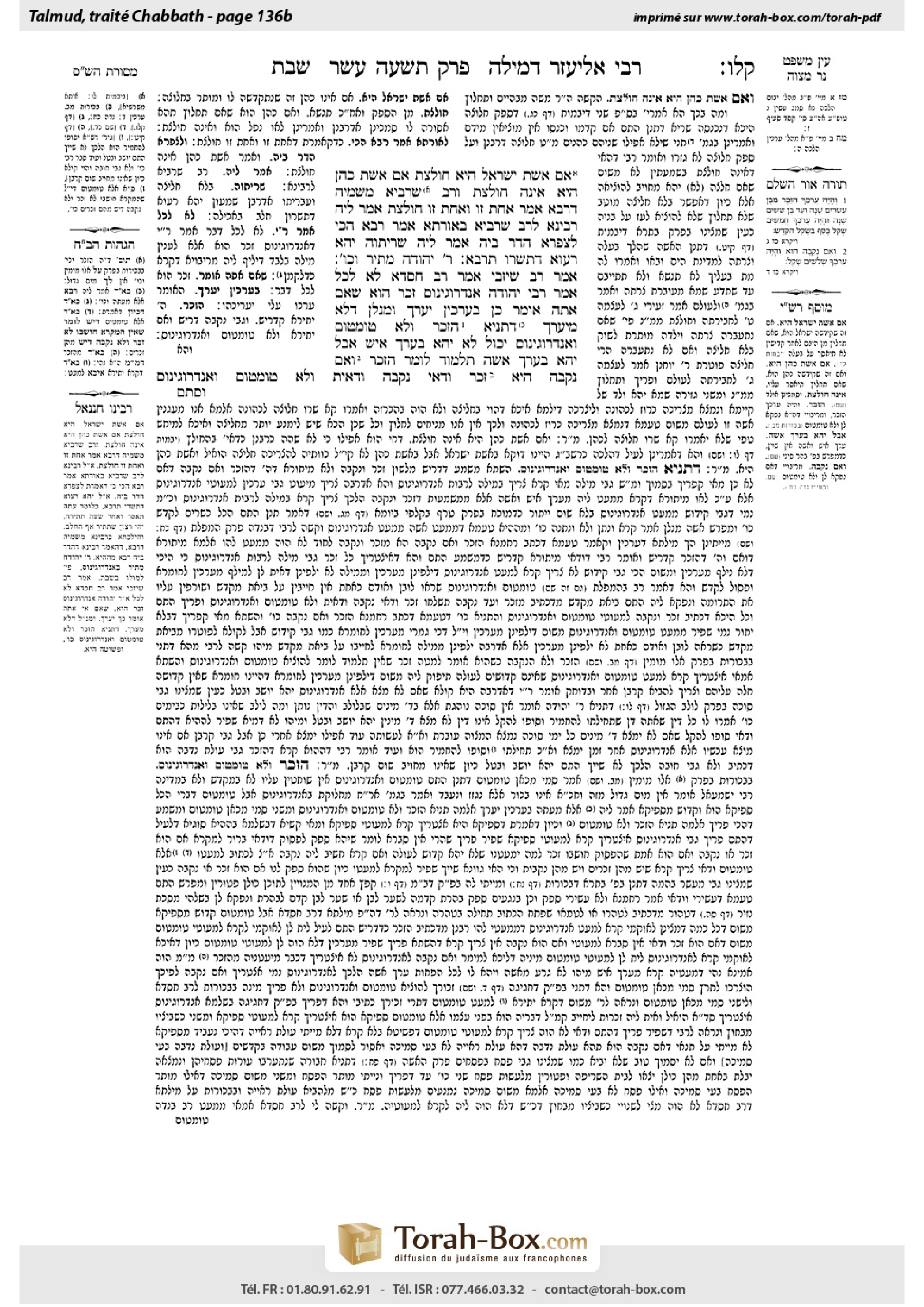
Shabbat 136b: Talmud study for Daf Yomi
Daf Yomi is the daily study of one Talmud folio. Explore 37 tractates with scans, Hebrew text, Sefaria English and AI-generated French translations where annotated.
Passage selection and English or AI-generated French translation are available where the scan has annotations. Daf Study is independent of Torah-Box and Sefaria.
Browse Shabbat · שבת · All tractatesShabbat 136b text and translations
This page of Shabbat includes the Aramaic text, an English translation and an AI-generated French translation, alongside the scan above.
שבת קל״ו ב · Aramaic and Hebrew text
אִם אֵשֶׁת יִשְׂרָאֵל הִיא — חוֹלֶצֶת. אִם אֵשֶׁת כֹּהֵן הִיא — אֵינָהּ חוֹלֶצֶת.
וְרַב שֵׁרֵבְיָא מִשְּׁמֵיהּ דְּרָבָא אָמַר: אַחַת זוֹ וְאַחַת זוֹ — חוֹלֶצֶת.
אֲמַר לֵיהּ רָבִינָא לְרַב שֵׁרֵבְיָא: בְּאוּרְתָּא אֲמַר רָבָא הָכִי, לְצַפְרָא הֲדַר בֵּיהּ. אֲמַר לֵיהּ שְׁרִיתוּהָ? יְהֵא רַעֲוָא דְּתִשְׁרוֹ תַּרְבָּא.
רַבִּי יְהוּדָה מַתִּיר וְכוּ׳. אָמַר רַב שֵׁיזְבִי אָמַר רַב חִסְדָּא: לֹא לַכֹּל אָמַר רַבִּי יְהוּדָה אַנְדְּרוֹגִינוֹס זָכָר הוּא, שֶׁאִם אַתָּה אוֹמֵר כֵּן, בַּעֲרָכִין יֵעָרֵךְ!
וּמְנָלַן דְּלָא מִיעֲרַךְ? דְּתַנְיָא: ״הַזָּכָר״ — וְלֹא טוּמְטוּם וְאַנְדְּרוֹגִינוֹס. יָכוֹל לֹא יְהֵא בְּעֵרֶךְ אִישׁ אֲבָל יְהֵא בְּעֵרֶךְ אִשָּׁה — תַּלְמוּד לוֹמַר: ״הַזָּכָר״, ״וְאִם נְקֵבָה הִיא״. זָכָר וַדַּאי, נְקֵבָה וַדָּאִית — וְלֹא טוּמְטוּם וְאַנְדְּרוֹגִינוֹס.
Shabbat 136b · English translation
If she is the wife of an Israelite, meaning she became betrothed to an Israelite, who may marry a woman who has undergone ḥalitza, she performs ḥalitza due to uncertainty. Given that the child may have been stillborn and therefore never considered alive, in which case she would be obligated to undergo levirate marriage or perform ḥalitza, by performing ḥalitza, she removes any doubt and can remain with her new husband. However, if she is the wife of a priest, she does not perform ḥalitza, as if she were to perform ḥalitza she would be prohibited to her husband the priest. Since there are those who hold that that the baby is considered alive from the moment of its birth, based on that opinion, she is exempt from performing ḥalitza, after the fact.
Rav Sherevya said in the name of Rava: Both this, the woman married to an Israelite, and that, the woman married to a priest, perform ḥalitza, as the prohibition against marrying a woman not released from her bond of levirate marriage is a stringent one, and the fact that her husband is a priest is not taken into consideration.
Ravina said to Rav Sherevya: In the evening Rava indeed said so, as you said; however, in the morning he retracted his statement, and that is what I cited. Rav Sherevya, however, did not accept this explanation, and said: Did you permit the wife of a priest without ḥalitza, despite the fact that Rabban Shimon ben Gamliel deems the baby stillborn unless he survives to the age of thirty days? Since you have violated his ruling, may it be God’s will that you continue along this path and permit the eating of forbidden fat.
We learned in the mishna that Rabbi Yehuda permits circumcising a hermaphrodite on Shabbat. Rav Sheizvi said that Rav Ḥisda said: Not with regard to all matters did Rabbi Yehuda say that a hermaphrodite is considered a male; it was only with regard to circumcision, as if you say so, that the legal status of a hermaphrodite is that of a male in every sense, then even with regard to vows of valuation, he should be valuated.
And from where do we derive that he is not valuated? As it was taught in the Sifra, the halakhic midrash on Leviticus, with regard to the verse: “Then your valuation shall be for the male from the age of twenty years until the age of sixty years, your valuation shall be fifty shekel of silver, after the shekel of the Sanctuary” (Leviticus 27:3). The Sages inferred: “The male” means the definite male but not a tumtum or a hermaphrodite. I might have thought that these shall not be valuated according to the valuation of a man, but shall be valuated according to the valuation of a woman. Therefore, the verse states: “The male,” and in the following verse: “And if she is a female, then your valuation shall be thirty shekels” (Leviticus 27:4), indicating: Only a definite male or a definite female, but not a tumtum or a hermaphrodite, which are categorized as neither male nor female.
Shabbat 136b · Traduction française (IA)
Si elle est l’épouse d’un Israélite, c’est-à-dire si elle a été fiancée à un Israélite, qui peut épouser une femme ayant subi la ḥalitsa, elle accomplit la ḥalitsa par précaution, en raison du doute. En effet, l’enfant a peut-être été mort-né et n’a donc jamais été considéré comme vivant ; dans ce cas, elle serait tenue de contracter un mariage léviratique ou d’accomplir la ḥalitsa. En accomplissant la ḥalitsa, elle écarte tout doute et peut rester avec son nouvel époux. En revanche, si elle est l’épouse d’un prêtre, elle n’accomplit pas la ḥalitsa, car cela la rendrait interdite à son mari prêtre. Puisque certains soutiennent que le bébé est considéré comme vivant dès sa naissance, selon cette opinion, elle est dispensée, après coup, d’accomplir la ḥalitsa.
Rav Sherevya dit au nom de Rava : aussi bien celle-ci, la femme mariée à un Israélite, que celle-là, la femme mariée à un prêtre, accomplissent la ḥalitsa, car l’interdiction d’épouser une femme qui n’a pas été libérée de son lien de mariage léviratique est rigoureuse, et le fait que son mari soit prêtre n’est pas pris en considération.
Ravina dit à Rav Sherevya : le soir, Rava a effectivement dit ce que tu rapportes ; cependant, le matin, il est revenu sur ses paroles, et c’est ce que j’ai cité. Rav Sherevya n’accepta toutefois pas cette explication et dit : As-tu donc permis à l’épouse d’un prêtre de rester avec lui sans accomplir la ḥalitsa, alors que Rabban Shimon ben Gamliel considère le bébé comme mort-né à moins qu’il ne survive jusqu’à l’âge de trente jours ? Puisque tu as enfreint sa décision, puisse Dieu faire que tu poursuives dans cette voie et que tu permettes de consommer de la graisse interdite.
Nous avons appris dans la Michna que Rabbi Yehouda permet de circoncire un hermaphrodite le Chabbat. Rav Sheizvi dit au nom de Rav Ḥisda : Rabbi Yehouda n’a pas dit, à propos de toutes les questions, qu’un hermaphrodite est considéré comme un mâle ; il l’a dit uniquement à propos de la circoncision. En effet, si l’on disait que le statut juridique d’un hermaphrodite est en tout point celui d’un mâle, alors, même pour les vœux d’évaluation, il devrait être soumis à une évaluation.
Et d’où déduisons-nous qu’il n’est pas soumis à une évaluation ? Comme il a été enseigné dans la Sifra, le midrach halakhique sur le Lévitique, à propos du verset : « Ton évaluation sera pour le mâle âgé de vingt ans jusqu’à l’âge de soixante ans ; ton évaluation sera de cinquante sicles d’argent, selon le sicle du Sanctuaire » (Lévitique 27, 3). Les Sages en déduisent : « Le mâle » désigne un mâle dont le sexe est certain, mais pas un tumtum ni un hermaphrodite. J’aurais pu penser que ceux-ci ne seraient pas soumis à l’évaluation prévue pour un homme, mais à celle prévue pour une femme. C’est pourquoi le verset dit : « Le mâle », puis, au verset suivant : « Et si c’est une femelle, ton évaluation sera de trente sicles » (Lévitique 27, 4), ce qui indique que seuls un mâle ou une femelle dont le sexe est certain sont concernés, mais pas un tumtum ni un hermaphrodite, qui ne sont catégorisés ni comme mâles ni comme femelles.
Traduction française générée par IA à partir de l’édition anglaise de Sefaria. Vérifie toujours un passage avec le texte source.
Text from Sefaria: William Davidson Edition - Vocalized Aramaic (CC BY NC); William Davidson Edition - English (CC BY NC).