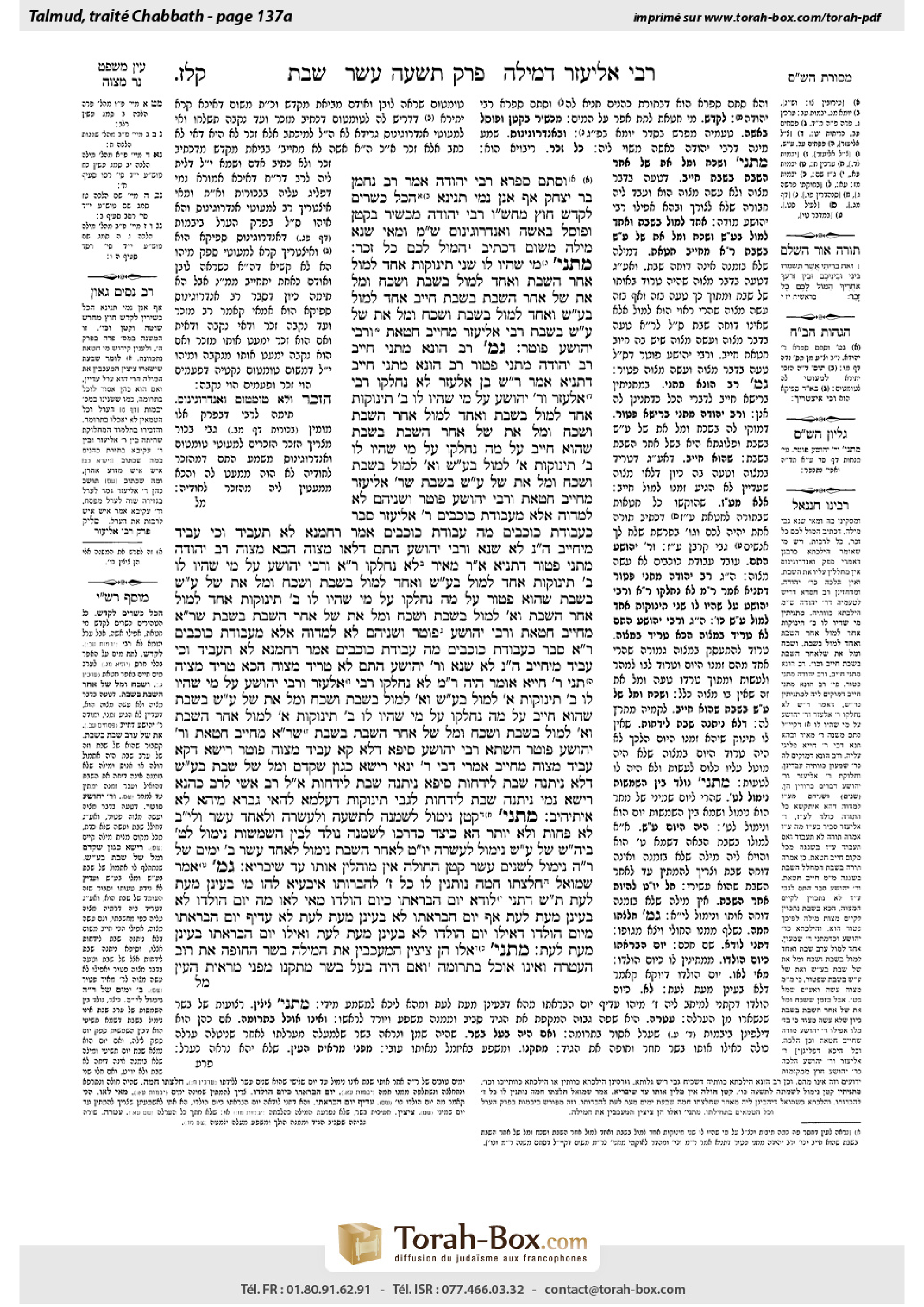
Shabbat 137a: Talmud study for Daf Yomi
Daf Yomi is the daily study of one Talmud folio. Explore 37 tractates with scans, Hebrew text, Sefaria English and AI-generated French translations where annotated.
Passage selection and English or AI-generated French translation are available where the scan has annotations. Daf Study is independent of Torah-Box and Sefaria.
Browse Shabbat · שבת · All tractatesShabbat 137a text and translations
This page of Shabbat includes the Aramaic text, an English translation and an AI-generated French translation, alongside the scan above.
שבת קל״ז א · Aramaic and Hebrew text
וּסְתָם סִפְרָא רַבִּי יְהוּדָה.
אָמַר רַב נַחְמָן בַּר יִצְחָק: אַף אֲנַן נָמֵי תְּנֵינָא: הַכֹּל כְּשֵׁרִים לְקַדֵּשׁ, חוּץ מֵחֵרֵשׁ שׁוֹטֶה וְקָטָן. רַבִּי יְהוּדָה מַכְשִׁיר בְּקָטָן וּפוֹסֵל בְּאִשָּׁה וְאַנְדְּרוֹגִינוֹס. שְׁמַע מִינַּהּ.
וּמַאי שְׁנָא מִילָה? מִשּׁוּם דִּכְתִיב: ״הִמּוֹל לָכֶם כׇּל זָכָר״.
מַתְנִי׳ מִי שֶׁהָיוּ לוֹ שְׁנֵי תִינוֹקוֹת, אֶחָד לָמוּל אַחַר הַשַּׁבָּת וְאֶחָד לָמוּל בַּשַּׁבָּת, וְשָׁכַח וּמָל אֶת שֶׁל אַחַר הַשַּׁבָּת בַּשַּׁבָּת — חַיָּיב.
אֶחָד לָמוּל בְּעֶרֶב שַׁבָּת וְאֶחָד לָמוּל בַּשַּׁבָּת, וְשָׁכַח וּמָל אֶת שֶׁל עֶרֶב שַׁבָּת בַּשַּׁבָּת — רַבִּי אֱלִיעֶזֶר מְחַיֵּיב חַטָּאת, וְרַבִּי יְהוֹשֻׁעַ פּוֹטֵר.
גְּמָ׳ רַב הוּנָא מַתְנֵי ״חַיָּיב״, רַב יְהוּדָה מַתְנֵי ״פָּטוּר״.
רַב הוּנָא מַתְנֵי ״חַיָּיב״, דְּתַנְיָא, אָמַר רַבִּי שִׁמְעוֹן בֶּן אֶלְעָזָר: לֹא נֶחְלְקוּ רַבִּי אֶלְעָזָר וְרַבִּי יְהוֹשֻׁעַ עַל מִי שֶׁהָיוּ לוֹ שְׁנֵי תִינוֹקוֹת, אֶחָד לָמוּל בַּשַּׁבָּת וְאֶחָד לָמוּל אַחַר הַשַּׁבָּת, וְשָׁכַח וּמָל אֶת שֶׁל אַחַר הַשַּׁבָּת בַּשַּׁבָּת — שֶׁהוּא חַיָּיב.
עַל מָה נֶחְלְקוּ — עַל מִי שֶׁהָיוּ לוֹ שְׁנֵי תִינוֹקוֹת, אֶחָד לָמוּל בְּעֶרֶב שַׁבָּת וְאֶחָד לָמוּל בַּשַּׁבָּת, וְשָׁכַח וּמָל אֶת שֶׁל עֶרֶב שַׁבָּת בַּשַּׁבָּת — שֶׁרַבִּי אֱלִיעֶזֶר מְחַיֵּיב חַטָּאת, וְרַבִּי יְהוֹשֻׁעַ פּוֹטֵר.
וּשְׁנֵיהֶם לֹא לְמָדוּהָ אֶלָּא מֵעֲבוֹדָה זָרָה. רַבִּי אֱלִיעֶזֶר סָבַר: כַּעֲבוֹדָה זָרָה, מָה עֲבוֹדָה זָרָה אָמַר רַחֲמָנָא ״לָא תַּעֲבֵיד״, וְכִי עֲבִיד — מִיחַיַּיב, הָכָא נָמֵי — לָא שְׁנָא.
וְרַבִּי יְהוֹשֻׁעַ: הָתָם — דְּלָאו מִצְוָה, הָכָא — מִצְוָה.
רַב יְהוּדָה מַתְנֵי ״פָּטוּר״, דְּתַנְיָא, אָמַר רַבִּי מֵאִיר: לֹא נֶחְלְקוּ רַבִּי אֱלִיעֶזֶר וְרַבִּי יְהוֹשֻׁעַ עַל מִי שֶׁהָיוּ לוֹ שְׁנֵי תִינוֹקוֹת, אֶחָד לָמוּל בְּעֶרֶב שַׁבָּת וְאֶחָד לָמוּל בַּשַּׁבָּת, וְשָׁכַח וּמָל אֶת שֶׁל עֶרֶב שַׁבָּת בַּשַּׁבָּת — שֶׁהוּא פָּטוּר.
עַל מָה נֶחְלְקוּ — עַל מִי שֶׁהָיוּ לוֹ שְׁנֵי תִינוֹקוֹת, אֶחָד לָמוּל אַחַר הַשַּׁבָּת וְאֶחָד לָמוּל בַּשַּׁבָּת, וְשָׁכַח וּמָל אֶת שֶׁל אַחַר הַשַּׁבָּת בַּשַּׁבָּת — שֶׁרַבִּי אֱלִיעֶזֶר מְחַיֵּיב חַטָּאת, וְרַבִּי יְהוֹשֻׁעַ פּוֹטֵר.
וּשְׁנֵיהֶם לֹא לְמָדוּהָ אֶלָּא מֵעֲבוֹדָה זָרָה. רַבִּי אֱלִיעֶזֶר סָבַר: כַּעֲבוֹדָה זָרָה, מָה עֲבוֹדָה זָרָה אָמַר רַחֲמָנָא ״לָא תַּעֲבֵיד״, וְכִי עָבֵיד — מִיחַיַּיב, הָכָא נָמֵי — לָא שְׁנָא.
וְרַבִּי יְהוֹשֻׁעַ: הָתָם — לָא טְרִיד [בְּ]מִצְוָה, הָכָא — טְרִיד.
תָּנֵי רַבִּי חִיָּיא: אוֹמֵר הָיָה רַבִּי מֵאִיר, לֹא נֶחְלְקוּ רַבִּי אֱלִיעֶזֶר וְרַבִּי יְהוֹשֻׁעַ עַל מִי שֶׁהָיוּ לוֹ שְׁנֵי תִינוֹקוֹת, אֶחָד לָמוּל בְּעֶרֶב שַׁבָּת וְאֶחָד לָמוּל בַּשַּׁבָּת, וְשָׁכַח וּמָל אֶת שֶׁל עֶרֶב שַׁבָּת בַּשַּׁבָּת — שֶׁהוּא חַיָּיב.
עַל מָה נֶחְלְקוּ — עַל מִי שֶׁהָיוּ לוֹ שְׁנֵי תִינוֹקוֹת, אֶחָד לָמוּל אַחַר הַשַּׁבָּת וְאֶחָד לָמוּל בַּשַּׁבָּת, וְשָׁכַח וּמָל שֶׁל אַחַר הַשַּׁבָּת בַּשַּׁבָּת — שֶׁרַבִּי אֱלִיעֶזֶר מְחַיֵּיב חַטָּאת וְרַבִּי יְהוֹשֻׁעַ פּוֹטֵר.
הַשְׁתָּא רַבִּי יְהוֹשֻׁעַ סֵיפָא דְּלָא קָא עָבֵיד מִצְוָה — פּוֹטֵר, רֵישָׁא, דְּקָא עָבֵיד מִצְוָה — מְחַיֵּיב?!
אָמְרִי דְּבֵי רַבִּי יַנַּאי: רֵישָׁא, כְּגוֹן שֶׁקָּדַם וּמָל שֶׁל שַׁבָּת בְּעֶרֶב שַׁבָּת, דְּלֹא נִיתְּנָה שַׁבָּת לִידָּחוֹת. סֵיפָא נִיתְּנָה שַׁבָּת לִידָּחוֹת.
אֲמַר לֵיהּ רַב אָשֵׁי לְרַב כָּהֲנָא: רֵישָׁא נָמֵי נִיתְּנָה שַׁבָּת לִידָּחוֹת לְגַבֵּי תִּינוֹקוֹת דְּעָלְמָא! לְהַאי גַּבְרָא מִיהָא לָא אִיתְיְהִיב.
מַתְנִי׳ קָטָן נִימּוֹל לִשְׁמֹנָה, לְתִשְׁעָה, וְלַעֲשָׂרָה, וּלְאַחַד עָשָׂר, וְלִשְׁנֵים עָשָׂר, לֹא פָּחוֹת וְלֹא יוֹתֵר.
הָא כֵּיצַד? כְּדַרְכּוֹ — לִשְׁמֹנָה. נוֹלַד לְבֵין הַשְּׁמָשׁוֹת — נִימּוֹל לְתִשְׁעָה. בֵּין הַשְּׁמָשׁוֹת שֶׁל עֶרֶב שַׁבָּת — נִימּוֹל לַעֲשָׂרָה.
יוֹם טוֹב לְאַחַר הַשַּׁבָּת — נִימּוֹל לְאַחַד עָשָׂר. שְׁנֵי יָמִים שֶׁל רֹאשׁ הַשָּׁנָה — נִימּוֹל לִשְׁנֵים עָשָׂר.
קָטָן הַחוֹלֶה — אֵין מוֹהֲלִין אוֹתוֹ עַד שֶׁיַּבְרִיא.
גְּמָ׳ אָמַר שְׁמוּאֵל: חֲלָצַתּוּ חַמָּה — נוֹתְנִין לוֹ כׇּל שִׁבְעָה לְהַבְרוֹתוֹ.
אִיבַּעְיָא לְהוּ: מִי בָּעֵינַן מֵעֵת לְעֵת?
תָּא שְׁמַע, דְּתָנֵי לוּדָּא: יוֹם הַבְרָאָתוֹ כְּיוֹם הִוָּלְדוֹ. מַאי לָאו: מָה יוֹם הִוָּלְדוֹ לָא בָּעֵינַן מֵעֵת לְעֵת — אַף יוֹם הַבְרָאָתוֹ לָא בָּעֵינַן מֵעֵת לְעֵת.
לָא, עֲדִיף יוֹם הַבְרָאָתוֹ מִיּוֹם הִוָּלְדוֹ, דְּאִילּוּ יוֹם הִוָּלְדוֹ — לָא בָּעֵינַן מֵעֵת לְעֵת, וְאִילּוּ יוֹם הַבְרָאָתוֹ — בָּעֵינַן מֵעֵת לְעֵת.
מַתְנִי׳ אֵלּוּ הֵן צִיצִין הַמְעַכְּבִין אֶת הַמִּילָה: בָּשָׂר הַחוֹפֶה אֶת רוֹב הָעֲטָרָה, וְאֵינוֹ אוֹכֵל בִּתְרוּמָה.
וְאִם הָיָה בַּעַל בָּשָׂר — מְתַקְּנוֹ, מִפְּנֵי מַרְאִית הָעַיִן.
Shabbat 137a · English translation
And an unattributed halakha cited in the Sifra generally reflects the opinion of Rabbi Yehuda.
Rav Naḥman bar Yitzḥak said: We too also learned in a mishna that Rabbi Yehuda does not consider a hermaphrodite to be a male in every sense. The Sages disagreed over sanctification of the waters of a purification offering, i.e., the placing of the ashes of the red heifer in potable, running spring water: Everyone is fit to sanctify the waters of a purification offering, except for a deaf-mute, an imbecile, and a minor. Rabbi Yehuda deems a minor fit, but deems a woman and a hermaphrodite unfit. Apparently, Rabbi Yehuda does not consider the legal status of a hermaphrodite to be like that of a male. The Gemara concludes: Conclude from this.
The Gemara asks: What is different about the halakhot of circumcision, with regard to which Rabbi Yehuda categorizes a hermaphrodite as a male in regard to its laws? The Gemara answers that it is due to the fact that it is written: “This is My covenant which you shall keep, between Me and you and your seed after you: Circumcise for yourselves every male” (Genesis 17:10), and he interprets the phrase “every male” as an amplification including anyone who could possibly be included in the category of a male.
MISHNA: One who had two babies to circumcise, one of whom he needed to circumcise on the day after Shabbat, and one of whom he needed to circumcise on Shabbat, and he forgot and circumcised the one that should have been circumcised after Shabbat on Shabbat, he is liable to bring a sin-offering, because he performed the prohibited labor of causing a wound not in the framework of performing a mitzva, as no obligation yet exists to circumcise the child.
If there were two babies, one to circumcise on Shabbat eve, and one to circumcise on Shabbat, and he forgot and circumcised the one that he should have circumcised on Shabbat eve on Shabbat, Rabbi Eliezer deems him liable to bring a sin-offering, as circumcision after its appointed time does not override Shabbat. And Rabbi Yehoshua exempts him; since he intended to perform a mitzva, and despite his error in fact performed a mitzva, he is exempt from bringing a sin-offering.
GEMARA: There is a dispute among the amora’im with regard to the correct version of our mishna, based on an early dispute of the tanna’im: Rav Huna teaches the first clause of the mishna as stating: Liable, whereas Rav Yehuda teaches the first clause as stating: Exempt.
The Gemara explains: Rav Huna taught the first clause as stating: Liable, based on that which was taught in a baraita that Rabbi Shimon ben Elazar said: Rabbi Eliezer and Rabbi Yehoshua did not disagree with regard to one who had two babies, one to circumcise on Shabbat and one to circumcise after Shabbat, and he forgot and circumcised the one who should have been circumcised after Shabbat on Shabbat; in that case, everyone agrees that he is liable to bring a sin-offering.
With regard to what did they disagree? With regard to one who had two babies, one to circumcise on Shabbat eve and one to circumcise on Shabbat, and he forgot and circumcised the one who should have been circumcised on Shabbat eve on Shabbat, as Rabbi Eliezer renders him liable to bring a sin-offering for this unwitting transgression, and Rabbi Yehoshua exempts him.
And both of them only derived it from idolatry, where the Torah details the halakhot of bringing a sin-offering for an unwitting transgression. Rabbi Eliezer holds: The law of every unwitting transgression is like that of idolatry. Just as with regard to idolatry the Torah stated: Do not perform certain activities, and when one performs them unwittingly, he is liable to bring a sin-offering, here too it is no different, and since he transgressed the prohibition, he is liable to bring a sin-offering.
And Rabbi Yehoshua holds: There, where the unwitting transgression was not performed in order to fulfill a mitzva, one is liable to bring a sin-offering. Here, his intention was to perform a mitzva, and one who unwittingly violates a prohibition in the course of attempting to fulfill a mitzva is exempt from bringing a sin-offering. This is according to the opinion of Rav Huna, based on the opinion of Rabbi Shimon ben Elazar.
Rav Yehuda taught the first clause as stating: Exempt, based on that which was taught in a baraita that Rabbi Meir said: Rabbi Eliezer and Rabbi Yehoshua did not disagree over one who had two babies to circumcise, one to circumcise on Shabbat eve and one to circumcise on Shabbat, and he forgot and circumcised the one who should have been circumcised on Shabbat eve on Shabbat; in that case, everyone agrees that he is exempt from bringing a sin-offering, as that circumcision fulfilled a mitzva.
With regard to what did they disagree? With regard to one who had two babies, one to circumcise after Shabbat and one to circumcise on Shabbat, and he forgot and circumcised the one who should have been circumcised after Shabbat on Shabbat, as Rabbi Eliezer deems him liable to bring a sin-offering, and Rabbi Yehoshua exempts him.
And the Gemara notes here too that both of them only derived it from idolatry. Rabbi Eliezer holds: The halakha of every unwitting transgression sin is like that of idolatry: Just as with regard to idolatry the Torah stated: Do not perform certain activities, and when one performs them unwittingly he is liable to bring a sin-offering, here too it is no different, and since he violated the prohibition, he is liable to bring a sin-offering.
And Rabbi Yehoshua holds: There, with regard to idolatry, one is liable to bring a sin-offering when he performs the transgression, because he is not preoccupied with the performance of a mitzva. Here, he is preoccupied with the performance of a mitzva, and anyone who unwittingly transgresses a prohibition while preoccupied with a mitzva is exempt from bringing a sin-offering.
Rabbi Ḥiyya taught another version of the same dispute between the tanna’im: Rabbi Meir would say that Rabbi Eliezer and Rabbi Yehoshua did not disagree over one who had two babies, one to circumcise on Shabbat eve and one to circumcise on Shabbat, and he forgot and circumcised the one who should have been circumcised on Shabbat eve on Shabbat; in that case, everyone agrees that he is liable to bring a sin-offering.
With regard to what did they disagree? With regard to one who had two babies to circumcise, one to circumcise after Shabbat and one to circumcise on Shabbat, and he forgot and circumcised the one who should have been circumcised after Shabbat on Shabbat, Rabbi Eliezer deems him liable to bring a sin-offering, and Rabbi Yehoshua exempts him.
The Gemara expresses surprise at this last version: Now, after all, in the latter clause, where he did not perform a mitzva, Rabbi Yehoshua exempts him; in the first clause, where he performed a mitzva, does Rabbi Yehoshua deem him liable?
In the school of Rabbi Yannai they say: The first clause of the baraita is referring to a unique situation, where the circumcisor first unwittingly circumcised the baby who should have been circumcised on Shabbat on Shabbat eve. In that case, Shabbat is not given to be overridden at all, since the baby who was supposed to be circumcised on Shabbat was already circumcised. In the latter clause, however, the circumcision was performed in a situation where Shabbat is given to be overridden.
Rav Ashi said to Rav Kahana that this explanation is difficult: In the first clause too, Shabbat is given to be overridden with regard to babies in general, as it is permitted to circumcise a baby whose eighth day occurs on Shabbat. He replied: That is indeed so; however, with regard to this person, Shabbat is not given to be overridden, as there is no longer any child who is supposed to be circumcised on Shabbat. Therefore, if he unwittingly performed a circumcision on Shabbat, he is not considered to have unwittingly performed a transgression while preoccupied with the performance of a mitzva.
MISHNA: Although a child is generally circumcised at eight days, as the verse states: “And on the eighth day, the flesh of his foreskin shall be circumcised” (Leviticus 12:3), nevertheless, at times he is circumcised at nine days, at times at ten days, at eleven days, and at twelve days, no earlier and no later.
How so? In his usual manner, a child is circumcised at eight days. If he was born at twilight and it is therefore uncertain on which day he was born, he is circumcised at nine days, as his circumcision is postponed due to that uncertainty, as perhaps the eighth day from his birth has not yet arrived. If he was born at twilight on Shabbat eve, he is not circumcised on the following Shabbat, due to the uncertainty whether it is the eighth or ninth day since his birth, and only a circumcision definitely performed at the appointed time overrides Shabbat. Rather, he is circumcised on Sunday, and the result is that he is circumcised at ten days.
If there was a Festival after that Shabbat, he is not circumcised on the Festival either, and he is circumcised at eleven days. And if that Shabbat was followed by two days of Rosh HaShana, the result is that he is circumcised at twelve days.
The mishna states another halakha: With regard to a sick child, one does not circumcise him until he becomes healthy.
GEMARA: We learned in the mishna that one does not circumcise a sick baby until he becomes healthy. Shmuel said: A baby that was sick and had a high fever, and subsequently the fever left him, one gives him a full seven days to heal before circumcising him.
With regard to this issue, a dilemma was raised before the Sages: Do we require, during the recovery period, to wait from the time the seven days begin to the exact same time seven days later, i.e., seven complete, twenty-four-hour periods, or is it enough to wait seven days without taking into account the time of day?
The Gemara suggests: Come and hear a solution to this from that which the Sage Luda taught: The day of his healing is like the day of his birth. What, is it not that just as from the day of his birth we need not wait from the time he is born to the same time on the eighth day to circumcise him, so too, with regard to the day of his healing, we need not wait from the time he heals to the same time seven days later?
The Gemara refutes this: No, the day of his healing is superior to the day of his birth. While from the day of his birth until circumcision we need not wait from time to time, from the day of his healing we need to wait seven complete days from time to time.
MISHNA: These are the shreds of flesh that invalidate the circumcision if they are not cut. The essential element of circumcision is the removal of the flesh that covers most of the corona, and a child that was not circumcised in this manner is considered uncircumcised, and he does not eat teruma.
And if he was properly circumcised but he was fleshy, and it appears as though he has not been properly circumcised, the circumcisor should correct it by circumcising more than necessary, to avoid the appearance of transgression, so he will not appear uncircumcised.
Shabbat 137a · Traduction française (IA)
Une halakha du Sifra énoncée sans attribution reflète généralement l’opinion de Rabbi Yehuda.
Rav Naḥman bar Yitzḥak dit : « Nous aussi, nous avons appris dans une Michna que Rabbi Yehuda ne considère pas un androgyne comme un mâle à tous égards. » Les Sages étaient en désaccord au sujet de la sanctification des eaux d’un sacrifice de purification, c’est-à-dire de l’ajout des cendres de la vache rousse à de l’eau de source potable et courante : tout le monde peut sanctifier ces eaux, à l’exception d’un sourd-muet, d’un simple d’esprit et d’un mineur. Rabbi Yehuda juge un mineur apte à le faire, mais une femme et un androgyne inaptes. Il apparaît donc que Rabbi Yehuda ne considère pas le statut juridique d’un androgyne comme identique à celui d’un mâle. La Guemara conclut : « Déduis-en. »
La Guemara demande : En quoi les halakhot de la circoncision sont-elles différentes, puisque Rabbi Yehuda considère qu’un androgyne a le statut d’un mâle en ce qui les concerne ? La Guemara répond que cela tient au fait qu’il est écrit : « Voici l’alliance que vous observerez, entre moi et vous et ta descendance après toi : tout mâle parmi vous sera circoncis » (Genèse 17:10). Il interprète l’expression « tout mâle » comme une extension incluant toute personne susceptible de relever de la catégorie des mâles.
MICHNA : Celui qui avait deux bébés à circoncire, l’un le lendemain du Chabbat et l’autre le Chabbat, et qui, par oubli, circoncit le Chabbat celui qui aurait dû l’être après le Chabbat, est tenu d’apporter un sacrifice expiatoire, car il a accompli le travail interdit consistant à faire une plaie sans que cela relève de l’accomplissement d’une mitsva, puisqu’il n’avait pas encore l’obligation de circoncire cet enfant.
S’il avait deux bébés, l’un à circoncire la veille du Chabbat et l’autre le Chabbat, et qu’il oublia et circoncit le Chabbat celui qu’il aurait dû circoncire la veille du Chabbat, Rabbi Eliezer le déclare tenu d’apporter un sacrifice expiatoire, car une circoncision effectuée après le moment prescrit ne repousse pas le Chabbat. Rabbi Yehoshua l’en exempte : puisqu’il avait l’intention d’accomplir une mitsva et qu’en dépit de son erreur il a effectivement accompli une mitsva, il est exempté d’apporter un sacrifice expiatoire.
GUEMARA : Les amoraïm sont en désaccord sur la version exacte de notre Michna, en raison d’un ancien désaccord entre les tannaïm : Rav Huna enseigne la première partie de la Michna avec la formule « est tenu », tandis que Rav Yehuda l’enseigne avec la formule « est exempté ».
La Guemara explique : Rav Huna enseigne la première partie avec la formule « est tenu », en se fondant sur une baraïta où Rabbi Shimon ben Elazar dit : Rabbi Eliezer et Rabbi Yehoshua n’étaient pas en désaccord au sujet de celui qui avait deux bébés, l’un à circoncire le Chabbat et l’autre après le Chabbat, et qui, par oubli, circoncit le Chabbat celui qui aurait dû l’être après le Chabbat. Dans ce cas, tous conviennent qu’il est tenu d’apporter un sacrifice expiatoire.
Sur quoi étaient-ils en désaccord ? Sur le cas de celui qui avait deux bébés, l’un à circoncire la veille du Chabbat et l’autre le Chabbat, et qui oublia et circoncit le Chabbat celui qu’il aurait dû circoncire la veille du Chabbat. Rabbi Eliezer le déclare tenu d’apporter un sacrifice expiatoire pour cette transgression involontaire, tandis que Rabbi Yehoshua l’en exempte.
Tous deux n’ont tiré leur enseignement que du culte des idoles, au sujet duquel la Torah détaille les règles relatives à l’apport d’un sacrifice expiatoire pour une transgression involontaire. Rabbi Eliezer estime que la règle applicable à toute transgression involontaire est la même que celle du culte des idoles. De même que, concernant le culte des idoles, la Torah a énoncé certaines interdictions, dont la transgression involontaire rend passible d’un sacrifice expiatoire, il en va de même ici : puisqu’il a transgressé l’interdiction, il est tenu d’apporter un sacrifice expiatoire.
Rabbi Yehoshua, lui, estime que, dans ce cas-là, où la transgression involontaire n’a pas été commise dans le but d’accomplir une mitsva, on est tenu d’apporter un sacrifice expiatoire. Ici, il avait l’intention d’accomplir une mitsva, et celui qui transgresse involontairement une interdiction en tentant d’accomplir une mitsva est exempté d’apporter un sacrifice expiatoire. Telle est l’opinion de Rav Huna, fondée sur celle de Rabbi Shimon ben Elazar.
Rav Yehuda enseigne la première partie avec la formule « est exempté », en se fondant sur une baraïta où Rabbi Meir dit : Rabbi Eliezer et Rabbi Yehoshua n’étaient pas en désaccord au sujet de celui qui avait deux bébés à circoncire, l’un la veille du Chabbat et l’autre le Chabbat, et qui oublia et circoncit le Chabbat celui qu’il aurait dû circoncire la veille du Chabbat. Dans ce cas, tous conviennent qu’il est exempté d’apporter un sacrifice expiatoire, car cette circoncision a accompli une mitsva.
Sur quoi étaient-ils en désaccord ? Sur le cas de celui qui avait deux bébés, l’un à circoncire après le Chabbat et l’autre le Chabbat, et qui, par oubli, circoncit le Chabbat celui qui aurait dû l’être après le Chabbat. Rabbi Eliezer le déclare tenu d’apporter un sacrifice expiatoire, tandis que Rabbi Yehoshua l’en exempte.
La Guemara relève ici aussi que tous deux n’ont tiré leur enseignement que du culte des idoles. Rabbi Eliezer estime que la règle applicable au sacrifice expiatoire pour toute transgression involontaire est la même que celle du culte des idoles : de même que, concernant le culte des idoles, la Torah a énoncé certaines interdictions, dont la transgression involontaire rend passible d’un sacrifice expiatoire, il en va de même ici ; puisqu’il a transgressé l’interdiction, il est tenu d’apporter un sacrifice expiatoire.
Rabbi Yehoshua, lui, estime que, dans le cas du culte des idoles, on est tenu d’apporter un sacrifice expiatoire lorsqu’on commet la transgression, car on n’est pas absorbé par l’accomplissement d’une mitsva. Ici, il est absorbé par l’accomplissement d’une mitsva, et quiconque transgresse involontairement une interdiction alors qu’il est absorbé par l’accomplissement d’une mitsva est exempté d’apporter un sacrifice expiatoire.
Rabbi Ḥiyya enseigna une autre version du même désaccord entre les tannaïm : selon Rabbi Meir, Rabbi Eliezer et Rabbi Yehoshua n’étaient pas en désaccord au sujet de celui qui avait deux bébés, l’un à circoncire la veille du Chabbat et l’autre le Chabbat, et qui oublia et circoncit le Chabbat celui qu’il aurait dû circoncire la veille du Chabbat. Dans ce cas, tous conviennent qu’il est tenu d’apporter un sacrifice expiatoire.
Sur quoi étaient-ils en désaccord ? Sur le cas de celui qui avait deux bébés à circoncire, l’un après le Chabbat et l’autre le Chabbat, et qui, par oubli, circoncit le Chabbat celui qui aurait dû l’être après le Chabbat. Rabbi Eliezer le déclare tenu d’apporter un sacrifice expiatoire, tandis que Rabbi Yehoshua l’en exempte.
La Guemara s’étonne de cette dernière version : après tout, dans la dernière partie, où il n’a pas accompli de mitsva, Rabbi Yehoshua l’en exempte ; dans la première partie, où il a accompli une mitsva, Rabbi Yehoshua le déclarerait tenu d’apporter un sacrifice expiatoire ?
À l’école de Rabbi Yannai, on dit : La première partie de la baraïta se rapporte à une situation particulière, où le circonciseur a d’abord circoncis par inadvertance, la veille du Chabbat, le bébé qui aurait dû être circoncis le Chabbat. Dans ce cas, le Chabbat n’est pas repoussé, puisque le bébé qui devait être circoncis le Chabbat l’a déjà été. Dans la dernière partie, en revanche, la circoncision est effectuée dans une situation où le Chabbat est repoussé.
Rav Ashi dit à Rav Kahana que cette explication est difficile : dans la première partie aussi, le Chabbat est repoussé pour les bébés en général, puisqu’il est permis de circoncire un bébé dont le huitième jour tombe le Chabbat. Il lui répondit : C’est exact ; cependant, pour cet homme, le Chabbat n’est pas repoussé, car il n’y a plus aucun enfant qui soit censé être circoncis le Chabbat. Par conséquent, s’il a effectué par inadvertance une circoncision le Chabbat, on ne considère pas qu’il a transgressé involontairement une interdiction alors qu’il était absorbé par l’accomplissement d’une mitsva.
MICHNA : Bien qu’un enfant soit généralement circoncis à huit jours, comme le dit le verset : « Le huitième jour, on circoncira la chair de son prépuce » (Lévitique 12:3), il arrive néanmoins qu’il soit circoncis à neuf jours, parfois à dix jours, à onze jours ou à douze jours, ni plus tôt ni plus tard.
Comment cela ? Dans le cas habituel, un enfant est circoncis à huit jours. S’il est né au crépuscule, de sorte qu’on ne sait pas avec certitude quel jour il est né, il est circoncis à neuf jours, car la circoncision est reportée en raison de cette incertitude : peut-être le huitième jour depuis sa naissance n’est-il pas encore arrivé. S’il est né au crépuscule la veille du Chabbat, il n’est pas circoncis le Chabbat suivant, car on ne sait pas avec certitude s’il s’agit du huitième ou du neuvième jour depuis sa naissance ; seule une circoncision dont on sait avec certitude qu’elle a lieu au moment prescrit repousse le Chabbat. Il est donc circoncis le dimanche, si bien qu’il l’est à dix jours.
Si une fête suit ce Chabbat, il n’est pas circoncis non plus pendant la fête, et il est circoncis à onze jours. Et si ce Chabbat est suivi de deux jours de Roch Hachana, il en résulte qu’il est circoncis à douze jours.
La Michna énonce une autre halakha : dans le cas d’un enfant malade, on ne le circoncit pas avant qu’il soit rétabli.
GUEMARA : Nous avons appris dans la Michna qu’on ne circoncit pas un bébé malade avant qu’il soit rétabli. Shmuel dit : Si un bébé a été malade et a eu une forte fièvre, puis que la fièvre est tombée, on lui accorde sept jours entiers pour se rétablir avant de le circoncire.
À ce sujet, les Sages soulevèrent une question : pendant la période de convalescence, faut-il attendre à partir du moment où commencent les sept jours jusqu’à la même heure sept jours plus tard, c’est-à-dire sept périodes complètes de vingt-quatre heures, ou suffit-il d’attendre sept jours sans tenir compte de l’heure ?
La Guemara propose : « Venez et entendez » une réponse tirée de l’enseignement du sage Luda : « Le jour de son rétablissement est comme le jour de sa naissance. » Cela signifie-t-il que, de même que, pour le jour de sa naissance, nous n’avons pas à attendre jusqu’à la même heure le huitième jour pour le circoncire, de même, pour le jour de son rétablissement, nous n’avons pas à attendre jusqu’à la même heure sept jours plus tard ?
La Guemara réfute cette déduction : Non, le jour de son rétablissement a un statut supérieur à celui du jour de sa naissance. Alors que, depuis le jour de sa naissance jusqu’à la circoncision, nous n’avons pas à attendre de la même heure à la même heure, depuis le jour de son rétablissement, nous devons attendre sept jours entiers, de la même heure à la même heure.
MICHNA : Voici les lambeaux de chair qui invalident la circoncision s’ils ne sont pas coupés. L’élément essentiel de la circoncision consiste à retirer la chair qui recouvre la majeure partie du gland ; un enfant qui n’a pas été circoncis de cette manière est considéré comme incirconcis et ne peut pas consommer la terouma.
Et s’il a été correctement circoncis, mais qu’il est charnu et semble ne pas avoir été correctement circoncis, le circonciseur doit rectifier cela en retirant davantage de chair que nécessaire, afin d’éviter l’apparence d’une transgression et qu’il ne semble pas incirconcis.
Traduction française générée par IA à partir de l’édition anglaise de Sefaria. Vérifie toujours un passage avec le texte source.
Text from Sefaria: William Davidson Edition - Vocalized Aramaic (CC BY NC); William Davidson Edition - English (CC BY NC).