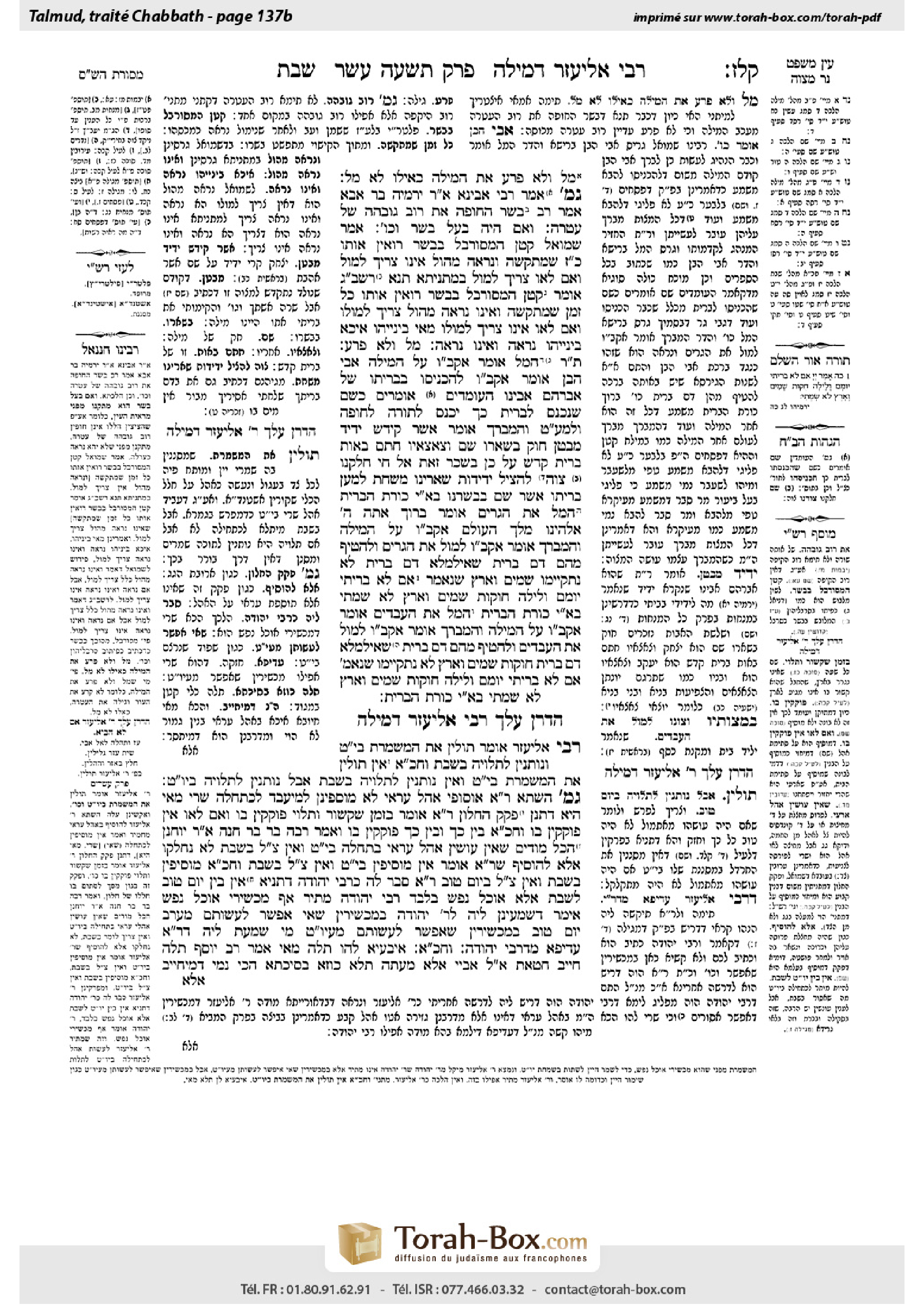
Shabbat 137b: Talmud study for Daf Yomi
Daf Yomi is the daily study of one Talmud folio. Explore 37 tractates with scans, Hebrew text, Sefaria English and AI-generated French translations where annotated.
Passage selection and English or AI-generated French translation are available where the scan has annotations. Daf Study is independent of Torah-Box and Sefaria.
Browse Shabbat · שבת · All tractatesShabbat 137b text and translations
This page of Shabbat includes the Aramaic text, an English translation and an AI-generated French translation, alongside the scan above.
שבת קל״ז ב · Aramaic and Hebrew text
מָל וְלֹא פָּרַע אֶת הַמִּילָה — כְּאִילּוּ לֹא מָל.
גְּמָ׳ אָמַר רַבִּי אֲבִינָא אָמַר רַבִּי יִרְמְיָה בַּר אַבָּא אָמַר רַב: בָּשָׂר הַחוֹפֶה אֶת רוֹב גּוֹבְהָהּ שֶׁל עֲטָרָה.
וְאִם הָיָה בַּעַל בָּשָׂר וְכוּ׳. אָמַר שְׁמוּאֵל: קָטָן הַמְסוּרְבָּל בְּבָשָׂר, רוֹאִין אוֹתוֹ, כׇּל זְמַן שֶׁמִּתְקַשֶּׁה וְנִרְאֶה מָהוּל — אֵינוֹ צָרִיךְ לָמוּל, וְאִם לָאו — צָרִיךְ לָמוּל.
בְּמַתְנִיתָא תָּנָא, רַבָּן שִׁמְעוֹן בֶּן גַּמְלִיאֵל אוֹמֵר: קָטָן הַמְסוּרְבָּל בְּבָשָׂר, רוֹאִין אוֹתוֹ, כׇּל זְמַן שֶׁמִּתְקַשֶּׁה וְאֵינוֹ נִרְאֶה מָהוּל — צָרִיךְ לְמוּלוֹ, וְאִם לָאו — אֵינוֹ צָרִיךְ לְמוּלוֹ.
מַאי בֵּינַיְיהוּ? אִיכָּא בֵּינַיְיהוּ, נִרְאֶה וְאֵינוֹ נִרְאֶה.
מָל וְלֹא פָּרַע. תָּנוּ רַבָּנַן, הַמָּל אוֹמֵר: ״אֲשֶׁר קִדְּשָׁנוּ בְּמִצְוֹתָיו וְצִוָּנוּ עַל הַמִּילָה״. אֲבִי הַבֵּן אוֹמֵר: ״אֲשֶׁר קִדְּשָׁנוּ בְּמִצְוֹתָיו וְצִוָּנוּ לְהַכְנִיסוֹ בִּבְרִיתוֹ שֶׁל אַבְרָהָם אָבִינוּ״. הָעוֹמְדִים אוֹמְרִים: ״כְּשֵׁם שֶׁנִּכְנַס לַבְּרִית, כָּךְ יִכָּנֵס לְתוֹרָה לְחוּפָּה וּלְמַעֲשִׂים טוֹבִים״.
וְהַמְבָרֵךְ אוֹמֵר: ״אֲשֶׁר קִידֵּשׁ יָדִיד מִבֶּטֶן, חוֹק בִּשְׁאֵרוֹ שָׂם, וְצֶאֱצָאָיו חָתַם בְּאוֹת בְּרִית קֹדֶשׁ. עַל כֵּן בִּשְׂכַר זֹאת אֵל חַי חֶלְקֵנוּ [צוּרֵנוּ], צִוָּה לְהַצִּיל יְדִידוּת שְׁאֵרֵינוּ מִשַּׁחַת לְמַעַן בְּרִיתוֹ אֲשֶׁר שָׂם בִּבְשָׂרֵנוּ. בָּרוּךְ אַתָּה ה׳ כּוֹרֵת הַבְּרִית״.
הַמָּל אֶת הַגֵּרִים אוֹמֵר: ״בָּרוּךְ אַתָּה ה׳ אֱלֹהֵינוּ מֶלֶךְ הָעוֹלָם אֲשֶׁר קִדְּשָׁנוּ בְּמִצְוֹתָיו וְצִוָּנוּ עַל הַמִּילָה״, וְהַמְבָרֵךְ אוֹמֵר: ״אֲשֶׁר קִדְּשָׁנוּ בְּמִצְוֹתָיו וְצִוָּנוּ לָמוּל אֶת הַגֵּרִים וּלְהַטִּיף מֵהֶם דַּם בְּרִית, שֶׁאִילְמָלֵא דַּם בְּרִית לֹא נִתְקַיְּימוּ שָׁמַיִם וָאָרֶץ, שֶׁנֶּאֱמַר: ׳אִם לֹא בְרִיתִי יוֹמָם וָלָיְלָה חוּקּוֹת שָׁמַיִם וָאָרֶץ לֹא שָׂמְתִּי׳. בָּרוּךְ אַתָּה ה׳ כּוֹרֵת הַבְּרִית״.
הַמָּל אֶת הָעֲבָדִים אוֹמֵר: ״אֲשֶׁר קִדְּשָׁנוּ בְּמִצְוֹתָיו וְצִוָּנוּ עַל הַמִּילָה״, וְהַמְבָרֵךְ אוֹמֵר: ״אֲשֶׁר קִדְּשָׁנוּ בְּמִצְוֹתָיו וְצִוָּנוּ לָמוּל אֶת הָעֲבָדִים וּלְהַטִּיף מֵהֶם דַּם בְּרִית, שֶׁאִילְמָלֵא דַּם בְּרִית חוּקּוֹת שָׁמַיִם וָאָרֶץ לֹא נִתְקַיְּימוּ, שֶׁנֶּאֱמַר: ׳אִם לֹא בְרִיתִי יוֹמָם וָלָיְלָה חוּקּוֹת שָׁמַיִם וָאָרֶץ לֹא שָׂמְתִּי׳. בָּרוּךְ אַתָּה ה׳ כּוֹרֵת הַבְּרִית״.
הדרן עלך רבי אליעזר דמילה
מַתְנִי׳ רַבִּי אֱלִיעֶזֶר אוֹמֵר: תּוֹלִין אֶת הַמְשַׁמֶּרֶת בְּיוֹם טוֹב, וְנוֹתְנִין לַתְּלוּיָה בַּשַּׁבָּת. וַחֲכָמִים אוֹמְרִים: אֵין תּוֹלִין אֶת הַמְשַׁמֶּרֶת בְּיוֹם טוֹב, וְאֵין נוֹתְנִין לַתְּלוּיָה בַּשַּׁבָּת, אֲבָל נוֹתְנִין לַתְּלוּיָה בְּיוֹם טוֹב.
גְּמָ׳ הַשְׁתָּא רַבִּי אֱלִיעֶזֶר אוֹסוֹפֵי אֹהֶל עֲרַאי לָא מוֹסְפִינַן, לְמִיעְבַּד לְכַתְּחִלָּה שְׁרֵי?!
מַאי הִיא — דִּתְנַן: פְּקַק הַחַלּוֹן, רַבִּי אֱלִיעֶזֶר אוֹמֵר: בִּזְמַן שֶׁקָּשׁוּר וְתָלוּי — פּוֹקְקִין בּוֹ, וְאִם לָאו — אֵין פּוֹקְקִין בּוֹ. וַחֲכָמִים אוֹמְרִים: בֵּין כָּךְ וּבֵין כָּךְ — פּוֹקְקִין בּוֹ.
וְאָמַר רַבָּה בַּר בַּר חָנָה אָמַר רַבִּי יוֹחָנָן: הַכֹּל מוֹדִים שֶׁאֵין עוֹשִׂין אֹהֶל עֲרַאי בַּתְּחִלָּה בְּיוֹם טוֹב, וְאֵין צָרִיךְ לוֹמַר בַּשַּׁבָּת. לֹא נֶחְלְקוּ אֶלָּא לְהוֹסִיף, שֶׁרַבִּי אֱלִיעֶזֶר אוֹמֵר: אֵין מוֹסִיפִין בְּיוֹם טוֹב, וְאֵין צָרִיךְ לוֹמַר בַּשַּׁבָּת. וַחֲכָמִים אוֹמְרִים: מוֹסִיפִין בַּשַּׁבָּת, וְאֵין צָרִיךְ לוֹמַר בְּיוֹם טוֹב.
רַבִּי אֱלִיעֶזֶר סָבַר לַהּ כְּרַבִּי יְהוּדָה. דְּתַנְיָא: אֵין בֵּין יוֹם טוֹב לַשַּׁבָּת אֶלָּא אוֹכֶל נֶפֶשׁ בִּלְבָד. רַבִּי יְהוּדָה מַתִּיר אַף מַכְשִׁירֵי אוֹכֶל נֶפֶשׁ.
אֵימַר דְּשָׁמְעִינַן לֵיהּ לְרַבִּי יְהוּדָה בְּמַכְשִׁירִין שֶׁאִי אֶפְשָׁר לַעֲשׂוֹתָם מֵעֶרֶב יוֹם טוֹב, בַּמַּכְשִׁירִין שֶׁאֶפְשָׁר לַעֲשׂוֹתָם מֵעֶרֶב יוֹם טוֹב מִי שָׁמְעַתְּ לֵיהּ?!
דְּרַבִּי אֱלִיעֶזֶר עֲדִיפָא מִדְּרַבִּי יְהוּדָה.
וַחֲכָמִים אוֹמְרִים. אִיבַּעְיָא לְהוּ: תָּלָה מַאי? אָמַר רַב יוֹסֵף: תָּלָה — חַיָּיב חַטָּאת.
אֲמַר לֵיהּ אַבָּיֵי: אֶלָּא מֵעַתָּה, תְּלָא כּוּזָא בְּסִיכְּתָא הָכִי נָמֵי דְּמִיחַיַּיב?!
Shabbat 137b · English translation
If one circumcised but did not uncover the flesh at the area of the circumcision by folding back the thin membrane beneath the foreskin, it is as if he had not circumcised.
GEMARA: Rabbi Avina said that Rabbi Yirmeya bar Abba said that Rav said: When the mishna said most of the corona, they meant the flesh that covers most of the height of the corona, as well as most of its circumference.
We learned in the mishna: If the baby was fleshy, the circumcisor corrects the circumcision so that it will not appear uncircumcised. Shmuel said: A child who is encumbered with flesh, one examines him, and as long as when his limb hardens he looks circumcised, one need not circumcise him again. And if not, meaning he does not appear circumcised even then, one must circumcise him again.
It was taught in a baraita that Rabban Shimon ben Gamliel says: A child who is encumbered with flesh, one examines him, and as long as when it hardens it does not appear circumcised, one needs to circumcise him again, and if not, one need not circumcise him again.
The Gemara asks: What is the practical difference between these two formulations? The Gemara answers: There is a practical difference between them in a case where he appears circumcised but does not appear fully circumcised. According to Shmuel, in order to avoid an additional circumcision, one must appear fully circumcised, and this state is insufficient. According to Rabban Shimon ben Gamliel, only one who appears uncircumcised requires further circumcision; this partial circumcision is adequate.
We learned in the mishna: If he circumcised a child but did not uncover the area of the circumcision, it is as if he did not circumcise him. The Sages taught in a Tosefta that one who circumcises a child recites: Who has made us holy through His commandments, and commanded us concerning circumcision. The father of the circumcised child recites: Who has made us holy through His commandments, and commanded us to bring him into the covenant of Abraham, our father. Those standing there recite: Just as he has entered into the covenant, so may he enter into Torah, marriage, and good deeds.
And the one who recites the additional blessing says: Who made the beloved one holy from the womb, marked the decree in his flesh, and gave his descendants the seal and the sign of the holy covenant. Therefore, as a reward for this, the living God, our Portion, commanded to deliver the beloved of our flesh from destruction, for the sake of His covenant that He set in our flesh. Blessed are You, Lord, Who establishes the covenant.
One who circumcises converts says: Blessed are You, Lord, our God, King of the universe, Who made us holy with His commandments, and commanded us concerning circumcision. And the one who recites the additional blessing recites: Who has made us holy with His commandments, and commanded us to circumcise converts, and to drip from them covenantal blood, as were it not for the blood of the covenant, the heaven and earth would not be sustained, as it is stated: “If My covenant would not be with day and night, the ordinances of heaven and earth I would not have placed” (Jeremiah 33:25), which is interpreted to mean that were it not for the covenant of circumcision that is manifest both day and night, the world would cease to exist. He concludes the blessing with the phrase: Blessed are You, Lord, Who establishes the covenant.
When a Jew buys a Canaanite slave, he is obligated to circumcise the slave, as the slave is partially entering the covenant of the Jewish people. One who circumcises slaves recites a blessing: Who made us holy with His commandments, and commanded us concerning circumcision. And the one who recites the additional blessings says a blessing similar to those mentioned above: Who made us holy with His commandments, and commanded us to circumcise slaves, and to drip from them covenantal blood, as were it not for the blood of the covenant the heaven and earth would not be sustained, as it is stated: “If My covenant would not be with day and night, the ordinances of heaven and earth I would not have placed” (Jeremiah 33:25). Blessed are You, Lord, Who establishes the covenant.
MISHNA: Rabbi Eliezer says: One may suspend and stretch over a base the strainer through which sediment is filtered from wine, on a Festival. And one may place wine through a strainer that was already suspended the day before; however, one may not suspend the strainer on Shabbat. And the Rabbis say: One may not suspend the strainer on a Festival, and one may not place wine for filtering through a suspended strainer on Shabbat; however, one may place wine through a suspended strainer on a Festival.
GEMARA: The Gemara raises a difficulty with regard to Rabbi Eliezer’s position: Now, Rabbi Eliezer holds that we may not even add to a temporary tent on Shabbat; could it be that to make a tent is permitted ab initio? Stretching a strainer over a base, which Rabbi Eliezer permits, is comparable to making a tent.
The Gemara explains the question: What is this opinion of Rabbi Eliezer’s? As we learned in a mishna: With regard to a window shutter used to cover a skylight, Rabbi Eliezer says: When it is tied to and hanging from the window, i.e., it is not touching the ground, one may shutter the window with it, and if not, one may not shutter the window with it. And the Rabbis say: Both in this case and in that case one may shutter with it.
And Rabba bar bar Ḥana said that Rabbi Yoḥanan said: Everyone agrees that one may not construct a temporary tent on a Festival for the first time, and needless to say, one may not do so on Shabbat. The tanna’im disagree only with regard to adding to an existing tent, as Rabbi Eliezer says: One may not add to an existing structure on a Festival, and needless to say, one may not do so on Shabbat. And the Rabbis say: One may add to the temporary structure on Shabbat, and needless to say, one may do so on a Festival.
The Gemara answers: Rabbi Eliezer indeed holds that the suspension of a strainer constitutes a prohibited labor. However, Rabbi Eliezer holds in accordance with the opinion of Rabbi Yehuda with regard to actions that facilitate preparation of food on a Festival, as it was taught in a baraita: The only difference between a Festival and Shabbat is with regard to the preparation of food alone. It is permitted to perform labors for the purpose of food preparation on a Festival, but not on Shabbat. Rabbi Yehuda permits even actions that facilitate food preparation on a Festival, e.g., fixing utensils with which food is prepared on the Festival. Similarly, Rabbi Eliezer permits the suspension of a strainer, which would otherwise constitute a prohibited labor, in order to prepare wine for use on the Festival.
The Gemara asks: Say that we heard that Rabbi Yehuda permits labors that are otherwise prohibited if they pertain to actions that facilitate food preparation that cannot be performed on the eve of the Festival; however, with regard to actions that facilitate food preparation that can be performed on the eve of the Festival, did you hear that he permits doing so?
The Gemara answers: The leniency of Rabbi Eliezer exceeds that of Rabbi Yehuda. Unlike Rabbi Yehuda, Rabbi Eliezer does not distinguish between actions that facilitate food preparation that can and those that cannot be performed on the eve of the Festival.
We learned in the mishna: And the Rabbis say: One may not suspend the strainer on a Festival. A dilemma was raised before the Sages: If he suspended a strainer unwittingly, what is the halakha? Rav Yosef said: If he suspended it, he is liable to bring a sin-offering, like anyone who unwittingly performs a labor prohibited by Torah law on Shabbat.
Abaye said to him: But if that is so, that an action of that sort constitutes performance of the prohibited labor of building by Torah law, then if one suspended a jug on a peg, is he also liable for building a tent?
Shabbat 137b · Traduction française (IA)
Si l’on a circoncis l’enfant sans découvrir le gland au niveau de la circoncision, en rabattant la fine membrane située sous le prépuce, c’est comme si on ne l’avait pas circoncis.
GUEMARA : Rabbi Avina a dit au nom de Rabbi Yirmeya bar Abba, qui a dit au nom de Rav : lorsque la Michna dit « la majeure partie du gland », elle désigne la chair qui couvre la majeure partie de la hauteur du gland ainsi que la majeure partie de sa circonférence.
Nous avons appris dans la Michna : si le bébé était charnu, celui qui pratique la circoncision rectifie celle-ci afin qu’il ne paraisse pas incirconcis. Chmouel a dit : pour un enfant recouvert de chair, on l’examine ; tant que, lorsque son membre se raidit, il a l’apparence d’un circoncis, il n’est pas nécessaire de le circoncire de nouveau. Sinon, c’est-à-dire s’il n’a pas cette apparence même alors, il faut le circoncire de nouveau.
Il a été enseigné dans une baraïta que Rabban Chimon ben Gamliel dit : pour un enfant recouvert de chair, on l’examine ; tant que, lorsque son membre se raidit, il n’a pas l’apparence d’un circoncis, il faut le circoncire de nouveau ; sinon, il n’est pas nécessaire de le circoncire de nouveau.
La Guemara demande : quelle est la différence pratique entre ces deux formulations ? La Guemara répond : la différence pratique concerne le cas où il a l’apparence d’un circoncis, mais pas celle d’un circoncis complet. Selon Chmouel, pour éviter une circoncision supplémentaire, il faut avoir pleinement l’apparence d’un circoncis ; cette apparence ne suffit donc pas. Selon Rabban Chimon ben Gamliel, seule une personne qui a l’apparence d’un incirconcis doit être circoncise de nouveau ; cette circoncision partielle suffit.
Nous avons appris dans la Michna : si l’on a circoncis un enfant sans découvrir la zone de la circoncision, c’est comme si on ne l’avait pas circoncis. Les Sages ont enseigné dans une Tosefta que celui qui circoncit un enfant récite : « Qui nous a sanctifiés par Ses commandements et nous a ordonné la circoncision. » Le père de l’enfant circoncis récite : « Qui nous a sanctifiés par Ses commandements et nous a ordonné de le faire entrer dans l’alliance d’Abraham, notre père. » Les personnes présentes récitent : « De même qu’il est entré dans l’alliance, qu’il entre ainsi dans la Torah, le mariage et les bonnes actions. »
Et celui qui récite la bénédiction supplémentaire dit : « Qui a sanctifié le bien-aimé dès le sein maternel, a marqué le décret dans sa chair et a donné à ses descendants le sceau et le signe de l’alliance sainte. C’est pourquoi, en récompense de cela, le Dieu vivant, notre part, a ordonné de préserver le bien-aimé de notre chair de la destruction, en raison de Son alliance qu’Il a placée dans notre chair. Béni sois-Tu, Seigneur, qui établis l’alliance. »
Celui qui circoncit des convertis dit : « Béni sois-Tu, Seigneur, notre Dieu, Roi de l’univers, qui nous as sanctifiés par Ses commandements et nous as ordonné la circoncision. » Et celui qui récite la bénédiction supplémentaire dit : « Qui nous as sanctifiés par Ses commandements et nous as ordonné de circoncire les convertis et de faire couler d’eux le sang de l’alliance ; car sans le sang de l’alliance, le ciel et la terre ne subsisteraient pas, comme il est dit : “Si Mon alliance avec le jour et la nuit n’existait pas, Je n’aurais pas établi les lois du ciel et de la terre” (Jérémie 33,25). » Ce verset est interprété ainsi : sans l’alliance de la circoncision, qui se manifeste jour et nuit, le monde cesserait d’exister. Il conclut la bénédiction par ces mots : « Béni sois-Tu, Seigneur, qui établis l’alliance. »
Lorsqu’un Juif achète un esclave cananéen, il est tenu de le circoncire, car l’esclave entre partiellement dans l’alliance du peuple juif. Celui qui circoncit des esclaves récite une bénédiction : « Qui nous a sanctifiés par Ses commandements et nous a ordonné la circoncision. » Et celui qui récite les bénédictions supplémentaires dit une bénédiction semblable à celles mentionnées précédemment : « Qui nous a sanctifiés par Ses commandements et nous a ordonné de circoncire les esclaves et de faire couler d’eux le sang de l’alliance ; car sans le sang de l’alliance, le ciel et la terre ne subsisteraient pas, comme il est dit : “Si Mon alliance avec le jour et la nuit n’existait pas, Je n’aurais pas établi les lois du ciel et de la terre” (Jérémie 33,25). Béni sois-Tu, Seigneur, qui établis l’alliance. »
MICHNA : Rabbi Eliezer dit : pendant un jour de fête, on peut suspendre le filtre qui retient le dépôt du vin et le tendre sur un support. On peut aussi verser du vin dans un filtre déjà suspendu depuis la veille ; en revanche, on ne peut pas suspendre le filtre pendant Chabbat. Et les Sages disent : on ne peut pas suspendre le filtre pendant un jour de fête, ni verser du vin pour le filtrer dans un filtre suspendu pendant Chabbat ; en revanche, on peut verser du vin dans un filtre suspendu pendant un jour de fête.
GUEMARA : La Guemara soulève une difficulté concernant la position de Rabbi Eliezer : or, Rabbi Eliezer considère que même ajouter à une tente temporaire est interdit pendant Chabbat ; se pourrait-il qu’il soit permis de construire une tente d’emblée ? Tendre un filtre sur un support, ce que Rabbi Eliezer autorise, revient à construire une tente.
La Guemara précise la question : quelle est cette opinion de Rabbi Eliezer ? Nous avons appris dans une Michna : au sujet d’un volet de fenêtre servant à couvrir une lucarne, Rabbi Eliezer dit : s’il est attaché à la fenêtre et suspendu à celle-ci, c’est-à-dire qu’il ne touche pas le sol, on peut fermer la fenêtre avec ; sinon, on ne peut pas la fermer avec. Et les Sages disent : dans les deux cas, on peut la fermer avec.
Et Rabba bar bar Ḥana a dit au nom de Rabbi Yoḥanan : tous sont d’accord qu’on ne peut pas construire une tente temporaire pour la première fois pendant un jour de fête et, à plus forte raison, qu’on ne peut pas le faire pendant Chabbat. Les tannaïm ne sont en désaccord qu’au sujet de l’ajout à une tente déjà existante. Rabbi Eliezer dit : on ne peut pas ajouter à une structure existante pendant un jour de fête et, à plus forte raison, on ne peut pas le faire pendant Chabbat. Les Sages disent : on peut ajouter à une structure temporaire pendant Chabbat et, à plus forte raison, on peut le faire pendant un jour de fête.
La Guemara répond : Rabbi Eliezer considère bien que suspendre un filtre constitue un travail interdit. Toutefois, Rabbi Eliezer suit l’opinion de Rabbi Yehouda concernant les actes qui facilitent la préparation des aliments pendant un jour de fête, comme cela a été enseigné dans une baraïta : la seule différence entre un jour de fête et Chabbat concerne la préparation des aliments. Il est permis d’accomplir des travaux en vue de préparer des aliments pendant un jour de fête, mais pas pendant Chabbat. Rabbi Yehouda autorise même les actes qui facilitent la préparation des aliments pendant un jour de fête, par exemple la réparation des ustensiles servant à préparer les aliments pendant ce jour de fête. De même, Rabbi Eliezer autorise à suspendre un filtre, ce qui constituerait autrement un travail interdit, afin de préparer du vin destiné à être utilisé pendant le jour de fête.
La Guemara demande : nous avons certes entendu que Rabbi Yehouda autorise les travaux autrement interdits lorsqu’ils concernent des actes facilitant la préparation des aliments qui ne peuvent pas être accomplis la veille du jour de fête ; mais a-t-on entendu qu’il autorise ces actes lorsqu’ils peuvent être accomplis la veille du jour de fête ?
La Guemara répond : l’assouplissement de Rabbi Eliezer va au-delà de celui de Rabbi Yehouda. Contrairement à Rabbi Yehouda, Rabbi Eliezer ne distingue pas entre les actes facilitant la préparation des aliments qui peuvent être accomplis la veille du jour de fête et ceux qui ne le peuvent pas.
Nous avons appris dans la Michna : les Sages disent qu’on ne peut pas suspendre le filtre pendant un jour de fête. Les Sages ont soulevé une question : s’il a suspendu un filtre par inadvertance, quelle est la halakha ? Rav Yossef a dit : s’il l’a suspendu, il est tenu d’apporter un sacrifice expiatoire, comme quiconque accomplit par inadvertance, pendant Chabbat, un travail interdit par la Torah.
Abayé lui dit : mais si tel est le cas, si un acte de ce genre constitue l’accomplissement du travail de construction interdit par la Torah, alors, si quelqu’un suspend une cruche à un crochet, est-il lui aussi passible d’un sacrifice pour avoir construit une tente ?
Traduction française générée par IA à partir de l’édition anglaise de Sefaria. Vérifie toujours un passage avec le texte source.
Text from Sefaria: William Davidson Edition - Vocalized Aramaic (CC BY NC); William Davidson Edition - English (CC BY NC).