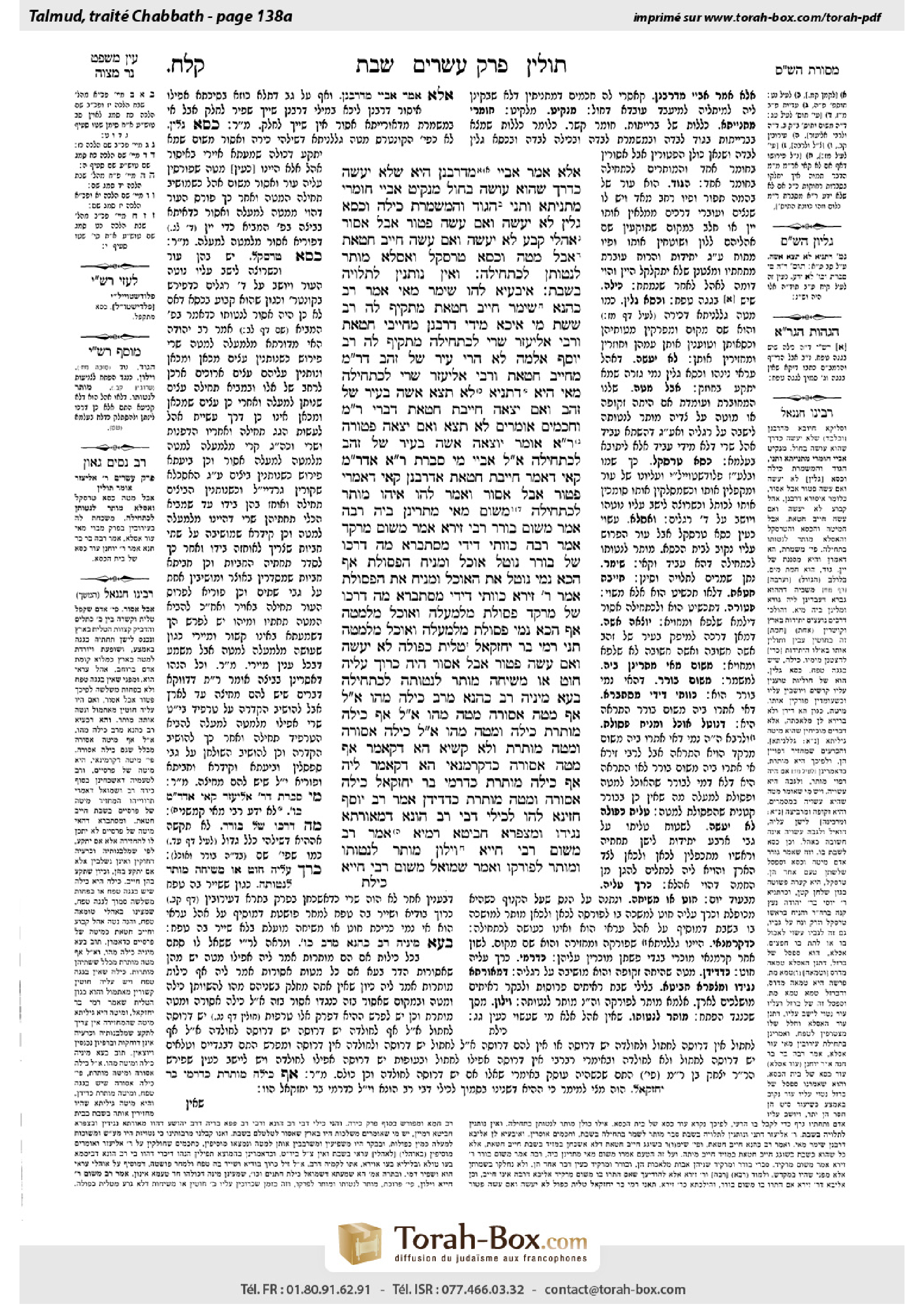
Shabbat 138a: Talmud study for Daf Yomi
Daf Yomi is the daily study of one Talmud folio. Explore 37 tractates with scans, Hebrew text, Sefaria English and AI-generated French translations where annotated.
Passage selection and English or AI-generated French translation are available where the scan has annotations. Daf Study is independent of Torah-Box and Sefaria.
Browse Shabbat · שבת · All tractatesShabbat 138a text and translations
This page of Shabbat includes the Aramaic text, an English translation and an AI-generated French translation, alongside the scan above.
שבת קל״ח א · Aramaic and Hebrew text
אֶלָּא אָמַר אַבָּיֵי: מִדְּרַבָּנַן הִיא, שֶׁלֹּא יַעֲשֶׂה כְּדֶרֶךְ שֶׁהוּא עוֹשֶׂה בַּחוֹל.
מְנַקֵּיט אַבָּיֵי חוּמְרֵי מַתְנְיָתָא וְתָנֵי: הַגּוֹד וְהַמְשַׁמֶּרֶת, כִּילָּה וְכִסֵּא גַלִּין — לֹא יַעֲשֶׂה, וְאִם עָשָׂה — פָּטוּר אֲבָל אָסוּר. אׇהֳלֵי קְבַע — לֹא יַעֲשֶׂה, וְאִם עָשָׂה — חַיָּיב חַטָּאת. אֲבָל מִטָּה וְכִסֵּא טְרַסְקָל וְאַסְלָא — מוּתָּר לִנְטוֹתָן לְכַתְּחִילָּה.
וְאֵין נוֹתְנִין לַתְּלוּיָה בַּשַּׁבָּת. אִיבַּעְיָא לְהוּ: שִׁימֵּר מַאי? אָמַר רַב כָּהֲנָא: שִׁימֵּר — חַיָּיב חַטָּאת.
מַתְקֵיף לַהּ רַב שֵׁשֶׁת: מִי אִיכָּא מִידֵּי דְּרַבָּנַן מְחַיְּיבִי חַטָּאת, וְרַבִּי אֱלִיעֶזֶר שָׁרֵי לְכַתְּחִילָּה?!
מַתְקֵיף לַהּ רַב יוֹסֵף: אַלְּמָה לָא? הֲרֵי עִיר שֶׁל זָהָב, דְּרַבִּי מֵאִיר מְחַיֵּיב חַטָּאת, וְרַבִּי אֱלִיעֶזֶר שָׁרֵי לְכַתְּחִילָּה.
מַאי הִיא — דְּתַנְיָא: לֹא תֵּצֵא אִשָּׁה בְּעִיר שֶׁל זָהָב, וְאִם יָצְאָה — חַיֶּיבֶת חַטָּאת, דִּבְרֵי רַבִּי מֵאִיר. וַחֲכָמִים אוֹמְרִים: לֹא תֵּצֵא, וְאִם יָצְאָה פְּטוּרָה. רַבִּי אֱלִיעֶזֶר אוֹמֵר: יוֹצְאָה אִשָּׁה בְּעִיר שֶׁל זָהָב לְכַתְּחִילָּה.
אֲמַר לֵיהּ אַבָּיֵי: מִי סָבְרַתְּ רַבִּי אֱלִיעֶזֶר אַדְּרַבִּי מֵאִיר קָאֵי, דְּאָמַר חַיֶּיבֶת חַטָּאת? אַדְּרַבָּנַן קָאֵי, דְּאָמְרִי פָּטוּר אֲבָל אָסוּר, וַאֲמַר לְהוּ אִיהוּ מוּתָּר לְכַתְּחִילָּה.
מִשּׁוּם מַאי מַתְרִינַן בֵּיהּ? רַבָּה אָמַר: מִשּׁוּם בּוֹרֵר. רַבִּי זֵירָא אָמַר: מִשּׁוּם מְרַקֵּד.
אָמַר רַבָּה, כְּווֹתִי דִּידִי מִסְתַּבְּרָא: מָה דַּרְכּוֹ שֶׁל בּוֹרֵר — נוֹטֵל אוֹכֵל וּמַנִּיחַ הַפְּסוֹלֶת, אַף הָכָא נָמֵי: נוֹטֵל אֶת הָאוֹכֵל וּמַנִּיחַ אֶת הַפְּסוֹלֶת.
אָמַר רַבִּי זֵירָא, כְּווֹתִי דִּידִי מִסְתַּבְּרָא: מָה דַּרְכּוֹ שֶׁל מְרַקֵּד — פְּסוֹלֶת מִלְּמַעְלָה וְאוֹכֶל מִלְּמַטָּה, אַף הָכָא נָמֵי: פְּסוֹלֶת מִלְּמַעְלָה וְאוֹכֶל מִלְּמַטָּה.
תָּנֵי רָמֵי בַּר יְחֶזְקֵאל: טַלִּית כְּפוּלָה לֹא יַעֲשֶׂה, וְאִם עָשָׂה — פָּטוּר אֲבָל אָסוּר. הָיָה כָּרוּךְ עָלֶיהָ חוּט אוֹ מְשִׁיחָה — מוּתָּר לִנְטוֹתָהּ לְכַתְּחִילָּה.
בְּעָא מִינֵּיהּ רַב כָּהֲנָא מֵרַב: כִּילָּה מַהוּ? אֲמַר לֵיהּ: אַף מִטָּה אֲסוּרָה. מִטָּה מַהוּ? אֲמַר לֵיהּ: אַף כִּילָּה מוּתֶּרֶת. כִּילָּה וּמִטָּה מַהוּ? אֲמַר לֵיהּ: כִּילָּה אֲסוּרָה וּמִטָּה מוּתֶּרֶת.
וְלָא קַשְׁיָא. הָא דְּקָאָמַר אַף מִטָּה אֲסוּרָה — כִּדְקַרְמֹנָאֵי. הָא דְּקָאֲמַר לֵיהּ אַף כִּילָּה מוּתֶּרֶת — כִּדְרָמֵי בַּר יְחֶזְקֵאל. כִּילָּה אֲסוּרָה וּמִטָּה מוּתֶּרֶת — כִּדְדִידַן.
אָמַר רַב יוֹסֵף: חֲזֵינָא לְהוּ לְכִילֵּי דְּבֵי רַב הוּנָא דְּמֵאוּרְתָּא נְגִידָא וּמִצַּפְרָא חֲבִיטָא רַמְיָא.
אָמַר רַב מִשּׁוּם רַבִּי חִיָּיא: וִילוֹן מוּתָּר לִנְטוֹתוֹ וּמוּתָּר לְפוֹרְקוֹ.
וְאָמַר שְׁמוּאֵל מִשּׁוּם רַבִּי חִיָּיא:
Shabbat 138a · English translation
Rather, Abaye said: It is a rabbinic decree issued so that one will not conduct himself on Shabbat in the manner that he conducts himself during the week.
Abaye would consolidate the principles of the baraitot pertaining to the construction of a tent on Shabbat and teach: With regard to a large wineskin, a wine strainer, a canopy hung over a bed, and a folding chair whose cover is detached from its legs, one may not assemble them due to the prohibition against making a temporary tent. If one did so unwittingly, he is exempt by Torah law from bringing a sin-offering, but it is prohibited by rabbinic decree. With regard to permanent tents, one may not make them, and if he did so, he is liable to bring a sin-offering for performing the prohibited labor of building. However, with regard to a bed, and a folding chair [teraskal] whose cover is attached to its legs, and a collapsible toilet, it is permissible to open them ab initio, since they are prepared for use from before Shabbat.
We also learned in the mishna: One may not place wine for filtering even into a suspended strainer on Shabbat. A dilemma was raised before the Sages: If one strained wine, what is the halakha? Rav Kahana said: If one strained wine, he is liable to bring a sin-offering.
Rav Sheshet strongly objects to this: Is there something for which the Rabbis render one liable to bring a sin-offering and Rabbi Eliezer permits its performance ab initio? Extreme differences of opinion of that kind are rarely found in one mishna.
Rav Yosef strongly objects to this question: Why not? Isn’t there an analogous dispute with regard to a woman who wears a city of gold ornament from one domain to another on Shabbat, as Rabbi Meir renders her liable to bring a sin-offering, and Rabbi Eliezer permits it even ab initio?
What is that dispute? As it was taught in a baraita: A woman may not go out into the public domain on Shabbat with a city of gold ornament. And if she did go out with it into the public domain, she is liable to bring a sin-offering; this is the statement of Rabbi Meir. And the Rabbis say: She may not go out with it ab initio, and if she went out, she is exempt. And Rabbi Eliezer says: A woman may go out with a city of gold ornament ab initio. Apparently, there is precedent for a dispute in which one opinion maintains that an action incurs liability to bring a sin-offering, while another opinion rules that it is permitted ab initio.
Abaye said to Rav Yosef: Do you hold that Rabbi Eliezer is relating to the statement of Rabbi Meir, who said that she is liable to bring a sin-offering? He is relating to the statement of the Rabbis, who said one is exempt but it is prohibited, and he said to them that he holds that it is permitted ab initio. Had there not been the intermediate opinion of the Rabbis, an argument with such extreme opinions would not have been possible.
The Gemara asks: One is liable to bring a sin-offering for straining. Due to performance of what category of prohibited labor do we forewarn him? Rabba said: It is for the category of selecting, as one is selecting the wine from the sediment. Rabbi Zeira said: It is for the category of sifting, as straining is similar to sifting flour in a sifter, which is a form of selecting.
Rabba said: According to my opinion, it is reasonable. What is the manner of one who selects? He takes the food and leaves the refuse; here too, when straining wine, one takes the food and leaves the refuse.
Rabbi Zeira said: According to my opinion, that this is not typical selection but rather a specific type of selection, it is reasonable, as what is the manner of sifting? The refuse remains atop the sifter and the food is below. Here too, when straining wine, the refuse remains atop the strainer and the food is below.
Rami bar Yeḥezkel taught: With regard to a doubled cloak, one may not make a covering on Shabbat by taking the cloak and placing it over a rope and extending the two sides in order to form something similar to a canopy beneath which one could lie (ge’onim; Rif). And if one made it, he is exempt from bringing a sin-offering by Torah law, but it is prohibited by rabbinic decree. If there was a string or a cord wrapped around it before Shabbat, and the cloak was attached to the string while folded, it is permitted to spread it and stretch it ab initio.
On a related issue, Rav Kahana raised a dilemma before Rav: In the case of a canopy, what is the halakha? Is it permitted to spread it on Shabbat? He said to him: Even a bed is prohibited. Rav Kahana asked: With regard to a bed, what is the halakha? He said to him: Even a canopy is permitted. Rav Kahana again asked: In the case of a bed and a canopy, what is the halakha? He said to him: A canopy is prohibited, and a bed is permitted.
The Gemara comments: And this is not difficult, as the responses do not in fact contradict one another. Rather, when he said: Even a bed is prohibited, this is referring to folding beds like those of the Carmanians. Unfolding them is considered like making a tent. When he said: Even a canopy is permitted, this is referring to spreading the canopy in the manner explained by Rami bar Yeḥezkel. The canopy was bound by a string from before Shabbat. When he said: A canopy is prohibited, and a bed is permitted, this is referring to beds and canopies like ours, which do not fold. A bed of that kind involves no building. However, spreading canopies is performed in a manner similar to constructing a tent.
Rav Yosef said: I saw the canopies of the house of Rav Huna that were spread out in the evening, and in the morning they were cast off and lying on the ground. This indicates that it is permitted to dismantle and spread them on Shabbat.
Rav said in the name of Rabbi Ḥiyya: With regard to a curtain, it is permitted to spread it, and it is permitted to dismantle it. Since a curtain has no roof, neither action constitutes establishing a tent.
And Shmuel said in the name of Rabbi Ḥiyya:
Shabbat 138a · Traduction française (IA)
Abaye dit plutôt : C’est un décret rabbinique, édicté afin que l’on ne se conduise pas le Chabbat comme on se conduit pendant la semaine.
Abaye regroupait les principes des baraïtot relatives à la construction d’une tente le Chabbat et les enseignait ainsi : une grande outre à vin, un filtre à vin, un dais suspendu au-dessus d’un lit et une chaise pliante dont la toile est détachée des pieds ne peuvent pas être montés, en raison de l’interdiction de construire une tente temporaire. Si quelqu’un le fait par inadvertance, il est exempt, selon la Torah, d’apporter un sacrifice expiatoire, mais cela reste interdit par décret rabbinique. Quant aux tentes permanentes, il est interdit de les construire ; si quelqu’un le fait, il est tenu d’apporter un sacrifice expiatoire pour avoir accompli le travail interdit de construire. En revanche, un lit, une chaise pliante [teraskal] dont la toile est fixée aux pieds et des toilettes pliantes peuvent être ouverts d’emblée, puisqu’ils sont prêts à l’emploi depuis avant le Chabbat.
Nous avons également appris dans la Michna : il est interdit de placer du vin à filtrer, même dans un filtre suspendu, le Chabbat. Les Sages soulevèrent la question suivante : quelle est la halakha si quelqu’un filtre du vin ? Rav Kahana dit : s’il a filtré du vin, il est tenu d’apporter un sacrifice expiatoire.
Rav Sheshet s’y oppose vivement : existe-t-il une action pour laquelle les Sages rendent quelqu’un passible d’un sacrifice expiatoire, alors que Rabbi Eliezer en permet l’accomplissement d’emblée ? On trouve rarement, dans une même Michna, des opinions aussi radicalement divergentes.
Rav Yosef s’oppose vivement à cette question : pourquoi pas ? N’existe-t-il pas un désaccord analogue au sujet d’une femme qui transporte un bijou en forme de ville d’or d’un domaine à un autre le Chabbat ? Rabbi Meïr la rend passible d’un sacrifice expiatoire, tandis que Rabbi Eliezer le permet même d’emblée.
Quel est ce désaccord ? Comme il a été enseigné dans une baraïta : une femme ne doit pas sortir dans le domaine public le Chabbat avec un bijou en forme de ville d’or. Si elle est sortie dans le domaine public avec ce bijou, elle est tenue d’apporter un sacrifice expiatoire ; telle est l’opinion de Rabbi Meïr. Les Sages disent : elle ne doit pas sortir ainsi d’emblée, mais si elle l’a fait, elle est exemptée. Rabbi Eliezer dit : une femme peut sortir d’emblée avec un bijou en forme de ville d’or. Il existe donc un précédent à un désaccord où, selon une opinion, une action rend passible d’un sacrifice expiatoire, tandis que selon une autre, elle est permise d’emblée.
Abaye dit à Rav Yosef : penses-tu que Rabbi Eliezer se réfère à l’opinion de Rabbi Meïr, qui dit qu’elle est tenue d’apporter un sacrifice expiatoire ? Il se réfère à l’opinion des Sages, qui disent que l’on est exempt, mais que cela reste interdit ; lui leur dit qu’il considère que c’est permis d’emblée. S’il n’y avait pas eu l’opinion intermédiaire des Sages, un désaccord aux positions aussi extrêmes n’aurait pas été possible.
La Guemara demande : celui qui filtre du vin est passible d’un sacrifice expiatoire. Pour quelle catégorie de travail interdit l’avertit-on ? Rabba dit : pour la catégorie du tri, puisqu’il sépare le vin du dépôt. Rabbi Zeïra dit : pour la catégorie du tamisage, car filtrer ressemble au tamisage de la farine dans un tamis, qui relève de la catégorie du tri.
Rabba dit : selon mon opinion, cela se comprend. Comment procède-t-on lorsqu’on trie ? On prend l’aliment et on laisse le rebut ; ici aussi, lorsqu’on filtre du vin, on prend l’aliment et on laisse le rebut.
Rabbi Zeïra dit : selon mon opinion, puisque ce n’est pas le tri habituel, mais une forme particulière de tri, cela se comprend. Comment procède-t-on lorsqu’on tamise ? Le rebut reste au-dessus du tamis et l’aliment se trouve en dessous. Ici aussi, lorsqu’on filtre du vin, le rebut reste au-dessus du filtre et l’aliment se trouve en dessous.
Rami bar Yeḥezkel enseigna : concernant un manteau doublé, il est interdit de créer un abri le Chabbat en prenant le manteau, en le posant sur une corde et en étendant ses deux pans afin de former une sorte de dais sous lequel on pourrait s’allonger (Geonim ; Rif). Si quelqu’un le fait, il est exempt, selon la Torah, d’apporter un sacrifice expiatoire, mais cela reste interdit par décret rabbinique. Si, avant le Chabbat, une ficelle ou une corde était enroulée autour du manteau et que celui-ci y était attaché alors qu’il était plié, il est permis de le déployer et de l’étendre d’emblée.
Sur un sujet connexe, Rav Kahana souleva une question devant Rav : quelle est la halakha concernant un dais ? Est-il permis de le déployer le Chabbat ? Il lui répondit : même un lit est interdit. Rav Kahana demanda : quelle est la halakha concernant un lit ? Il lui répondit : même un dais est permis. Rav Kahana demanda de nouveau : quelle est la halakha concernant un lit et un dais ? Il lui répondit : un dais est interdit, et un lit est permis.
La Guemara fait remarquer que cela ne pose pas de difficulté, car ces réponses ne se contredisent pas réellement. Lorsqu’il dit : « Même un lit est interdit », il s’agit des lits pliants comme ceux des Carmaniens. Les déplier revient à construire une tente. Lorsqu’il dit : « Même un dais est permis », il s’agit de déployer le dais de la manière expliquée par Rami bar Yeḥezkel. Le dais était attaché par une ficelle depuis avant le Chabbat. Lorsqu’il dit : « Un dais est interdit, et un lit est permis », il s’agit de lits et de dais comme les nôtres, qui ne se plient pas. Un lit de ce type n’implique aucun acte de construction. En revanche, déployer un dais se fait d’une manière semblable à la construction d’une tente.
Rav Yosef dit : j’ai vu les dais de la maison de Rav Houna déployés le soir ; le matin, ils avaient été détachés et gisaient à terre. Cela indique qu’il est permis de les démonter et de les déployer le Chabbat.
Rav dit au nom de Rabbi Ḥiyya : il est permis de déployer un rideau et il est permis de le démonter. Comme un rideau n’a pas de toit, aucune de ces deux actions ne constitue l’établissement d’une tente.
Et Shmuel dit au nom de Rabbi Ḥiyya :
Traduction française générée par IA à partir de l’édition anglaise de Sefaria. Vérifie toujours un passage avec le texte source.
Text from Sefaria: William Davidson Edition - Vocalized Aramaic (CC BY NC); William Davidson Edition - English (CC BY NC).