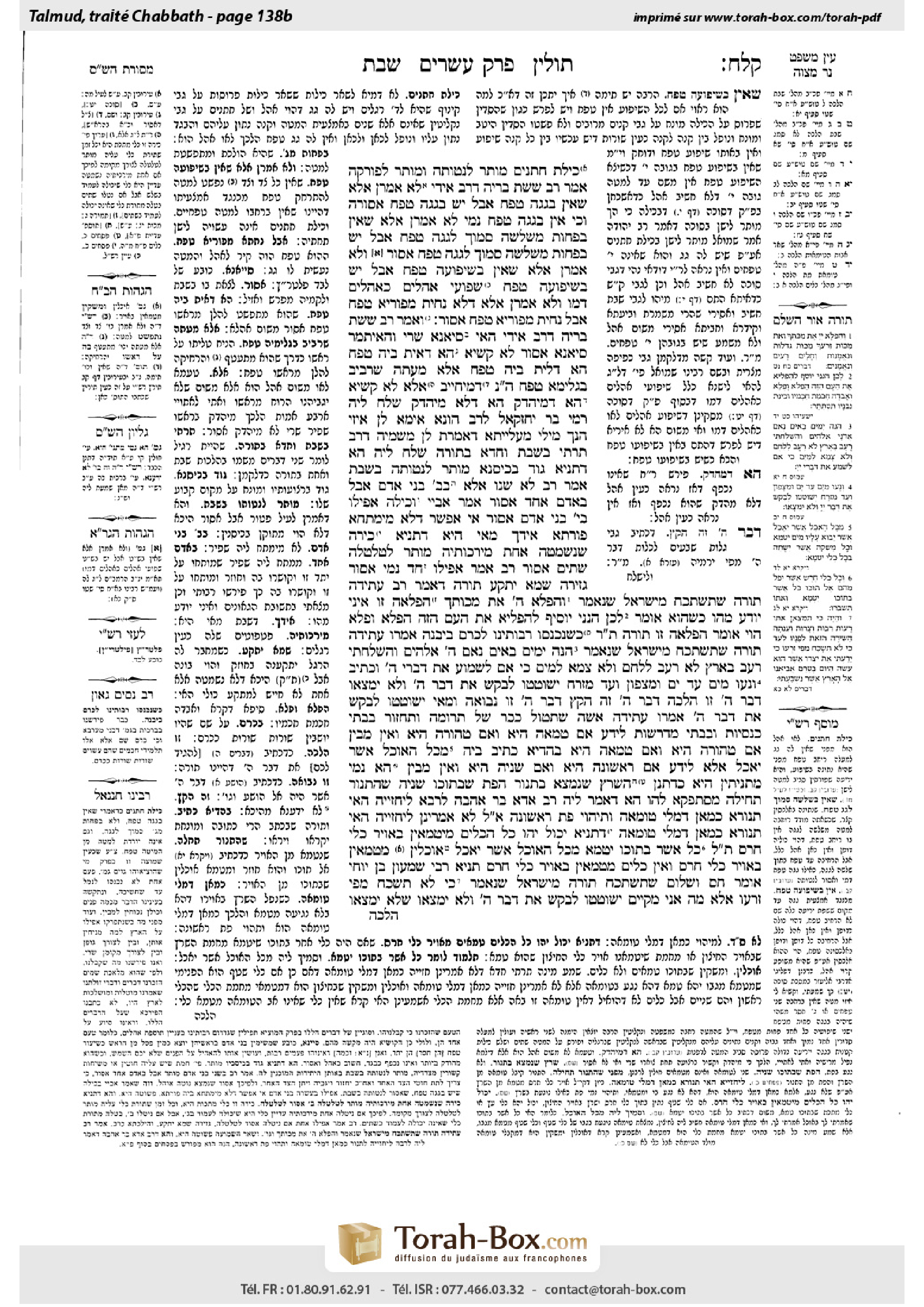
Shabbat 138b: Talmud study for Daf Yomi
Daf Yomi is the daily study of one Talmud folio. Explore 37 tractates with scans, Hebrew text, Sefaria English and AI-generated French translations where annotated.
Passage selection and English or AI-generated French translation are available where the scan has annotations. Daf Study is independent of Torah-Box and Sefaria.
Browse Shabbat · שבת · All tractatesShabbat 138b text and translations
This page of Shabbat includes the Aramaic text, an English translation and an AI-generated French translation, alongside the scan above.
שבת קל״ח ב · Aramaic and Hebrew text
כִּילַּת חֲתָנִים מוּתָּר לִנְטוֹתָהּ וּמוּתָּר לְפוֹרְקָהּ.
אָמַר רַב שֵׁשֶׁת בְּרֵיהּ דְּרַב אִידִי: לָא אֲמַרַן אֶלָּא שֶׁאֵין בְּגַגָּהּ טֶפַח, אֲבָל יֵשׁ בְּגַגָּהּ טֶפַח — אֲסוּרָה. וְכִי אֵין בְּגַגָּהּ טֶפַח נָמֵי לָא אֲמַרַן אֶלָּא שֶׁאֵין בְּפָחוֹת מִשְּׁלֹשָׁה סָמוּךְ לְגַגָּהּ טֶפַח, אֲבָל יֵשׁ בְּפָחוֹת מִשְּׁלֹשָׁה סָמוּךְ לְגַגָּהּ טֶפַח — אָסוּר. וְלָא אֲמַרַן אֶלָּא שֶׁאֵין בְּשִׁיפּוּעָהּ טֶפַח, אֲבָל יֵשׁ בְּשִׁיפּוּעָהּ טֶפַח — שִׁפּוּעֵי אֹהָלִים כְּאֹהָלִים דָּמוּ. וְלָא אֲמַרַן אֶלָּא דְּלָא נָחֵית מִפּוּרְיָא טֶפַח, אֲבָל נָחֵית מִפּוּרְיָא טֶפַח — אָסוּר.
וְאָמַר רַב שֵׁשֶׁת בְּרֵיהּ דְּרַב אִידִי: הַאי סְיָאנָא שָׁרֵי. וְהָאִיתְּמַר: סְיָאנָא אָסוּר! לָא קַשְׁיָא: הָא דְּאִית בֵּיהּ טֶפַח, הָא דְּלֵית בֵּיהּ טֶפַח.
אֶלָּא מֵעַתָּה, שַׁרְבֵּיב בִּגְלִימָא טֶפַח הָכִי נָמֵי דְּמִיחַיַּיב? אֶלָּא לָא קַשְׁיָא: הָא דְּמִיהַדַּק, הָא דְּלָא מִיהַדַּק.
שְׁלַח לֵיהּ רָמֵי בַּר יְחֶזְקֵאל לְרַב הוּנָא: אֵימָא לַן אִיזִי הָנָךְ מִילֵּי מְעַלְּיָיתָא דַּאֲמַרְתְּ לַן מִשְּׁמֵיהּ דְּרַב, תַּרְתֵּי בְּשַׁבָּת וַחֲדָא בְּתוֹרָה.
שְׁלַח לֵיהּ: הָא דְּתַנְיָא גּוֹד בְּכִיסָנָא מוּתָּר לִנְטוֹתָהּ בְּשַׁבָּת — אָמַר רַב: לֹא שָׁנוּ אֶלָּא בִּשְׁנֵי בְּנֵי אָדָם, אֲבָל בְּאָדָם אֶחָד — אָסוּר.
אָמַר אַבָּיֵי: וְכִילָּה אֲפִילּוּ בַּעֲשָׂרָה בְּנֵי אָדָם אָסוּר. אִי אֶפְשָׁר דְּלָא מִימַּתְחָא פּוּרְתָּא.
אִידַּךְ מַאי הִיא דְּתַנְיָא: כִּירָה שֶׁנִּשְׁמְטָה אַחַת מִיַּרְכוֹתֶיהָ — מוּתָּר לְטַלְטְלָהּ. שְׁתַּיִם — אָסוּר. רַב אָמַר: אֲפִילּוּ חַד נָמֵי אָסוּר, גְּזֵירָה שֶׁמָּא יִתְקַע.
תּוֹרָה — דְּאָמַר רַב: עֲתִידָה תּוֹרָה שֶׁתִּשְׁתַּכַּח מִיִּשְׂרָאֵל, שֶׁנֶּאֱמַר: ״וְהִפְלָא ה׳ אֶת מַכֹּתְךָ״, הַפְלָאָה זוֹ אֵינִי יוֹדֵעַ מַהִי. כְּשֶׁהוּא אוֹמֵר: ״לָכֵן הִנְנִי יוֹסִיף לְהַפְלִיא אֶת הָעָם הַזֶּה הַפְלֵא וָפֶלֶא״ — הֱוֵי אוֹמֵר: הַפְלָאָה זוֹ תּוֹרָה.
תָּנוּ רַבָּנַן: כְּשֶׁנִּכְנְסוּ רַבּוֹתֵינוּ לַכֶּרֶם בְּיַבְנֶה אָמְרוּ, עֲתִידָה תּוֹרָה שֶׁתִּשְׁתַּכַּח מִיִּשְׂרָאֵל, שֶׁנֶּאֱמַר: ״הִנֵּה יָמִים בָּאִים נְאֻם ה׳ אֱלֹהִים וְהִשְׁלַחְתִּי רָעָב בָּאָרֶץ לֹא רָעָב לַלֶּחֶם וְלֹא צָמָא לַמַּיִם כִּי אִם לִשְׁמוֹעַ אֵת דִּבְרֵי ה׳״, וּכְתִיב: ״וְנָעוּ מִיָּם עַד יָם וּמִצָּפוֹן וְעַד מִזְרָח יְשׁוֹטְטוּ לְבַקֵּשׁ אֶת דְּבַר ה׳ וְלֹא יִמְצָאוּ״.
״דְּבַר ה׳״ — זוֹ הֲלָכָה, ״דְּבַר ה׳״ — זֶה הַקֵּץ, ״דְּבַר ה׳״ — זוֹ נְבוּאָה.
וּמַאי ״יְשׁוֹטְטוּ לְבַקֵּשׁ אֶת דְּבַר ה׳״? אָמְרוּ: עֲתִידָה אִשָּׁה שֶׁתִּטּוֹל כִּכָּר שֶׁל תְּרוּמָה וְתַחֲזוֹר בְּבָתֵּי כְנֵסִיּוֹת וּבְבָתֵּי מִדְרָשׁוֹת לֵידַע אִם טְמֵאָה הִיא וְאִם טְהוֹרָה הִיא, וְאֵין מֵבִין.
אִם טְהוֹרָה הִיא וְאִם טְמֵאָה הִיא בְּהֶדְיָא כְּתִיב בֵּיהּ: ״מִכׇּל הָאוֹכֶל אֲשֶׁר יֵאָכֵל״! אֶלָּא: לֵידַע אִם רִאשׁוֹנָה הִיא וְאִם שְׁנִיָּה הִיא, וְאֵין מֵבִין.
הָא נָמֵי מַתְנִיתִין הִיא? כְּדִתְנַן: הַשֶּׁרֶץ שֶׁנִּמְצָא בַּתַּנּוּר — הַפַּת שֶׁבְּתוֹכוֹ שְׁנִיָּה, שֶׁהַתַּנּוּר תְּחִילָּה.
מִסְתַּפְּקָא לְהוּ הָא דַּאֲמַר לֵיהּ רַב אַדָּא בַּר אַהֲבָה לְרָבָא: לֶיחְזְיֵיהּ לְהַאי תַּנּוּרָא כְּמַאן דִּמְלֵי טוּמְאָה וְתִיהְוֵי פַּת רִאשׁוֹנָה!
אֲמַר לֵיהּ: לָא אָמְרִינַן לֶיחְזְיֵיהּ לְהַאי תַּנּוּרָא כְּמַאן דִּמְלֵי טוּמְאָה. דְּתַנְיָא: יָכוֹל יְהוּ כׇּל הַכֵּלִים מִיטַּמְּאִין בַּאֲוִיר כְּלִי חֶרֶס, תַּלְמוּד לוֹמַר: ״כֹּל אֲשֶׁר בְּתוֹכוֹ יִטְמָא״, ״מִכׇּל הָאוֹכֶל אֲשֶׁר יֵאָכֵל״ — אוֹכָלִין מִטַּמְּאִין בַּאֲוִיר כְּלִי חֶרֶס, וְאֵין כֵּלִים מִטַּמְּאִין בַּאֲוִיר כְּלִי חֶרֶס.
תַּנְיָא, רַבִּי שִׁמְעוֹן בֶּן יוֹחַי אוֹמֵר: חַס וְשָׁלוֹם שֶׁתִּשְׁתַּכַּח תּוֹרָה מִיִּשְׂרָאֵל, שֶׁנֶּאֱמַר: ״כִּי לֹא תִשָּׁכַח מִפִּי זַרְעוֹ״. אֶלָּא מָה אֲנִי מְקַיֵּים ״יְשׁוֹטְטוּ לְבַקֵּשׁ אֶת דְּבַר ה׳ וְלֹא יִמְצָאוּ״? שֶׁלֹּא יִמְצְאוּ
Shabbat 138b · English translation
With regard to a bridegroom’s canopy, which has no roof but is entirely sloped, it is permitted to spread it and it is permitted to dismantle it on Shabbat.
Rav Sheshet, son of Rav Idi, said: We only said that it is permitted in a case where its roof is not a handbreadth wide; however, if its roof is a handbreadth wide, it is prohibited. Furthermore, even when its roof is not a handbreadth wide, we only said that it is permitted where there is not the width of a handbreadth within three handbreadths of its roof; however, if it expands to the width of a handbreadth within three handbreadths of its roof, it is prohibited. And we only stated that it is permitted where there is not in its incline the width of a handbreadth; however, if there is in its incline the width of a handbreadth, it is prohibited. This halakha is in accordance with the principle that the inclines of tents, even though they are not actual roofs, are considered like tents. And we only said that this canopy is permitted where no part of the canopy descends to a handbreadth below the bed; however, if part of the canopy descends to a handbreadth below the bed, it is prohibited, as the bed itself becomes a roof, and the curtain is considered a wall.
And Rav Sheshet, son of Rav Idi, also said: Wearing this felt hat is permitted on Shabbat, even though it has a wide brim and is similar to a tent. The Gemara raises a difficulty: Wasn’t it stated elsewhere that it is prohibited to wear a felt hat on Shabbat? The Gemara answers: This is not difficult: This latter statement, which prohibited wearing the hat, is referring to a case where its brim has the width of a handbreadth wide and is similar to a tent. That statement by Rav Sheshet, which permits wearing the hat, is referring to a case where its brim does not have the width of a handbreadth.
The Gemara asks: But if that is so, if one extended his cloak a handbreadth beyond his head, would you also say that he is liable for making a tent? Rather, this is not difficult. The reason the hat is prohibited is not due to making a tent, but due to concern that the wind might blow the cap off one’s head and he will come to carry it by hand. The conflicting statements can be resolved as follows: This statement of Rav Sheshet, which permits wearing the hat, is referring to a case where it is fitted firmly on his head. That statement, which prohibits wearing the hat, is referring to a case where it is not fitted firmly.
Rami bar Yeḥezkel sent to Rav Huna: Say to us, please, those excellent statements that you said to us in the name of Rav, two with regard to the halakhot of Shabbat, and one with regard to the Torah.
Rav Huna sent to him in response: With regard to that which was taught in a baraita: It is permitted to spread a large wineskin and suspend it by its straps on Shabbat, Rav said: They only taught that it is permitted if it is performed by two people together. They do not stretch the wineskin like a tent; rather, they place it without stretching it. However, it is prohibited for one person to do so by himself, due to the concern that he may establish a tent of sorts.
Abaye said: And it is prohibited to spread a canopy on Shabbat even with ten people. The reason for this is that it is impossible that it will not be stretched a bit for a certain period of time, which would establish a temporary tent.
And the other halakha with regard to Shabbat, what is it? As it was taught in a baraita: In the case of a stove, one of whose legs fell, it is permitted to move it on Shabbat. Since it remains a vessel, it may be moved if it is taking up a space that is needed. However, if two of its legs fell, it is prohibited, since it is then a broken vessel. Rav said: Even if only one leg fell, it is also prohibited to handle it, due to a decree lest one fasten the leg in place forcefully and be liable for preparing a vessel for use.
With regard to Torah, Rav Huna related that Rav said: The Torah is destined to be forgotten from the Jewish people. It is stated at the conclusion of the curses in the Torah’s reproof: “And the Lord will make your plagues astonishing, and the plagues of your seed, great plagues of long continuance, and evil diseases of long continuance” (Deuteronomy 28:59). This term of astonishment, mentioned in the verse in addition to the explicit punishments, I do not know what it is. But when the verse states elsewhere: “Therefore, behold, I will continue to astonish this people with wondrous astonishment, and the wisdom of its wise will be lost, and the understanding of its men of understanding shall be hidden” (Isaiah 29:14), you must say: This astonishment is referring to forgetting the Torah.
The Sages taught a similar idea in the Tosefta: When our Sages entered the vineyard in Yavne, they said: The Torah is destined to be forgotten from the Jewish people, as it is stated: “Behold, days are approaching, says the Lord God, and I will send forth a hunger in the land, not a hunger for bread and not a thirst for water, but for hearing the words of the Lord” (Amos 8:11). And it states: “And they will drift from sea to sea, and from north to east they will roam to find the word of the Lord, but they will not find it” (Amos 8:12).
“The word of the Lord” in this context bears many meanings. “The word of the Lord”; that is halakha. “The word of the Lord”; that is the end of days. “The word of the Lord”; that is prophecy. All these will be lost from the Jewish people.
And what is the meaning of: “They will roam to find the word of the Lord, but they will not find it”? They said: It is destined that a woman will take a loaf of teruma bread and circulate among the synagogues and study halls to ascertain whether it is ritually impure or whether it is ritually pure, and there will be none who understands.
The Gemara asks: How is it possible that they will be unable to understand whether the loaf is ritually pure or whether it is ritually impure? It is explicitly written in the Torah with regard to this: “All food that is eaten upon which water falls shall contract impurity, and all liquid drunk in any vessel shall contract impurity” (Leviticus 11:34). There can be no doubt as to the question of whether or not the loaf can become impure. Rather, the Gemara explains: The woman seeks to ascertain whether it assumes first-degree ritual impurity status or whether it assumes second-degree ritual impurity status; and there will be none who understands.
The Gemara asks: That too is an explicit mishna, and how is it that none will know an explicit mishna? As we learned in a mishna: If the carcass of a creeping animal was found in the airspace of an oven, the bread inside it assumes second-degree ritual impurity status, as the creeping animal, which is a primary source of impurity, renders the oven impure with first-degree ritual impurity. The oven then renders the bread impure with second-degree ritual impurity.
The Gemara responds: They are uncertain with regard to that which Rav Adda bar Ahava said to Rava: Let us view this oven as one filled with impurity, and the bread will then assume first-degree ritual impurity status. In other words, the legal status of food in the airspace of an earthenware vessel that also has the carcass of a creeping animal in its airspace is that of food that came into contact with the creeping animal, even if the food does not come into contact with the carcass of a creeping animal.
He said to him that we do not say: Let us view the oven as one filled with ritual impurity, as it was taught in a baraita: One might think that all vessels should become ritually impure in the airspace of an earthenware vessel that has the carcass of a creeping animal in its airspace; therefore, the verse states: “And any earthenware vessel in which any of them falls, all that is in it shall be impure, and you shall break it. All food that is eaten, upon which water comes, shall be impure; and all drink that may be drunk, in any vessel, shall be impure” (Leviticus 11:33–34). The baraita learns from the juxtaposition of these verses that foods become ritually impure in the airspace of earthenware vessels, but vessels do not become ritually impure in the airspace of earthenware vessels. Apparently, the airspace of an oven is not considered filled with the impurity of the carcass of a creeping animal. If that were the case, even vessels would become ritually impure.
An opposing view was taught in another baraita. Rabbi Shimon ben Yoḥai says: Heaven forfend that the Torah should be forgotten from the Jewish people, as it is stated: “And this song shall answer to him as a witness, for it shall not be forgotten from his seed” (Deuteronomy 31:21). Rather, how do I explain: “They will roam to find the word of God, but they will not find it”? It means that they will not find
Shabbat 138b · Traduction française (IA)
En ce qui concerne un dais nuptial, qui n’a pas de toit mais est entièrement incliné, il est permis de le déployer et de le démonter pendant Chabbat.
Rav Sheshet, fils de Rav Idi, dit : Nous avons seulement dit que cela est permis lorsque son toit a une largeur inférieure à un téfaḥ ; toutefois, si son toit a une largeur d’un téfaḥ, cela est interdit. En outre, même lorsque son toit a une largeur inférieure à un téfaḥ, nous avons seulement dit que cela est permis s’il n’y a pas une largeur d’un téfaḥ à moins de trois téfaḥim de son toit ; toutefois, s’il s’élargit jusqu’à atteindre une largeur d’un téfaḥ à moins de trois téfaḥim de son toit, cela est interdit. Et nous avons seulement dit que cela est permis si la partie inclinée n’a pas une largeur d’un téfaḥ ; toutefois, si elle a une largeur d’un téfaḥ, cela est interdit. Cette halakha est conforme au principe selon lequel les pans inclinés des tentes, bien qu’ils ne soient pas de véritables toits, sont considérés comme des tentes. Enfin, nous avons seulement dit que ce dais est permis si aucune partie ne descend à moins d’un téfaḥ sous le lit ; toutefois, si une partie du dais descend à un téfaḥ sous le lit, cela est interdit, car le lit lui-même devient un toit et le rideau est considéré comme une paroi.
Rav Sheshet, fils de Rav Idi, dit également : Il est permis de porter ce chapeau de feutre pendant Chabbat, même s’il a un large bord et ressemble à une tente. La Guemara soulève une difficulté : N’a-t-il pas été dit ailleurs qu’il est interdit de porter un chapeau de feutre pendant Chabbat ? La Guemara répond : Il n’y a pas de contradiction. Cette dernière déclaration, qui interdit de porter le chapeau, concerne un cas où son bord a une largeur d’un téfaḥ et ressemble à une tente. La déclaration de Rav Sheshet, qui autorise le port du chapeau, concerne un cas où son bord a une largeur inférieure à un téfaḥ.
La Guemara demande : Mais si tel était le cas, si quelqu’un étendait son manteau d’un téfaḥ au-delà de sa tête, diriez-vous également qu’il est passible d’une sanction pour avoir fait une tente ? Il n’y a toutefois pas de contradiction. Le chapeau est interdit non pas parce que son port revient à faire une tente, mais parce que l’on craint que le vent ne l’emporte de sa tête et qu’il ne se mette à le transporter à la main. On peut résoudre ainsi les déclarations contradictoires : La déclaration de Rav Sheshet, qui autorise le port du chapeau, concerne un cas où il est bien ajusté sur sa tête. L’autre déclaration, qui interdit de le porter, concerne un cas où il n’est pas bien ajusté.
Rami bar Yeḥezkel envoya ce message à Rav Houna : Dis-nous, s’il te plaît, ces excellents enseignements que tu nous as rapportés au nom de Rav : deux concernant les halakhot de Chabbat et un concernant la Torah.
Rav Houna lui répondit : À propos de ce qui a été enseigné dans une baraïta — il est permis de déployer une grande outre à vin et de la suspendre par ses courroies pendant Chabbat —, Rav dit : On a seulement enseigné que cela est permis lorsque deux personnes le font ensemble. Elles n’étirent pas l’outre comme une tente ; elles la placent sans l’étirer. Toutefois, il est interdit à une seule personne de le faire seule, de crainte qu’elle n’installe une sorte de tente.
Abayé dit : Il est interdit de déployer un dais pendant Chabbat, même à dix personnes. En effet, il est impossible qu’il ne soit pas étiré un peu pendant un certain temps, ce qui reviendrait à installer une tente temporaire.
Et quelle est l’autre halakha concernant Chabbat ? Comme il a été enseigné dans une baraïta : si l’un des pieds d’un poêle tombe, il est permis de le déplacer pendant Chabbat. Puisqu’il reste un ustensile, on peut le déplacer s’il occupe un espace dont on a besoin. Toutefois, si deux de ses pieds sont tombés, il est interdit de le déplacer, car il s’agit alors d’un ustensile brisé. Rav dit : Même si un seul pied est tombé, il est également interdit de le manipuler, par décret, de crainte que l’on ne fixe le pied de force et que l’on ne soit passible d’une sanction pour avoir préparé un ustensile en vue de son utilisation.
Concernant la Torah, Rav Houna rapporta que Rav dit : La Torah est destinée à être oubliée par le peuple juif. À la fin des malédictions de la réprimande de la Torah, il est dit : « L’Éternel rendra extraordinaires tes plaies et les plaies de ta descendance, grandes plaies persistantes et maladies malignes persistantes » (Deutéronome 28:59). Je ne sais pas ce que désigne cette idée d’« extraordinaire », mentionnée dans le verset en plus des châtiments explicitement énoncés. Mais lorsque le verset dit ailleurs : « C’est pourquoi, voici, je continuerai d’étonner ce peuple par un étonnement merveilleux, et la sagesse de ses sages périra, et l’intelligence de ses hommes intelligents se cachera » (Isaïe 29:14), il faut dire que cet étonnement désigne l’oubli de la Torah.
Les Sages enseignèrent une idée semblable dans la Tossefta : lorsque nos Sages entrèrent dans le vignoble de Yavné, ils dirent : La Torah est destinée à être oubliée par le peuple juif, comme il est dit : « Voici, des jours viennent, dit le Seigneur Dieu, où j’enverrai la famine dans le pays, non une famine de pain ni une soif d’eau, mais une famine d’entendre les paroles de l’Éternel » (Amos 8:11). Et il est dit : « Ils erreront de mer en mer et, du nord à l’est, ils parcourront le pays pour chercher la parole de l’Éternel, mais ils ne la trouveront pas » (Amos 8:12).
Dans ce contexte, « la parole de l’Éternel » revêt plusieurs sens : « la parole de l’Éternel », c’est la halakha ; « la parole de l’Éternel », c’est la fin des temps ; « la parole de l’Éternel », c’est la prophétie. Tout cela sera perdu par le peuple juif.
Et que signifie : « Ils parcourront le pays pour chercher la parole de l’Éternel, mais ils ne la trouveront pas » ? Ils dirent qu’il arrivera qu’une femme prenne un pain de terouma et circule entre les synagogues et les maisons d’étude pour savoir s’il est rituellement impur ou rituellement pur, sans trouver personne qui le sache.
La Guemara demande : Comment est-il possible qu’ils ne puissent pas comprendre si le pain est rituellement pur ou impur ? La Torah écrite dit explicitement à ce sujet : « Tout aliment que l’on mange, sur lequel tombe de l’eau, deviendra impur, et toute boisson que l’on boit, dans n’importe quel récipient, deviendra impure » (Lévitique 11:34). Il ne peut donc y avoir aucun doute quant à la possibilité que le pain devienne impur. La Guemara explique plutôt que la femme cherche à savoir s’il acquiert le statut d’impureté rituelle de premier degré ou celui d’impureté rituelle de second degré, sans trouver personne qui le sache.
La Guemara demande : Cela aussi figure explicitement dans une Michna ; comment se fait-il donc que personne ne connaisse une Michna explicite ? En effet, nous avons appris dans une Michna : si la carcasse d’un animal rampant est trouvée dans l’espace intérieur d’un four, le pain qui s’y trouve acquiert le statut d’impureté rituelle de second degré, car l’animal rampant, qui est une source primaire d’impureté, rend le four impur au premier degré. Le four rend ensuite le pain impur au second degré.
La Guemara répond : Ils sont dans l’incertitude au sujet de ce que Rav Adda bar Ahava a dit à Rava : Considérons ce four comme rempli d’impureté, et le pain acquiert alors le statut d’impureté rituelle de premier degré. Autrement dit, le statut juridique d’un aliment placé dans l’espace intérieur d’un récipient en terre cuite qui contient également, dans son espace intérieur, la carcasse d’un animal rampant est celui d’un aliment qui a été en contact avec cet animal, même si l’aliment n’a pas été en contact avec sa carcasse.
Il lui répondit que nous ne disons pas : « Considérons le four comme rempli d’impureté rituelle », comme il a été enseigné dans une baraïta : on aurait pu penser que tous les ustensiles deviennent rituellement impurs dans l’espace intérieur d’un récipient en terre cuite qui contient, dans son espace intérieur, la carcasse d’un animal rampant. C’est pourquoi le verset dit : « Tout récipient en terre cuite dans lequel tombe l’un d’entre eux, tout ce qui s’y trouve sera impur, et vous le briserez. Tout aliment que l’on mange, sur lequel vient de l’eau, sera impur ; et toute boisson que l’on peut boire, dans n’importe quel récipient, sera impure » (Lévitique 11:33–34). La baraïta déduit du rapprochement de ces versets que les aliments deviennent rituellement impurs dans l’espace intérieur des récipients en terre cuite, mais que les ustensiles ne deviennent pas rituellement impurs dans l’espace intérieur de tels récipients. Il apparaît donc que l’espace intérieur d’un four n’est pas considéré comme rempli de l’impureté de la carcasse d’un animal rampant. Si tel était le cas, même les ustensiles deviendraient rituellement impurs.
Une opinion contraire a été enseignée dans une autre baraïta. Rabbi Shimon ben Yoḥai dit : À Dieu ne plaise que la Torah soit oubliée par le peuple juif, comme il est dit : « Et ce chant témoignera contre lui, car il ne sera pas oublié par sa descendance » (Deutéronome 31:21). Comment expliquer alors : « Ils parcourront le pays pour chercher la parole de Dieu, mais ils ne la trouveront pas » ? Cela signifie qu’ils ne trouveront
Traduction française générée par IA à partir de l’édition anglaise de Sefaria. Vérifie toujours un passage avec le texte source.
Text from Sefaria: William Davidson Edition - Vocalized Aramaic (CC BY NC); William Davidson Edition - English (CC BY NC).