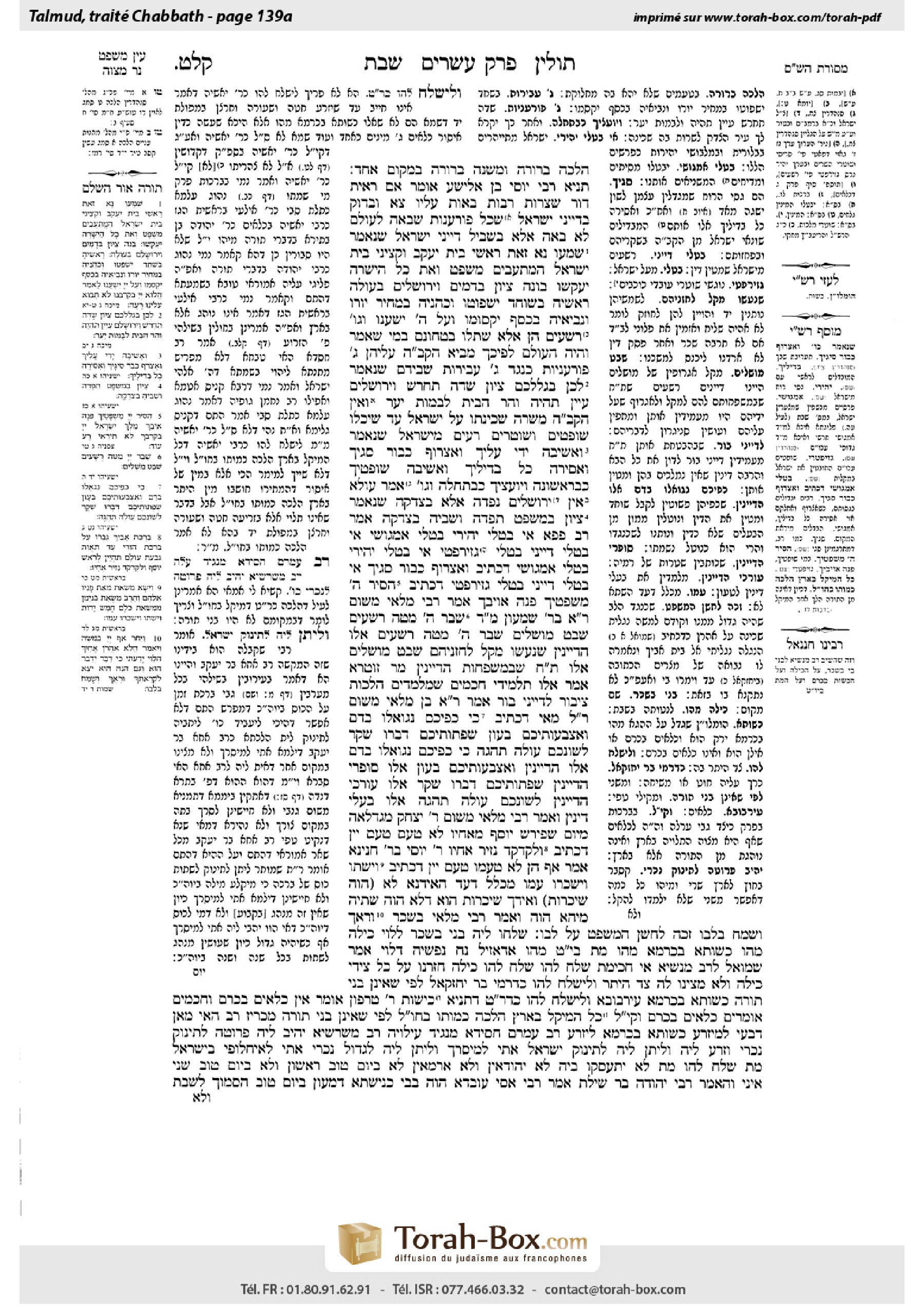
Shabbat 139a: Talmud study for Daf Yomi
Daf Yomi is the daily study of one Talmud folio. Explore 37 tractates with scans, Hebrew text, Sefaria English and AI-generated French translations where annotated.
Passage selection and English or AI-generated French translation are available where the scan has annotations. Daf Study is independent of Torah-Box and Sefaria.
Browse Shabbat · שבת · All tractatesShabbat 139a text and translations
This page of Shabbat includes the Aramaic text, an English translation and an AI-generated French translation, alongside the scan above.
שבת קל״ט א · Aramaic and Hebrew text
הֲלָכָה בְּרוּרָה וּמִשְׁנָה בְּרוּרָה בִּמְקוֹם אֶחָד.
תַּנְיָא, רַבִּי יוֹסֵי בֶּן אֱלִישָׁע אוֹמֵר: אִם רָאִיתָ דּוֹר שֶׁצָּרוֹת רַבּוֹת בָּאוֹת עָלָיו — צֵא וּבְדוֹק בְּדַיָּינֵי יִשְׂרָאֵל. שֶׁכׇּל פּוּרְעָנוּת שֶׁבָּאָה לְעוֹלָם לֹא בָּאָה אֶלָּא בִּשְׁבִיל דַּיָּינֵי יִשְׂרָאֵל, שֶׁנֶּאֱמַר: ״שִׁמְעוּ נָא זֹאת רָאשֵׁי בֵּית יַעֲקֹב וּקְצִינֵי בֵּית יִשְׂרָאֵל הַמְתַעֲבִים מִשְׁפָּט וְאֵת כׇּל הַיְשָׁרָה יְעַקֵּשׁוּ. בּוֹנֶה צִיּוֹן בְּדָמִים וִירוּשָׁלִַים בְּעַוְלָה. רָאשֶׁיהָ בְּשׁוֹחַד יִשְׁפּוֹטוּ וְכֹהֲנֶיהָ בִּמְחִיר יוֹרוּ וּנְבִיאֶיהָ בְּכֶסֶף יִקְסוֹמוּ וְעַל ה׳ יִשָּׁעֵנוּ וְגוֹ׳״.
רְשָׁעִים הֵן, אֶלָּא שֶׁתָּלוּ בִּטְחוֹנָם בְּמִי שֶׁאָמַר וְהָיָה הָעוֹלָם. לְפִיכָךְ, מֵבִיא הַקָּדוֹשׁ בָּרוּךְ הוּא עֲלֵיהֶן שָׁלֹשׁ פּוּרְעָנִיּוֹת כְּנֶגֶד שָׁלֹשׁ עֲבֵירוֹת שֶׁבְּיָדָם, שֶׁנֶּאֱמַר: ״לָכֵן בִּגְלַלְכֶם צִיּוֹן שָׂדֶה תֵחָרֵשׁ וִירוּשָׁלִַים עִיִּין תִּהְיֶה וְהַר הַבַּיִת לְבָמוֹת יָעַר״.
וְאֵין הַקָּדוֹשׁ בָּרוּךְ הוּא מַשְׁרֶה שְׁכִינָתוֹ עַל יִשְׂרָאֵל עַד שֶׁיִּכְלוּ שׁוֹפְטִים וְשׁוֹטְרִים רָעִים מִיִּשְׂרָאֵל, שֶׁנֶּאֱמַר: ״וְאָשִׁיבָה יָדִי עָלַיִךְ וְאֶצְרוֹף כַּבּוֹר סִיגָיִךְ וְאָסִירָה כׇּל בְּדִילָיִךְ. וְאָשִׁיבָה שׁוֹפְטַיִךְ כְּבָרִאשׁוֹנָה וְיוֹעֲצַיִךְ כְּבַתְּחִלָּה וְגוֹ׳״.
אָמַר עוּלָּא: אֵין יְרוּשָׁלָיִם נִפְדֵּית אֶלָּא בִּצְדָקָה, שֶׁנֶּאֱמַר: ״צִיּוֹן בְּמִשְׁפָּט תִּפָּדֶה וְשָׁבֶיהָ בִּצְדָקָה״.
אָמַר רַב פָּפָּא: אִי בָּטְלִי יְהִירֵי — בָּטְלִי אַמְגּוּשֵׁי. אִי בָּטְלִי דַּיָּינֵי — בָּטְלִי גְּזִירְפָּטֵי.
אִי בָּטְלִי יְהִירֵי בָּטְלִי אַמְגּוּשֵׁי — דִּכְתִיב: ״וְאֶצְרוֹף כַּבּוֹר סִיגָיִךְ״.
אִי בָּטְלִי דַּיָּינֵי בָּטְלִי גְּזִירְפָּטֵי — דִּכְתִיב: ״הֵסִיר ה׳ מִשְׁפָּטַיִךְ פִּנָּה אוֹיְבֵךְ״.
אָמַר רַבִּי מַלַּאי מִשּׁוּם רַבִּי אֶלְעָזָר בְּרַבִּי שִׁמְעוֹן: מַאי דִּכְתִיב ״שָׁבַר ה׳ מַטֵּה רְשָׁעִים שֵׁבֶט מוֹשְׁלִים״. ״שָׁבַר ה׳ מַטֵּה רְשָׁעִים״ — אֵלּוּ הַדַּיָּינִין שֶׁנַּעֲשׂוּ מַקֵּל לְחַזָּנֵיהֶם. ״שֵׁבֶט מוֹשְׁלִים״ — אֵלּוּ תַּלְמִידֵי חֲכָמִים שֶׁבְּמִשְׁפְּחוֹת הַדַּיָּינִין. מָר זוּטְרָא אָמַר: אֵלּוּ תַּלְמִידֵי חֲכָמִים שֶׁמְלַמְּדִים הִלְכוֹת צִיבּוּר לְדַיָּינֵי בּוּר.
אָמַר רַבִּי אֱלִיעֶזֶר בֶּן מַלַּאי מִשּׁוּם רֵישׁ לָקִישׁ: מַאי דִּכְתִיב ״כִּי כַפֵּיכֶם נְגֹאֲלוּ בַדָּם וְאֶצְבְּעוֹתֵיכֶם בֶּעָוֹן, שִׂפְתוֹתֵיכֶם דִּבְּרוּ שֶׁקֶר לְשׁוֹנְכֶם עַוְלָה תֶהְגֶּה״.
״כִּי כַפֵּיכֶם נְגוֹאֲלוּ בַדָּם״ — אֵלּוּ הַדַּיָּינִין. ״וְאֶצְבְּעוֹתֵיכֶם בְּעָוֹן״ — אֵלּוּ סוֹפְרֵי הַדַּיָּינִין. ״שִׂפְתוֹתֵיכֶם דְּבָרוֹ שֶׁקֶר״ — אֵלּוּ עוֹרְכֵי הַדַּיָּינִין. ״לְשׁוֹנְכֶם עַוְלָה תֶּהְגֶּה״ — אֵלּוּ בַּעֲלִי דִּינִין.
וְאָמַר רַבִּי מַלַּאי מִשּׁוּם רַבִּי יִצְחָק מַגְדְּלָאָה: מִיּוֹם שֶׁפֵּירַשׁ יוֹסֵף מֵאֶחָיו לֹא טָעַם טַעַם יַיִן, דִּכְתִיב: ״וּלְקׇדְקֹד נְזִיר אֶחָיו״.
רַבִּי יוֹסֵי בְּרַבִּי חֲנִינָא אָמַר: אַף הֵן לֹא טָעֲמוּ טַעַם יַיִן, דִּכְתִיב: ״וַיִּשְׁתּוּ וַיִּשְׁכְּרוּ עִמּוֹ״, מִכְּלָל דְּעַד הָאִידָּנָא לָא הֲוָה שִׁיכְרוּת. וְאִידַּךְ, שִׁיכְרוּת הוּא דְּלָא הֲוָה, שְׁתִיָּהּ מִיהָא הֲוָה.
וַאֲמַר רַבִּי מַלַּאי: בִּשְׂכַר ״וְרָאֲךָ וְשָׂמַח בְּלִבּוֹ״, זָכָה לְחֹשֶׁן הַמִּשְׁפָּט עַל לִבּוֹ.
שְׁלַחוּ לֵיהּ בְּנֵי בָּשְׁכָּר לְלֵוִי: כִּילָּה מַהוּ? כְּשׁוּתָא בְּכַרְמָא מַהוּ? מֵת בְּיוֹם טוֹב מַהוּ?
אַדְּאָזֵיל נָח נַפְשֵׁיהּ דְּלֵוִי. אָמַר שְׁמוּאֵל לְרַב מְנַשְּׁיָא: אִי חַכִּימַתְּ, שְׁלַח לְהוּ. שְׁלַח לְהוּ: כִּילָּה — חָזַרְנוּ עַל כׇּל צִידֵּי כִּילָּה וְלֹא מָצִינוּ לָהּ צַד הֶיתֵּר.
וְלִישְׁלַח לְהוּ כִּדְרָמֵי בַּר יְחֶזְקֵאל! לְפִי שֶׁאֵינָן בְּנֵי תוֹרָה.
כְּשׁוּתָא בְּכַרְמָא — עִירְבּוּבָא. וְלִישְׁלַח לְהוּ כִּדְרַבִּי טַרְפוֹן? דְּתַנְיָא: כְּשׁוּת, רַבִּי טַרְפוֹן אוֹמֵר: אֵין כִּלְאַיִם בַּכֶּרֶם. וַחֲכָמִים אוֹמְרִים: כִּלְאַיִם בַּכֶּרֶם. וְקַיְימָא לַן: כׇּל הַמֵּיקֵל בָּאָרֶץ, הֲלָכָה כְּמוֹתוֹ בְּחוּץ לָאָרֶץ! לְפִי שֶׁאֵינָן בְּנֵי תוֹרָה.
מַכְרִיז רַב: הַאי מַאן דְּבָעֵי לְמִיזְרַע כְּשׁוּתָא בְּכַרְמָא — לִיזְרַע. רַב עַמְרָם חֲסִידָא מְנַגֵּיד עִילָּוֵיהּ.
רַב מְשַׁרְשְׁיָא יָהֵיב לֵיהּ פְּרוּטָה לְתִינוֹק גּוֹי וְזָרַע לֵיהּ. וְלִיתֵּן לֵיהּ לְתִינוֹק יִשְׂרָאֵל! אָתֵי לְמִיסְרַךְ: וְלִיתֵּן לֵיהּ לְגָדוֹל גּוֹי! אָתֵי לְאִיחַלּוֹפֵי בְּיִשְׂרָאֵל.
מֵת — שְׁלַח לְהוּ: מֵת לֹא יִתְעַסְּקוּ בּוֹ לֹא יְהוּדָאִין וְלֹא אַרְמָאִין, לֹא בְּיוֹם טוֹב רִאשׁוֹן וְלֹא בְּיוֹם טוֹב שֵׁנִי.
אִינִי?! וְהָאָמַר רַבִּי יְהוּדָה בַּר שִׁילַת אָמַר רַבִּי אַסִּי: עוֹבָדָא הֲוָה בְּבֵי כְנִישְׁתָּא דְּמָעוֹן בְּיוֹם טוֹב הַסָּמוּךְ לַשַּׁבָּת,
Shabbat 139a · English translation
clear halakha and clear teaching together, but rather there will be disputes among the Sages.
It was taught in a baraita that Rabbi Yosei ben Elisha says: If you see a generation that many troubles are befalling it, go and examine the judges of Israel. Perhaps their sins are the cause, as any calamity that comes to the world comes due to the judges of Israel acting corruptly, as it is stated: “Please hear this, heads of the house of Jacob, and officers of the house of Israel, who abhor justice and pervert all equity, who build up Zion with blood, and Jerusalem with iniquity. Their heads they judge for bribes, and their priests teach for hire, and their prophets divine for money; yet they lean upon the Lord, saying: Is not the Lord in our midst? No evil shall befall us” (Micah 3:9–11).
The Gemara comments: They are wicked, but they placed their trust in the One Who spoke and the world came into being, the Almighty. Therefore, the Holy One, Blessed be He, brings upon them three calamities corresponding to the three transgressions for which they are responsible, as it is stated in the following verse: “Therefore, because of you, Zion shall be plowed as a field, and Jerusalem shall become heaps, and the Temple Mount as the high places of a forest” (Micah 3:12).
And the Holy One, Blessed be He, will not rest His Divine Presence on the Jewish people until evil judges and officers shall be eliminated from the Jewish people, as it is stated: “And I will turn My hand upon you, and I will purge away your dross as with lye, and I will remove all your alloy. And I will restore your judges as at first, and your counselors as at the beginning; afterward you shall be called the city of righteousness, a faithful city” (Isaiah 1:25–26).
Ulla said: Jerusalem will be redeemed only through righteousness, as it is stated: “Zion will be redeemed with justice and those who return to her with righteousness” (Isaiah 1:27).
Rav Pappa said: If the arrogant will cease to exist, the Persian fire priests will cease to exist as well. If the deceitful judges will cease to exist, the royal officers [gazirpatei] and taskmasters will cease to exist.
He explains: If the arrogant will cease, the Persian fire priests will cease, as it is written: “And I will purge away your dross [sigayikh] as with lye, and I will remove all your alloy [bedilayikh].” This teaches that when the conceited and haughty [sigim] are purged, the priests of fire, who are separated [muvdalim] from the fear of God, will also cease.
He said: If the deceitful judges cease, the royal officers and taskmasters will cease, as it is written: “The Lord has removed your judgment, cast out your enemy” (Zephaniah 3:15).
Rabbi Mallai said in the name of Rabbi Elazar, son of Rabbi Shimon: What is the meaning of that which is written: “The Lord has broken the staff of the wicked, the rod of the rulers” (Isaiah 14:5)? He explains: “The Lord has broken the staff of the wicked”; these are the judges who have become staffs for their attendants. The attendants abuse people, and the judges provide the attendants with legal backing and moral support. “The rod of the rulers”; these are the Torah scholars who are members of the families of the judges. These Torah scholars assist their relatives, the judges, conceal their faults. Mar Zutra said: These are the Torah scholars who teach communal halakhot to ignorant judges. They teach ignorant judges just enough Torah and modes of conduct to prevent the people from realizing how ignorant they are, enabling them to maintain their positions.
Rabbi Eliezer ben Mallai said in the name of Reish Lakish: What is the meaning of that which is written: “For your hands are defiled with blood, and your fingers with iniquity; your lips have spoken lies, your tongue utters wickedness” (Isaiah 59:3)?
He explains: “For your hands are defiled with blood”; these are the judges who take bribes in their hands. “And your fingers with iniquity”; these are the scribes of the judges, who write falsehood with their fingers. “Your lips have spoken lies”; these are the legal advisors. “Your tongue utters wickedness”; these are the litigants themselves.
And Rabbi Mallai said in the name of Rabbi Yitzḥak from Migdal: From the day that Joseph took leave from his brothers, he did not sample a taste of wine, as it is written: “They shall be on the head of Joseph, and on the crown of the head of he who was separated [nezir] from his brothers” (Genesis 49:26). The language of the verse alludes to the fact that Joseph conducted himself like a nazirite and abstained from wine.
Rabbi Yosei, son of Rabbi Ḥanina, said: Joseph’s brothers too did not sample the taste of wine during the intervening period, due to their remorse, as it is written: “And they drank and became drunk with him” (Genesis 43:34). By inference: Until now there was no drunkenness, as they abstained from drinking. And the other Sage, Rabbi Mallai, holds: It was drunkenness of which there was none; however, there was drinking on the part of the brothers during the intervening years.
And Rabbi Mallai said: It is stated in the verse: “And the anger of the Lord was kindled against Moses, and He said: Is there not Aaron your brother the Levite, I know that he can surely speak, and also behold, he is coming out to greet you, and he will see you and be glad in his heart” (Exodus 4:14). Rabbi Mallai taught that as reward for Aaron’s lack of jealousy at seeing his brother Moses rise to greatness, as it is stated: “And he will see you and be glad in his heart,” he merited to become the High Priest, and for the breastplate of judgment to rest on his heart.
The Gemara returns to the laws of a canopy. The inhabitants of the town of Bashkar sent to Levi: What is the halakha with regard to spreading a canopy on Shabbat? Additionally, what is the halakha with regard to hops in a vineyard? Do they constitute a prohibited mixture of diverse kinds? Finally, what is the halakha with regard to one who died on a Festival? How can the people attend to his burial?
As the messenger was going with the question, Levi died. Shmuel said to Rav Menashya: If you are wise and able to respond, send them answers to their questions. He sent them: With regard to a canopy, we reviewed all aspects of the matter of the canopy, and we did not find any permissible aspect.
The Gemara asks: And let him send them that it can be permitted in accordance with the opinion of Rami bar Yeḥezkel. The Gemara answers: He did not want to reveal that leniency to them, because they are not well versed in Torah, and they would not distinguish between permitted and prohibited methods of spreading the canopy.
He also told them: Hops in a vineyard are a forbidden mixture of diverse kinds. The Gemara asks: And let him send them the message that it is permitted in accordance with the opinion of Rabbi Tarfon, as it was taught in the Tosefta: With regard to hops, Rabbi Tarfon says: They do not constitute a prohibited mixture of food crops in a vineyard, and the Rabbis say: They constitute a forbidden mixture of food crops in a vineyard. And we maintain that anyone who is lenient with regard to the halakhot of diverse kinds in Eretz Yisrael, even if the halakha is not ruled in accordance with his opinion, the halakha is ruled in accordance with his opinion outside of Eretz Yisrael, where the halakhot of diverse kinds apply only by rabbinic law. The Gemara explains: He did not reveal this leniency to them, because they were not well versed in Torah.
With regard to the matter of hops in a vineyard, the Gemara relates that Rav would announce: One who seeks to sow hops in a vineyard, let him sow. In contrast, Rav Amram Ḥasida would administer lashes for sowing hops in a vineyard.
The Gemara relates that Rav Mesharshiya would give a peruta to a gentile child, and the child would sow hops for him. The Gemara asks: And let him give the peruta to a Jewish child, who is also not obligated in mitzva observance. The Gemara answers: He may come to continue this habit and violate the prohibition as an adult. The Gemara asks: And let him give the peruta to an adult gentile. The Gemara answers: He may come to confuse him with a Jew.
With regard to a person who died on a Festival, he sent them in response: If a person died on a Festival, neither Jews nor Arameans, i.e., gentiles, should attend to his burial, neither on the first day of a Festival, nor on the second day of a Festival observed in the Diaspora.
The Gemara asks: Is that so? Didn’t Rabbi Yehuda bar Sheilat say that Rabbi Asi said: There was an incident in the synagogue of the settlement of Maon on a Festival adjacent to Shabbat. A person died,
Shabbat 139a · Traduction française (IA)
une halakha claire et un enseignement clair réunis ; au contraire, il y aura des controverses parmi les Sages.
Il a été enseigné dans une baraïta que Rabbi Yosei ben Elisha dit : Si tu vois une génération accablée par de nombreux malheurs, va examiner les juges d’Israël. Peut-être leurs fautes en sont-elles la cause, car toute calamité qui s’abat sur le monde est due à la corruption des juges d’Israël, comme il est dit : « Écoutez donc ceci, chefs de la maison de Jacob et dirigeants de la maison d’Israël, vous qui abhorrez la justice et pervertissez toute équité, qui bâtissez Sion dans le sang et Jérusalem dans l’iniquité. Ses chefs jugent pour des pots-de-vin, ses prêtres enseignent contre rémunération et ses prophètes devinent contre de l’argent ; pourtant, ils s’appuient sur le Seigneur en disant : “Le Seigneur n’est-il pas au milieu de nous ? Aucun malheur ne nous atteindra” » (Michée 3, 9-11).
La Guemara commente : Ils sont méchants, mais ils ont placé leur confiance en Celui qui a parlé et le monde est venu à l’existence, le Tout-Puissant. C’est pourquoi le Saint, béni soit-Il, fait s’abattre sur eux trois calamités, correspondant aux trois transgressions dont ils sont responsables, comme il est dit dans le verset suivant : « À cause de vous, Sion sera labourée comme un champ, Jérusalem deviendra un amas de ruines et le mont du Temple, des hauteurs boisées » (Michée 3, 12).
Et le Saint, béni soit-Il, ne fera pas résider Sa Présence divine sur le peuple juif tant que les juges et les dirigeants malfaisants n’auront pas été éliminés du peuple juif, comme il est dit : « Je tournerai Ma main contre toi, je purifierai tes scories comme avec de la potasse et j’enlèverai tout ton alliage. Je rétablirai tes juges comme autrefois et tes conseillers comme au commencement ; après cela, on t’appellera ville de justice, cité fidèle » (Isaïe 1, 25-26).
Oulla dit : Jérusalem ne sera rachetée que par la justice, comme il est dit : « Sion sera rachetée par le droit, et ceux qui reviendront à elle par la justice » (Isaïe 1, 27).
Rav Pappa dit : Si les arrogants disparaissent, les prêtres perses du feu disparaîtront également. Si les juges fourbes disparaissent, les officiers royaux [gazirpatei] et les contremaîtres disparaîtront.
Il explique : Si les arrogants disparaissent, les prêtres perses du feu disparaîtront, comme il est écrit : « Je purifierai tes scories [sigayikh] comme avec de la potasse et j’enlèverai tout ton alliage [bedilayikh]. » Cela enseigne que lorsque les vaniteux et les orgueilleux [sigim] sont éliminés, les prêtres du feu, qui sont séparés [muvdalim] de la crainte de Dieu, disparaissent eux aussi.
Il dit : Si les juges fourbes disparaissent, les officiers royaux et les contremaîtres disparaîtront, comme il est écrit : « Le Seigneur a écarté ton jugement, Il a chassé ton ennemi » (Sophonie 3, 15).
Rabbi Mallai dit au nom de Rabbi Elazar, fils de Rabbi Shimon : Que signifie ce qui est écrit : « Le Seigneur a brisé le bâton des méchants, le sceptre des dirigeants » (Isaïe 14, 5) ? Il explique : « Le Seigneur a brisé le bâton des méchants » : il s’agit des juges qui sont devenus des bâtons pour leurs assistants. Les assistants maltraitent les gens, et les juges leur apportent un soutien juridique et moral. « Le sceptre des dirigeants » : il s’agit des érudits de Torah qui appartiennent aux familles des juges. Ces érudits de Torah aident leurs proches, les juges, en dissimulant leurs défauts. Mar Zutra dit : Il s’agit des érudits de Torah qui enseignent les halakhot communautaires à des juges ignorants. Ils enseignent aux juges ignorants juste assez de Torah et de règles de conduite pour empêcher le peuple de se rendre compte de leur ignorance, leur permettant ainsi de conserver leurs fonctions.
Rabbi Eliezer ben Mallai dit au nom de Reish Lakish : Que signifie ce qui est écrit : « Car vos mains sont souillées de sang et vos doigts d’iniquité ; vos lèvres ont proféré des mensonges, votre langue profère la méchanceté » (Isaïe 59, 3) ?
Il explique : « Car vos mains sont souillées de sang » : il s’agit des juges qui prennent des pots-de-vin dans leurs mains. « Et vos doigts d’iniquité » : il s’agit des scribes des juges, qui écrivent des mensonges de leurs doigts. « Vos lèvres ont proféré des mensonges » : il s’agit des conseillers juridiques. « Votre langue profère la méchanceté » : il s’agit des plaideurs eux-mêmes.
Et Rabbi Mallai dit au nom de Rabbi Yitzḥak de Migdal : Depuis le jour où Joseph prit congé de ses frères, il ne goûta plus au vin, comme il est écrit : « Qu’ils soient sur la tête de Joseph et sur le sommet de la tête de celui qui fut séparé [nezir] de ses frères » (Genèse 49, 26). Le langage du verset fait allusion au fait que Joseph se conduisit comme un nazir et s’abstint de vin.
Rabbi Yosei, fils de Rabbi Ḥanina, dit : Les frères de Joseph, eux aussi, ne goûtèrent pas au vin durant la période intermédiaire, par remords, comme il est écrit : « Ils burent et s’enivrèrent avec lui » (Genèse 43, 34). On en déduit que jusqu’alors, il n’y avait pas eu d’ivresse, car ils s’étaient abstenus de boire. L’autre Sage, Rabbi Mallai, estime qu’il n’y avait pas eu d’ivresse, mais que les frères avaient bu pendant les années intermédiaires.
Et Rabbi Mallai dit : Il est dit dans le verset : « La colère du Seigneur s’enflamma contre Moïse, et Il dit : “Aaron, ton frère, le Lévite, n’est-il pas là ? Je sais qu’il parlera certainement. Et voici qu’il vient à ta rencontre ; il te verra et se réjouira dans son cœur” » (Exode 4, 14). Rabbi Mallai enseigna qu’en récompense de l’absence de jalousie d’Aaron lorsqu’il vit son frère Moïse accéder à la grandeur, comme il est dit : « Il te verra et se réjouira dans son cœur », Aaron mérita de devenir le grand prêtre et que le pectoral du jugement repose sur son cœur.
La Guemara revient aux lois relatives à un dais. Les habitants de la ville de Bashkar envoyèrent une question à Levi : Quelle est la halakha concernant le fait de déployer un dais pendant Chabbat ? En outre, quelle est la halakha concernant le houblon dans une vigne ? Constitue-t-il un mélange interdit d’espèces différentes ? Enfin, quelle est la halakha concernant une personne morte un jour de fête ? Comment peut-on procéder à son inhumation ?
Alors que le messager était en route avec la question, Levi mourut. Shmuel dit à Rav Menashya : Si tu es sage et capable de répondre, envoie-leur les réponses à leurs questions. Il leur envoya ceci : Concernant le dais, nous avons examiné tous les aspects de la question et n’avons trouvé aucune manière permise de le faire.
La Guemara demande : Pourquoi ne pas leur répondre que cela est permis conformément à l’opinion de Rami bar Yeḥezkel ? La Guemara répond : Il ne voulait pas leur révéler cette indulgence, car ils ne connaissaient pas bien la Torah et ne sauraient pas distinguer les manières permises des manières interdites de déployer le dais.
Il leur dit également : Le houblon dans une vigne constitue un mélange interdit d’espèces différentes. La Guemara demande : Pourquoi ne pas leur répondre que c’est permis conformément à l’opinion de Rabbi Tarfon, comme il a été enseigné dans la Tosefta : Concernant le houblon, Rabbi Tarfon dit qu’il ne constitue pas un mélange interdit de cultures dans une vigne, tandis que les Rabbins disent qu’il constitue un mélange interdit de cultures dans une vigne. Or, nous considérons que quiconque se montre indulgent concernant les lois des espèces différentes en Terre d’Israël, même si la halakha n’est pas tranchée conformément à son opinion, voit la halakha tranchée conformément à son opinion hors de la Terre d’Israël, où les lois des espèces différentes ne s’appliquent que par décret rabbinique. La Guemara explique : Il ne leur révéla pas cette indulgence, car ils ne connaissaient pas bien la Torah.
À propos du houblon dans une vigne, la Guemara rapporte que Rav proclamait : Que celui qui souhaite semer du houblon dans une vigne le fasse. En revanche, Rav Amram Ḥasida faisait administrer des coups de fouet à ceux qui semaient du houblon dans une vigne.
La Guemara rapporte que Rav Mesharshiya donnait une perouta à un enfant non juif, et l’enfant semait du houblon pour lui. La Guemara demande : Pourquoi ne pas donner la perouta à un enfant juif, qui n’est pas non plus tenu d’observer les mitsvot ? La Guemara répond : Il pourrait prendre l’habitude de continuer ainsi et transgresser l’interdit à l’âge adulte. La Guemara demande : Pourquoi ne pas donner la perouta à un adulte non juif ? La Guemara répond : Il pourrait en venir à le confondre avec un Juif.
Au sujet d’une personne morte un jour de fête, il leur envoya cette réponse : Si une personne meurt un jour de fête, ni les Juifs ni les Araméens, c’est-à-dire les non-Juifs, ne doivent procéder à son inhumation, ni le premier jour d’une fête ni le deuxième jour d’une fête observé dans la Diaspora.
La Guemara demande : Est-ce bien le cas ? Rabbi Yehuda bar Sheilat n’a-t-il pas dit que Rabbi Asi a dit : Il est arrivé que, dans la synagogue du village de Maon, un jour de fête qui précédait immédiatement Chabbat, une personne mourut,
Traduction française générée par IA à partir de l’édition anglaise de Sefaria. Vérifie toujours un passage avec le texte source.
Text from Sefaria: William Davidson Edition - Vocalized Aramaic (CC BY NC); William Davidson Edition - English (CC BY NC).