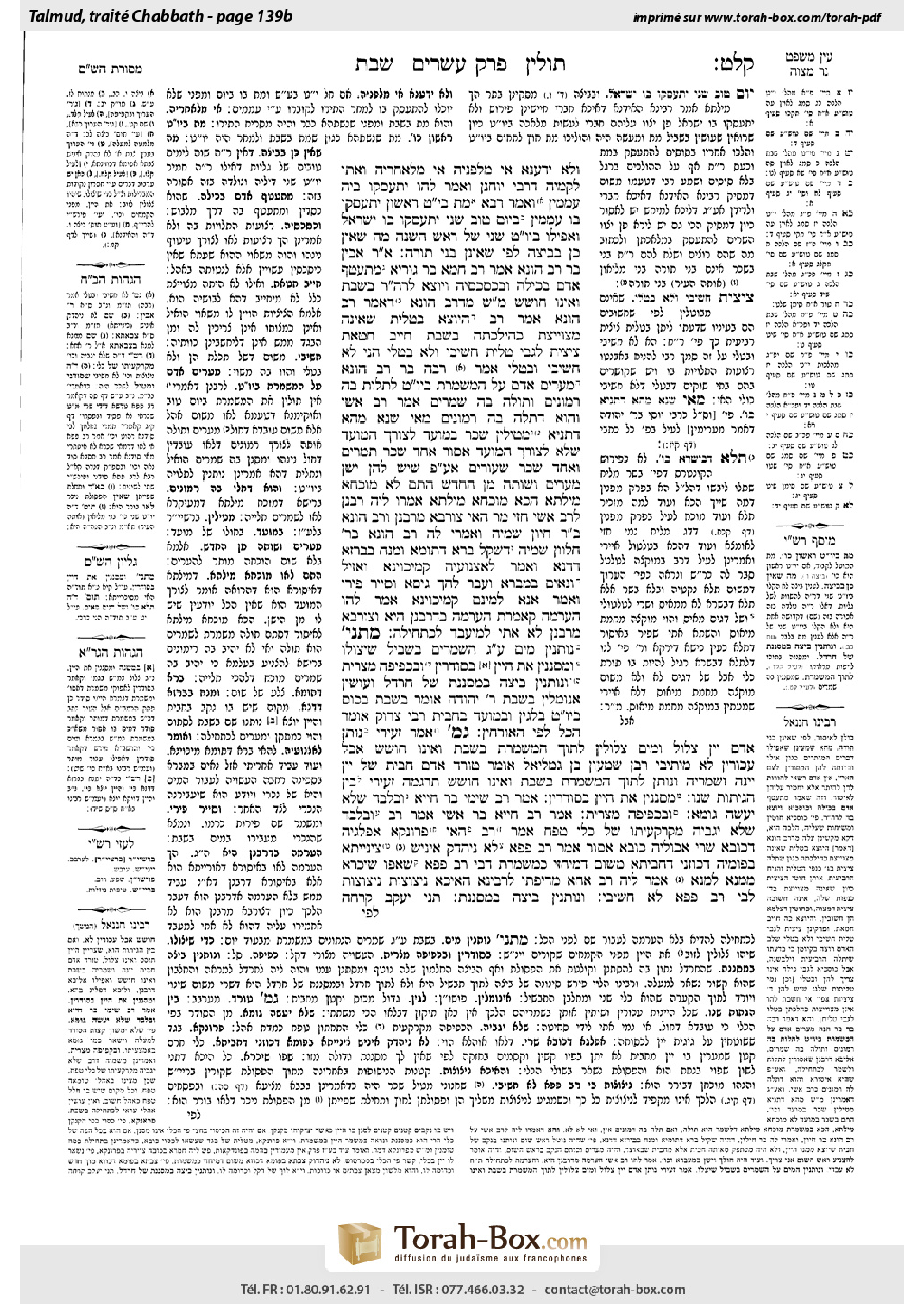
Shabbat 139b: Talmud study for Daf Yomi
Daf Yomi is the daily study of one Talmud folio. Explore 37 tractates with scans, Hebrew text, Sefaria English and AI-generated French translations where annotated.
Passage selection and English or AI-generated French translation are available where the scan has annotations. Daf Study is independent of Torah-Box and Sefaria.
Browse Shabbat · שבת · All tractatesShabbat 139b text and translations
This page of Shabbat includes the Aramaic text, an English translation and an AI-generated French translation, alongside the scan above.
שבת קל״ט ב · Aramaic and Hebrew text
וְלָא יָדַעְנָא אִי מִלְּפָנֶיהָ אִי מִלְּאַחֲרֶיהָ, וַאֲתוֹ לְקַמֵּיהּ דְּרַבִּי יוֹחָנָן, וַאֲמַר לְהוּ: יִתְעַסְּקוּן בֵּיהּ עַמְמִין.
וְאָמַר רָבָא: מֵת בְּיוֹם טוֹב רִאשׁוֹן יִתְעַסְּקוּ בּוֹ עַמְמִין, בְּיוֹם טוֹב שֵׁנִי — יִתְעַסְּקוּ בּוֹ יִשְׂרָאֵל, וַאֲפִילּוּ בְּיוֹם טוֹב שֵׁנִי שֶׁל רֹאשׁ הַשָּׁנָה. מַה שֶּׁאֵין כֵּן בְּבֵיצָה. לְפִי שֶׁאֵינָן בְּנֵי תוֹרָה.
אָמַר רַבִּי אָבִין בַּר רַב הוּנָא אָמַר רַב חָמָא בַּר גּוּרְיָא: מִתְעַטֵּף אָדָם בְּכִילָּה וּבְכִסְכָּסֶיהָ וְיוֹצֵא לִרְשׁוּת הָרַבִּים בְּשַׁבָּת, וְאֵינוֹ חוֹשֵׁשׁ.
מַאי שְׁנָא מִדְּרַב הוּנָא, דְּאָמַר רַב הוּנָא אָמַר רַב: הַיּוֹצֵא בְּטַלִּית שֶׁאֵינָהּ מְצוּיֶּיצֶת כְּהִילְכָתָהּ בְּשַׁבָּת — חַיָּיב חַטָּאת! צִיצִית לְגַבֵּי טַלִּית — חֲשִׁיבִי, וְלָא בָּטְלִי. הָנֵי לָא חֲשִׁיבִי, וּבָטְלִי.
אָמַר רַבָּה בַּר רַב הוּנָא: מַעֲרִים אָדָם עַל הַמְשַׁמֶּרֶת בְּיוֹם טוֹב לִתְלוֹת בָּהּ רִמּוֹנִים, וְתוֹלֶה בָּהּ שְׁמָרִים. אָמַר רַב אָשֵׁי: וְהוּא דְּתָלָה בָּהּ רִמּוֹנִים.
מַאי שְׁנָא מֵהָא דְּתַנְיָא: מְטִילִין שֵׁכָר בַּמּוֹעֵד לְצוֹרֶךְ הַמּוֹעֵד, שֶׁלֹּא לְצוֹרֶךְ הַמּוֹעֵד — אָסוּר, אֶחָד שֵׁכַר תְּמָרִים וְאֶחָד שֵׁכַר שְׂעוֹרִים. אַף עַל פִּי שֶׁיֵּשׁ לָהֶן יָשָׁן — מַעֲרִים וְשׁוֹתֶה מִן הֶחָדָשׁ!
הָתָם לָא מוֹכְחָא מִילְּתָא, הָכָא מוֹכְחָא מִילְּתָא.
אֲמַרוּ לֵיהּ רַבָּנַן לְרַב אָשֵׁי: חֲזִי מָר הַאי צוּרְבָּא מֵרַבָּנַן וְרַב הוּנָא בֶּן רַבִּי חִיּוֹן שְׁמֵיהּ, וְאָמְרִי לַהּ רַב הוּנָא בְּרַבִּי חִלְווֹן שְׁמֵיהּ, דְּשָׁקֵל בְּרָא דְתוּמָא וּמַנַּח בְּבַרְזָא דְּדַנָּא, וְאָמַר: לְאַצְּנוֹעֵיהּ קָמִיכַּוֵינָא. וְאָזֵיל וְנָאֵים בְּמַבָּרָא, וְעָבַר לְהַךְ גִּיסָא וְסָיַיר פִּירֵי, וְאָמַר: אֲנָא לְמֵינַם קָמִיכַּוֵינָא!
אֲמַר לְהוּ: הַעֲרָמָה קָאָמְרַתְּ? הַעֲרָמָה בִּדְרַבָּנַן הִיא, וְצוּרְבָּא מֵרַבָּנַן לָא אָתֵי לְמִיעְבַּד לְכַתְּחִילָּה.
מַתְנִי׳ נוֹתְנִין מַיִם עַל גַּבֵּי הַשְּׁמָרִים בִּשְׁבִיל שֶׁיִּצּוֹלּוּ. וּמְסַנְּנִין אֶת הַיַּיִן בְּסוּדָרִין וּבִכְפִיפָה מִצְרִית.
וְנוֹתְנִין בֵּיצָה בִּמְסַנֶּנֶת שֶׁל חַרְדָּל, וְעוֹשִׂין אֵנוֹמֵלִין בְּשַׁבָּת. רַבִּי יְהוּדָה אוֹמֵר: בַּשַּׁבָּת בְּכוֹס, בְּיוֹם טוֹב — בְּלָגִין, וּבַמּוֹעֵד — בְּחָבִית. רַבִּי צָדוֹק אוֹמֵר הַכֹּל לְפִי הָאוֹרְחִין.
גְּמָ׳ אָמַר זְעֵירִי: נוֹתֵן אָדָם יַיִן צָלוּל וּמַיִם צְלוּלִין לְתוֹךְ הַמְשַׁמֶּרֶת בְּשַׁבָּת וְאֵינוֹ חוֹשֵׁשׁ, אֲבָל עֲכוּרִין — לָא.
מֵיתִיבִי, רַבָּן שִׁמְעוֹן בֶּן גַּמְלִיאֵל אוֹמֵר: טוֹרֵד אָדָם חָבִית שֶׁל יַיִן יֵינָהּ וּשְׁמָרֶיהָ, וְנוֹתֵן לְתוֹךְ הַמְשַׁמֶּרֶת בַּשַּׁבָּת וְאֵינוֹ חוֹשֵׁשׁ! תַּרְגְּמַהּ זְעֵירִי: בֵּין הַגִּיתּוֹת שָׁנוּ.
מְסַנְּנִין אֶת הַיַּיִן בְּסוּדָרִין. אָמַר רַב שִׁימִי בַּר חִיָּיא: וּבִלְבַד שֶׁלֹּא יַעֲשֶׂה גּוּמָּא.
וּבִכְפִיפָה מִצְרִית. אָמַר רַב חִיָּיא בַּר אָשֵׁי אָמַר רַב: וּבִלְבַד שֶׁלֹּא יַגְבִּיהַּ מִקַּרְקָעִיתוֹ שֶׁל כְּלִי טֶפַח.
אָמַר רַב: הַאי פְּרוֹנְקָא, אַפַּלְגֵיהּ דְכוּבָּא — שְׁרֵי, אַכּוּלֵּיהּ כּוּבָּא — אֲסִיר.
אָמַר רַב פָּפָּא: לָא נִיהַדַּק אִינִישׁ צִינְיָיתָא בְּפוּמֵּיהּ דְּכוּזַנְתָּא (דְּחָבִיתָא), מִשּׁוּם דְּמֶיחְזֵי כִּמְשַׁמֶּרֶת.
דְּבֵי רַב פָּפָּא שָׁאפוּ שִׁיכְרָא מִמָּנָא לְמָנָא. אֲמַר לֵיהּ רַב אַחָא מִדִּיפְתִּי לְרָבִינָא: הָאִיכָּא נִיצוֹצוֹת! נִיצוֹצוֹת לְבֵי רַב פָּפָּא לָא חֲשִׁיבִי.
וְנוֹתְנִין בֵּיצָה בִּמְסַנֶּנֶת. תָּנֵי יַעֲקֹב קָרְחָה:
Shabbat 139b · English translation
and I do not know whether the Festival occurred before Shabbat or after Shabbat. And they came before Rabbi Yoḥanan, and he said to them: Let gentiles attend to his burial.
And likewise, Rava said: If a person died on the first day of a Festival, gentiles may attend to his burial; on the second day of a Festival observed in the Diaspora, Jews may attend to his burial. And this is the halakha even on the second day of the festival of Rosh HaShana, which is not so with regard to an egg. With regard to an egg laid on the Festival, the two days of Rosh HaShana are considered one long day that cannot be disconnected. Therefore, in contrast to other two-day Festivals in the Diaspora, use of an egg laid on the first day of Rosh HaShana is prohibited on the second day. However, in deference to the dead, the Sages were lenient with regard to burial on the second day of Rosh HaShana. Why then did Rav Menashya prohibit the inhabitants of Bashkar from attending to the burial on a Festival? The Gemara answers: Because they were not well versed in Torah.
Rabbi Avin bar Rav Huna said that Rav Ḥama bar Gureya said: A person may wrap himself in a canopy and in its straps and go out to the public domain on Shabbat, and he need not be concerned about violating the prohibited act of carrying out a burden.
The Gemara asks: In what way is the halakha with regard to the straps different from that which Rav Huna said? As Rav Huna said that Rav said: One who goes out unwittingly to the public domain on Shabbat with a four-cornered garment that does not have the requisite ritual fringes attached is liable to bring a sin-offering, because the remaining fringes are not an integral part of the garment. Since they do not fulfill the mitzva, they are considered a burden that may not be carried into the public domain on Shabbat. The Gemara answers: There is a distinction between the cases. Ritual fringes are significant relative to a garment and are not negated. They are considered an independent entity that may not be carried out into the public domain. These straps of a canopy are not significant and are negated.
Rabba bar Rav Huna said: According to the Rabbis, who prohibit suspending a strainer on a Festival, a person may nevertheless employ artifice and circumvent the prohibition against suspending a strainer by taking it on a Festival and suspending it for the purpose of pomegranates in it, which is permitted. Once the strainer is suspended, he may suspend it in order to filter sediment from the wine, as even the Rabbis hold that on a Festival it is permitted to do this straining through a strainer that is already suspended. Rav Ashi said: And this is only permitted provided that he actually suspended pomegranates in it before using it to strain wine. It must be obvious to all that he used the strainer in a permitted manner.
The Gemara asks: In what way is that halakha different from that which was taught in a baraita: One may begin brewing beer during the intermediate days of a Festival for the purpose of using it on the Festival. If it is not for the purpose of the Festival, it is prohibited. This is the halakha both with regard to date beer and with regard to barley beer. And even though they have old beer, one may employ artifice and say that he wishes to drink from the new, and that he is making beer on the intermediate days of the Festival for that purpose. Apparently, it is permitted to employ artifice even without actively demonstrating that one is performing the action for a permitted purpose. This contradicts the opinion of Rav Ashi.
The Gemara answers: There, with regard to beer, the matter is not evident. When people see someone starting to brew beer, they have no way of knowing whether or not he has beer at home, and consequently, whether or not the action itself is prohibited in that case. However, here, with regard to a strainer, the matter is evident, as people see him suspending a strainer for wine, which is prohibited.
On the topic of artifice, the Gemara relates that the Rabbis said to Rav Ashi: Master, observe this Torah scholar, and Rav Huna ben Rabbi Ḥayon is his name, and some say that his name is Rav Huna, son of Rabbi Ḥalvan, who took a slice of garlic and placed it in the spout of a barrel, and said: I intend to store it. He thereby stopped the spout on Shabbat. And similarly, he went and slept in a ferry on the river, and the ferryman sailed the ferry across the river, and he thereby crossed to the other side and inspected the fruit of his vineyard. He said: I intend to sleep. In this way, he crosses the river by boat on Shabbat, which is a prohibited activity.
Rav Ashi said to them: Are you speaking of artifice? This is artifice employed to circumvent a rabbinic prohibition, and a Torah scholar will not come to perform the action ab initio without artifice. Therefore, there is no reason to prohibit him from doing so.
MISHNA: One may pour water over sediment that is in a strainer on Shabbat so that it will become clear and clean. And similarly, one may filter wine through cloths and through an Egyptian basket made from palm leaves. Since these liquids are drinkable even without filtering, doing so does not violate the prohibition of selecting.
And likewise, one may place an egg in a mustard strainer in order to separate the yolk from the egg-white, and one may prepare anumlin, a wine-based drink, on Shabbat. Rabbi Yehuda says: On Shabbat one may only make anumlin in a small cup; on a Festival, in a larger vessel; and on the intermediate days of a Festival, one may even prepare it in a barrel. Rabbi Tzadok says: There is no objective principle; rather, it is all according to the number of guests; if they are numerous, one may prepare a larger quantity of anumlin.
GEMARA: Ze’iri said: A person may place clear wine and clear water into a strainer on Shabbat, and he need not be concerned over the prohibition of selecting, as the wine is drinkable even without this filtering. However, doing so with murky liquids, no, one may not strain them.
The Gemara raises an objection from a baraita: Rabban Shimon ben Gamliel says: A person may stir a barrel of wine, mixing its wine and its sediment, and place it in a strainer on Shabbat, and he need not be concerned. Apparently, it is permitted to place even murky wine in a strainer. Ze’iri explained that baraita and resolved the difficulty: That was taught with regard to wine between the presses, when the wine has yet to ferment and will remain murky even after filtering.
We learned in the mishna: One may filter wine through cloths on Shabbat. Rav Shimi bar Ḥiyya said: This is permitted provided one does not make an indentation in the cloth, making it into a receptacle, as one must diverge from the usual, weekday manner of performing this activity.
We also learned in the mishna: And it is permitted to filter wine on Shabbat through an Egyptian basket. Rav Ḥiyya bar Ashi said that Rav said the following caveat to that statement: It is permitted provided one does not lift the basket a handbreadth from the bottom of the lower vessel. This ensures that one performs the activity in an atypical manner (Rabbeinu Yona).
Rav said: It is permitted to place this cover that has holes for filtering over half a barrel, but it is prohibited to spread it over the entire barrel, in order that it not appear as though one is using it as a filter (Rabbeinu Ḥananel).
Rav Pappa said: A person may not attach a bundle of straw to the mouth of a barrel’s spigot, because it appears like a strainer.
The Gemara relates: The members of Rav Pappa’s household would carefully pour beer from one vessel to another so that the dregs from one vessel would not pass to the other. Rav Aḥa from Difti said to Ravina: But there are the final drops, which remain when one pours the beer into another vessel. When pouring the final drops from the dregs left in the vessel, one is in violation of the prohibition of selecting. He replied: In Rav Pappa’s house they would leave the final drops in the first vessel together with the dregs. They would not attempt to separate them, as the last drops were not significant to the household of Rav Pappa, because beer was always readily available in his house.
And we further learned in the mishna: One may place an egg in a mustard strainer on Shabbat in order to separate the yolk from the egg-white. The Sage, Ya’akov Korḥa, taught a reason for this:
Shabbat 139b · Traduction française (IA)
et je ne sais pas si la fête a eu lieu avant le Chabbat ou après le Chabbat. Ils se présentèrent devant Rabbi Yoḥanan, qui leur dit : « Que des non-Juifs s’occupent de son enterrement. »
De même, Rava dit : Si quelqu’un meurt le premier jour d’une fête, des non-Juifs peuvent s’occuper de son enterrement ; le deuxième jour d’une fête célébrée en Diaspora, des Juifs peuvent s’occuper de son enterrement. Cette halakha s’applique même au deuxième jour de Roch Hachana, contrairement au cas d’un œuf. En effet, pour un œuf pondu un jour de fête, les deux jours de Roch Hachana sont considérés comme un seul jour prolongé, qu’on ne peut dissocier. Par conséquent, contrairement aux autres fêtes de deux jours célébrées en Diaspora, il est interdit d’utiliser le deuxième jour un œuf pondu le premier jour de Roch Hachana. Toutefois, par égard pour le défunt, les Sages se montrèrent indulgents concernant l’enterrement le deuxième jour de Roch Hachana. Pourquoi Rav Menashya interdit-il donc aux habitants de Bashkar de s’occuper de l’enterrement un jour de fête ? La Guemara répond : parce qu’ils n’étaient pas versés dans la Torah.
Rabbi Avin bar Rav Huna dit au nom de Rav Ḥama bar Gureya : On peut s’envelopper dans un dais avec ses lanières et sortir dans le domaine public le Chabbat, sans craindre de transgresser l’interdiction de transporter une charge.
La Guemara demande : En quoi la halakha concernant les lanières diffère-t-elle de celle qu’a énoncée Rav Huna ? Rav Huna a en effet dit au nom de Rav : Celui qui sort par inadvertance dans le domaine public le Chabbat avec un vêtement à quatre pans auquel ne sont pas attachées les franges rituelles requises est passible d’apporter un sacrifice expiatoire, car les franges manquantes ne font pas partie intégrante du vêtement. Puisqu’elles n’accomplissent pas la mitsva, elles sont considérées comme une charge qu’il est interdit de transporter dans le domaine public le Chabbat. La Guemara répond : Les cas sont différents. Les franges rituelles sont importantes par rapport au vêtement et ne sont pas annulées. Elles sont considérées comme une entité indépendante qu’il est interdit de transporter dans le domaine public. En revanche, les lanières de ce dais ne sont pas importantes et sont annulées.
Rabba bar Rav Huna dit : Selon les Rabbins, qui interdisent de suspendre une passoire un jour de fête, on peut néanmoins user d’un artifice pour contourner cette interdiction : prendre la passoire un jour de fête et la suspendre pour y mettre des grenades, ce qui est permis. Une fois la passoire suspendue, on peut l’utiliser pour filtrer le dépôt du vin, car même les Rabbins admettent qu’un jour de fête il est permis de filtrer ainsi au moyen d’une passoire déjà suspendue. Rav Ashi dit : Cela n’est permis qu’à condition d’y avoir effectivement mis des grenades avant de s’en servir pour filtrer le vin. Il faut que tous voient qu’on a utilisé la passoire d’une manière permise.
La Guemara demande : En quoi cette halakha diffère-t-elle de ce qui a été enseigné dans une baraïta : On peut commencer à brasser de la bière pendant les jours intermédiaires d’une fête afin de la consommer pendant la fête. Si ce n’est pas dans ce but, c’est interdit. Cela vaut aussi bien pour la bière de dattes que pour la bière d’orge. Même si l’on a de la vieille bière, on peut user d’un artifice et dire qu’on souhaite boire de la nouvelle et qu’on la brasse pendant les jours intermédiaires de la fête à cette fin. Il apparaît donc qu’il est permis d’user d’un artifice sans démontrer concrètement qu’on accomplit l’action dans un but permis. Cela contredit l’avis de Rav Ashi.
La Guemara répond : Dans le cas de la bière, la chose n’est pas manifeste. Quand les gens voient quelqu’un commencer à brasser de la bière, ils ne peuvent pas savoir s’il en a chez lui ou non, et donc si, dans ce cas, l’action est interdite ou non. En revanche, ici, dans le cas de la passoire, la chose est manifeste, car les gens le voient suspendre une passoire pour filtrer du vin, ce qui est interdit.
Au sujet des artifices, la Guemara rapporte que les Rabbins dirent à Rav Ashi : « Maître, regarde ce talmid ḥakham. Il s’appelle Rav Huna ben Rabbi Ḥayon ; certains disent qu’il s’appelle Rav Huna, fils de Rabbi Ḥalvan. » Il prit une gousse d’ail, la plaça dans le goulot d’un tonneau et dit : « J’ai l’intention de la conserver. » Il obtura ainsi le goulot le Chabbat. De même, il alla dormir sur un bac sur la rivière ; le passeur fit traverser le bac, et il passa ainsi sur l’autre rive pour inspecter les fruits de sa vigne. Il dit : « J’ai l’intention de dormir. » Il traversa ainsi la rivière en bateau le Chabbat, ce qui est une activité interdite.
Rav Ashi leur dit : « Vous parlez d’un artifice ? Il s’agit d’un artifice employé pour contourner une interdiction rabbinique, et un talmid ḥakham n’en viendra pas à accomplir l’action d’emblée sans artifice. Il n’y a donc aucune raison de lui interdire de procéder ainsi. »
MICHNA : On peut verser de l’eau sur le dépôt qui se trouve dans une passoire le Chabbat, afin qu’il devienne limpide et propre. De même, on peut filtrer le vin à travers des étoffes et à travers un panier égyptien fait de feuilles de palmier. Puisque ces liquides sont buvables même sans être filtrés, cette opération ne transgresse pas l’interdiction de trier.
De même, on peut placer un œuf dans une passoire à moutarde afin de séparer le jaune du blanc, et préparer de l’anumlin, une boisson à base de vin, le Chabbat. Rabbi Yehuda dit : Le Chabbat, on ne peut préparer de l’anumlin que dans une petite coupe ; un jour de fête, dans un récipient plus grand ; et pendant les jours intermédiaires d’une fête, on peut même en préparer dans un tonneau. Rabbi Tzadok dit : Il n’existe pas de règle fixe ; tout dépend du nombre d’invités. S’ils sont nombreux, on peut préparer une plus grande quantité d’anumlin.
GUEMARA : Ze’iri dit : On peut mettre du vin limpide et de l’eau limpide dans une passoire le Chabbat, sans craindre de transgresser l’interdiction de trier, car le vin est buvable même sans cette filtration. En revanche, il n’en va pas de même pour les liquides troubles : on ne peut pas les filtrer.
La Guemara soulève une objection à partir d’une baraïta : Rabban Shimon ben Gamliel dit : « On peut remuer un tonneau de vin, en mélangeant le vin et son dépôt, puis le placer dans une passoire le Chabbat, sans s’en inquiéter. » Il apparaît donc qu’il est permis de mettre même du vin trouble dans une passoire. Ze’iri expliqua cette baraïta et résolut la difficulté : cela a été enseigné à propos du vin qui se trouve entre les pressoirs, lorsque le vin n’a pas encore fermenté et qu’il restera trouble même après la filtration.
Nous avons appris dans la Michna : On peut filtrer du vin à travers des étoffes le Chabbat. Rav Shimi bar Ḥiyya dit : Cela est permis à condition de ne pas creuser un creux dans l’étoffe pour en faire un récipient, car il faut s’écarter de la manière habituelle d’accomplir cette activité en semaine.
Nous avons également appris dans la Michna : Il est permis de filtrer du vin le Chabbat à travers un panier égyptien. Rav Ḥiyya bar Ashi dit au nom de Rav qu’il faut toutefois respecter la restriction suivante : cela est permis à condition de ne pas soulever le panier à une hauteur d’une largeur de paume au-dessus du fond du récipient inférieur. Ainsi, l’activité est accomplie d’une manière inhabituelle (Rabbeinu Yona).
Rav dit : Il est permis de placer ce couvercle percé servant à filtrer sur la moitié d’un tonneau, mais il est interdit de l’étendre sur tout le tonneau, afin que cela ne donne pas l’impression qu’on s’en sert comme d’un filtre (Rabbeinu Ḥananel).
Rav Pappa dit : On ne peut pas fixer une botte de paille à l’ouverture du robinet d’un tonneau, car cela ressemble à une passoire.
La Guemara rapporte : Les membres de la maison de Rav Pappa versaient soigneusement la bière d’un récipient dans un autre, afin que le dépôt du premier ne passe pas dans le second. Rav Aḥa de Difti dit à Ravina : « Mais il reste les dernières gouttes lorsqu’on verse la bière dans un autre récipient. En versant ces dernières gouttes avec le dépôt resté dans le récipient, on transgresse l’interdiction de trier. » Il lui répondit : « Dans la maison de Rav Pappa, ils laissaient les dernières gouttes dans le premier récipient avec le dépôt. Ils ne cherchaient pas à les séparer, car ces dernières gouttes n’avaient pas d’importance pour les gens de la maison de Rav Pappa, la bière y étant toujours disponible. »
Nous avons également appris dans la Michna : On peut placer un œuf dans une passoire à moutarde le Chabbat afin de séparer le jaune du blanc. Le Sage Ya’akov Korḥa en enseigna la raison :
Traduction française générée par IA à partir de l’édition anglaise de Sefaria. Vérifie toujours un passage avec le texte source.
Text from Sefaria: William Davidson Edition - Vocalized Aramaic (CC BY NC); William Davidson Edition - English (CC BY NC).