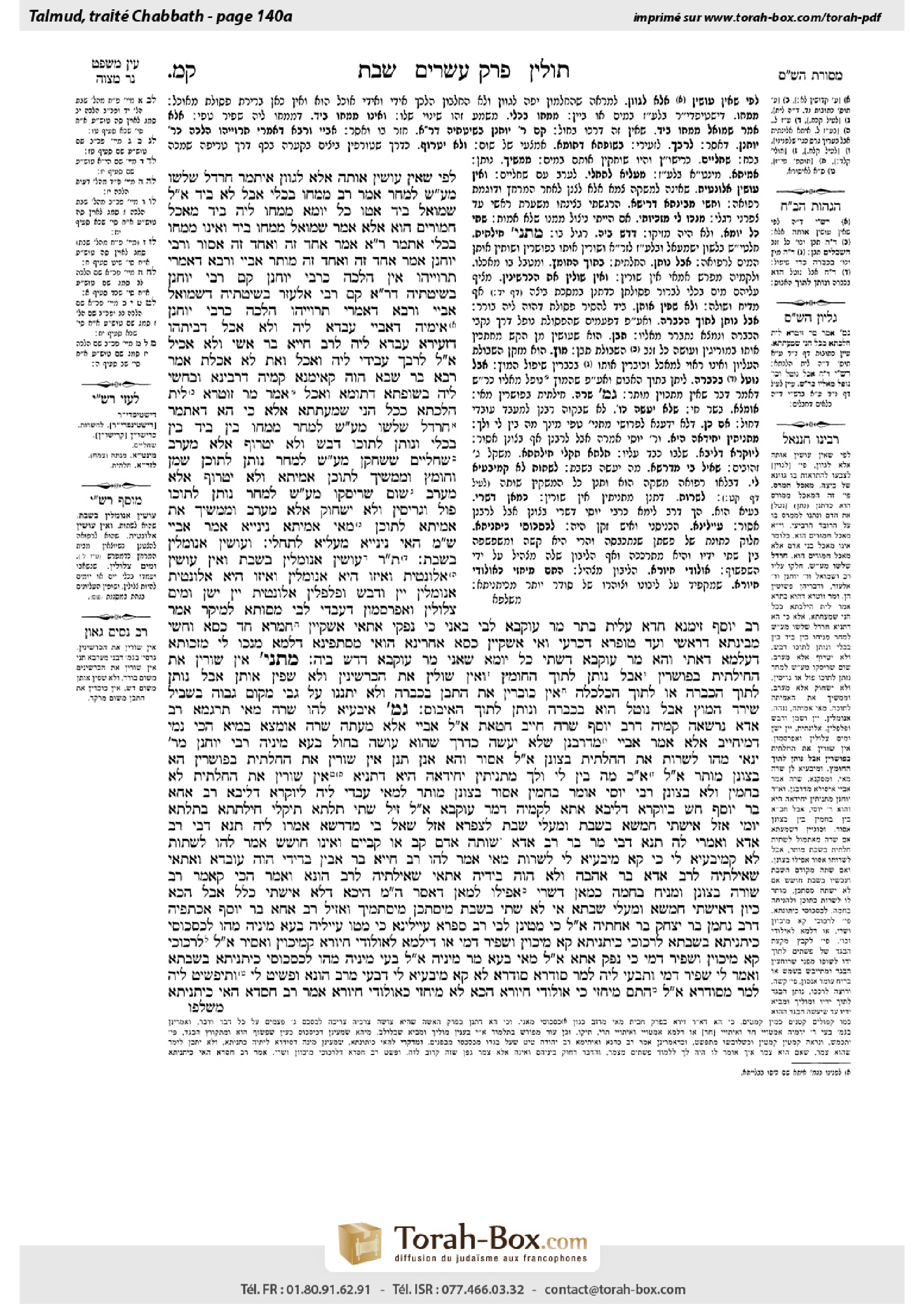
Shabbat 140a: Talmud study for Daf Yomi
Daf Yomi is the daily study of one Talmud folio. Explore 37 tractates with scans, Hebrew text, Sefaria English and AI-generated French translations where annotated.
Passage selection and English or AI-generated French translation are available where the scan has annotations. Daf Study is independent of Torah-Box and Sefaria.
Browse Shabbat · שבת · All tractatesShabbat 140a text and translations
This page of Shabbat includes the Aramaic text, an English translation and an AI-generated French translation, alongside the scan above.
שבת ק״מ א · Aramaic and Hebrew text
לְפִי שֶׁאֵין עוֹשִׂין אוֹתָהּ אֶלָּא לְגָוֶון.
אִיתְּמַר. חַרְדָּל שֶׁלָּשׁוֹ מֵעֶרֶב שַׁבָּת, לְמָחָר, אָמַר רַב: מְמַחוֹ בִּכְלִי אֲבָל לֹא בַּיָּד.
אֲמַר לֵיהּ שְׁמוּאֵל: (בַּיָּד?!) אַטּוּ כׇּל יוֹמָא בְּיָד מְמַחוּ לֵיהּ?! מַאֲכַל חֲמוֹרִים הוּא! אֶלָּא אָמַר שְׁמוּאֵל: מְמַחוֹ בַּיָּד וְאֵינוֹ מְמַחוֹ בִּכְלִי.
אִתְּמַר. רַבִּי אֶלְעָזָר אָמַר: אֶחָד זֶה וְאֶחָד זֶה — אָסוּר. וְרַבִּי יוֹחָנָן אָמַר: אֶחָד זֶה וְאֶחָד זֶה — מוּתָּר. אַבָּיֵי וְרָבָא דְּאָמְרִי תַּרְוַיְיהוּ: אֵין הֲלָכָה כְּרַבִּי יוֹחָנָן.
קָם רַבִּי יוֹחָנָן בְּשִׁיטְתֵיהּ דְּרַבִּי אֶלְעָזָר, קָם רַבִּי אֶלְעָזָר בְּשִׁיטְתֵיהּ דִּשְׁמוּאֵל. אַבָּיֵי וְרָבָא דְּאָמְרִי תַּרְוַיְיהוּ: הֲלָכָה כְּרַבִּי יוֹחָנָן.
אִימֵּיהּ דְּאַבָּיֵי עֲבַדָא לֵיהּ, וְלָא אֲכַל. דְּבֵיתְהוּ דִּזְעִירָא עֲבַדָא לֵיהּ לְרַב חִיָּיא בַּר אָשֵׁי, וְלָא אֲכַל. אֲמַרָה לֵיהּ: לְרַבָּךְ עֲבַדִי לֵיהּ וַאֲכַל, וְאַתְּ לָא אָכְלַתְּ? אָמַר רָבָא בַּר שְׁבָא: הֲוָה קָאֵימְנָא קַמֵּיהּ דְּרָבִינָא וּבְחַשִׁי לֵיהּ בְּשׁוּפְתָּא דְתוּמָא וַאֲכַל.
אָמַר מָר זוּטְרָא: לֵית הִלְכְתָא כְּכׇל הָנֵי שְׁמַעְתָּתָא, אֶלָּא כִּי הָא דְּאִתְּמַר: חַרְדָּל שֶׁלָּשׁוֹ מֵעֶרֶב שַׁבָּת, לְמָחָר מְמַחוֹ בֵּין בַּיָּד בֵּין בִּכְלִי וְנוֹתֵן לְתוֹכוֹ דְּבַשׁ. וְלֹא יִטְרוֹף, אֶלָּא מְעָרֵב.
שַׁחֲלַיִים שֶׁשְּׁחָקָן מֵעֶרֶב שַׁבָּת, לְמָחָר נוֹתֵן לְתוֹכָן שֶׁמֶן וָחוֹמֶץ, וּמַמְשִׁיךְ לְתוֹכָן אַמִּיתָא. וְלֹא יִטְרוֹף אֶלָּא מְעָרֵב. שׁוּם שֶׁרִיסְּקוֹ מֵעֶרֶב שַׁבָּת, לְמָחָר נוֹתֵן לְתוֹכוֹ פּוֹל וּגְרִיסִין, וְלֹא יִשְׁחוֹק אֶלָּא מְעָרֵב, וּמַמְשִׁיךְ אֶת אַמִּיתָא לְתוֹכָן. מַאי אַמִּיתָא? נִינְיָיא. אָמַר אַבָּיֵי: שְׁמַע מִינַּהּ הַאי נִינְיָיא מְעַלְּיָא לְתַחְלֵי.
וְעוֹשִׂין אֵנוֹמֵלִין בְּשַׁבָּת. תָּנוּ רַבָּנַן: עוֹשִׂין אֵנוֹמֵלִין בְּשַׁבָּת, וְאֵין עוֹשִׂין אֲלוּנְטִית. וְאֵיזוֹ הִיא אֵנוֹמֵלִין וְאֵיזוֹ הִיא אֲלוּנְטִית? אֵנוֹמֵלִין יַיִן וּדְבַשׁ וּפִלְפְּלִין. אֲלוּנְטִית יַיִן יָשָׁן וּמַיִם צְלוּלִין וַאֲפַרְסְמוֹן, דְּעָבְדִי לְבֵי מַסּוּתָא לְמֵיקַר.
אָמַר רַב יוֹסֵף: זִימְנָא חֲדָא עַלִּית בָּתַר מָר עוּקְבָא לְבֵי בָאנֵי. כִּי נְפַקִי, אֲתַאי אַשְׁקְיַין חַמְרָא חַד כָּסָא, וְחַשִּׁי מִבִּינְתָא דְרֵאשִׁי וְעַד טוּפְרָא דְכַרְעִי. וְאִי אַשְׁקְיַין כָּסָא אַחֲרִינָא — הֲוַאי מִסְתְּפֵינָא דִּלְמָא מְנַכּוּ לִי מִזָּכְוָתָא דְּעָלְמָא דְּאָתֵי. וְהָא מָר עוּקְבָא דְּשָׁתֵי כׇּל יוֹמָא? שָׁאנֵי מָר עוּקְבָא דְּדָשׁ בֵּיהּ.
מַתְנִי׳ אֵין שׁוֹרִין אֶת הַחִילְתִּית בְּפוֹשְׁרִין, אֲבָל נוֹתֵן לְתוֹךְ הַחוֹמֶץ. וְאֵין שׁוֹלִין אֶת הַכַּרְשִׁינִין וְלֹא שָׁפִין אוֹתָן, אֲבָל נוֹתֵן לְתוֹךְ הַכְּבָרָה אוֹ לְתוֹךְ הַכַּלְכָּלָה.
אֵין כּוֹבְרִין אֶת הַתֶּבֶן בִּכְבָרָה, וְלֹא יִתְּנֶנּוּ עַל גַּבֵּי מָקוֹם גָּבוֹהַּ בִּשְׁבִיל שֶׁיֵּרֵד הַמּוֹץ. אֲבָל נוֹטֵל הוּא בַּכְּבָרָה וְנוֹתֵן לְתוֹךְ הָאֵיבוּס.
גְּמָ׳ אִיבַּעְיָא לְהוּ: שָׁרָה, מַאי? תַּרְגְּמָא רַב אַדָּא נַרְשָׁאָה קַמֵּיהּ דְּרַב יוֹסֵף: שָׁרָה — חַיָּיב חַטָּאת.
אֲמַר לֵיהּ אַבָּיֵי: אֶלָּא מֵעַתָּה שְׁרָה אוּמְצָא בְּמַיָּא הָכִי נָמֵי דְּמִיחַיַּיב? אֶלָּא אָמַר אַבָּיֵי: מִדְּרַבָּנַן — שֶׁלֹּא יַעֲשֶׂה כְּדֶרֶךְ שֶׁהוּא עוֹשֶׂה בַּחוֹל.
בְּעָא מִינֵּיהּ רַבִּי יוֹחָנָן מֵרַבִּי יַנַּאי: מַהוּ לִשְׁרוֹת אֶת הַחִלְתִּית בְּצוֹנֵן? אֲמַר לֵיהּ: אָסוּר. וְהָא אֲנַן תְּנַן: אֵין שׁוֹרִין אֶת הַחִלְתִּית בְּפוֹשְׁרִין — הָא בְּצוֹנֵן מוּתָּר!
אֲמַר לֵיהּ: אִם כֵּן מַה בֵּין לִי וְלָךְ. מַתְנִיתִין יְחִידָאָה הִיא, דְּתַנְיָא: אֵין שׁוֹרִין אֶת הַחִלְתִּית לֹא בְּחַמִּין וְלֹא בְּצוֹנֵן. רַבִּי יוֹסֵי אוֹמֵר: בְּחַמִּין — אָסוּר, בְּצוֹנֵן — מוּתָּר.
לְמַאי עָבְדִי לֵיהּ? לְיוּקְרָא דְלִיבָּא. רַב אַחָא בַּר יוֹסֵף חָשׁ בְּיוּקְרָא דְלִיבָּא. אֲתָא לְקַמֵּיהּ דְּמָר עוּקְבָא. אֲמַר לֵיהּ: זִיל שְׁתִי תְּלָתָא תִּיקְלֵי חִילְתִּיתָא בִּתְלָתָא יוֹמֵי. אֲזַל אִישְׁתִּי חַמְשָׁא בְּשַׁבְּתָא וּמַעֲלֵי שַׁבְּתָא. לְצַפְרָא אֲזַל שְׁאַל בֵּי מִדְרְשָׁא. אֲמַרוּ לֵיהּ: תָּנָא דְּבֵי רַב אַדָּא, וְאָמְרִי לַהּ תָּנָא דְּבֵי מָר בַּר רַב אַדָּא: שׁוֹתֶה אָדָם קַב אוֹ קַבַּיִים וְאֵינוֹ חוֹשֵׁשׁ.
אֲמַר לְהוּ: לִשְׁתּוֹת — לָא קָמִיבַּעְיָא לִי, כִּי קָא מִיבַּעְיָא לִי — לִשְׁרוֹת, מַאי? אֲמַר לְהוּ רַב חִיָּיא בַּר אָבִין: בְּדִידִי הֲוָה עוֹבָדָא, וַאֲתַאי שְׁאֵילְתֵּיהּ לְרַב אַדָּא בַּר אַהֲבָה וְלָא הֲוָה בִּידֵיהּ. אֲתַאי שְׁאֵילְתֵּיהּ לְרַב הוּנָא, וַאֲמַר: הָכִי קָאָמַר רַב, שׁוֹרֶה בְּצוֹנֵן וּמַנִּיחַ בַּחַמָּה.
כְּמַאן דְּשָׁרֵי? אֲפִילּוּ לְמַאן דְּאָסַר — הָנֵי מִילֵּי הֵיכָא דְּלָא אִישְׁתִּי כְּלָל, אֲבָל הָכָא — כֵּיוָן דְּאִישְׁתִּי חַמְשָׁא וּמַעֲלֵי שַׁבְּתָא, אִי לָא שָׁתֵי בְּשַׁבָּת — מִיסְתַּכַּן.
מִיסְתְּמִיךְ וְאָזֵיל רַב אַחָא בַּר יוֹסֵף אַכַּתְפֵּיהּ דְּרַב נַחְמָן בַּר יִצְחָק בַּר אֲחָתֵיהּ. אֲמַר לֵיהּ: כִּי מָטֵינַן לְבֵי רַב סָפְרָא עַיְּילִינַּן. כִּי מְטוֹ עַיְּילֵיהּ. בְּעָא מִינֵּיהּ: מַהוּ לְכַסְכּוֹסֵי כִּיתָּנִיתָא בְּשַׁבְּתָא? לְרַכּוֹכֵי כִּיתָּנִיתָא קָא מִיכַּוֵּין — וְשַׁפִּיר דָּמֵי, אוֹ דִילְמָא לְאוֹלוֹדֵי חִיוָּרָא קָמִיכַּוֵּין — וַאֲסִיר? אֲמַר לֵיהּ: לְרַכּוֹכֵי קָא מִיכַּוֵּין וְשַׁפִּיר דָּמֵי.
כִּי נְפַק אֲתָא, אֲמַר לֵיהּ: מַאי בְּעָא מָר מִינֵּיהּ? אֲמַר לֵיהּ בְּעַי מִינֵּיהּ: מַהוּ לְכַסְכּוֹסֵי כִּיתָּנִיתָא בְּשַׁבְּתָא, וַאֲמַר לִי: שַׁפִּיר דָּמֵי.
וְתִבְּעֵי לֵיהּ לְמָר סוּדָרָא? סוּדָרָא לָא קָא מִיבַּעְיָא לִי, דִּבְעַי מֵרַב הוּנָא וּפְשַׁט לִי.
וְתִיפְּשִׁיט לֵיהּ לְמָר מִסּוּדָרָא? אֲמַר לֵיהּ: הָתָם — מִיחְזֵי כִּי אוֹלוֹדֵי חִיוָּרָא, הָכָא — לָא מִיחְזֵי כְּאוֹלוֹדֵי חִיוָּרָא.
אָמַר רַב חִסְדָּא: הַאי כִּיתָּנִיתָא
Shabbat 140a · English translation
Because it is only made to enhance the color of the food. That does not negate the egg-white as significant food in the sense that it would be considered waste, and therefore, no actual selection is performed.
It is stated: With regard to mustard that one kneaded on Shabbat eve, on the following day, Shabbat, Rav said: One may dissolve it in wine or water with a vessel, but not with his hand, as using a vessel diverges from the normal method of preparation.
Shmuel said to him: Why may he not dissolve it with his hand? Is that to say that he dissolves it with his hand every day? If it is prepared in that manner, it is donkey food. Certainly dissolving by hand is not the manner in which mustard is prepared during the week. Therefore, dissolving mustard with a vessel should not be permitted on Shabbat. Rather, Shmuel said the opposite: He may dissolve it with his hand as a divergence from the typical method of preparation, but he may not dissolve it in the usual manner, with a vessel.
It is stated that amora’im from Eretz Yisrael also disputed this issue, as Rabbi Elazar said: Both this and that, dissolving by hand and with a vessel, are prohibited; while Rabbi Yoḥanan said: Both this and that are permitted. Abaye and Rava both said: The halakha is not in accordance with the lenient opinion of Rabbi Yoḥanan.
Subsequently, Rabbi Yoḥanan stood and adopted the opinion of Rabbi Elazar and prohibited both methods of dissolving. Rabbi Elazar stood and adopted the opinion of Shmuel, who prohibited using a vessel but permitted it by hand. Given these stances, Abaye and Rava both said: The halakha is in accordance with the opinion of Rabbi Yoḥanan, who prohibited both methods.
The Gemara relates: Abaye’s mother, actually his foster mother, prepared mustard for him, and he did not eat it. Ze’eira’s wife prepared mustard for Rav Ḥiyya bar Ashi, her husband’s student, and he did not eat it. She said to him: I made this for your rabbi and he ate it, and you do not eat it? Rava bar Shabba said: I was standing before Ravina, and they stirred mustard for him with the inner part of the garlic, and he ate it.
Mar Zutra said: The halakha is not in accordance with any of these statements. Rather, it is in accordance with this one, as it was stated: Mustard that one kneaded on Shabbat eve, on the following day he may dissolve it either by hand or with a vessel, and he may place honey in it. And when he dissolves it he may not beat it forcefully as would a craftsman, but he may mix it gently.
Cress that one ground on Shabbat eve, on the following day he may place oil and vinegar in it, and add amita into the mixture, and he may not beat it, but he may mix it. Similarly, garlic that one crushed on Shabbat eve, on the following day, he may place beans and grits in it, and he may not pound, but mix, and he may add amita into the mixture. The Gemara asks: What is amita? The Gemara answers: It is mint. Abaye said: Learn from this that adding mint is beneficial for cress.
We also learned in the mishna: One may prepare anumlin on Shabbat. The Sages taught in a baraita: One may prepare anumlin on Shabbat. However, one may not prepare aluntit. The baraita explains: And what is anumlin and what is aluntit? Anumlin is a drink, which is a mixture of wine, honey, and pepper. Aluntit is a mixture of aged wine and clear water and balsam, which they prepare for use after bathing in a bathhouse to cool down from the heat of the bathhouse. It is prohibited to prepare it on Shabbat because it is a form of remedy.
Rav Yosef said: On one occasion, I followed Mar Ukva into a bathhouse. When I exited, he came and gave me one cup of this wine to drink, and I felt its chill from the hairs on my head down to the toenails on my feet. And if he had given me another cup to drink, and if I would have survived it, I would have feared a reduction of my merit in the World-to-Come. The Gemara asks: Didn’t Mar Ukva drink this wine every day? How was he not harmed? The Gemara answers: Mar Ukva was different, as he grew accustomed to it.
MISHNA: One may not soak asafoetida in lukewarm water to prepare a medicinal drink from it; however, one may place it into vinegar like a standard spice. And one may not soak vetches in water in order to separate them from their chaff, nor rub them by hand so as to remove their chaff. However, one may place them into a sieve or into a basket, and if the chaff gets removed, so be it.
One may not sift straw in a sieve, and similarly, one may not place it on a high place so that that the chaff blows away in the wind; however, one may take the straw in a sieve and place it into the trough of an animal, and one need not be concerned if the chaff is removed in the process.
GEMARA: A dilemma was raised before the Sages: If one unwittingly soaked asafoetida on Shabbat, what is the halakha? Rav Adda from the city of Naresh interpreted it before Rav Yosef: If one soaked it, he is liable to bring a sin-offering.
Abaye said to him: But if that is so, if one soaked a piece of meat in water, would you also say that he is liable? No cooking was performed at all. Rather, Abaye said: It is prohibited by rabbinic decree, so that one will not conduct himself on Shabbat in the manner in which he conducts himself during the week.
Rabbi Yoḥanan raised a dilemma before Rabbi Yannai: What is the halakha with regard to soaking asafoetida in cold water on Shabbat? Rabbi Yannai said to him: It is prohibited. Rabbi Yoḥanan asked: Didn’t we learn in the mishna: One may not soak asafoetida in lukewarm water, indicating that it is permitted to soak it in cold water?
Rabbi Yannai said to him: If so, that is the difference between my knowledge and yours, as I am able to analyze the halakha more profoundly. In this case, the mishna is not a reliable source, as the mishna expresses an individual opinion. As it was taught in the Tosefta: One may neither soak asafoetida in hot water nor in cold water. Rabbi Yosei says: In hot water it is prohibited; in cold water it is permitted. The mishna that does not prohibit cold water is in accordance with the individual opinion of Rabbi Yosei, but the halakha is not ruled based on that opinion.
The Gemara asks: For what purpose is soaked asafoetida prepared? The Gemara answers: As a cure for heaviness of the heart. One who feels a pain in his heart drinks asafoetida. The Gemara relates: Rav Aḥa bar Yosef felt heaviness in his heart. He came before Mar Ukva to ask his advice. Mar Ukva said to him: Go drink the weight of three shekels of asafoetida in three days. He went and drank on Thursday and Shabbat eve. In the morning, he went and asked in the study hall if he could drink it on Shabbat. They said to him: The Sage from the school of Rav Adda taught, and others say, that the Sage from the school of Mar bar Rav Adda taught: A person may drink asafoetida on Shabbat, even a kav or two kav, and he need not be concerned about the decree prohibiting medicine, because asafoetida is drunk by healthy people as well.
Rav Aḥa bar Yosef said to them: With regard to drinking, I have no dilemma. When I raised a dilemma, it is with regard to soaking asafoetida; what is the halakha? Rav Ḥiyya bar Avin said to them: There was an incident that happened with me, and I came and asked that question to Rav Adda bar Ahava, and he did not have an answer for it. I came and asked Rav Huna, and he said that this is what Rav is saying: One may soak asafoetida in cold water and place it in the sun to warm it so it will be fit to drink.
The Gemara asks: Was Rav’s ruling according to the opinion of the one who permitted soaking asafoetida in cold water? The Gemara answers: His ruling could be even according to the opinion of the one who prohibited doing so; this prohibition applies only when he had not drunk asafoetida at all; however, here, since he drank it on Thursday and on Shabbat eve, if he does not drink on Shabbat he would thereby be endangered. Therefore, he is permitted even to soak the asafoetida.
The Gemara relates another incident involving Rav Aḥa bar Yosef: Rav Aḥa bar Yosef was walking and leaning on the shoulder of Rav Naḥman bar Yitzḥak, his sister’s son. Rav Aḥa said to him: When we arrive at Rav Safra’s house, bring me in. When they arrived, Rav Naḥman brought him in. Rav Aḥa then raised a dilemma before Rav Safra: What is the halakha pertaining to rubbing and thereby softening a linen shirt that is hard after being laundered on Shabbat? Does one intend to soften the shirt, and one may well do so? Or perhaps he intends to generate whiteness in the shirt, and it is prohibited? Rav Safra said to him: He intends to soften, and one may well do so.
When Rav Aḥa emerged and came from Rav Safra’s house, Rav Naḥman said to him: What dilemma did the Master raise before Rav Safra? Rav Aḥa said to him: I raised the following dilemma before him: What is the halakha pertaining to rubbing and thereby softening a linen shirt on Shabbat, and he said to me: One may well do so.
Rav Naḥman bar Yitzḥak asked: And let the Master raise the same dilemma with regard to rubbing a scarf. He replied: I did not raise the dilemma with regard to a scarf, as I raised it before Rav Huna. And he resolved it for me and said that it is permitted (Rif).
Rav Naḥman asked him: And let the Master resolve the dilemma with regard to a shirt from Rav Huna’s ruling with regard to a scarf. Rav Aḥa said to him: There is a difference between the cases: There, in the case of a shirt, it appears that one is generating whiteness, whereas here, in the case of a scarf, it does not appear that one is generating whiteness, as people are not so particular with the whiteness of a scarf, and one’s intention is undoubtedly to soften it.
Rav Ḥisda said: With regard to this linen shirt,
Shabbat 140a · Traduction française (IA)
Car elle ne sert qu’à rehausser la couleur de l’aliment. Cela n’ôte pas au blanc d’œuf son statut d’aliment important, au point qu’il soit considéré comme un déchet ; par conséquent, aucun tri véritable n’est effectué.
Il est enseigné au sujet de la moutarde que l’on a pétrie la veille de Chabbat : le lendemain, Chabbat, Rav a dit qu’on peut la délayer dans du vin ou de l’eau à l’aide d’un ustensile, mais pas avec la main, car l’emploi d’un ustensile s’écarte de la manière habituelle de la préparer.
Chmouel lui dit : « Pourquoi ne pourrait-on pas la délayer avec la main ? Faut-il comprendre qu’on la délaye ainsi chaque jour ? Si on la préparait de cette manière, ce serait de la nourriture pour les ânes. » Il est certain que délayer à la main n’est pas la manière habituelle de préparer la moutarde en semaine. Par conséquent, il ne faudrait pas permettre de délayer la moutarde avec un ustensile pendant Chabbat. Chmouel dit plutôt l’inverse : on peut la délayer à la main, en s’écartant de la manière habituelle de procéder, mais on ne peut pas la délayer de la manière habituelle, avec un ustensile.
Il est rapporté que des amoraïm d’Eretz Israël ont également divergé sur cette question : Rabbi Elazar a dit que les deux méthodes, délayer à la main comme avec un ustensile, sont interdites, tandis que Rabbi Yoḥanan a dit que toutes deux sont permises. Abayé et Rava ont tous deux dit que la halakha ne suit pas l’opinion indulgente de Rabbi Yoḥanan.
Par la suite, Rabbi Yoḥanan se leva et adopta l’opinion de Rabbi Elazar, interdisant les deux méthodes de délayage. Rabbi Elazar se leva et adopta l’opinion de Chmouel, qui interdisait l’emploi d’un ustensile mais l’autorisait à la main. Compte tenu de ces positions, Abayé et Rava dirent tous deux que la halakha suit l’opinion de Rabbi Yoḥanan, qui interdisait les deux méthodes.
La Guemara rapporte que la mère d’Abayé — en réalité, sa mère adoptive — lui prépara de la moutarde, mais qu’il n’en mangea pas. La femme de Ze’eira en prépara pour Rav Ḥiyya bar Ashi, l’élève de son mari, mais celui-ci n’en mangea pas non plus. Elle lui dit : « J’en ai préparé pour ton maître et lui en a mangé ; et toi, tu n’en manges pas ? » Rava bar Shabba dit : « Je me tenais auprès de Ravina ; on lui mélangea de la moutarde avec le cœur de l’ail, et il en mangea. »
Mar Zutra dit : « La halakha ne suit aucune de ces opinions ; elle suit plutôt celle-ci, comme il a été enseigné : pour la moutarde que l’on a pétrie la veille de Chabbat, on peut, le lendemain, la délayer à la main ou avec un ustensile, et y ajouter du miel. Lorsqu’on la délaye, on ne doit pas la battre vigoureusement comme le ferait un artisan, mais on peut la mélanger doucement. »
Pour le cresson que l’on a broyé la veille de Chabbat, on peut, le lendemain, y mettre de l’huile et du vinaigre, puis ajouter de l’amita au mélange ; on ne doit pas le battre, mais on peut le mélanger. De même, pour l’ail que l’on a écrasé la veille de Chabbat, on peut, le lendemain, y mettre des fèves et du gruau ; on ne doit pas le piler, mais on peut le mélanger et y ajouter de l’amita. La Guemara demande : « Qu’est-ce que l’amita ? » Elle répond : « C’est de la menthe. » Abayé dit : « Apprends de là que l’ajout de menthe est bénéfique pour le cresson. »
Nous avons également appris dans la Michna : on peut préparer de l’anumlin pendant Chabbat. Les Sages ont enseigné dans une baraïta : on peut préparer de l’anumlin pendant Chabbat, mais on ne peut pas préparer de l’aluntit. La baraïta explique : qu’est-ce que l’anumlin et qu’est-ce que l’aluntit ? L’anumlin est une boisson composée de vin, de miel et de poivre. L’aluntit est un mélange de vin vieux, d’eau claire et de baume, que l’on prépare pour le boire après s’être baigné aux bains publics, afin de se rafraîchir après la chaleur des bains. Il est interdit de la préparer pendant Chabbat, car c’est une forme de remède.
Rav Yosef dit : « Un jour, j’ai suivi Mar Ukva dans un établissement de bains. À ma sortie, il vint me donner à boire une coupe de ce vin, et j’en ressentis la fraîcheur depuis les cheveux de ma tête jusqu’aux ongles de mes orteils. S’il m’en avait donné une autre coupe et que j’y aie survécu, j’aurais craint que mon mérite dans le monde à venir ne diminue. » La Guemara demande : Mar Ukva ne buvait-il pas ce vin chaque jour ? Comment n’en était-il pas incommodé ? Elle répond : Mar Ukva était différent, car il s’y était accoutumé.
MICHNA : On ne peut pas faire tremper de l’asa-fœtida dans de l’eau tiède pour en préparer une boisson médicinale ; cependant, on peut la mettre dans du vinaigre comme une épice ordinaire. On ne peut pas non plus faire tremper des vesces dans l’eau afin de les séparer de leur balle, ni les frotter à la main pour en enlever la balle. On peut toutefois les placer dans un tamis ou dans un panier ; si la balle s’en détache, tant mieux.
On ne peut pas tamiser de la paille dans un tamis. De même, on ne peut pas la placer en hauteur pour que le vent en emporte la balle. On peut toutefois prendre la paille dans un tamis et la mettre dans la mangeoire d’un animal, sans avoir à se soucier de la balle qui s’en détacherait au passage.
GUEMARA : Les Sages posèrent la question suivante : si quelqu’un fait tremper de l’asa-fœtida par inadvertance pendant Chabbat, quelle est la halakha ? Rav Adda, de la ville de Naresh, expliqua devant Rav Yosef que s’il l’a fait tremper, il est tenu d’apporter un sacrifice expiatoire.
Abayé lui dit : « Mais si c’est ainsi, si quelqu’un faisait tremper un morceau de viande dans l’eau, dirais-tu aussi qu’il est passible d’une offrande ? Aucune cuisson n’a été effectuée. » Abayé dit plutôt : c’est interdit par décret rabbinique, afin que l’on ne se comporte pas pendant Chabbat comme on le fait en semaine.
Rabbi Yoḥanan posa une question à Rabbi Yannai : « Quelle est la halakha concernant le fait de faire tremper de l’asa-fœtida dans de l’eau froide pendant Chabbat ? » Rabbi Yannai lui répondit : « C’est interdit. » Rabbi Yoḥanan demanda : « N’avons-nous pas appris dans la Michna qu’on ne peut pas faire tremper de l’asa-fœtida dans de l’eau tiède, ce qui indique qu’on peut la faire tremper dans de l’eau froide ? »
Rabbi Yannai lui dit : « Si c’est ainsi, voilà en quoi mes connaissances diffèrent des tiennes : je suis capable d’analyser la halakha plus profondément. » Dans ce cas, la Michna n’est pas une source fiable, car elle exprime une opinion individuelle. En effet, il a été enseigné dans la Tosefta : on ne peut faire tremper de l’asa-fœtida ni dans de l’eau chaude ni dans de l’eau froide. Rabbi Yosei dit : « Dans l’eau chaude, c’est interdit ; dans l’eau froide, c’est permis. » La Michna, qui n’interdit pas l’eau froide, suit l’opinion individuelle de Rabbi Yosei, mais la halakha n’est pas tranchée selon cette opinion.
La Guemara demande : dans quel but prépare-t-on de l’asa-fœtida en la faisant tremper ? Elle répond : comme remède contre la lourdeur du cœur. Celui qui ressent une douleur au cœur boit de l’asa-fœtida. La Guemara rapporte que Rav Aḥa bar Yosef ressentit une lourdeur au cœur et se présenta devant Mar Ukva pour lui demander conseil. Mar Ukva lui dit : « Va boire l’équivalent de trois shekels d’asa-fœtida en trois jours. » Il alla en boire le jeudi et la veille de Chabbat. Le matin, il se rendit à la maison d’étude et demanda s’il pouvait en boire pendant Chabbat. On lui répondit : « Le Sage de l’école de Rav Adda a enseigné — d’autres disent que c’est le Sage de l’école de Mar bar Rav Adda qui l’a enseigné — qu’une personne peut boire de l’asa-fœtida pendant Chabbat, même un kav ou deux kav, sans avoir à se soucier du décret interdisant les remèdes, car les personnes en bonne santé boivent également de l’asa-fœtida. »
Rav Aḥa bar Yosef leur dit : « Boire ne me pose aucune question. Ce que je demandais, c’est s’il est permis de faire tremper l’asa-fœtida ; quelle est la halakha ? » Rav Ḥiyya bar Avin leur dit : « Un incident m’est arrivé ; je suis allé poser cette question à Rav Adda bar Ahava, qui n’a pas su y répondre. Je suis ensuite allé interroger Rav Huna, qui m’a dit que voici ce que Rav enseigne : on peut faire tremper de l’asa-fœtida dans de l’eau froide et la placer au soleil pour la réchauffer, afin qu’elle soit propre à être bue. »
La Guemara demande : la décision de Rav suivait-elle l’opinion de celui qui autorisait à faire tremper l’asa-fœtida dans l’eau froide ? Elle répond : sa décision pouvait aussi suivre l’opinion de celui qui l’interdisait. Cette interdiction ne s’applique que si la personne n’a pas du tout bu d’asa-fœtida ; mais ici, puisqu’elle en a bu le jeudi et la veille de Chabbat, si elle n’en boit pas pendant Chabbat, elle se mettrait en danger. Elle est donc autorisée à faire tremper l’asa-fœtida.
La Guemara rapporte un autre épisode concernant Rav Aḥa bar Yosef : celui-ci marchait en s’appuyant sur l’épaule de Rav Naḥman bar Yitzḥak, le fils de sa sœur. Rav Aḥa lui dit : « Quand nous arriverons chez Rav Safra, fais-moi entrer. » À leur arrivée, Rav Naḥman le fit entrer. Rav Aḥa posa alors à Rav Safra la question suivante : « Quelle est la halakha concernant le fait de frotter une chemise de lin, rêche après avoir été lavée, pour l’assouplir pendant Chabbat ? L’intention est-elle de l’assouplir, ce qui est tout à fait permis, ou cherche-t-on à la blanchir, ce qui est interdit ? » Rav Safra lui répondit : « L’intention est de l’assouplir, et c’est tout à fait permis. »
Lorsque Rav Aḥa sortit de chez Rav Safra, Rav Naḥman lui dit : « Quelle question le Maître a-t-il posée à Rav Safra ? » Rav Aḥa lui répondit : « Je lui ai posé la question suivante : quelle est la halakha concernant le fait de frotter une chemise de lin pour l’assouplir pendant Chabbat ? Il m’a répondu que c’était tout à fait permis. »
Rav Naḥman bar Yitzḥak demanda : « Et pourquoi le Maître ne lui a-t-il pas posé la même question au sujet du frottement d’un foulard ? » Rav Aḥa répondit : « Je n’ai pas posé la question au sujet d’un foulard, car je l’avais posée à Rav Huna, qui avait tranché pour moi en disant que c’était permis » (Rif).
Rav Naḥman lui demanda : « Et pourquoi le Maître ne tranche-t-il pas la question au sujet d’une chemise à partir de la décision de Rav Huna concernant un foulard ? » Rav Aḥa lui répondit : « Les cas diffèrent. Là, dans le cas d’une chemise, il semble qu’on cherche à la blanchir, tandis qu’ici, dans le cas d’un foulard, il ne semble pas qu’on cherche à le blanchir, car les gens ne sont pas aussi exigeants quant à la blancheur d’un foulard ; l’intention est donc indubitablement de l’assouplir. »
Rav Ḥisda dit : « Concernant cette chemise de lin, »
Traduction française générée par IA à partir de l’édition anglaise de Sefaria. Vérifie toujours un passage avec le texte source.
Text from Sefaria: William Davidson Edition - Vocalized Aramaic (CC BY NC); William Davidson Edition - English (CC BY NC).