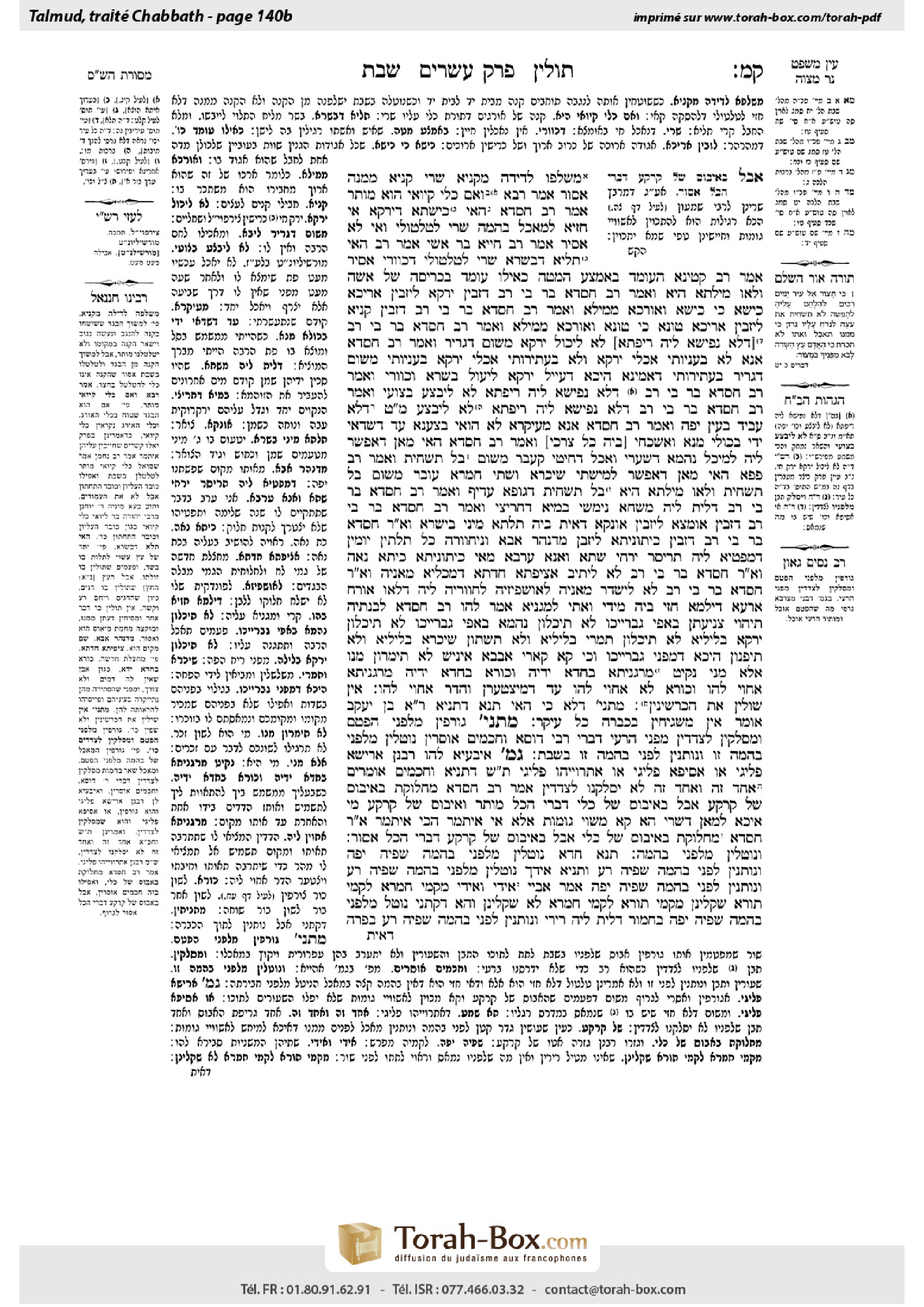
Shabbat 140b: Talmud study for Daf Yomi
Daf Yomi is the daily study of one Talmud folio. Explore 37 tractates with scans, Hebrew text, Sefaria English and AI-generated French translations where annotated.
Passage selection and English or AI-generated French translation are available where the scan has annotations. Daf Study is independent of Torah-Box and Sefaria.
Browse Shabbat · שבת · All tractatesShabbat 140b text and translations
This page of Shabbat includes the Aramaic text, an English translation and an AI-generated French translation, alongside the scan above.
שבת ק״מ ב · Aramaic and Hebrew text
מִשְׁלְפָא לְדִידַהּ מִקַּנְיָא — שְׁרֵי, קַנְיָא מִינַּהּ — אֲסִיר. אָמַר רָבָא: וְאִם כְּלִי קִיוָּאֵי הוּא — מוּתָּר.
אָמַר רַב חִסְדָּא: הַאי כִּישְׁתָּא דְיַרְקָא, אִי חַזְיָא לְמַאֲכַל בְּהֵמָה — שְׁרֵי לְטַלְטוֹלַהּ, וְאִי לָא — אֲסִיר.
אָמַר רַב חִיָּיא בַּר אָשֵׁי אָמַר רַב: הַאי תַּלְיָא, דְבִשְׂרָא — שְׁרֵי לְטַלְטוֹלֵהּ, דְּכַוְורֵי — אֲסִיר.
אָמַר רַב קַטִּינָא: הָעוֹמֵד בָּאֶמְצַע הַמִּטָּה, כְּאִילּוּ עוֹמֵד בִּכְרֵיסָהּ שֶׁל אִשָּׁה. וְלָאו מִילְּתָא הִיא.
וְאָמַר רַב חִסְדָּא: בַּר בֵּי רַב דְּזָבֵין יַרְקָא — לִיזְבֵּין אֲרִיכָא, כִּישָּׁא כִּי כִישָּׁא, וְאוּרְכָּא מִמֵּילָא.
וְאָמַר רַב חִסְדָּא: בַּר בֵּי רַב דְּזָבֵין קַנְיָא — לִיזְבֵּין אֲרִיכָא, טוּנָא כִּי טוּנָא, וְאוּרְכָּא מִמֵּילָא.
וְאָמַר רַב חִסְדָּא: בַּר בֵּי רַב [דְּלָא נְפִישָׁא לֵיהּ רִיפְתָּא] — לָא לֵיכוֹל יַרְקָא, מִשּׁוּם דְּגָרֵיר. וְאָמַר רַב חִסְדָּא: אֲנָא לָא בַּעֲנִיּוּתִי אֲכַלִי יַרְקָא, וְלָא בְּעַתִּירוּתִי אֲכַלִי יַרְקָא. בַּעֲנִיּוּתִי — מִשּׁוּם דְּגָרֵיר. בְּעַתִּירוּתִי — דְּאָמֵינָא: הֵיכָא דְּעָיֵיל יַרְקָא, לֵיעוּל בִּשְׂרָא וְכַוְורֵי.
וְאָמַר רַב חִסְדָּא: בַּר בֵּי רַב דְּלָא נְפִישָׁא לֵיהּ רִיפְתָּא — לָא לִיבְצַע בַּצּוֹעֵי. (וְאָמַר רַב חִסְדָּא: בַּר בֵּי רַב דְּלָא נְפִישָׁא לֵיהּ רִיפְתָּא — לָא לִיבְצַע. מַאי טַעְמָא? — דְּלָא עָבֵיד בְּעַיִן יָפָה.) וְאָמַר רַב חִסְדָּא: אֲנָא מֵעִיקָּרָא לָא הֲוַאי בָּצַעְנָא עַד דִּשְׁדַאי יָדִי בְּכוּלֵּי מָנָא, וְאַשְׁכַּחִי [בֵּיהּ כׇּל צֻרְכִּי].
וְאָמַר רַב חִסְדָּא: הַאי מַאן דְּאֶפְשָׁר לֵיהּ לְמֵיכַל נַהֲמָא דִשְׂעָרֵי וְאָכַל דְּחִיטֵּי קָעָבַר מִשּׁוּם ״בַּל תַּשְׁחִית״. וְאָמַר רַב פָּפָּא: הַאי מַאן דְּאֶפְשָׁר לְמִישְׁתֵּי שִׁיכְרָא וְשָׁתֵי חַמְרָא — עוֹבֵר מִשּׁוּם ״בַּל תַּשְׁחִית״. וְלָאו מִילְּתָא הִיא — ״בַּל תַּשְׁחִית״ דְּגוּפָא עֲדִיף.
וְאָמַר רַב חִסְדָּא: בַּר בֵּי רַב דְּלֵית לֵיהּ מִשְׁחָא — נִימְשֵׁי בְּמַיָּא דַחֲרִיצִי.
וְאָמַר רַב חִסְדָּא: בַּר בֵּי רַב דְּזָבֵין אוּמְצָא — לִיזְבֵּין אוּנְקָא, דְּאִית בֵּיהּ תְּלָתָא מִינֵי בִישְׂרָא.
וְאָמַר רַב חִסְדָּא: בַּר בֵּי רַב דְּזָבֵין כִּיתּוֹנִיתָא — לִיזְבַּן מִדִּנְהַר אַבָּא, וְנִיחַוְּורַהּ כֹּל תְּלָתִין יוֹמִין, דִּמְפַטְּיָא לֵיהּ תְּרֵיסַר יַרְחֵי שַׁתָּא, וַאֲנָא עָרְבָא. מַאי ״כִּיתּוֹנִיתָא״? — כִּיתָּא נָאָה.
וְאָמַר רַב חִסְדָּא: בַּר בֵּי רַב לָא לִיתִּיב אַצִּיפְּתָא חַדְתָּא, דִּמְכַלְּיָא מָאנֵיהּ.
וְאָמַר רַב חִסְדָּא: בַּר בֵּי רַב לָא לִישַׁדַּר מָאנֵיהּ לְאוּשְׁפִּיזֵיהּ לְחַוּוֹרֵיהּ לֵיהּ, דְּלָאו אוֹרַח אַרְעָא, דִּילְמָא חָזֵי בֵּיהּ מִידֵּי וְאָתֵי לְמִגַּנְּיָא.
אֲמַר לְהוּ רַב חִסְדָּא לִבְנָתֵיהּ: תִּיהְוְיָין צְנִיעָן בְּאַפֵּי גַּבְרַיְיכוּ, לָא תֵּיכְלוּן נַהֲמָא בְּאַפֵּי גַבְרַיְיכוּ.
לָא תֵּיכְלוּן יַרְקָא בְּלֵילְיָא, לָא תֵּיכְלוּן תַּמְרֵי בְּלֵילְיָא, וְלָא תִּשְׁתּוֹן שִׁיכְרָא בְּלֵילְיָא, וְלָא תִּיפְּנוֹן הֵיכָא דְּמִפְּנוּ גַּבְרַיְיכוּ.
וְכִי קָא קָארֵי אִינִישׁ אַבָּבָא — לָא תֵּימְרוּן ״מַנּוּ״, אֶלָּא ״מַנִּי״.
נָקֵיט מַרְגָּנִיתָא בַּחֲדָא יְדֵיהּ וְכוּרָא בַּחֲדָא יְדֵיהּ. מַרְגָּנִיתָא — אַחְוִי לְהוּ, וְכוּרָא — לָא אַחְוִי לְהוּ עַד דְּמִיצְטַעֲרָן, וַהֲדַר אַחְוִי לְהוּ.
אֵין שׁוֹלִין אֶת הַכַּרְשִׁינִין. מַתְנִיתִין דְּלָא כִי הַאי תַּנָּא, דְּתַנְיָא, רַבִּי אֱלִיעֶזֶר בֶּן יַעֲקֹב אוֹמֵר: אֵין מַשְׁגִּיחִין בַּכְּבָרָה כׇּל עִיקָּר.
מַתְנִי׳ גּוֹרְפִין מִלִּפְנֵי הַפַּטָּם וּמְסַלְּקִין לִצְדָדִין מִפְּנֵי הָרְעִי, דִּבְרֵי רַבִּי דּוֹסָא, וַחֲכָמִים אוֹסְרִין. נוֹטְלִין מִלִּפְנֵי בְּהֵמָה זוֹ וְנוֹתְנִין לִפְנֵי בְּהֵמָה זוֹ בְּשַׁבָּת.
גְּמָ׳ אִיבַּעְיָא לְהוּ: רַבָּנַן אַרֵישָׁא פְּלִיגִי, אוֹ אַסֵּיפָא פְּלִיגִי, אוֹ אַתַּרְוַיְיהוּ פְּלִיגִי?
תָּא שְׁמַע, דְּתַנְיָא: וַחֲכָמִים אוֹמְרִים אֶחָד זֶה וְאֶחָד זֶה — לֹא יְסַלְּקֶנּוּ לִצְדָדִין.
אָמַר רַב חִסְדָּא: מַחֲלוֹקֶת בְּאֵיבוּס שֶׁל קַרְקַע, אֲבָל בְּאֵיבוּס שֶׁל כְּלִי — דִּבְרֵי הַכֹּל מוּתָּר. וְאֵיבוּס שֶׁל קַרְקַע מִי אִיכָּא לְמַאן דְּשָׁרֵי?! הָא קָא מַשְׁוֵי גּוּמּוֹת! אֶלָּא, אִי אִיתְּמַר הָכִי אִיתְּמַר: אָמַר רַב חִסְדָּא מַחֲלוֹקֶת בְּאֵיבוּס שֶׁל כְּלִי, אֲבָל בְּאֵיבוּס שֶׁל קַרְקַע — דִּבְרֵי הַכֹּל אָסוּר.
וְנוֹטְלִין מִלִּפְנֵי בְּהֵמָה. תְּנָא חֲדָא: נוֹטְלִין מִלִּפְנֵי בְּהֵמָה שֶׁפִּיהָ יָפֶה וְנוֹתְנִין לִפְנֵי בְּהֵמָה שֶׁפִּיהָ רַע. וְתַנְיָא אִידַּךְ: נוֹטְלִין מִלִּפְנֵי בְּהֵמָה שֶׁפִּיהָ רַע וְנוֹתְנִין לִפְנֵי בְּהֵמָה שֶׁפִּיהָ יָפֶה!
אָמַר אַבָּיֵי: אִידֵּי וְאִידֵּי מִקַּמֵּי חַמְרָא לְקַמֵּי תוֹרָא — שָׁקְלִינַן, מִקַּמֵּי תוֹרָא לְקַמֵּי חַמְרָא — לָא שָׁקְלִינַן. וְהָא דְּקָתָנֵי ״נוֹטֵל מִלִּפְנֵי בְּהֵמָה שֶׁפִּיהָ יָפֶה״ — בַּחֲמוֹר, דְּלֵית לֵיהּ רִירֵי. ״וְנוֹתְנִין לִפְנֵי בְּהֵמָה שֶׁפִּיהָ רַע״ — בְּפָרָה,
Shabbat 140b · English translation
to remove it from the reed upon which it is hanging is permitted; however, to remove the reed from it is prohibited. Since the reed is not a vessel, it is set-aside. Rava said: And if it is hung on a weaver’s vessel, it is permitted to remove the vessel as well. Although its primary function is for a prohibited labor, since it is a vessel, it may be moved.
Rav Ḥisda said: This bundle of vegetables, if it is suitable for animal food, it is permitted to move it on Shabbat, but if not, it is prohibited to move it.
Rav Ḥiyya bar Ashi said that Rav said as follows: In the case of this hook, if it is used for hanging meat, it is permitted to move it, as it is also suitable for other uses. However, if it is a hook for hanging fish, it is prohibited to move it, because it smells bad (Rabbeinu Ḥananel) and is used exclusively for fish.
Rav Ketina said: One who stands on a board in the middle of a bed, it is as though he were standing on the stomach of a woman. Just as he would certainly injure the woman, he will certainly break the bed (ge’onim). The Gemara comments: And it is not a correct matter, and it is not accepted as halakha.
On the topic of the bundle of vegetables, the Gemara cites additional advice on similar issues that Rav Ḥisda said to poor scholars experiencing difficulty earning a livelihood: A student of a Torah academy who buys vegetables should buy long ones. A bundle is a bundle, and they have a standard thickness at a standard price. However, the addition of length comes on its own for free.
And Rav Ḥisda also said: A student of a Torah academy who buys reeds should buy long ones, since a bundle is a bundle. Bundles of reeds have a standard thickness, but the length comes on its own for free.
And Rav Ḥisda further said: A student of a Torah academy who does not have much bread should not eat a vegetable, because it whets the appetite. And Rav Ḥisda said: I neither ate a vegetable in my state of poverty, nor did I eat a vegetable in my state of wealth. In my poverty, I did not eat a vegetable because it whets the appetite. In my wealth, I did not eat a vegetable because I said: Where a vegetable enters, let meat and fish enter instead.
And Rav Ḥisda said: A student of a Torah academy who does not have much bread should not cut it into thin slices; rather, he should eat what he has in one helping. And Rav Ḥisda said: A student of a Torah academy who does not have much bread should not break it for guests. What is the reason? As he will not do so in a generous manner. And Rav Ḥisda said: Originally, I would not break bread until I placed my hand in the entire dish to assure that I found that there was enough bread to meet my needs.
And Rav Ḥisda also said: One who is able to eat barley bread and nevertheless eats wheat bread violates the prohibition against wanton destruction. One who wastes resources is comparable to one who destroys items of value. And Rav Pappa said: One who is able to drink beer and nevertheless drinks wine violates the prohibition against wanton destruction. The Gemara comments: And this is not a correct matter, as the prohibition against destruction of one’s body takes precedence. It is preferable for one to care for his body by eating higher quality food than to conserve his money.
And Rav Ḥisda said: A student of a Torah academy who has no oil should wash, i.e., smear himself, with ditch water, as the scum that accumulates in it is as useful as oil.
And Rav Ḥisda said: A student of a Torah academy who buys meat should buy from the neck [unka], as there are three types of meat there.
And Rav Ḥisda said: A student of a Torah academy who buys a linen shirt [kitonita] should buy it from those who work by the river Abba, and should wash it every thirty days, so that it will last him for the twelve months of the year. And I guarantee that the shirt will remain in good shape. The Gemara comments: What is the meaning of kitonita? A fine class [kita], as fine clothing provide one entry into a well-dressed class of people.
And Rav Ḥisda said: A student of a Torah academy should not sit on a new mat, as its dampness ruins his garments.
And Rav Ḥisda said: A student of a Torah academy should not give his clothes to his host to wash for him, as that is not proper behavior, for the host might see something on it, such as signs of a seminal emission, and he will be demeaned in the eyes of his host.
After citing Rav Ḥisda’s recommendations to students, the Gemara cites his advice to his daughters. Rav Ḥisda said to his daughters: Be modest before your husbands; do not eat bread before your husbands, lest you eat too much and be demeaned in their eyes.
Similarly, he advised: Do not eat vegetables at night, as vegetables cause bad breath. Do not eat dates at night and do not drink beer at night, as these loosen the bowels. And do not relieve yourself in the place where your husbands relieve themselves, so that they will not be revolted by you.
And when a person calls at the door seeking to enter, do not say: Who is it, in the masculine form, but rather: Who is it, in the feminine form. Avoid creating the impression that you have dealings with other men.
In order to demonstrate the value of modesty to his daughters, Rav Ḥisda held a pearl in one hand and a clod of earth in the other. The pearl he showed them immediately, and the clod of earth, he did not show them until they were upset due to their curiosity, and then he showed it to them. This taught them that a concealed object is more attractive than one on display, even if it is less valuable.
We learned in the mishna: One may not soak vetches in water in order to separate them from their chaff. However, one may take the straw in a sieve and place it into the trough of an animal. The Gemara comments: The mishna is not in accordance with the opinion of this tanna, as it was taught in a baraita: Rabbi Eliezer ben Ya’akov says: One may not look at a sieve at all on Shabbat, lest one come to violate the prohibited labor of selecting.
MISHNA: One may sweep hay from before an animal that is being fattened, and one may move hay to the sides for an animal that grazes on its own in the field (Rabbeinu Ḥananel); this is the statement of Rabbi Dosa. And the Rabbis prohibit doing so. One may take hay from before this animal and place it before that animal on Shabbat.
GEMARA: A dilemma was raised before the Sages: Do the Rabbis, who are stringent, disagree with the first clause of Rabbi Dosa’s statement, or do they disagree with the latter clause of the mishna, or do they disagree with both clauses?
Come and hear a resolution from that which was taught in a baraita. And the Rabbis say: With regard to both this, hay placed before an animal set aside for fattening, and that, hay placed before an animal that grazes on its own, one may not move it to the sides. Apparently, the Rabbis rule stringently in both cases.
Rav Ḥisda said: This dispute is with regard to a trough formed in the ground; however, with regard to a trough which is a vessel, everyone agrees that it is permitted. The Gemara expresses surprise: Is there anyone who permits doing so in a trough formed in the ground? Isn’t one leveling holes and thereby performing the prohibited labors of building or plowing? Rather, if it was stated, it was stated as follows: Rav Ḥisda said: This dispute applies only to a trough that is a vessel; however, with regard to a trough formed in the ground, everyone agrees that it is prohibited, due to the concern lest one level holes.
We also learned in the mishna: One may take hay from before this animal and place it before that animal. It was taught in one baraita: One may take hay from before an animal whose mouth is fine and place it before an animal whose mouth is foul. And it was taught in another baraita: One may take hay from before an animal whose mouth is foul and place it in front of an animal whose mouth is fine. There is an apparent contradiction between the two baraitot.
Abaye said: Both this baraita and that baraita hold that one may take hay from before a donkey and place it before an ox. However, one may not take hay from before an ox and place it before a donkey. The formulation of the baraitot can be explained as follows: That which was taught: One may take hay from before an animal whose mouth is fine, is referring to a donkey, and the reason the baraita says its mouth is fine is because it has no spittle. Therefore, the donkey does not dampen the remaining hay with its saliva. And the statement: And one may place it before an animal whose mouth is foul, is referring to a cow,
Shabbat 140b · Traduction française (IA)
Il est permis de le retirer du roseau auquel il est suspendu ; en revanche, il est interdit de retirer le roseau de l’objet. Puisque le roseau n’est pas un ustensile, il est mouktsé. Rava dit : s’il est suspendu à un ustensile de tisserand, il est également permis de déplacer l’ustensile. Bien que sa fonction principale soit liée à un travail interdit, puisqu’il s’agit d’un ustensile, on peut le déplacer.
Rav Ḥisda dit : ce fagot de légumes, s’il convient à l’alimentation des animaux, il est permis de le déplacer pendant Chabbat ; sinon, il est interdit de le déplacer.
Rav Ḥiyya bar Ashi dit au nom de Rav : dans le cas de ce crochet, s’il sert à suspendre de la viande, il est permis de le déplacer, car il convient aussi à d’autres usages. En revanche, s’il s’agit d’un crochet destiné à suspendre du poisson, il est interdit de le déplacer, car il dégage une mauvaise odeur (Rabbeinu Ḥananel) et ne sert qu’au poisson.
Rav Ketina dit : celui qui se tient sur une planche placée au milieu d’un lit, c’est comme s’il se tenait sur le ventre d’une femme. De même qu’il blesserait certainement cette femme, il briserait certainement le lit (ge’onim). La Guemara commente : cette affirmation n’est pas juste et n’est pas retenue comme halakha.
À propos du fagot de légumes, la Guemara rapporte d’autres conseils que Rav Ḥisda donnait aux érudits pauvres qui peinaient à gagner leur vie sur des sujets similaires : un étudiant d’une académie de Torah qui achète des légumes devrait en choisir de longs. Un fagot reste un fagot, et son épaisseur est standard pour un prix standard. En revanche, la longueur supplémentaire est offerte gratuitement.
Rav Ḥisda dit aussi : un étudiant d’une académie de Torah qui achète des roseaux devrait en choisir de longs, car un fagot reste un fagot. Les fagots de roseaux ont une épaisseur standard, mais la longueur supplémentaire est offerte gratuitement.
Rav Ḥisda dit encore : un étudiant d’une académie de Torah qui n’a pas beaucoup de pain ne devrait pas manger de légumes, car cela ouvre l’appétit. Rav Ḥisda dit aussi : je n’ai mangé de légumes ni lorsque j’étais pauvre ni lorsque j’étais riche. Dans ma pauvreté, je n’en mangeais pas parce que cela ouvre l’appétit. Dans ma richesse, je n’en mangeais pas parce que je me disais : là où pourrait entrer un légume, que la viande et le poisson entrent à sa place.
Rav Ḥisda dit aussi : un étudiant d’une académie de Torah qui n’a pas beaucoup de pain ne devrait pas le couper en fines tranches ; il devrait plutôt manger en une seule fois ce qu’il a. Rav Ḥisda dit encore : un étudiant d’une académie de Torah qui n’a pas beaucoup de pain ne devrait pas en rompre pour des invités. Pourquoi ? Parce qu’il ne le ferait pas généreusement. Rav Ḥisda dit aussi : au début, je ne rompais pas le pain avant d’avoir plongé la main dans tout le plat pour m’assurer qu’il y avait assez de pain pour répondre à mes besoins.
Rav Ḥisda dit aussi : celui qui peut manger du pain d’orge, mais mange néanmoins du pain de blé, enfreint l’interdit du gaspillage délibéré. Celui qui gaspille des ressources est comparable à celui qui détruit des objets de valeur. Rav Pappa dit : celui qui peut boire de la bière, mais boit néanmoins du vin, enfreint l’interdit du gaspillage délibéré. La Guemara commente : cette affirmation n’est pas juste, car l’interdit de porter atteinte à son propre corps prime. Il vaut mieux prendre soin de son corps en mangeant des aliments de meilleure qualité que préserver son argent.
Rav Ḥisda dit : un étudiant d’une académie de Torah qui n’a pas d’huile devrait se laver, c’est-à-dire s’enduire, avec l’eau d’un fossé, car l’écume qui s’y accumule est aussi utile que l’huile.
Rav Ḥisda dit : un étudiant d’une académie de Torah qui achète de la viande devrait en acheter dans le cou [unka], car on y trouve trois sortes de viande.
Rav Ḥisda dit : un étudiant d’une académie de Torah qui achète une chemise de lin [kitonita] devrait l’acheter auprès de ceux qui travaillent près du fleuve Abba et la laver tous les trente jours, afin qu’elle lui dure les douze mois de l’année. Je te garantis qu’elle restera en bon état. La Guemara commente : que signifie kitonita ? Une classe raffinée [kita], car des vêtements raffinés permettent d’accéder à une classe de gens bien habillés.
Rav Ḥisda dit : un étudiant d’une académie de Torah ne devrait pas s’asseoir sur une natte neuve, car son humidité abîme ses vêtements.
Rav Ḥisda dit : un étudiant d’une académie de Torah ne devrait pas confier ses vêtements à son hôte pour qu’il les lave, car cela ne convient pas. L’hôte pourrait y voir quelque chose, comme des traces d’émission séminale, et l’étudiant serait déconsidéré à ses yeux.
Après avoir rapporté les recommandations de Rav Ḥisda aux étudiants, la Guemara cite ses conseils à ses filles. Rav Ḥisda dit à ses filles : soyez pudiques devant vos maris ; ne mangez pas de pain avant eux, de peur de trop manger et d’être déconsidérées à leurs yeux.
Il leur conseilla également : ne mangez pas de légumes le soir, car ils donnent mauvaise haleine. Ne mangez pas de dattes le soir et ne buvez pas de bière le soir, car elles relâchent les intestins. Ne vous soulagez pas non plus à l’endroit où vos maris se soulagent, afin qu’ils ne soient pas dégoûtés par vous.
Et lorsqu’une personne frappe à la porte pour entrer, ne demandez pas : « Qui est-ce ? » au masculin, mais plutôt : « Qui est-ce ? » au féminin. Évitez de donner l’impression que vous avez des relations avec d’autres hommes.
Pour montrer à ses filles la valeur de la pudeur, Rav Ḥisda tint une perle dans une main et une motte de terre dans l’autre. Il leur montra immédiatement la perle, mais ne leur montra la motte de terre qu’après qu’elles eurent été contrariées par leur curiosité ; alors, il la leur montra. Il leur enseigna ainsi qu’un objet caché est plus attirant qu’un objet exposé, même s’il a moins de valeur.
Nous avons appris dans la Michna : on ne peut pas faire tremper des vesces dans l’eau afin de les séparer de leur balle. Toutefois, on peut prendre la paille dans un tamis et la placer dans l’auge d’un animal. La Guemara commente : la Michna ne suit pas l’opinion de ce tanna, car il a été enseigné dans une baraïta : Rabbi Eliezer ben Ya’akov dit : on ne doit même pas regarder un tamis pendant Chabbat, de peur d’en venir à enfreindre le travail interdit de trier.
MICHNA : On peut balayer le foin qui se trouve devant un animal qu’on engraisse, et déplacer le foin sur les côtés pour un animal qui paît seul dans le champ (Rabbeinu Ḥananel) ; telle est l’opinion de Rabbi Dosa. Les Sages l’interdisent. On peut prendre le foin qui se trouve devant cet animal et le placer devant cet autre animal pendant Chabbat.
GUEMARA : Une question fut posée aux Sages : les Sages, qui sont rigoureux, sont-ils en désaccord avec la première partie de la déclaration de Rabbi Dosa, avec la dernière partie de la Michna, ou avec les deux ?
Viens et entends une réponse tirée de ce qui a été enseigné dans une baraïta. Les Sages disent : dans les deux cas, qu’il s’agisse du foin placé devant un animal destiné à être engraissé ou du foin placé devant un animal qui paît seul, on ne peut pas le déplacer sur les côtés. Il apparaît donc que les Sages statuent avec rigueur dans les deux cas.
Rav Ḥisda dit : cette controverse concerne une auge creusée dans le sol ; en revanche, pour une auge qui est un ustensile, tous conviennent que c’est permis. La Guemara s’étonne : quelqu’un permettrait-il de le faire dans une auge creusée dans le sol ? Ne nivelle-t-on pas des trous, accomplissant ainsi les travaux interdits de construire ou de labourer ? Si cette opinion a été énoncée, elle l’a été ainsi : Rav Ḥisda dit que cette controverse ne concerne qu’une auge qui est un ustensile ; en revanche, pour une auge creusée dans le sol, tous conviennent que c’est interdit, par crainte qu’on ne nivelle des trous.
Nous avons également appris dans la Michna : on peut prendre le foin qui se trouve devant cet animal et le placer devant cet autre animal. Une baraïta enseigne : on peut prendre le foin devant un animal dont la bouche est propre et le placer devant un animal dont la bouche est sale. Une autre baraïta enseigne : on peut prendre le foin devant un animal dont la bouche est sale et le placer devant un animal dont la bouche est propre. Il y a une contradiction apparente entre les deux baraïtot.
Abaye dit : les deux baraïtot, celle-ci comme celle-là, soutiennent qu’on peut prendre le foin devant un âne et le placer devant un bœuf. En revanche, on ne peut pas prendre le foin devant un bœuf et le placer devant un âne. On peut expliquer ainsi la formulation des baraïtot : l’enseignement selon lequel on peut prendre le foin devant un animal dont la bouche est propre concerne un âne ; la baraïta précise que sa bouche est propre parce qu’il n’a pas de salive. L’âne n’humidifie donc pas le foin restant avec sa salive. Quant à l’énoncé : « et on peut le placer devant un animal dont la bouche est sale », il concerne une vache,
Traduction française générée par IA à partir de l’édition anglaise de Sefaria. Vérifie toujours un passage avec le texte source.
Text from Sefaria: William Davidson Edition - Vocalized Aramaic (CC BY NC); William Davidson Edition - English (CC BY NC).