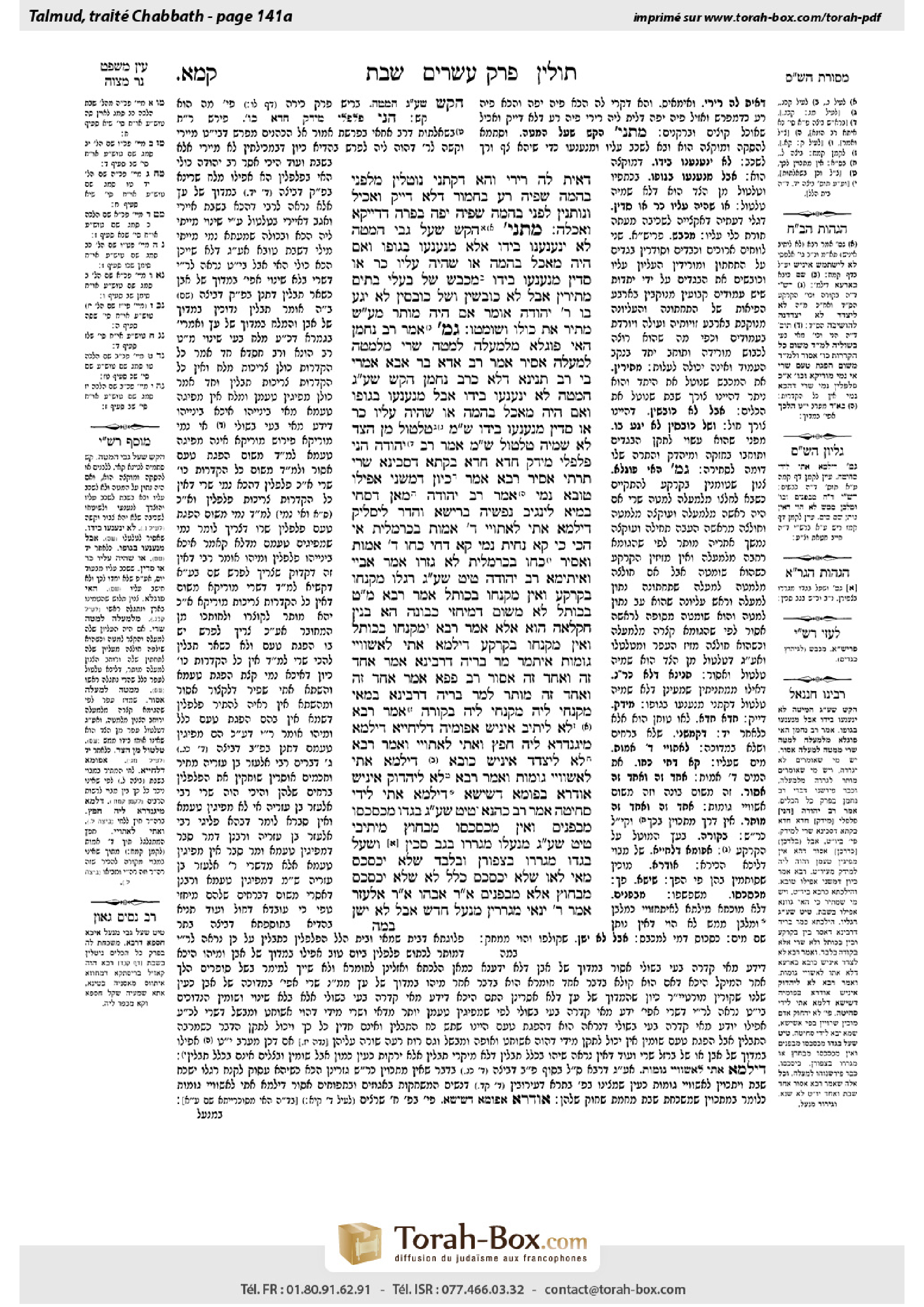
Shabbat 141a: Talmud study for Daf Yomi
Daf Yomi is the daily study of one Talmud folio. Explore 37 tractates with scans, Hebrew text, Sefaria English and AI-generated French translations where annotated.
Passage selection and English or AI-generated French translation are available where the scan has annotations. Daf Study is independent of Torah-Box and Sefaria.
Browse Shabbat · שבת · All tractatesShabbat 141a text and translations
This page of Shabbat includes the Aramaic text, an English translation and an AI-generated French translation, alongside the scan above.
שבת קמ״א א · Aramaic and Hebrew text
דְּאִית לַהּ רִירֵי.
וְהָא דְּקָתָנֵי ״נוֹטְלִין מִלִּפְנֵי בְּהֵמָה שֶׁפִּיהָ רַע״ — בַּחֲמוֹר, דְּלָא דָּיֵיק וְאָכֵיל. ״וְנוֹתְנִין לִפְנֵי בְּהֵמָה שֶׁפִּיהָ יָפֶה״ — בְּפָרָה, דְּדָיְיקָא וְאָכְלָה.
מַתְנִי׳ הַקַּשׁ שֶׁעַל גַּבֵּי הַמִּטָּה — לֹא יְנַעְנְעֶנּוּ בְּיָדוֹ, אֶלָּא מְנַעַנְעוֹ בְּגוּפוֹ. וְאִם הָיָה מַאֲכַל בְּהֵמָה, אוֹ שֶׁהָיָה עָלָיו כַּר אוֹ סָדִין — מְנַעַנְעוֹ בְּיָדוֹ.
מַכְבֵּשׁ שֶׁל בַּעֲלֵי בָתִּים — מַתִּירִין, אֲבָל לֹא כּוֹבְשִׁין. וְשֶׁל כּוֹבְסִין — לֹא יִגַּע בּוֹ. רַבִּי יְהוּדָה אוֹמֵר: אִם הָיָה מוּתָּר מֵעֶרֶב שַׁבָּת — מַתִּיר אֶת כּוּלּוֹ וְשׁוֹמְטוֹ.
גְּמָ׳ אָמַר רַב נַחְמָן: הַאי פּוּגְלָא, מִלְּמַעְלָה לְמַטָּה — שְׁרֵי. מִלְּמַטָּה לְמַעְלָה — אֲסִיר.
אָמַר רַב אַדָּא בַּר אַבָּא, אָמְרִי בֵּי רַב: תְּנֵינָא דְּלָא כְּרַב נַחְמָן. הַקַּשׁ שֶׁעַל גַּבֵּי הַמִּטָּה — לֹא יְנַעַנְעֶנּוּ בְּיָדוֹ, אֲבָל מְנַעַנְעוֹ בְּגוּפוֹ. וְאִם הָיָה מַאֲכַל בְּהֵמָה, אוֹ שֶׁהָיָה עָלָיו כַּר אוֹ סָדִין — מְנַעַנְעוֹ בְּיָדוֹ. שְׁמַע מִינַּהּ טִלְטוּל מִן הַצַּד — לָא שְׁמֵיהּ טִלְטוּל. שְׁמַע מִינַּהּ.
אָמַר רַב יְהוּדָה: הָנֵי פִּלְפְּלֵי, מֵידַק חֲדָא חֲדָא בְּקַתָּא דְסַכִּינָא — שְׁרֵי, תַּרְתֵּי — אֲסִיר. רָבָא אָמַר: כֵּיוָן דִּמְשַׁנֵּי — אֲפִילּוּ טוּבָא נָמֵי.
אָמַר רַב יְהוּדָה: מַאן דְּסָחֵי בְּמַיָּא — לִינַגֵּיב נַפְשֵׁיהּ בְּרֵישָׁא וַהֲדַר לִיסְלֵיק, דִילְמָא אָתֵי לְאֵתוֹיֵי אַרְבַּע אַמּוֹת בְּכַרְמְלִית.
אִי הָכִי, כִּי קָא נָחֵית נָמֵי, קָא דָּחֵי כֹּחוֹ אַרְבַּע אַמּוֹת, וַאֲסִיר! כֹּחוֹ בְּכַרְמְלִית — לָא גְזַרוּ.
אָמַר אַבָּיֵי, וְאִיתֵּימָא רַב יְהוּדָה: טִיט שֶׁעַל גַּבֵּי רַגְלוֹ — מְקַנְּחוֹ בַּקַּרְקַע, וְאֵין מְקַנְּחוֹ בַּכּוֹתֶל.
אָמַר רָבָא: מַאי טַעְמָא בַּכּוֹתֶל לָא, מִשּׁוּם דְּמֶיחְזֵי כְּבוֹנֶה? הָא בִּנְיָן חַקְלָאָה הוּא!
אֶלָּא אָמַר רָבָא: מְקַנְּחוֹ בַּכּוֹתֶל וְאֵין מְקַנְּחוֹ בַּקַּרְקַע — דִּילְמָא אָתֵי לְאַשְׁווֹיֵי גּוּמּוֹת.
אִיתְּמַר. מָר בְּרֵיהּ דְּרָבִינָא אָמַר: אֶחָד זֶה וְאֶחָד זֶה — אָסוּר. רַב פָּפָּא אָמַר: אֶחָד זֶה וְאֶחָד זֶה — מוּתָּר.
לְמָר בְּרֵיהּ דְּרָבִינָא בְּמַאי מְקַנְּחִי לֵיהּ? מְקַנְּחִי לֵיהּ בְּקוֹרָה.
אָמַר רָבָא: לָא לִיתִּיב אִינִישׁ אַפּוּמֵּיהּ דְּלִיחְיָיא, דִילְמָא מִיגַּנְדְּרָא לֵיהּ חֵפֶץ וְאָתֵי לְאֵתוֹיֵי.
וְאָמַר רָבָא: לָא לִיצַדֵּד אִינִישׁ כּוּבָּא, דִּילְמָא אָתֵי לְאַשְׁווֹיֵי גּוּמּוֹת.
וְאָמַר רָבָא: לָא לִיהַדֵּק אִינִישׁ אוּדְרָא בְּפוּמָּא דְשִׁישָׁא, דִילְמָא אָתֵי לִידֵי סְחִיטָה.
אָמַר רַב כָּהֲנָא: טִיט שֶׁעַל גַּבֵּי בִּגְדּוֹ — מְכַסְכְּסוֹ מִבִּפְנִים וְאֵין מְכַסְכְּסוֹ מִבַּחוּץ.
מֵיתִיבִי: טִיט שֶׁעַל גַּבֵּי מִנְעָלוֹ — מְגָרְרוֹ בְּגַב סַכִּין, וְשֶׁעַל בִּגְדּוֹ — מְגָרְרוֹ בְּצִפּוֹרֶן, וּבִלְבַד שֶׁלֹּא יְכַסְכֵּס. מַאי לָאו, שֶׁלֹּא יְכַסְכֵּס כְּלָל! לָא שֶׁלֹּא יְכַסְכֵּס מִבַּחוּץ, אֶלָּא מִבִּפְנִים.
אָמַר רַבִּי אֲבָהוּ אָמַר רַבִּי אֶלְעָזָר אָמַר רַבִּי יַנַּאי: מְגָרְרִין מִנְעָל חָדָשׁ, אֲבָל לֹא יָשָׁן.
Shabbat 141a · English translation
which has spittle.
And that which was taught in the other baraita: One may take hay from before an animal whose mouth is foul, is referring to a donkey. Its mouth is foul because it does not discern between different foods and it eats everything. And the statement: One may place it before an animal whose mouth is fine, is referring to a cow, which discerns between different foods and only then it eats.
MISHNA: With regard to straw that is on top of a bed, if a person wishes to lie on it, he may not move it with his hand to smooth it, as the straw is set aside for kindling; rather, he may move it with his body. Since moving straw with one’s body is not the usual manner, it is permitted. And if the straw was designated as animal food, or a pillow or sheet was on it, which would clearly indicate that the straw was placed on the bed so one could sleep on it, the straw is not considered set-aside, and one may move it even with his hand.
A press which belongs to a homeowner, one may loosen it on Shabbat. This press is used to dry and press clothing after laundering. One loosens it to remove clothing from it. However, one may not press clothing with it on Shabbat. And in the case of a press that belongs to a launderer, which is made specifically for pressing and requires professional expertise for its operation, one may not touch it. Rabbi Yehuda says: If the launderer’s press was loosened somewhat on Shabbat eve, he may loosen it completely on Shabbat and remove the garment.
GEMARA: With regard to moving items that are set aside, the Gemara cites that which Rav Naḥman said: This radish, which was buried in the earth, if it was buried from top to bottom, with its wide end at the top and its narrow end at the bottom, it is permitted to remove it on Shabbat. When the radish is buried in that manner, one does not move the earth when he removes the radish. However, if the radish was buried in the earth from bottom to top, with the wide end at the bottom, it is prohibited.
Rav Adda bar Abba said: They say in the school of Rav: We already learned in the mishna that the halakha is not in accordance with the opinion of Rav Naḥman: With regard to straw on top of a bed, one may not move it with his hand, but he may move it with his body. And if it is animal food, or a pillow or sheet is on it, he may move it even with his hand. Conclude from here that moving an item in an atypical manner is not considered moving. The Gemara concludes: Indeed, conclude from here that this is indeed the case.
The Gemara cites a somewhat similar case. Rav Yehuda said: In the case of these peppers, crushing them one by one with the handle of a knife is permitted. However, crushing two at a time is prohibited, because it appears to be a prohibited labor. Rava said: Since he alters the manner in which he performs this activity, even crushing many at a time is also permitted.
Rav Yehuda also said: One who bathes in water should first dry himself immediately upon exiting, and then ascend to the coast, lest he come to carry the remaining drops of water on his body four cubits in a karmelit.
The Gemara asks: If so, if there is a concern about carrying water, there should be concern when one descends into the water as well. In that case, his force propels water four cubits into the river, and it should be prohibited. The Gemara answers: With regard to movement that results from his force in a karmelit, the Sages did not issue a decree. Since one does not directly propel the water, but the water moves only as an extension of his motion, and since the river is a karmelit, and the prohibition to carry there is only a rabbinic law, the Sages did not issue a decree for one who descends into the water.
In a similar decree, Abaye said, and some say that it was stated by Rav Yehuda: If one has mud on his foot, he may wipe it on the ground on Shabbat, but he may not wipe it on a wall.
Rava said: What is the reason that he may not wipe it off on a wall? Is it because it appears like building, as he is adding plaster to the wall? That is the building of a field laborer, which is not an actual building. There is no concern in that case because in adding plaster to that building, one does not perform the prohibited labor of building.
Rather, Rava said: On the contrary, He may wipe it on a wall, but he may not wipe it on the ground. This is due to the concern lest one come to level holes in the ground while wiping his foot.
It is stated that other amora’im disputed this issue. Mar, son of Ravina, said: Both this, wiping the mud on a wall, and that, wiping the mud on the ground, are prohibited. Rav Pappa said: Both this and that are permitted.
The Gemara asks: According to the opinion of Mar, son of Ravina, with what may he wipe his foot? The Gemara answers: Even according to his opinion, there is a permitted manner to clean his foot; he wipes it on a beam on the ground.
Rava said: A person should not sit on Shabbat right at the entrance to a closed alleyway where a side post is placed as a symbolic partition enabling one to carry inside the alleyway. The reason for this is that perhaps an object will roll into the public domain and one will come to get it, as there is no conspicuous demarcation between inside and outside the alleyway.
And Rava also said a similar decree: A person may not position a barrel on a dirt floor, lest he come to level holes in the ground while smoothing the surface upon which he is positioning the barrel.
And furthermore, Rava said: A person may not stuff a rag into the mouth of a jug [shisha] on Shabbat, lest he come to violate the prohibition of squeezing liquid from the cloth.
Rav Kahana said: With regard to mortar that is on one’s garment on Shabbat, one may rub it off from the inside, but one may not rub it off from the outside, because that is comparable to the prohibited labor of laundering.
The Gemara raises an objection from that which we learned: With regard to mortar that is on one’s shoe, he may scrape it off with the back of a knife as a departure from the typical manner of scraping. And mortar which is on one’s clothes, he may scrape off with his fingernail, as long as he does not rub it. The Gemara asks: What, is it not saying that he may not rub it at all? The Gemara rejects that premise: No, it is saying that he may not rub it from the outside, rather from the inside.
Rabbi Abbahu said that Rabbi Elazar said that Rabbi Yannai said: One may scrape mud off of a new shoe on Shabbat, but not off of an old shoe, because a layer of the shoe will be removed, which constitutes the prohibited labor of smoothing.
Shabbat 141a · Traduction française (IA)
qui contient de la salive.
Et ce qui a été enseigné dans l’autre baraïta : « On peut prendre le foin placé devant un animal dont la bouche est sale » se rapporte à un âne. Sa bouche est sale parce qu’il ne distingue pas les différents aliments et mange de tout. Quant à l’affirmation : « On peut le placer devant un animal dont la bouche est propre », elle se rapporte à une vache, qui distingue les différents aliments et ne mange qu’ensuite.
MICHNA : À propos de la paille qui se trouve sur un lit, si quelqu’un souhaite s’y allonger, il ne peut pas la déplacer avec la main pour l’aplanir, car elle est réservée à servir de combustible ; il peut en revanche la déplacer avec son corps. Puisque déplacer de la paille avec son corps n’est pas la manière habituelle de le faire, cela est permis. Si la paille a été destinée à nourrir un animal, ou si un oreiller ou un drap a été posé dessus, ce qui indique clairement qu’elle a été placée sur le lit pour qu’on puisse dormir dessus, elle n’est pas considérée comme mouktsé et on peut la déplacer même avec la main.
On peut desserrer pendant Chabbat le pressoir d’un particulier. Ce pressoir sert à sécher et à presser les vêtements après leur lavage. On le desserre pour en retirer les vêtements. Toutefois, on ne peut pas y presser des vêtements pendant Chabbat. Quant au pressoir d’un blanchisseur, conçu spécialement pour presser et dont le maniement exige un savoir-faire professionnel, on ne peut pas y toucher. Rabbi Yehouda dit : Si le pressoir du blanchisseur a été quelque peu desserré la veille de Chabbat, il peut le desserrer complètement pendant Chabbat et retirer le vêtement.
GUEMARA : À propos du déplacement d’objets mouktsé, la Guemara rapporte ce que Rav Naḥman a dit : Ce radis enfoui dans la terre, s’il l’a été de haut en bas, avec son extrémité large en haut et son extrémité étroite en bas, on peut le retirer pendant Chabbat. Lorsqu’un radis est enfoui de cette manière, on ne déplace pas la terre en le retirant. En revanche, s’il a été enfoui de bas en haut, avec son extrémité large en bas, il est interdit de le retirer.
Rav Adda bar Abba a dit : On dit à l’école de Rav que nous avons déjà appris dans la Michna que la halakha ne suit pas l’avis de Rav Naḥman : à propos de la paille qui se trouve sur un lit, on ne peut pas la déplacer avec la main, mais on peut la déplacer avec son corps. Et si elle est destinée à nourrir un animal, ou si un oreiller ou un drap a été posé dessus, on peut la déplacer même avec la main. Déduis-en que déplacer un objet d’une manière inhabituelle n’est pas considéré comme un déplacement. La Guemara conclut : En effet, déduis-en que c’est bien le cas.
La Guemara cite un cas quelque peu similaire. Rav Yehouda a dit : Il est permis d’écraser ces poivres un par un avec le manche d’un couteau. En revanche, il est interdit d’en écraser deux à la fois, car cela donne l’apparence d’un travail interdit. Rava a dit : Puisqu’il modifie sa manière d’accomplir cette action, il est également permis d’en écraser plusieurs à la fois.
Rav Yehouda a également dit : Celui qui se baigne dans l’eau doit d’abord se sécher immédiatement en sortant, puis gagner la berge, de peur qu’il ne transporte les gouttes d’eau restantes sur son corps sur une distance de quatre coudées dans un karmelit.
La Guemara demande : Si tel est le cas, s’il y a lieu de craindre le transport d’eau, il devrait aussi y avoir lieu de le craindre lorsqu’on entre dans l’eau. Dans ce cas, la force de son mouvement propulse l’eau sur quatre coudées dans la rivière, et cela devrait être interdit. La Guemara répond : Les Sages n’ont pas décrété d’interdiction concernant un mouvement qui résulte de sa force dans un karmelit. Puisqu’il ne propulse pas directement l’eau, mais que celle-ci ne se déplace qu’en conséquence de son mouvement, et puisque la rivière est un karmelit, où l’interdiction de transporter relève seulement d’une loi rabbinique, les Sages n’ont pas décrété d’interdiction pour celui qui entre dans l’eau.
Dans le cadre d’un décret similaire, Abayé a dit — certains attribuent cette règle à Rav Yehouda : Si quelqu’un a de la boue sur le pied, il peut l’essuyer sur le sol pendant Chabbat, mais il ne peut pas l’essuyer contre un mur.
Rava a dit : Pourquoi ne peut-il pas l’essuyer contre un mur ? Est-ce parce que cela ressemble à une construction, puisqu’il ajoute du plâtre au mur ? Il s’agirait là d’un travail de maçon, qui ne constitue pas une véritable construction. Il n’y a pas lieu de s’en inquiéter dans ce cas, car ajouter du plâtre à ce mur ne revient pas à accomplir le travail interdit de construire.
Rava a plutôt dit : Au contraire, il peut l’essuyer contre un mur, mais il ne peut pas l’essuyer sur le sol. Cela s’explique par la crainte qu’il ne finisse par égaliser les trous du sol en s’essuyant le pied.
Il est rapporté que d’autres amoraïm sont en désaccord sur cette question. Mar, fils de Ravina, a dit : Les deux gestes, essuyer la boue contre un mur et l’essuyer sur le sol, sont interdits. Rav Pappa a dit : Les deux gestes sont permis.
La Guemara demande : Selon l’avis de Mar, fils de Ravina, sur quoi peut-il s’essuyer le pied ? La Guemara répond : Même selon son avis, il existe une manière permise de nettoyer son pied : il l’essuie sur une poutre posée au sol.
Rava a dit : Pendant Chabbat, une personne ne doit pas s’asseoir juste à l’entrée d’une ruelle fermée, où un poteau latéral est placé comme cloison symbolique permettant de transporter à l’intérieur de la ruelle. Cela s’explique par la crainte qu’un objet ne roule jusque dans le domaine public et que la personne ne vienne le récupérer, car il n’y a pas de démarcation visible entre l’intérieur et l’extérieur de la ruelle.
Rava a également énoncé un décret similaire : une personne ne doit pas poser un tonneau sur un sol en terre, de peur qu’elle ne finisse par égaliser les trous du sol en aplanissant la surface sur laquelle elle pose le tonneau.
Rava a en outre dit : Pendant Chabbat, une personne ne doit pas enfoncer un chiffon dans l’ouverture d’une cruche [shisha], de peur qu’elle ne finisse par transgresser l’interdiction d’extraire du liquide du tissu en le pressant.
Rav Kahana a dit : Pendant Chabbat, s’il y a du mortier sur son vêtement, on peut le frotter depuis l’intérieur, mais pas depuis l’extérieur, car cela s’apparente au travail interdit de blanchir.
La Guemara soulève une objection à partir de ce que nous avons appris : S’il y a du mortier sur sa chaussure, il peut le gratter avec le dos d’un couteau, d’une manière inhabituelle. S’il y a du mortier sur ses vêtements, il peut le gratter avec son ongle, à condition de ne pas le frotter. La Guemara demande : N’est-il pas dit qu’il ne peut absolument pas le frotter ? La Guemara rejette cette prémisse : Non, cela signifie qu’il ne peut pas le frotter depuis l’extérieur, mais qu’il peut le faire depuis l’intérieur.
Rabbi Abbahou a dit au nom de Rabbi Elazar, qui a dit au nom de Rabbi Yannai : Pendant Chabbat, on peut gratter la boue d’une chaussure neuve, mais pas celle d’une chaussure usée, car une couche de la chaussure serait retirée, ce qui constitue le travail interdit de lisser.
Traduction française générée par IA à partir de l’édition anglaise de Sefaria. Vérifie toujours un passage avec le texte source.
Text from Sefaria: William Davidson Edition - Vocalized Aramaic (CC BY NC); William Davidson Edition - English (CC BY NC).