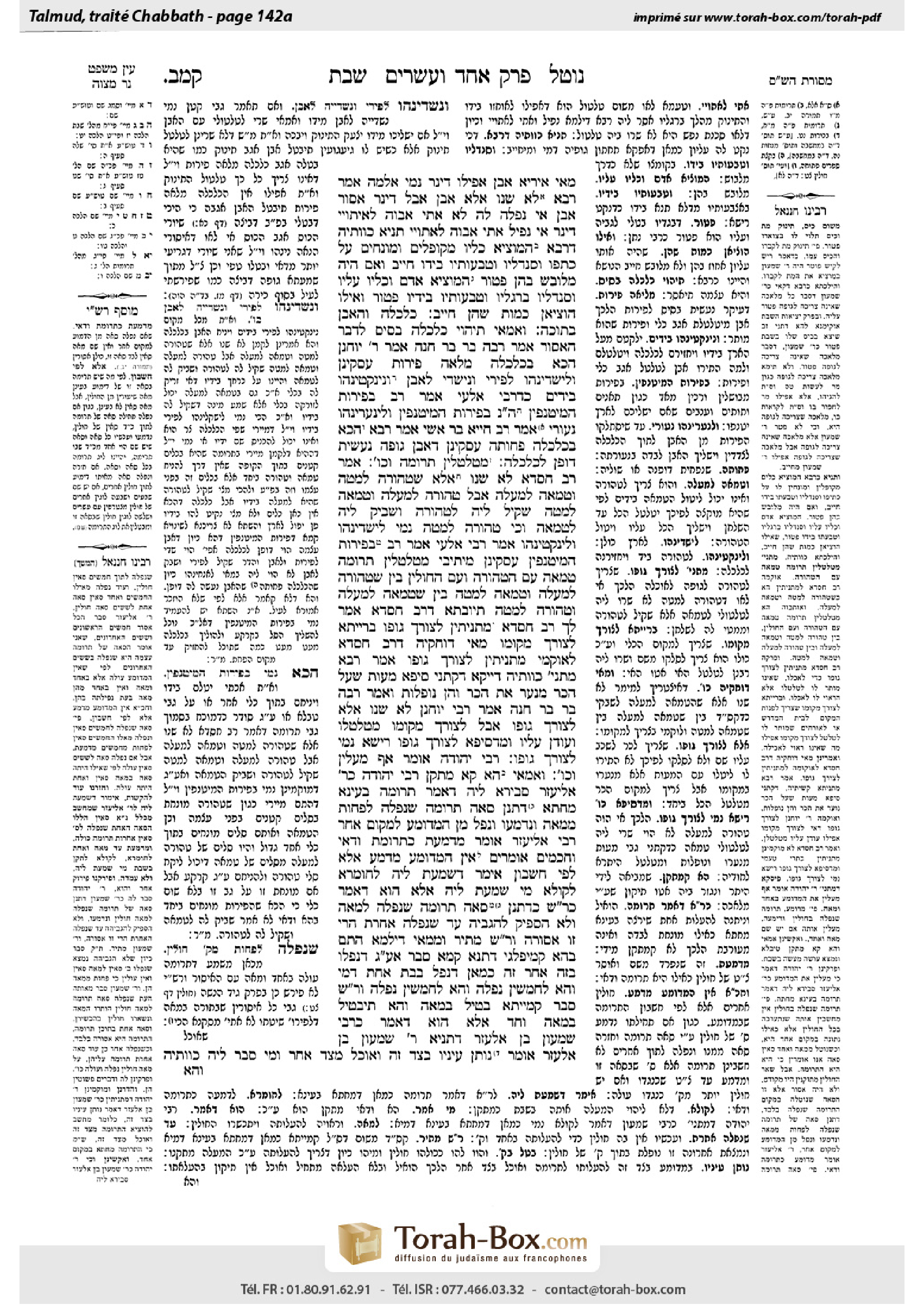
Shabbat 142a: Talmud study for Daf Yomi
Daf Yomi is the daily study of one Talmud folio. Explore 37 tractates with scans, Hebrew text, Sefaria English and AI-generated French translations where annotated.
Passage selection and English or AI-generated French translation are available where the scan has annotations. Daf Study is independent of Torah-Box and Sefaria.
Browse Shabbat · שבת · All tractatesShabbat 142a text and translations
This page of Shabbat includes the Aramaic text, an English translation and an AI-generated French translation, alongside the scan above.
שבת קמ״ב א · Aramaic and Hebrew text
מַאי אִירְיָא אֶבֶן, אֲפִילּוּ דִּינָר נָמֵי! אַלְּמָה אָמַר רָבָא: לֹא שָׁנוּ אֶלָּא אֶבֶן, אֲבָל דִּינָר — אָסוּר! אֶבֶן, אִי נָפְלָה (לַהּ) — לָא אָתֵי אֲבוּהּ לְאֵיתוֹיֵי. דִּינָר, אִי נָפֵיל — אָתֵי אֲבוּהּ לְאֵתוֹיֵי.
תַּנְיָא כְּווֹתֵיהּ דְּרָבָא: הַמּוֹצִיא כֵּלָיו מְקוּפָּלִים וּמוּנָּחִים עַל כְּתֵפוֹ, וְסַנְדָּלָיו וְטַבְּעוֹתָיו בְּיָדוֹ — חַיָּיב. וְאִם הָיָה מְלוּבָּשׁ בָּהֶן — פָּטוּר.
הַמּוֹצִיא אָדָם וְכֵלָיו עָלָיו, וְסַנְדָּלָיו בְּרַגְלָיו, וְטַבְּעוֹתָיו בְּיָדָיו — פָּטוּר, וְאִילּוּ הוֹצִיאָן כְּמוֹת שֶׁהֵן — חַיָּיב.
כַּלְכַּלָּה וְהָאֶבֶן בְּתוֹכָהּ. וְאַמַּאי? תֶּיהְוֵי כַּלְכָּלָה בָּסִיס לְדָבָר הָאָסוּר! אָמַר רַבָּה בַּר בַּר חָנָה אָמַר רַבִּי יוֹחָנָן: הָכָא בְּכַלְכַּלָּה מְלֵאָה פֵּירוֹת עָסְקִינַן. וְלִישְׁדִּינְהוּ לְפֵירֵי, וְנִישְׁדֵּי לְאֶבֶן, וְנִינְקְטִינְהוּ בְּיָדַיִם! כִּדְרַבִּי אִלְעַי אָמַר רַב: בְּפֵירוֹת הַמִּיטַּנְּפִין, הָכָא נָמֵי: בְּפֵירוֹת הַמִּיטַּנְּפִין.
וְלִינַעֲרִינְהוּ נַעוֹרֵי! אָמַר רַב חִיָּיא בַּר אָשֵׁי אָמַר רָבָא: הָכָא בְּכַלְכַּלָּה פְּחוּתָה עָסְקִינַן, דְּאֶבֶן גּוּפָהּ נַעֲשֵׂית דּוֹפֶן לַכַּלְכַּלָּה.
מְטַלְטְלִין תְּרוּמָה וְכוּ׳. אָמַר רַב חִסְדָּא: לֹא שָׁנוּ אֶלָּא שֶׁטְּהוֹרָה לְמַטָּה וּטְמֵאָה לְמַעְלָה. אֲבָל טְהוֹרָה לְמַעְלָה וּטְמֵאָה לְמַטָּה — שָׁקֵיל לֵיהּ לִטְהוֹרָה וְשָׁבֵיק לֵיהּ לִטְמֵאָה.
וְכִי טְהוֹרָה לְמַטָּה נָמֵי, לִישְׁדִּינְהוּ וְלִינְקְטִינְהוּ! אָמַר רַבִּי אִלְעַי אָמַר רַב: בְּפֵירוֹת הַמִּיטַּנְּפִין עָסְקִינַן.
מֵיתִיבִי: מְטַלְטְלִין תְּרוּמָה טְמֵאָה עִם הַטְּהוֹרָה וְעִם הַחוּלִּין, בֵּין שֶׁטְּהוֹרָה לְמַעְלָה וּטְמֵאָה לְמַטָּה, בֵּין שֶׁטְּמֵאָה לְמַעְלָה וּטְהוֹרָה לְמַטָּה, תְּיוּבְתָּא דְּרַב חִסְדָּא!
אָמַר לְךָ רַב חִסְדָּא: מַתְנִיתִין — לְצוֹרֶךְ גּוּפוֹ, בָּרַיְיתָא — לְצוֹרֶךְ מְקוֹמוֹ.
מַאי דּוּחְקֵיהּ דְּרַב חִסְדָּא לְאוֹקוֹמֵי מַתְנִיתִין לְצוֹרֶךְ גּוּפוֹ?
אָמַר רָבָא: מַתְנִיתִין כְּווֹתֵיהּ דַּיְיקָא, דְּקָתָנֵי סֵיפָא: מָעוֹת שֶׁעַל הַכַּר — מְנַעֵר אֶת הַכַּר וְהֵן נוֹפְלוֹת. וְאָמַר רַבָּה בַּר בַּר חָנָה אָמַר רַבִּי יוֹחָנָן: לֹא שָׁנוּ אֶלָּא לְצוֹרֶךְ גּוּפוֹ, אֲבָל לְצוֹרֶךְ מְקוֹמוֹ — מְטַלְטְלוֹ וְעוֹדָן עָלָיו. וּמִדְּסֵיפָא לְצוֹרֶךְ גּוּפוֹ — רֵישָׁא נָמֵי לְצוֹרֶךְ גּוּפוֹ.
רַבִּי יְהוּדָה אוֹמֵר: אַף מַעֲלִין וְכוּ׳. וְאַמַּאי?! הָא קָא מְתַקֵּן!
רַבִּי יְהוּדָה כְּרַבִּי אֱלִיעֶזֶר סְבִירָא לֵיהּ, דְּאָמַר: תְּרוּמָה בְּעֵינַהּ מַחֲתָא.
דִּתְנַן: סְאָה תְּרוּמָה שֶׁנָּפְלָה לְפָחוֹת מִמֵּאָה, וְנִדְמְעוּ, וְנָפַל מִן הַמְדוּמָּע לְמָקוֹם אַחֵר, רַבִּי אֱלִיעֶזֶר אוֹמֵר: מְדַמַּעַת כִּתְרוּמַת וַדַּאי.
וַחֲכָמִים אוֹמְרִים: אֵין הַמְדוּמָּע מְדַמֵּעַ אֶלָּא לְפִי חֶשְׁבּוֹן.
אֵימַר דְּשָׁמְעַתְּ לֵיהּ לְחוּמְרָא, לְקוּלָּא מִי שָׁמְעַתְּ לֵיהּ?!
אֶלָּא: הוּא דְּאָמַר כְּרַבִּי שִׁמְעוֹן, כְּדִתְנַן: סְאָה תְּרוּמָה שֶׁנָּפְלָה לְמֵאָה, וְלֹא הִסְפִּיק לְהַגְבִּיהַּ עַד שֶׁנָּפְלָה אַחֶרֶת — הֲרֵי זוֹ אֲסוּרָה. וְרַבִּי שִׁמְעוֹן מַתִּיר.
וּמִמַּאי? דִילְמָא הָתָם בְּהָא קָמִיפַּלְגִי, דְּתַנָּא קַמָּא סָבַר אַף עַל גַּב דְּנָפְלוּ בָּזֶה אַחַר זֶה — כְּמַאן דְּנָפַל בְּבַת אַחַת דָּמֵי. וְהָא לְחַמְשִׁין נְפַלָה, וְהָא לְחַמְשִׁין נְפַלָה. וְרַבִּי שִׁמְעוֹן סָבַר: קַמַּיְיתָא בְּטִיל בִּמְאָה, וְהָא תִּיבְטֵיל בִּמְאָה וְחַד.
אֶלָּא: הוּא דְּאָמַר כְּרַבִּי שִׁמְעוֹן בֶּן אֶלְעָזָר. דְּתַנְיָא, רַבִּי שִׁמְעוֹן בֶּן אֶלְעָזָר אוֹמֵר: נוֹתֵן עֵינָיו בְּצַד זֶה, וְאוֹכֵל מִצַּד אַחֵר.
וּמִי סָבַר לֵיהּ כְּווֹתֵיהּ?
Shabbat 142a · English translation
why does the mishna refer specifically to moving a stone? The same should hold true even for a dinar, as well. Why, then, did Rava say: They only taught this in a case where the child has a stone in his hand; however, if the child has a dinar in his hand, it is prohibited to lift the child? The Gemara answers: Actually, lifting the child with a dinar should also be permitted. However, the Sages issued a decree prohibiting lifting the child with a dinar because with regard to a stone, if it falls, his father will not come to bring it. However, with regard to a dinar, if it falls, his father will come to bring it.
It was taught in a baraita in accordance with the opinion of Rava: On Shabbat, one who carries out his clothes to the public domain while they are folded and placed on his shoulder, and his sandals on his feet and his rings in his hand, not on his fingers, is liable. And if he was wearing them, he is exempt for all of them, as they are negated relative to him.
One who carries out a person with his garments on him, and his sandals on his feet, and his rings on the fingers of his hands, i.e., wearing all of his clothes and jewelry in the typical manner, is exempt, whereas if he carried them out as they are, i.e., the person was holding his clothes in his hands, he is liable for carrying out the clothes, just as Rava said.
We learned in the mishna: And it is permissible to take a basket with a stone inside it on Shabbat. The Gemara asks: And why may he do so? The basket should be a base for a prohibited object, and a base for a prohibited object is set-aside and may not be moved on Shabbat. Rabba bar bar Ḥana said that Rabbi Yoḥanan said: Here, we are dealing with a basket full of fruit. The basket is a base for permitted items as well, not only a base for the stone. The Gemara asks: Why may he move the basket and the stone? There is an alternative. And let him throw the fruit and throw the stone out of the basket, and take the fruit in his hands, and there will be no need to move the stone. The Gemara answers: As Rabbi Elai said that Rav said in a different context: It is referring to fruits that become soiled and ruined. Here, too, it is referring to fruits that become soiled and ruined if he throws them down.
The Gemara asks a question: And let him shake them until the stone is on one side of the basket, enabling him to throw the stone out of the basket. Rav Hiyya bar Ashi said that Rava said: Here, we are dealing with a broken basket with a hole, in which the stone serves as a side of the basket by sealing the hole. Therefore, he cannot throw it out of the basket.
We learned in the mishna: And one may move ritually impure teruma with ritually pure teruma. Rav Ḥisda said: They only taught this in a case where the pure teruma is on the bottom and the impure teruma is on the top. In that case, if one wants to reach the pure teruma, there is no alternative to taking the impure teruma as well. However, if the pure teruma is on the top and the impure teruma is on the bottom, he takes the pure teruma and leaves the impure teruma.
The Gemara asks a question: And when the pure teruma is on the bottom too, let him throw the impure fruit, and take the pure fruit. Rabbi Elai said that Rav said: It is referring to fruits that become soiled and ruined, which cannot be thrown from the basket.
The Gemara raises an objection to the statement of Rav Ḥisda: One may move impure teruma with the pure teruma and with the non-sacred produce, whether the pure is on the top and the impure is on the bottom, or whether the impure is on the top and the pure is on the bottom. This is a conclusive refutation of the statement of Rav Hisda.
The Gemara answers that Rav Ḥisda could have said to you: The mishna, which, according to Rav Ḥisda, permits moving the impure teruma with the pure teruma only when the pure teruma is on top, is referring to a case where he needs the basket for the purpose of utilizing the object itself, i.e., he wants to eat the fruit. The baraita is referring to a case where he needs the basket for the purpose of utilizing its place, i.e., he wants to move the basket in order to vacate its place, in which case he may move it even if it contains impure teruma exclusively.
The Gemara asks: What impelled Rav Ḥisda to establish the mishna as referring specifically to a case where he needs the basket for the purpose of utilizing the object itself? Why can’t he explain the mishna as referring to any case?
Rava said: The mishna is precise in accordance with the opinion of Rav Ḥisda, as it is taught in the latter clause, the next mishna: With regard to coins that are on a cushion, he shakes the cushion and the coins fall. And Rabba bar bar Ḥana said that Rabbi Yoḥanan said: They only taught that he may shake the cushion in a case where it is for the purpose of utilizing the cushion itself. However, if he needs it for the purpose of utilizing its place, he may move it, even though the coins are still on it. And from the fact that the latter clause of the mishna is referring to a case where he needs the cushion for the purpose of utilizing the cushion itself, the first clause, too, is referring to a case where he needs the basket for the purpose of utilizing the basket itself.
We learned in the mishna that Rabbi Yehuda says: One may even lift a measure of teruma that was nullified from a mixture of one hundred measures of non-sacred produce and one measure of teruma. The Gemara asks: And why is it permitted? Isn’t he rendering the produce fit for consumption? The Sages issued a decree prohibiting the performance of any action that renders an item fit for use on Shabbat.
The Gemara answers: Rabbi Yehuda holds in accordance with the opinion of Rabbi Eliezer, who said: Teruma is considered as if it is placed in its pure unadulterated state. By lifting the measure of teruma, one does not render the rest of the mixture fit for consumption. It is considered as if the measure of teruma never intermingled with the rest of the produce and the measure that he lifted from the produce is the measure that fell into the produce.
As we learned in a mishna: A se’a of teruma that fell into less than one hundred se’a of non-sacred produce causes it to become a prohibited mixture. The teruma is not nullified by the non-sacred produce. And then, if a se’a from the mixture fell into a different place with non-sacred produce, Rabbi Eliezer says: The se’a from the original mixture renders it a prohibited mixture in the same way that definite teruma would. This is due to the concern that the same se’a of teruma that fell into the first mixture never intermingled with the produce and subsequently fell into the second mixture. Therefore, it requires nullification like unadulterated teruma.
And the Rabbis say: The se’a from the original prohibited mixture only renders the second one a prohibited mixture according to the proportion of teruma in the entire mixture. In other words, the percentage of teruma in each se’a of the original mixture is representative of the percentage of teruma in the entire mixture. Only that measure of teruma need be nullified. Rabbi Eliezer’s opinion that the teruma in the mixture is not considered mixed, and it is considered as if it was placed in its pure unadulterated state, corresponds to Rabbi Yehuda’s opinion that by lifting the measure of teruma, one does not render the rest of the mixture fit for consumption.
The Gemara rejects this: Say that you heard that Rabbi Eliezer expresses his opinion in this matter to rule stringently. Did you hear him express his opinion to rule leniently? He expressed concern lest the fallen teruma might not have intermingled with the non-sacred produce in the first mixture, and therefore, the second mixture is prohibited. However, he does not consider this a certainty.
Rather, Rabbi Yehuda stated his halakha in accordance with the opinion of Rabbi Shimon, as we learned in a mishna: If a se’a of teruma fell into one hundred se’a of non-sacred produce, and he did not manage to lift that se’a from the mixture until another se’a of teruma fell into the mixture, this entire mixture is prohibited. This is because two se’a of teruma are mixed with one hundred se’a of non-sacred produce. And Rabbi Shimon permits the mixture. Rabbi Shimon holds that the first se’a that fell into the produce is not mixed with it; it is placed in its unadulterated state. When the second se’a falls, it is also placed in its unadulterated state, and the two se’a do not join together.
The Gemara rejects this comparison: And from what does that conclusion ensue? Perhaps there, they are disagreeing with regard to this: That the first tanna holds: Even though two se’a of teruma fell one after another, it is as though they fell at once, and this se’a of teruma fell into fifty se’a of non-sacred produce, and this se’a of teruma fell into fifty se’a of non-sacred produce, which are insufficient to nullify teruma. And Rabbi Shimon holds: The first se’a was nullified immediately when it fell into one hundred se’a, and this se’a will be nullified in one hundred and one se’a. There is no connection between this dispute and the opinion that by lifting the measure of teruma, one does not render the rest of the mixture fit for consumption.
Rather, Rabbi Yehuda stated his halakha in accordance with the opinion of Rabbi Shimon ben Elazar. As it was taught in a baraita that Rabbi Shimon ben Elazar says: One need not lift a se’a from the mixture in order to render it permitted to eat. It is sufficient if he casts his eyes on this side of the mixture and decides to separate a se’a from the produce on that side, and he eats from a different side of the mixture and physically separates the se’a later. Lifting a se’a from the mixture does not render the mixture fit for consumption, as it is permitted to partake from the mixture even without removing a se’a. That is the rationale for Rabbi Yehuda’s opinion.
The Gemara asks: And does Rabbi Yehuda hold in accordance with the opinion of Rabbi Shimon ben Elazar?
Shabbat 142a · Traduction française (IA)
Pourquoi la Michna mentionne-t-elle précisément le déplacement d’une pierre ? Il devrait en être de même pour un dinar. Pourquoi Rava a-t-il donc dit : « Ils n’ont enseigné cela que dans le cas où l’enfant a une pierre dans la main ; en revanche, si l’enfant a un dinar dans la main, il est interdit de le soulever » ? La Guemara répond : En réalité, il devrait également être permis de soulever l’enfant avec un dinar. Toutefois, les Sages ont décrété qu’il est interdit de soulever l’enfant avec un dinar, car si la pierre tombe, son père ne viendra pas la ramasser ; tandis que si le dinar tombe, son père viendra le ramasser.
Il a été enseigné dans une baraïta conformément à l’opinion de Rava : Celui qui, le Chabbat, transporte ses vêtements dans le domaine public alors qu’ils sont pliés et posés sur son épaule, ses sandales aux pieds et ses bagues dans la main, et non aux doigts, est passible. Mais s’il les porte sur lui, il est quitte pour tous ces objets, car ils sont accessoires à sa personne.
Celui qui transporte une personne vêtue de ses vêtements, chaussée de ses sandales et portant ses bagues aux doigts, c’est-à-dire qui porte tous ses vêtements et ses bijoux de la manière habituelle, est quitte. En revanche, s’il les transporte tels quels, c’est-à-dire si la personne tient ses vêtements dans ses mains, il est passible pour le transport des vêtements, comme Rava l’a dit.
Nous avons appris dans la Michna : Il est permis de transporter le Chabbat un panier contenant une pierre. La Guemara demande : Pourquoi le peut-on ? Le panier devrait être un support pour un objet interdit, et un tel support est mouktsé et ne peut être déplacé le Chabbat. Rabba bar bar Ḥana a dit au nom de Rabbi Yoḥanan : Ici, il s’agit d’un panier plein de fruits. Le panier est aussi un support pour des objets permis, et pas seulement pour la pierre. La Guemara demande : Pourquoi peut-il déplacer le panier et la pierre ? Il existe une autre possibilité : qu’il jette les fruits et la pierre hors du panier, puis prenne les fruits dans ses mains ; il n’aurait alors pas besoin de déplacer la pierre. La Guemara répond : Comme Rabbi Elai a dit au nom de Rav dans un autre contexte, il s’agit de fruits qui se salissent et s’abîment. Ici aussi, il s’agit de fruits qui se salissent et s’abîment s’il les jette par terre.
La Guemara pose une question : Qu’il les secoue donc jusqu’à ce que la pierre se trouve d’un côté du panier, ce qui lui permettrait de la jeter hors du panier. Rav Ḥiyya bar Ashi a dit au nom de Rava : Ici, il s’agit d’un panier cassé et troué, dans lequel la pierre sert de paroi en bouchant le trou. Il ne peut donc pas la jeter hors du panier.
Nous avons appris dans la Michna : On peut déplacer de la terouma impure avec de la terouma pure. Rav Ḥisda a dit : Ils n’ont enseigné cela que dans le cas où la terouma pure se trouve en dessous et la terouma impure au-dessus. Dans ce cas, s’il veut atteindre la terouma pure, il n’a d’autre choix que de prendre également la terouma impure. En revanche, si la terouma pure se trouve au-dessus et la terouma impure en dessous, il prend la terouma pure et laisse la terouma impure.
La Guemara pose une question : Même lorsque la terouma pure se trouve en dessous, qu’il jette donc les fruits impurs et prenne les fruits purs. Rabbi Elai a dit au nom de Rav : Il s’agit de fruits qui se salissent et s’abîment et qu’on ne peut donc pas jeter hors du panier.
La Guemara soulève une objection à l’affirmation de Rav Ḥisda : On peut déplacer de la terouma impure avec de la terouma pure et avec des produits non consacrés, que la terouma pure soit au-dessus et l’impure en dessous, ou que l’impure soit au-dessus et la pure en dessous. Cela réfute définitivement l’affirmation de Rav Ḥisda.
La Guemara répond que Rav Ḥisda aurait pu te dire : La Michna, qui, selon Rav Ḥisda, autorise à déplacer la terouma impure avec la terouma pure uniquement lorsque la terouma pure est au-dessus, parle d’un cas où il a besoin du panier pour utiliser l’objet lui-même, c’est-à-dire qu’il veut manger les fruits. La baraïta parle d’un cas où il a besoin du panier pour utiliser l’espace qu’il occupe, c’est-à-dire qu’il veut le déplacer afin de libérer cet espace ; dans ce cas, il peut le déplacer même s’il ne contient que de la terouma impure.
La Guemara demande : Qu’est-ce qui a poussé Rav Ḥisda à interpréter la Michna comme parlant précisément d’un cas où il a besoin du panier pour utiliser l’objet lui-même ? Pourquoi ne peut-il pas expliquer que la Michna s’applique à n’importe quel cas ?
Rava a dit : La Michna est formulée avec précision conformément à l’opinion de Rav Ḥisda, comme l’enseigne sa clause finale, dans la Michna suivante : À propos de pièces de monnaie qui se trouvent sur un coussin, il secoue le coussin et les pièces tombent. Rabba bar bar Ḥana a dit au nom de Rabbi Yoḥanan : Ils n’ont enseigné qu’il pouvait secouer le coussin que dans le cas où il en a besoin pour utiliser le coussin lui-même. En revanche, s’il en a besoin pour utiliser l’espace qu’il occupe, il peut le déplacer même si les pièces sont encore dessus. Et puisque la clause finale de la Michna parle d’un cas où il a besoin du coussin pour utiliser le coussin lui-même, la clause initiale parle elle aussi d’un cas où il a besoin du panier pour utiliser le panier lui-même.
Nous avons appris dans la Michna que Rabbi Yehuda dit : On peut même soulever une mesure de terouma qui a été annulée dans un mélange composé de cent mesures de produits non consacrés et d’une mesure de terouma. La Guemara demande : Pourquoi cela est-il permis ? Ne rend-il pas ainsi les produits propres à la consommation ? Les Sages ont décrété qu’il est interdit, le Chabbat, d’accomplir toute action qui rend un objet propre à l’usage.
La Guemara répond : Rabbi Yehuda suit l’opinion de Rabbi Eliezer, qui a dit : La terouma est considérée comme si elle demeurait dans son état pur, sans mélange. En soulevant la mesure de terouma, on ne rend pas le reste du mélange propre à la consommation. C’est comme si cette mesure de terouma ne s’était jamais mêlée au reste des produits et que la mesure qu’il a soulevée était celle-là même qui était tombée dans les produits.
Comme nous l’avons appris dans une Michna : Une séa de terouma qui tombe dans moins de cent séa de produits non consacrés rend le mélange interdit. La terouma n’est pas annulée par les produits non consacrés. Puis, si une séa de ce mélange tombe ailleurs, dans des produits non consacrés, Rabbi Eliezer dit : La séa provenant du mélange initial rend ce nouveau mélange interdit, comme le ferait de la terouma certaine. Cela tient à la crainte que la même séa de terouma tombée dans le premier mélange ne s’y soit jamais mêlée aux produits et soit ensuite tombée dans le second mélange. Elle doit donc être annulée comme de la terouma pure, sans mélange.
Et les Sages disent : La séa provenant du mélange initialement interdit ne rend le second mélange interdit qu’en proportion de la terouma présente dans le mélange entier. Autrement dit, le pourcentage de terouma dans chaque séa du mélange initial correspond au pourcentage de terouma dans l’ensemble du mélange. Seule cette quantité de terouma doit être annulée. L’opinion de Rabbi Eliezer, selon laquelle la terouma du mélange n’est pas considérée comme mêlée et est considérée comme si elle demeurait dans son état pur, sans mélange, correspond à l’opinion de Rabbi Yehuda selon laquelle, en soulevant la mesure de terouma, on ne rend pas le reste du mélange propre à la consommation.
La Guemara rejette cet argument : Tu as entendu Rabbi Eliezer exprimer son opinion sur cette question afin de trancher avec rigueur. L’as-tu entendu exprimer son opinion afin de trancher avec indulgence ? Il a exprimé la crainte que la terouma tombée ne se soit peut-être pas mêlée aux produits non consacrés dans le premier mélange et que le second mélange soit donc interdit. Toutefois, il ne considère pas cela comme une certitude.
Mais plutôt, Rabbi Yehuda a énoncé sa halakha conformément à l’opinion de Rabbi Shimon, comme nous l’avons appris dans une Michna : Si une séa de terouma tombe dans cent séa de produits non consacrés et qu’il ne réussit pas à retirer cette séa du mélange avant qu’une autre séa de terouma n’y tombe, tout le mélange est interdit. En effet, deux séa de terouma sont mêlées à cent séa de produits non consacrés. Rabbi Shimon autorise le mélange. Selon lui, la première séa tombée dans les produits ne s’y mêle pas ; elle demeure dans son état pur, sans mélange. Lorsque la seconde séa tombe, elle aussi demeure dans son état pur, sans mélange, et les deux séa ne s’additionnent pas.
La Guemara rejette cette comparaison : De quoi cette conclusion découle-t-elle ? Peut-être que leur désaccord porte sur le point suivant : le premier tanna considère que, même si les deux séa de terouma sont tombées l’une après l’autre, c’est comme si elles étaient tombées en même temps : cette séa de terouma est tombée dans cinquante séa de produits non consacrés, et cette autre séa de terouma est tombée dans cinquante séa de produits non consacrés, quantités insuffisantes pour annuler la terouma. Rabbi Shimon, lui, considère que la première séa a été annulée immédiatement lorsqu’elle est tombée dans cent séa, et que cette séa sera annulée dans cent une séa. Il n’y a aucun lien entre ce désaccord et l’opinion selon laquelle, en soulevant la mesure de terouma, on ne rend pas le reste du mélange propre à la consommation.
Mais plutôt, Rabbi Yehuda a énoncé sa halakha conformément à l’opinion de Rabbi Shimon ben Elazar. En effet, il a été enseigné dans une baraïta que Rabbi Shimon ben Elazar dit : Il n’est pas nécessaire de retirer une séa du mélange pour le rendre propre à la consommation. Il suffit de porter son regard sur un côté du mélange et de décider d’en séparer une séa, puis de manger d’un autre côté du mélange et de séparer physiquement la séa plus tard. Le fait de retirer une séa du mélange ne le rend pas propre à la consommation, puisqu’il est permis de manger de ce mélange même sans en retirer une séa. Telle est la raison de l’opinion de Rabbi Yehuda.
La Guemara demande : Rabbi Yehuda suit-il donc l’opinion de Rabbi Shimon ben Elazar ?
Traduction française générée par IA à partir de l’édition anglaise de Sefaria. Vérifie toujours un passage avec le texte source.
Text from Sefaria: William Davidson Edition - Vocalized Aramaic (CC BY NC); William Davidson Edition - English (CC BY NC).