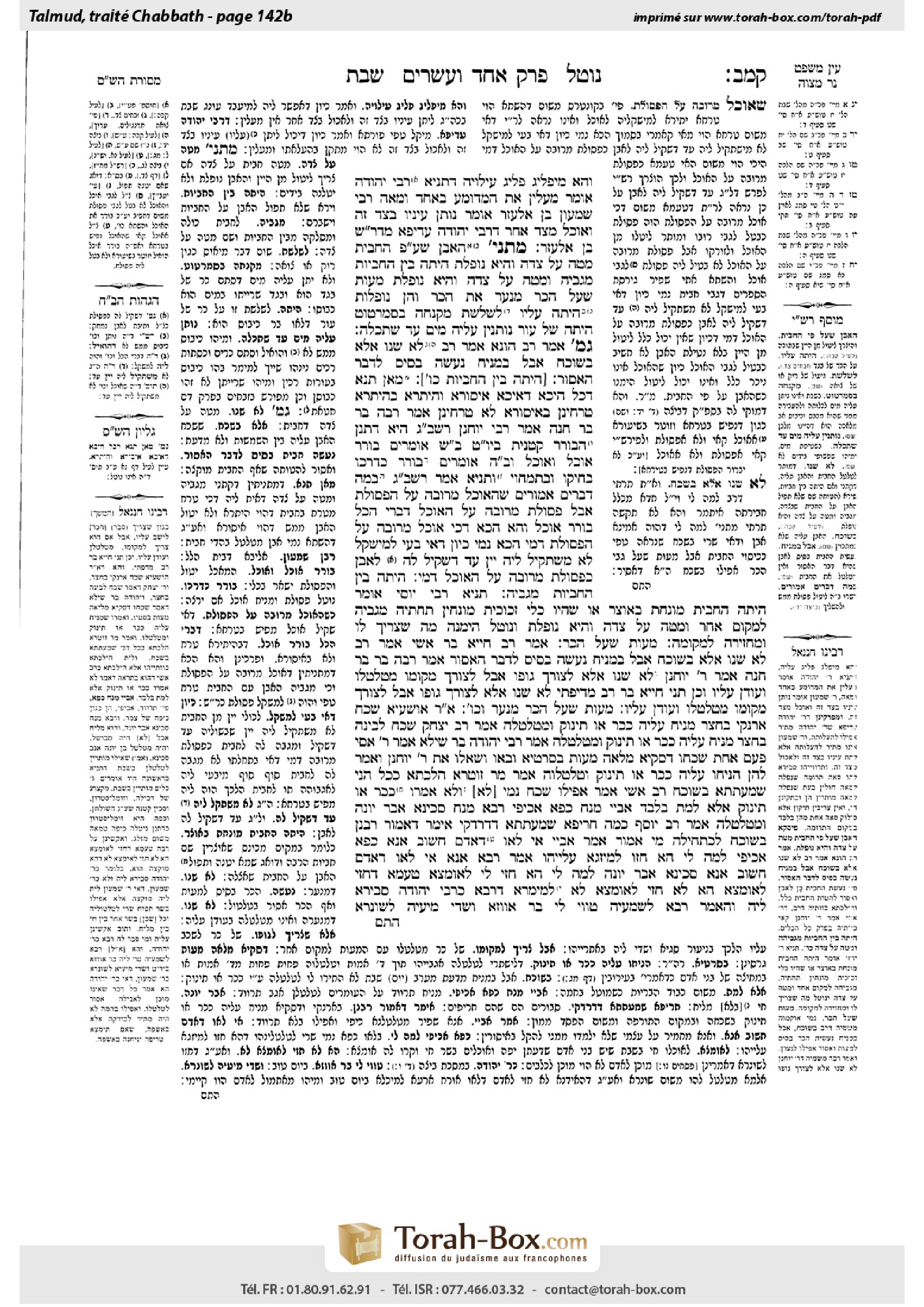
Shabbat 142b: Talmud study for Daf Yomi
Daf Yomi is the daily study of one Talmud folio. Explore 37 tractates with scans, Hebrew text, Sefaria English and AI-generated French translations where annotated.
Passage selection and English or AI-generated French translation are available where the scan has annotations. Daf Study is independent of Torah-Box and Sefaria.
Browse Shabbat · שבת · All tractatesShabbat 142b text and translations
This page of Shabbat includes the Aramaic text, an English translation and an AI-generated French translation, alongside the scan above.
שבת קמ״ב ב · Aramaic and Hebrew text
וְהָא מִיפְלָג פְּלִיג עִילָּוֵיהּ, דְּתַנְיָא, רַבִּי יְהוּדָה אוֹמֵר: מַעֲלִין אֶת הַמְדוּמָּע בְּאֶחָד וּמֵאָה. רַבִּי שִׁמְעוֹן בֶּן אֶלְעָזָר אוֹמֵר: נוֹתֵן עֵינָיו בְּצַד זֶה וְאוֹכֵל מִצַּד אַחֵר.
דְּרַבִּי יְהוּדָה עֲדִיפָא מִדְּרַבִּי שִׁמְעוֹן בֶּן אֶלְעָזָר.
מַתְנִי׳ הָאֶבֶן שֶׁעַל פִּי הֶחָבִית — מַטָּהּ עַל צִדָּהּ, וְהִיא נוֹפֶלֶת. הָיְתָה בֵּין הֶחָבִיּוֹת — מַגְבִּיהָהּ וּמַטָּהּ עַל צִדָּהּ, וְהִיא נוֹפֶלֶת.
מָעוֹת שֶׁעַל הַכַּר — מְנַעֵר אֶת הַכַּר, וְהֵן נוֹפְלוֹת. הָיְתָה עָלָיו לִשְׁלֶשֶׁת — מְקַנְּחָהּ בִּסְמַרְטוּט. הָיְתָה שֶׁל עוֹר — נוֹתְנִין עָלֶיהָ מַיִם עַד שֶׁתִּכְלֶה.
גְּמָ׳ אָמַר רַב הוּנָא אָמַר רַב: לֹא שָׁנוּ אֶלָּא בְּשׁוֹכֵחַ, אֲבָל בְּמַנִּיחַ — נַעֲשָׂה בָּסִיס לְדָבָר הָאָסוּר.
[הָיְתָה בֵּין הֶחָבִיּוֹת כּוּ׳.] מַאן תַּנָּא דְּכֹל הֵיכָא דְּאִיכָּא אִיסּוּרָא וְהֶיתֵּרָא — בְּהֶיתֵּרָא טָרְחִינַן, בְּאִיסּוּרָא לָא טָרְחִינַן?
אָמַר רַבָּה בַּר בַּר חָנָה אָמַר רַבִּי יוֹחָנָן: רַבָּן שִׁמְעוֹן בֶּן גַּמְלִיאֵל הִיא. דִּתְנַן: הַבּוֹרֵר קִטְנִית בְּיוֹם טוֹב, בֵּית שַׁמַּאי אוֹמְרִים: בּוֹרֵר אוֹכֶל וְאוֹכֵל. וּבֵית הִלֵּל אוֹמְרִים: בּוֹרֵר כְּדַרְכּוֹ, בְּחֵיקוֹ וּבַתַּמְחוּי.
וְתַנְיָא, אָמַר רַבָּן שִׁמְעוֹן בֶּן גַּמְלִיאֵל: בַּמֶּה דְּבָרִים אֲמוּרִים — שֶׁהָאוֹכֶל מְרוּבֶּה עַל הַפְּסוֹלֶת. אֲבָל פְּסוֹלֶת מְרוּבָּה עַל הָאוֹכֶל — דִּבְרֵי הַכֹּל בּוֹרֵר אוֹכֶל.
וְהָא הָכָא, דְּכִי אוֹכֶל מְרוּבֶּה עַל הַפְּסוֹלֶת דָּמֵי!
הָכָא נָמֵי, כֵּיוָן דְּאִי בָּעֵי לְמִישְׁקַל, לָא מִשְׁתְּקִיל לֵיהּ יַיִן עַד דְּשָׁקֵיל לַהּ לְאֶבֶן — כִּפְסוֹלֶת מְרוּבָּה עַל הָאוֹכֶל דָּמֵי.
הָיְתָה בֵּין הֶחָבִיּוֹת — מַגְבִּיהַּ. תַּנְיָא, רַבִּי יוֹסֵי אוֹמֵר: הָיְתָה הֶחָבִית מוּנַּחַת בָּאוֹצָר, אוֹ שֶׁהָיוּ כְּלֵי זְכוּכִית מוּנָּחִין תַּחְתֶּיהָ — מַגְבִּיהָה לְמָקוֹם אַחֵר, וּמַטָּהּ עַל צִדָּהּ, וְהִיא נוֹפֶלֶת, וְנוֹטֵל הֵימֶנָּה מַה שֶּׁצָּרִיךְ לוֹ, וּמַחְזִירָה לִמְקוֹמָהּ.
מָעוֹת שֶׁעַל הַכַּר. אָמַר רַב חִיָּיא בַּר אָשֵׁי אָמַר רַב: לֹא שָׁנוּ אֶלָּא בְּשׁוֹכֵחַ, אֲבָל בְּמַנִּיחַ — נַעֲשָׂה בָּסִיס לְדָבָר הָאָסוּר.
אָמַר רַבָּה בַּר בַּר חָנָה אָמַר רַבִּי יוֹחָנָן: לֹא שָׁנוּ אֶלָּא לְצוֹרֶךְ גּוּפוֹ, אֲבָל לְצוֹרֶךְ מְקוֹמוֹ — מְטַלְטְלוֹ וְעוֹדָן עָלָיו. וְכֵן תָּנֵי חִיָּיא בַּר רַב מִדִּיפְתִּי: לֹא שָׁנוּ אֶלָּא לְצוֹרֶךְ גּוּפוֹ, אֲבָל לְצוֹרֶךְ מְקוֹמוֹ — מְטַלְטְלוֹ וְעוֹדָן עָלָיו.
מָעוֹת שֶׁעַל הַכַּר מְנַעֵר וְכוּ׳. אָמַר רַבִּי אוֹשַׁעְיָא: שָׁכַח אַרְנָקִי בֶּחָצֵר — מַנִּיחַ עָלֶיהָ כִּכָּר אוֹ תִּינוֹק וּמְטַלְטְלָהּ. אָמַר רַב יִצְחָק: שָׁכַח לְבֵינָה בֶּחָצֵר — מַנִּיחַ עָלֶיהָ כִּכָּר אוֹ תִּינוֹק, וּמְטַלְטְלָהּ. אָמַר רַבִּי יְהוּדָה בַּר שֵׁילָא אָמַר רַבִּי אַסִּי: פַּעַם אַחַת שָׁכְחוּ דִּסַקַּיָּא מְלֵאָה מָעוֹת בִּסְרַטְיָא, וּבָאוּ וְשָׁאֲלוּ אֶת רַבִּי יוֹחָנָן, וְאָמַר לָהֶן: הַנִּיחוּ עָלֶיהָ כִּכָּר אוֹ תִּינוֹק, וְטַלְטְלוּהָ.
אָמַר מָר זוּטְרָא: הִלְכְתָא כְּכׇל הָנֵי שְׁמַעְתָּתָא בְּשׁוֹכֵחַ. רַב אָשֵׁי אָמַר: אֲפִילּוּ שֹׁכֵחַ נָמֵי [לָא] — וְלֹא אָמְרוּ כִּכָּר אוֹ תִּינוֹק אֶלָּא לְמֵת בִּלְבַד.
אַבָּיֵי מַנַּח כַּפָּא אַכִּיפֵי. רָבָא מַנַּח סַכִּינָא אַבַּר יוֹנָה וּמְטַלְטְלָהּ. אָמַר רַב יוֹסֵף: כַּמָּה חַרִּיפָן שְׁמַעְתָּתָא דְּדַרְדַּקֵּי! אֵימַר דַּאֲמוּר רַבָּנַן בְּשׁוֹכֵחַ, לְכַתְּחִילָּה מִי אֲמוּר?!
אָמַר אַבָּיֵי: אִי לָאו דְּאָדָם חָשׁוּב אֲנָא, כַּפָּא אַכִּיפֵי לְמָה לִי? הָא חֲזוּ לְמִיזְגָּא עֲלַיְיהוּ!
אָמַר רָבָא: אֲנָא, אִי לָאו דְּאָדָם חָשׁוּב אֲנָא — סַכִּינָא אַבַּר יוֹנָה לְמָה לִי? הָא חֲזֵי לִי לְאוּמְצָא.
טַעְמָא דַּחֲזֵי לְאוּמְצָא, הָא לָא חֲזֵי לְאוּמְצָא — לָא. לְמֵימְרָא דְּרָבָא כְּרַבִּי יְהוּדָה סְבִירָא לֵיהּ?
וְהָאָמַר רָבָא לְשַׁמָּעֵיהּ: טְוִוי לִי בַּר אֲווֹזָא, וּשְׁדִי מֵיעֵיהּ לְשׁוּנָּרָא.
Shabbat 142b · English translation
Doesn’t he disagree with him? As it was taught in a baraita that Rabbi Yehuda says: One may lift a measure of teruma that was nullified from a mixture of one hundred measures of non-sacred produce and one measure of teruma. Rabbi Shimon ben Elazar says: One casts his eyes on this side of the mixture and decides to separate a se’a from the produce on that side, and he eats from a different side of the mixture.
The Gemara rejects this: Fundamentally, the two tanna’im agree, but the opinion of Rabbi Yehuda is more far-reaching than the opinion of Rabbi Shimon ben Elazar. Rabbi Yehuda says that since thought is sufficient, lifting the se’a does not render the produce fit for consumption, and it is preferable if he lifts the se’a even on Shabbat.
MISHNA: With regard to a stone, which is set-aside on Shabbat and may not be moved, that was placed on the mouth of a barrel, one tilts the barrel on its side, and the stone falls. If the barrel was among other barrels, and the other barrels might break if the stone falls on them, he lifts the barrel to distance it from the other barrels, and then tilts it on its side, and the stone falls.
With regard to coins that are on a cushion, he shakes the cushion and the coins fall. If there was bird dung (Arukh) on the cushion, he wipes it with a rag, but he may not wash it with water because of the prohibition against laundering. If the cushion was made of leather, and laundering is not a concern, he places water on it until the bird dung ceases.
GEMARA: Rav Huna said that Rav said: They only taught this halakha with regard to a stone in a case where one forgets the stone on the barrel. However, if he places the stone on the barrel, the barrel becomes a base for a prohibited object, which itself may not be moved throughout Shabbat.
We learned in the mishna: If the barrel was among other barrels, he lifts the barrel and then tilts it on its side, and the stone falls. The Gemara asks: Who is the tanna who holds that any place that there is a prohibited item and a permitted item, we may exert ourselves for the permitted item, but we may not exert ourselves for the prohibited item? One must exert himself to lift the barrel, and he may not remove the stone, although doing so would minimize his exertion.
Rabba bar bar Ḥana said that Rabbi Yoḥanan said: It is Rabban Shimon ben Gamliel. As we learned in a mishna: With regard to one who selects legumes on a Festival, separating edible and inedible, Beit Shammai say: He selects food and eats it immediately and leaves the waste. And Beit Hillel say: He selects in his usual manner, and may even remove the waste and leave the food, in his lap or in a large vessel.
And it was taught in a baraita that Rabban Shimon ben Gamliel said: In what case are these matters, the dispute between Beit Shammai and Beit Hillel, stated: In a case where the quantity of the food is greater than the quantity of the waste. However, if the quantity of the waste is greater than the quantity of the food, everyone agrees that one selects the food to avoid the exertion involved in removing the waste, which itself may not be moved. The same is true here. He moves the barrel and not the stone, which is like waste.
The Gemara asks: And here, in the case of the barrel, isn’t it comparable to a case where the food is greater than the waste, as the barrel, which is food, is bigger and heavier than the stone. In addition, it is easier to move the stone. Nevertheless, he is not permitted to do so, in accordance with the opinion of Beit Hillel.
The Gemara answers: Here, too, since if he wants to take the wine, the wine cannot be taken until he removes the stone, the legal status of the stone is like that of waste which is greater in quantity than the food, and it cannot be likened to the case of selecting. In this case, he is unable to move the barrel without moving the stone.
We learned in the mishna: If the barrel was among other barrels, he lifts the barrel. It was taught in a baraita: Rabbi Yosei says: If the barrel was placed in a storeroom amongst other barrels, or if glass vessels were placed beneath it, preventing him from tilting the barrel and letting the stone fall, he lifts the barrel and moves it to a different place, and he tilts it on its side, and the stone falls. And then he takes from the barrel what he needs, and restores the barrel to its place.
We learned in the mishna: With regard to coins that are on a cushion, he shakes the cushion and the coins fall. Rav Hiyya bar Ashi said that Rav said: They only taught this halakha with regard to a case where one forgets the coins on the cushion; however, if he places the coins on the cushion, the cushion becomes a base for a prohibited object and may not be moved at all.
Rabba bar bar Ḥana said that Rabbi Yoḥanan said: They only taught the halakha that one shakes the cushion and the coins fall, when he needs the cushion for the purpose of utilizing the cushion itself; but if he needs it for the purpose of utilizing its place, he moves the cushion with the coins still on it. And likewise, Hiyya bar Rav from Difti taught in a baraita: They only taught the halakha that one shakes the cushion and the coins fall, when he needs the cushion for the purpose of utilizing the cushion itself, but if he needs it for the purpose of utilizing its place, he moves the cushion with the coins still on it.
We learned in the mishna: With regard to coins that are on a cushion, he shakes the cushion and the coins fall.
Rabbi Oshaya said: If one forgot a purse of money in the courtyard on Shabbat eve, and he remembers it on Shabbat and wants to bring it into the house, he places a loaf of bread or a baby on it and moves it. The purse becomes a base for a permitted object and may be moved.
Rav Yitzhak said: If one forgot a brick in the courtyard, he places a loaf of bread or a baby on it and moves it.
Rabbi Yehuda bar Sheila said that Rabbi Asi said: Once, they forgot a saddlebag [diskaya] full of coins in a main street, and they came and asked Rabbi Yoḥanan, and he said to them: Place a loaf or a baby on it, and move it.
Mar Zutra said: The halakha is in accordance with all these statements in the case of one who forgets. However, if one intentionally left an object, even a valuable object, on Shabbat eve, he may not employ artifice and move it the following day. Rav Ashi said: If one forgot, he may also not employ artifice, and they only stated that movement by means of a loaf or a baby for the purposes of moving a corpse alone.
The Gemara relates: Abaye would place a spoon on bundles of produce, so that he would be able to move the bundles because of the spoon. Rava would place a knife on a slaughtered young dove and move it. Rav Yosef said mockingly: How sharp is the halakha of children? Say that the Sages stated this halakha only in a case where one forgets, but did they say that one may do so ab initio?
Abaye explained his actions and said: If not for the fact that I am an important person, why would I need to place a spoon on the bundles? Aren’t the bundles themselves suited to lean upon? I could have carried the bundles without the spoon.
Similarly, Rava said: If not for the fact that I am an important person, why would I need to place a knife on a young dove? Isn’t the young dove itself suited to be eaten as raw meat?
The Gemara asks: The reason that it is permitted to move the slaughtered dove is because it is suited to be eaten by a person as raw meat; but if it is not suited to be eaten by a person as raw meat, no, it may not be moved. Is that to say that Rava holds in accordance with the opinion of Rabbi Yehuda, that on Shabbat it is prohibited to move food that was originally designated for human consumption and is now only suited for animal consumption?
Didn’t Rava say to his attendant on a Festival: Roast a duck for me, and throw its intestines to the cat. Moving the duck’s intestines was permitted in order to feed the cat. Similarly, moving the dove should have been permitted not because it is raw meat fit for consumption by a person, but because it is suited for consumption by a dog.
Shabbat 142b · Traduction française (IA)
N’est-il pas en désaccord avec lui ? Comme il a été enseigné dans une baraïta : Rabbi Yehouda dit : On peut prélever une mesure de terouma qui a été annulée dans un mélange de cent mesures de produits profanes et d’une mesure de terouma. Rabbi Shimon ben Elazar dit : On porte son regard sur un côté du mélange et l’on décide d’en prélever une séa, puis on mange d’un autre côté du mélange.
La Guemara rejette cette explication : fondamentalement, les deux tannaim sont d’accord, mais l’avis de Rabbi Yehouda va plus loin que celui de Rabbi Shimon ben Elazar. Rabbi Yehouda dit que, puisque la pensée suffit, le fait de prélever la séa ne rend pas les produits propres à la consommation ; il est donc préférable de prélever la séa, même pendant Chabbat.
MICHNA : Quant à une pierre, qui est mouktsé le Chabbat et ne peut être déplacée, posée sur l’ouverture d’un tonneau, on incline le tonneau sur le côté et la pierre tombe. Si le tonneau se trouve parmi d’autres tonneaux, que la pierre risque de briser en tombant dessus, on soulève le tonneau pour l’éloigner des autres, puis on l’incline sur le côté et la pierre tombe.
Quant à des pièces de monnaie posées sur un coussin, on secoue le coussin et les pièces tombent. S’il y a de la fiente d’oiseau (Arukh) sur le coussin, on l’essuie avec un chiffon, mais on ne peut pas le laver à l’eau, en raison de l’interdiction de blanchir. Si le coussin est en cuir et que le blanchiment ne pose pas de problème, on y verse de l’eau jusqu’à ce que la fiente d’oiseau disparaisse.
GUEMARA : Rav Houna dit au nom de Rav : Ils n’ont enseigné cette halakha qu’au sujet d’une pierre que l’on a oubliée sur le tonneau. En revanche, si l’on pose la pierre sur le tonneau, celui-ci devient une base pour un objet interdit, qui ne peut lui-même être déplacé pendant tout le Chabbat.
Nous avons appris dans la Michna : Si le tonneau se trouve parmi d’autres tonneaux, on le soulève, puis on l’incline sur le côté et la pierre tombe. La Guemara demande : Quel est le tanna qui estime que, lorsqu’il y a un objet interdit et un objet permis, on peut faire un effort pour l’objet permis, mais pas pour l’objet interdit ? Il faut faire l’effort de soulever le tonneau, et l’on ne peut pas retirer la pierre, même si cela réduirait l’effort à fournir.
Rabba bar bar Ḥana dit au nom de Rabbi Yoḥanan : C’est Rabban Shimon ben Gamliel. En effet, nous avons appris dans une Michna : Celui qui trie des légumineuses pendant un jour de fête, en séparant ce qui est comestible de ce qui ne l’est pas, Beit Shammaï disent : Il trie les aliments et les mange immédiatement, en laissant les déchets. Beit Hillel disent : Il trie à sa manière habituelle, et peut même retirer les déchets et laisser les aliments, dans son giron ou dans un grand récipient.
Et il a été enseigné dans une baraïta que Rabban Shimon ben Gamliel dit : Dans quel cas ces propos, concernant le désaccord entre Beit Shammaï et Beit Hillel, ont-ils été énoncés ? Dans le cas où la quantité d’aliments est supérieure à celle des déchets. En revanche, si la quantité de déchets est supérieure à celle des aliments, tous conviennent que l’on trie les aliments afin d’éviter l’effort nécessaire pour retirer les déchets, qui ne peuvent eux-mêmes être déplacés. Il en va de même ici : on déplace le tonneau, et non la pierre, qui est comparable aux déchets.
La Guemara demande : Mais ici, dans le cas du tonneau, n’est-on pas dans une situation comparable à celle où la quantité d’aliments est supérieure à celle des déchets, puisque le tonneau, qui contient le vin, est plus grand et plus lourd que la pierre ? De plus, il est plus facile de déplacer la pierre. Pourtant, on n’est pas autorisé à le faire, conformément à l’avis de Beit Hillel.
La Guemara répond : Ici aussi, puisque, s’il veut prendre le vin, il ne peut le faire avant d’avoir retiré la pierre, le statut de celle-ci est comparable à celui de déchets dont la quantité dépasse celle des aliments ; ce cas ne peut donc pas être assimilé au tri. En l’occurrence, il ne peut pas déplacer le tonneau sans déplacer la pierre.
Nous avons appris dans la Michna : Si le tonneau se trouve parmi d’autres tonneaux, on le soulève. Il a été enseigné dans une baraïta : Rabbi Yossei dit : Si le tonneau a été placé dans un entrepôt, parmi d’autres tonneaux, ou si des récipients en verre ont été placés dessous, empêchant de l’incliner pour faire tomber la pierre, on soulève le tonneau et on le déplace ailleurs ; on l’incline alors sur le côté et la pierre tombe. Ensuite, on prend dans le tonneau ce dont on a besoin et on le remet à sa place.
Nous avons appris dans la Michna : Quant à des pièces de monnaie posées sur un coussin, on secoue le coussin et les pièces tombent. Rav Ḥiyya bar Ashi dit au nom de Rav : Ils n’ont enseigné cette halakha que dans le cas où l’on a oublié les pièces sur le coussin ; en revanche, si l’on y pose les pièces, le coussin devient une base pour un objet interdit et ne peut absolument pas être déplacé.
Rabba bar bar Ḥana dit au nom de Rabbi Yoḥanan : Ils n’ont enseigné la halakha selon laquelle on secoue le coussin pour faire tomber les pièces que lorsqu’on a besoin du coussin lui-même ; mais si l’on a besoin de l’espace qu’il occupe, on déplace le coussin avec les pièces encore dessus. De même, Ḥiyya bar Rav de Difti a enseigné dans une baraïta : Ils n’ont enseigné cette halakha que lorsqu’on a besoin du coussin lui-même ; mais si l’on a besoin de l’espace qu’il occupe, on déplace le coussin avec les pièces encore dessus.
Nous avons appris dans la Michna : Quant à des pièces de monnaie posées sur un coussin, on secoue le coussin et les pièces tombent. Rabbi Oshaya dit : Si l’on a oublié une bourse d’argent dans la cour à la veille du Chabbat, puis qu’on s’en souvient pendant Chabbat et qu’on veut la rentrer dans la maison, on pose dessus un pain ou un bébé, puis on la déplace. La bourse devient une base pour un objet permis et peut être déplacée. Rav Yitzhak dit : Si l’on a oublié une brique dans la cour, on pose dessus un pain ou un bébé, puis on la déplace. Rabbi Yehouda bar Sheila dit au nom de Rabbi Asi : Un jour, on oublia une sacoche [diskaya] pleine de pièces de monnaie dans une rue principale. On vint demander à Rabbi Yoḥanan, qui leur dit : Posez dessus un pain ou un bébé, puis déplacez-la.
Mar Zutra dit : La halakha est conforme à toutes ces déclarations dans le cas d’un objet oublié. En revanche, si l’on a volontairement laissé un objet, même précieux, la veille du Chabbat, on ne peut pas recourir à un stratagème pour le déplacer le lendemain. Rav Ashi dit : Même en cas d’oubli, on ne peut pas recourir à un stratagème ; ils n’ont autorisé le déplacement au moyen d’un pain ou d’un bébé que pour déplacer un cadavre.
La Guemara rapporte : Abaye plaçait une cuillère sur des bottes de produits, afin de pouvoir déplacer les bottes grâce à la cuillère. Rava plaçait un couteau sur un jeune pigeon abattu et le déplaçait. Rav Yossef dit sur un ton moqueur : Comme la halakha des enfants est affûtée ! Dis plutôt que les Sages n’ont énoncé cette halakha que dans le cas où l’on oublie un objet ; ont-ils vraiment dit qu’on pouvait agir ainsi a priori ?
Abaye expliqua sa conduite et dit : Si je n’étais pas une personne importante, pourquoi aurais-je besoin de placer une cuillère sur les bottes ? Les bottes elles-mêmes ne peuvent-elles pas servir d’appui ? J’aurais pu les transporter sans la cuillère.
De même, Rava dit : Si je n’étais pas une personne importante, pourquoi aurais-je besoin de placer un couteau sur un jeune pigeon ? Le jeune pigeon lui-même ne peut-il pas être mangé cru ?
La Guemara demande : La raison pour laquelle il est permis de déplacer le pigeon abattu est qu’il peut être consommé cru par un être humain ; mais s’il ne peut pas être consommé cru par un être humain, alors il ne peut pas être déplacé. Cela signifie-t-il que Rava suit l’avis de Rabbi Yehouda, selon lequel il est interdit, le Chabbat, de déplacer un aliment initialement destiné à la consommation humaine mais qui ne convient plus qu’à la consommation animale ?
Rava n’a-t-il pas dit à son serviteur, un jour de fête : « Fais-moi rôtir un canard et jette ses intestins au chat » ? Il était permis de déplacer les intestins du canard pour nourrir le chat. De même, on aurait dû pouvoir déplacer le pigeon, non pas parce que sa chair crue convient à la consommation humaine, mais parce qu’elle convient à la consommation d’un chien.
Traduction française générée par IA à partir de l’édition anglaise de Sefaria. Vérifie toujours un passage avec le texte source.
Text from Sefaria: William Davidson Edition - Vocalized Aramaic (CC BY NC); William Davidson Edition - English (CC BY NC).