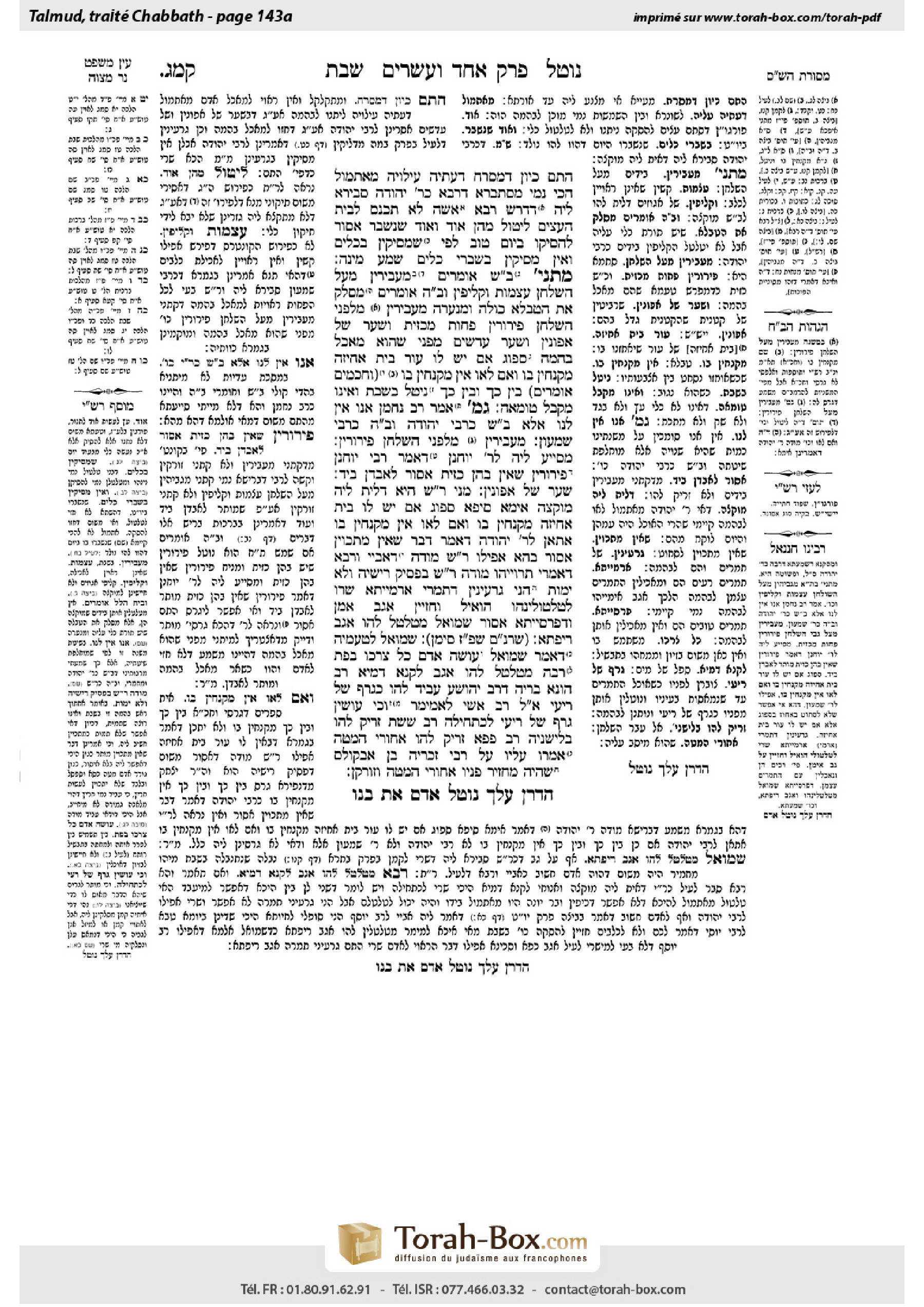
Shabbat 143a: Talmud study for Daf Yomi
Daf Yomi is the daily study of one Talmud folio. Explore 37 tractates with scans, Hebrew text, Sefaria English and AI-generated French translations where annotated.
Passage selection and English or AI-generated French translation are available where the scan has annotations. Daf Study is independent of Torah-Box and Sefaria.
Browse Shabbat · שבת · All tractatesShabbat 143a text and translations
This page of Shabbat includes the Aramaic text, an English translation and an AI-generated French translation, alongside the scan above.
שבת קמ״ג א · Aramaic and Hebrew text
הָתָם כֵּיוָן דְּמַסְרַח, דַּעְתֵּיהּ עִילָּוֵיהּ מֵאֶתְמוֹל.
הָכִי נָמֵי מִסְתַּבְּרָא דְּרָבָא כְּרַבִּי יְהוּדָה סְבִירָא לֵיהּ, דְּדָרֵשׁ רָבָא: אִשָּׁה לֹא תִּכָּנֵס לְבֵית הָעֵצִים לִיטּוֹל מֵהֶן אוּד. וְאוּד שֶׁנִּשְׁבַּר — אָסוּר לְהַסִּיקוֹ בְּיוֹם טוֹב, לְפִי שֶׁמַּסִּיקִין בְּכֵלִים וְאֵין מַסִּיקִין בְּשִׁבְרֵי כֵלִים. שְׁמַע מִינַּהּ.
מַתְנִי׳ בֵּית שַׁמַּאי אוֹמְרִים: מַעֲבִירִין מֵעַל הַשֻּׁלְחָן עֲצָמוֹת וּקְלִיפִּין. וּבֵית הִלֵּל אוֹמְרִים: מְסַלֵּק אֶת הַטַּבְלָא כּוּלָּהּ וּמְנַעֲרָהּ.
מַעֲבִירִין מִלִּפְנֵי הַשֻּׁלְחָן פֵּירוּרִין פָּחוֹת מִכְּזַיִת, וְשֵׂעָר שֶׁל אֲפוּנִין וּשְׂעַר עֲדָשִׁים, מִפְּנֵי שֶׁהוּא מַאֲכַל בְּהֵמָה.
סְפוֹג, אִם יֵשׁ לוֹ עוֹר בֵּית אֲחִיזָה — מְקַנְּחִין בּוֹ, וְאִם לָאו — אֵין מְקַנְּחִין בּוֹ. וַחֲכָמִים אוֹמְרִים: בֵּין כָּךְ וּבֵין כָּךְ נִיטָּל בְּשַׁבָּת, וְאֵינוֹ מְקַבֵּל טוּמְאָה.
גְּמָ׳ אָמַר רַב נַחְמָן: אָנוּ אֵין לָנוּ אֶלָּא: בֵּית שַׁמַּאי כְּרַבִּי יְהוּדָה, וּבֵית הִלֵּל כְּרַבִּי שִׁמְעוֹן.
מַעֲבִירִין מִלִּפְנֵי הַשֻּׁלְחָן פֵּירוּרִין. מְסַיַּיע לֵיהּ לְרַבִּי יוֹחָנָן, דְּאָמַר רַבִּי יוֹחָנָן: פֵּירוּרִין שֶׁאֵין בָּהֶן כְּזַיִת — אָסוּר לְאַבְּדָן בַּיָּד.
שֵׂעָר שֶׁל אֲפוּנִין. מַנִּי? — רַבִּי שִׁמְעוֹן הִיא, דְּלֵית לֵיהּ מוּקְצֶה.
אֵימָא סֵיפָא: סְפוֹג, אִם יֵשׁ לוֹ בֵּית אֲחִיזָה — מְקַנְּחִין בּוֹ, וְאִם לָאו אֵין מְקַנְּחִין בּוֹ. אֲתָאן לְרַבִּי יְהוּדָה, דְּאָמַר: דָּבָר שֶׁאֵין מִתְכַּוֵּין — אָסוּר!
בְּהָא אֲפִילּוּ רַבִּי שִׁמְעוֹן מוֹדֶה, דְּאַבָּיֵי וְרָבָא דְּאָמְרִי תַּרְוַיְיהוּ: מוֹדֶה רַבִּי שִׁמְעוֹן בִּ״פְסִיק רֵישֵׁיהּ וְלָא יְמוּת״.
הָנֵי גַּרְעִינִין דְּתַמְרֵי אֲרַמָּיָיתָא שְׁרוּ לְטַלְטוֹלִינְהוּ, הוֹאִיל וְחַזְיָין אַגַּב אִמָּן. וּדְפָרְסְיָיתָא — אָסוּר.
שְׁמוּאֵל מְטַלְטֵל לְהוּ אַגַּב רִיפְתָּא. (שרנ״ם שפ״ז סִימָן.) שְׁמוּאֵל לְטַעְמֵיהּ, דְּאָמַר שְׁמוּאֵל: עוֹשֶׂה אָדָם כׇּל צָרְכּוֹ בְּפַת.
רַבָּה מְטַלְטֵל לְהוּ אַגַּב לָקָנָא דְמַיָּא. רַב הוּנָא בְּרֵיהּ דְּרַב יְהוֹשֻׁעַ עָבֵיד לְהוּ כִּגְרָף שֶׁל רֶיעִי. אֲמַר לֵיהּ רַב אָשֵׁי לְאַמֵּימָר: וְכִי עוֹשִׂין גְּרָף שֶׁל רֶיעִי לְכַתְּחִילָּה?
רַב שֵׁשֶׁת זָרֵיק לְהוּ בְּלִישָּׁנֵיהּ. רַב פָּפָּא זָרֵיק לְהוּ אֲחוֹרֵי הַמִּטָּה. אָמְרוּ עָלָיו עַל רַבִּי זְכַרְיָה בֶּן אַבְקוּלָס שֶׁהָיָה מַחֲזִיר פָּנָיו אֲחוֹרֵי הַמִּטָּה וְזוֹרְקָן.
הדרן עלך נוטל אדם את בנו
Shabbat 143a · English translation
The Gemara answers: There, since the intestines will putrefy as time passes, they are on his mind from yesterday. Since Shabbat eve, he has had in mind to feed them to the cat.
The Gemara adds: So too, it is reasonable to say that Rava holds in accordance with the opinion of Rabbi Yehuda, as Rava taught: A woman may not enter the wood storehouse to take a wooden poker to stoke a fire on a Festival. And with regard to a poker that broke, it is prohibited to kindle a fire with it on a Festival, as one may kindle a fire on a Festival with vessels that may be moved, but one may not kindle a fire with broken vessels that broke during the Festival. They are set-aside and prohibited. Conclude from it that Rava ruled in accordance with the opinion of Rabbi Yehuda with regard to the halakhot of set-aside.
MISHNA: Beit Shammai say: One may clear bones and shells left from the Shabbat meal from the table with his hand. And Beit Hillel say: One may remove the entire board [tavla] that is the table surface and shake the bones and shells off of it, but he may not lift them with his hand because they are set-aside and may not be moved.
One may clear bread crumbs from the table, even if they are less than an olive-bulk, and pea and lentil pods. Even though it is not fit for human consumption, it may be moved because it is animal fodder.
With regard to a sponge, if it has leather as a handle, one may wipe the table with it, and if not, one may not wipe the table with it lest he come to squeeze liquid from it. And the Rabbis say: Both this, a dry sponge with a handle, and that, one without a handle, may be moved on Shabbat and it does not become ritually impure. A sponge is not among the substances that can become ritually impure, neither by Torah law nor by rabbinic decree.
GEMARA: Rav Naḥman said: Reverse the two opinions, as we have only Beit Shammai in accordance with the opinion of Rabbi Yehuda, who prohibits moving set-aside items, and Beit Hillel in accordance with the opinion of Rabbi Shimon, who permits doing so.
We learned in the mishna: One may clear bread crumbs from the table. The Gemara comments: This supports the opinion of Rabbi Yoḥanan, as Rabbi Yoḥanan said: With regard to crumbs that are less than an olive-bulk, it is prohibited to destroy them by hand in deference to the food.
We learned in the mishna: One may clear pea and lentil pods from the table on Shabbat. The Gemara asks: Whose opinion is it in the mishna? It is the opinion of Rabbi Shimon, who is not of the opinion that there is a prohibition of set-aside.
Say the latter clause of the mishna: With regard to a sponge, if it has leather as a handle, one may wipe the table with it, and if not, one may not wipe the table with it. We have arrived at the opinion of Rabbi Yehuda, who said: An unintentional act is prohibited, as he certainly does not intend to squeeze liquid from the sponge.
The Gemara answers: In that case, even Rabbi Shimon agrees that it is prohibited, as it is Abaye and Rava who both say: Rabbi Shimon agrees in a case of: Cut off its head will it not die, i.e., inevitable consequences. When the prohibited outcome that ensues from the unintentional action is inevitable, Rabbi Shimon agrees that it is prohibited. Squeezing liquid from a sponge is an inevitable consequence.
With regard to those pits of Aramean dates, which are low quality and occasionally fed to animals, it is permitted to move the pits since they are fit for use due to their origin, i.e., the dates that were prepared as animal feed beforehand. And moving pits of Persian dates is prohibited. Since those dates are high quality and are not prepared for animals, their pits, too, are not prepared for that use.
The Gemara relates that Shmuel would carry them along with bread. The letters shin, resh, nun, mem, shin, peh, zayin are a mnemonic of the Sages whose opinions are cited below: Shmuel, Rabba, Huna, Ameimar, Sheshet, Pappa, Zekharya. The Gemara comments: Shmuel’s statement is consistent with his reasoning, as Shmuel said: A man may perform all his needs with bread. As long as the bread remains edible, he need not be concerned that he is treating the bread contemptuously.
Rabba would move them along with a pitcher of water. Rav Huna, son of Rav Yehoshua, would render them a chamber pot with excrement. The Sages permitted moving repulsive vessels. Here, too, he would collect all the date pits and then move them out because they were disgusting. Rav Ashi said to Ameimar: And may one create a chamber pot with excrement ab initio? Although the Sages permitted moving a container of excrement, they did not permit creating one ab initio so that it would be permitted to move it.
Rav Sheshet would dispose of the pits with his tongue. Rav Pappa would dispose of them behind the divan on which he sat while eating because he did not want to move them in another manner. They said about Rabbi Zekharya ben Avkolas that he would turn his face toward the back of the divan and dispose of them.
Shabbat 143a · Traduction française (IA)
La Guemara répond : Là, puisque les intestins finiront par se putréfier, il y pense depuis la veille. Dès la veille de Chabbat, il avait l’intention de les donner au chat.
La Guemara ajoute : De même, il est raisonnable de dire que Rava suit l’opinion de Rabbi Yehouda, car Rava a enseigné : Une femme ne peut pas entrer dans le bûcher pour prendre un tisonnier en bois afin de raviver le feu pendant un jour de fête. Quant à un tisonnier qui s’est brisé, il est interdit d’allumer un feu avec pendant un jour de fête, car on peut allumer un feu pendant un jour de fête avec des ustensiles que l’on peut déplacer, mais non avec des ustensiles qui se sont brisés pendant le jour de fête. Ceux-ci sont mouktsé et interdits. Conclus-en que Rava a statué conformément à l’opinion de Rabbi Yehouda concernant les lois du mouktsé.
MICHNA : Beit Chammaï disent : On peut enlever de la table avec la main les os et les coquilles laissés après le repas de Chabbat. Beit Hillel disent : On peut retirer toute la planche [tavla], qui constitue le plateau de la table, et en secouer les os et les coquilles, mais on ne peut pas les ramasser avec la main, car ils sont mouktsé et ne peuvent pas être déplacés.
On peut enlever de la table les miettes de pain, même si elles font moins que le volume d’une olive, ainsi que les cosses de pois et de lentilles. Bien qu’elles ne conviennent pas à la consommation humaine, on peut les déplacer, car elles servent de nourriture aux animaux.
Concernant une éponge, si elle est munie d’un manche en cuir, on peut essuyer la table avec ; sinon, on ne peut pas l’utiliser pour essuyer la table, de peur de finir par en extraire du liquide en la pressant. Les Sages disent : Dans les deux cas, qu’elle soit sèche et munie d’un manche ou non, on peut déplacer l’éponge pendant Chabbat, et elle ne peut pas devenir rituellement impure. Une éponge ne fait pas partie des matières susceptibles de devenir rituellement impures, ni selon la Torah ni par décret rabbinique.
GUEMARA : Rav Na’hman dit : Inverse les deux opinions, car seuls Beit Chammaï suivent l’opinion de Rabbi Yehouda, qui interdit de déplacer les objets mouktsé, tandis que Beit Hillel suivent celle de Rabbi Chimon, qui le permet.
Nous avons appris dans la Michna : On peut enlever de la table les miettes de pain. La Guemara commente : Cela appuie l’opinion de Rabbi Yo’hanan, car Rabbi Yo’hanan a dit : Il est interdit de détruire à la main les miettes dont le volume est inférieur à celui d’une olive, par égard pour la nourriture.
Nous avons appris dans la Michna : On peut enlever de la table, pendant Chabbat, les cosses de pois et de lentilles. La Guemara demande : De qui est l’opinion exprimée dans la Michna ? C’est celle de Rabbi Chimon, qui ne reconnaît pas l’interdiction du mouktsé.
Examinons la dernière partie de la Michna : Concernant une éponge, si elle est munie d’un manche en cuir, on peut essuyer la table avec ; sinon, on ne peut pas l’utiliser pour essuyer la table. Nous sommes parvenus à l’opinion de Rabbi Yehouda, qui a dit : Un acte non intentionnel est interdit, alors qu’il n’a certainement pas l’intention d’extraire du liquide de l’éponge en la pressant.
La Guemara répond : Dans ce cas, même Rabbi Chimon reconnaît que c’est interdit, car Abayé et Rava disent tous deux : Rabbi Chimon reconnaît le principe « Si on lui coupe la tête, ne mourra-t-il pas ? », c’est-à-dire celui des conséquences inévitables. Lorsque l’issue interdite découlant de l’acte non intentionnel est inévitable, Rabbi Chimon reconnaît que c’est interdit. Extraire du liquide d’une éponge est une conséquence inévitable.
Quant aux noyaux de dattes araméennes, de qualité médiocre et parfois données aux animaux, il est permis de les déplacer, puisqu’ils sont aptes à cet usage en raison de leur origine, c’est-à-dire les dattes qui avaient été préparées à l’avance comme nourriture pour les animaux. En revanche, il est interdit de déplacer les noyaux de dattes persanes. Ces dattes étant de bonne qualité et n’étant pas préparées pour les animaux, leurs noyaux non plus ne sont pas destinés à cet usage.
Chemouel les déplaçait avec du pain. Les lettres chin, rech, noun, mem, chin, pé, zaïn forment un moyen mnémotechnique des Sages dont les opinions sont citées ci-dessous : Chemouel, Rabba, Houna, Ameïmar, Chéchet, Pappa, Zekharya. La Guemara commente : La déclaration de Chemouel est conforme à son raisonnement, car Chemouel a dit : Un homme peut se servir du pain pour tous ses besoins. Tant que le pain reste comestible, il n’a pas à craindre de le traiter avec mépris.
Rabba les déplaçait avec une cruche d’eau. Rav Houna, fils de Rav Yehochoua, en faisait un pot de chambre avec des excréments. Les Sages ont permis de déplacer les récipients répugnants. Ici aussi, il rassemblait tous les noyaux de dattes, puis les déplaçait parce qu’ils étaient répugnants. Rav Achi dit à Ameïmar : Peut-on créer d’emblée un pot de chambre avec des excréments ? Bien que les Sages aient permis de déplacer un récipient contenant des excréments, ils n’ont pas permis d’en créer un d’emblée afin de pouvoir ensuite le déplacer.
Rav Chéchet se débarrassait des noyaux avec sa langue. Rav Pappa les jetait derrière le divan sur lequel il était assis pendant qu’il mangeait, car il ne voulait pas les déplacer autrement. On disait de Rabbi Zekharya ben Avkolas qu’il tournait le visage vers l’arrière du divan et s’en débarrassait.
Traduction française générée par IA à partir de l’édition anglaise de Sefaria. Vérifie toujours un passage avec le texte source.
Text from Sefaria: William Davidson Edition - Vocalized Aramaic (CC BY NC); William Davidson Edition - English (CC BY NC).