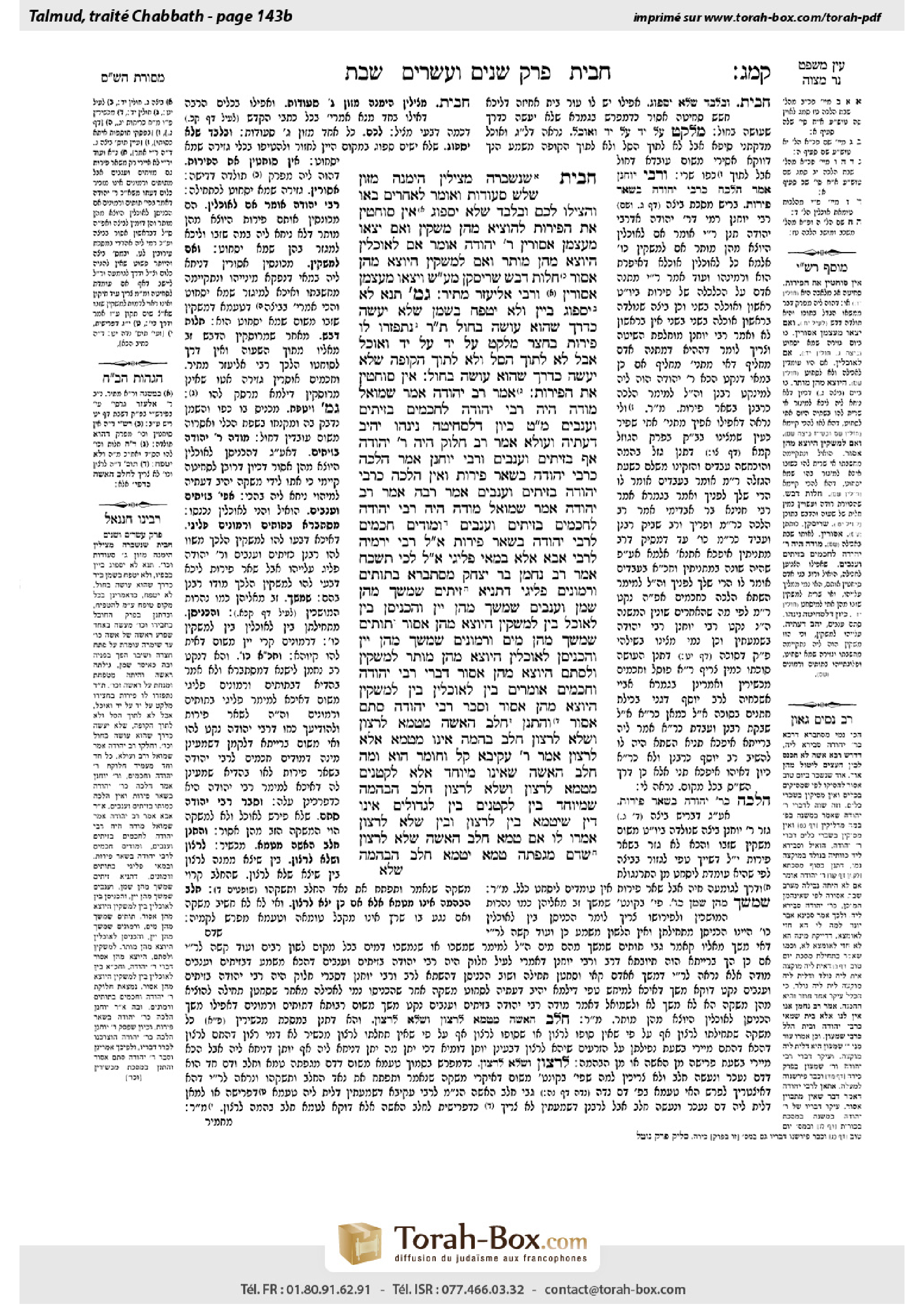
Shabbat 143b: Talmud study for Daf Yomi
Daf Yomi is the daily study of one Talmud folio. Explore 37 tractates with scans, Hebrew text, Sefaria English and AI-generated French translations where annotated.
Passage selection and English or AI-generated French translation are available where the scan has annotations. Daf Study is independent of Torah-Box and Sefaria.
Browse Shabbat · שבת · All tractatesShabbat 143b text and translations
This page of Shabbat includes the Aramaic text, an English translation and an AI-generated French translation, alongside the scan above.
שבת קמ״ג ב · Aramaic and Hebrew text
מַתְנִי׳ חָבִית שֶׁנִּשְׁבְּרָה מַצִּילִין הֵימֶנָּה מְזוֹן שָׁלֹשׁ סְעוּדוֹת, וְאוֹמֵר לַאֲחֵרִים: בֹּאוּ וְהַצִּילוּ לָכֶם. וּבִלְבַד שֶׁלֹּא יִסְפּוֹג. אֵין סוֹחֲטִין אֶת הַפֵּירוֹת לְהוֹצִיא מֵהֶן מַשְׁקִין, וְאִם יָצְאוּ מֵעַצְמָן — אֲסוּרִין. רַבִּי יְהוּדָה אוֹמֵר: אִם לָאוֹכָלִין — הַיּוֹצֵא מֵהֶן מוּתָּר. וְאִם לְמַשְׁקִין — הַיּוֹצֵא מֵהֶן אָסוּר. חַלּוֹת דְּבַשׁ שֶׁרִיסְּקָן מֵעֶרֶב שַׁבָּת, וְיָצְאוּ מֵעַצְמָן — אֲסוּרִין, וְרַבִּי אֱלִיעֶזֶר מַתִּיר.
גְּמָ׳ תָּנָא: לֹא יִסְפּוֹג בְּיַיִן וְלֹא יְטַפֵּחַ בְּשֶׁמֶן, שֶׁלֹּא יַעֲשֶׂה כְּדֶרֶךְ שֶׁהוּא עוֹשֶׂה בַּחוֹל. תָּנוּ רַבָּנַן: נִתְפַּזְּרוּ לוֹ פֵּירוֹת בֶּחָצֵר — מְלַקֵּט עַל יָד עַל יָד, וְאוֹכֵל, אֲבָל לֹא לְתוֹךְ הַסַּל וְלֹא לְתוֹךְ הַקּוּפָּה, שֶׁלֹּא יַעֲשֶׂה כְּדֶרֶךְ שֶׁהוּא עוֹשֶׂה בַּחוֹל.
אֵין סוֹחֲטִין אֶת הַפֵּירוֹת. אָמַר רַב יְהוּדָה אָמַר שְׁמוּאֵל: מוֹדֶה הָיָה רַבִּי יְהוּדָה לַחֲכָמִים בְּזֵיתִים וַעֲנָבִים. מַאי טַעְמָא? כֵּיוָן דְּלִסְחִיטָה נִינְהוּ — יָהֵיב דַּעְתֵּיהּ. וְעוּלָּא אָמַר רַב: חָלוּק הָיָה רַבִּי יְהוּדָה אַף בְּזֵיתִים וַעֲנָבִים. וְרַבִּי יוֹחָנָן אָמַר: הֲלָכָה כְּרַבִּי יְהוּדָה בִּשְׁאָר פֵּירוֹת, וְאֵין הֲלָכָה כְּרַבִּי יְהוּדָה בְּזֵיתִים וַעֲנָבִים.
אָמַר רַבָּה אָמַר רַב יְהוּדָה אָמַר שְׁמוּאֵל: מוֹדֶה הָיָה רַבִּי יְהוּדָה לַחֲכָמִים בְּזֵיתִים וַעֲנָבִים, וּמוֹדִים חֲכָמִים לְרַבִּי יְהוּדָה בִּשְׁאָר פֵּירוֹת.
אֲמַר לֵיהּ רַבִּי יִרְמְיָה לְרַבִּי אַבָּא: אֶלָּא בְּמַאי פְּלִיגִי? אֲמַר לֵיהּ: לְכִי תַּשְׁכַּח. אָמַר רַב נַחְמָן בַּר יִצְחָק: מִסְתַּבְּרָא בְּתוּתִים וְרִמּוֹנִים פְּלִיגִי.
דְּתַנְיָא: זֵיתִים שֶׁמָּשַׁךְ מֵהֶן שֶׁמֶן וַעֲנָבִים שֶׁמָּשַׁךְ מֵהֶן יַיִן, וְהִכְנִיסָן, בֵּין לְאוֹכֶל בֵּין לְמַשְׁקִין — הַיּוֹצֵא מֵהֶן אָסוּר. תּוּתִים שֶׁמָּשַׁךְ מֵהֶן מַיִם וְרִמּוֹנִים שֶׁמָּשַׁךְ מֵהֶן יַיִן, וְהִכְנִיסָן, לָאוֹכָלִין — הַיּוֹצֵא מֵהֶן מוּתָּר, לְמַשְׁקִין וְלִסְתָם — הַיּוֹצֵא מֵהֶן אָסוּר, דִּבְרֵי רַבִּי יְהוּדָה. וַחֲכָמִים אוֹמְרִים: בֵּין לָאוֹכָלִין בֵּין לְמַשְׁקִין — הַיּוֹצֵא מֵהֶן אָסוּר.
וְסָבַר רַבִּי יְהוּדָה סְתָם אָסוּר?! וְהָתְנַן: חֲלֵב הָאִשָּׁה מְטַמֵּא לְרָצוֹן וְשֶׁלֹּא לְרָצוֹן. חֲלֵב בְּהֵמָה אֵינוֹ מְטַמֵּא אֶלָּא לְרָצוֹן.
אָמַר רַבִּי עֲקִיבָא: קַל וָחוֹמֶר הוּא, וּמֶה חֲלֵב הָאִשָּׁה שֶׁאֵינוֹ מְיוּחָד אֶלָּא לִקְטַנִּים — מְטַמֵּא לְרָצוֹן וְשֶׁלֹּא לְרָצוֹן, חֲלֵב הַבְּהֵמָה שֶׁמְיוּחָד בֵּין לִקְטַנִּים בֵּין לִגְדוֹלִים, אֵינוֹ דִּין שֶׁיְּטַמֵּא בֵּין לְרָצוֹן וּבֵין שֶׁלֹּא לְרָצוֹן? אָמְרוּ לוֹ: אִם טָמֵא חֲלֵב הָאִשָּׁה שֶׁלֹּא לְרָצוֹן, שֶׁדַּם מַגֵּפָתָהּ טָמֵא, יְטַמֵּא חֲלֵב הַבְּהֵמָה
Shabbat 143b · English translation
MISHNA: From a barrel of wine or oil that broke on Shabbat, one may rescue from it food sufficient for three meals, and one may also say to others: Come and rescue food for yourselves. This applies provided that one does not soak up the wine or oil with a sponge or rag, due to the prohibition of squeezing. One may not squeeze fruits on Shabbat in order to extract liquids from them. And if liquids seeped out on their own, it is prohibited to use them on Shabbat. Rabbi Yehuda says: If the fruits were designated for eating, the liquid that seeps from them on Shabbat is permitted. There is no concern lest one purposely squeeze liquids from fruit that is designated for eating. And if the fruits were originally designated for liquids, the liquids that seep from them on Shabbat are prohibited. In the case of honeycombs that one crushed on Shabbat eve, and honey and wax seeped from them on their own on Shabbat, they are prohibited, and Rabbi Eliezer permits using them.
GEMARA: It was taught in the Tosefta: One may not soak up wine and one may not collect oil in his hand, so that one will not conduct himself on Shabbat in the manner that he conducts himself during the week. The Sages taught in a baraita: If one’s fruit was scattered in a courtyard on Shabbat, one may collect them from hand to hand, a little at a time, and eat them immediately. However, one may not collect them into a basket or into a box, so that one will not conduct himself on Shabbat in the manner that he conducts himself during the week.
We learned in the mishna: One may not squeeze fruit on Shabbat, and the liquid that seeps from fruit on its own is prohibited. Rabbi Yehuda, however, distinguishes between fruit that is designated for eating, in which case the liquid that seeps out on its own is permitted, and fruit that is designated for juicing, in which case the liquid that seeps out on its own on Shabbat is prohibited. Rav Yehuda said that Shmuel said: Rabbi Yehuda concedes to the Rabbis with regard to olives and grapes. Even if they were designated for eating, the liquid that seeps from them on its own on Shabbat is prohibited. What is the reason for this? Since they are generally used for squeezing, one had in mind from the outset that these would serve that purpose as well, even if he designated them for eating. And Ulla said that Rav said: Rabbi Yehuda was in disagreement even with regard to olives and grapes. And Rabbi Yoḥanan said: The halakha is in accordance with the opinion of Rabbi Yehuda with regard to other fruits, and the halakha is not in accordance with the opinion of Rabbi Yehuda with regard to olives and grapes.
Rabba said that Rav Yehuda said that Shmuel said as follows: Rabbi Yehuda would concede to the Rabbis with regard to olives and grapes, and the Rabbis would concede to Rabbi Yehuda with regard to other fruit.
Rabbi Yirmeya said to Rabbi Abba: If it is true that they agree with each other, with regard to what do they disagree? He said to him: When you find it, i.e., examine this matter and you will find areas in which they disagree. Rav Naḥman bar Yitzḥak said: It stands to reason that they disagree with regard to mulberries and pomegranates, which have intermediate status, between olives and grapes, which are always considered designated for juicing, and other fruits, which are not.
As it was taught in a baraita: With regard to olives from which one squeezed oil and grapes from which one squeezed wine before Shabbat (Tosafot), and he subsequently brought them into his house, whether he brought them in for use as food or whether he brought them in for use of their liquids, that which seeps from them on its own on Shabbat is prohibited. However, with regard to mulberries from which one squeezed water, i.e., juice, and pomegranates from which one squeezed wine, i.e., pomegranate juice, and he brought them into the house, if he originally brought them in for use as food, what seeps from them is permitted. And if he brought them in for use of their liquids, and similarly, if he brought them in without specifying his intention, what seeps from them is prohibited. This is the statement of Rabbi Yehuda. And the Rabbis say: Whether he brought them into the house for use as food or whether he brought them in for use of their liquids, what seeps from them is prohibited.
The Gemara questions this baraita: And does Rabbi Yehuda maintain that in the case of undesignated fruit that was not designated for a specific purpose, the liquid that seeps on its own is prohibited? Didn’t we learn in a mishna: A woman’s milk is considered a liquid and therefore renders food susceptible to ritual impurity, whether the milk was expressed volitionally and whether it was expressed unvolitionally? On the other hand, milk of an animal only renders food susceptible to ritual impurity if it was milked volitionally but not if it drips out on its own.
Rabbi Akiva said: It is an a fortiori inference that this is incorrect: Just as a woman’s milk, which is intended only for young children, is considered a liquid and renders food susceptible to ritual impurity both if the milk is expressed volitionally and if it is expressed unvolitionally, the milk of an animal, which is intended for both young and old, is it not logical that it should render food susceptible to ritual impurity, both if it was expressed volitionally and if it was expressed unvolitionally? They said to him that this a fortiori inference can be refuted in the following way: If a woman’s milk renders food susceptible to ritual impurity even when the milk was expressed unvolitionally, as the status of the blood of her wound is also that of a liquid that renders food susceptible to ritual impurity, that does not mean that the milk of an animal renders food susceptible to ritual impurity
Shabbat 143b · Traduction française (IA)
MICHNA : Si un tonneau de vin ou d’huile se brise pendant Chabbat, on peut en sauver de quoi manger trois repas. On peut aussi dire aux autres : « Venez sauver de quoi manger pour vous-mêmes. » Cela est permis à condition de ne pas éponger le vin ou l’huile avec une éponge ou un chiffon, en raison de l’interdiction d’essorer. Il est interdit de presser des fruits pendant Chabbat pour en extraire le jus. Si du jus s’en écoule spontanément, il est interdit de l’utiliser pendant Chabbat. Rabbi Yehouda dit : Si les fruits étaient destinés à être mangés, le jus qui s’en écoule pendant Chabbat est permis. Il n’y a pas à craindre que l’on presse délibérément les fruits destinés à être mangés. Si, en revanche, les fruits étaient destinés à fournir du jus, le jus qui s’en écoule pendant Chabbat est interdit. Quant aux rayons de miel écrasés la veille de Chabbat, si le miel et la cire s’en écoulent spontanément pendant Chabbat, ils sont interdits ; Rabbi Eliezer permet de les utiliser.
GUEMARA : Il a été enseigné dans la Tossefta : On ne doit pas éponger le vin ni recueillir l’huile dans sa main, afin de ne pas se comporter pendant Chabbat comme on le fait en semaine. Les Sages ont enseigné dans une baraïta : Si les fruits de quelqu’un se sont dispersés dans une cour pendant Chabbat, il peut les ramasser à la main, un peu à la fois, et les manger immédiatement. Toutefois, il ne doit pas les ramasser dans un panier ou dans une caisse, afin de ne pas se comporter pendant Chabbat comme on le fait en semaine.
Nous avons appris dans la Michna : Il est interdit de presser des fruits pendant Chabbat, et le jus qui s’en écoule spontanément est interdit. Rabbi Yehouda distingue toutefois entre les fruits destinés à être mangés, auquel cas le jus qui s’en écoule spontanément est permis, et les fruits destinés à être pressés, auquel cas le jus qui s’en écoule pendant Chabbat est interdit. Rav Yehouda a dit au nom de Shmouel : Rabbi Yehouda reconnaît l’avis des Rabbins au sujet des olives et des raisins. Même s’ils étaient destinés à être mangés, le jus qui s’en écoule spontanément pendant Chabbat est interdit. Pour quelle raison ? Puisqu’ils sont généralement pressés, on a d’emblée à l’esprit qu’ils serviront aussi à cela, même s’ils étaient destinés à être mangés. Oulla a dit au nom de Rav : Rabbi Yehouda était en désaccord même au sujet des olives et des raisins. Rabbi Yoḥanan a dit : La halakha suit l’opinion de Rabbi Yehouda pour les autres fruits, mais ne la suit pas pour les olives et les raisins.
Rabba a dit au nom de Rav Yehouda, qui l’a dit au nom de Shmouel : Rabbi Yehouda aurait reconnu l’avis des Rabbins au sujet des olives et des raisins, et les Rabbins auraient reconnu l’avis de Rabbi Yehouda au sujet des autres fruits.
Rabbi Yirmeya dit à Rabbi Abba : S’ils sont effectivement d’accord entre eux, sur quoi sont-ils en désaccord ? Il lui répondit : « Quand tu le trouveras », c’est-à-dire : examine cette question et tu trouveras des cas où ils sont en désaccord. Rav Naḥman bar Yitzḥak dit : Il est raisonnable de supposer qu’ils sont en désaccord au sujet des mûres et des grenades, qui ont un statut intermédiaire entre les olives et les raisins, toujours considérés comme destinés à être pressés, et les autres fruits, qui ne le sont pas.
Car il a été enseigné dans une baraïta : À propos des olives dont on a pressé l’huile et des raisins dont on a pressé le vin avant Chabbat [Tosafot], puis que l’on a apportés chez soi, qu’on les ait apportés pour les utiliser comme aliments ou pour en utiliser les jus, ce qui s’en écoule spontanément pendant Chabbat est interdit. En revanche, à propos des mûres dont on a extrait le jus et des grenades dont on a extrait le vin, c’est-à-dire le jus de grenade, puis que l’on a apportées chez soi, si on les a apportées à l’origine pour les utiliser comme aliments, ce qui s’en écoule est permis. Mais si on les a apportées pour en utiliser les jus, ou si on les a apportées sans préciser son intention, ce qui s’en écoule est interdit. Telle est l’opinion de Rabbi Yehouda. Les Rabbins disent : Qu’on les ait apportées chez soi pour les utiliser comme aliments ou pour en utiliser les jus, ce qui s’en écoule est interdit.
La Guemara met cette baraïta en question : Rabbi Yehouda soutient-il donc que, dans le cas de fruits auxquels aucun usage précis n’a été assigné, le jus qui s’en écoule spontanément est interdit ? N’avons-nous pas appris dans une Michna : Le lait d’une femme est considéré comme un liquide et rend donc les aliments susceptibles de contracter l’impureté rituelle, qu’il ait été exprimé volontairement ou involontairement ? En revanche, le lait d’un animal ne rend les aliments susceptibles de contracter l’impureté rituelle que s’il a été trait volontairement, mais pas s’il s’écoule spontanément.
Rabbi Akiva dit : Une déduction a fortiori montre que cela est incorrect : de même que le lait d’une femme, qui est destiné uniquement aux jeunes enfants, est considéré comme un liquide et rend les aliments susceptibles de contracter l’impureté rituelle, qu’il ait été exprimé volontairement ou involontairement, le lait d’un animal, destiné aux jeunes comme aux adultes, ne devrait-il pas, à plus forte raison, rendre les aliments susceptibles de contracter l’impureté rituelle, qu’il ait été trait volontairement ou involontairement ? Ils lui répondirent que cette déduction a fortiori peut être réfutée de la manière suivante : si le lait d’une femme rend les aliments susceptibles de contracter l’impureté rituelle même lorsqu’il a été exprimé involontairement, c’est parce que le sang de sa blessure est lui aussi un liquide qui rend les aliments susceptibles de contracter l’impureté rituelle. Cela ne signifie pas que le lait d’un animal rend les aliments susceptibles de contracter l’impureté rituelle.
Traduction française générée par IA à partir de l’édition anglaise de Sefaria. Vérifie toujours un passage avec le texte source.
Text from Sefaria: William Davidson Edition - Vocalized Aramaic (CC BY NC); William Davidson Edition - English (CC BY NC).