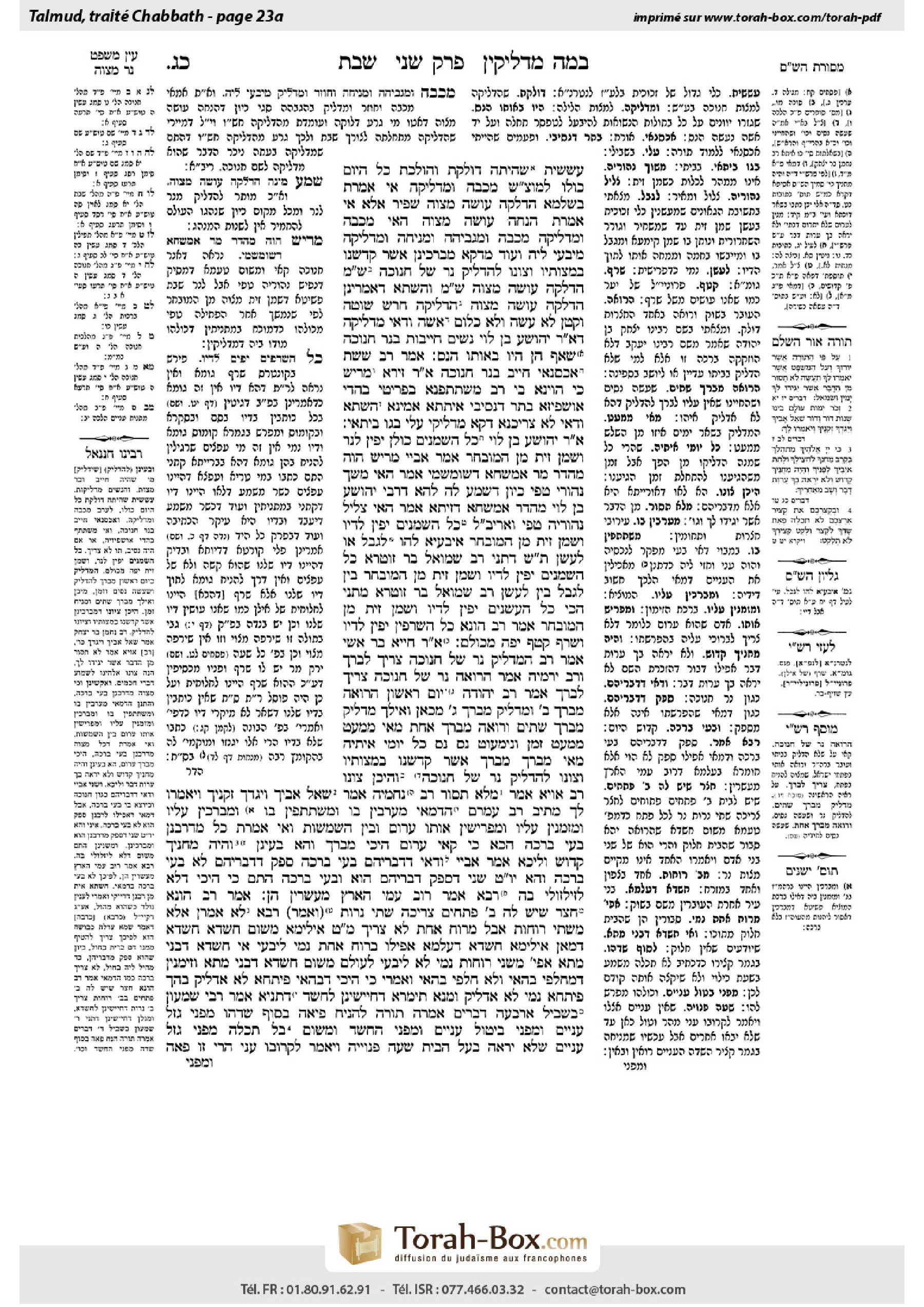
Shabbat 23a: Talmud study for Daf Yomi
Daf Yomi is the daily study of one Talmud folio. Explore 37 tractates with scans, Hebrew text, Sefaria English and AI-generated French translations where annotated.
Passage selection and English or AI-generated French translation are available where the scan has annotations. Daf Study is independent of Torah-Box and Sefaria.
Browse Shabbat · שבת · All tractatesShabbat 23a text and translations
This page of Shabbat includes the Aramaic text, an English translation and an AI-generated French translation, alongside the scan above.
שבת כ״ג א · Aramaic and Hebrew text
עֲשָׁשִׁית שֶׁהָיְתָה דּוֹלֶקֶת וְהוֹלֶכֶת כׇּל הַיּוֹם כּוּלּוֹ, לְמוֹצָאֵי שַׁבָּת מְכַבָּהּ וּמַדְלִיקָהּ. אִי אָמְרַתְּ בִּשְׁלָמָא הַדְלָקָה עוֹשָׂה מִצְוָה — שַׁפִּיר. אֶלָּא אִי אָמְרַתְּ הַנָּחָה עוֹשָׂה מִצְוָה, הַאי מְכַבָּהּ וּמַדְלִיקָהּ, מְכַבָּהּ וּמַגְבִּיהָהּ וּמַנִּיחָהּ וּמַדְלִיקָהּ מִיבְּעֵי לֵיהּ! וְעוֹד: מִדְּקָא מְבָרְכִינַן ״אֲשֶׁר קִדְּשָׁנוּ בְּמִצְוֹתָיו וְצִוָּנוּ לְהַדְלִיק נֵר שֶׁל חֲנוּכָּה״ — שְׁמַע מִינָּה הַדְלָקָה עוֹשָׂה מִצְוָה. שְׁמַע מִינָּה.
וְהַשְׁתָּא דְּאָמְרִינַן הַדְלָקָה עוֹשָׂה מִצְוָה, הִדְלִיקָהּ חֵרֵשׁ שׁוֹטֶה וְקָטָן לֹא עָשָׂה וְלֹא כְלוּם. אִשָּׁה וַדַּאי מַדְלִיקָה, דְּאָמַר רַבִּי יְהוֹשֻׁעַ בֶּן לֵוִי: נָשִׁים חַיָּיבוֹת בְּנֵר חֲנוּכָּה שֶׁאַף הֵן הָיוּ בְּאוֹתוֹ הַנֵּס.
אָמַר רַב שֵׁשֶׁת: אַכְסְנַאי חַיָּיב בְּנֵר חֲנוּכָּה. אָמַר רַבִּי זֵירָא: מֵרֵישׁ כִּי הֲוֵינָא בֵּי רַב, מִשְׁתַּתַּפְנָא בִּפְרִיטֵי בַּהֲדֵי אוּשְׁפִּיזָא. בָּתַר דִּנְסֵיבִי אִיתְּתָא, אָמֵינָא: הַשְׁתָּא וַדַּאי לָא צְרִיכְנָא, דְּקָא מַדְלְקִי עֲלַי בְּגוֹ בֵּיתַאי.
אָמַר רַבִּי יְהוֹשֻׁעַ בֶּן לֵוִי: כׇּל הַשְּׁמָנִים כּוּלָּן יָפִין לַנֵּר, וְשֶׁמֶן זַיִת מִן הַמּוּבְחָר. אָמַר אַבָּיֵי: מֵרֵישׁ הֲוָה מְהַדַּר מָר אַמִּשְׁחָא דְשׁוּמְשְׁמֵי. אָמַר: הַאי מְשִׁיךְ נְהוֹרֵיהּ טְפֵי. כֵּיוָן דִּשְׁמַע לַהּ לְהָא דְּרַבִּי יְהוֹשֻׁעַ בֶּן לֵוִי, מְהַדַּר אַמִּשְׁחָא דְזֵיתָא. אָמַר: הַאי צְלִיל נְהוֹרֵיהּ טְפֵי.
וְאָמַר רַבִּי יְהוֹשֻׁעַ בֶּן לֵוִי: כׇּל הַשְּׁמָנִים יָפִין לַדְּיוֹ, וְשֶׁמֶן זַיִת מִן הַמּוּבְחָר. אִיבַּעְיָא לְהוּ: לְגַבֵּל, אוֹ לְעַשֵּׁן? תָּא שְׁמַע, דְּתָנֵי רַב שְׁמוּאֵל בַּר זוּטְרָא: כׇּל הַשְּׁמָנִים יָפִין לַדְּיוֹ, וְשֶׁמֶן זַיִת מִן הַמּוּבְחָר — בֵּין לְגַבֵּל בֵּין לְעַשֵּׁן. רַב שְׁמוּאֵל בַּר זוּטְרָא מַתְנֵי הָכִי: כׇּל הָעֲשָׁנִים יָפִין לַדְּיוֹ, וְשֶׁמֶן זַיִת מִן הַמּוּבְחָר. אָמַר רַב הוּנָא: כׇּל הַשְּׂרָפִין יָפִין לַדְּיוֹ, וּשְׂרַף קְטָף יָפֶה מִכּוּלָּם.
אָמַר רַב חִיָּיא בַּר אָשֵׁי אָמַר רַב: הַמַּדְלִיק נֵר שֶׁל חֲנוּכָּה צָרִיךְ לְבָרֵךְ. וְרַב יִרְמְיָה אָמַר: הָרוֹאֶה נֵר שֶׁל חֲנוּכָּה צָרִיךְ לְבָרֵךְ. אָמַר רַב יְהוּדָה: יוֹם רִאשׁוֹן, הָרוֹאֶה מְבָרֵךְ שְׁתַּיִם, וּמַדְלִיק מְבָרֵךְ שָׁלֹשׁ. מִכָּאן וְאֵילָךְ, מַדְלִיק מְבָרֵךְ שְׁתַּיִם, וְרוֹאֶה מְבָרֵךְ אַחַת. מַאי מְמַעֵט? מְמַעֵט זְמַן: וְנִימְעוֹט נֵס! — נֵס כׇּל יוֹמֵי אִיתֵיהּ.
מַאי מְבָרֵךְ? — מְבָרֵךְ: ״אֲשֶׁר קִדְּשָׁנוּ בְּמִצְוֹתָיו וְצִוָּנוּ לְהַדְלִיק נֵר שֶׁל חֲנוּכָּה״. וְהֵיכָן צִוָּנוּ? רַב אַוְיָא אָמַר: מִ״לֹּא תָסוּר״. רַב נְחֶמְיָה אָמַר: ״שְׁאַל אָבִיךָ וְיַגֵּדְךָ זְקֵנֶיךָ וְיֹאמְרוּ לָךְ״.
מֵתִיב רַב עַמְרָם: הַדְּמַאי, מְעָרְבִין בּוֹ וּמִשְׁתַּתְּפִין בּוֹ וּמְבָרְכִין עָלָיו וּמְזַמְּנִין עָלָיו וּמַפְרִישִׁין אוֹתוֹ עָרוֹם וּבֵין הַשְּׁמָשׁוֹת. וְאִי אָמְרַתְּ כׇּל מִדְּרַבָּנַן בָּעֵי בְּרָכָה, הָכָא כִּי קָאֵי עָרוֹם הֵיכִי מְבָרֵךְ? וְהָא בָּעֵינַן וְהָיָה מַחֲנֶיךָ קָדוֹשׁ — וְלֵיכָּא! אָמַר אַבָּיֵי: וַדַּאי דְּדִבְרֵיהֶם בָּעֵי בְּרָכָה, סָפֵק דְּדִבְרֵיהֶם לָא בָּעֵי בְּרָכָה.
וְהָא יוֹם טוֹב שֵׁנִי דִּסְפֵק דִּבְרֵיהֶם הוּא, וּבָעֵי בְּרָכָה? הָתָם כִּי הֵיכִי דְּלָא לִיזַלְזְלוּ בֵּהּ. רָבָא אָמַר: רוֹב עַמֵּי הָאָרֶץ מְעַשְּׂרִין הֵן.
אָמַר רַב הוּנָא: חָצֵר שֶׁיֵּשׁ לָהּ שְׁנֵי פְּתָחִים צְרִיכָה שְׁתֵּי נֵרוֹת. (וְאָמַר) [אָמַר] רָבָא: לָא אֲמַרַן אֶלָּא מִשְׁתֵּי רוּחוֹת, אֲבָל מֵרוּחַ אַחַת — לָא צְרִיךְ. מַאי טַעְמָא? אִילֵּימָא מִשּׁוּם חֲשָׁדָא — חֲשָׁדָא דְמַאן? אִילֵּימָא חֲשָׁדָא דְעָלְמָא — אֲפִילּוּ בְּרוּחַ אַחַת נָמֵי לִיבְעֵי! אִי חֲשָׁדָא דִּבְנֵי מָתָא — אֲפִילּוּ מִשְׁתֵּי רוּחוֹת נָמֵי לָא לִיבְעֵי. לְעוֹלָם מִשּׁוּם חֲשָׁדָא דִּבְנֵי מָתָא, וְזִימְנִין דְּחָלְפִי בְּהַאי וְלָא חָלְפִי בְּהַאי, וְאָמְרִי: כִּי הֵיכִי דִּבְהַאי פִּיתְחָא לָא אַדְלִיק — בְּהָךְ פִּיתְחָא נָמֵי לָא אַדְלִיק.
וּמְנָא תֵּימְרָא דְּחָיְישִׁינַן לַחֲשָׁד? — דְּתַנְיָא אָמַר רַבִּי שִׁמְעוֹן: בִּשְׁבִיל אַרְבָּעָה דְּבָרִים אָמְרָה תּוֹרָה לְהַנִּיחַ פֵּיאָה בְּסוֹף שָׂדֵהוּ: מִפְּנֵי גֶּזֶל עֲנִיִּים, וּמִפְּנֵי בִּיטּוּל עֲנִיִּים, וּמִפְּנֵי הַחֲשָׁד, וּמִשּׁוּם ״בַּל תְּכַלֶּה״. מִפְּנֵי גֶּזֶל עֲנִיִּים — שֶׁלֹּא יִרְאֶה בַּעַל הַבַּיִת שָׁעָה פְּנוּיָיה וְיֹאמַר לִקְרוֹבוֹ עָנִי: ״הֲרֵי זוֹ פֵּאָה״.
Shabbat 23a · English translation
A lantern that continued to burn the entire day of Shabbat, at the conclusion of Shabbat one extinguishes it and lights it again as a Hanukkah light. Granted, if you say that lighting accomplishes the mitzva, the requirement to extinguish the lantern and relight it in order to fulfill the mitzva of kindling the Hanukkah light works out well. However, if you say that placing accomplishes the mitzva, this statement, which stated that one extinguishes it and lights it, is imprecise. According to this opinion, it needed to say: One extinguishes it and lifts it from its place and sets it down and lights it, as only by placing the lamp in an appropriate place could one fulfill the mitzva of the Hanukkah light. Furthermore, there is additional proof that lighting accomplishes the mitzva. From the fact that we recite the following blessing over the mitzva of kindling the Hanukkah light: Who has made us holy through His commandments and has commanded us to light the Hanukkah light, the Gemara suggests: Conclude from this that lighting accomplishes the mitzva, as it is over lighting that one recites the blessing. The Gemara concludes: Indeed, conclude from this.
And, the Gemara remarks, now that we say that lighting accomplishes the mitzva, there are practical ramifications. If a deaf-mute, an imbecile, or a minor, all of whom are of limited intellectual capacity and not obligated in mitzvot, kindled the Hanukkah light, he did nothing in terms of fulfilling the mitzva, even if an adult obligated in mitzvot subsequently set it down in its appropriate place. That is because placing a lit lamp does not constitute fulfillment of the mitzva. The lighting must be performed by a person with full intellectual capacity, obligated in mitzvot. However, a woman certainly may light, as Rabbi Yehoshua ben Levi said: Women are obligated in lighting the Hanukkah light, as they too were included in that miracle of being saved from the decree of persecution.
Rav Sheshet said: A guest is obligated in lighting the Hanukkah light in the place where he is being hosted. The Gemara relates that Rabbi Zeira said: At first, when I was studying in the yeshiva, I would participate with perutot, copper coins, together with the host [ushpiza], so that I would be a partner in the light that he kindled. After I married my wife, I said: Now I certainly need not do so because they light on my behalf in my house.
Rabbi Yehoshua ben Levi said: All the oils are suitable for the Hanukkah lamp, and olive oil is the most select of the oils. Abaye said: At first, my Master, Rabba, would seek sesame oil, as he said: The light of sesame oil lasts longer and does not burn as quickly as olive oil. Once he heard that statement of Rabbi Yehoshua ben Levi, he sought olive oil because he said: Its light is clearer.
On a similar note, Rabbi Yehoshua ben Levi said: All the oils are suitable for making ink, and olive oil is the most select. A dilemma was raised before the Sages: What was Rabbi Yehoshua ben Levi’s intention: Did he mean that olive oil is the most select in terms of being the best for use to mix and knead with the soot produced from a fire in manufacturing ink; or did he mean for use to smoke, i.e., burning olive oil to produce smoke is the most select method of producing the soot used in manufacturing ink? Come and hear a resolution to this from that which Rav Shmuel bar Zutrei taught: All oils are suitable for ink, and olive oil is the most select, both to knead and to smoke. Rav Shmuel bar Zutra taught it this way: All types of smoke are good for ink, and olive oil is the most select. Similarly, Rav Huna said: All saps are good for strengthening the ink compound, and balsam sap is the best of all.
Rav Ḥiyya bar Ashi said that Rav said: One who lights a Hanukkah light must recite a blessing. And Rabbi Yirmeya said: One who sees a burning Hanukkah light must recite a blessing because the mitzva is not only to kindle the light but to see the light as well. Therefore, there is room to recite a blessing even when seeing them. Rav Yehuda said: On the first day of Hanukkah, the one who sees burning lights recites two blessings, and the one who lights recites three blessings. From there on, from the second day of Hanukkah, the one who lights recites two blessings, and the one who sees recites one blessing. The Gemara asks: What blessing does he omit on the other days? The Gemara answers: He omits the blessing of time: Who has given us life, sustained us, and brought us to this time. The Gemara asks: And let us omit the blessing of the miracle: Who has performed miracles. The Gemara answers: The miracle is relevant on all of the days, whereas the blessing: Who has given us life, is only pertinent to the first time he performs the mitzva each year.
And what blessing does one recite? He recites: Who has made us holy through His commandments and has commanded us to light the Hanukkah light. The Gemara asks: And where did He command us? The mitzva of Hanukkah is not mentioned in the Torah, so how is it possible to say that it was commanded to us by God? The Gemara answers that Rav Avya said: The obligation to recite this blessing is derived from the verse: “You shall not turn aside from the sentence which they shall declare unto you, to the right, nor to the left” (Deuteronomy 17:11). From this verse, the mitzva incumbent upon all of Israel to heed the statements and decrees of the Sages is derived. Therefore, one who fulfills their directives fulfills a divine commandment. Rav Neḥemya said that the mitzva to heed the voice of the Elders of Israel is derived from the verse: “Ask your father, and he will declare unto you, your Elders, and they will tell you” (Deuteronomy 32:7).
Rav Amram raised an objection from that which we learned in a mishna: With regard to doubtfully tithed produce [demai], i.e., grain that was acquired from an am ha’aretz about which there is uncertainty whether or not he tithed it; one may use it to establish an eiruv, i.e., joining of courtyards and joining of borders, and to establish the merging of alleys, and one recites a blessing before and after eating it, and one invites a quorum for recitation of Grace after Meals after eating it. Although the Sages said that one is required to separate tithes from demai, they allowed it to be used for specific purposes and in exigent circumstances. And they said that one may separate the tithe from demai when he is naked and at dusk Shabbat eve, a time when separating tithes from actual untithed produce [tevel] is prohibited. And if you say that every action instituted by rabbinic ordinance requires a blessing, as fulfillment of rabbinic ordinances is based on the mitzva: You shall not turn aside, here, when he stands naked, how can he recite a blessing? Don’t we require fulfillment of the mitzva: “Therefore shall your camp be holy; that He see no unseemly thing in you, and turn away from you” (Deuteronomy 23:15)? And the camp is not holy when one recites a blessing in a state of nakedness. Abaye said: There is room to distinguish between the cases: In a case where there is a definite mitzva by rabbinic law, a blessing is required. In a case where there is a rabbinic ordinance instituted due to uncertainty with regard to the circumstances, as in the case of demai, which may or may not have been tithed already, a blessing is not required.
The Gemara asks: Isn’t the second day of a Festival in the Diaspora a rabbinic ordinance instituted due to uncertainty whether the first day or the second is the actual Festival, and nevertheless a blessing is required? On the second day of the Festival one recites the same blessings as he does on the first. The Gemara answers: There, in the case of the second day of the Festival, the reason that blessings are required is so that people will not treat it with contempt. If Festival blessings were not required on the second day of the Festival, people would take its sanctity lightly. Rava said another reason: Demai is not considered to be an ordinance instituted by the Sages due to uncertainty. In fact, in most cases, an am ha’aretz tithes. The concern lest they do not tithe is not a full-fledged case of uncertainty. It is merely a case of suspicion for which the Sages did not institute a blessing. That is not the case with regard to the second day of a Festival. Even though it was instituted due to uncertainty, one must recite the Festival blessings. Since it was instituted by the Sages, one is obligated to recite a blessing just as he recites blessings for other rabbinic ordinances.
Rav Huna said: A courtyard that has two entrances requires two lamps, one lamp at each entrance, so that it will be obvious that the residents of this courtyard light properly. And Rava said: We only said this in a case where the two entrances face two different directions. However, if they both face in the same direction one need not light at more than one entrance. The Gemara clarifies Rava’s statement: What is the reason for this? If you say that it is because those who see the entrance without a lamp burning will harbor suspicion lest he does not kindle the Hanukkah light, whose suspicion concerns us? If you say that the concern is with regard to the suspicion of people who do not live in the city and are unfamiliar with the courtyard’s tenants, even when both entrances face the same direction let them be required to light at both entrances because visitors are unaware that there are two entrances to that courtyard. And if the concern is with regard to the suspicion of the residents of that city, even when the two entrances face two different directions let them not be required to light at both entrances. The local residents know that only one person lives in the courtyard and will assume that if he did not light at one entrance he surely lit at the other. The Gemara answers: Actually, say that it is because of the suspicion of the residents of that city, and sometimes they pass this entrance and do not pass that one, and they say: Just as he did not light in this entrance, in that second entrance he also did not light. In order to avoid suspicion, it is preferable to light at both entrances.
And from where do you say that we are concerned about suspicion? As it was taught in a Tosefta that Rabbi Shimon said: On account of four things the Torah said that one should leave pe’a, crops for the poor in the corner of his field, specifically at the end of his field. Only after one has cut virtually the entire field should he leave an uncut corner for the poor. He should not designate an area for pe’a in the middle of the field in the course of cutting the field. The reasons for this ruling are: Due to robbing the poor, and due to causing the poor to be idle, and due to suspicion, and due to the verse: “You shall not wholly reap the corner of your field” (Leviticus 23:22). The Gemara explains: Due to robbing the poor; so that the owner of the house will not see a time when the field is unoccupied and there are no poor people in the area. If he could designate pe’a as he wished, there is room to suspect that he might say to his poor relative: This is pe’a, in the place and at the time that he chooses. He would thereby conceal the fact that there is pe’a in his field from other poor people. The result would be that, for all intents and purposes, he robbed pe’a from those with whom he did not share the information.
Shabbat 23a · Traduction française (IA)
Une lampe qui est restée allumée toute la journée de Chabbat : à la sortie de Chabbat, on l’éteint, puis on la rallume comme lampe de Hanoucca. Certes, si l’on dit que l’allumage accomplit la mitsva, il est logique qu’il faille éteindre la lampe et la rallumer afin d’accomplir la mitsva d’allumer la lampe de Hanoucca. Cependant, si l’on dit que le placement accomplit la mitsva, cette affirmation, selon laquelle on l’éteint puis on l’allume, manque de précision. Selon cette opinion, il aurait fallu dire : on l’éteint, on la soulève de son emplacement, on la pose, puis on l’allume, car ce n’est qu’en plaçant la lampe à l’endroit approprié que l’on peut accomplir la mitsva de la lampe de Hanoucca. En outre, un autre élément prouve que l’allumage accomplit la mitsva. Puisque nous récitons la bénédiction suivante pour la mitsva d’allumer la lampe de Hanoucca : « Qui nous a sanctifiés par Ses commandements et nous a ordonné d’allumer la lampe de Hanoucca », la Guemara suggère d’en conclure que l’allumage accomplit la mitsva, puisque c’est pour l’allumage que l’on récite la bénédiction. La Guemara conclut : En effet, concluons-en ainsi.
Et, remarque la Guemara, dès lors que nous disons que l’allumage accomplit la mitsva, cela a des conséquences pratiques. Si un sourd-muet, un déficient intellectuel ou un mineur, qui ont tous des capacités intellectuelles limitées et ne sont pas tenus aux mitsvot, allume la lampe de Hanoucca, il n’a rien accompli au regard de la mitsva, même si un adulte tenu aux mitsvot la pose ensuite à l’endroit approprié. En effet, poser une lampe déjà allumée ne constitue pas l’accomplissement de la mitsva. L’allumage doit être effectué par une personne jouissant de toutes ses facultés intellectuelles et tenue aux mitsvot. Cependant, une femme peut certainement allumer, car Rabbi Yehoshoua ben Lévi a dit : Les femmes sont tenues d’allumer la lampe de Hanoucca, car elles aussi ont été concernées par ce miracle : elles ont été sauvées du décret de persécution.
Rav Chéchet a dit : Un invité est tenu d’allumer la lampe de Hanoucca à l’endroit où il est hébergé. La Guemara rapporte que Rabbi Zeïra a dit : Au début, lorsque j’étudiais à la yéchiva, je contribuais en donnant des péroutot, des pièces de cuivre, à mon hôte [ushpiza], afin de participer à la lampe qu’il allumait. Après m’être marié, je me suis dit : À présent, je n’ai certainement plus besoin de le faire, car on allume pour moi chez moi.
Rabbi Yehoshoua ben Lévi a dit : Toutes les huiles conviennent pour la lampe de Hanoucca, mais l’huile d’olive est la meilleure. Abayé a dit : Au début, mon maître Rabba recherchait l’huile de sésame, car il disait : La lumière de l’huile de sésame dure plus longtemps et ne se consume pas aussi vite que celle de l’huile d’olive. Lorsqu’il entendit cette déclaration de Rabbi Yehoshoua ben Lévi, il se mit à rechercher de l’huile d’olive, car il disait : Sa lumière est plus claire.
Dans le même ordre d’idées, Rabbi Yehoshoua ben Lévi a dit : Toutes les huiles conviennent à la fabrication de l’encre, mais l’huile d’olive est la meilleure. Les Sages soulevèrent une question : Quelle était l’intention de Rabbi Yehoshoua ben Lévi ? Voulait-il dire que l’huile d’olive est la meilleure pour être mélangée et pétrie avec la suie produite par un feu lors de la fabrication de l’encre, ou voulait-il dire qu’elle est la meilleure pour produire de la fumée, c’est-à-dire que brûler de l’huile d’olive est la meilleure méthode pour produire la suie utilisée dans la fabrication de l’encre ? Venez entendre une réponse tirée de ce que Rav Shmouel bar Zoutra enseigna : Toutes les huiles conviennent à l’encre, et l’huile d’olive est la meilleure, aussi bien pour pétrir que pour produire de la fumée. Rav Shmouel bar Zoutra l’enseigna ainsi : Toutes les sortes de fumée conviennent à l’encre, mais celle de l’huile d’olive est la meilleure. De même, Rav Houna a dit : Toutes les sèves conviennent pour renforcer la préparation de l’encre, mais la sève de baume est la meilleure de toutes.
Rav Ḥiyya bar Ashi a dit au nom de Rav : Celui qui allume une lampe de Hanoucca doit réciter une bénédiction. Rabbi Yirmeya a dit : Celui qui voit une lampe de Hanoucca allumée doit réciter une bénédiction, car la mitsva ne consiste pas seulement à allumer la lampe, mais aussi à la voir. Il y a donc lieu de réciter une bénédiction même lorsqu’on la voit. Rav Yehouda a dit : Le premier jour de Hanoucca, celui qui voit les lampes allumées récite deux bénédictions, et celui qui les allume en récite trois. À partir du deuxième jour de Hanoucca, celui qui allume en récite deux et celui qui voit en récite une. La Guemara demande : Quelle bénédiction omet-il les autres jours ? La Guemara répond : Il omet la bénédiction du temps : « Qui nous a donné la vie, nous a soutenus et nous a fait parvenir à ce moment. » La Guemara demande : Pourquoi ne pas omettre la bénédiction du miracle : « Qui a accompli des miracles » ? La Guemara répond : Le miracle reste pertinent tous les jours, tandis que la bénédiction « Qui nous a donné la vie » ne concerne que la première fois, chaque année, où il accomplit la mitsva.
Et quelle bénédiction récite-t-on ? On récite : « Qui nous a sanctifiés par Ses commandements et nous a ordonné d’allumer la lampe de Hanoucca. » La Guemara demande : Et où nous l’a-t-Il ordonné ? La mitsva de Hanoucca n’est pas mentionnée dans la Torah ; comment peut-on donc dire que Dieu nous l’a ordonnée ? La Guemara répond que Rav Avya a dit : L’obligation de réciter cette bénédiction se déduit du verset : « Tu ne t’écarteras pas de la sentence qu’ils t’indiqueront, ni à droite ni à gauche » (Deutéronome 17:11). Ce verset permet de déduire que tout Israël a l’obligation d’écouter les paroles et les décrets des Sages. Ainsi, celui qui suit leurs directives accomplit un commandement divin. Rav Neḥemya a dit que l’obligation d’écouter la voix des anciens d’Israël se déduit du verset : « Interroge ton père, et il te l’apprendra ; tes anciens, et ils te le diront » (Deutéronome 32:7).
Rav Amram souleva une objection à partir de ce que nous avons appris dans une Michna : Les produits dont le prélèvement des dîmes est incertain [demai], c’est-à-dire le grain acheté à un am ha’aretz au sujet duquel on ne sait pas s’il a prélevé les dîmes, peuvent servir à établir un érouv, c’est-à-dire une association de cours et une association de limites, ainsi qu’à établir la fusion des ruelles. On récite une bénédiction avant et après en avoir mangé, et l’on peut constituer un quorum pour la récitation du Birkat Hamazon après en avoir mangé. Bien que les Sages aient dit qu’il faut prélever les dîmes du demai, ils en ont autorisé l’usage à certaines fins et dans des circonstances difficiles. Ils ont dit que l’on peut prélever la dîme du demai alors qu’on est nu et au crépuscule de la veille de Chabbat, moment où il est interdit de prélever les dîmes de produits certainement non soumis à la dîme [tevel]. Et si tu dis que toute action instituée par décret rabbinique exige une bénédiction, puisque l’accomplissement des décrets rabbiniques repose sur le commandement « Tu ne t’écarteras pas », alors, ici, lorsqu’il est nu, comment peut-il réciter une bénédiction ? N’exige-t-on pas l’accomplissement du commandement : « Ton camp sera saint, afin qu’Il ne voie chez toi rien d’indécent et ne se détourne pas de toi » (Deutéronome 23:15) ? Or, le camp n’est pas saint lorsqu’on récite une bénédiction nu. Abayé a dit : On peut distinguer les cas. Lorsqu’il s’agit d’une mitsva rabbinique certaine, une bénédiction est requise. Lorsqu’il s’agit d’un décret rabbinique institué en raison d’une incertitude quant aux circonstances, comme dans le cas du demai, dont les dîmes ont peut-être déjà été prélevées, une bénédiction n’est pas requise.
La Guemara demande : Le deuxième jour d’une fête en Diaspora n’est-il pas un décret rabbinique institué en raison de l’incertitude quant à savoir si la fête tombe le premier ou le deuxième jour ? Pourtant, une bénédiction est requise. Le deuxième jour de la fête, on récite les mêmes bénédictions que le premier. La Guemara répond : Dans le cas du deuxième jour de la fête, les bénédictions sont requises afin que les gens ne le traitent pas avec mépris. Si les bénédictions de la fête n’étaient pas requises le deuxième jour, les gens prendraient sa sainteté à la légère. Rava a donné une autre raison : Le demai n’est pas considéré comme un décret institué par les Sages en raison d’une incertitude. En réalité, dans la plupart des cas, un am ha’aretz prélève les dîmes. La crainte qu’il ne les ait pas prélevées ne constitue pas une véritable incertitude ; il ne s’agit que d’un soupçon, pour lequel les Sages n’ont pas institué de bénédiction. Il en va autrement du deuxième jour d’une fête. Bien qu’il ait été institué en raison d’une incertitude, il faut réciter les bénédictions de la fête. Puisqu’il a été institué par les Sages, on est tenu de réciter une bénédiction, comme pour les autres décrets rabbiniques.
Rav Houna a dit : Une cour qui a deux entrées exige deux lampes, une à chaque entrée, afin qu’il soit manifeste que les habitants de cette cour allument correctement. Rava a dit : Nous n’avons dit cela que dans le cas où les deux entrées donnent sur des directions différentes. Toutefois, si elles donnent toutes deux dans la même direction, il n’est pas nécessaire d’allumer à plus d’une entrée. La Guemara précise la déclaration de Rava : Quelle en est la raison ? Si tu dis que c’est parce que ceux qui voient une entrée sans lampe allumée pourraient soupçonner que l’on n’allume pas la lampe de Hanoucca, de quel soupçon se préoccupe-t-on ? Si tu dis qu’il s’agit du soupçon des personnes qui ne vivent pas dans la ville et ne connaissent pas les habitants de la cour, alors, même si les deux entrées donnent dans la même direction, qu’ils soient tenus d’allumer aux deux entrées, car les visiteurs ignorent que cette cour a deux entrées. Et si l’on se préoccupe du soupçon des habitants de cette ville, alors, même si les deux entrées donnent sur des directions différentes, qu’ils ne soient pas tenus d’allumer aux deux entrées. Les habitants savent qu’une seule personne vit dans la cour et supposeront que, s’il n’a pas allumé à une entrée, il a certainement allumé à l’autre. La Guemara répond : En réalité, dis que c’est le soupçon des habitants de cette ville qui est en cause ; il arrive qu’ils passent devant une entrée sans passer devant l’autre, et ils se disent : « De même qu’il n’a pas allumé à cette entrée, il n’a pas non plus allumé à la seconde. » Pour éviter tout soupçon, il est préférable d’allumer aux deux entrées.
Et d’où sait-on que nous nous préoccupons du soupçon ? D’après ce qui a été enseigné dans une baraïta : Rabbi Shimon a dit que la Torah a ordonné de laisser la péa, les récoltes destinées aux pauvres dans le coin du champ, pour quatre raisons, et précisément à la fin du champ. Ce n’est qu’après avoir presque entièrement moissonné le champ qu’on doit laisser un coin non moissonné aux pauvres. On ne doit pas désigner un emplacement pour la péa au milieu du champ pendant qu’on le moissonne. Les raisons de cette règle sont : éviter de dépouiller les pauvres, éviter de faire perdre leur temps aux pauvres, éviter les soupçons, et se conformer au verset : « Tu ne moissonneras pas entièrement le coin de ton champ » (Lévitique 23:22). La Guemara explique : Éviter de dépouiller les pauvres, afin que le propriétaire ne choisisse pas un moment où le champ est désert et où aucun pauvre ne se trouve dans les environs. Si le propriétaire pouvait désigner la péa à sa guise, on pourrait craindre qu’il dise à son parent pauvre : « Voici la péa », à l’endroit et au moment de son choix. Il cacherait ainsi aux autres pauvres la présence de péa dans son champ. En conséquence, à toutes fins pratiques, il aurait privé de la péa ceux à qui il n’en aurait pas communiqué l’existence.
Traduction française générée par IA à partir de l’édition anglaise de Sefaria. Vérifie toujours un passage avec le texte source.
Text from Sefaria: William Davidson Edition - Vocalized Aramaic (CC BY NC); William Davidson Edition - English (CC BY NC).